Monthly Archives: July 2025

Hollywood Superstars Who Graced the QC’s Park-N-Shop

Preview: QC Concerts’ Side Show at Booth Playhouse

By Perry Tannenbaum

When Louella Parsons, the undisputed queen of Hollywood gossip, saw the Hilton Sisters’ first movie in 1932, she proclaimed: “For pure sensationalism, Freaks tops any picture yet produced. It’s more fantastic and grotesque than any shocker ever written.” At the height of their fame, Daisy and Violet Hilton could fill a large stadium.

Or at least, they tried. On July 18, 1936, billboards all around Dallas – some as large as 60 feet tall – invited the public to the Centennial Exposition at the Texas State Fairgrounds. For just 25 cents, you could enter the Fair Park Stadium, newly rebranded as the Cotton Bowl, and attend Violet’s wedding, with twin sister Daisy as her maid of honor. Afterwards, the sibs would perform with their dance band.

How could it be otherwise? For Violet and Daisy were Siamese twins, joined at the hip. Superstars. During their careers, they performed with Bob Hope, Jack Benny, and Burns & Allen. Hope and Burns were the sisters’ most illustrious dance partners! But the Hiltons died in relative obscurity. When they hadn’t shown up for work at the Park-N-Shop on Wilkinson Boulevard for a few days, Charlotte Police found them dead in their nearby apartment on January 4, 1969 at the age 0f 60.

The Siamese twins – actually born in Brighton, England – had succumbed to the Hong Kong flu. Blame it all on the Asians, right?

There should be a soft spot in Charlotteans’ hearts for two of our own and for Bill Russell’s Side Show, the 1997 Broadway musical about the Hilton Twins’ rise to fame. But no matter how thoughtful and intriguing the original version and the revised 2014 revival were to reviewers, neither production gained box office traction in New York and neither toured here.

Until now, the only adult company to present Side Show in the Queen City was the Queen City Theatre Company at McLohon Theater in 2008. The McLohon was an ideal locale for the seedy, carnival ambiance of Side Show. Russell’s cast includes not just the Twins, after all, but also a Cannibal King, a Snake Woman, a Reptile Man, three Harem Girls, and – perhaps most monstrous of all – The Boss who employs, exploits, and abuses them.

Though pennies won’t get you into this show unless you have a huge jarful, the freaks return to Charlotte this week – with their startling welcome.

Come look at the freaks

come gape at the geeks

come examine these aberrations

their malformations

grotesque physiques

only pennies for peeks

Once again, The Boss will invite you into his “odditorium.” While the McGlohon and its Spirit Square cohort, Duke Energy Theater, remain in hibernation until 2027, undergoing their makeovers, Queen City Concerts is reviving Side Show at Booth Playhouse. It’s a more intimate Blumenthal Arts venue than the McGlohon, true enough, but not quite as creepy.

Chief chef directing this colorful cast – and leading a full orchestra playing Henry Krieger’s music in Harold Wheeler’s original orchestral arrangements – is QC founder Zachary Tarlton. Adoration of the original score is Tarlton’s specialty, but here he had the luxury of cherry-picking from two Broadway versions, maybe shuffling the songlist a little and restoring some of the 1997 tunes that had been dropped in crafting the more historically accurate 2014 revision.

“We chose to do the original 1997 Broadway version of Side Show,” says Tarlton, “because it is Side Show in its purest form. While the show closed quickly, it garnered several Tony nominations and launched the careers of its leading ladies: Alice Ripley and Emily Skinner. For those unfamiliar with the original show, the 2014 production seemed polished and pristine. For fans of the original, it was met with harsh criticism.”

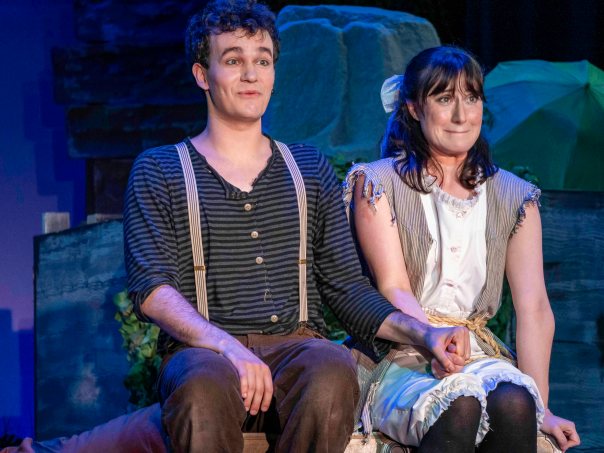
Fans of the original, Tarlton will tell you, are a cult following. Whether the stars of the new QC Concerts production, Ava Smith as Daisy and Sierra Key as Violet, are members of that cult is an open question. But they are both fervid admirers of the show.

Before Tarlton saw her as his Daisy, Smith had portrayed Violet in a Teen City Stage presentation at CPCC’s Pease Auditorium in 2016 – while she was still a high schooler in Gastonia. Key was also in high school when she first met Smith in 2013, and they’ve been besties ever since their first show together.

Naturally, Key saw the 2016 show that starred her bestie. In a freakish reenactment of Side Show scheduled for later this year, Smith will be one of Key’s bridesmaids at her wedding.

“A little fun fact,” Smith adds, “people often mistake us for sisters! Just like Daisy and Violet, we have stood by each other through the good and bad times. Our connection in real life makes the necessary onstage connection come naturally.”

Russell sharply differentiates Daisy from Violet early on in his script, while they’re still slaving on the midway. Two young men, Terry Connor and Buddy Foster, secure a private audience with the sibs after their freakshow. Buddy’s idea is that he could teach the Hilton Twins how to sing and dance while Terry can get them a shot in vaudeville as their booking agent.

Both of the women would jump at the chance to escape the side show, but until now, they haven’t been offered a feasible alternative. The Boss keeps them under lock-and-key as part of his freak collection.

It’s Terry, not quite on board with the vaudeville scheme, who asks what the sisters yearn for.

“Daisy is bold, outgoing, stubborn, and determined to be famous,” Smith says. “She loves performing and knows exactly what she wants. Violet is shy, sensitive, and just wants a simpler, quieter life. But even with those differences, they share such a deep love for each other and a longing to just be ‘Like Everyone Else.’ I believe Daisy and Violet really are two halves of a whole.”

As halves or opposites, they are both keenly and perpetually aware of how laughable their aspirations are to their captors and the people who pay to peep at them. Even if they are at odds, every choice they’ve made individually has been with the tacit agreement of their twin. Yes, the fiery Daisy can aspire to vengeance against the mockers and the detractors while Violet merely hopes to prove them wrong and be rid of them.

But they must move together, whatever they do, and cannot pretend they’re the same as everyone else. Daisy aims higher, fired by the full breadth of the American dream, but it’s Violet, no less American, who is more poignant and relatable.

“What’s so powerful about Side Show,” Key declares, “is that it tells the story of people who are seen as ‘different’ simply for existing in the world as they are. As someone who is part of the LGBTQ+ community, that resonates with me deeply – especially right now, in a time where identity and visibility are still so politicized and debated. Violet’s longing for love, acceptance, and belonging is incredibly human, and that’s what I focus on.

“The physical connection with another actor may be unusual, but it’s all in service of telling a story that challenges perceptions and invites empathy.”

Going back eight or nine decades, Russell can take us beyond empathy and show us quite bluntly how the Hiltons themselves had yet to evolve. Their strongest champion before Buddy and Terry arrive as deliverers is Jake. He’s not really a Cannibal King “from the inky jungles of the darkest continent,” as The Boss would have us think, nor a poster boy for his collection of “god’s mistakes.”

He’s simply a rather strong African-American man. With a very soft spot for Violet. His inability to say no to her becomes the ticket to the Hilton Twins’ freedom.

So yes, they are also capable of prejudice and exploitation.

“One of the darkest moments in the show comes late in Act Two,” Tarlton observes, “when Jake asks Violet why she will not accept his deformities when he accepts hers, acknowledging the color of his skin while he accepts her as a conjoined twin. While that was during the Great Depression, we realize this same conversation could just as easily have been today. It is a show that is challenging at the core.”

Amen. Two of my most unforgettable moments in a Broadway theater happened on the evening when I first laid eyes on Ripley and Skinner. They didn’t instantly appear as the two Hilton sisters. They converged from opposite sides of the Richard Rodgers Theatre, facing each other as they sang and, just seconds afterwards, facing us. Then they conjoined right there, magically becoming one and moving as one – as naturally as Daisy and Violet had presumably done all their lives – for the remainder of the evening until taking their bows.

This must have been exactly as Russell envisioned it. “In the Broadway production,” he wrote in his Production Note. “Daisy and Violet’s connection was created by the two actors standing side by side. They were never literally connected by corsets, Velcro or any other costume piece. This allowed the audience to participate in creating the twins’ connection with their collective imagination and made the actors’ achievement of appearing to be joined all the more impressive.”

Even more primal and gripping was The Boss’s follow-up introduction as we were led inside his side show tent alongside the other freak seekers who had paid their dimes. “Please remain in your seats,” he told us commandingly, “to experience our premiere attraction in its most revealing display.”

A dazzling blast of backlight assaulted us as the conjoined twins, standing together with their limbs splayed out, appeared in dark silhouette. The sight was shocking, like a gigantic black spider writhing before us, twice the size of a normal person.

Fascinating. Fearsome. And yet… hauntingly beautiful.

Hohenstein Gets Greedier in His Second Go-Round With “Peter and the Starcatcher”

Review: Peter and the Starcatcher at Matthews Playhouse

By Perry Tannenbaum

July 12, 2025, Matthews, NC – Though their names are similar and they’ve both written about Peter Pan, the temperamental gap between James M. Barrie and Dave Barry would seem to be as wide as oceans. Barrie created Peter in 1904 as an embodiment of eternal youth and the spirit of noble adventure. A century after Peter made his stage debut (played by a woman, of course), Barry teamed up with Ridley Pearson to write a novel-length prequel, Peter and the Starcatchers, keeping the non-fantasy base of the story in Victorian England while snatching Neverland from up among the stars and plopping it down on an earthly ocean.

What Rick Elice seems to have done, in returning the Barry-Pearson preteen page-turner to its stage origins, is to worshipfully replicate all the seagoing pirate action of Starcatchers along with Barry’s choicest quips. Then to supercharge the effect, Elice seems to concentrate it all so that it flies by in a blizzardy blur, all the more frenetic because scenery is stripped so bare – people become doors, ropes become ocean waves, and flag streamers are crocodile teeth – that we’re exercising sizable hunks of imagination to fill out what’s actually happening before our eyes.

Barrie fairies were jubilantly diced and desecrated by Barry’s mischief and mirth: or so it seemed the first three times I saw Elice’s Peter and the Starcatcher – on Broadway, on tour, and at Theatre Charlotte, directed by Jill Bloede. Having read Barry’s Pulitzer Prize-winning humor pieces for decades, I was so sure of my familiarity with America’s beloved joke-and-quip machine that I never bothered to read a single page of his Starcatchers. My naïve conclusion was that Elice had simply let the Barrie-Barry mashup work its magic with as little intervention – and budget – as possible.

My fourth encounter with Starcatcher at Matthews Playhouse, once again directed by Bloede, helped to enlighten me. In her previous work with the script, the evanescence of the budding relationship between Peter and Molly Aster – and the poignancy of their parting – felt more touching to me than previously. That’s significant compensation for anyone who adores Barrie’s original story, whose magic can seem drowned in humor, wit, and shtick when first encountering Starcatcher.

This time around at Matthews Playhouse, another thematic thread struck me for the first time: Elice’s orphaned Peter reaches puberty without ever having a first or last name. By now, it will only come with his consent. At the other end of the moral spectrum, Black Stache has been searching throughout his pirate career for a hero antagonist who will perpetuate his fame.

So their first grand meeting and tussle have biblical Israel-Angel proportions and consequences, or Robin Hood-Little John echoes if you prefer a secular, literary parallel. Two combatants become permanently linked and one of them emerges with a new name. Bloede’s staging here, when Peter gets his name from Stache – and later when Pan is added on – brought a new aura to those moments.

That’s what sent me to the web in search of Barry-Pearson’s actual text. Elice’s wit and humor seemed to chime with the belly laughs Barry’s newspaper columns repeatedly deliver. But is the class clown who grew up no less jokey truly capable of such yiddishe flavor and mythic depth? My suspicions were confirmed in the very first sentence of Barry’s saga: it already includes Peter’s name! An even more amazing revelation awaits if we read on. The jokey Barry tone we know and love is nowhere to be found in the opening chapters we can sample at Amazon. Instead, Barry and Pearson were following along on the dark gallows humor path that Lemony Snicket had pioneered with his Series of Unfortunate Events books for kids.

Deep breath. In my previous reviews of Starcatcher, I repeatedly gave Barry too much credit and blame for what I had seen and much too little to Elice. Both the jokiness and the mythic dimensions of Starcatcher can be credited to Elice – with additional bravos for how thoroughly he convinces us that this is how Barry would tell the origin story of Peter Pan.

Meanwhile, community theatre in Davidson, Charlotte, and Matthews continue to reap the dubious benefit of having so little professional-grade theatre in the Queen City. What a cast Bloede has assembled! Before the show began, representatives from the North Carolina Theatre Conference presented artistic director Sarah Bumgardner with their Theatre of the Year Award for 2024. So the folks backstage with their costumes on, waiting overtime for the ceremonies to conclude, were obviously under extra pressure to deliver. Even Bloede was nervous!

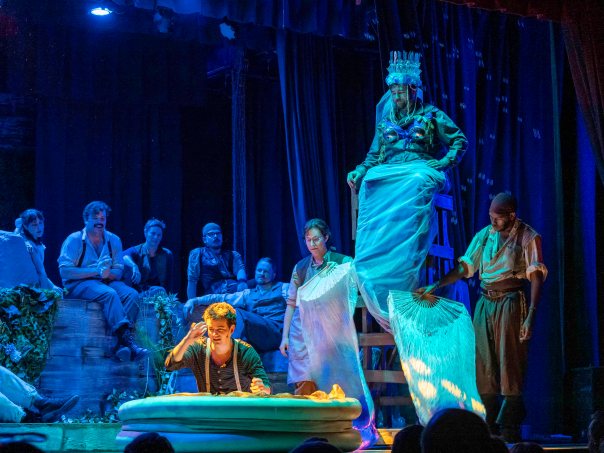
No matter how good your cast is, there’s plenty of stage business to be nervous about in running Starcatcher.Actors must move all the props and furniture around and keep track of all the many Yvette Moten costumes they must find and change in and out of as we move from a London dock to two sailing ships to a faraway island with a beach, a mountain, and a jungle. Stage manager Jessie Hull had to be preternaturally adept. Molly must float in the air. Peter and some nameless alley cat must fly. A lot going on while the quips shoot out at us, many of them newly minted to mock Myers Park and nearby country clubs.

Nearly all of these players were newcomers to Starcatcher, beginning with Joshua Brand as Peter and Emma Brand as Molly, presumably arriving on the Fullwood Theater stage with ready-made chemistry. Their boy-girl antipathy is no less charming than their tentative stabs at intimacy, and both can seem fueled by the promise of adventure and ignited by its thrill. The only holdover from Bloede’s 2018 cast is Johnny Hohenstein, who in bygone days crossdressed to portray Mrs. Bumbrake, Molly’s flirtatious nanny.

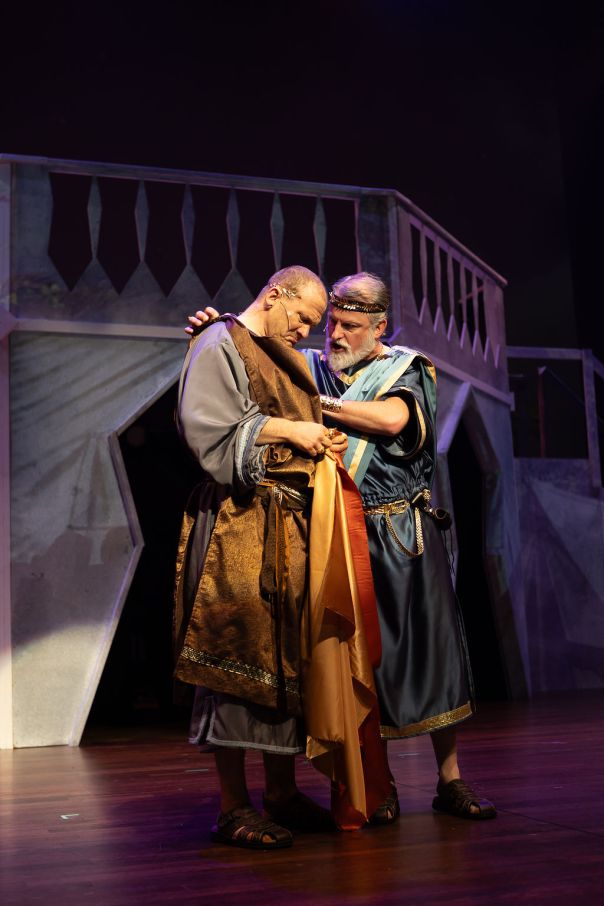
With even more liberties, including more than a slight leftover effeminacy from Bumbrake, Hohenstein burst into full flower as the carnivorous Black Stache, heartily devouring the scenery in Stache’s emblematic amputation scene. His eyes shone greedily as he attacked the hambone bits, and yet a queer kind of avuncular calmness came over him as he finally met his predestined antagonist and named him. For some reason, Hohenstein drew the only problematic microphone on opening night but remained unflustered by its fussiness.

Of course, one of the glories of Peter Pan is its superabundance of meanies and piratical buffoons, and we do not lack them here. In her latest crossdressing exploit, Andrea King was the perfectly servile and supercilious Smee, with glints of valor and wickedness. Chip Bradley was the wily Slank, Captain of the Neverland,who steals the precious trunk full of starstuff from under the nose of Lord Aster, the Queen’s devoted ambassador and most eminent Starcatcher. Andrew Pippin portrayed the austere Aster with sufficient British crust, entrusted with the mission of transporting the precious starstuff cargo to Rundoon, where the trunk can be dumped into a nearby volcano and kept out of evil hands.

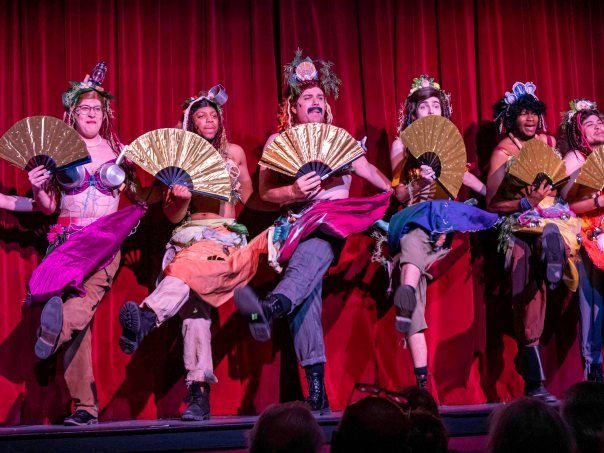
When we reach the faraway island where Peter and the trunk of starstuff serendipitously wash ashore, we will find that Neifert Enrique is the outré and eccentric King Fighting Prawn, monarch of the Mollusk natives. Was this the wildest of Moten’s costumes, or was it Hohenstein’s at the start of Act 2 during his brief song-and-dance as one of the Mermaids? Maybe Ryan Caulley snatches the prize toward the very end as Teacher, a salmon magically transformed into a Mermaid sage atop a lifeguard’s chair. It was a fitting reward for Caulley after a full evening gagged as Captain Scott from the first moment we saw him aboard his ship, the Wasp.

Ben Allen as Prentiss and Alijah Wilson as Ted were more individualized than Peter’s fellow orphans had been in previous productions I’d seen, and Miles Thompson was more rounded and nuanced as Alf, the smelly sailor who woos and distracts Molly’s nanny. Davis Hickson wasn’t as giddy and over-the-top as Hohenstein had been as Bumbrake at Theatre Charlotte in days of yore, so the Alf-Bumbrake thing (with Alf breaking most of the wind) was less orgiastic now and more genuinely warm.

The Delphic Oracle Sings The Go-Go’s

Review: Head Over Heels at Duke Family Performance Hall by Davidson Community Players

By Perry Tannenbaum

Heaven, Elysium, Utopia, Paradise, and Arcadia are all perfect places in our minds, too placid and static to be considered as settings for comedy, thrilling action, or drama. If you were in search of a perfect backdrop for the music of The Go-Go’s, you would more likely pick a city on the California coast, Las Vegas, or even Indianapolis than opting for heaven or the Elysian Fields.

That’s not how Jeff Whitty saw it when he conceived Head Over Heels. You get the idea that, after birthing Avenue Q, Whitty almost had free rein from the Oregon Shakespeare Festival to do anything he pleased. Whether he was inspired by the Elizabethan aura of OSF’s outdoor and indoor stages in greeny Ashland, Oregon – or bound to play up to them – Whitty reached back to The Countess of Pembroke’s Arcadia by Sir Philip Sidney, first published by the Countess in 1593.

Whitty had absolutely no intention of bridging the two eras – or smoothing the discordance between Elizabethan and Go-Go’s English. Whitty does tone it down a bit when Philoclea, the younger daughter of Arcadia’s King Basilius, tells her ardent admirer Musidorus to “Speak English, not Eclogue” when the shepherd boy begins his wooings.

At about the time that Head Over Heels premiered at OSF in 2015, Something Rotten!, with Will Shakespeare as its rockstar, was premiering on Broadway. That might explain the lukewarm reception that greeted Whitty’s show when it had its NYC premiere in 2018, for its Broadway run fizzled out in less than six months.

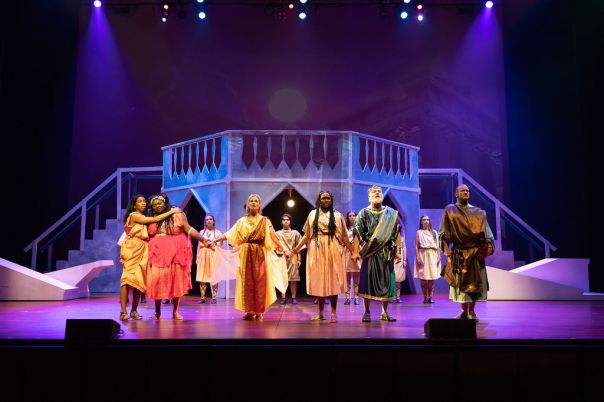
You can judge for yourself at spacious Duke Family Performance Hall as Davidson Community Playhouse rather splendidly presents its summer musical in nearly all of its gender bending glory. For this Metrolina premiere, projection designer Caleb Sigmon, scenic designer Ryan Maloney, and costume designer Yvette Moten fill the Broadway-sized stage on the Davidson College campus with eye-popping color and Hellenic style.

With the disclaimer that I’d never heard a single bar of Go-Go’s music before Head Over Heels came to our region, I can say that I delved into The Go-Go’s greatest hits afterwards on Spotify and listened to the original Broadway cast album. From the opening “We Got the Beat” onwards, the two generations of singers up at Exit 30 on I-77 beat them both.

Word of DCP’s excellence has extended its reach, and director Chris Patton and music director Matthew Primm have reaped the benefits. Belting the Go-Go’s “Beautiful” to her own mirror, Jassi Bynum is the vain elder sister, Pamela (a name apparently invented by Sir Philip). No less capable of letting loose, Kiearra Gary is the obedient “Good Girl” sister, Philoclea. And the well-established powerhouse, Nonye Obichere, is Mopsa, who seems for awhile to be a third sister until we learn that she is actually the daughter of the King’s steward, Dametas.

When Mopsa’s heart is broken, she will flee to Lesbos (wink, wink) and sing “Vacation.” Obichere slays at least as convincingly as the sisters.

It’s easy enough to get confused by the parents because they’re all white folk who fit nicely into Sidney’s Grecian mold but look nothing like their offspring. Yet Lisa Schacher, not seen hereabouts in a truly breakout musical role since the early days of QC Concerts, keeps her where-have-you-been-all-my-life belting capabilities under wraps until after intermission as Gynecia, the Arcadian queen. We’re not just talking Judy Garland belting, for Schacher crosses over the borderline to Whitney Houston territory along with Bynum, Gary, and Obichere.

Once whatever was clogging Tommy Foster’s larynx in the first moments of Saturday night’s performance as Dametas was expelled, the longtime veteran reminded us that he could also wail. Saddled with a more earthbound voice, Rob Addison brings a nicely grizzled dignity to King Basilius that is forceful enough for the lead vocal of “Get Up and Go” and his climactic king-and-queen duet with Schacher, “This Old Feeling.”

Kel Wright, whose pronouns are Kel and I in her coy bio, is the gender-fluid complication roiling the eternal placidity of Arcadia. She is the ardent shepherd boy Musidorus, Philoclea’s bestie since her tomboy days, who must disguise himself as an Amazon warrior, Cleophila, after he’s banished from Arcadia in order to regain access to his lady love.

Everybody seems to be attracted to Cleophila, though they come to all the possible conclusions about the Amazon’s true gender. It’s a mess – a hormonal thundershower that afflicts the King, the Queen, and their daughters. All of them scurry about in a mad passion that comes off with all the innocent merriment of a musical comedy. Adding to all of this hilarity is the disconnect between Wright’s tinniness and the Amazon’s virility, so feverishly irresistible to Pamela and her mom.

All of this mad pursuit, however, happens under the cloud of a prophesy that threatens Arcadia’s doom. A snake sent by Pythio, the Delphic Oracle, lets loose of a letter summoning King Basilius to the temple to hear the Oracle’s oracle. In Sidney’s original manuscript, not recovered until 1908, the prophecy is given concisely in verse at the end of the novel’s opening paragraph.

Thy elder care shall from thy careful face

By princely mean be stolen and yet not lost;

Thy younger shall with nature’s bliss embrace

An uncouth love, which nature hateth most.

Thou with thy wife adult’ry shalt commit,

And in thy throne a foreign state shall sit.

All this on thee this fatal year shall hit.

Whitty actually retains the adultery line – with its apostrophe! – but flips the plotlines of the elder and younger daughters. In Arcadia, Basilius is seeking to preserve his family and kingdom, but in Head Over Heels, he’s also battling to ward off the mass extinction of Arcadians. Forget about the “fatal year”: Each time one of the four prophecies is fulfilled, a flag will fall. If Basilius fails to confound the Delphic Oracle’s prophecy and the fourth flag falls… game over. If he succeeds in thwarting the prophecy even once, Arcadia is saved.

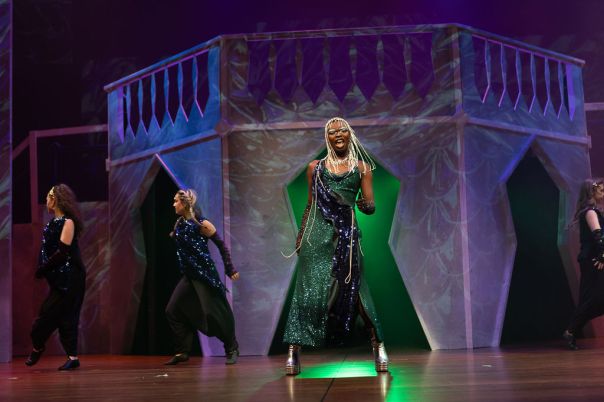
The roadblock to all this heroic questing and defying taking hold at Duke Family is the sensational Treyveon Purvis as the glittery Pythio, who describes themselves as a “non-binary plural.” No, that isn’t verbatim from Arcadia. We don’t need to understand every word of “Vision of Nowness” instantly as Pythio bodaciously belts it. If you don’t catch a phrase the first time or Purvis slurs it, you’ll get a second chance. Besides, the Go-Go’s lyrics are of little consequence once the song is done.

But the four prophecies and the fluttery flag drops are the whole damn evening, so when Purvis garbled every one of Pythio’s pronouncements – and the flag bit as well – much of what followed became equally incomprehensible. Why were those flags falling again? Was Foster wildly excited when he caught those falling flags, or was his Dametas frantically panicked?

Never could get a read on all these things until I sorted them out later at home. A few other gems had eluded me when I perused the script. For example, when Wright is lavishing her outsized voice on Musidorus’s “Mad About You,” the shepherd’s backup group are his sheep, altering the Go-Go’s deathless lyric to “Ma-ad about ewe.” Bleating as they sang? I don’t remember.

Nor did it quite register that Pythio’s backup were all snakes. So there was little chance for me to savor Purvis’s best line of the night: “Snakelettes, slither hither!” They are only named that one time, so catch it if you can.

Arguably, the main historic aspect of Head Over Heels was that it offered Peppermint, as Pythio, the opportunity to be the first openly trans actor taking on a major role on Broadway. There’s summery breeziness to this show and a cozy ending, not nearly as biting as Avenue Q. Maybe if the Broadway production had had the chance to run for a full summer, it might have found its legs instead of perishing in the dead of winter.

It’s the Go-Go’s, after all. Just don’t go in expecting the usual Jack-shall-have-Jill windup. Whitty remains a bit queer.