Review: A Musical Offering at St. Mark’s Lutheran
By Perry Tannenbaum
Whether it’s jazz, bluegrass, or the rock fantasias of Eric Clapton, John McLaughlin, and Carlos Santana, much of modern music is rooted in the appeal of riffing on a tune. That allure has been around for centuries, known as theme and variations when dressed up in the periwigs and cravats of the Baroque Era. Among the great classical composers who have shown off their wizardry in the form are Rachmaninoff, Tchaikovsky, Brahms, Beethoven, and Bach.
Embellishing a melody and cracking open its chord structure are at the heart of theme-and-variations praxis, but there are also wicked, macho elements of challenge, competition, and virtuosity baked into the form. The jam session in jazz becomes a cutting contest when two titans collide. Who can imagine and execute the most intricate, complex, and satisfying variation?
So it was gratifying to learn that Johann Sebastian Bach’s A Musical Offering originated as a challenge. The challenge was issued in Berlin to the visiting Leipzig master – by none other than Frederick II, King of Prussia, his son Carl Philipp Emanuel’s employer. After Bach had duly impressed the king, his noblemen, and an assembly of the finest musicians in Europe by improvising new compositions on each of the new fortepianos at court, King Frederick laid down his gauntlet.
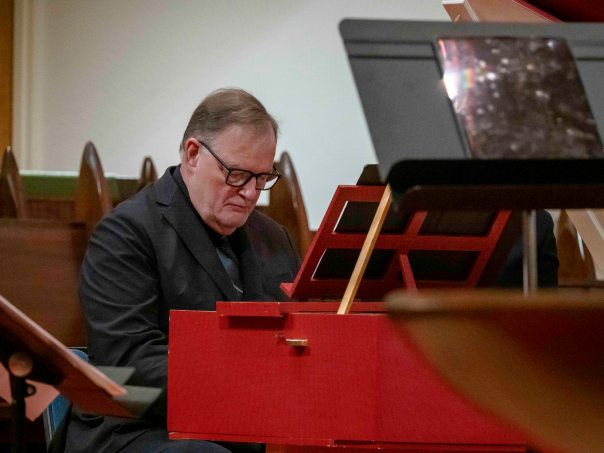
Compose a three-part fugue on the spot based on a melody he, the king, had written. Game on! Bach sat down once again at one of the keyboards he had just tested and tossed off a brand new 1747 masterwork on May 7, the first piece in Bach Akademie Charlotte’s inaugural concert of 2025 at St. Mark’s Lutheran Church, played by renowned harpsichordist Ian Watson.
Thankfully, “Frederick the Great” was royally miffed to see Bach meet his challenge so effortlessly. He literally doubled down on his challenge to humiliate his distinguished guest, daring Bach to execute a six-part fugue on the same tune. Here Bach judiciously yielded, saying that he would need some time at home to fulfill such a daunting assignment on such a worthy theme. Within two months, at age 62, Bach delivered on the king’s request and completed the six-part invention plus over a dozen more canonic gems.
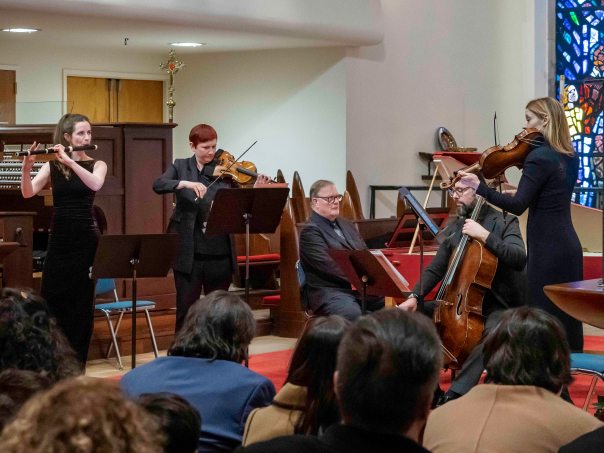
Modern recordings of A Musical Offering are all over 50 minutes in length and, depending on whether the original theme is prefaced, 16 or 17 tracks. Various instrumental configurations are available after the initial solo track. For this live Akademie concert, BACh artistic leader Guy Fishman assembled an all-star quintet that included himself on cello, Watson at the keyboard, Emi Fergusson on transverse flute, co-artistic leader Aisslinn Nosky on violin, and Renée Hemsing playing viola and violin.
Though I have four or five Goldberg Variations in my collection, I’ve never heard Bach’s most famous variations performed live, so this opportunity to hear the lesser-known Musicalisches Opfer was doubly special. Interspersed with the marquee piece of the evening were three other works, a CPE Bach Violin Sonata, a flute sonata by King Frederick II, and a Cello Sonata by Carl Heinrich Braun, another Bach contemporary.
Fishman’s spoken remarks, supplemented by his generous program notes, vividly described the king’s arrogance and his guest’s tactful responses. Nor did the principal cellist of Boston’s Handel & Haydn Society avoid detailing the various devices and complexities that Bach lavished on his thematically connected compositions. But with five musicians assembled before us, many in the audience must have been surprised that Watson alone would be playing Bach’s opening salvo.
The result was denser and tinnier than orchestral recordings of the Ricercar a 3, with less linearity than a recording on organ that I’ve heard. Three voices presented by two hands on a live stage! No matter how dense that sounded – remember that an organ can differentiate with multiple keyboards and registers plus a pedal board – it was amazing to see and hear.

Each new movement in the piece was usefully punctuated by musicians rising and sitting while music stands were being set up in new configurations. Nevertheless, confusion set in before we reached the second piece of the evening, the King of Prussia’s Flute Sonata No. 9. Three movements were listed under the Musical Offering and the ensemble was clearly playing more.
I lost track. Scattered in the program, in clusters of three, five, and five (if I’m deciphering the typography properly), were the remaining pieces of the Musical Offering. Titles for the remaining movements didn’t entirely correspond with titles of any recording available to me on Apple or Spotify. The four Sonata movements embedded in the piece could have been mistaken for another listing if it weren’t for the BWV catalog number, and a hefty number of the segments that could easily be recognized were played sooner or later than common practice.
Most recordings don’t label any of the movements “Quaerendo invenietis,” a title given twice in the Akademie program, and where they do appear, they are played consecutively. Not at St. Mark’s Lutheran. The climactic Ricercar a 6 that Frederick had ordered, for another example, usually claims Track 9 on Musical Offering recordings. At St. Mark’s Lutheran, it was sixteenth and last on the bill. Thus I can say with conviction that all five instrumentalists were involved in the glorious finale, but I’m more than a bit hazy on most of the rest.
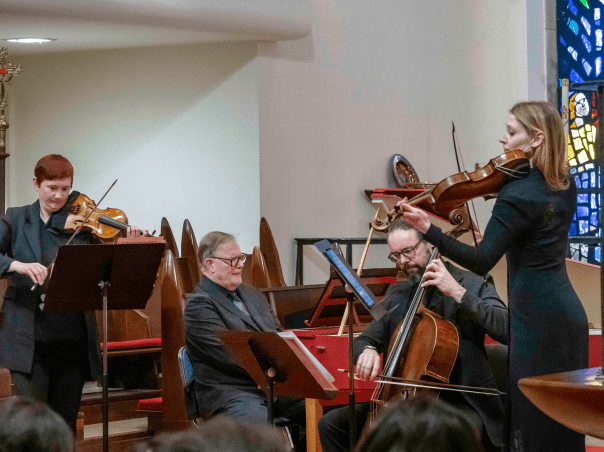
While this disorientation made it impossible for us to even attempt to track the incredible gymnastics of Bach’s inventions – themes and variations played in reverse, simultaneously in varying tempos, descending instead of ascending, or even upside down – the confusion didn’t carry over to the other pieces on the program. Here we were freer to scrutinize and enjoy.
Fergusson, of course, benefitted most from the spotlight shifting toward the non-Musicalisches pieces. One of these by Frederick II, in addition to the four-movement sequence embedded in the Offering, was a flute sonata. It was possible, upon hearing Fergusson’s performance of the king’s Sonata No. 9, to reserve judgment for a little while since the first of Frederick’s three E-minor movements was at a slow Grave tempo. Prussia’s monarch was a flutist, after all, writing chiefly to spotlight his own prowess.
But the next two movements were fast and faster, Allegro assai and Presto, so there could be no doubting Frederick’s genuine proficiency as a composer or as a performer. The piece was also sufficiently virtuosic to tempt me toward rushing to judgment on Fergusson, partly because the acoustics at St. Mark’s were so extraordinarily friendly to her transverse flute.

This performance was the best I had seen live on baroque flute since 2004 when I had the privilege of seeing, hearing, and meeting Michala Petri at the Verbier Festival. When we arrived at the four-movement Trio Sonata for Flute, Violin, and Continuo shortly after intermission, my reflex reactions to Fergusson’s artistry were bolstered. In the lyrical odd-numbered movements, her fruity tone bloomed again. And in the two uptempo Allegros, where her virtuosity not only impressed but intertwined with Nosky’s delicious work, one could nearly marvel as much at the musicians as at the composer.
“Now for something completely different,” Fishman quipped before leaning into Graun Sonata for Violoncello and Continuo in C, accompanied by Watson. If you’ve heard Fishman tackle Bach’s Cello Suites here in Charlotte, the three-movement Graun was lighter and less daunting. Fishman seemed to have the most fun with the final Allegretto, making it dance in its 3/4 waltz tempo.

Even simpler, Fishman joined Watson as continuo partners in Carl Philipp Emanuel’s Violin Sonata in D, accompanying Nosky. Here again, the piece was not a stretch for anyone involved, but it brought us merrily enough to intermission, with another movement in 3/4, a leisurely Menuet sandwiched between two iterations of a faster one.
The piece closes a delightful collection of CPE Violin Sonatas released by Rachel Podger in 2023, demonstrating over and over that Bach’s most prestigious son merits more play. Three minor-key sonatas on the same disc are equally fine. The E-minor, in particular, yields more pleasure in less time.
Photos by Perry Tannenbaum


