Stevie Wonder made the point so memorably over 50 years ago when he dropped his Talking Book album: “You and I” sounds so much more melodious and natural than if you reverse those pronouns. As Laura Gunderson’s unique 2014 dramedy reminds us, now wrapping up Theatre Charlotte’s 95th season, I AND YOU sounds and feels rather awkward – even if it’s grammatically correct.
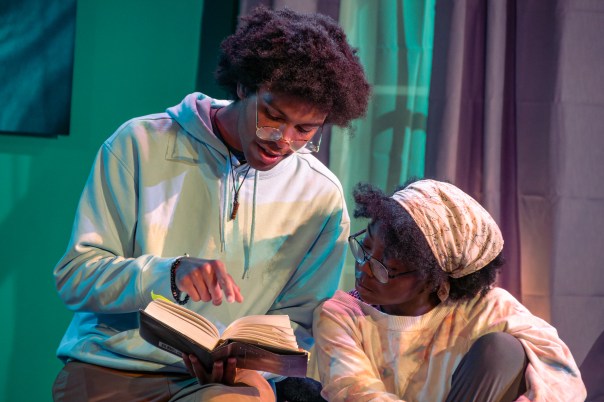
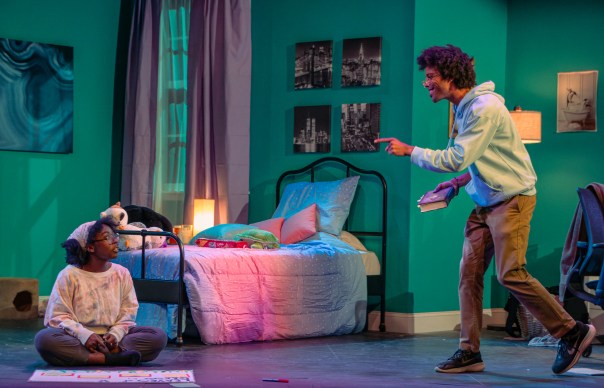
Predictably, the play is written for two high-school-aged people going through an awkward meeting, and director Rasheeda Moore makes the two-hander a little more fit for community theatre programming by rotating two different casts during the production’s two-weekend run. Pronouns figure prominently in the plot from the beginning, for when Anthony enters Caroline’s bedroom and meets her – without prior notice – for the first time, he’s carrying a really lame handmade poster and a fairly shabby old book, overflowing with scraps of sticky notes and bookmarks.
He’s a young man on an urgent mission, so desperate in his pleading that he almost sounds commanding. You and I, he is telling her, need to collaborate on a project for our American Lit class where we show how the meaning of I and You keeps changing during the course of Walt Whitman’s “Song of Myself.” That’s a rather big ask of Caroline, a rather ornery young woman suffering from a liver disease that keeps her out of school most of the time. She actually hates poetry, let alone Walt Whitman.
Caroline’s objections to poetry and how it’s taught in school are rather intelligent, and Anthony’s advocacy of Whitman is passionate and rather erudite for a teen. If they can get together, the outcome could be provocative. We know that Caroline isn’t really going to throw Anthony out, and we know that Anthony isn’t going to storm off, never to be seen again, so it’s gratifying that Gunderson only briefly feints in those directions. Once these formalities are dispensed with, our main interest jibes with that of the people before us onstage: getting acquainted and finding out why they’re worth our time.
Gunderson keeps it personal and unpredictable, with mercifully few ensuing chances that Anthony and Caroline will break apart before they get to know each other. They do get to know each other over two acts, with multiple scenes before and after intermission. Through various disagreements, crises, musical jams, and accords – and of course, through the lyricism and the merging, pantheistic spirit of Whitman.
Along the way, Anthony’s classroom assignment becomes a subtle template. For while he and Caroline are wrestling with the multitudes that Whitman packs into his pronouns, we find ourselves on the lookout for how the I and You speaking to each other onstage are changing before our eyes – in their views of themselves, each other, and what they can do and be together. Even so, the outcome was beyond my wildest imagination, though Gunderson had skillfully dropped a hint or two.
Moore is similarly thoughtful in how she handles her two casts, the Walt Cast and the Whitman Cast. They are listed in that order on our playbills, but it was the Whitman Cast, Njoki Tiagha and John Emilio Felipe, who actually premiered this production last Friday at the Queens Road barn. That’s the cast I saw at the Sunday matinee, so the Walt Cast (Dorian Herring and Isabella Frommelt) will be performing more times during the second week of the run as they continue to alternate, evening the score for the last time at this coming Sunday’s matinee.
You’ll also notice – and perhaps appreciate – that the players in each cast are listed in the order of Whitman pronouns they will explore. Chris Timmons’ set design is richly hued, a nicely coordinated mix of turquoise, blue, and purple, always in tune with Timmons’ lighting. The décor is more dreamy than girly, particularly when Caroline turns on the little light show she has installed. Bedridden though she often is, she is outfitted with a laptop, a cellphone that serves as a gateway to her someday becoming a photographer, a smoke detector with a dead battery, and a turtle pillow that she hugs fiercely and talks to.
Anthony, we learn, is a varsity basketball player fresh from a game where he had a traumatic experience. Not a total loser with women, he comes bearing waffle fries.
Although Gunderson specifies the race of each character, Moore demonstrates that she finds such prescriptions disposable. Her results with the Whitman Cast are quite admirable, though she needs to tell both players to turn up the volume if they’re to conquer the acoustic problems of the renovated Old Barn. Even the most veteran actors who have appeared there since the grand reopening have sometimes struggled to be heard.
Tiagha is near-perfect as Caroline, particularly in mixing the teen’s intelligence with her eccentricities. She only needs to let us know a wee bit more clearly that Anthony is getting over on her and that she is falling for him (and Walt’s poetry). The opposite problem afflicts Felipe, who is perennially a couple of notches too shy and worshipful toward Caroline – he’s a popular jock at school! – without gaining sufficient confidence as he begins to make headway. While I question those choices, I must applaud how intensely Felipe inhabits every moment. Furthermore, the rapport that Tiagha and Felipe have sown is superb at every turn.
Gunderson strikes the right chord in developing her protagonists through the music they love. For a boomer like me – who owns Jerry Lee Lewis’s complete Sun Sessions as well as John Coltrane’s complete Atlantic, Impulse, and Prestige recordings – her choices couldn’t be more perfect. Or authentic. YMMV, y’all.
Staggering our ability to comprehend, with a death toll of a million people over the space of just 100 days, the Rwandan genocide of 1994 isn’t the easiest subject to deal with, either for those who lost loved ones in the slaughter or for the international community that looked away. Co-creators Gakire Katese Odile, who speaks to us, and Ross Manson, who also directs, both know that the carnage cannot be minimized or undone.
Collaborating on The Book of Life, which premiered at the Edinburgh International Festival last September, Odile and Ross don’t even point fingers at those who sowed the deadly discord with toxic misinformation. Instead, their mission is one of healing for the survivors of the catastrophe and building concrete new hopes to replace the ruins. Staged at Festival Hall (formerly Memminger Auditorium) in its US premiere, The Book of Life is undoubtedly one of the most extraordinary events at Spoleto Festival USA this year, a genial ceremony of storytelling, music, dance, AV projections, and communal empathy.
We all received little pencils and pieces of paper as we entered the hall, so it was no mystery that we would participate. Odile, better known as Kiki, tells us something curious in the early moments about her encounters with both survivors and perpetrators: all of them speak of “we” in addressing their experiences instead of “I,” the more logical first-person.
To break through that defensive emotional distancing, Kiki asked them all to write personal letters to the dearest relatives they lost or, in the case of the perpetrators, the people they killed. Kiki’s collection of these letters, some of which she reads to us, are her Book of Life. Since each of these recalls a different story, it is easy enough for Kiki to weave other elements into the fabric of her show.
One recurring thread is an origin folktale where a leopard calls together the entire animal world and asks them all how they can steal away a piece of the sun from the other side of creation to light up their world of darkness. In succeeding episodes, a mole rat, a vulture, and a wee spider volunteer to be the leopard’s stealthy envoys, tunneling through to the other world, chipping off a piece of sun that won’t be missed, and bringing it back intact to spread the light.
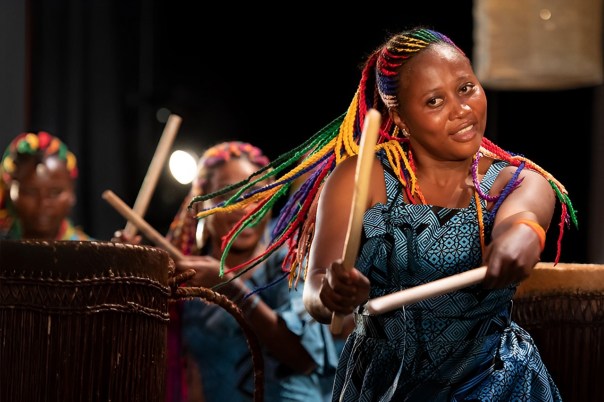
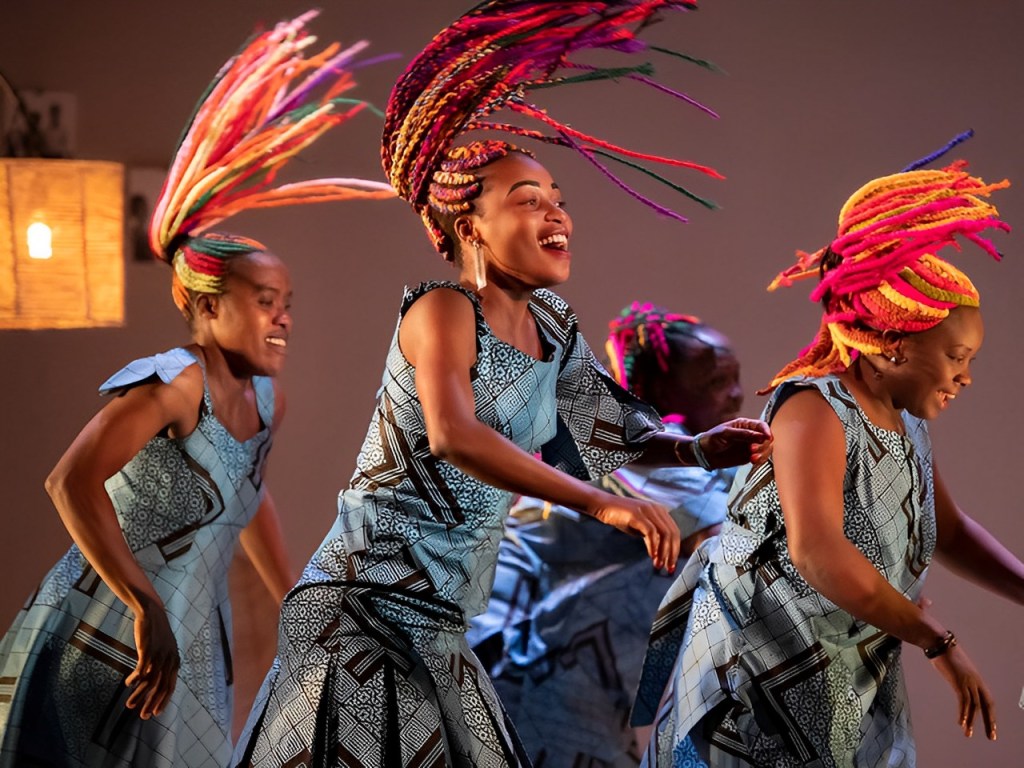
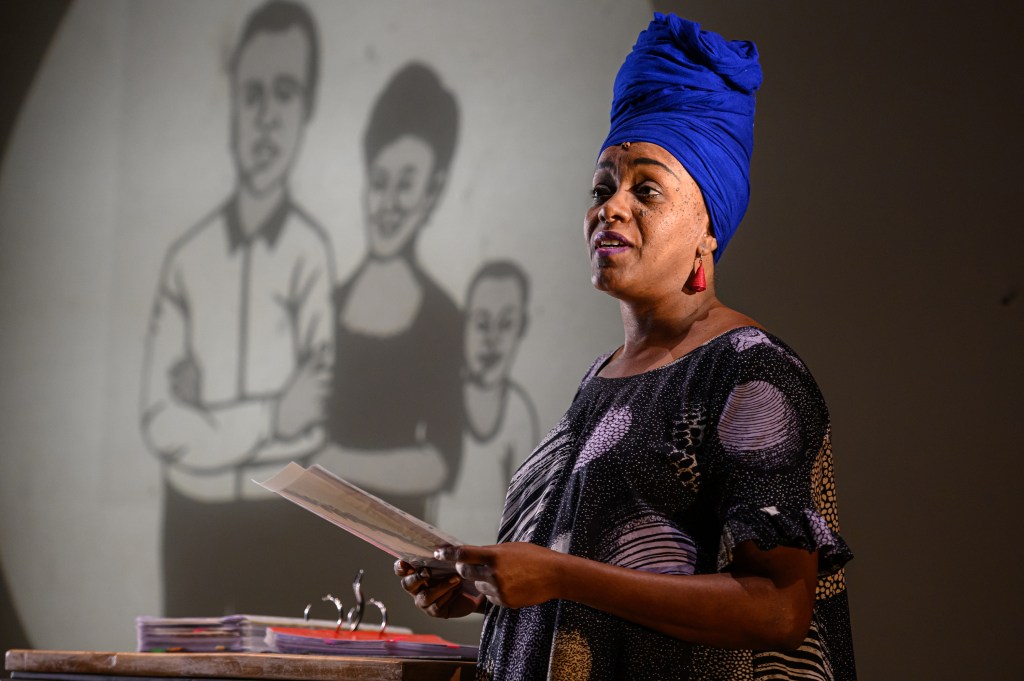
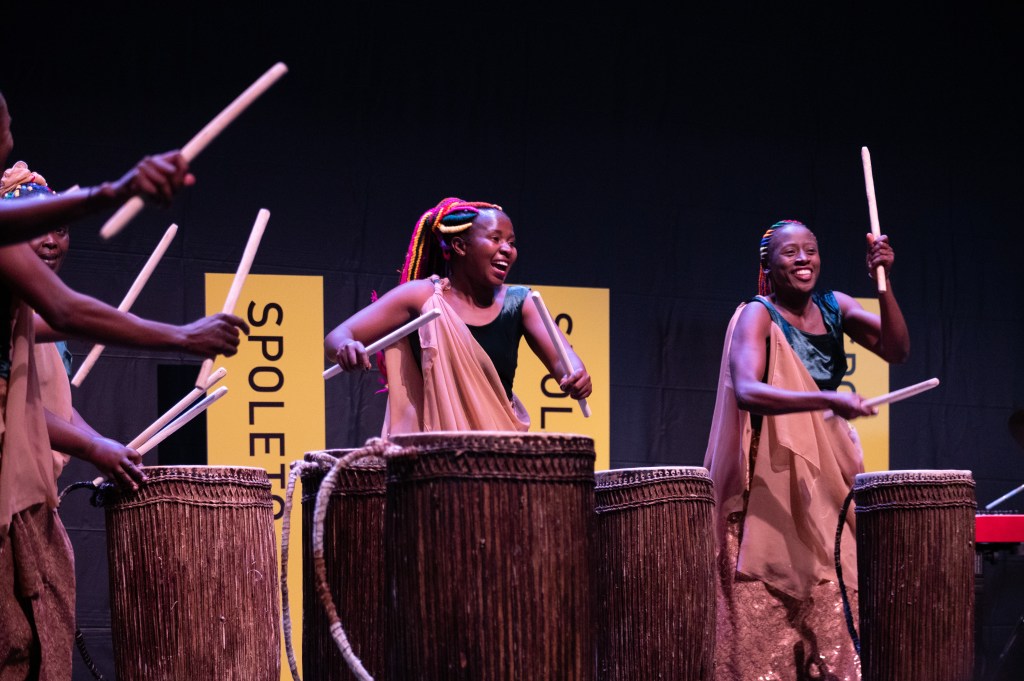
Spread across the stage, four women in amazing multicolored braids on each side of Kiki, are a group of live light-givers, the inspirational Ingoma Nshya (“New Drum” or “New Power” if you don’t speak Kinyarwandan): The Women Drummers of Rwanda. In the wake of the 1994 genocide, a grassroots movement incorporating all of Kiki’s constructive and conciliatory impulses founded the first Rawandan women’s drum circle in centuries – overturning a taboo against women even touching a drum or approaching a drummer.
The group’s name proves to be rather modest, for the women not only pound complex arrangements by Mutangana Mediatrice on their large conga drums, they sing impressively – as soloists or as a chorus – and they also dance, swinging their multicolored braids as part of the choreography or in pure joy. Translations of the songs are projected upstage, where we also see animations that accompany the testimonial letters and the animal fable.
Altogether, I thought that Kiki didn’t read nearly enough letters from The Book to counterbalance all of her charming diversions. Perhaps the most pleasing of these was hearing of her initiative to employ more women in Rwanda, an ice cream shop called Sweet Dreams, staffed entirely by women.
Most intriguing was Kiki’s unique exercise in sharing, when she asked everyone to draw a picture of one of our grandfathers with our pencils and papers. Not at all standoffish, Kiki herself came out into the hall to collect our handiwork, a nice touch. Then she gathered the entire drumming ensemble around her onstage to pick a winner that was shared with all of us, blown up on the projection screen.
The sharing continued as Kiki showed us a sheaf of past winners, one by one. After the show, trays of today’s drawings would be available in the lobby, and Kiki encouraged us to pick up one of these grandfathers as a keepsake on the way out. It was a fine way of underscoring a key point: images and memories of loved ones we have lost are still in our hearts and minds, shareable if we make the effort.
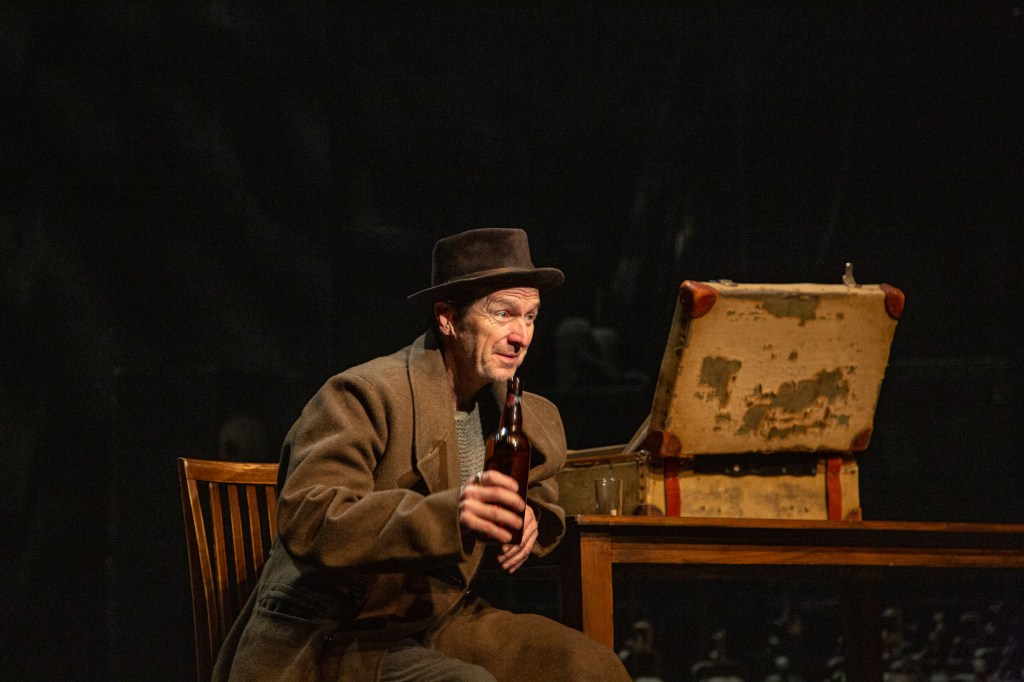
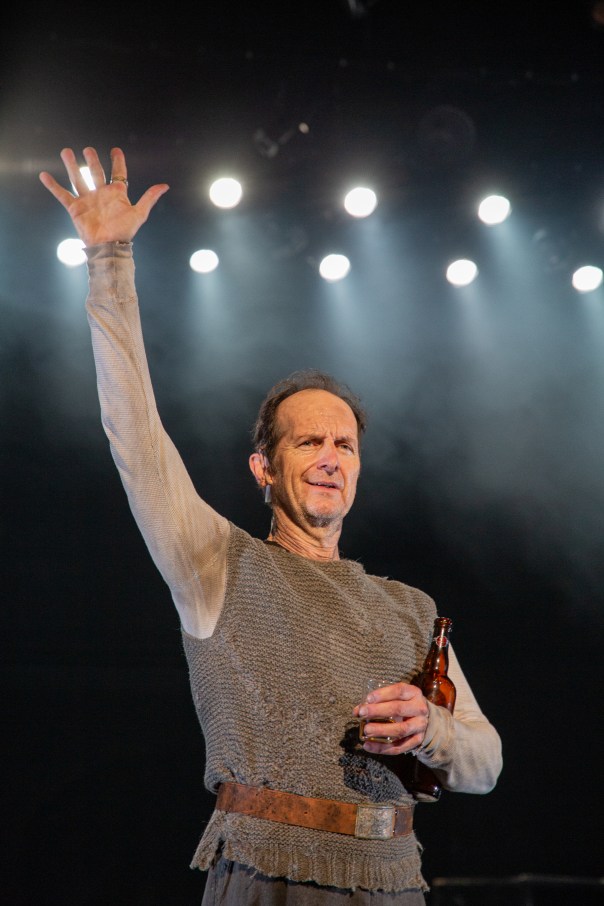
Writer-director Lisa Peterson and writer-actor Denis O’ Hare have chosen well in naming their adaptation of Homer’s epic AN ILIAD. For this Iliad is to be understood as one of many possibilities: one of many ways of retelling the blind poet’s colorful account of the Trojan War, which itself codifies many ancient oral transmissions by the Greek bard, and sadly, one of many wars that can be lamented, bewailed, and memorialized in this way.
There’s a noticeable world-weariness in O’Hare’s demeanor as he enters for his Spoleto Festival USA debut, turns off a downstage ghostlight, and moves it to the wings at the antique Dock Street Theatre as he settles into the storytelling. Clearly in his eyes, it isn’t a story that does credit to mankind.
We quickly learn that Achilles and Hector will be the chief protagonists and adversaries in this distillation. Mercilessly, Peterson and O’Hare zero in on chief Greek personalities, just as Homer did, but with a more concentrated focus on their pettiness and hypocrisy. The war was begun when Hector’s brother, Paris, eloped with the beauteous Helen of Troy, stealing her from King Menelaus of Sparta.
King Agamemnon of Argos, brother of Menelaus, declares war on Troy to avenge his brother’s disgrace, and launches the fabled thousand ships to bring Helen back. O’Hare actually dips into the Robert Fagles translation of Homer to enumerate the kingdoms and the exact numbers of their ships that have sailed the seas with armed soldiers just to settle this domestic squabble.
Yet when we first see O’Hare portraying Agamemnon, nine long years into the 20-year war, the Argive king is refusing to give back a woman he shouldn’t have, despite the fact that the gods have already punished him for his insolence by decimating the entire Greek army with plague. When the Greek general finally relents, he does so by taking Achilles’ woman, Briseis (spoils of a previous war!), in exchange. Achilles’ isn’t pleased at all, but his counter to this indignity is more sullen and tranquil: the greatest champion of the Greeks sits in his tent, refusing to fight.
O’Hare is so focused on the pettiness and selfishness of Achilles that he ignores the impact and implications of his sitdown strike: by sulking on the sidelines, Achilles does as much – if not more – to turn the tide of the war than the deaths of thousands in the plague. That’s how colossally great this warrior so often proves to be in Homer’s telling.
But despite O’Hare’s anti-heroic sentiments, there is no stinting when he arrives at the wrath of Achilles, the Myrmidon king, after Hector has slain his beloved Patroclus. Nor should there be, since “Goddess, sing the rage of Peleus’ son Achilles” is the opening plea from Homer to his Muse in Fagles’ translation – and every other – clearly the Bard’s central subject.
There’s a huge payoff for dwelling on Achilles’ rage and his barbaric exultation after he has avenged Patroclus’s killing. The fury of it resonates through the Homeric catalogue that O’Hare inserts into his narrative, a catalogue of wars that have raged around the world since the Trojan War that parallels the Homer’s catalogue of ships that sailed on Troy.
Ultimately, Achilles’ fury and his fearsome rampage are a towering eruption of his hurt pride and the bitterness of his compounded losses. Agamemnon surely hasn’t appeased him, and his best friend Patroclus found no way to end his sulking. Yet when he spirals out of control, still furious after wreaking his revenge, it is the grieving King Priam, Hector’s aged father, who finally calms Achilles down and returns him to civility.
O’Hare crafts his storytelling, referencing our pandemic sufferings and the war in Ukraine along the way, in a manner that augments the dignity and poignancy of Priam’s supplications – making us understand how deeply the old king must reach to stir Achilles’ humanity and steer him back toward reason.
The magic of this moment is in the commonality of the grief that Achilles and Priam can share. It is a grief that men have perpetrated and suffered forever. We shake our heads sadly over how devastatingly hurtful and heartbreaking it all is – and how utterly senseless and stupid.
With so many theatre, dance, opera, jazz, orchestral, choral, and chamber music events to choose from – more than 300 artists from around the world, streaming in and out of Charleston over 17 days (May 26 through June 11 this year) – planning a dip into Spoleto Festival USA is always a challenge. Even Spoleto’s general director, Mena Mark Hanna, struggles to prescribe a strategy, as hesitant as a loving mother of 39 children to pick favorites.
“My suggestion for a first-time participant,” he says, sidestepping, “would be to see two things you like and feel comfortable about seeing, maybe that’s Nickel Creek (May 31-June 1) and Kishi Bashi (June 3), and two things that are really pushing the envelope for you. So maybe that’s Dada Masilo (June 1-4) and Only an Octave Apart (June 7-11).”
Nicely said. Only you can easily take in the first three events Hanna has named within three days, but you’ll need another four days before you can see singer-songwriter phenom Justin Vivian Bond and their monster opera-meets-cabaret-meets-pop collaboration with countertenor sensation Anthony Roth Costanzo. If you happened to see the recent Carol Burnett tribute on TV, the cat is out of the bag as far as what that will sound like, if you remember the “Only an Octave Apart” duet with opera diva Beverly Sills – recreated for Carol by Bernadette Peters and Kristin Chenowith.
What it will look like can be savored in the Spoleto brochure.
The giddy Bond-Costanzo hybrid is one of the key reasons that my wife Sue and I are lingering in Charleston through June 9. Equally decisive is the chance to see jazz legends Henry Threadgill (June 6) and Abdullah Ibrahim (June 8), the Spoleto Festival USA Chorus singing Thomas Tallis’ Spem in alium (June 7-8),and Jonathon Heyward conducting Hector Berlioz’s Symphonie Fantastique (June 9).
One other irresistible lure: the opportunity to see Maestra Mei-Ann Chen conduct Antonín Dvořák’s New World Symphony(June 7), along with works by Florence Price and Michael Abels – less than four months after her scintillating debut with the Charlotte Symphony.
Abels, you may recall, teamed with Rhiannon Giddens last year in composing Omar, the new opera that premiered at Spoleto – after an epic gestation that spanned the pandemic – and won the Pulitzer Prize for Music earlier this month. It was a proud moment for Spoleto, for Charleston, and for the Carolinas. For Hanna, it was an extra special serendipity to help shepherd that work to completion.
“I mean, it’s kind of incredible,” he explains, “to be someone who comes from Egyptian parentage, speaks Arabic, grew up sort of fascinated by opera and stage work and spent their career in opera and was a boy soprano – to then have this opportunity to bring to life the words of an enslaved African in Charleston, South Carolina. And those words are Arabic!”
We may discern additional serendipity in the programming of this year’s opera, Samuel Barber and Gian Carlo Menotti’s Vanessa (May 27-June 10), which garnered the Pulitzer in 1958. Revived at Spoleto in 1978, the second year of the festival – with festival founder Menotti stage directing – the production was videotaped by PBS and syndicated nationwide on Great Performances, a huge boost for the infant fest. That revival also sparked a critical revival of Barber’s work.
Omar was the centerpiece of a concerted pushback at Spoleto last year against the Islamophobia of the MAGA zealots who had dominated the headlines while the new opera was taking shape. Vanessa is part of what Hanna sees as a subtler undercurrent in this year’s lineup, more about #MeToo, Black Lives Matter, and the repeal of Roe v. Wade.
“I want there to be a kind of cohesiveness without necessarily us being able to see what the theme is,” Hanna reveals. “If there is something that unifies a lot of these pieces, it’s about understanding that we are telling stories from our past, some of them the most ancient stories that we have in our intellectual heritage. We are looking at these stories with a different sense that takes on the reverberations of today’s social discourse.”
Among other works this season at Spoleto that Hanna places in his ring of relevance are An Iliad (May 26-June 3), a one-man retelling of Homer’s epic featuring Denis O’Hare; Igor Stravinsky’s The Rite of Spring (June 5), as an orchestral concert and the inspiration for Masilo’s The Sacrifice; Helen Pickett’s new adaptation of Arthur Miller’s The Crucible for Scottish Ballet (June 2-4); and A Poet’s Love (May 26-30), a reinterpretation of Robert Schumann’s Dichterliebe song cycle by tenor/pianist Jamez McCorkle, who played the title role in Omar last year – with stagecraft, shadow puppetry, and projections by Miwa Matreyek.
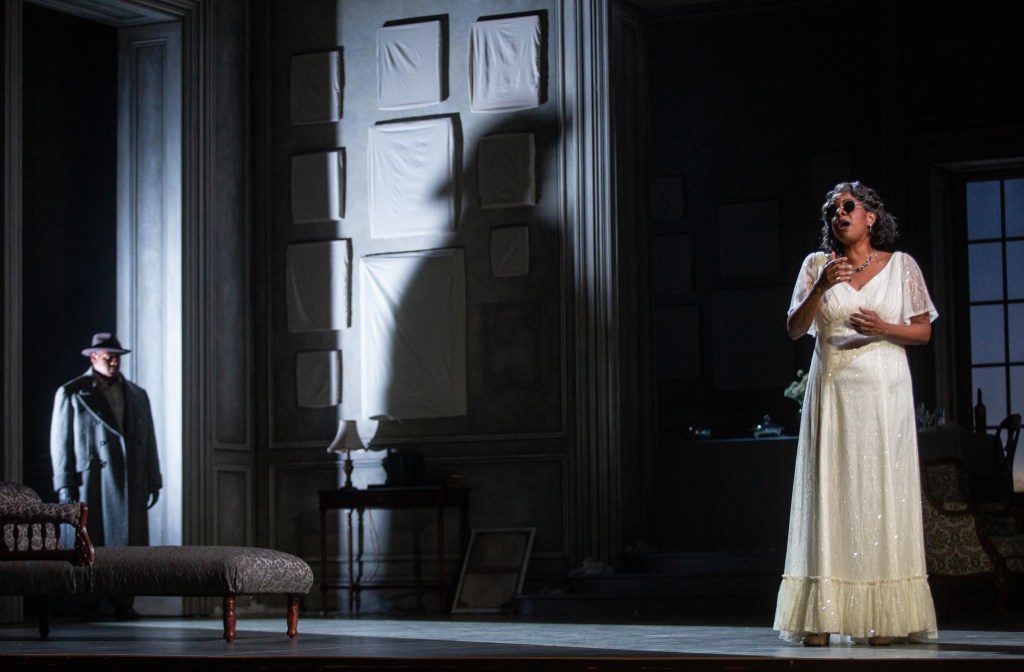
“Going back to the Trojan War, An Iliad is as much about war and plague then as it can be today with the reverberations of Ukraine and the pandemic,” says Hanna. “Vanessa, is reinterpreted here through the lens of a remarkable female director, Rodula Gaitanou. The cast is just killer: You have Nicole Heaston as the lead with Zoe Reams and Edward Graves and Malcolm McKenzie and Rosalind Plowright, just a world class cast at the very, very top. And it’s also really cool to see these roles, which are traditionally sung by Caucasian people, being sung by people of color.”
Aside from the recurring motif of reclusion, so vividly resonant for all of us since our collective pandemic experience, Hanna points to a key turning point in the opera. Menotti left it mysterious and ambiguous in his libretto at a key point when Vanessa’s niece, Erika, either has a miscarriage or – more likely – an abortion.
For Hanna, that brings up an important question: “What does that mean now when we are looking at a renewed political assault on female autonomy? So these stories take on new messaging, new reverberation in 2023. And we need to retell these stories with the new lens of today.”
Especially in the Carolinas.
Long accompanied by a more grassroots and American-flavored satellite, the Piccolo Spoleto Festival, Menotti’s international arts orgy has taken a long, long time to shed its elitist mantle. Now it is moving forcefully in that inclusive direction with a new Pay What You Will program, offering tickets to about 20 performances for as low as $5 – thanks to an anonymous donor who is liberating about $50,000 of ticket inventory.
Hanna brought this exciting concept to the unnamed donor, hasn’t talked to him or her or them – yet – about sponsoring the program in future years, but he is pledging to continue it regardless.
“What art can do is endow you with a new experience, a transformational experience that you did not have before you took your seat,” he says. “It can help create an understanding of another side that is normally seen by one perspective as socially disparate, as highly politicized, as a discourse that’s just way too far away. Art can break down that barrier through the magic and enchantment of performance. To me, having those artists onstage, representative of a demographic we wish to serve, only takes us so far. We also have to lower the barrier of entry so that we can actually serve that demographic.”
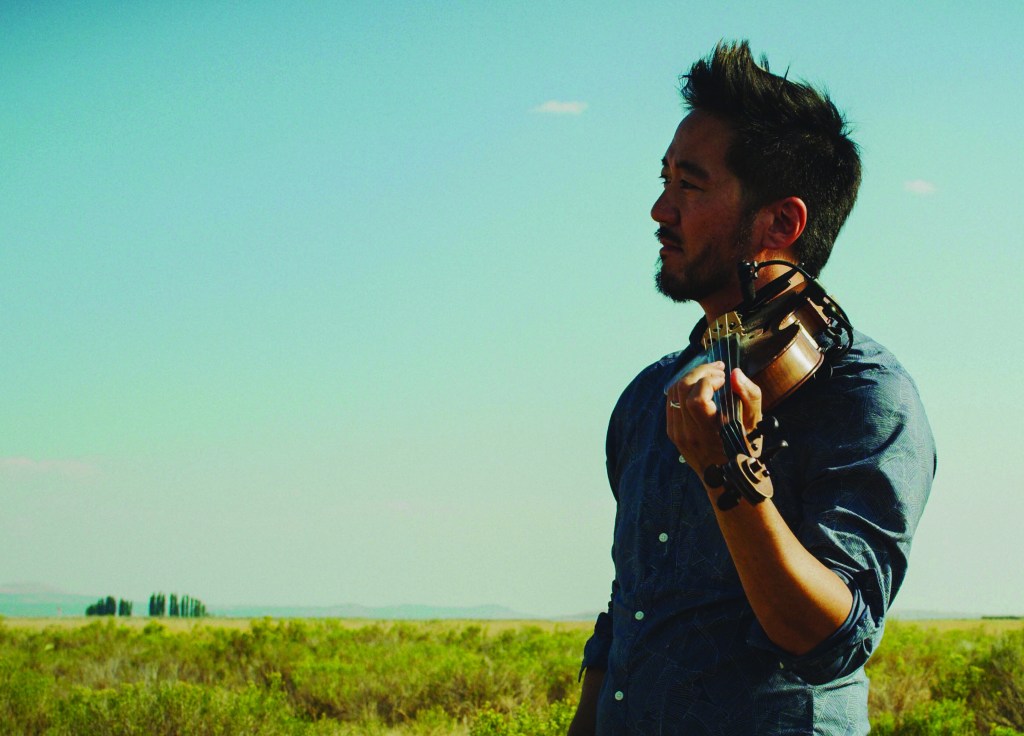
Kishi Bashi not only continues Spoleto’s well-established outreach to Asian culture, he also typifies the more hybrid, genre-busting artists that Hanna wants to include at future festivals.
“We want to try to find these artists that are like pivot artists, who occupy these interstitial spaces between dance and theater and classical music and jazz and folk music,” Hanna declares. “And Kishi Bashi is one of those. He plays the violin on stage. He has all of these violinists on stage with him, but it’s this kind of strange, hallucinatory, intoxicating music that’s like somehow trance music and Japanese folk music, but using sort of Western classical instruments. Yet it’s very much in an indie rock tradition as well.”
Other wild hybrids include Leyla McCalla (May 26), the former Carolina Chocolate Drops cellist who blends Creole, Cajun, and American jazz and folk influences; Australian physical theatre company Gravity & Other Myths (June 7-11), mixing intimate confessions with acrobatics; Alisa Amador (June 7), synthesizing rock, jazz, Latin and alt folk; and the festival finale, Tank and the Bangas (June 11), hyphenating jazz, hip-hop, soul, and rock. Pushing the envelope in that direction is exciting for Hanna, and he promises more of the same for the ’24, ’25, and ’26 festivals.
Until the Pulitzer win, the year had been pretty rough on Hanna, losing Geoff Nuttall, the personable host of the lunchtime Chamber Music Series at Dock Street Theatre. Nuttall was the artist who convinced Hanna to come to Spoleto. At the tender age of 56, Nuttall had become the elder of Spoleto’s artistic leadership when he died, beloved for his style, wit, demonstrative fiddling, and his passionate advocacy of the music. Especially Papa Haydn.
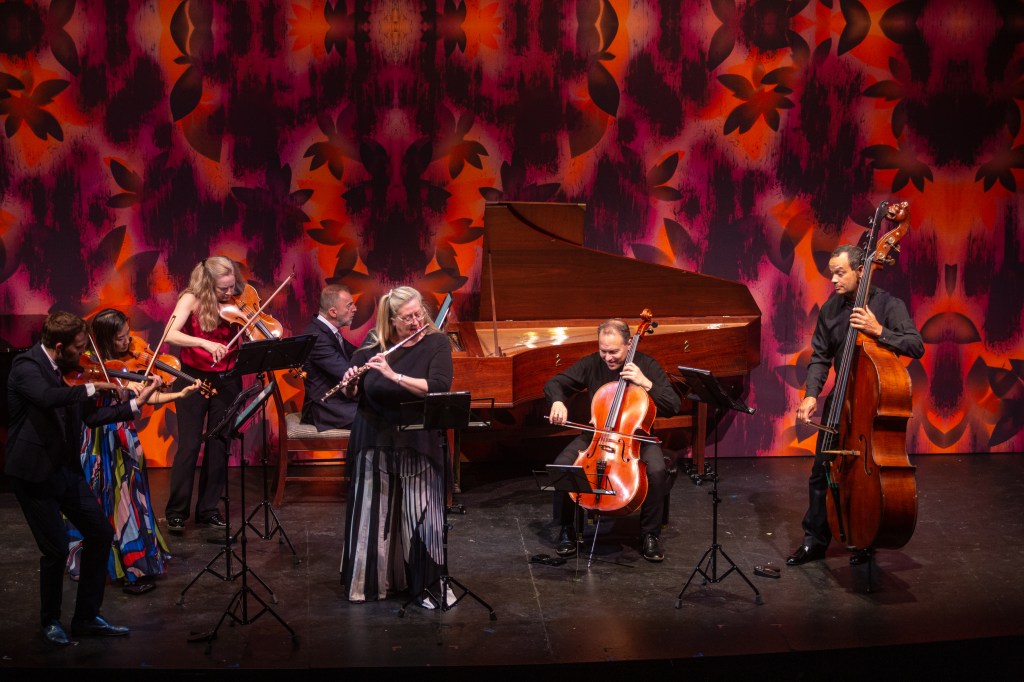
The special Celebrating Geoff Nuttall (May 26) concert will gather his close friends and colleagues for a memorial tribute at Charleston Gaillard Center, including violinist Livia Sohn, cellist Alisa Weilerstein, countertenor Anthony Roth Costanzo, tenor Paul Groves, pianist Stephen Prutsman, and surviving members of the St. Lawrence Quartet. The occasion will be enhanced by the Spoleto Festival USA Orchestra and Atlanta Symphony’s Robert Spano – plus other guests soon to be announced.
Hosting chores for the lunchtime 2023 Chamber Music series, spread over the full festival, 11 different programs presented three times each (16 performances at 11:00am, 17 at 1:00pm) will be divvied among vocalists and instrumentalists who perform at the Dock. It was totally inappropriate, in Hanna’s eyes to replace Nuttall onstage this year, but he will begin to consider the charismatic violinist’s successor during the festival and into the summer. Hanna assured me that the player-to-be-named later will be a performer who participates in the musicmaking.
Continuing on the trail blazed by Amistad (2008), Porgy and Bess (2016) and Omar, Hanna wants to place renewed emphasis on the Port City and its African connection. It must run deeper than seeing Vanessa delivered by people of color.
“Charleston was the port of entry for the Middle Passage,” Hanna reminds us. “And Charleston has at its core an incredibly rich Gullah-Geechee-West African-American tradition that is part of the reason this is such a special, beautiful place to live in with its baleful history. So I think that you see that this year, you see that with Gakire Katese and The Book of Life (June 1-4), you see that with Dada Masilo and The Sacrifice, you see that with Abdullah Ibrahim and Ekaya.”
Resonating with the brutalities of Ukraine, Ethiopia, and Syria on three different continents, the US Premiere of Odile Gakire Katese’s The Book of Life may be the sleeper of this year’s festival, crafted from collected letters by survivors and perpetrators of Rwanda’s 1994 genocide and performed by Katese, better known as Kiki. “After the unthinkable, a path forward,” the festival brochure proclaims. The finding-of-hope theme will be underscored by music created by Ingoma Nshya, Rwanda’s first-ever female drumming ensemble, founded by Katese.
“Kiki is engaging with how a country tries to reconcile with its recent, terrifically horrific past of the Rwandan genocide as someone who grew up Rwandan in exile. You see that in the work of Abdallah Ibrahim, who was really one of the great musicians of the anti-apartheid movement, who composed an anthem for the anti-apartheid movement, was in a kind of exile between Europe and North America in the 80s. And then when he finally came back to South Africa for Nelson Mandela’s inauguration, Nelson Mandela called him our Mozart, South Africa’s Mozart.”
Marvelous to relate, you can hear more of South Africa’s Mozart this year at Spoleto Festival USA than Vienna’s Wolfgang Amadeus – or Germany’s Ludwig von Beethoven. That’s how eclectic and adventurous this amazing multidisciplinary festival has become.
Review: Only an Octave Apart at Spoleto Festival USA
By Perry Tannenbaum
Photo: Nina Westervelt
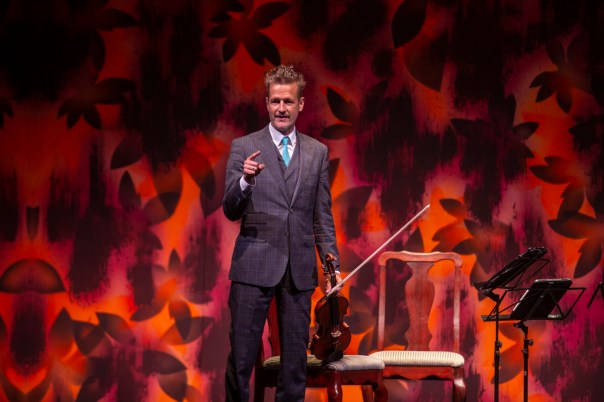
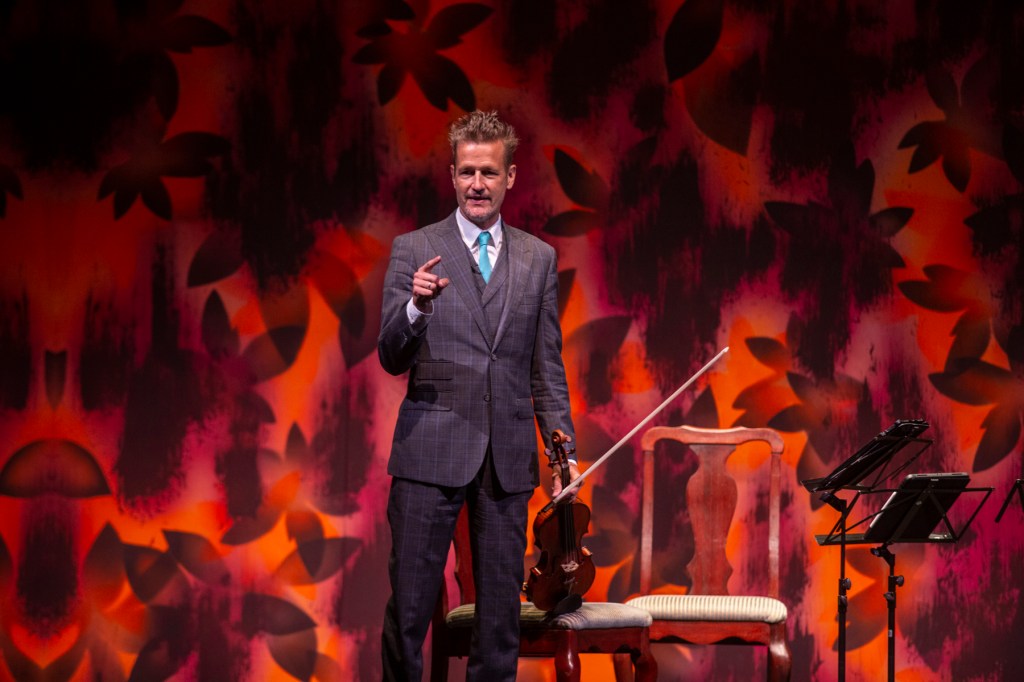
As we were recently reminded in a special CBS celebration of Carol Burnett’s 90th birthday, “Only an Octave Apart” was first sung by Burnett and soprano Beverly Sills in 1976 on the stage of the Metropolitan Opera. That was a year before the first Spoleto Festival USA was first presented in Charleston, South Carolina. So the full-length CD recorded by Anthony Roth Costanzo and Justin Vivian Bond, followed by the full-length Only an Octave Apartstage show, now live at Dock Street Theatre, is a fascinating look at how much things have changed – and how much they haven’t – since the crown jewel of New World arts festivals was still in embryo.
When Burnett and Sills staged their duet, the New Met was still a pre-teen at the Lincoln Center, and their encounter was mostly about the comical incongruity between network TV and opera, pop and high culture, a sweet voice that could benefit from amplification and one that gloriously blared, and how delightfully these vast differences could be bridged. Julie Andrews subsequently filled in at Sills’ spot opposite Burnett, somewhat altering the chemistry and disparity, and Bernadette Peters recently teamed up with Kristin Chenoweth when Burnett was feted.
Costanzo and Bond are clearly in a different mold, and their show produces a different, more risqué vibe. The younger Costanzo is gay, and the elder Mx Bond is trans, so the chemistry is brasher and bolder, and after engagements in Brooklyn and London, they can jubilantly proclaim that this is the show’s first foray “into a Hate State.” Nothing remotely as mundane as network TV is in this cross-cultural rendezvous. Now we have edgy cabaret encountering baroque-era opera, drag pitted against high culture, and a sweet countertenor mixing it up with a non-binary baritone who seem to have razor blades in their larynx.
Watching Octave after attending Bond and Costanzo’s joint interview with Martha Teichner the previous afternoon was a lot like sitting in an echo chamber, since much of their early patter was about ground already covered: how their show came into being and their mutual admiration. As the lines about the Hate State affirm (along with Bond’s repeated quips about performing at the “Stiletto Festival”), there is flexibility built into the script, a certain amount of spontaneity and improvisation for the cabaret divx to feel free and a certain amount of structure and recognizable landmarks for Costanzo to feel secure and oriented.
Of course, those who came to the show after listening to the Octave CD had a different echo-chamber experience. For me, the anticipation of what songs these two flamboyant performers would sing together – aside from the title song, of course – was genuinely suspenseful.
Even though I’d seen publicity shots, the outré Jonathan Anderson costumes turned out to be more of a wallop. The first pair of full-length gowns, with their pointy projections, could double as writing desks! Although they were seriously overmiked, I wanted to hear much more of Bond at a softer volume, for Costanzo has been a staple at my visits to Spoleto for over 20 years, long before his Akhnaten apotheosis at the Met.
No wonder, then, that the most satisfying duet for me – and everyone else in the room – was the fun-filled mashup where Bond sang the novelty pop hit, “Walk Like an Egyptian,” while Costanzo actually did that, crossing in front of Bond as he reprised the quacking gibberish Philip Glass wrote for him when he portrayed the ancient Pharaoh. Naturally, the exuberant Bond wanted to get a piece of that quacking action themselves, and Costanzo completed the role reversals by singing the pop trinket as high as it has ever been sung.
Less successful role-reversal silliness came earlier in the show when Costanzo stationed himself behind the curtain so Bond could feel like the bewitching Carmen as they lip-synced the countertenor’s rendition of the “Habanera.” More to my liking was Costanzo’s singing of both roles in an Orpheus and Eurydice duet by Christoph Willibald Gluck, underscoring what he had told us the day before in the Teichner interview, that he had started his operatic career as a tenor.
Yet Costanzo confided in the scripted format of Octave that he found the countertenor pre-1750 lane too narrow to stick strictly with an operatic career, and Bond sagely confirmed the enormity of their co-star’s ambitions. Perhaps this was what impressed me most about Bond and their rapport with Costanzo. Speaking barely above a Lauren Bacall purr, they could interrupt the ebullient Costanzo in mid-gush and not a word of their quips or barbs would go unheard.
Before the rousing “Egyptian” climax, there are more serious and affirming interludes that help set up this zany showstopper. Costanzo sings Franz Liszt’s “Über Allen Gipfeln Ist Ruh,” based on Goethe’s valedictory poem; Bond brings tenderness and a very timely pathos to “I’m Always Chasing Rainbows,” and he only goes slightly overboard on the loneliness of “Me and My Shadow.” The duet on Patrick Cowley’s “Stars” was the most consistently powerful of the night, but only because their rendition of “Under Pressure” by David Bowie and Queen – some notably operatic rockstars – veered into “Vesti la giubba” from Pagliacci.
In the midst of the COVID pandemic, Only an Octave Apart started off as a recording project that would keep the artists busy, productive, and connected. But the stage version of OCTAVE continues to benefit its stars and expand their skill sets. While Costanzo has acclimated himself to venturing off-book onstage, he has noticed that his newfound comfort and relaxation have carried over into his singing. His hunched-up shoulders have eased down, and one night, he discovered that he had sung three notes higher than he had ever reached before.
Naturally, there were a few Hate Staters in the audience who had blundered into the Dock Street Theatre not knowing just how far apart from their comfort zones this show would be. They walked out at various points, exhibiting differing levels of tolerance that might be clinically analyzed. More of us were uplifted by the audacity and pride we saw onstage – and by the overwhelming acceptance throughout the hall.
Every so often, we were reminded of Taylor Mac’s triumphant return to Charleston in 2011 after a previous conquest, when he proclaimed, “This is my festival now, bitches!” and renamed it The Stiletto Festival. It is rather pitiful that America has regressed at least as much as it has progressed since then. That made Only an Octave Apartmore than a heartening display of courage and lighthearted determination from Costanzo and Bond. In a Hate State flooded with MAGA maniacs, this was a rainbow of love.
Baked into many great American plays is the notion that dreaming big, striving for the golden apple of success, is a kind of latter-day hubris – sure to be tragically quashed and beaten down. Walter Lee Younger in Lorraine Hansberry’s A Raisin in the Sun was a grim example of such a tragic hero, dreaming of owning a liquor store in Chicago during the 1950s. It was hard for me not to think of Walter Lee’s beatdown – and paradoxically, the soaring success of Sidney Poitier, the breakthrough actor who portrayed him – as Dominique Morisseau’s Detroit ’67 unfolded at Theatre Charlotte.
Tautly directed by Ron McClelland and superbly designed by Chris Timmons, Morisseau’s work is darker and bloodier than Hansberry’s classic but emphatically more hopeful. Even with the background of the Detroit race riots of 1967, the pride of Black culture never leaves our eardrums for long as a clunky old record turntable, replaced by a slicker 8-track player and a pair of bookshelf loudspeakers, cranks out the hits of Motown’s famed music machine.
Come on, David Ruffin! The Temptations! Smokey Robinson and The Miracles. Mary Wells. Martha and the Vandellas. The Four Tops. Gladys Knight and the Pips. Marvin Gaye.
Morisseau’s protagonist, Lank, and his sister Chelle are trying to upgrade their unlicensed basement bar so that it will become more competitive with other after-hours speakeasies – when Sly, Lank’s best friend and a numbers runner, offers him an opportunity to buy into a legit bar. History lesson: a police raid on one of the unlicensed bars Lank and Chelle are seeking to emulate triggered the Detroit riots, the worst in 20th century America until another shining example of policing, the Rodney King riots in LA, eclipsed them in 1992.
While the riots rage and Michigan guv George Romney is calling in the National Guard, Lank and Sly are striving to scout out their hoped-for property and close on a deal – against Chelle’s wishes. Meanwhile, a second hubris slowly develops as Lank shelters a lovely white woman, Caroline, who has been battered and is mysteriously linked with the white underworld. She’s actually in more mortal danger than Lank.
Despite mutual suspicions, Caroline and Lank are drawn to each other. But they bond over Motown music, and they are both capable of busting a dance move.
The rioting in the Motor City was a prelude to the Black Power demonstrations at the Mexico City Olympics in 1968. We can also view them as a precipitating factor leading to the pride-filled Summer of Soul celebrations in Harlem and the rapprochement between the races on the musical scene that accelerated at the gloriously chaotic and inspiring Woodstock Festival of 1969, for so many of us the decade-defining event of the ‘60s.
So Detroit ’67 not captures a city in turmoil, it echoes the prime crosscurrents of that era, the struggle of Black people for their legitimate rights, the backlash from white people and government, and the mainstreaming of Motown as it breaks into pop culture. And by the way, Sidney Poitier’s To Sir With Love and Guess Who’s Coming to Dinner were both released in 1967. The question of whether Blacks were making significant progress, suffice it to say, was very much up in the air as we watch this action at the Queens Road barn.
Running an underground business together, Lank and Chelle are more advanced in their autonomy, street smarts, and connections than Walter Lee and his sister Beneatha were, still living under their mother’s roof with Walter Lee’s wife and child. Pushback against Lank’s feasible but difficult dream comes entirely from Chelle, who can realize deep down that continuing to run an illegal operation is also a risky choice.
Morriseau, McClelland, and Shinitra Lockett, making her acting debut as Chelle, all seem to have made this same calculation. So Lockett seems noticeably more vehement in her opposition toward Lank’s romance with Caroline than in her objections toward his business venture with Sly. On the business end, Sly’s persistence and charm in pursuit of Chelle’s affections bodes well for his deal-making prospects, another softening factor, for Lockett occasionally shows us that the slickster is making headway.
Because we see Graham Williams is so composed and self-assured as Sly, we can begin to see Lank as acting audaciously and responsibly. Yet there’s enough shiftiness mixed with Williams’ confidence for us to retain Walter-Lee misgivings about their venture, especially when the riots and the National Guard are thrown into the mix. Devin Clark, one of Charlotte’s best and most consistent performers for more than nine years, gives Lank a stressed and urgent edge. He’s not as regal and commanding as he was portraying Brutus last summer, but he’s far more spontaneous and charismatic.
Chandler Pelliciotta, in their Theatre Charlotte debut, brings a bit of shy diffidence to Caroline that meshes well with her story. Her worldly swagger has obviously been dealt a severe blow as she wakens, bruised and disoriented, in the basement of a Black man’s home she has never seen before. While Lank is drawn to her and wishes to protect her – we aren’t always sure which of these impulses is in play – Chelle has a couple of good reasons to wish her gone.
Not the least of these is the trouble Caroline is in with people who have battered her with impunity. The trouble might pursue her and find her at this fledgling underground speakeasy. It’s an awkward position tinged with risqué allure, but Pelliciotta’s performance leans more into the awkwardness, their glamor far less in the forefront than their fearfulness – for Caroline herself and for her protectors.
You can probably name 15 Black sitcoms that have characters like Chelle’s mismatched chum, Bunny: sexy, flirty, quick-witted, and imperturbable. Germôna Sharp, in her bodacious Charlotte debut, takes on her life-of-the-party role with gusto and sass. Sharp makes sure we’re not getting a PG-17 version of Bunny: slithery, regal, carnal, and militantly unattached. She will dance with anybody – Lank, Sly, or Chelle – but not for long, totally neutral amid the sibling fray.
Costume designer Dee Abdullah helps turn on the glam, more flamboyant for Sharp and more elegant for Pelliciotta. Morriseau withholds from her characters any sententious awareness that they are standing at Ground Zero of anything historic, now or in the future, but she clearly wishes that awareness on us. A distinctive black fist is prominently painted on one of the basement walls, right above the record player and the 8-track, and its presence is meaningfully explained.
Nor should we consider evocations of Hansberry’s classic urban drama as accidental. Morriseau’s script tells us that her protagonist’s name, Lank, is short for Langston. It cannot be a coincidence that the poet Langston Hughes wrote “Harlem,” the iconic poem from which Hansberry drew the title of her masterwork, A Raisin in the Sun.
I first ran into Mena Mark Hanna at last year’s Spoleto Festival USA, when he was sitting near to us at Sottile Theatre, enthusiastically selling the merits of the festival to a total stranger. Almost immediately, I walked up to him and filed a complaint: my wife Sue and I couldn’t see everything! Again and again, we were forced to choose between missing the end of one performance or missing the beginning of another. Hanna, the new incoming general director at Spoleto, empathized, having faced the same dilemma.
So we were off to a good start, good enough when the calendar circled around for me to call up the Spoleto office and ask for 15 minutes of Hanna’s time after I received the green light from Queen City Nerve to write up a festival preview. To my surprise and delight, he gave me 40 and far more prime insights, experiences, and hype than I needed.
This edit of the complete interview contains all the overflow.
Perry Tannenbaum: How are you doing?
Mena Mark Hanna: Very well. Happy to have the conversation.
Yeah, this is really a treat for me too. So tell me how Spoleto is doing this year financially.
Well, knock on wood, we seem to be doing pretty well with ticket sales. And you know, we’re working to create a culture of belonging with the institution that goes into some of our accessibility efforts, like Pay What You Will and Open Stagedoor.
So I’m looking at that Pay What You Will initiative, looking into it a little bit more in terms of which events will be eligible, and it’s a pretty impressive list.
Thank you.
I was worried at first about the timing, but now I’m understanding that the timing may not have been in response to wanting to fill up houses so much as the fact that somebody, some anonymous somebody, wanted to launch this initiative.
Yeah. When you think about our society, right, we’ve got three types of institutions. We’ve got public institutions, local governmental you bodies and things like that. We also have private for-profit entities, publicly traded companies, and then we have nonprofits that kind of sit in between that public and private space.
And to me, we sort of fill in the gaps that our public sector cannot extend to our community and our private sector cannot compensate for. What that means is that we should be holders, we should be generators, we should be engendering public value for our community.
So Spoleto is not just one of the preeminent performing arts festivals. It’s also a place where people can have transformational experiences. We want to make that shared to a wider segment of our audience. We want to share to a wider segment of the public and a wider slice of the community of the Lowcountry in the greater Charleston area.
I believe very deeply in that mission. And I also think that that leads to a healthier understanding of some of the principles and values that are at the center and core of the art that we produce and create at Spoleto – principles of diversity, of access, of inclusivity. Those principles are really about engendering and creating a culture of belonging through the festival.
What art can do is that it can endow you with a new experience, an experience that you did not have before you took your seat. It can help create an understanding of another side that is normally seen by one perspective as socially disparate, as highly politicized, as a discourse that’s just way too far away. And it can break down that barrier through the magic and through the enchantment of performance.
Having those artists on stage representative of a demographic we wish to serve only takes us so far. We also have to lower the barrier of entry so that we can actually serve that demographic.
So is that a kind of a flowery way of hinting that you were in search of such an anonymous donor and pitching it in the way you were explaining it to me just now?
Well, this anonymous donor is someone whos also very passionate about these principles and about these core values at the festival. We can only do so much in order to make something like this offer to a wide range of our audience. I mean, it’s a significant amount of ticket inventory. It’s about $50,000 of ticket inventory.
Not only is that a significant amount of ticket inventory, but we have to create our own private landing page for it. There’s community outreach and initiatives that go into it. There is a whole set of staff and human resources that go into creating a program like this and running a program like this effectively. And that also takes money. So it’s not just the ticket inventory that takes money. It’s running the program.
And the hope is that we would be able to do this in a way where we would be able to offer this to our community without really losing money on it. And that’s where the generosity of this anonymous donor really shone through. And it’s someone that I think is an incredible person to be supporting the festival.
Yeah, it must be. I mean, kudos. And many thanks, I should say.
Thank you.
Is this something that even comes too late to be a part of the festival program booklet? Or is there like a special place that will be set aside for acknowledging this new program?
I don’t know if it’s going to be in the program booklet, but it’s definitely a program that we will keep up in future years.
Ah, OK! That’s through the same anonymous donor, or are you just going to carry the torch from here on in?
Well, carry the torch from here on in. I haven’t spoken with the anonymous donor about future years.
So is this like a combination of you and this donor putting your heads together and coming up with this concept or is this something that was brought fully to you, concepted by him or her?
No, no. We brought this idea to the donor.
Ah, okay. That sounds terrific. So are you feeling a certain kind of anxiety about actually coming out with a festival that has no more legacy elements in it, especially after Omar won the Pulitzer Prize?
You know, the great thing about 2022 is that it really was a collaborative effort between myself and Nigel [Redden]. And even Omar was a collaborative effort between myself and Nigel. When I came in in 2021, we had a significant production consortium of co-producers and co-commissioners for the piece.
And there were things about the piece that really needed to be addressed because the piece had sort of been in this kind of COVID stasis. So the way, you know, we think about it that even there, there was kind of a handover from Nigel to me about making sure that Omar can really work for 2022 – and that was exciting.
I mean, it’s kind of incredible to be someone who comes from Egyptian parentage, speaks Arabic, grew up sort of fascinated by opera and stage work, and spent their career in opera and was a boy soprano, to then have this opportunity to bring to life the words of an enslaved African in Charleston, South Carolina.
And those words are Arabic!
That’s a remarkable, strange serendipity for me to have been in that position of helping steward that piece to life. So it really was very much a collaborative effort in 2022. Even 2023 will have some things that are kind of holdovers from the pre-pandemic era or the canceled season of 2020. I mean, the idea of bringing Jonathon Heyward down was something that Nigel had worked on for the 2020 season as well.
So I don’t think you can point at one thing and say this is Nigel, this is Mena, this is Nigel, this is Mena. I think that there are a lot of different sorts of personalities and curators and thinkers that touch something like Spoleto Festival. It’s very, very much a collaborative entity, the way we create and curate the season.
I have expertise in music, and I have a lot of expertise in opera and maybe I have some secondary expertise in theater, but I certainly do not know enough about all of the performing arts to know every single thing so intimately wherein I would be able to curate every single chamber concert performance, every single orchestral performance, every single jazz performance.
It’s very, very, very diverse and we have a great team at the festival with our lead producer, Liz Keller-Tripp, our jazz curator, Larry Blumenfeld, our director of orchestral activities, John Kennedy, and our choral director Joe Miller. Between all of us, we curate together and try to come up with a spectacular entity that is Spoleto Festival USA.
I mean, there’s a reason why you don’t see many producing multidisciplinary festivals. They don’t really exist.
Because it’s really hard to create something like this collaboratively and source all of the right expertise in all of these different disciplines and then kind of find the right artists who could work in between those disciplines. Someone like Jamez McCorkle, for example, who’s doing A Poet’s Love this year, which is wonderful.
It’s a difficult, strange operation. It’s different from an opera company, a dance company, a theater, so on and so forth. It’s all of these things combined, and then it’s sort of event-oriented and time-delimited. So to bring these things together, it’s really about, you know, all of this being greater than the sum of its parts and that’s due to some great expertise that we have at the festival.
Yeah. I have two questions about the formatting of the festival. One is whether the clearly discernible thematic structure of last year’s festival, bringing the East or Middle East to the West, has been repeated in any way that I have not been able to so far discern in this year’s festival. And second, whether the position that Geoff Nuttall held is just being kept vacant for this one festival or whether he’ll be replaced by next year?
So let me tackle the first question first. I am not a fan of really obvious themes that kind of are pedantic and hit you over the head. Last year was a unique case insofar as it was the first festival coming out of the pandemic, and there was a lot in that festival that also addressed some of the concerns that were raised in the pandemic that have to do with our own societal dissensus and our own inability to reckon with our past culturally, historically, politically as a country.
And Omar is a part of that, but it was only a part of that. It was maybe the centerpiece of that, but a lot of that just kind of overflowed outside of Omar. The idea of centering Africa as also an origin point of the United States is something that will always be a particular concern of the Spoleto Festival because we’re in Charleston. And Charleston was the port of entry for the Middle Passage.
Charleston has at its core an incredibly rich Gullah-Geechee-West African-American tradition that is part of the reason this is such a special, beautiful place to live in with its baleful history. So I think that you see that this year, you see that with Kiki [Gakire] Katese and The Book of Life, you see that with Dada Masilo and the Sacrifice, you see that with Abdullah Ibrahim and Ekaya.
You see that these are also artists from Africa that are engaging in their own social, cultural and political discourses. That Kiki is engaging with how a country tries to reconcile with its recent, terrifically horrific past of the Rwandan genocide as someone who grew up Rwandan in exile. You see that in the work of Abdallah Ibrahim, who was really one of the great musicians of the anti-apartheid movement, who composed an anthem for the anti-apartheid movement, was in a kind of exile between Europe and North America in the 80s.
Then when he finally came back to South Africa for Nelson Mandela’s inauguration, Nelson Mandela called him our Mozart, South Africa’s Mozart. So you see that with these artists, how they are engaged in their own social, cultural and political discourse, and how they are trying to reckon with their own past. And that’s something that is an important lesson that we want to take on and learn in a place like Charleston.
We can look to African artists and understand that they are also part of this place and that they are also part of America’s origin story. It’s not just about Europe and North America. So I think that’s always going to be something that’s on prominent display at the festival.
But even more so than that, this is a festival that, if you look at a kind of undercurrent thematically, there is unity there. I always want the festival to kind of have a cohesiveness, a cogency, without necessarily saying, “This year we are talking about crime and punishment,” or “this year we are talking about love’s labour’s lost” or something like that.
No, I want there to be a kind of cohesiveness without necessarily us being able to see what the theme is. That’s what is kind of exciting and unifying about putting all of these different pieces together. If there is something that unifies a lot of these pieces, it’s about us understanding that we are telling stories from our past, some of them the most ancient stories that we have in our intellectual heritage. We are looking at these stories with a different sense that takes on the reverberations of today’s social discourse.
I mean, An Iliad going back to the Trojan War is as much about war and plague then as it can be today with the reverberations of Ukraine and the pandemic. Vanessa, which is an opera that was premiered in 1958 and then brought back to the festival in 1978, is reinterpreted here through the lens of a remarkable female director, Rodula Gaitanou. And there is a quite strange ambiguous moment in the opera of either an abortion or a miscarriage.
What does that mean now when we are looking at a renewed political assault on female autonomy? So these stories take on new messaging, new reverberation in 2023. And we need to retell these stories with the new lens of today.
You look through all of these pieces, The Crucible, The Rite of Spring, Vanessa, An Iliad, even Dichterliebe by Schumann, and it’s all about taking those stories and kind of having a renewed understanding of how we tell those stories and who we are telling them to, and who is telling those stories.
About the second point, chamber music. Yeah, I think all in due time, there will be new leadership in the chamber music series. I mean, Geoff was this remarkable figure who, speaking of storytelling, was perhaps one of the most incredible practitioners of his practice insofar as making chamber music accessible and having us sort of like look at Brahms, Beethoven, and Haydn – maybe not Brahms, he didn’t like Brahms very much – with a renewed sense of understanding, and he did that by sort of giving the story of chamber music in America a completely new life and a new understanding.
I became really close to Geoff over the last two years. He was actually on the hiring committee for me, and he was one of two people that would report to me on the hiring committee, and it was a committee of ten people. I largely took this position because Jeff convinced me to. He convinced me to because he was so excited about what we could invent, what we could create together.
He was so excited by the interdisciplinary-ness of the festival and how that could actually spill over into chamber music. We at least got one festival together. We started to make changes.
At least we had one festival together, but it’s tough, man. This has been a really, really tough year without Geoff. It’s been a year of enormous highs and lows. It’s been a year where the festival won, helped to produce and create an opera that did win the Pulitzer and a year where it lost its lodestar in Geoff.
It’s been a very, very, very difficult year. We are making sure that we are celebrating Geoff through the festival. The festival opens with a celebration of all the music that he loved and in the grandest statement possible at the Gaillard with orchestra and chamber music members and so on and so forth and different soloists.
Then all through the chamber music series, it’s going to be a celebration of Geoff through the people who loved him the most, his chamber music family. People that you know: Paul Wiancko, Pedja Muzijevic, Livia Sohn, Alisa Weilerstein, Anthony Roth Costanzo. That was his family. They will all have an opportunity – of course, also the St. Lawrence String Quartet will be here – they will all have an opportunity to celebrate him and live and love what Geoff was so great at by performing and playing together.
So will there be chamber music at the festival in the future? Of course. The music will continue to rock at the Dock.
I was more specifically interested in who will replace Geoff in his hosting chores, and I guess attached to that question, whether or not it might be time to step back and ask yourself if there isn’t a lot of room for improving the diversity of the people who are in charge of the various music departments at Spoleto, who seem to be conspicuously white and male, and remembering that Nigel stepped down because he felt he was part of that pattern.
Yeah, at the very least, I’m Arab. No, I think Perry, you’re 100% right. To me, the important thing is that we don’t put someone in a place out of a sense of performative duty. We put someone in that place because they are going to be of great accretionary value to the festival, because they espouse the ideals of the festival, and because they are the best person to be in that position.
I’m the first to say that I would balk at any kind of jingoistic declaration that I’m in such and such position because I’m an Arab American. I think people of color want to be recognized for the work that they do and often, the structural sort of biases that they have to overcome in these imperfect institutions in order to get to those positions.
To me, it’s about the best person, and of course, making sure that we look extra hard to find some of those people that may have been swept under the rug by these implicit biases that exist in our imperfect institutions. We’re definitely going to take a keen look at chamber music over the next few years. Well, actually, through this festival, let me say, and into the summer.
And yeah, there will be some structure that will replace Geoff. Additionally, it’s important to mention that this year, we did not want to put someone in place immediately to replace Geoff. We didn’t think that was appropriate.
We wanted to make sure that this was a celebration of Geoff, and that the people who were celebrating him and honoring him were doing so by performing at the Chamber Music Series, helping to co-curate the Chamber Music Series, and helping to emcee the Chamber Music Series. This year, we decided to make that a collective effort in his honor.
But if there is a template in the Chamber Music Series about who does host, until now, 2023, the hosts have all been people who occasionally perform on the Dock Street stage. So do you feel locked into that?
Oh yeah, I don’t think we’ll peel that back. No, no, no, no, no. Because I think one of the important things is actually the ability to host Chamber Music and make it feel approachable and intimate. That should come from a practitioner of Chamber Music, someone who could actually perform it on stage.
Yeah, bravo. I was hoping I wasn’t misinterpreting what you were saying. Like you could have done a nationwide search for somebody else.
No, no. Thank you for the clarifying question. There’s no way we’re going to hire John Malkovich to host Chamber Music. That’s not the vibe.
And the great thing about Geoff is that he was able to demonstrate the pieces effectively as such a great performer. And that’s what made that Chamber Music Series, and that’s also true of Charles Wadsworth, and that’s also true of Leonard Bernstein. That’s what makes the great communicators in classical music great, is that they can sit there, they can communicate it, they can perform it, and they can do so without any compunction or any sense of superiority.
For sure, the people who will be hosting Chamber Music this year and into the future will be practitioners of Chamber Music and people who are playing in the Chamber Music Series.
Hooray. So what do you think, or is it dangerous to say what you think the highlights of Spoleto 2023 are?
Well if you allow me a kind of punchy suggestion as a general director, which is very carefully branded and thought through, my suggestion for a first-time participant would be to see two things you like and feel comfortable about seeing, maybe that’s Nickel Creek and Kishi Bashi, and two things that are really pushing the envelope for you. So maybe that’s Dada Masilo and Only an Octave Apart.
Personally, I’m extremely excited about A Poet’s Love, which is a world premiere project we’re doing with Jamez McCorkle, who was Omar in Omar last year. And it’s partly exciting because you have the sheer unadulterated joy of seeing this piece be performed by a single accompanist and vocalist.
You know, I’m a pianist by background and trade, and I’ve accompanied Dichterliebe before, and it’s enormously difficult to perform. And the fact that Jamez can just kind of do it in one essence – it’s just like music incarnate. It’s totally, totally insane that he can do that. I mean, he’s one of the most spectacular artists that I’ve ever come across.
He’s doing it with collaboration with Miwa Matreyek, who does this kind of like shadow puppetry, moving image art that’s kind of like in a gothic whimsy that feels very appropriately 19th century, but also with this kind of magical technology through projection and shadow work. So it’s a really cool, strange project and I assure you that you will never have seen anything like it before.
I’m also extremely excited about this production of Vanessa. I mean, the cast is just killer.
You have Nicole Heaston as the lead with Zoie Reams and Edward Graves and Malcolm MacKenzie and Rosalind Plowright. I mean, that is just a world class cast at the very, very top. And it’s also really cool to see these roles, which are traditionally sung by Caucasian people, being sung by people of color. I think that’s also an incredible sort of sense of joy and interpretation in this piece. And it’s conducted with absolute precision and aplomb by Tim Myers. So I’m excited about that.
I’m very excited about Only an Octave Apart. You could only have seen it publicly in either New York or London. So to have it here, it shows sort of how prominent Spoleto is on the world stage – that even if we’re not producing something and we’re presenting something, most of the time, if you’re going to see something here, it’s going to be very, very difficult for you to see it at a local theater or in a place other than New York or London.
So it’s cool to see that. I’m extremely excited about Scottish Ballet and The Crucible. I mean, that’s a new score by a composer named, believe it or not, Peter Salem.
That is unbelievable. I’ll give you that.
It is hard for me to say: I’m also excited about Kishi Bashi. That’s something you’re going to start seeing a little bit more in the festival on the popular music side, an expansion of what we normally do in our genres. We want to try to find these artists that are like pivot artists that occupy these interstitial spaces between dance and theater and classical music and jazz and folk music. And Kishi Bashi is one of those.
He plays the violin on stage. He has all of these violinists on stage with him, but it’s this kind of strange, hallucinatory, intoxicating music that’s like somehow trance music and Japanese folk music, but using sort of Western classical instruments. But it’s very much in an indie rock tradition as well.
And to kind of see us expand and experiment a little bit more and try to widen the tent of what the festival does is exciting in 2023. And you’re going to see a little bit more of that in ‘24, ‘25, and ‘26.
That’s definitely promising. Are we also experiencing or witnessing at Spoleto something of a reconciliation with Gian Carlo Menotti beginning?
Hooo!
You didn’t expect that one, did you?
I did not expect that one. All I can say about Gian Carlo is that he had great vision in founding the Spoleto Festival and was a spectacular impresario. I never knew him personally. And you know, if you’re talking about a reconciliation or reckoning artistically, I’m very happy to speak about that, because I think that Vanessa is a work that was premiered in 1958 at the Met, it won a Pulitzer that year, it was then done in Spoleto in 1978. I think Barber lived until 1991.
So that moment when Vanessa was done in 1978 was not just a moment for the festival. Because it was a Great Performances capture that was syndicated throughout the country on PBS. It was a great moment of national recognition for the festival. But it was a great moment of re-evaluating Samuel Barber as a composer nationally.
And it was really when people started to look at Samuel Barber. You know, in 1978 there was a great decade-and-a-half of serious intellectual academic ultra-serialism in classical music, the likes of not just Boulez but on the American side with Milton Babbitt and so on. The work of Samuel Barber in his kind of neo-romantic lyricism had fallen out of fashion and out of favor by the late ‘70s, especially also with the rise of the minimalism movement with the likes of Terry Riley, Steve Reich, and Philip Glass and now John Adams.
So it’s really a moment of recognizing Samuel Barber and Gian Carlo Menotti in the creation of this work of Vanessa, and I think that Vanessa is a great American opera that has truly been underappreciated. It tells a story that is urgent, is psychologically harrowing, is about reclusion in a way, which is very appropriate after the pandemic, perhaps kind of scarily so. It tells a story about love and about the blurriness and ambiguity that can happen in love.
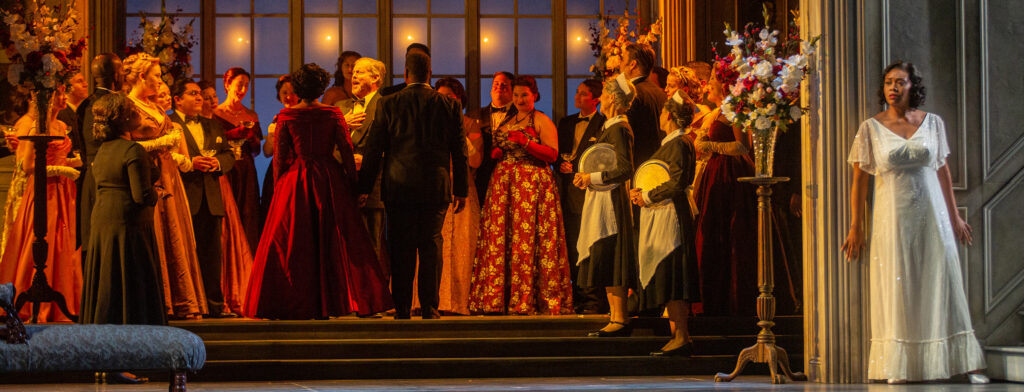
It’s a harrowing kind of weird story that is told on stage, especially in this setting, through a very Ingmar Bergman-like production that has such spectacular force perception, such great theatrical ambiguity onstage, such depth where you can sort of see through one wall, see through past another wall, and then see through a third wall, and you have this sense that the stage is never ending. It’s just a sense of false prosceniums.
I think if we’re going to reevaluate Gian Carlo Menotti, let’s do so from an artistic perspective and look at what he had given to us, not just as a great impresario, but as a librettist and as a director, as well as a composer, but as a librettist and a director through the work of Vanessa by Samuel Barber.
Yeah, I think it might be overdue for us all being reminded just how talented he was as a writer.
Yeah, I agree. And also how important he was for opera in North America. I mean we have not just one of the great festivals in this country due to him. We have one of the great producing opera festivals in this country due to him. He was a key figure not just as an impresario, but as a composer and a librettist and a director working in American opera and creating a voice for American opera on both sides of the Atlantic.
So yes, I think that’s correct.
In terms of being underappreciated, I would look at Spoleto itself in addition to Barber from the standpoint of becoming maybe the most important force for new music that we have right now.
I don’t know if we can say we’re underappreciated. I mean, we put on Omar, and it’s going all over the place, and we’ve certainly received recognition through the incredible work of Rhiannon [Giddens] and Michael [Abels] and their work being recognized for a Pulitzer. But I think the festival has always been recognized as a great center for new music and new opera specifically.
Especially in the last five, 10 years, you’ve seen some works, Quartett by Luca Francesconi and Das Mädchen [The Little Match Girl] by [Helmut] Lachenmann, and Tree of Codes by Liza Lim, which were either North American premieres or world premieres. And in those cases, you see a real sense that there’s an internationalism to the festival, that the festival is promoting work that is truly importing from Italy, Germany, Australia, and so on, putting it on here and doing so at the highest sort of caliber of creative excellence.
But I also think that the festival is about creating new work and creating new American work. And that was something that you see more in the Menotti years in the ‘70s and ‘80s, where this is the center of new American opera and new American work.
That’s something that we’re going to be looking at over the next few years: How can Spoleto be a sandbox of creative ingenuity, not just in opera, but across multiple disciplines? How can it be an incubator, an accelerator of new ideas when we are in a city with a tragic past and an incredible outward beauty? What does that mean for the creation of work here and how that work can potentially have national and international reverberations?
So I think that this is a center of new work, generally speaking, and it’s really going to lean into that over the next few years.

















 Art on My Sleeve