Monthly Archives: July 2021

“Freedom Summer” Illuminates White Privilege, Sloppy With Its History

Review:  Freedom Summer at UNCSA

By Perry Tannenbaum
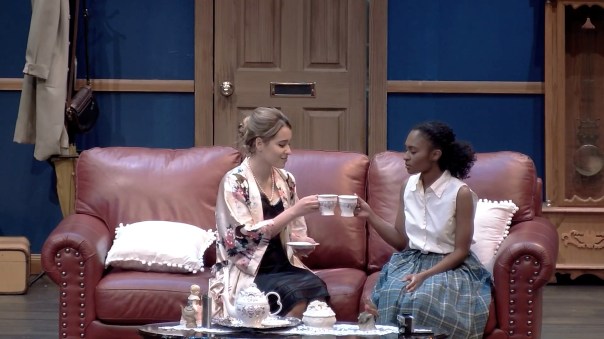
2021~Freedom Summer-18

Those of us who remember the affable senator from Arizona, Barry Goldwater, and the threat that he posed to President Lyndon Johnson and his vision of a “Great Society,” likely also remember the names of James Chaney, Andrew Goodman, and Michael Schwerner. Barely a month after Johnson signed the Civil Rights Act of 1964, and just over two weeks after Goldwater had won the Republican presidential nomination in San Francisco, the bodies of those three men, missing since June 21, were found 44 days later on August 4, buried underneath an earthen dam near Philadelphia, Mississippi.

Ranging in age from 20 to 25, the young men had been encouraging disenfranchised Black Mississippians to register to vote in the upcoming election. Their disappearance spurred momentum for ratification of the Civil Rights Act – and their martyrdom at the hands of a brutal lynch mob helped pave the way for passage of the Voting Rights Act of 1965. In Freedom Summer, playwright Cynthia Robinson takes us back to the morning of August 4, when the Mississippi atrocity came to light. In a North Carolina Black Repertory Company production streamed online by the Appalachian Summer Festival from Appalachian State University, we saw how the news impacted a Mississippi family in crisis – on protagonist Nora Healey’s wedding day in Boston, Massachusetts.

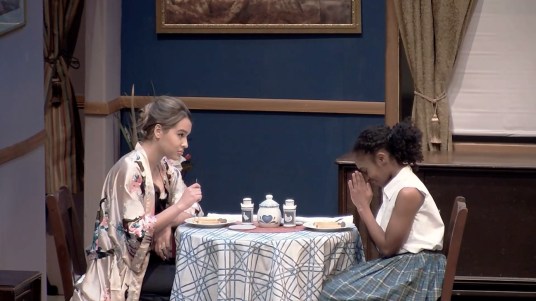
Nora, née Peola Carrington, has been passing for white since her northward journey from Jackson, Mississippi, two years earlier. Her sister, Carrie, has been waiting outside in the pouring rain for a good part of the morning, making sure that the street is clear before knocking on Nora’s door. Against Nora’s wishes, Carrie has followed Nora to Boston, hoping to break up the wedding and send her older sister back home to take care of their recently widowed mother. These opening moments capsulize the attachment and antagonism between the siblings. Nora sees Carrie outside her front door through her peep hole but instinctively lets her in anyway, despite the fact that having a sister who is unquestionably Black will spoil everything if her fiancé or his family were to show up. Of course, Carrie’s care in preserving this ruse, waiting until the coast was clear, exemplifies the same sort of ambivalence.
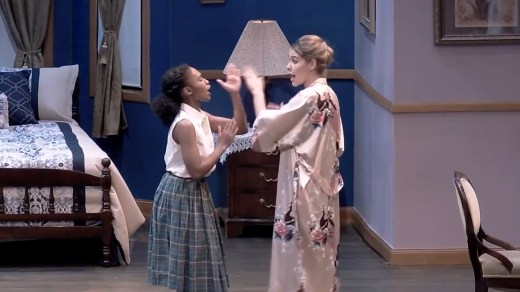
2021~Freedom Summer-21

So Freedom Summer often mimics the motion of other reunion plays, like Crimes of the Heart, where siblings shuttle between fondly reminiscing or laughing over their shared pasts and arguing furiously over eternal grudges and differences. Robinson’s drama has a few lighter moments in the sisters’ past, including a schoolyard chant they made up together, how Carrie likes her scrambled eggs, a resurrection of fried bologna sandwiches, and listening to The Shirelles. All of these were eclipsed for Nora by the locals’ lynching of Isaiah, the young man that she had a crush on. That was more than adequate reason for big sister to flee to Boston and fashion a new identity. On the other hand, continuing her life in Jackson, Carrie found more than sufficient motivation to head up toward Ohio for training at Western College to become part of the Freedom Summer campaign. To Nora’s annoyance – and mine, I’ll have to admit – Carrie wanted her older sister to ditch her wedding plans immediately and head on down to Mississippi to take her place in caring for Mom, while she traveled on to Ohio.
2021~Freedom Summer-09

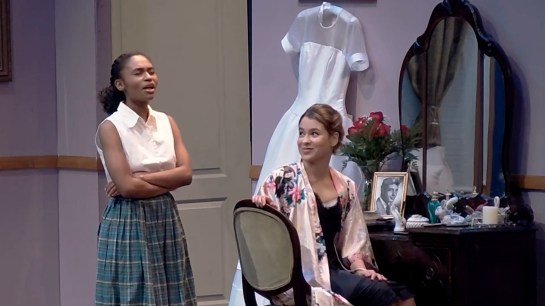
Robinson’s drama, then, ultimately becomes about a unique and provocative choice, for after attaining the joys and freedoms of white privilege, Nora is told by her upstart sister to give them up. Should we blame Nora for wanting to hold on? Robinson has her Nora articulating the transformative wonders, the liberations of attaining white privilege, and here is Carrie, the sister with the darker skin and nappy hair, lecturing her that she should be back home, fighting for the rights and liberties of her brothers and sisters who have decided against taking the simple steps she has, packing up and leaving. As the confrontation between the sisters unfolds, we learn that Nora’s choice spans two generations, for their mom could have passed for white had she chosen to, but she stood by Dad, inescapably Black, in building their lives in Jackson. For so many reasons, Nora cannot agree with that choice.

In directing this new play, which has yet to be performed for a live audience, Jackie Alexander could have helped Robinson more in aligning Freedom Summer with the actual history of that hot 1964 summer. A quick dip into Wikipedia would have told them that, by the end of June 1964, the families of the missing white civil rights workers, Goodman and Schwerner, had met with President Johnson in the Oval Office, and that their disappearance had become a top story for Walter Cronkite, the CBS Evening News, and the nation at large.

Yet Nora’s posh Boston living room and dining room aren’t equipped with either a television or a telephone. Instead, news of the bodies being found comes across Nora’s console radio in the form of bulletins interrupting her music. It’s a pretty awkward moment, then, when a newsman preempts for the third or fourth time and announces that the deaths of Chaney, Goodman, and Schwerner are beginning to garner national attention – for a couple of reasons. Actual history has been saying otherwise for over a month, and the fact that anything is gaining national attention isn’t the stuff of news bulletins. Instead of curing Robinson’s carelessness, Alexander only compounds it, for no matter which Boston radio station the bulletins interrupt, the voice of the announcer is always the same, listed in the credits as belonging to Eric Dowdy and unmistakably infused with a Southern accent.

Set designer Lizabeth Ramirez captures the proper Bostonian ambiance of Nora’s pad without going overboard, and costume designer Frenchie Slade clearly delineates between Nora’s nonchalant stylishness and Carrie’s backwoods dowdiness. In Mariah Guillmatte, Alexander found an actor who was close to perfection as Nora, with touches of vanity, defensiveness, and paranoia as she kept and protected her ongoing masquerade. Yet above all, Guillmatte was passionate in her eloquence as she decried Isaiah’s brutal lynching and when she recalled her own sense of humiliation while her mother lived a degraded life as a menial cleaning woman instead of moving the family out of Jackson and passing as white. Guillmatte turned up the passion as she tried to warn Carrie of the dangers she was facing as part of the Freedom Summer campaign, turning her scorn instead upon Goodman and Schwerner, the white northerners who had underestimated the perils. And Guillmatte applied the right mix of stubbornness and vulnerability as she stood up for her fiancé James’s character and the likelihood that he would stand up for her if he discovered her secret.

2021~Freedom Summer-30

Robinson has made it difficult for anybody to shine as Carrie, for she arrives in Boston with a suitcase full of objects that she returns to and unveils, one after another, each time she wishes to make a point. This motif magnifies the sense that Carrie, annoying enough already, is bringing evidence against her sister and putting her on trial. Yet Nikyla Boxley as Carrie rarely if ever looked like a passionate idealist who could transcend this repetitive ritual. Instead, with her arms rigidly hanging almost always at her sides, Boxley seemed like a girl who had learned right from wrong in schoolrooms and at her church, though she claims to be a political crusader now and bound for law school when the revolution is won. When Carrie turned on music or sat down for tea, breakfast, or bologna, Boxley would suddenly loosen up as if released from strict military discipline with an “at ease” command. Alexander should have helped Boxley smooth out such incongruities. The best of Boxley, if you could ignore the rigidity of her posture, came when she argued on behalf of her activism, on behalf of honoring the heroism of those who had died for the cause, and against Nora’s deceiving her fiancé – and herself.
2021~Freedom Summer-14

Freedom Summer is actually a newly enlarged version of a previous Robinson play, Peola’s Passing, which was about 30 minutes in length. There have been growing pains in the transition, no doubt, as the new script attempts to add more weight by absorbing the pivotal history of the tumultuous summer of 1964. When Boxley and Guillmatte got into the crux of the Carrington sisters’ debate, Nora’s need for liberation and self-fulfillment pitted against the power of Carrie’s compulsion to remedy the unjust oppression of her people, Robinson’s dialogue, with strong and passionate arguments on both sides, crackled with vitality and authenticity, not at all diluted. I’d urge both Robinson and Alexander to dig deeper and sharpen Freedom Summer, so that it delivers its meaningful history even more accurately when it opens for a live audience.

CP’s “Joseph” Connects With Talent and Style, Frustrates With Ongoing Audio Woes

Review:  Joseph and the Amazing Technicolor Dreamcoat at Halton Theater

By Perry Tannenbaum

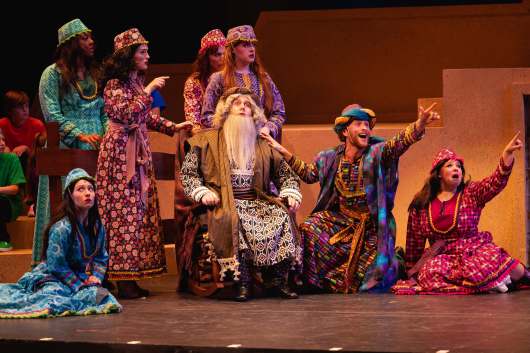
THEA2021-DLV-0708-2138

Before this weekend, Halton Theater hadn’t opened its doors to a theatre crowd since February 2020, and Central Piedmont Community College Summer Theatre had been dark since July 2019, when they closed their five-show season with A Gentleman’s Guide to Love and Murder. Returning to the Halton stage as guest director of Andrew Lloyd Webber’s Joseph and the Amazing Technicolor Dreamcoat, Tom Hollis posed a poignant question during his introductory remarks. Does it really count as a season when a company offers its audience just one production? Even the most loyal Central Piedmont supporter can’t buy a 2021 season ticket, that’s for sure. And until Central Piedmont Community College completes its recovery from a debilitating ransomware attack this past winter, they won’t be able to accept credit card payments at their Overcash ticket windows. Cash or checks for walk-ups, plastic for online sales only.

Opening night at Halton was a cautious first step back toward pre-pandemic norms – with a Delta-be-damned giddiness to it as COVID protocols were loosened at last. For most of the crowd mingling in the Halton lobby before and after the show, this was probably the first public event they had risked in at least 16 months, a milestone moment. For the theatre folk scattered among us, it was an emotional reunion – an affirmation.

Last season was originally envisioned as Hollis’s grand valedictory after nearly four decades at Central Piedmont, his latter years as theatre department chair. An encore reset of the lost 2020 season was rumored for a while as Central Piedmont scrambled with their winter programming, so Joseph is a double surprise – not among the shows announced for the lost 47th Central Piedmont Summer Theatre season and the only show replacing them. Previously mounted in Summer 1993 and revived in Summer 2001 at the now-demolished Pease Auditorium (the CPCC Theatre production of 2008 at the Halton was a wintertime affair) – with rousing success on all occasions – Joseph is likely more bankable than Footloose, lighter on the budget than The Music Man, and far better-known and cheaper to produce than Something Rotten! Additionally, there is likely a finely calculated ecology in a true Central Piedmont Summer season that allows the college the biggest bang for their bucks when auditioning and casting their overall troupe of performers and designers. These discarded musicals, plus Peter Pan Jr. and a Ken Ludwig comedy, might conceivably be in cold storage, slated for resurrection in 2022.THEA2021-DLV-0708-1267

Sitting in Row K, I only noticed one gentleman taking a restroom break during this intermission-free presentation, and I was somewhat surprised that the cast began taking their bows a mere 71 minutes after the show commenced. Another eight minutes came packaged in a “Megamix” reprise of Webber’s most bodacious songs – or parodies, since the composer delights in shuttling among an unlikely array of genres in retelling the most epic tale from the Book of Genesis, aided by Tim Rice’s lyrics. The news of Joseph’s demise is delivered to his doting father, Jacob, in the form of a sobbing lone-prairie cowboy song. Pharaoh is transformed into a pre-historic Elvis as he rocks his account of his prophetic dreams. The poverty of Joseph’s 11 brothers during the years of famine takes on the nostalgic air of a sad French café, complete with Apache dancer, and Naphtali’s pleas for the innocence of little brother Benjamin come in the form of a Caribbean calypso.THEA2021-DLV-0708-1815

Curiously, the irreverence and multitudinous anachronisms of this Webber-Rice concoction, not to mention the narrative alterations of Holy Writ, have never seemed to spark any massive public outcry from Judeo-Christian clergy. Maybe the outright anachronisms, beginning with the Technicolor in the title, insulate all the irreverence and textual tinkering from being taken seriously. James Duke’s scenic design and Bob Croghan’s costume design underscore the assurance that we are not in the immediate vicinity of ancient Egypt or Canaan, fortified by the equally anachronistic projection designs by Infante Media. No, this is more like a Disney or a Las Vegas style of Egypt, with Duke taking full advantage of the lordly height of the Halton stage compared with Pease’s pancake panorama. Our Elvis is also a Vegas version, clearly the sequined, jumpsuited, decadent superstar of his latter days. The Duke-Infante collaboration is so glittery and colorful that it is only slightly upstaged by Croghan’s creations for Pharaoh and Joseph.THEA2021-DLV-0708-1357

You don’t often get the chance to design a costume that is hyped in the title of a show, and Croghan, on the Charlotte scene even longer than I, doesn’t disappoint. The impact of this mid-pandemic return to live theatre caught me off-guard several times. Each time a major character made his or her first entrance – Lindsey Schroeder as our Narrator, Rixey Terry as Joseph, and J. Michael Beech as Pharaoh – I had that tingling sensation of recognizing something basic and exciting that had been missing in my life for over a year.

My biggest surprise, a frisson of renewal, came from the audience when they reacted to the most iconic moment in Joseph, when the brothers picked up the skirts of Croghan’s knockout dreamcoat so that it formed a pinwheel around Rixey, spinning around as he, Schroeder, and the ensemble sang “Joseph’s Coat.” Anybody even glancingly familiar with musical theatre anticipates this moment before it happens, or at least recalls it fondly from a previous encounter. But part of the audience at Halton erupted in delighted and surprised laughter, recalling what the first London and Broadway and high school audiences must have experienced when Joseph was new and reminding me of my own delight back in 1993.THEA2021-DLV-0708-1130

Rixey walked a treacherous tightrope, blending innocence with vanity as beautifully and energetically as any Joseph I’ve ever seen, lacking the cloying wholesomeness that only true Donny Osmond fans will miss. Maybe a plunge or two into that saccharine syrup might make Rixey more memorable in “Any Dream Will Do,” but I would prefer that he add a sprinkling of excess to those melodramatic moments when he is unjustly imprisoned, crying out his “Close Every Door.” Lighting designer Jeff Childs does come to the prisoner’s rescue, adding some spiritual gravitas.

Schroeder was brimful of brilliance as the Narrator, infusing enough energy into her string of recitative that it never devolved into tedious singsong, though she was often unintelligible. Beech’s misfortunes with his microphone were even more egregious as Pharaoh, including intermittent sonic dropouts, but his audio setup was likely jostled over the course of the evening, since he donned different costumes and headgear for his other roles – Jacob, Potiphar, and the doomed Baker.

Admittedly, it’s churlish of me to keep harping on Central Piedmont’s defective sound equipment and the cavalcade of professional-grade technicians who have failed to tame it. North of $115 million are being spent on replacing Pease, originally a lecture hall, with a genuine theatre facility, while Central Piedmont’s audio woes have gone unaddressed since 2005, when the Halton was new. But new generations come to the Halton every year, and new summer visitors from afar get their first taste of Charlotte theatre there – and they still need to be cautioned. By the time the “Megamix” came around on opening night, Beech’s “Song of the King” was only fitfully audible and Schroeder’s mic was intermittently dropping out.

THEA2021-DLV-0708-1993

More power, then, to the performers onstage who merrily soldiered through. Even the charade of the brothers’ mournful moments was untarnished. All of the cameo solos hit their marks. Matthew Howie was hilariously rusticated as Reuben delivering the bad news to Jacob with “One More Angel,” and Neifert Enrique as Simeon – aided by his brothers and Emma Metzger’s scene-stealing table dance – brought a boulevardier’s wistful regret to “Those Canaan Days,” with more than a soupçon of self-mockery in his lamentations.

Even more THEA2021-DLV-0708-2049irrepressible and irresistible was the calypso lightness and joy that Griffin Digsby brought to the “Benjamin Calypso” as Naphtali. Around the third or fourth time Digsby reached the “Oh no! Not he!” refrain, I had to stop myself, for I had started to sing along. Just another adjustment I’ll need to make after 16 months of consuming theatre in front of my computer monitor and TV set. It was hard to be displeased by anything that accompanied this welcome change.

The Cookers Heat Up the Cistern

Review:  The Cookers at Spoleto

By Perry Tannenbaum

Dive In by Leigh Webber leighwebber.comAfter a pandemic-induced hiatus that canceled last-year’s 17-day event, Spoleto Festival USA is back in Charleston for 2021 – but not all the way. Opera, symphony, and choral presentations remain in lockdown, Spoleto’s indoor jazz venue remains shuttered, and the long-anticipated premiere of Rhiannon Gidden’s Omar remains on hold until 2022. The festival’s general director, Nigel Redden, who has announced that he will be stepping down in October after a 26-year stint at the helm, admitted that the efficacy of COVID vaccines and the speed of recovery had wrong-footed Spoleto in their scheduling.
The only indoor events at Spoleto this year were The Woman in Black, on loan from its epic 30-year run in London’s West End, and the daily series of lunchtime chamber music concerts at historic Dock Street Theatre, always the bedrock of the festival. Live dance and music events are otherwise outdoors. With necessity as their mother, a whole brood virtual events, presented online or on your cellphone, has been invented.

Deep in the heart of Trump Country, Spoleto does impose social distancing in arranging seating, and they ask ticketholders to be properly masked until they are isolated in their seating pods. These hardships didn’t seem to dampen the rush on the festival box office, creating a quandary for omnivores like me. Press comps were unavailable for the first 12 chamber music concerts, forcing us to miss the opening weekend with its combo of New Orleans celebrations on successive nights at The Cistern. The first of these featured the Preservation Hall Jazz Band and the second, a tribute to the life and music of multi-instrumentalist Danny Barker, offered Catherine Russell as its featured vocalist.

Dive In by Leigh Webber leighwebber.com

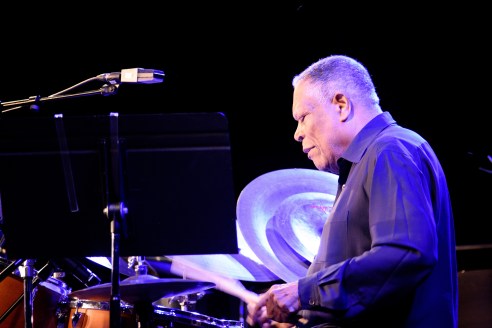
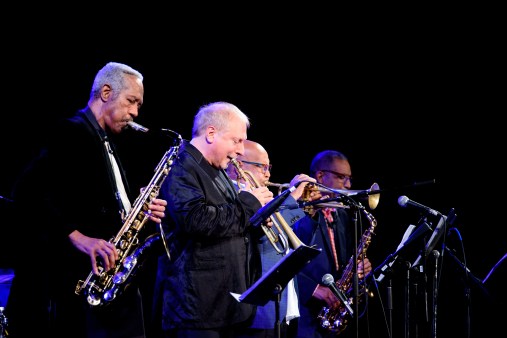
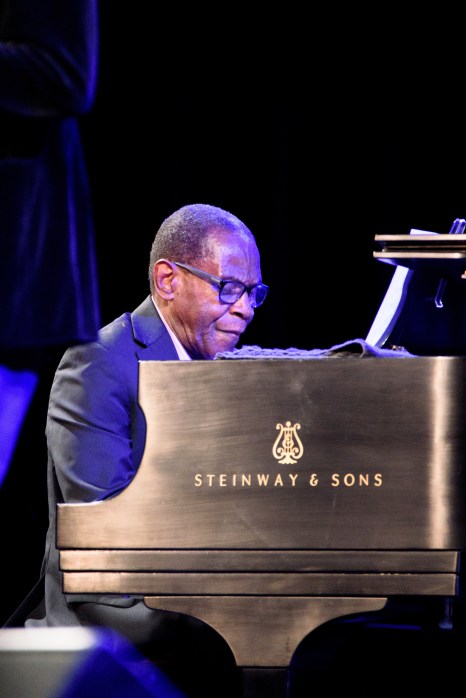
Since I had reviewed performances by both Preservation Hall and Russell in recent years, I punted on the first weekend and opted for The Cookers on the middle weekend of Spoleto, when access to the chamber music series would also open up. Allowing us to catch up with such heavyweights as George Cables, Cecil McBee, Eddie Henderson, and Billy Hart, all of whom I knew well from recordings but had never seen live, The Cookers were anything but a consolation prize. Then there was also an opportunity to reconnect with Billy Harper and Donald Harrison, two sax greats whom I hadn’t seen on a bandstand in well over 10 years.

If the weather cooperated.

Over and over, I had checked on the forecasts. No wavering from predictions of thunderstorms slated to plague that second weekend – and no contingency plans, the press office told me, if the Saturday night concert were to be rained out. It was a nail-biter, especially after what happened to us on Friday night. My wife Sue and I were nearly finished with dinner when my iPhone beeped with a text telling me that Ballet Under the Stars had been cancelled. By then, rain was pouring down so ferociously that, after paying our bill, we told our waitress to open a dessert tab.

We could be thankful that we made it back to our hotel that night, because the floodwaters near where we had parked reached the tops of our tires at one of the intersections. We soon passed police barricades barring traffic to the streets we had just left moments before.

Ominous clouds loomed overhead as we walked past The Cistern on the night of the concert. Spoleto crew were obviously no more confident than we were. Tentpoles surrounded the bandstand where The Cookers were scheduled to perform, with a white carnival-like canopy protecting the electronics. We speculated that maybe they would perform in a light rain and let the audience fend for themselves. Or maybe The Cookers were merely having a cookout.

As we took our seats underneath one of The Cistern’s live oaks, the stage crew moved the tentpoles and canopy off the staging platform minutes before the 9:00pm start. Apparently, local radar had given the band a green light. But for how long? We’ve seen scenarios – including just two years ago, when Carla Bley brought her trio to The Cistern – when festival officials, citing an oncoming storm, forced the performers to curtail their program.

Fortune smiled on us, for the band not only stayed onstage for the scheduled hour-and-a-quarter, they overstayed, lingering longer than 90 minutes. Some might also say they overcooked, for these were mostly searing, incendiary performances. The only mellowing agents all evening long were bassist McBee, who merely smoked on his solo in his own “Peacemaker,” and trumpeter David Weiss, organizer of the group and its spokesman, whose sizzling hot solos actually seemed to cool things down amid this torrid zone of horns.Dive In by Leigh Webber leighwebber.com

Tenor saxophonist Harper, brooding by the keyboard near Cables and playing a gruff, disconnected cadenza, clued us into how it would be. This turbulence was before Harper joined the other horns downstage for the four-barreled launch of his “Call of the Wild and Peaceful Heart,” the title tune of the band’s most recent release. Within moments of this brash and brassy opening salvo, Harper seemed to have the stage all to himself, totally possessed as he unleashed a snarling, squealing, epic rant that announced he was ready for more than a cutting contest – he was geared-up for a knife fight.

When Henderson returned to his mic with his trumpet, and when Harrison followed with his alto sax, each man soloed as if Harper’s gauntlet had been tossed at him, dueling with the tenor great and with each other. After Henderson answered Harper’s fury with some awesome flame throwing, Harrison didn’t flinch, firing off a face-melting solo of his own. Arrangements for this and three other Cookers tunes from past CDs were looser live than in their studio versions, encouraging all this calculated fury and derangement. If you caught the body language of whoever was blowing and the next man up, you were hip to the fact that there was no ironclad limit to the solos.Dive In by Leigh Webber leighwebber.com

With relative subtlety, the rhythm section of Cables, McBee, and Hart seemed relegated to timekeeping toward the rear of the bandstand as the men with the horns jousted in the foreground. Like McBee in “Peacemaker,” both the pianist and drummer got their shots. Cables set up his own composition, “The Mystery of Monifa Brown,” which was the only tune in the set not previously recorded by the septet. On the Cistern stage, the group totally transformed the tune from what it was on the 2016 Songbook album with Cables’ trio. Not only did the addition of the horns bring fresh fire, Cables himself thundered in a way that came far closer to the sound and percussive fury of McCoy Tyner.

Dive In by Leigh Webber leighwebber.com

As often happens in live concerts, drummer Hart got his chance to shine in the finale, Wayne Shorter’s “The Core,” after yet another searing peroration from Harper’s tenor. The sizzle of Billy’s cymbals and the barrage on his toms left scorched earth in his wake.

Paradoxically, Henderson may have received the most precious gift of the night as the Harper tune of the set, “If One Could Only See,” gave the trumpet ace an opportunity to slow the tempo – an oasis of meditative calm amid the livid flame-broiling at The Cistern. For many in the crowd, the change of pace may have come as a revelation, but for those of us who have followed the group since their genesis in 2010, it was a reminder that The Cookers can still deliver when they turn down the heat.

Jazz at Spoleto culminates this weekend with Jason and Alicia Moran’s co-production, Two Wings: The Music of Black America in Migration. Instead of Reconstruction, the Morans will be focusing on the music of 1910-1970 – and the key moments that forged so much of modern American music afterwards. Aside from the Morans, Wycliffe Gordon and the Imani Winds are among the talents gathered under the live oaks at The Cistern for this musical narrative.