Daily Archives: December 9, 2018

A Catchphrase Becomes a Mantra in “A Christmas Story”

Review: A Christmas Story, The Musical

By Perry Tannenbaum


Photo 3 - Colton_Maurer_as_Ralphie_and_the_Company_of_A_CHRISTMAS_STORY

Long before it became New York’s AM haven for Rush Limbaugh and Sean Hannity, WOR was the late night hangout of Jean Shepherd, the place where he became something of a cult hero – or maybe a folk hero if you take his roguish, Bohemian homespun manner into account. His holiday idyll, A Christmas Story, recalling his boyhood in an obscure Indiana town, is the chief reason why we remember Shepherd. It’s likely also the reason why 1938 Red Ryder Carbine Action BB Guns are still available at Walmart, Bass Pro Shops, and Dick’s Sporting Goods more than 50 years after the last Red Ryder comic strip appeared in print.

Aside from the fabled Red Ryder air rifle – and the extra trimmings our hero Ralphie never fails to mention – there’s another familiar earmark in A Christmas Story. Whether he expresses his yearning obliquely through a magazine ad strategically placed in his living room, excitedly in front of a store display, panegyrically in a school essay, or confidentially in Santa’s lap, the barrier to Ralphie’s Holy Grail is always the same: “You’ll shoot your eye out!”

As your might fear, for the phrase is already sufficiently repeated, A Christmas Story, The Musical turns the catchphrase into a pervasive mantra – a phantasmagorical one partway into Act 2 after Miss Shields, Ralphie’s teacher, reacts to his essay. Transported to a fantasy speakeasy, even Ralphie’s classmates pronounce the fatal slogan in mocking singsong, fiendishly relishing our hero’s failure to get what he so dearly cherishes.
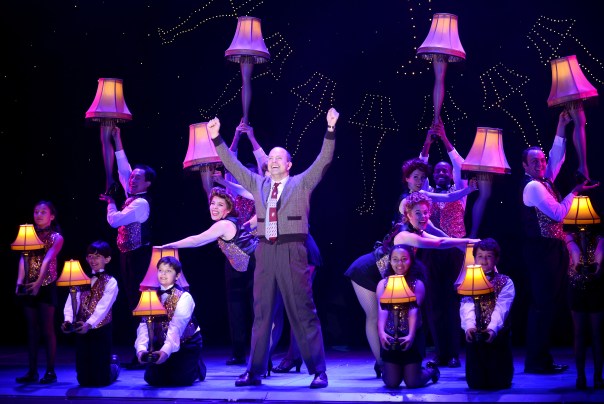
We’d be fine if this expansion were the worst of Joseph Robinette’s mistakes in adapting the 1983 Turner Entertainment film for the stage. Years after Oliver and Annie had proven a pre-teen’s ability to carry his or her weight in a Broadway musical – and less than two years before Matilda would prove it again – Robinette looks to narrator Jean, Ralphie’s parents, and Miss Shields for avenues to expand his book or let composers Benj Pasek and Justin Paul plump up the songlist.

You might retch at all the geniality that Chris Carsten lavishes on Jean, but it’s an enthusiastic heartland geniality, and he isn’t singing much. We can also allow that the epic stress that Lauren Kent as Miss Shields puts on the “You’ll Shoot Your Eye Out” prohibition siphons away some the ogre aspect that might taint Ralphie’s mom. But that strands Briana Gantsweg as Mother in the deadly realm of being almost entirely understanding and nurturing, toward her husband and her sons – in two of Pasek & Paul’s most sweetly innocuous songs. They stop the show in ways that aren’t helpful.

Most of the true joy that beams out at us at Ovens Auditorium in this show comes from Ian Shaw as the ever-embattled, ever-tenacious Ralphie (alternating with Michael Norman) and Paul Nobrega as The Old Man, a similarly-assailed eccentric who barely takes notice of his pint size buckaroo’s numerous tribulations. Largely ignoring Ralphie, The Old Man’s Herculean challenges include taming the furnace, eluding the next-neighborhoods dogs, and winning recognition in a very silly crossword puzzle contest.

With Pasek & Paul rising to the occasion, perhaps the best musical moments in the show are songs inspired by The Old Man, “The Genius on Cleveland Street” and “A Major Award.” Nobrega’s struggles with the crossword puzzle also give Gantswag her best moments, striving to feed the answers to her intensely dimwitted husband without defiling his self-esteem.

Starting out with Shepherd taking us to his WOR studio A Christmas Story, The Musical takes its time before reaching cruising gear. But times were slower in 1940, when Robinette sets the story, and set designer Walt Spangler and costume designer Elizabeth Hope Clancy create a folksy, slightly cartoonist charm that chimes well with this familiar yarn, which will warm your holiday a little if you’re patient. Playing time, 1:54, is 21 minutes more than the movie, so nobody’s in a rush.


Pairing Whitacre’s “Deep Field” Tone Poem With New “Deep Field” Film, Symphony Presents a Semi-World Premiere

Review:  The Planets and Deep Field 

By Perry Tannenbaum


Charlotte Symphony hasfared well with Gustav Holst’s The Planets in the past, programming itno fewer than five times over the last 13 seasons in the orchestra’s Classics, KnightSounds, and LolliPops series. But it didn’t become a hot ticket until Christopher Warren-Green took over the reins as Symphony’s musical director. Back in the fall of 2010, Warren-Green inaugurated the KnightSounds Series with a “Planets!” extravaganza that included NASA animations projected over the musicians at Knight Theater as they played and narrative from a local TV meteorologist between movements. A mini planetarium was set up at the Bechtler Museum next door before the concert, and telescopes stationed outdoors, focused on Jupiter and other wonders in the sky, awaited concertgoers’ gazes afterwards. Every available seat was sold for that performance, so it was hardly a surprise that the next time Symphony offered Holst’s signature work in 2013, it led off the season.

At Belk Theater, Warren-Green could field the large orchestra prescribed in the composer’s subtitle, and the fortified corps benefited from enhanced acoustics – since the maiden concert at Knight Theater predated the installation there of a sorely needed acoustic shell. If the Knight Theater performance was distinguished by superior showmanship, the Belk Theater sequence excelled in authenticity and sonic brilliance. For the 2018 encore, the showmanship has returned! Most of it was lavished upon the first piece in the program, Eric Whitacre’s Deep Field.The Nevada native’s work premiered in 2015 but it was presented for the first time with a new film, Deep Field: The Impossible Magnitude of Our Universe,and a dedicated Deep Field smartphone app, to be activated by audience members when maestro Warren-Green gave his cue. Contributors to the film include scientists and visualizers from the Space Telescope Science Institute and Virtual Choir 5, which includes more than 8,000 voices, aged 4-87, from 120 countries around the globe. Source material for the film – and inspiration for the music – was the landmark “deep field” image produced by NASA’s  Hubble Telescope in 1995, when it was trained on a seemingly blank and minuscule area of space for an epic 10 days and 342 time-exposures, revealing more than 1,500 galaxies that had never been seen before.

Extra lagniappe was added to the showmanship when trombonist Thomas Burge, who moonlighted for eight years as a WDAV weekend host until this past summer, came out to deliver the evening’s introductory remarks dressed up in a NASA spacesuit. Many if not most of the audience members with smartphones hadn’t acted on emails sent by Symphony earlier in the week urging them to download the Deep Field app, so that and logging in to the Blumenthal Performing Arts’ wi-fi network further ballooned the prefatory segment of the program. Adding to the fun, Warren-Green not only showed us what his silent cue would look like but also pantomimed what his reaction would be if we messed up.

Facing away from us until he gave us his cue, Warren-Green was the only musician onstage with a view of the screen. Synchronizing the ensemble with the film seemed to be a very complex task for him, looking down at his score and directing his players while sneaking peeks at the film. The film adds a whole new layer onto Whitacre’s composition. It was amazing how precise the synchronization appeared to be. Imprecision seemed permissible at the start, when Whitacre’s score merely proved how apt the use of a soft minimalist style was for simulating a journey through space. The power of the Deep Field film asserted itself as soon as it began, transforming Whitacre’s music into an unobtrusive film score. Yet the film ultimately proved to be a potent accompaniment for the film, for the entrance of the French horns was pivotal as the brass section and the first violins joined in the orchestral swell while the density of stars increased onscreen and colorful galaxies blossomed.

Whitacre had a bigger musical build to follow with snare drums and timpani, and the onset of our smartphones was yet to come, with the Charlotte Symphony Chorus standing by-behind the instrumentalists. Techies among our readers will be glad to hear that the Deep Field app was designed to play even when your smartphone is set on mute, thus preventing the interference of other alerts and the sounds you’ve chosen to signal email and message arrivals. No rude surprises there, and the differing reaction times to Warren-Green’s cue only enhanced the floating, white-noise, Star Trek flavor of the app’s sound. The video also had a surprise or two at this juncture, superimposing photos of people onto the galactic panorama. At first, the gallery of portraits evoked a choir for me, but perhaps because the filmmakers wished to avoid a sharp contrast with the black void of space, the black-and-white photos ultimately reminded me of the anteroom of the Holocaust Museum in DC, surely not the intended effect. More colorful, less ghostly images would help.

Three performances of Deep Field and The Planets are scheduled, an obvious indication that Symphony is aware of how hot this ticket is. Looking around the hall on Friday night, I didn’t see any patches of unsold seats, a testament to Charlotte’s undimmed affection for Holst’s astrological explorations. If you’re worried that repetition has dulled Warren-Green’s zest for the planetary suite, that concern was dispelled in the opening movement, “Mars, the Bringer of War,” where the musical director was as animated as I’ve seen him this season, prodding the orchestra to a full roar. It was interesting to see how Holst leaned as heavily on the celesta to depict outer space as Whitacre would lean on minimalism, using its distinctive timbre to sprinkle serenity on the “Venus, the Bringer of Peace” movement and to augment the Tinkerbell playfulness of the ensuing “Mercury, the Winged Messenger.”

“Jupiter, the Bringer of Jollity” seemed to be the most British of the movements with Warren-Green wielding the baton, a countryman of the composer, and his account of “Saturn, the Bringer of Old Age” had as much gravitas as ever. The lugubrious opening built to an anguish tinged with timpani and tubular bells before twin harps emerged over a haze of double basses. “Uranus, the Magician” retained the Sorcerer’s Apprentice flavoring that I’d noted in previous Symphony renditions and, with the Symphony Chorus softly chiming in from offstage, “Neptune, the Mystic” had a heavenliness that can only be experienced in live performance.

While I might have pointed to the thinness cruelly exposed in the opening of Deep Field, I was at a loss to point out any flaws in Symphony’s presentation until a concertgoer sitting nearby piped up. He thought a larger screen in a darkened hall would have made Deep Field a more immersive experience. I’ve been informed that Symphony actually uses three different screens at Belk Theater, and the one deployed for Deep Field was larger than the one it uses when it presents an overhead view of guest pianists’ hands traversing the keyboard. But it wasn’t the largest screen in the arsenal, the one that hovers over Movie in Concert performances, such as the just-concluded Home Alone showings, where Symphony plays the film scores live and in-sync with the films. Maybe the midsize screen wasn’t the best choice for the Whitacre semi-premiere.


Actor’s Gym Unearths a Gem in “Fallen Angels”

Review: Fallen Angels

By Perry Tannenbaum

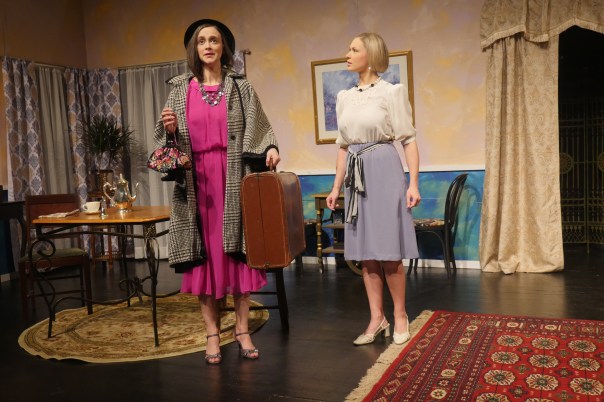
When a playwright puts the finishing touches on his or her latest comedy, it’s without any knowledge about how prevailing attitudes and expectations might change out in the audience over the next 93 years. No playwright has ever had the chance to look back that far, and that includes Noël Coward, whose Fallen Angels is playing at Duke Energy Theater in an Actor’s Gym production directed by Tony Wright.

Knowing Noël, I’d say he’d either gasp or laugh out loud. Opportunity knocks for Coward’s protagonists, Julia Sterroll and Jane Banbury, when their husbands head off on a golfing weekend just when an old flame of both ladies, Maurice Duclos, sends them billet-doux saying that he’ll be arriving back in London after an absence of many years –so many years that the husbands, Fred and Willy, have no idea of who Maurice is nor any knowledge of his torrid affairs with their wives.

After Fred’s departure, Julia is momentarily left alone with her new smarty-pants maid, Saunders. That’s when Jane arrives at the Sterrolls’, all aflutter with the news. Julia, who was just a few minutes earlier discussing with Fred exactly how much fire was left in their mellowing marriage, hadn’t yet read her note from Maurice. It quickly becomes evident, as the women discuss Maurice, that those flames still burn brightly, perhaps more brightly than ever. They’re a little scared.What will they do when he arrives?

Their first impulse is exactly what an audience would expect – in 1925: to flee as quickly as they can to protect their honor, which presumably cannot withstand Maurice’s irresistible charms. A mere 35 years after Oscar Wilde had declared, “The only way to get rid of temptation is to yield to it,” such an outlook was still wicked, irresponsible, and risqué.

Nowadays, coaxed by Madison Avenue, amoral leaders, social media, and longstanding American traditions of fierce individuality, we find ourselves – regardless of gender – inwardly urging Julia and Jane, Go for it! Whereas we’re taken aback in 2018 by the ladies’ knee-jerk-prissiness, their eventual decision to stay and face Maurice was immoral enough to give London’s censors pause before allowing Fallen Angels to be performed.

Once Julia and Jane have opted for what we perceive as the road-more-taken, you might expect that attitude adjustment becomes far less necessary. Yet in more subtle ways, the presumption of wickedness works its way deeply to the bones of Coward’s comedy. Instead of building his comedy upon Julia and Jane’s rekindled romances – and their wacky or delicious maneuverings to keep their husbands in the dark – we find an unexpected amount of time devoted to maintaining their wicked resolve. Here our complications arise from the women’s resorting to martinis and champagne to sustain their courage during their excited vigil.

So it’s helpful that Tony Wright and his design team keep reminding us that the people onstage are living indifferent times. While Tim Baxter-Ferguson’s set design isn’t the ultimate in elegance, the requirements of a British drawing room are met, including a baby grand where Saunders will upstage Julia. Davita Galloway’s costumes, particularly the flapper-flavored outfits for the partying ladies as they sip their martinis, stamp the era most decisively.

The women must dominate this comedy,and Wright has found a marvelously varied trio. Originally played by Tallulah Bankhead, Julia is the formidable serenity that is serially agitated by Saunders, Jane, and Maurice to comical effect. Jennifer Barnette takes that serenity to a loftier, more angelic plane, slightly muting her discomfiture and giving more space for the eccentricities of Saunders and Jane to shine. Karina Caporino pounces on her opportunity as Jane with frenetic energy, more brittle and midlife than we’ve ever seen her, which easily makes Jane the most screwball of her trademark neurotics.

Erin Darcy as Saunders is possibly the most vivid period trimming in this whole confection, a servant who is more knowledgeable, widely traveled, and skilled than the mistress she serves, aware of her superiority and maybe a little bit haughty about it. Saunders’ sophistication lays bare the delusion that the Sterrolls or the Banburys are living lives of consequence. Perhaps it’s Darcy’s aplomb at the piano that gives Barnette her best episode of humiliation.

In this context, Emmanuel Barbe is a perfect choice as Maurice. He is suave and self-assured, with a savoir-fair that is unmistakably French, yet he doesn’t quite have the polish and youth that would make knees buckle in high society. Barbe’s down-market elegance is still more than enough to make David Hensley as Fred and Michael Anderson as Willy seem gullible, dimwitted, and humdrum. Hensley as Fred seems to be the sort who feels like he’s fulfilling his destiny by opening a newspaper at the breakfast table, while Anderson, once he reconciles with Fred and Jane, gives Willy exactly the smiling insouciance that Wright wants for his ending.

I have to go back to 2005 and The Tempest to find the last Actor’s Gym production I reviewed. It’s great to have Wright and his Gym back on the scene, especially when the Gym unearths a gem like this.