Daily Archives: May 11, 2017

Corey Mitchell Fine-tunes a Kook’s Southern Drawl

In Corey Mitchell’s production of 'Memphis the Musical,' Joe McCourt (right) plays Huey Calhoun, and Dani Burke Huey’s love interest Felicia Farrell.

Preview: Memphis The Musical

By Perry Tannenbaum

You can see Huey Calhoun as a scavenger, a conman, and an illiterate hick. Or you can see him as a rock ‘n’ roll visionary, a natural salesman, and a quirky promotional genius. However you see Huey, in Memphis the Musical at Theatre Charlotte starting this Friday, you will not find him dull. Based loosely on the career of Memphis radio jock Dewey Phillips, the story by Joe DiPetro may remind you of Hairspray, another musical that took us back to the early days of rock and tensions between the races.

Taking us to the innards of radio as well as TV, Memphis gets us closer to the true heart of rock. South of the Mason-Dixon line, there’s more bigotry from whites — and more wariness from blacks — when Huey not only promotes African American music on the middle of the AM dial, but also romances a black singer.

Without the comical cross-dressing, cartoonish bigots, and outrageous promotional stunts incorporated into Hairspray, the terrain of Memphis will be more difficult to navigate. So it’s exciting to learn that Tony Award winner Corey Mitchell will be directing, Joe McCourt will be starring as Huey, and Dani Burke will be sparking Huey’s passions as femme fatale Felicia Farrell.

Burke has been sensational in her two previous mainstage appearances at the Queens Road barn, first with her lead vocal on “Aquarius” in the 2014 production of Hair and again last year singing “Disco Inferno” in Saturday Night Fever. Since his Theatre Charlotte debut as the star of Godspell in 2008, McCourt has shown us astonishing range, from Roger Davis of Rent to the porn-addicted Trekkie Monster of Avenue Q to low-self-esteem finalist Leaf Coneybear in The 25th Annual Putnam County Spelling Bee.

After singing telegrams on land and entertaining on cruise ships at sea, Mitchell came to Charlotte in 2001 by way of Wilmington — and its Opera House Theatre Company — to make his sensational local debut as Hysterium in the Theatre Charlotte production of A Funny Thing Happened to Me on the Way to the Forum. Since then, Mitchell has directed or acted in productions at Theatre Charlotte, Davidson Community Players, CPCC, and Actor’s Theatre of Charlotte.

What makes Mitchell such a key part of the Charlotte scene is his teaching and directing in the theatre program at Northwest School of the Arts. And don’t think his special Tony Award for Theatre Education was a bolt out of the blue. Aside from a CL Theatre Award, Mitchell has snagged honors from the Metrolina Theatre Association, the North Carolina Theatre Conference, the Educational Theatre Association, the International Thespian Festival, and National Youth Theatre. Productions directed by Mitchell have garnered at least a dozen Blumey Awards — with seven more nominations still in play for the 2017 ceremonies at Belk Theater on May 21.

You could say he’s connected in the community. It would have been hard for anybody who has performed extensively in Charlotte to catch Mitchell off-guard at auditions when he cast Memphis. He has worked with Burke before in Davidson and is quite familiar McCourt’s work. Tyler Smith, who plays Felicia’s protective brother Delray, is coming off a powerful performance as Coalhouse Walker, fueling CP’s production of Ragtime.

“The three of them bring so much presence and power to the stage,” Mitchell says. “Joe’s work is incredible. The biggest challenge has been just the herculean task Joe has to take on each evening. Huey is in every single scene in this show.”

Surprisingly, Mitchell doesn’t take the view that Memphis is about race, mixed couples, or even the title city.

“I decided to treat the relationship between Huey and Felicia on the micro level of how this man loves this woman,” Mitchell explains. “While Huey has an absolute obsession with black music, he certainly doesn’t fetishize black women in general. He is specifically in love with this woman — and despite her best efforts not to be, Felicia is love with this man. She is, however, a realist.”

Huey was an eccentric goofball when Chad Kimball played him in the original Broadway production, slinking back and forth across the stage, seemingly unable to take two consecutive steps in the same direction. He wasn’t Gomer Pyle, but Huey was very Southern, perhaps in a way that New Yorkers could look down on from afar.

“Trying to portray his unique persona was challenging,” McCourt admits. “We decided to tame the over-exaggerated drawl of Chad Kimball’s original Broadway take so that he doesn’t appear too cartoonish but still hold on to his kooky side. It has been hard finding a balance between too much and not enough [drawl] while trying hard not to insult the Southern accent itself!”
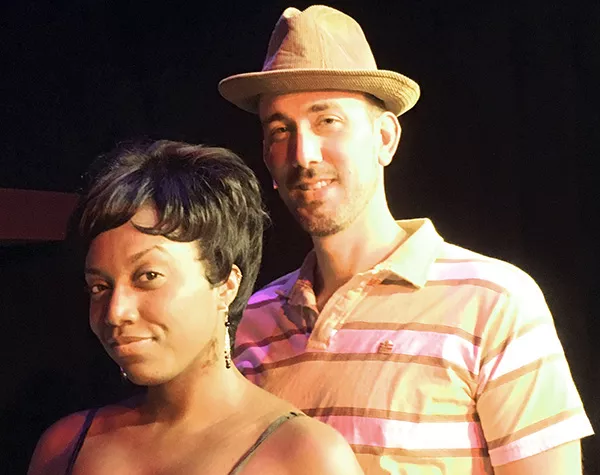
Dani Burke as Felicia Farrell and Joe McCourt as Huey Calhoun.

A new worry materializes when you make the illiterate Huey smarter and more cunning in Charlotte than he was on Broadway. Hopefully, the micro lens that Mitchell wants to apply to Huey and Felicia is helping McCourt to skirt the impression that he is slyly exploiting her commercial potential.

“Huey is a born salesman and smart for being uneducated,” says McCourt. “I don’t see him as a con artist nor cunning. He’s naive to a fault, a free spirit that knows what he wants. Music moved him; so it was no surprise that he fell for Felicia, who not only inspired him musically but also opened his heart to new possibilities. He simply lacked the emotional intelligence and social skills to handle those feelings. I’m walking a fine line trying to make sure he doesn’t come across the wrong way.”

And Mitchell, for all his accolades, is giving McCourt free rein. They’re definitely on the same page when it comes to portraying Southerners.

“I want to strike a balance with him — and the rest of the cast, for that matter — to be Southern without being a caricature,” Mitchell says. “Too often, I see Southern people portrayed onstage as rubes. Joe is an impeccable actor and a professional in the best sense of the word. I try to give him room to play and explore and then nuance in those areas that seem to need a little tweaking.”

Ultimately, the issue that drives a wedge between Huey and Felicia isn’t race or prejudice. It’s an issue that our most gifted theatre artists constantly wrestle with: should I build on what I’ve done here in my hometown, or should I set out for a bigger market in the hopes of greater opportunities and nationwide renown? McCourt senses that Memphis brings Huey a feeling of comfort and security, that he also fears the unknown.

He can identify with the dilemma.

“For me personally,” he says, “I took that leap and moved from a small town south of Buffalo and headed to NYC many years ago for the possibility of making it ‘big.’ Although young and bold, looking back, I was also afraid of failure, which held me back from pursuing many things there. I’m at a different stage in my life now. So building upon what I’ve done here in Charlotte has been very fulfilling. A realtor by day, a performer by night, and a father and husband in between!”

Mitchell is far from cooped-up in Charlotte since his Tony triumph. He has delivered keynote addresses at theatre conferences across the Southeast and traveled to Dubai as a Varkey Teacher Ambassador. Purple Dreams, a documentary about Mitchell’s 2013 production of The Color Purple at Northwest, was released on April 7 to considerable publicity and acclaim.

So it’s likely we’ll be seeing more from both Mitchell and McCourt in Charlotte for years to come. Their best work may still lie ahead.

Opera Carolina – and Six International Collaborators – Present a Top-Drawer La Fanciulla del West

Review: Charlotte Opera The Girl of the Golden West

By Perry Tannenbaum

When Opera Carolina general director and principal conductor James Meena walked out onto the Belk Theater stage to introduce the Charlotte premiere of Puccini’s La Fanciulla del West, he was appropriately sporting a black Western-style Stetson. That hat nearly grew old before our eyes as Meena delivered his curtain speech, for he had so much more to say than usual – even when he’s enumerating the generous sponsors of a production and capping off a season by announcing next year’s lineup. Not only was the New York City Opera a collaborator on this production (as they were for last season’s American premiere of Rachmaninoff’s Aleko), so were five new co-producing companies from Italy, including Teatro del Giglio in Lucca, Puccini’s hometown.

That was just the first leg of the extras from Meena. One of the sponsors, Wells Fargo, is actually represented in the opera – and in the David Belasco melodrama, The Girl of the Golden West, from which Puccini took his storyline – by Ashby, the Wells Fargo agent on the trail of Dick Johnson, our hero. So the storied San Francisco company has contributed some memorabilia to the design of this production, dating back to its iconic stagecoach days during the California Gold Rush. Finally, if there were some in the audience who weren’t already aware of it, tenor Marcello Giordani, who was about to sing the role of Johnson (alias the outlaw Ramerrez), has brought his international vocal competition to Charlotte. The four sessions of preliminary rounds, semifinals, and finals are interlaced with the three performances of La Fanciulla at Belk Theater. All in all, quite a week for Meena and Opera Carolina.

Although Sheriff Jack Rance broods among the miners at the Polka Saloon in the opening moments, impatiently awaiting the arrival of Minnie, La Fanciulla doesn’t zero in on its core story and characters as efficiently as Puccini’s Tosca, Butterfly, and Bohème. That’s not a problem if you have strong singers in the secondary roles carrying the early action. Most of the singers in minor roles gave first-rate performances. Jeff McEvoy as camp minstrel Jake Wallace gave a fine account of the homesick “Che faranno I vecchi miei” aria, justifiably launching an empathetic men’s chorus after him. Baritone Giovanni Guagliardo was such a powerful presence onstage that you could think he was one of the leading players until he was identified as Sonora, and bass-baritone Dan Boye slid ably from bravado to pathos as Sid when the card dealer was caught cheating. But all of the aspirants to Minnie’s regard didn’t sound as formidable as Sonora, and tenor Gianluca Bocchino was shockingly underpowered when he appeared as Nick, the Polka’s sly barkeep. Bocchino must have been pretty alarmed himself, for he sang much more effectively later on.

The poignant homesickness of the minstrel and the collection Sonora takes up on behalf of the disillusioned miner are well worth keeping in mind when Minnie pleads for Johnson’s life in Act 3. Similarly, the miners’ rage against Sid’s duplicity – and Rance’s authoritative intervention on behalf of the cardsharper, meting out punishment that is less than a noose – also foreshadows what we’ll see from them after intermission. While the overall design is artful, there was a welcome intensification of the drama when Minnie, Johnson, and the outlaw’s chief pursuer, Agent Ashby, showed up. As Sheriff Rance, baritone Aleksey Bogdanov is a powerful, menacing presence – Scarpia-like in his driving urges, with feelings and morals layered on. But until he was alone with Minnie, past the midpoint of Act 1, Rance could not reveal his soul. Singing the “Minnie, dalla mia casa son partito” aria, Bogdanov showed it to us, a wisp of tenderness mixed into his gruffness. Although they don’t come into play nearly as dramatically, Ashby also seems to have feelings for Minnie, and baritone Jason McKinney has a powerful presence that matches up well with the other lawman.

Stage director and production designer Ivan Stefanutti has responded well to the demands of this drama in casting and directing these two imposing baritones, but there is an extra measure of flamboyance to this pioneering spaghetti Western. Set in the foothills of the mighty Sierra Mountains, this Western emphatically separates itself from the Cactus League of the genre by including a massive blizzard at the climax of Act 2. So the men don’t merely sport boots, buckskins, vests, and a panoply of brimmed and furry hats. They also wear a variety of coats. In a wonderful array of costumes – including a turquoise suit for Rance – Steffanuti has gone with fur coats for both Rance and Johnson. Ashby’s rakish raincoat, on the other hand, is worthy of the Flying Dutchman.

Maybe a couple of words should be said about the projections designed by Op Carolina’s Michael Baumgarten. Setting the scene in the Sierras, the animated views of the mountain are tastefully dark and monochromatic, maybe a little too aggressively varied for their purpose. The animated backdrops, when the Polka interior becomes established, also changed a little too busily for my taste, but the emphasis on the Ramerrez wanted poster pointed up a prime advantage of animation. One second, the poster can be many times lifesize; the next moment, it can diminish to insignificance. In Act 2, as we reached the pivotal poker game between Minnie and Rance – with Ramerrez’s life as the stakes – the backdrop filled with supersized playing cards. But do they really need to crazily flip around like we’re in a living slot machine? Again the background changes at Minnie’s cabin were too busy, at one point seeming to suggest that Minnie lives inside a tree, and later implying that either Ramerrez’s gang or the Sheriff’s posse was outside guarding the cabin. Mercifully, Baumgarten was more restrained in Act 3, and the dawn of Ramerrez’s redemption came with more subtlety.

Giordani measures up well physically against his imposing antagonists, but the tenor has a noticeably gentler demeanor as Johnson, more convincing as an ardent lover than as a cunning and ruthless bandit on the run. Since he’s tracked down, shot, and strung up, banditry wasn’t a particularly strong aptitude for Ramerrez, so a name change followed by a career change would be sensible directions that he could see for himself in Act 2. Puccini’s music certainly pulls Johnson toward romance, redemption, and domesticity, and Giordani responds best in the heartfelt “Io non ti lascio più” duet in Act 2, before his past dalliances with a certain Nina are confirmed. Listening to Giordani deliver the “Ch’ella mi creda” in Act 3 when the jig is up, I really did feel like this was a penitent and reformed Ramerrez.

Making her Opera Carolina debut, soprano Kristin Sampson brings a stocky presence to Minnie that seemed, upon a few minutes of reflection, to be as right as Ethel Merman singing the gun-toting Annie Oakley. While I’d be leery of seeing Sampson as the fragile Mimi in Bohème, there was Tosca-like power for her to work with here as she made her dynamic entrance with a good-sized firearm holstered on her hip. She decisively resisted Rance and did not melt easily when Johnson started wooing, so her half of the Act 2 love duet came with a delicious onrush of amorous passion we hadn’t heard before. Yet she far surpassed herself in Act 3, pleading for Ramerrez’s life – one miner at a time – in Minnie’s “Non vi fu mai chi disse ‘Basta!’” The plaint built powerfully in its conviction, and as the miners gradually joined in, became a chorus of communal forgiveness and kindness that I found unexpectedly moving. Never having seen La Fanciulla performed live before, I hoped I’d be seeing a first-rate production of second-rate Puccini. Leaving Belk Theater, I had the distinct feeling that this opera deserves top-drawer status. I suspect many other longtime Opera Carolina subscribers felt the same.