Daily Archives: February 12, 2017

Hit the Road, James, With a Mind-Boggling “Hitchhiker’s Guide”

trillbeer

Review:  The Hitchhiker’s Guide to the Galaxy

By Perry Tannenbaum

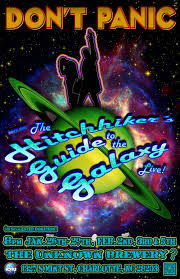
Can this really be the end? Citizens of the Universe and its indefatigable intergalactic peacekeeper, James Cartee, are leaving Charlotte, heading for Texas, and only possibly leaving an appendage behind them to carry on their mission. Closing with The Hitchhiker’s Guide to the Galaxy at the Unknown Brewing Company, their most lavish production since they adapted The Princess Bride at the now-defunct Breakfast Club in 2011, COTU is going out with a big bang.

Two parallel events trigger the sci-fi comedy as we meet the shambling, stiff-necked Arthur Dent, who never sheds his PJs and bathrobe throughout his mind-boggling travels. On the earthly plane, Arthur is battling to keep his Cottington home from demolition by the county to provide a pulverized right-of-way for a new thruway. He’s ready to lay down his life for his property, and he’s actually lying down in front of his Cottington cottage so that the county bulldozer can’t move further.

Meanwhile, on a more galactic plane, Vogon overlords who are constructing a hyperspace bypass have slated Earth for demolition. Why a perpetually moving planet in a perpetually expanding universe would be slated for demolition is beside the point, do you hear me?

By the most improbable coincidence, Arthur is singled out for rescue by Ford Prefect, an embedded alien who contributes to the Hitchhiker’s Guide as a roving travel writer. Yes, when Douglas Adams first conceived his sci-fi serial for BBC

zaphod

Radio in 1978, ebooks were already on his imaginary assembly line. Arthur frequently consults his pocket reader after hitchhiking aboard a new space cruise or during his downtime, but it is Mandy Kendall who brings The Book to life between stints as our narrator.

She’s also, as our costume designer, the person who makes COTU’s valedictory so outré sensational. Arthur may be a humdrum everyman, with Chris Freeman faithfully executing his shambling duties, but Tom Ollis and Billy Whalen, tethered together as two-headed galaxy prez Zaphod Beeblebrox, take us back past the disco ‘70s to the hippy ‘60s with their outfit. Loud colors, a florid headband, with brash tie-dyes clashing unapologetically against paisleys.

Of course, Beeblebrox doesn’t exhaust the weird phenomena Kendall must costume on Arthur’s odyssey. Other cameos range from Ravenous Bugbladder Beast of Traal (Greg Irwin), Marvin the morose robot (David G. Holland), Deep Thought the computer (Martin Barry), a Whale (Kevin Sario) swimming with a Bowl of Petunias, and the two life forms on our planet that are smarter than we are, mice and dolphins.

Freeman maintains a British diffidence that occasionally flares into puzzlement amid his haywire journeying, but Nathan Morris as Ford is the optimistic huckster forever urging Arthur onwards, almost oozing insincerity when the going gets tough. Like the brainy Trillian and the gregarious Book, Ford is occasionally incomprehensible when he uses jargon that is outside the ken of the BBC and the OED.
index

Both Ford and Kendall occasionally stumbled on their lines Saturday night when they wandered through this alien corn, less like the terminology of a botany catalogue than the brainchildren of Lewis Carroll. By comparison, Elisha Bryant skates through these lingual brambles effortlessly as the other earthling in our story, not merely assimilating into the galactic hierarchy after being kidnapped by Beeblebrox, but becoming his/its/their right-hand organism.

If you saw Bryant’s work recently in two of the plays at Children’s Theatre’s WonderFest, including the title role in The Commedia Snow White, her excellence at the Unknown Brewing Company will come as no surprise. Every time Bryant appears, it’s in a different costume. Trillian is adequate reason for Arthur to keep on traipsing across the galaxy.

Aside from their helter-skelter production style or their intriguing choices of classics and film adaptations, COTU is best known for pioneering new venues, going where no other theatre company has presented before. Surrounding the players with a wall of wooden casks and an armada of tall stainless steel brewing tanks, the Unknown was surprisingly apt for a sci-fi comedy.

Yes, the sound seal between the brewing room and the bustling taproom wasn’t perfect as the evening ripened, and the makeshift seating wasn’t cushy enough to prevent the onset of butt burnout at the end of the show. But you can settle into the general seating with your brewski in hand, and there was a convenient food truck parked outside last Saturday night on the corner of S. Mint and Lincoln Streets. I can vouch for the blackened salmon sandwich that I took into the theater, but once the lights went down, I couldn’t accurately describe all its green and crunchy contents.

Getting the answer to the meaning of life from Deep Thought is a profound reason for going, so I won’t be a spoiler. But the anthem near the close of Act 2 is such an emblematic goodbye that I can’t resist. After sitting behind the control board for most of the night, cuing projections that I suspect he devised and overseeing the excellent sound, Cartee strode forward to the stage and joined the action – as a dolphin. Somehow in time-honored comic book style, Adams had brought us back to Earth just before the wily dolphins threw off their domesticated disguises and fled the planet.

“So long,” they sang in a joyous, rudimentary production number, “and thanks for all the fish!” Goodbye to you, too, COTU. Thanks for sticking with it so long through so many challenges and hardships.



One Amazing Voice Stands Out at Suspicious Cheese Lords Concert

Review: Suspicious Cheese Lords

By Perry Tannenbaum

hqdefault

You probably wouldn’t guess it by their name, but the Suspicious Cheese Lords are a vocal group hailing from Washington, DC. Their name derives from the mischievously mistranslated title of a Thomas Tallis motet, “Suscipe quæso Domine,” a work that their website tells us the Cheese Lords have never performed. Suspicious! Considering that the Lords proudly specialize in works, from Gregorian chant through the Renaissance, that have never been recorded before, we cannot know whether these eccentric choristers will ever perform their quasi-namesake motet. Eccentric or not, the Cheese Lords had plenty of church gigs under their belts, participating in services at places as awesome as Washington’s National Cathedral, before they arrived at the Abbey Basilica on the Belmont Abbey College campus for their Sunday afternoon concert.

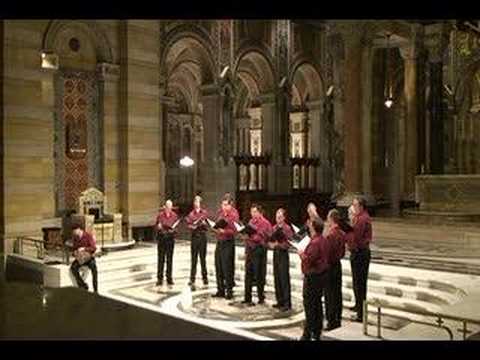
Those belts were conventional leather rather than thick rope, although the Cheese Lords were the choir-in-residence at DC’s Franciscan Monastery from 1998 to 2006. Attired in dark slacks and burgundy shirts, the Cheese Lords looked rather humdrum compared to their name. Nor were they terribly suspicious – except for their prime spokesperson and leader, Christopher Riggs. After emcee Karen Hite Jacob had just made the blunder of speaking to us via a lectern microphone, rendering her intro almost completely unintelligible, Riggs separated himself from the ensemble and offered greetings, individual intros of his colleagues and, with the assistance of each of the Lords’ four sections, a thorough demonstration of polyphony. Yet his first words to us, “Can you hear me?” must surely have been rhetorical, notwithstanding the fact that he had disdained the microphone. Riggs’ big baritone voice boomed across the hall effortlessly.

What was suspicious, surprising, and sensational was yet to come. Riggs, known as “Lord Taskmaster” at the Cheese Lords website, receded into the ensemble and proceeded to tune and cue the other singers – from the countertenor section. Neither “receded” or even “blended” would be entirely accurate here. As we moved from the demonstration snippet of Giovanni Pierluigi da Palestrina’s “Sicut cervus” (Psalm 42:2) to a full performance of the piece, it became apparent first that Riggs’ singing voice was a gleaming countertenor, as effortless as his speaking voice. More remarkable, as the concert continued, it became obvious that Riggs’ countertenor was a dominant voice. I have no trouble believing Riggs’ website blurb where it claims that Lord Taskmaster’s range extends from bass to countertenor. It’s just hard for me to believe that he isn’t better known.

After the Palestrina, the program took a hairpin turn that I loved – to a living composer’s setting of Psalm 43. Tony Domenick’s “Vindicate Me, O God” not only livened the program with its contrast, it enabled the Cheese Lords to re-emphasize the differences between modern harmony and polyphony. Better yet, the work was the first winner of a compositional prize, contested by composers aged 35 or younger, awarded in 2016. Where the effect of the Palestrina had been somewhat intoxicating, overlapping words blending in a language I don’t speak, the Domenick performance glowed in English with clarity and plainspoken emotion. The Abbey Basilica may be unkind to softspoken people who resort to amplification, but it’s very much like heaven for a choir, uncompromised by dead-end nooks that might muffle the commingling of sound waves.

Unfortunately, the shuttle between ancient and modern compositions wasn’t repeated. Nor was there a return to English, though translations abounded in the eight-page program booklet. The Cheese Lords proceeded to stitch together a “FrankenMass” from sources and parodies spanning five centuries, beginning (chronologically, anyway) with a Gregoria chant by Hermannus Contractus (1013-54) and terminating with a pair of pieces by Elzéar Genet (c1470-1548). Pieces were grouped in the order of the five sections of the ordinary Mass: Kyrie, Gloria, Credo, Sanctus, and Agnus Dei. Most of the sections led off with a piece that was later parodied. Now Riggs was careful to explain that the parodists weren’t at all mocking their sources as Mel Brooks’s Young Frankenstein mocked the Boris Karloff classic. These were simply choral pieces that used earlier pieces as jumping-off points for development and elaboration, so Ludwig Senfl’s “Gloria” from Missa L’Homme armé no more mocked the anonymous 15th century composer of “L’homme armé” than Rachmaninoff mocked Paganini. In between these two pieces, we heard a different repurposing of “L’homme armé” by Robert Morton, who composed an “Il sera pour vu conbatu” overlay for the earlier song.

A bit of convoluted logic justified the inclusion of the unparodied “Kyrie” from an anonymous 13th century Messe de Tournai, and the messy formatting of the printed material, where a lyric might appear four boldfaced headers after a song title was mentioned, had my head spinning a bit. Compounding my confusion, a “Gloria” heading appeared in boldface on the line directly above the two Palestrina pieces where the composer parodied himself with his “Credo” from Missa O admirabile commercium. The music itself soothed my confusion, and a few more of the 10 Lords came forward to personably introduce the pieces. By far the least informative – and most entertaining – of these presentations was Cheese Lords founder and president Clifton “Skip” West III, who gave a lively account of the Tallis-based etymology of the group.

There were interesting wrinkles in the arrangements. The “Kyrie” began with a tenor-countertenor duet, baritone Sargon de Jesus soloed to kick off Senfl’s “Gloria” (where the tenors soon took the lead), and after disappearing behind the far altar before West’s remarks, two basses and a baritone began the “Alma Redemptoris Mater” plainchant from their distant concealment. Reunited, the full ensemble turned in some of their most beautiful work on Jean Mouton’s “Sanctus,” though lyrics were missing from the booklet, which repeated its misleading layout.

Even more delightful was the arrival at the music of Genet and the unexpectedly worldly source of his “Agnus Dei” from Missa Se mieulx ne vient. The first line of the original French rondeau translates as “If it doesn’t get any better, I’m not content with love.” Surprisingly, searches of Spotify and Amazon confirm that recordings of Genet are almost exclusively a Cheese Lords domain: no other full-length CD devoted to Genet is available at either outlet. The Cheese Lords’ 2002 Maestro Di Capella, including the complete Se mieulx mass, has no competition. Now if they had to do it all over again, I suspect they would have recorded the parodied song, as they subsequently did prefacing their recordings of the L’Homme armé, O admirabile commercium, and Alma Redeptoris Mater masses.

Our sampling of the piece confirmed that Genet’s music deserves a full hearing as much as the more frequently recorded Palestrina, Senfl, and Mouton. The warmth of the ensemble in live performance at the Basilica surpassed the engineered recording, where the post-production mix may have enabled Riggs to sound more subdued if no less distinctive. Added to the completed “FrankenMass” was another Genet gem, “Tibi Christe,” a hymn for the feast of St. Michael. The special treat here was the shuttling alternatum style, alternating verses of chant and polyphony. Riggs called our attention to the first of the two polyphonic stanzas, where brave Michael pulverizes the devil. Actually, the live performance far exceeded the recorded version in clarity and excitement, which was held in check until the final stanza on the CD. For the encore, one of the tenors – Kevin Elam, I believe – brought out a tambourine as the Cheese Lords finished with an even more freewheeling Spanish tune, “Rey a Quien Reyes Adoran.” People lined up after the concert for the merch that discreetly appeared on the Basilica’s piano. More gathered around the remarkable Riggs and his cohorts.

Two Pieces by Sasha Janes Highlight Charlotte Ballet’s Innovative Works

Review Dance: Charlotte Ballet’s Innovative Works and Its Tribute to Jean-Pierre Bonnefoux
By Perry Tannenbaum


Twenty years is a long time in the history of a dance troupe – four or more generations for Charlotte Ballet if you calculate how long the typical dancer remains before moving along or retiring. Charlotte Ballet’s artistic director, Jean-Pierre Bonnefoux, is taking the latter route after 20 seasons at the helm, an era during which excellence was admirably sustained while the organization grew in strength, most notably in its facilities and educational programming. So it was appropriate to dedicate the latest iteration of Innovative Works as a special tribute to Bonnefoux, not only because this annual showcase of new, exciting, and intimate works was his brainchild but because its current home has been the Patricia McBride and Jean-Pierre Bonnefoux Center for Dance since 2011. There’s no better place for Charlotte Ballet to celebrate.

When Bonnefoux first divulged his imminent fadeout to emeritus status a couple of years ago, he told me that he wouldn’t be choreographing any new pieces, although some new wrinkles were evident in the million-dollar makeover of his Nutcracker last fall. There were no surprises in the 2017 crop of Innovative pieces. The in-house feel of the programming still remains intact, all of the choreographers hailing from within the Charlotte Ballet orbit without any unexpected debuts.

The program began and ended with pieces by associate artistic director (and resident choreographer) Sasha Janes, whose pieces continue to grow more intriguing every year. In between, there were works by Mark Diamond, director of Charlotte Ballet II, Sarah Hayes Harkins, a longtime principal in the company, and David Ingram, a fondly-remembered alum. Continuing the tradition of recent years, each of these choreographers cut an intro that was projected on the side walls of the McBride-Bonnefoux studio before each dance began. Since Janes’ “Hallejujah” was a reprise from last year, Bonnefoux took the opportunity of subbing for Janes, reflecting back on his Innovative series while introducing a piece that was well worth its revival.

170126-peterzay48-web

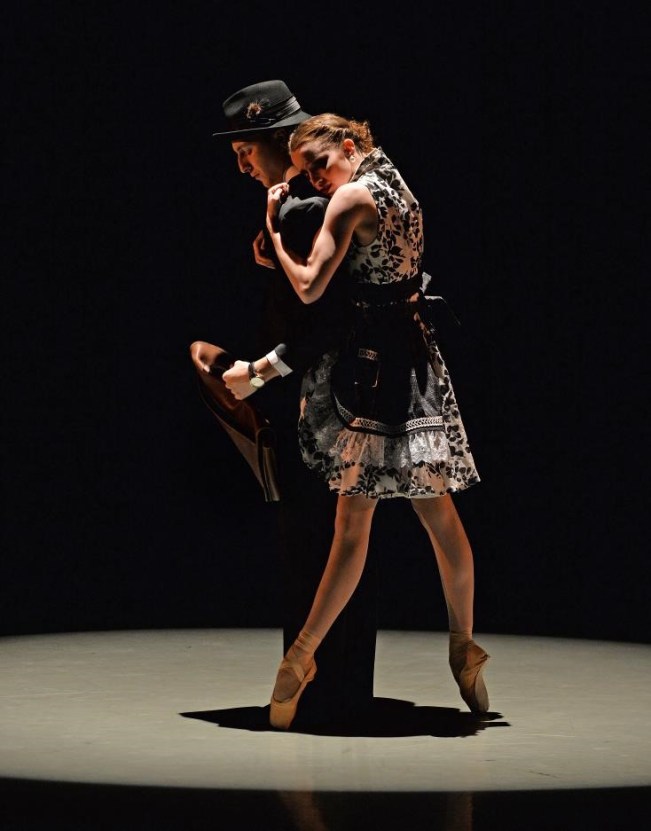
Opening the program, Janes’ “Utopia” was a startling piece to come from a man who spent his formative years in Australia, born more than a decade after the songs on his playlist – by The Platters, Link Wray, Patience & Prudence, and The Teddy Bears – found their way to jukeboxes on 45 rpm discs. The Aussie’s erudition with The Platters is particularly impressive in his sardonic look at 1950’s American domesticity, where everything wasn’t the Father Knows Best bliss that Eisenhower voters would have us recall. “No Matter What You Are,” the song that bookends Janes’ piece, isn’t at all among The Platters’ greatest hits. For over a half century, it has been hidden in plain view on the flipside of “Smoke Gets in Your Eyes” – a clever hint that we’re watching the flipside of the Ike Era. With Elizabeth Truell as the Wife and Josh Hall as the Husband, we watch the typical morning scene of seeing the family breadwinner off to work. Only there was some visible desperation from Truell as she clung to her husband, handing him his hat and briefcase, the devoted housewife gone slightly berserk. Hall was visibly impatient and eager to go, irritated with all the affectionate blandishments, but as we adjourned to his office with “The Great Pretender” (The Platters’ breakthrough hit), we could see that the Husband was suffering from frustrations – and neuroses – of his own.

170126-peterzay150-web-1024x774

Enter Jamie Dee Clifton as the Secretary, to the beat – and power chords – of Wray’s “Rumble.” Her attempts at seduction got a far more welcome reception from the Husband, though there were definitely some signs of distress as he absorbed the vamping. Yet with Patience and Prudence’s “Tonight You Belong to Me,” there could be no doubting Secretary’s conquest, though the necking session was interrupted by a phone call from the patiently waiting Wife back home. Truell’s ensuing solo, begun on the couch of her Psychiatrist (Michael Menghini) was the most sensational segment of the suite for me, savagely contrasted with the cuddlesome harmonies of The Teddy Bears’ “To Know Him Is to Love Him.” The frenetic energies that preceded this therapy session came to full boil, overflowing into a primal scream that Truell delivered into the unresponsive shrink’s face (before he presented his bill). As Janes predicted in his intro, the repetition of “No Matter What You Are” and the bizarre morning send-off took on an added level of irony as we saw so much more clearly how the lyrics applied to the married couple’s daily ritual.

fix_1008-5717-web-1024x683

The other works that preceded intermission weren’t as daring, ambitious, or satisfying. Set to a Chopin favorite, Harkins’ “Gemini” never convinced me that we were seeing two aspects of the same individual, and the promised improvisation element eluded me altogether though the performances by Drew Grant and Ben Ingel were certainly intriguing. Part of the problem was the damage that the McBride-Bonnefoux acoustics did to Ingel’s monologue when he ventured into the audience. Not sitting in the center sections, I hardly understood a word. Nor could I tell what it was that Grant replied from the stage or determine whether it echoed what his partner had just spoken. In this one respect, Booth Playhouse, where Innovative was staged 1998-2009, was a better venue, though it was no better for pre-recorded music and less hospitable for lobby receptions. “Ever After” by Diamond was a better showcase for Harkins’ talents as she partnered with Hall in an abstract piece about the transition to afterlife, set to music by J.S. Bach, Ivan Spassov, and Karl Jenkins. Destined to partner in the program finale later in the evening, the Harkins-Hall duo stole most of what was left, in the wake of Rose Nuchims’ lighting design, of the focus that could have gone to the three other couples onstage. Another barrier to full appreciation was the language barrier, Bach’s German and Jenkins’ Latin.

fix_1008-4071-jeff-cravotta-web-1024x682

Following the hypnotic ecstasy of Diamond’s piece, Ingram’s new “Flamouriá” after the break was rousing and refreshing, set to the music of Luigi Boccherini, which deserves to be heard more often. The modern visuals – huge balloons suspended over the action, projections on the rear wall – clashed provocatively with the 18th century score, and a certain amount of sloppiness was built in to the concept. Movement by four couples, led by Alessandra Ball James and James Kopecky, was by the dancers, “curated” by Ingram. This sparked numerous questions as I watched. Like the other works on the program, “Flamouriá” will be danced by multiple sets of dancers as Innovative continues it run through February 18. So, will the movement change to accord with the other set of dancers – and did Ingram allow his performers any latitude, or multiple choices, in their movements? Unfortunately, some of the sloppiness I witnessed was layered on by the new projection technology that was lavished on the piece. Most of the video was blurry and, at times, edges of the projections cut randomly and inelegantly on the rear screen, stealing focus from the dancers. I’d also thought that those massive white balloons might double as projection surfaces – a potential that went unfulfilled. There were some special moments when Nuchims’ lighting was uncluttered by the new gadgetry, most notably when the dancers became silhouettes against the ginormous backlighting of the rear screen.

1454643066_crop

Little needs to be added to the raves I posted at my own website a year ago when Janes’ “Hallelujah” was first unveiled as the penultimate segment of his “Sketches from Grace,” especially since Harkins and Hall danced it last January as well. Okay, maybe not as well as they did this year after living another year with the piece and their dance partnership. The “Sketches,” originally intended by Janes as a tribute to Leonard Cohen, was deflected from its original purpose when the choreographer heard Jeff Buckley’s cover of “Hallelujah” and turned the suite into a Buckley-based sequence. But if Janes had introduced this year’s reprise instead of Bonnefoux, I suspect that he would have mentioned the Canadian troubadour’s death (on the eve of our momentous Election Day). Pared down to the originating essence of  became a fitting tribute to Cohen, with Harkins and Hall sensuously evoking the darkness of his vision through their memorial flame.

An Act of God Ordains Wedolowski as Divine Vessel

Theatre Review: Queen City Theatre An Act of God

By Perry Tannenbaum


promo2_aog

After gracing Broadway’s Studio 54 with his presence in the body of Jim Parsons, God has chosen Duke Energy Theatre at Spirit Square for his newest abode and the body of Queen City Theatre Company’s Kristian Wedolowski as his instrument. As may be divined from the title, An Act Of God, there is no intermission as God gives Charlotte his new Ten Commandments – but flanked by two of his angels, the obsequious Gabriel and the trouble-making Michael, there are occasional interruptions, with faux questions from the audience.

The zenith of David Javerbaum’s career, which took a major upswing during his tenure as head writer and executive producer of The Daily Show (not to mention his participation in Jon Stewart’s knee-slapper textbook, America: A Citizen’s Guide to Democracy Inaction), this script began up in the proverbial cloud as @TheTweetOfGod and coalesced into The Last Testament: A Memoir by God in 2011, four years before Parsons was appointed as his vessel. Not having spoken to us for nearly two millennia, Javerbaum’s God has a lot to get off his chest.

He’s tired of man’s misconceptions about God, tired of our demands upon him, and he’s developed a painful insight: mankind has been fashioned too much in his image, an arrogant, vengeful asshole. Not only has God been thinking about his anger management issues and a reset for the Ten Commandments, he’s contemplating a rollout of Universe 2.0. Steve Jobs seems to be his role model.

Act of God turns out to have two simultaneous organizing principles. While we’re seeing the big reveal (thanks to the multimedia ministrations of Lore Postman Schneider) of the New Ten Commandments, some of which are holdovers from the Original Ten, God is also giving us the lowdown on the early chapters of the Book of Genesis, Adam and Steve through Abraham. Then we’re doing a jump skip to that notorious parenting episode when God allowed his kid to come down here.

picture-aog

We still have to brave Wedolowki’s Uruguayan accent to comprehend the word of God, but he has made large leaps in mastering American cadences, so the wacky incongruity works in his favor after a while. Christopher Jones seems to embody the Serenity Prayer as Gabriel, though we suspect he’s terrified of the boss, and Steven B. Martin as Michael is perpetually flirting with a furlough to the Other Place, sporting the thinnest veneer of obedience.

The show had already taken the Donald aboard when it reopened this past summer on Broadway starring Sean Hayes, but artistic director Glenn Griffin adds new topicality, acknowledging that the bible chronicles “alternative facts” and warning against faith in the Carolina Panthers. He also takes the opportunity to turn his pre-show greetings into an extension of what follows, giving God the benefit of a really big Ed Sullivan-style intro. WFAE radio host Mike Collins is the unseen Voiceover. We only mention that because I haven’t been a guest on Collins’ Charlotte Talks for over a year.

Wacky Magrath Sisters Still Deliver Southern-Fried Hilarity

Theater Review: Charlotte’s Theatre Crimes of the Heart

By Perry Tannenbaum

image1

It’s been a long time – nearly 15 years as far as I can tell – since I’ve spent an evening with Beth Henley’s lovable Mississippi Magrath Sisters. Looking in on them at Theatre Charlotte’s revival of CRIMES OF THE HEART affirms how vividly these deftly differentiated sibs stick in a theatergoer’s memory. First and foremost, you’ll remember kooky Babe, who doubts her own sanity after shooting her husband. Carefree temptress Meg seems to be the enviable paragon, looking down on her sibs as she waltzes back to the home sod with her Left Coast cool, but she’s beginning to doubt her own specialness now that her stab at stardom has come up empty. Lastly, that dear and dutiful doormat, Lenny, with her shriveled ovary and low self-esteem.

If the 1981 Pulitzer Prize winner is beginning to show its age, I couldn’t tell it by the audience reaction at the Queens Road barn. The quirkiness and the comedy still work, but at a distance of 35 years, we can begin to appreciate what made CRIMES OF THE HEART so unique when it burst upon the scene.

Prize-winning plays and novels set in Dixie had invariably been about elegant, decayed, and tragic folk, following the Southern archetypes embraced by William Faulkner, Tennessee Williams, and Harper Lee. Henley showed us once and for all that the eccentricities celebrated in You Can’t Take It With You could play just as well down in Mississippi – even when peppered with dark Arsenic and Old Lace humor.

Yet Henley’s comedy is notably more realistic than Kaufman’s crowdpleaser and both lighter and saner than Arsenic. That’s because the Magrath sisters are quirky rather than balmy – and because no significant antagonist appears onstage. When Cousin Chick drops by to chide or alarm the sisters, she is more of an irritant than an antagonist, her exits usually comical hasty retreats. She’s more like the recurring meanie from a TV sitcom than a force to reckoned with. The only real threat is State Senator Zachery Bottrelle, convalescing offstage somewhere with the bullet hole in his gut that Babe put there.

The Magrath Sisters came equipped with leavening agents that had usually been absent from American comedies: sorrows and regrets. You could easily presume that these were Southern heirlooms from Williams’ iconic dramas, but I wouldn’t dismiss the possibility that this quality in Henley’s heroines may have had its roots in the novels of Jane Austen. Like Gentle Jane, Henley doesn’t presume to show us how men speak to each other when ladies aren’t in the room.

Directing for the first time at Theatre Charlotte, Christian Casper isn’t trying to reimagine our leading characters. Nor is set designer Chris Timmons trying to depict the Hazelhurst, Missisippi, home as any more luxurious or squalid than you might expect. We’re in a bland, slightly cheesy smalltown home, and its only discordant element is the dwarf fridge in the kitchen.

One of the ways that Henley binds her comedy together and makes it memorable is with the pair of ceremonies framing the action in celebration of Lenny’s 30th birthday. As you’ll see in the final moments, budgetary constraints are a bit more exposed than strictly necessary – cakewise and candlewise. But if Casper isn’t sufficiently savvy about the technical strategies to make the final scene truly shine, he certainly doesn’t mess up the opening.

Lenny’s clandestine celebrations get us off to a charming start with Meredith Westbrooks Owen as the pitiful birthday girl, repeatedly hunched over her wee little cupcake, singing to herself. Comedy – and the big news about the crime – burst in with Zendyn Duellman feasting on the role of Chick. Catty, gossipy, and fault-finding don’t completely describe Chick, for she’s also vulgar and trashy, richly deserving the Magraths’ scorn. Picking up a pair of pantyhose that Lenny has obligingly bought for her at the store, Chick begins squirming into them before our very eyes.

Henley meant Chick’s struggles to appear “slightly grotesque” in her stage directions, but Casper has Duellman going way beyond that. Like Lenny, we don’t care whether Chick remembers her cousin’s landmark birthday or not, but the same lapses from her younger sisters clearly hurt. Lenny’s clandestine candle-lighting lingers as an subliminal rebuke, underscoring her siblings’ tendency to be insensitive, neglectful, and self-absorbed. Beyond that, they expect Lenny to perform all the family’s mop-up chores, chiefly the onerous task of caring for bedridden Old Granddaddy.

From the moment that Jennifer Barnette enters as Meg, there are conflicting airs about her of regality and rebelliousness, elegance and uncouth. One minute, she’s lighting up a cigarette to vex Chick, the next she’s disconcerting Lenny by cracking pecans with her shoe. What a fascinating character arc for Barnette as she careens from Coca-Cola and stolen candy crèmes to bourbon and birthday cake. But of course, Barnette’s physical comedy – or even Chick’s, for that matter – will pale in comparison to Babe’s prodigies.

Emily Klingman performed them on opening night with a neurotic edge that eventually won me over. She repeatedly convinces us that Babe is the youngest, most immature person onstage, quite capable of obsessing morbidly over why her mom killed the family cat when she committed suicide. And hey, when a kitchen oven and a chandelier are among your props, you will get laughs.

Self-sacrifice is enough to win our affection for Lenny, but Henley calls upon two good men to help in sealing our fondness for her more self-centered sibs. Allen Eby is Doc Porter, surprisingly mellow for a man whom Meg left drenched and limping after a spectacular breakup during Hurricane Camille. On the other hand, Cole Long as dorky Barnette Lloyd, the legal eagle who is trying to keep Babe out of jail, seems uncannily capable of homing in on his client’s ditzy wavelength.