Daily Archives: December 14, 2016

Moscow Ballet’s “Nutcracker” Brims With Tradition, Grace, and Delight

Review : Great Russian Nutcracker

14-moscow-ballets-sergey-chumakov-and-elena-petrichenko-1

By Perry Tannenbaum

Now in its 24th annual North American tour with traditional Russian favorites, the Moscow Ballet is a massive enterprise to contemplate. Three separate tours are currently crisscrossing the US and Western Canada with their Great Russian Nutcracker. So on December 11, for example, when the Central tour came to Ovens Auditorium in Charlotte, the Eastern tour was in Syracuse, NY, and the Western tour was in Albuquerque, NM. And what about back home? We can’t imagine that the cupboard is bare back in the Motherland, where the puissant Putin rules.

So after seeing the new $1 million Charlotte Ballet remount of Tchaikovsky’s holiday favorite, I was curious to see how the Great Russian would compare – with Moscow’s resources and talent spread so far and wide. The negatives manifested themselves pretty quickly. You can’t replace the curtains with proscenium-spanning art at over 100 theaters when you’re only performing there just once, with few exceptions, and you can’t tour with three symphony orchestras playing the beloved score live.

Nor can you take over 200 schoolchildren on tours that last over a month – 54 days, in the case of the mammoth Western tour. This is where the Great Russian also becomes the friendly Nutcracker, for the Moscow Ballet teamed with Gay Porter’s Charlotte School of Ballet to fill over 70 roles: Party Children, Mice, Snowflakes, Snow Maidens, Snow Sprites, and backup dancers for the Act 2 divertissements by Moscow’s Spanish, Chinese, Russian, and French soloists.

So on any given night, over 200 costumes may be worn by aspiring dancers who hail from the towns where Moscow Ballet performs. Talk about outreach. Over 5,000 young dancers are getting to rehearse, perform, and wear those wondrous costumes in through Moscow’s Dance With Me program. Better than Halloween, as the Donald would say, believe me.

2-moscow-ballet-great-russian-nutcracker-set-designed-by-carl-sprague

The negatives I’ve spoken of soon recede. I didn’t have to send up a flare to alert the people in the soundbooth that the music was turned up too loud, but I did wish it were potted down sooner. When the curtains parted at Ovens, Moscow’s newly revamped scenery, with new designs by Carl Sprague, was definitely in the same class as Charlotte Ballet’s, with a faux proscenium as ornate as the real one I’d seen the previous weekend.

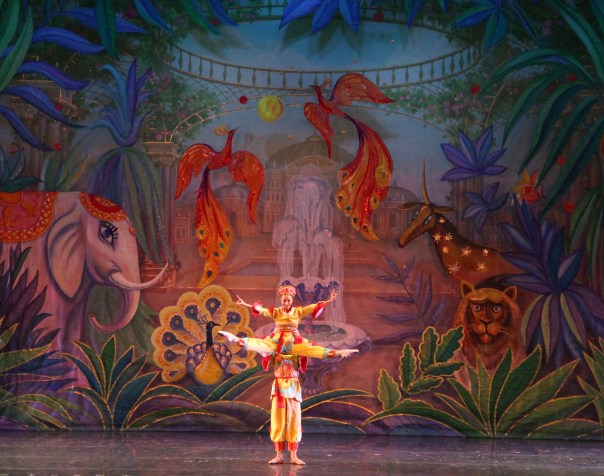
There weren’t as many scene changes as Charlotte Ballet lavishes on their production. The sleigh that carries Masha – better known to us as Clara – to the Land of Peace and Harmony remains earthbound instead of flying, and did the parade of playful 10-foot-high puppets ballyhooed in the program synopsis really escape my notice? Don’t think so. Most of these beasts were depicted on the imposing backdrop in a style vaguely reminiscent of Henri Rousseau.

Other details that distinguished this Nutcracker from those I’m accustomed to did not escape detection. Though there wasn’t liftoff for the sleigh, it was conveyed to Peace and Harmony by “Ded Moroz,” Russia’s Father Christmas, and Snow Maiden “Snegurochka,” both resplendently attired in Carolina – um, cerulean – blue costumes newly designed by Arthur Oliver. Uncle Drosselmeyer was a jovial gift-giving enchanter, still sporting a cape but more like a ringmaster or a game show host. And imagine, the Sugar Plum Fairy and her Cavalier never appear! Instead, it’s Masha and the Nutcracker Prince who dance the grand pas de deux.

21-moscow-ballets-ekaterina-bortiakova-and-akzhol-mussakhanov

After receiving so many gifts, Masha and her Prince present their dance to – the flowers that just waltzed for them? The synopsis is mum on that point, but Ekaterina Bortiakova is pure delight as our heroine, most adorable when does her simple tippy-toe shtick in the “Dance of Sugar Plum Fairy,” as light as the celesta cuing each step. She’s graceful, demure, vivacious, and youthful enough for us to imagine Nutcracker as a coming-of-age story. Andrey Batalov brings star quality of his own to the role of the Prince, definitely a cavalier partner when he sheds his Nutcracker headgear and brocaded waistcoat, most memorable when he whirls around the stage in his uptempo solo.

Choreography by balletmaster Stanislov Vlasov adheres to the manner of Tchaikovsky’s original collaborators, Lev Ivanov and Marius Petipa, most challenging when we arrive at the Act 2 showcases. Casting in these key spots is predictable, since only one pair of partners is listed for each of the divertissements, but most of the major roles we see in Act 1 are double-cast, including Masha and the Nutcracker Prince. Chiefly worthy of mention here were Sergey Dotsenko, a dashing Uncle Drosselmeyer in his florid purple cape, and Meievsky Vsevelod as the furtive and menacing Rat King.

Four of the six couples who partnered in Act 2 etched themselves vividly in my memory. In the snowy transition between the Stahlbaums’ Christmas soiree and Masha’s final destination, Anna Radik and an unmasked Dotsenko were the most sculpturesque of the couples as the Dove of Peace, each one of the silvery dancers bearing one of the bird’s luxuriant 10-foot-wide white wings, another new Oliver design. Perpetually leaning left with index fingers pointing upwards, Kseniia Stukalenko and Vladyslav Stepanov were the most charming and amusing pair as the Chinese Variation.
11-moscow-ballet-chinese-variation-set-design-valentin-federov

Contrasting marvelously – again – with the perky Chinese, Radik and Dotsenko returned as the smoldering Arabian Variation, with Radik executing snaky contortions that were unrivaled by anything else we saw. Clearly this was the most sensuous couple of the afternoon, but Veronika Melnyk and Michail Botoc as the Russian Variation took us to another dimension – sheer athleticism. Botoc, in particular, astonished with a series of leg-split jumps, a string of somersaults that spanned half the stage, and various gymnastic moves, effectively stealing the latter moments of the show. He even persisted during the curtain calls, unfurling the famed Cossack Kazatsky squat dance, more than sufficient reason why Putin wishes to recover the Ukraine.

The couple sitting next to my wife and me have a daughter who will be dancing with this tour when it arrives in Detroit. They came to Charlotte because one of their kin was a Charlotte School of Ballet student in a similar role at this performance. I could see that they had no regrets at all about making the trip to see a Mouse. Very likely, they and their daughter view the Great Russian Nutcracker as the experience of a lifetime. From the ovation and the swells of applause that spontaneously broke out all over Ovens during curtain calls, it was obvious that hundreds of non-relatives felt the same

Less Bard and More Beer

Theater Reviews: Every Christmas Story Ever Told (and then some!) and The Great American Trailer Park Christmas Musical

everyxmasstoryphoto2

By Perry Tannenbaum

Four centuries after William Shakespeare’s death, Charlotte’s own Chickspeare inhabits a parallel universe. Or maybe it’s retribution: while all of the Bard’s works were performed by all-male theatre troupes, all of Chickspeare’s productions since 1998 have been “All women! All the time!” as originally promised. The “All Shakespeare” in the middle of that slogan was gradually blurred and dropped as the Chix added Reduced Shakespeare Company lampoons to their rep and then ventured father afield.

Written by Michael Carleton, James FitzGerald, and John K. Alvarez, Every Christmas Story Ever Told (and then some!) is very much in the spirit of Reduced Shakespeare’s original assault on the Elizabethan titan’s complete works. The parentheses in the title, the quickie romp through multiple classics by three actors playing multiple roles, and the devotion of all of Act 2 to a single extravagant lampoon all follow the Reduced template.

But gender only begins to describe the difference between Chickspeare’s version and the 2010 Actor’s Theatre Every Christmas. The new model is as much an event as it is a theatre production, an experience that begins and ends at the newer NoDa Brewery on N. Tryon Street. In between, there are a couple of shuttle bus rides back and forth from the original Brewery location on N. Davidson Street. You’ll find more brew choices on tap at North Tryon, but the enticement of lifting a mug and participating in the many “To beer!” toasts during the Chix performance at North Davidson is hard to resist.

Few did last Friday night. Besides the brewskis, we had Anne Lambert lubricating the experience with a steady feed of Christmas trivia challenges on the bus ride to the show and the conviviality of the Chix banditas – Sheila Snow Proctor, Lane Morris, and Tanya McClellan – during their performance. But mainly, it was the beer that induced the party atmosphere.

Directing the show, Joanna Gerdy and Andrea King had a healthy disregard for the script. The playwrights labored under a handicap that never afflicted the Reduced Shakespeare collaborators when they chose ancient targets like Hamlet, the Bible, and American history for their merry desecrations. Unlike your seasonal carols, most of our familiar Christmas stories aren’t free-range prey. Copyright law prevents satiric assaults upon Rudolph the Red-Nosed Reindeer, the Charlie Brown Christmas, and the Yuletide yarns of Truman Capote, Dylan Thomas, and Jean Sheperd.

When Carleton, FitzGerald, and Alvarez lashed out at these restrictions, the result was “Gustav, the Green-Nosed Rain-Goat,” not the funniest sketch you’ll ever see. Morris never plays the mutated venison as if it were comedy gold, so there’s never any deadly straining to make it funnier than it is. We’ll raise a glass, and then we’ll move on.

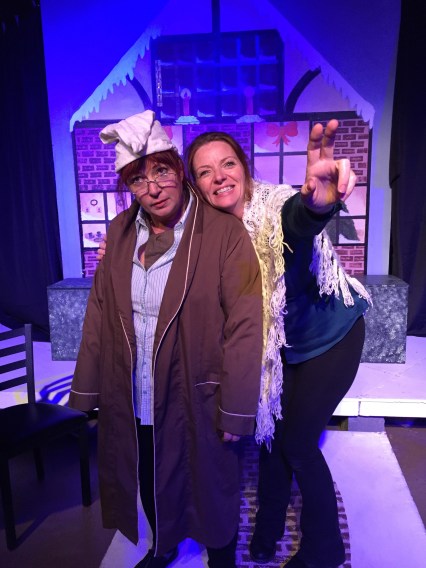
The premise of the show is that Proctor wishes to proceed traditionally with a presentation of Dickens’ A Christmas Carol, but Morris and McClellan are sick and tired of the same old stuff. Before they’ll allow Snow to read her Dickens and play her Scrooge, she must join them in a medley of other Christmas faves, including Frosty the Snowman, Macy’s Thanksgiving Parade, the Grinch, O’Henry’s “The Gift of the Magi,” and – maybe if there’s enough time – the inevitable It’s a Wonderful Life.

scrooge-and-mary2

There isn’t enough time, but that doesn’t deter Morris. While Proctor is on-task as Scrooge, with McClellan visiting her as all three ghosts, Morris keeps insisting that Proctor is George Bailey, inflicting on us a bevy of characters from New Bedford Falls, including George’s guardian angel, his brother, his banker nemesis, and his adoring wife. By the time Lane reaches the wife, it comes off oddly like a female impersonation.

Fortunately, Proctor is the ideal Scrooge in the face of these torments. There’s a bit of Oliver Hardy and Bud Abbott in her forbearance, but we somehow remain on her side throughout her ordeal. At the climax of Christmas Carol, Morris is still bedeviling her, so she finally submits to becoming George Bailey – in a schizophrenic frenzy that finds her shuttling between Scrooge and Bailey as both McClellan and Morris assail her.

In her surrender, Proctor produces a Jimmy Stewart impersonation that’s barely good enough to let you know what she’s doing. It will probably improve during the next couple of weekends as the run continues, but I’m not sure it should. Likewise, Proctor can be a mite slow changing costumes, but McClellan’s patience with her cast mate is so priceless, it would hardly pay for Proctor to hurry.

It’s been a rocky road for Actor’s Theatre of Charlotte since developers forced them out of their longtime home on Stonewall Street last summer. We thought they would resurface on Louise Avenue, but negotiations there collapsed, and the company tacked toward Freedom Drive. City and county paperwork delayed the opening, so their Toxic Avenger was redirected to a nearby church, and the current Great American Trailer Park Christmas Musical has been rerouted to the Patricia McBride and Jean-Pierre Bonnefoux Center for Dance, Charlotte Ballet’s HQ on N. Tryon Street.

I was curious to see how director Chip Decker and his design team would adapt to studios with so much space and such a high ceiling. With two fair-sized ramshackle trailers, topped by two jumbo projection screens, height isn’t a problem, and the design team fills out the stage with a fence, some Florida flamingo kitsch, an incongruous array of Star Wars memorabilia and, dead center of the stage between the two trailers, a half-decorated Christmas tree.

That odd tree, straddling the borderline between Rufus and Darleen’s properties, triggers Betsy Kelso’s plotline. Rufus loves Christmas and adores Darleen, but mean Darleen snarls “Bah” and “Humbug” to both. She will not decorate her trailer or even allow Rufus onto her property to decorate her side of the tree. That’s a source of huge consternation to Betty, the manager of Armadillo Acres, who has always wanted – but failed – to win the big prize awarded to the best-decorated trailer park. A vague curse plagues Armadillo Acres, and it too will to be exorcised before we reach a happy ending.

There’s a certain amount of respectability in Betty, so we’re fortunate that it is more than counterbalanced by the trashiness of her other tenants, Pickles and Lin (short for Linoleum). They also come in handy when ghosts are needed to populate Darleen’s Dickensian dream sequence. Rufus’s romantic fantasies and Betty’s hopes of nabbing top kitsch honors are revived when Darleen, in an effort to pull the plug on the park’s Christmas lights, gets electrocuted by Rufus’s déclassé cable-splitter and wakens with amnesia. That enables her to forget what a Scrooge she is and the fact that she belongs to Jackie, owner of a slutty pancake joint.

If you missed the first and second comings of this trashy romp, it’s good for you to know all the basics I’ve detailed. Although Actor’s Theatre has done well with the Charlotte Ballet space, they have thoroughly failed to conquer its acoustics. So the songs and lyrics by David Nehls are more crucial to your enjoyment than usual – but often unintelligible over the four-piece band led by music director Brad Fugate.

Tommy Foster isn’t as rednecky as Ryan Stamey was as Rufus, but he’s a tad more pathetic and lovable. Karen Christensen is more than sufficiently bitchy as Darleen, and we often forget that Matt Kenyon is in drag as Lin. (So does he, I suspect.) But Jon Parker Douglas nearly steals the show as Jackie when he is possessed during the climactic exorcism. It’s an epileptic farting fantasia that isn’t quickly forgotten – and the kind of broad physical comedy this acoustically-challenged show desperately needs.