Reviews: She Who Watches and Charlotte Symphony
By Perry Tannenbaum

When J. Sheridan Le Fanu serialized Carmilla in 1871-72, Count Dracula wasn’t even a gleam in Bram Stoker’s eye. Yet a quarter of a century later, when Dracula became the paradigm for modern vampire literature, Stoker himself acknowledged that Le Fanu’s most famous novella was a part of that gleam. So after a steady sprinkling of October visitations from the undead lord of Transylvania — no less than seven Metrolina Dracula productions since 2002 — it’s nice to see a change of pace in the form of a new PaperHouse Theatre adaptation of Le Fanu’s spellbinding horror classic.
Eerie echoes are a key motif in the storytelling, which co-directors Nicia Carla and Chester Shepherd have retitled She Who Watches in their adaptation. The narrator of the story, Laura, is haunted by a nightmarish experience from her childhood, when she awoke to find a teen-aged girl in her bedroom. That girl seemed to fall into a slumber on Laura’s chest, but when she awoke the second time, what the girl was doing made her shriek in terror. And then, before her governess could come to the rescue, the girl vanished into thin air!
It would be cruel to divulge much of what happens 12 years after this creepy prologue, but you’re correct in assuming that the beautiful face indelibly etched in Laura’s memory is Carmilla. How Carmilla returns to Laura’s home — and ultimately, her bed — took just under 69 minutes to deliciously unfold on opening night, with neat surprises and more eerie echoes along the way. That’s about the same amount of time you might spend in your family car getting from the I-277 overpass to the dubious thrills of Scarowinds.
It’s a shorter, more enjoyable evening at PaperHouse’s customary haunt, The Frock Shop. Le Fanu’s story placed the action at a lonely Austrian castle in a place called Styria, but the parlor of the Frock Shop cottage on Central Avenue seems to suit Carla and Shepherd quite dandily. The antique atmosphere is built in, augmented by a gallery of starchy, frilly, diaphanous, and full-length costumes designed by Magda Guichard.
Lighting designer Chaz Pofahl, strategically potting the illumination levels, is certainly a part of the spooky conspiracy, but our stage directors also utilize the windows lining two of the parlor’s walls to pique the suspense and ambiance. Perhaps emboldened by the numerous film, stage and TV adaptations of Carmilla that have come before, Carla and Sheperd have done some character shuffling as well. Instead of a kindly father, Laura’s lone parent is a coolish mom, and instead of a distressed friend of her father, General Spielsdorf, we get a more down-to-earth and frazzled Aunt Jean.
The core protagonists remain the same, and we’re very fortunate there. After two strong outings in Theatre Charlotte’s Miracle Worker and PaperHouse’s Much Ado About Nothing, Sarah Woldum is probably the busiest actress in town this year, taking on the role of Carmilla. She seems to revel in the menace of this role, seething with a mysterious intensity when she isn’t softening her prey with endearments. The whole chemistry of her is different from Dracula’s, seemingly resistant to daylight, but you wonder whether her episodes of weakness are symptoms of a gnawing blood hunger or simply playacting to draw sympathy. When Woldum becomes the predator, Carmilla’s rapacity is as much sexual as it is animal.
Racquel Nadhiri spoke too softly at the outset, compounding my difficulties with her Jamaican accent, so I won’t give her top marks as our Narrator. But Nadhiri beautifully captures the mixture of attraction and repulsion that is the essence of Laura’s reaction to Carmilla. Our empathy for Laura’s victimhood is that much stronger because it stems from her sunny heroism.
The ending that Carla and Shepherd have devised for her — distinctly different from Le Fanu’s — fits Nadhiri like a glove, and you might say that the word “bloodcurdling” was specially cooked up to describe her screams.
Two interludes punctuate the action, so you can get refills on the beverages that were served on the front lawn as you first entered, or you might nosh on cream puffs and sausage balls. When we reached the denouement, the audience was split in two, half of us ascending the staircase to witness the climactic encounter between Laura and Carmilla in the bedroom, half of us remaining downstairs to hear the disclosures that Laura’s mom receives from Aunt Jean.
You’ll have a better appreciation of the synchronicity of the two scenes from the downstairs vantage point, but everyone gets the chance to see both scenes — because, we realize, they actually occur simultaneously.
As I’ve already hinted, the cold and clueless Mother isn’t the plum role here, so you won’t be seeing Andrea King at her best, though she’s very good, of course. Most of the scene stealing comes from Rebecca Costas, busily changing costumes and characters throughout the show. Maybe her most comical turn is as the Doctor who says she’ll return so nervously that you can be absolutely sure she won’t, but she’s also pretty funny as Hunch-Hag, dispensing some fairly toxic marital insight to audience members.
Costas also gets a couple of serious cameos, first as the mysterious and malevolent Countess, Carmilla’s aunt. More urgent — and earnest — is Aunt Jean as the action comes to a boil.
Since her stint as she-devil Abigail Williams in CPCC Theatre’s 2001 production of The Crucible, Costas has only emerged briefly and intermittently on the local scene. It’s a kick to see her shining 15 years later in such a versatile performance, her devilish fire not only intact but several degrees hotter.
Charlotte Symphony’s 85th season is off to an exciting start, and Mary A. Deissler, the new president and CEO, is already making her impact. She has things to say, both onstage at Belk Theater when the orchestra plays and in the CSO program booklet, which isn’t as staid and stagnant as it used to be. Sitting down to last week’s Beethoven Symphony No. 2 concert, I found new artwork, festooned with pumpkins, on the cover.

The two artworks I’ve seen on the booklet covers, through two 2016-17 Classics concerts, already doubles the number I’ve seen in previous seasons. More importantly, Deissler has kept an inside page, opposite the page where you find tonight’s composers and compositions listed, reserved for herself. So instead of some generic remarks designed to linger more or more inanely as the season wore on, Deissler did a reset on page 17A.
The Welcome Page addressed the divisiveness that has fractured our community in recent weeks, the unifying power of music, and Deissler’s gratitude that we were back at a time when healing is needed. Rang true.
Switching from music director Christopher Warren-Green to guest conductor Michael Christie, the Beethoven offerings were more varied and adventurous than the All-Tchaikovsky season opener, veering off into Franz Liszt’s Piano Concerto No. 1 and his Totentanz before we jackknifed into György Ligeti’s folksier and funkier Concert Românesc.
Guest soloist Benedetto Lupo and the CSO brass were a bit overeager and brutish in the opening section of the concerto, but after the pianist navigated through his first softer, lyrical passages, everyone seemed to settle into a more relaxed groove. A fresh production wrinkle further enlivened the concert: a projection screen descended over the Belk stage so an overhead camera could transmit a bird’s eye view of the hurtin’ that Lupo was delivering to a defenseless Steinway Model D.
Van Cliburn himself might have winced.

 Like the students, the professional 64-member Eastern Festival Orchestra hails from around the country, mostly on furlough from symphony and university posts during the regular season. They double as the students’ mentors, for the Young Orchestras not only rehearse six times a week on a professional regimen, they also get one-on-one individual instruction from a faculty member every week, 3-4 chamber music rehearsals each week, and one sectional meet-up.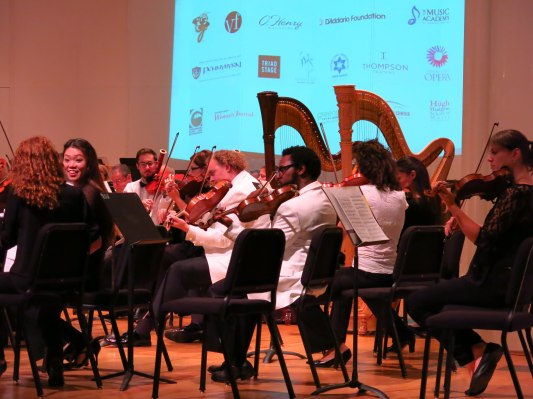


 Art on My Sleeve