Daily Archives: October 13, 2016

“1776” Still Preaches Compromise to a Skeptical Electorate

Musical Review: 1776 The Musical

By Perry Tannenbaum
2c12d4d82-b764-cbe5-a645e52c8298150f

Firebrand and future president John Adams couldn’t declare independence by himself. Not only did he need to recruit Thomas Jefferson to write our foundational document, he needed to get all 13 colonies represented at the Continental Congress – including his own Massachusetts – to come over to his side. As 1776 The Musical, currently running at Central Piedmont Community College, reminds us, Adams was too headstrong, combative, irritating, and off-putting to sow the seeds that would blossom into our republic.

With George Washington and his army further north, already engaging the British Crown on the battlefield, Adams couldn’t even count on his staunchest sympathizers, Jefferson from Virginia and Ben Franklin from Pennsylvania, to deliver their states’ votes. In fact, it would be an uphill battle for Adams to even get the matter of independence considered at the Congress in Philadelphia – over a year after the first shots had been fired at Lexington and Concord.

So in a climate and an election year where cooperation, compromise, and consensus are so widely despised, 1776 comes along propitiously to remind us how fundamental these things were in forming our national DNA and how essential they remain if we are to make big changes in our democracy. With inevitable sacrifices to detail and accuracy, Peter Stone‘s book presents the story with surprising nuance, depth, and even tragedy.

For a musical clocking in at 2:35 plus intermission, 1776 also has a surprisingly spare songlist, perhaps because composer Sherman Edwards had the original concept. There is also a gratifying self-awareness we can detect in the storytelling at Pease Auditorium in this CPCC Theatre production. We’re not seeing all white men all the time.

Edwards gracefully works in Adams’ wife Abigail through an ongoing exchange of letters that twice become duets. At a clandestine location away from the Congressional Hall, we peep in on an episode that Franklin has contrived to help Jefferson in his struggles to craft the Declaration, sending for Jefferson’s wife Martha. It’s already a conjugal visit by the time Franklin and Adams come calling.

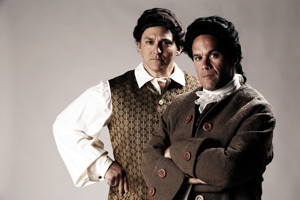
CP director Tom Hollis stirs the pot a little more with a modest infusion of colorblind casting, while costume designers Robert Croghan and Jamey Varnadore offer us what diversity they can, making the chasm between a New Jersey reverend and a South Carolina plantation owner as wide as possible.

Adams is rather lonely and hopeless before Franklin helps him form a cogent strategy to get things rolling. They send Richard Henry Lee of Virginia back home to convince his state legislature to back an initiative for independence. The jubilation of concocting this stratagem is celebrated by Adams, Franklin, and Lee in “The Lees of Virginia,” a song whose toxicity extends beyond its jaw-dropping silliness. I can only hope that its parade of dopey adverbs doesn’t lodge in your memory as an earworm.

Once we’ve crossed that jingling Delaware, we sail smoothly and convincingly through the labors that culminated in our nation’s birth. Virginia’s support leads to a majority vote approving consideration of an independence initiative, the formation of a committee to articulate the reasons and objectives for this action, with the proviso that the vote for adoption of this initiative must be unanimous. Every colony had veto power over the move for independence, adding tension to a drama whose outcome we already know, and leading to the compromise that stands as the Original Sin of our nation.

At the conclusion of his grievances against Britain, Jefferson penned two blistering paragraphs excoriating the Crown’s cultivation of the slave trade and – conveniently omitted from Stone’s book – their incitement of those slaves to rise up against their masters. After a devastating attack on Yankee hypocrisy in “Molasses to Rum,” future South Carolina governor Edward Rutledge demands that the section on slavery, effectively abolishing the institution, be stricken from the Declaration and walks out on the Continental Congress until he gets his way.

There is certainly no trivialization of that haunting but necessary compromise, and the hauteur of Josh Logsdon as Rutledge, along with his resounding singing voice, are among the chief reasons why 1776 will linger in your thoughts. Eric Johnston really is nettlesome and curmudgeonly as Adams, biting in his patriotic vocals yet petulantly tender when he’s interacting with his dear Abigail. Exorcising the clownish look that bedeviled Franklin in Theatre Charlotte’s 1995 production, James K. Flynn plausibly takes on America’s fount of aphorisms and brilliantly balances his avuncular practicality with his comical tendency to doze off.

Depicted as quiet, contemplative, and artistic, Jefferson is a romantic lead in Stone’s narrative who has almost been demoted to a supporting role. While George DeMott isn’t nearly the dreamboat Patrick Ratchford was when he sang the role in 1995, there comes a time when we’re supposed to be wondering what his sex appeal actually is. In giving weight to that question, DeMott is very appropriate. Nor could you hope for a more charming answer than “He Plays the Violin” from Emily Witte as Martha.

Witte is so graceful and charming that I could hardly imagine omitting her “Violin” when this musical was last revived on Broadway in 1997, more than 28 years after its original premiere. By coincidence, it is omitted from the songlists of 1776 on both the IBDB.com listing for the 1997 revival and in CP’s playbill. But Amazon assures me that it’s still on the 1997 cast album.

In real life there was an age difference of 29 years between John and AbiGail Adams, but Hollis dispenses with that gulf in casting Megan Postle as AbiGail Adams. As you’ll find, it’s a very unique role since Hollis insists on preserving the Adamses’ separation when they converse by mail, yet Postle warms wonderfully to the task. At the comical end of the spectrum, Alan Morgan can be commended for delivering the deadly Lee with all his giddy gleefulness, while choreographer Ron Chisholm doesn’t stint on the energy and dopiness of our Founding Fathers’ dances, fearlessly risking the charge of sacrilege.

Conspicuously missing from the Philadelphia deliberations is General Washington, but we periodically get gloomy dispatches from him in the field, delivered by Trey Thomason as the Courier. After a few of these, lights dim unexpectedly on Thomason, who sings grimly to us in “Mama, Look Sharp” about the realities of fighting and dying for your country.

Sobering moments like that are why 1776 remains relevant nearly 50 years after its original Broadway opening. Recounting how we reached our landmark July Fourth, this lively evening occasionally packs the power to explode our drum-and-fife expectations.

“First Date” Gets a Second Chance

Reviews:  First Date, Breakin’ Convention, A Year With Frog & Toad, Charlotte Symphony

By Perry Tannenbaum

When it hit Broadway three years ago, First Date wasn’t exactly a critical or box office triumph. Starring Zachary Levi (TV’s Chuck) and Krysta Rodriguez (from Smash), the pocket-sized musical — six actors and 90 minutes — drew jaundiced eyes from the theater press. Though the critics generally liked what they saw from Levi and Rodriguez, they focused far less charitably on the script by Austin Winsberg and the score by Alan Zachary and Michael Weiner. The most positive reviews conceded that mediocrity was in sight for the sitcom script and the pop rock score, yet when a few of those jaundiced eyes deigned to look around and observe others in the house, they had to admit that the audience was having a rollicking time. After the notices came out, attendance began to tumble, never to recover until the announced closing week less than five months later.

To give First Date a second chance on the road, its creators needed to think makeover. In a new Blumenthal Performing Arts presentation, now at Booth Playhouse through Nov. 20, it’s obvious that Charlotte’s backers and new director/choreographer Dan Knechtges have sparked a lot of rethinking.

Aaron is still a buttoned-down, slightly nerdy, risk-averse guy who is in a steady job without any self-fulfillment on the horizon. Mutual friends have set him up with Casey, an artsy Bohemian who keeps good guys like Aaron at arm’s length. Her weakness for bad boys has littered her past with a string of relationships that never worked out.

At the point where those bad boys come into play, Zachary and Weiner have gone to work on their songlist. Edgy British Guy and Edgy Rocker Guy are replaced by British Artist and Stoner Guy while their song, “Can’t Help but Love Me,” is similarly altered. Before that, we have a revamp of “Forever Online,” a song that was cut from the Broadway production soon after the opening. Now a new character, Google Girl, joins Casey and Aaron for “The World Wide Web Is Forever,” and this song — about Googling prospective dates before you meet them — may be the freshest, most delicious segment that First Date has to offer.

Transplanting the show from the 1100-seat Longacre Theatre in New York to the 434-seat Booth, Knechtges has implemented far more fundamental changes. Not only has he reduced the cast from six to five, he has brought members of the audience onstage, seating them around the bar and at tables at the restaurant where Aaron and Casey meet. These customers don’t sit around idly during the action.

Katerina Papacostas and Matthew Schatz in First Date. - DANIEL COSTON


Critics reviewing this remake can’t ignore the audience because they’re part of it. The main responsibility for getting patrons involved falls to Paul Ianniello as our Bartender/Waiter. Though we’ve relocated from Manhattan to Uptown Charlotte, this Waiter fits the New York stereotype of waiters biding their time until that magical day when they nail an audition. He’s super gregarious, marking Aaron as a dude on a blind date as soon as he enters, telling him to lose the tie and unbutton the shirt if he plans to reach first base.

He’ll also chat up the diners and drinkers, prevail upon them to switch tables, move to the bar, or even kick up their heels. Or he might reappear on the roof of the building or re-enter the restaurant from the street. Most memorable among his thought-cloud characters, Ianniello dons a tallit and enters as Aaron’s disapproving grandfather when he discovers that Casey is a shiksa.

Gretchen Wylder is Grandma Ida in this Jewish guignol number inspired by the Fruma-Sarah haunting from Fiddler on the Roof, getting the cheap laugh when she sings “I will break your matzo balls.” Tapering off just a smidge on her madcap energy, she also pops up at odd moments from behind the bar as Aaron’s former bipolar fiancée. Wielding a cocktail glass or a frying pan out in the box seats, Wylder is also Casey’s older and wiser sister, Lauren, reminding the prodigal that her biological clock is ticking or — more to the point — busting her on her self-defeating defensiveness with good guys.

As you’ve already divined, Aaron and Casey’s first date is littered with real and imagined interventions. In multiple incarnations, Kevin Zak as Man #2 completes the unholy trinity. Wearing a Luke Kuechly jersey and toting a “brewski,” Zak is most often Aaron’s best bud Gabe, telling the newbie to blind dating whether or not he’s straying from the golden path to Fuck County. Or he might change costumes and resurface from behind the bar as Reggie, a dimwitted ex-boyfriend who gets enraged when Casey doesn’t answer his repeated bailout calls to her cellphone.

At the eye of this cyclone of eccentricity, Matthew Schatz can be fairly nebbishy as Aaron without coming close to relinquishing his hold on comparative wholesomeness. Likewise, Katerina Papacostas doesn’t need to softpeddle Casey’s practical joking and hostility to sustain her desirability. Together, they rock “First Impressions” almost immediately after they meet, building up a pile of appeal they can squander.

Schatz’s take on Aaron makes him somewhat less cartoonish than Brad in Rocky Horror, while Papacostas’ Casey is slightly more wholesome than the most mainstream member of The Addams Family. Oh, wait a second: Rodriguez was Wednesday Addams, originating that role on Broadway before originating Casey. Pure coincidence, I’m sure.

Papacostas’ foxiness drew extra play on press night when our Waiter asked a customer to move over to the bar so Casey and Aaron could be seated. The audience member shot back a counterproposal, suggesting that Casey be seated right there next to him!

In this more informal format, it becomes more obvious that the very idea of first dates is a powerful draw for audiences, stirring up old memories, tingling feelings of anticipation, and long-dormant hormones. Perhaps the best alteration Winsberg has made to his script is making sure that some of the comedy at every performance will be unscripted.

breakin16_1000-835fa156f7

Proximity of last week’s openings in Charlotte to the police shooting of Keith Lamont Scott — and its tumultuous aftermath — seemed to tamp down turnout at Booth Playhouse on Thursday. Crowds outside for Friday evening’s Breakin’ Convention pre-shows, the spoken word slammers outdoors on the Levine Center for the Arts Plaza and the b-boys working the cypher in the Knight Theater lobby, were about the same anemic size as last year, when bad weather curtailed attendance.

14500226_10153753452641790_1232033451017722626_o-3833b8ed

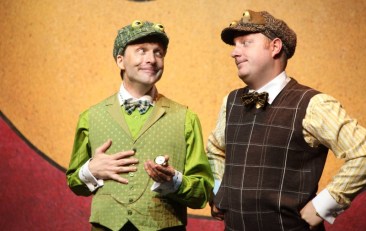
But when the sun shone so brightly and beautifully on Saturday afternoon, I could tell just by driving past the Spirit Square parking lot that Breakin’ Convention’s all-day Street Jam was bigger and better. Around the corner on 7th Street, another robust crowd of parents and kids were lapping up the Children’s Theatre of Charlotte revival of A Year With Frog & Toad, which is every bit as delightful as the 2008 version at ImaginOn — and more completely polished.

esther_yoo045

Charlotte Symphony subscribers kept the good vibe going on Saturday night, thronging to the All Tchaikovsky concert at Belk Theater. Guest soloist  gave them more than ample artistry with her fire, precision, and honeyed tone in the Violin Concerto, drawing a standing ovation after the opening movement. Music director Christopher Warren-Green and the orchestra were vibrant and dynamic in their accompaniment, so I had no qualms about joining the cheers and the ovation when Yoo’s performance reached its triumphant end.