Tag Archives: Ziad Jazz Quartet

Absent in 2020, Nnenna Freelon Offers a Heartfelt Raincheck

Review: Jazz @ the Bechtler Presents Nnenna Freelon

 By Perry Tannenbaum
2022~Nnenna Freelon-04

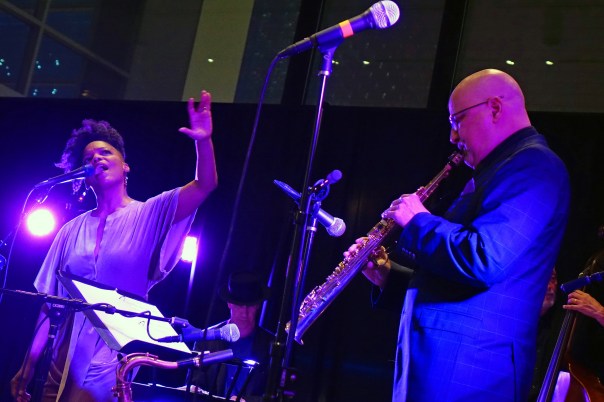
March 4, 2022, Charlotte, NC – We hadn’t seen or heard Nnenna Freelon singing in Charlotte for over four years before she returned for two shows with the Ziad Jazz Quartet last week, her latest Jazz at the Bechtler concert. The interval would have been just over two years if Freelon had appeared as scheduled at the Bechtler series’ all-star 10th anniversary celebration on January 3, 2020. While it’s tempting to assume that Freelon’s cancellation was part of her grieving process in the wake of her husband’s death of ALS the previous July, the six-time Grammy Award nominee had already gone into the recording studio in October 2019. The album that emerged from that stage of her grief processing, Time Traveler, was eventually released last May, so it could have come to us two years ago as the core of her canceled gig at the Bechtler, a nice little scoop for us.

Not to worry, after a bopping “Just Friends” warmup from his quartet, Ziad Rabie was now able to introduce Freelon as a seven-time Grammy nominee, with the outcome of her latest nomination for Time Traveler to be announced in Vegas on April 3. And there was also a scoop: Freelon will soon be inducted into the North Carolina Music Hall of Fame, alongside such greats as Nina Simone, James Taylor, John Coltrane, Thelonious Monk, Kate Smith, Loonis McGlohon, and Roberta Flack. The theme of Time Traveler was certainly evident in the concluding set we heard at 8:15, for it was doubly a time capsule, packaging songs we could have heard two years back at the originally-scheduled 10th anniversary gig alongside songs we did hear in November 2017.

There was nothing sneaky or accidental about the repeats, though Freelon didn’t point them out. As before, Freelon led off with her uptempo “Nature Boy,” rewriting the lyrics with a feminist twist the second time around after a searing soprano sax solo from Rabie. The ending was also the same, a “Moon River” that started off unusually mournful, hit a swinging midtempo, and eventually heated up to exultation. In a fascinating way, this questing read of “Moon River” merged Freelon’s time capsules together, for in 2017, she sang it as a tribute to two recently departed jazz greats, singer Al Jarreau and pianist Geri Allen, and she recorded it almost two years later as a tribute to her husband, famed architect Phil Freelon, who had designed Smithsonian Institute’s National Museum of African American History and Culture in Washington, the Museum of the African Diaspora in San Francisco, and the International Civil Rights Center and Museum in Greensboro.

2022~Nnenna Freelon-01Did the audience give Freelon and bassist Ron Brendle a standing ovation for their deep, mesmerizing duet on Hoagy Carmichael’s “Skylark” because they recalled it fondly from 2017 – or because it was so achingly lovely and poignant now? Also back from 2017 was Charlie Chaplin’s “Smile,” with drummer Al Sergel navigating the transitions back and forth from Freelon’s waltzy 3/4 time to Rabie’s break-loose solo on tenor sax in a fleet 4/4 tempo. These non-lunar reprises were all from Freelon’s Homefree album of 2010, and so was her slowed-down and bluesy “I Feel Pretty,” complete with her 2017 exhortation to the men in the audience to sing out the title line, because we needed to answer for nearly all the ugliness in our world. Notwithstanding #MeToo, probably truer in 2022 than before.

Despite its aching moments striving to reach across “Moon River,” Time Traveler remembers and celebrates love far more than it bemoans loss. Aside from versions of the title composition, two tracks address the main theme, Jim Croce’s “Time in a Bottle” and Jule Styne’s “Time After Time,” the one Freelon elected to bring to the Bechtler. Freelon repeated and obsessed over the title in a concluding cadenza that was every bit as ardent as her studio version, if not more so. Solos between the vocals, pianist Noel Freidline floating gracefully over Brendle’s bass, enhanced the soulfulness. But the album isn’t simply celebratory or sentimental, for Freelon gave Harold Arlen’s “Come Rain or Come Shine” a performance that was as down-to-earth as her spoken intro, confessing that she had no idea what she had said “I do” to at the altar when she and Phil were wed.2022~Nnenna Freelon-11

Always gorgeous, Freelon’s voice seems to be acquiring more varied textures. Up high, the Ella Fitzgerald sass is often joined with a Dinah Washington grit; and below, the Roberta Flack sensuousness occasionally gives way to a Carmen McRae worldliness and wisdom. The Freelon original, “Just You,” lost a little of its righteous gospel flavor in transitioning from the studio, where an organ and a guitar imparted a churchly tang, to the Bechtler’s lobby, where neither instrument was in attendance, though Rabie supplied superb fills on soprano sax. But a dominant motif of Freelon’s Time Traveler tribute is simply a return to songs that recapture the 1970’s, when the Phil-Nnenna romance first bloomed. Aside from “Time in a Bottle,” which serves double duty, Freelon revisits the ‘70s with Dionne Warwick’s “I Say a Little Prayer,” the Stylistics’ “You Make Me Feel Brand New,” and a Marvin Gaye medley.

Nnenna testified at the Bechtler to Phil’s adoration of “Betcha by Golly, Wow,” further evidence that he was a Stylistics fan, but he obviously wasn’t alone. Enhancing the studio version, Freelon was able to call upon the Bechtler audience to sing along with her on the refrain. Here the live instrumentation meshed almost perfectly with the studio performance as Freidline radically altered his piano timbre from acoustic to electric and Rabie more than ably substituted for Kirk Whalum in adding a smooth jazz vibe. As with “Moon River,” facets of Freelon’s concept came magnificently together. After remembering the 2017 Bechtler playlist by repeating some of it, she was giving us a raincheck on a hit she could have brought us in 2020, remembering her departed husband by singing a song they both loved. Through the mystery of music, we were singing along with Nnenna, joining her ritual of remembering Phil, while evoking memories of our own.

Originally published on 3/7 at CVNC.org

Ziad Quartet – Plus Extra Brass – Celebrates Classic Blue Train Album

Review:   Virtual Jazz at the Bechtler event hosted by The Playroom, the Ziad Jazz Quartet

By Perry Tannenbaum

Aside from the color blue, John Coltrane’s Blue Train and Miles Davis’s Kind of Blue have a few things in common. Both were recorded in the late fifties, Coltrane’s album for Blue Note in 1957 and Davis’s for Columbia in 1959, both featured sextets, both were dominated by compositions written by their leaders, and both were fueled by tenor saxophonist Coltrane at his fiery peak, one of the many reasons why both albums are regarded as jazz classics. As the title implies, Blue Train is the more hard-driving of the two albums, and in the second virtual Jazz at the Bechtler event hosted by The Playroom, the Ziad Jazz Quartet paid tribute to this beloved recording, roaring as perhaps they’ve never roared before. Pumping up the volume for this special event, and helping tenor saxophonist Ziad Rabie to replicate Trane’s original instrumentation, were guest artists Lynn Grissett playing trumpet and Rick Simerly ably sliding a trombone. Bassist Ron Brendle and percussionist Rick Dior returned in their backup roles, while Lovell Bradford took over Noël Freidline’s bench at the keyboard.

The two brass players made social distancing a bit more strained than last month’s Quartet tribute to Jimmy Heath, but space was adequate and both guests sported pandemically-correct masks with cunning mouth flaps designed for wind players, the first time I had seen these. Nor was there any delay in seeing these masks in action, for one of the most memorable aspects of the title tune that opens the Blue Train album is the roar of the saxophone, the trumpet, and the trombone all playing at once. Even watching a 23-inch monitor and listening through a pair of Boston Acoustic speakers via a Bluetooth hookup to my Yamaha receiver, I was surprised by how emotional I became listening to the familiar sound. It’s the trombone that makes the blend so distinctive, and maybe that’s why I found myself getting choked-up. Rabie certainly didn’t let me recover as he launched his solo, wasting no time in reaching peak form – perhaps the most majestic playing I’ve heard from him. Adding extra coal to the engine of this “Train,” as each of the horns nears the end of his solo, the other two horns back him up with a repeated riff, challenging the soloist to rise above them.

Rabie was pretty much at full throttle beginning his solo, so he needed to flare up to white heat with the brass behind him, yet Grissett came in softly with his trumpet solo, reminding us after Rabie’s fury that “Blue Train” is actually a midtempo tune. He and Simerly, who would follow, gradually came to a boil in their brass solos, and the other two horns would enter when the soloist had shifted into cruising gear – and the backup would prod them into redlining. It’s a wonderful arrangement, very much in the hard-bop tradition perfected at Blue Note records, so it came as no surprise when Rabie later stated that the musicians on the original recording had been given two days to rehearse. At the keyboard, Bradford was up to the challenge of having three horns behind him as his solo climaxed, beginning quietly and tightening the tension with each chorus. The quieted episodes of the performance enabled us to savor Brendle’s bass, heard to better advantage than at last month’s session, while Dior also made his presence known as the soloists reached maximum ferocity, most noticeably when crashing his cymbals in the transition between Simerly and Bradford. To be absolutely precise about the arrangement of the melody, repeated at the end, it was Rabie and Simerly who began, with Grissett’s entry on trumpet perfecting the blend.

Named by trombonist Curtis Fuller because of how the tune was sprung on him at the Blue Train recording session, “Moment’s Notice” has always been one of my favorite Coltrane compositions, notably covered by flutist Hubert Laws on his In the Beginning album. Once again, the three horn players combined in introducing the melody – until the final eight bars, which Ziad used as a runway to launch his solo. Rabie seemed to share my affection for this composition, for he worked Rodgers and Hammerstein’s “My Favorite Things” – a tune that Coltrane made a jazz standard – into his blazing solo. Simerly reached peak form in his solo, saluted again with a bomb from Dior as he made way for Grissett, cooling things down before gradually turning his solo up to high heat. Bradford’s allusions to the Scottish “Comin’ Through the Rye” in his solo were less Coltrane-connected than Rabie’s had been, but they made amusing musical sense.

The sextet played “Locomotion,” aptly described by Rabie as “a blues with a bridge,” at a noticeably slower tempo than you will hear on the Blue Train album (a newer release, The Ultimate Blue Train, adds two alternate takes to the original album). I have to say – heretically, I know – that Rabie has found the better groove. It’s another glorious arrangement, three horns again playing the melody until the final eight bars and Rabie once again launching into his solo after already seizing the spotlight. A similar falling away occurred in this arrangement when Simerly and Grissett began their solos, the rhythm section suddenly silenced as the brass players entered acapella. When the rhythm section returned, Dior on drums especially raucous, it was like giving each of these solos a fresh kickstart. Grissett was consistently wonderful through this entire set – maybe his evocation of Lee Morgan, the original Blue Train trumpeter, explains the unexpected emotional impact I felt with each of his solos. The rhythm section kept going when Bradford took his turn, building to a two-fisted apex before handing things over to Dior for a well-earned, well-bashed solo.

Rabie introduced Todd Smith, who informed us that he was in his fourth day as the Bechtler’s new executive director. Better yet, he said the Museum would be reopening in a couple of weeks with free admission to start. This little respite was followed by a change in mood as the sextet played “I’m Old Fashioned,” the only non-Coltrane composition on the album and the only ballad. Rabie played the melody, this time without the brass at all, beginning with the lovely ending to the Jerome Kern melody and then recapping as the full rhythm section entered so that the end the melody got an extra hearing before he set off into his solo. Simerly followed in a more solemn ballad mode, with enough space in the arrangement for Brendle to shine briefly before Bradford’s entry. The pianist didn’t hurry the tempo, but he certainly crammed more notes into it, reminding me of how Art Tatum and Red Garland treated the blues. Grissett’s solo, weaving bits of “My Funny Valentine” into the fabric, was another gem, Dior sensitively plying his brushes in accompaniment. A short coda from Grissett was backed by the other winds.

Grissett continued in the lead for the final piece, “Lazy Bird,” only sparingly accompanied by the other horns before swooping into his solo. Simerly played in a lighter vein, pointing up the melody’s anthemic jollity, while Rabie upstaged him slightly, pulling out his horn-player’s mask for the first time and trying it on. Perhaps he had been worried that taking the mask off for his emceeing chores would dislodge his eyeglasses or his earpieces. Whatever caused the hesitation, the mask was no impediment as Rabie’s tenor solo evoked Trane’s most joyous vein. Bradford continued the celebratory mood, giving way to Dior, who regained his customary ebullience with his sticks before Grissett led the outchorus.

Production of the latest livestream improved incrementally on its predecessor. The opening montage by Wonderland still rocks, and Playroom was still populated by four video cameras that never budged or zoomed. Positioning was slightly changed. The better-miked Brendle gave up his dedicated camera to Simerly, while Bradford shared his with Grissett. A third camera occasionally peeped in on Dior from the rear of the stage, and there was an establishing shot from front-and-center. Song titles were discreetly scrawled at the bottom of the screen, perhaps too briefly but a nice new touch. Only the rhythm section seemed to have gotten the blue memo about the dress code, while Rabie and Grissett veered off into olive green. Simerly was the outlier in a peach-and-tan outfit, but he blended best with the special burnt-orange COVID masks. Best of all, the set didn’t abruptly end at the hour mark, continuing at least ten minutes longer until the complete Blue Train tribute was done. Well done.