Tag Archives: Victor Wang

Duruflé and Respighi Are an Unexpectedly Dynamic Duo at Belk Theater

Review: Charlotte Symphony Plays Respighi’s Pines of Rome

By Perry Tannenbaum

November 14, 2025, Charlotte, NC – Neither Maurice Duruflé nor Ottorino Respighi would rank high among composers that Charlotte Symphony subscribers most wish to hear. The orchestra’s previous two music directors, Christopher Warren-Green and Christof Perick, never performed Respighi as part of the orchestra’s classics series – he remained the province of guest conductors – and the Duruflé Requiem, after concerts by the old Oratorio Singers and Carolina Voices early in the century, hadn’t surfaced at all locally since 2007.

So a pairing of Duruflé’s most highly regarded work with two Respighi favorites, The Pines of Rome and The Fountains of Rome, didn’t figure to fill Belk Theater with rabid enthusiasts. Yet the sheer scale of the Requiem, calling forth the Charlotte Master Chorale under Kenney Potter’s leadership, made the Belk an obvious choice over the snugger Knight Theater.

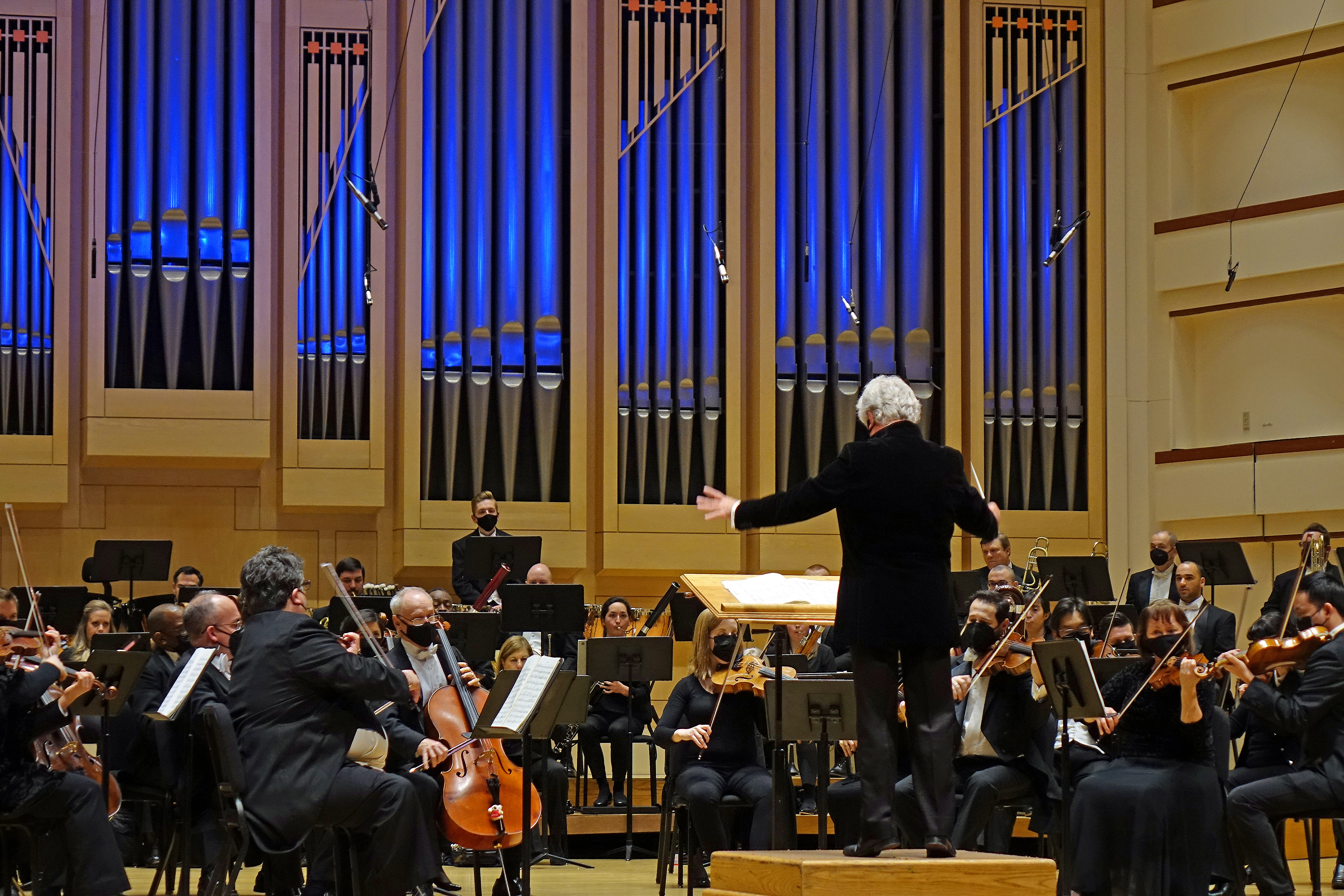
Although our current music director, Kwamé Ryan, brought us Respighi’s Roman Festivals last spring, a guest conductor was once again on the podium for these more beloved Roman delights by the Italian icon. While a Duruflé-Respighi pairing will never be boffo box office, starting with the Requiem – which likely drew hundreds of the choristers’ family members to these performances – made the host of Master Chorale choristers onstage before intermission available to swell the audience for the Fountains and Pines afterwards. Adding to the electricity in the house, guest maestro Francesco Lecce-Chong deployed two groups of brass players upstairs to opposite sides of the grand tier for the final “Appian Way” section of The Pines.

Based on Gregorian themes from the Mass of the Dead, the Requiem sounded like the oldest piece on the program, though it was the newest. Fortifying that impression was the dominant role of the Chorale compared to the two soloists, mezzo-soprano Megan Samarin and baritone Eleomar Cuello. Most of us likely felt that Cuello’s noble bearing and vocals in the “Domine Jesu Christe” section were all too brief: even there, the choir had the larger share of the singing.

Samarin’s conquest in the middle “Pie Jesu” section, an ethereal solo, also seemed too fleeting, though here the Chorale was silent. Sampling recorded versions of the Requiem on Spotify and Apple, you’ll probably conclude that the orchestral version performed at the Belk packs more wallop than the organ scoring, which was probably the version that Carolina Voices chose 18 years ago at the Friendship Missionary Baptist Church. Another reason for the guest vocalists to make a more muted impression this time.

The fourth section, the “Sanctus,” decisively upstaged Cuello as Lecce-Chong rallied the forces of the orchestra and the Chorale together, but the baritone returned for a second cameo during the first half of climactic “Libera Me,” fueling the fires of the choral “dies irae” that followed. Somehow, the sublimity of the concluding “In Paradism” doused those fires. The beatific loveliness of the women’s voices certainly made for a heavenly arrival, yet the men miraculously eclipsed them in their visionary entrance, truly a mystic chorus of angels.

Instrumental excellence peeped in occasionally during the Requiem, chiefly in Timothy Swanson’s oboe obbligato for the “Kyrie” section, in bassoonist AJ Neubert’s “Lux Aeterna” intro, and in the exquisite welcome to “In Paradisium” from yet another principal, harpist Andrea Mumm Trammell. Even more play was afforded to the players in the Respighi pieces with all their resplendent colors and shadings.

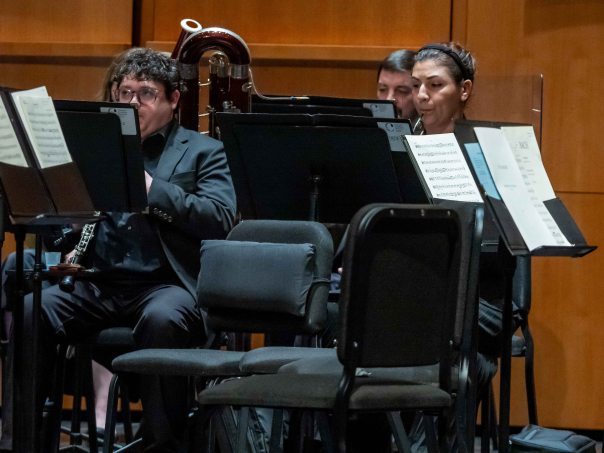
Memories of hearing Respighi are invariably more sugary to me than the actual music, which under Lecce-Chong’s baton, especially in The Fountains of Rome, was refreshing and exhilarating – and, of course, effervescent. Neubert probably made an even stronger impression on oboe in his lovely, languid sketching for “The Fountain of Valle Giulia at Dawn,” with principals Taylor Marino on clarinet, Jon Lewis on cello, and Victor Wang on flute following eloquently in the same opening section.

The sunnier middle sections, depicting “Triton Fountain” and “The Fountain of Trevi,” were more impressively orchestral and brassy, Triton’s horn issuing an early proclamation at the beginning of his section and a rampage of brass, chiefly trombones, heralding midday at Trevi, Rome’s most majestic fountain. No doubt the audience was a bit surprised by the delicacy of the Fountains finale, “The Villa Medici Fountain,” and its sprinkling of percussion, celesta, and soft chimes, simulating a distant church at twilight.

My mind had first been changed on Respighi way back in 1997 when Daniele Gatti had led the London Royal Philharmonic into town with diva pianist Alicia de Larrocha. His rendition of The Fountains with the Londoners was sufficiently revelatory for me to place a rush order for Gatti’s recording of Respighi’s complete Roman trilogy, where additional revelations awaited: Roman Festivals and Pines of Rome were both more powerful, varied, and grand. Though The Pines had popped up on my calendar at the dearly departed Eastern Music Festival in 2011, this was my first opportunity to hear – and compare – Fontane di Roma and Pini di Roma in the same live concert.

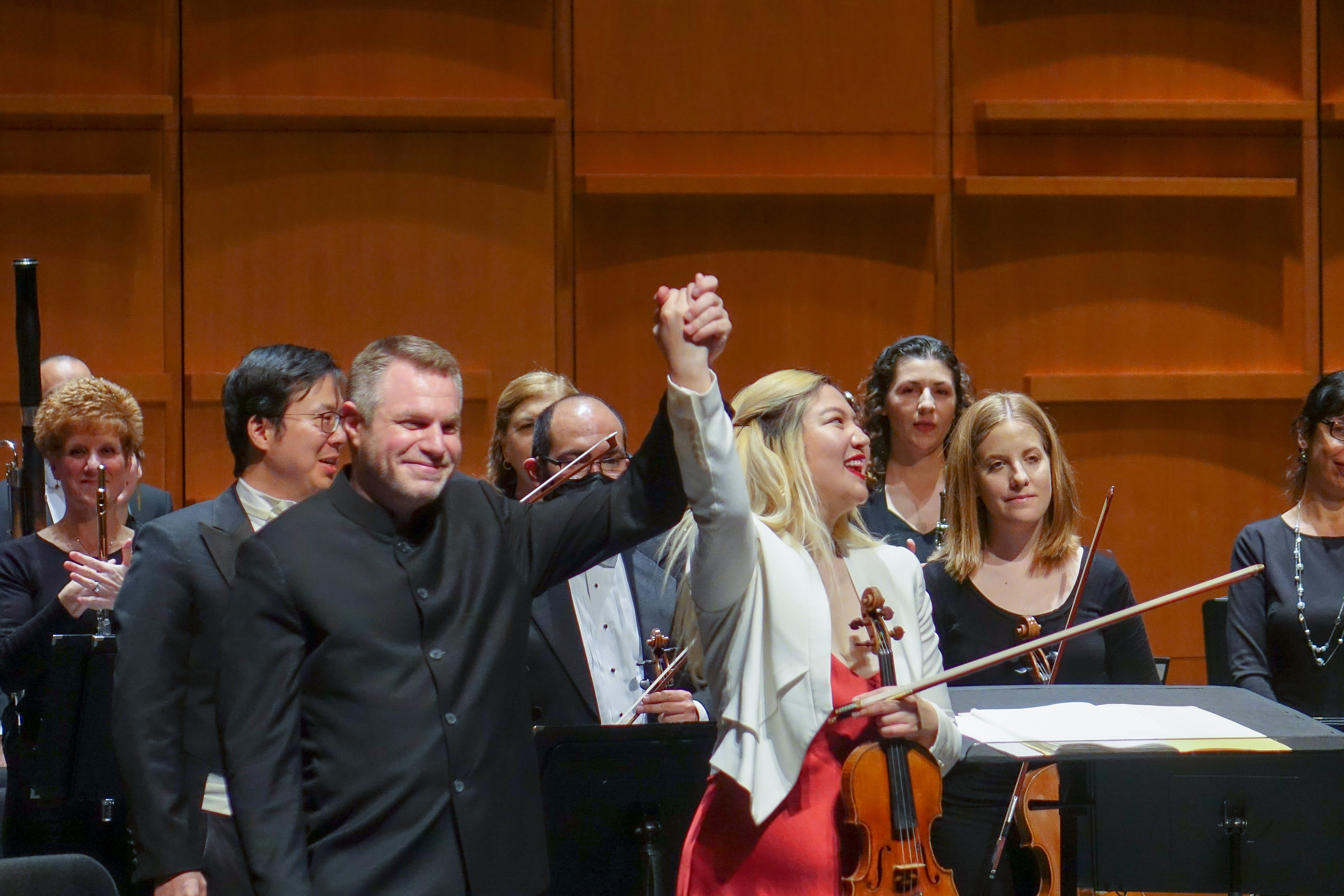
With a feel as sure for Respighi as Gatti’s, Lecce-Chong’s performance was worth the long wait. “The Pines of the Villa Borghese” had a marvelous orchestral bustle before principal trumpeter Alex Wilborn was dispatched to the wings for the signature eerie effect in the solemn “Pines Near a Catacomb.” Even more quietude came with “The Pines of the Janiculum” as piano, clarinet, cellos, and a soft oboe anthem enhanced the magic. But the epic build and variety of “The Pines of the Appian Way,” seasoned with prerecorded nightingale chirruping and crowned, at the end of a satisfyingly long and majestic crescendo, with the outbreak of brass from the balcony, surpassed the grandeur of the Respighi we had heard before and joined the peaks of the Master Chorale as the pinnacles of the evening.

Bach and Mozart Strive With Stravinsky at Knight Theater

Review: Orion Weiss with Charlotte Symphony

By Perry Tannenbaum

January 11, 2025, Charlotte, NC – Although we still get steady rations of Mozart from Charlotte Symphony since the days when Christof Perick passed the baton to Christopher Warren-Green, we havn’t heard much Bach from the orchestra since the autumnal Bachtoberfest faded from Symphony’s portfolio nearly a decade ago. This is understandable, if lamentable: after bringing us a double dose of the Baroque titan in 2018 – plus a shot of Vivaldi’s Four Seasons – violinist/conductor Aisslinn Nosky became a mainstay at Bach Akademie Charlotte (and one of the annual Charlotte Bach Festival’s primary claims to national prominence). A return to the Classics Series, set for 2020 via the Leipzig master’s Brandenburg Concerto #2, was quashed by the onset of COVID.

You could say that the suspense has been building. For a while, it seemed like CSO was tacitly conceding the high ground to the Akademie and its festival, presented by musicians from across the country who perform on authentic Baroque instruments. Playing the music of Bach on modern instruments, you could argue, has become paradoxically retro.

Yet the more deeply you explore musical history and authenticity, the more obvious it becomes that ancient (looking at you, Vivaldi-Schubert-Tchaikovsky) composers eagerly embraced new instruments, recycled their compositions for different instruments and different-sized ensembles, and encouraged musicians to copy, interpret, modify, and spread their music as they pleased. Reverence for absolute fidelity to original compositions is as absurd as assuming that top recording artists, whether it were Bob Dylan or Taylor Swift, would never allow covers of their greatest hits. If it sounds good – and magahits often do – go for it!

So it was heartening to find that CSO was intrepid enough to present a Bach Orchestral Suite in a modern-instrument performance and, perhaps to underscore the point, Johann Sebastian’s Keyboard Concerto No. 6, adapted by the composer himself from the Brandenburg No. 4. A certain amount of ambiguity pervaded Knight Theater as guest conductor Jeri Lynne Johnson made her debut. The house that greeted her was packed to the topmost row of the balcony. Yet the cause for the crush may have been the cancellation of the previous evening’s performance due to a “snowstorm” that had generated more bloated hype than solid news.

The only sparsity was on the Knight Theater stage. Johnson and the CSO would not be discarding all of the orthodoxies of the authenticists: the size of the orchestra had been scaled back to those employed in Bach’s days and those that would have played Mozart’s Symphony No. 25. The interloper on the program, Stravinsky’s Concerto for Piano & Wind Instruments, was also conspicuously downsized.

Viewed in profile, Johnson’s black suit – and her decisiveness – enhanced her resemblance to Kamala Harris. Symphony responded energetically to her baton all evening long, yet there was no lack of lyricism or finesse when Bach’s Orchestral Suite No. 3 transitioned from its brassy opening Overture to the famed Air (on a G string). Concertmaster Calin Lupanu, accorded considerable space in the opening movement, spearheaded the ethereal violin section to the requisite sublimity as the big tune gracefully swelled. Their intimacy quickly pointed up the advantage of a trimmed ensemble.

Subscribers who hadn’t scrutinized their program leaflets, let alone scanned its QR code for the full booklet, were likely shocked by the mass departure of the string sections, the arrival of the Steinway, and the empty chairs that remained as pianist Orion Weiss made his genial entrance. Deceptive! After a rather solemn Largo opening from the winds, with a somewhat promising crescendo at its center, Weiss’s first notes from the keyboard in the Allegro section were savage knuckle-busting clusters, met by a lusty clamor from the previously wan winds, crowned by a thumping of timpani.

Amid the cascade of chords that Weiss inflicted on the keyboard, a jazzy percussive rhythm infectiously emerged – even if it was impossible to determine whether the blizzard of notes Weiss was playing were the right notes. Suddenly, Weiss had taken on the appearance of a febrile Russian madman! The ensuing Largo provided lyrical reassurance, with some primeval passages set aside for oboists Erica Cice and principal Timothy Swanson. The pacing of the closing Allegro was almost as frenetic as the opening: if there were wrong notes here, Stravinsky had put them there with wicked glee.

This image has an empty alt attribute; its file name is 2025bach-mozart-7.jpg

Unless you were expecting an enormous horde of string players to flood the stage for the Mozart symphony, the biggest surprise after intermission was at the beginning, when Weiss returned for the Bach Keyboard Concerto. When Johnson stood by, she applauded not only Weiss but also flutists Amy Orsinger Whitehead and principal Victor Wang. Jackson’s outfit hadn’t been the only one I’d noticed until then. As she took her place with the winds for the Orchestral Suite, Whitehead’s black attire seemed to be strikingly ornate and elegant. So this featured slot explained the seeming breach of decorum.

Nor do you need to go more than a couple of bars into the Brandenburg Concerto No. 4 or its Keyboard Concerto offspring to savor the impact of its paired flutes delivering the catchy theme of its opening Allegro. Baroque aficionados, on the other hand, might have needed a minute or so to acclimate themselves to hearing the more rounded and gilded timbres of modern metal flutes. Their record shelves are likely clogged with trendier authentic recordings, marked by the presence of ancient wooden flutes and their hollower sound. Frankly, it was refreshing – and fun – for me, and Weiss bore a distinctly merrier look as well, though his cadenzas remained challenging.

Let’s not waste any more time in declaring that Charlotte Symphony retains its zest for Mozart. With this trim ensemble and Jackson’s accenting, what we heard at the Knight ranked among the most exemplary performances CSO has lavished on a Mozart symphony, even if the youthful No. 25 doesn’t rank among his very best. The opening 25-note sequence from the legendary 17-year-old prodigy, a 16-note vamp followed by a nine-note melody, hasn’t worn out its winsomeness in over 250 years.

Standing out almost as much as the crispness of the orchestra were the lovely solo spots from Swanson, capping what was perhaps his finest evening since assuming the first oboe chair this season. Jackson was gratifyingly bold in differentiating Mozart’s dynamics, finishing out the penultimate Menuetto with a satisfying crescendo. The closing Allegro featured more assertive playing from the winds pitted against the ferocity of the strings. Every now and then, we could discern Swanson’s oboe hovering above the fray.

Charismatic Parnther Justifies Shostakovich’s Top Billing at the Knight

Review: Charlotte Symphony Presents Shostakovich and Mendelssohn

By Perry Tannenbaum

November 8, 2024, Charlotte, NC – Hailing from Norfolk, VA – and perhaps the Sith Order of the Galactic Empire – guest conductor Anthony Parnther has brought a big James Earl Jones voice to Knight Theater and an even bigger personality. He instantly engaged Charlotte Symphony subscribers with a lengthy intro to the first piece of the evening, Samuel Coleridge-Taylor’s Ballade in A Minor (1898). Amid some insightful observations on the Black Britisher’s talents and his fin de siècle milieu, Parnther threw in some shtick that drew attention to his mighty larynx, looking askance at what appeared to be a perfectly fine microphone and coming to the mic’s rescue with his “opera voice” and, a bit later, with his “Shakespeare voice.”

In short, he dared to educate us and did a damn good job of it. The performance was just as brash, though occasionally too loud for the hall. There was gravitas in the opening measures sweeping into a zingy elan. Violins excelled in the midsection of the work with some very tender section playing, and the piece built nicely to an anthemic climax, reminding me of Jean Sibelius’s less-neglected symphonic masterworks. North Carolinians can point with pride to the best recorded version available on Spotify or Apple Music, featuring the Royal Liverpool Phil directed by Grant Llewellyn, who has given so much to The Old North State. Beyond that, Parnther could tell us very confidently that Black composers, according to the latest tallies, account for only 2.5% of programming among America’s top orchestras, knowing that we were quite entitled to feeling superior in the wake of hosting Sphinx Virtuosi a month ago – in a mostly Black and Hispanic program.

Sphinx’s visit turned out to be a gift that kept on giving, for the guest soloist playing Mendelssohn’s Violin Concerto in E minor, 16-year-old Amaryn Olmeda, was a first-prize winner – and audience fave – at the 24th Annual Sphinx Competition and toured with the Virtuosi two years ago. While I wouldn’t wish to compare Olmeda’s performance to my favorite recordings; including those by David Oistrakh, Yehudi Menuhin, and even Itzhak Perlman (who gave a live rendition at Belk Theater in 2019); there was certainly beauty aplenty in Olmeda’s account, with virtuosity to spare. But Symphony concertmaster Calin Lupanu attacked the infectious Allegro opening more fiercely in 2021, bowing with bolder panache when he played the piece online with Christopher Warren-Green at the podium. After a simple and lovely transition from principal bassoonist AJ Neubert, Olmeda was at her best in the middle Andante movement, freeing Parnther and the CSO to give her more robust support.

Olmeda relaxed and reveled more in the closing Allegretto-Allegro than she had in the previous outer movement, so Parnther and the CSO could be more assertive in their support, but true brilliance seeemed still beyond her at this tender age. Nonetheless, the audience joined me in giving Olmeda a standing O, perhaps sharing my feeling that we should pay her forward. Although attendance at the Knight was strikingly sparse, the young violinist was beaming. With a nicely articulated Bach solo, she returned our appreciation with an encore. Instinct tells me that the ripple of applause from the audience as intermission ended was in response to Olmeda joining them.

The young prodigy could not be faulted for the disappointing turnout, for the Sphinx Virtuosi had triumphed at Symphony’s annual gala last month. More likely, it was Shostakovich, topping the bill with his Symphony No. 9, who was the culprit on a beautiful autumn evening. Yet here was where Parnther and the CSO were at their best. The Norfolk native was pointedly suggestive in his introductory remarks, but mostly objective in his lengthy explorations – cuing us on what to look for in each of the five movements rather than telling us what to make of it. Thorough but never boring or academic, not at all show-offy or self-indulgent. Truly helpful.

The performance was spectacular, brilliantly contoured to the hall with fine evocative details, fully justifying Parnther’s enthusiastic intro. Which instrumentalist shone brightest in the opening Allegro was a tossup between Lupanu and piccolo stalwart Erinn Frechette, but principal trombonist John Bartlett stole all the scenes, emphatically partitioning the many episodes and injecting Shosty’s comedy with just two oompah notes. From that lighthearted opening – antithetical to what all Ninth Symphonies should be in the wake of Beethoven’s behemoth – we plunged into the depths and dolor of the Moderato, the lengthiest movement in this lapidary stunner. Principal clarinetist Taylor Marino, bolstered by section mate Samuel Sparrow, set the doleful tone of this sharply contrasting movement (again antithetical to the triumphal music Soviet Premier Joseph Stalin expected in 1945), achingly extended by two other principal winds, flutist Victor Wang and Neubert. Dreary strings increased the profundity of this oppressed lament, with Marino returning to soar above it in near-manic anguish.

It’s easy to lose your place after this unforgettable pairing of light and dark movements because the last three are played without pause, steadily increasing in intensity until a steady locomotion of victorious woodwinds are prodded into accelerating by the pulsations of the lower strings. These, in turn, triggered and excited the violins. Blaring brass then drove the journey into complete madness – and off the rails. Adding to the overwhelming bite of this sonic climax, the slashing, plucking, and sawing of the bowstrings across the stage added vivid visual drama.

Photos by Perry Tannenbaum

Charlotte Symphony’s New Maestro, Kwamé Ryan, Thrills a Packed House

Review: Tchaikovsky & Brahms at Belk Theater

By Perry Tannenbaum

April 5, 2024, Charlotte, NC – The audience at Belk Theater didn’t rise and sing the National Anthem as we do at the start of every new Charlotte Symphony season, but the occasion – Tchaikovsky & Brahms – was auspicious enough for Symphony president David Fisk to take the stage, notes in hand, and introduce the Orchestra’s newly designated music director, Kwamé Ryan. On the heels of CSO’s announcement that they were already at over 80% in reaching its $50 million fundraising campaign goal, ensuring Symphony’s financial stability, Classics subscribers had multiple reasons to express their enthusiasm – as Fisk spoke and when Ryan made his entrance. Both events had been sufficiently ballyhooed in the press. Fisk could wait a leisurely eight minutes after the normal starting time to make his appearance, so the usual curtain-up helter-skelter of late arrivals had subsided. Unless Ryan raised his eyes to the uppermost balcony, he saw a packed house ready to erupt.

Ryan’s greeting was even more personable than Fisk’s intro, so audience adoration actually rose a couple of notches before quiet prevailed and he could put his baton to use. This really was the beginning of a new Kwamé Ryan era, and the director designate did not fail to take advantage of that vibe. Instead of the “Star-Spangled Banner,” Ryan began his reign with what felt like the next best thing. With the composer seated in the orchestra, poised to receive more audience adulation, Ryan and Symphony performed Wang Jie’s Symphonic Overture “America, the Beautiful.” A self-professed “lover of adventure on mountains and cliffs,” Wie was thrilled when the Colorado Springs Philharmonic asked her to create a work inspired by nearby landmark Pikes Peak and the song written by Katherine Lee Bates in 1895 to a melody composed more than a decade earlier by Samuel A. Ward.

The commission was not at all outré, since Bates’s original poem was inspired by her first trip to the summit of Pikes Peak. You might say, however, that Jie’s music was inspired by America in 2016, since her description of this work stresses the unifying effect of the song amid political turbulence. She aimed for a piece that acknowledges how “fractured” we are while expressing the hope that a “re-harmonized” take on the anthemic song could still have healing and unifying powers. Fractured episodes alternate with Jie’s re-orchestrated presentations of Ward’s melody, presented in chunks of eight bars each until all of “America, the Beautiful” is reprised with brassy grandeur, followed by a frantically accelerated coda. Curiously, the piece probably does sound a lot more hopeful today, eight years after it was premiered barely two weeks before Election Day. A revision today might not contain the same wan, ruminating passage from the French horns or the silvery wistfulness from concertmaster Calin Ovidiu Lupanu. Wie’s energetic balancing act was almost nostalgic.

Although cellist Joshua Roman performed Tchaikovsky’s Variations on a Rococo Theme in Charlotte as recently as 2012 during an All-Tchaikovsky concert led by Christopher Warren-Green, the piece didn’t skyrocket to mountaintop status for me until Gautier Capuçon played it at the glorious Dvořák Hall during the Prague International Festival of 2019. Reaching that stratosphere would be difficult for both guest soloist Sterling Elliott and Ryan, navigating Pyotr’s score before the vivid memory of Semyon Bychkov’s exploits with the Czech Philharmonic had fully faded. Indeed, the delight and perfection of the Prague experience drifted beyond reach by the time Elliott and the CSO had traversed the mid-tempo prelude, the rococo theme modeled on Mozart, and the first two variations at a friskier pace. Ominously, it dawned on me that this was the first piece I was hearing Ryan conduct with Symphony that wasn’t composed by an American citizen.

With the onset of the dreamy Variation III, Elliott and Ryan found their footing, bringing forth the full sublimity of the Andante sostenuto. At that point, knowing that some bodacious virtuosity lay ahead in the final four Variations and the crowdpleasing coda, I resolved to try and watch Elliott from the perspective of those in the audience who were experiencing the Rococo for the first time. Wiping the slate clean not only enhanced my own experience, it plugged me into the excitement and wonder of the Belk Theater crowd as the buoyed Elliott slashed through the pyrotechnics in the latter half of Tchaikovsky’s concerto and shredded his bowstrings. If you factor in opening night jitters, Elliott’s encore figures to be even more awesome.

The Brahms Symphony No. 1 built to a similarly walloping climax after intermission. Limited rehearsal time – or simply the limited time Ryan and the Orchestra have had to become acquainted with each other – may have accounted for the somewhat listless and shapeless reading of the opening Un poco sostenuto and its subsequent transitions back and forth from Allegro. It was in the ensuing Andante sostenuto, where acting principal oboist Erica Cice had multiple chances to shine bookending principal clarinetist Taylor Marino’s eloquence, that the ensemble seemed to discover its voice, capped by some subtle soloing from Lupanu.

Marino spun a little more magic, in league with principal flutist Victor Wang, at the start of the third movement Allegretto as the ensemble ramped up for the grand finale, where Brahms First echoes Beethoven’s last. Here was where we could find the most encouraging examples of the pacing, sculpting, and exhilaration we can expect as Ryan settles in with Symphony for seasons to come. Repeatedly, principal French hornist Byron Johns was impressive, first as he hovered above the brass and later in concert with the other horns. There was admirable warmth from the strings in the big tune, with effective spotlights from Wang, Cice, and the four trombones. Everything was clicking during this finale, which crested with thunder, and the audience called Ryan back from the wings again and again with a standing ovation.

Falletta and Wilborn Dazzle at the Knight

Review: Charlotte Symphony Plays Wagner + Strauss

By Perry Tannenbaum

March 22, 2024, Charlotte, NC – Charlotte Symphony’s latest concert pairing, Wagner + Strauss, is logical and cohesive enough, but with the two Germans represented by the “Liebestod” (love-death) from Tristan and Isolde followed by the great Death and Transfiguration tone poem, abundant jollity seemed unlikely at Knight Theater. Wedged between these famed titans of 19th and 20th century music, however, were two lesser-knowns, Richard Strauss’s contemporary Oskar Böhme (1870-1938) and American composer Julia Perry (1924-1979). Thankfully, these composers, especially Oskar, lightened things up. Originally scheduled to perform with Symphony in August 2020, renowned conductor JoAnn Falletta returned for her first guest appearance with the orchestra since 2002, and principal trumpeter Alex Wilborn, similarly postponed by the pandemic, made his solo debut in Böhme’s Trumpet Concerto.

When former Symphony music director Christof Perick last performed the “Liebestod” at Belk Theater – almost precisely 15 years ago – he also paired the piece with a revered Strauss tone poem, Also Sprach Zarathustra. Strauss was one of Perick’s prime passions, and the Friday evening performance reaffirmed that the ardent Prelude and Liebestod remains deeply embedded in the ensemble’s DNA. Falletta’s reading, gradually peaking to a lovers’ climax, with delicious peeps at the hypnotic love theme that blossomed with promise, made me feel afterwards like asking if anybody else in the audience craved a cigarette.

Musically, it seems like a trumpet is a better post-coital sequel for Symphony than a cigarette when they finish the Liebestod, for who can contemplate Strauss’s Zarathustra without recalling its trumpet heraldry? Now that Wilborn is in the principal chair, he could bring us a virtuosic account of Böhme’s Trumpet Concerto with a surprise bonbon afterwards. The opening Allegro moderato brought forth a beautifully burnished tone from Wilborn’s horn and delectably supple phrasing, hardly seeming to challenge his technique, while Falletta emphasized the massiveness and lyricism of the orchestral accompaniment. That foundation segued nicely into the middle Adagio religioso movement, which began with stately dignity from the strings and brass and peaked with soaring aspiration from the soloist, no less pleasing than the melodic opening movement. It was only in the closing Rondo that we could savor anything close to Wilborn’s full virtuosity. Some real jollity here.

Perhaps both Wilborn and Falletta felt that the fireworks were all too brief in Böhme’s finale, for after the audience ovation, the trumpet virtuoso returned with perhaps the lengthiest encore ever heard at Knight Theater. Jean-Baptiste Arban’s “Variations on The Carnival of Venice” had all the virtuosic challenges and exploits you could ask for, with merciful orchestral interludes between the clusters of variations so that Wilborn could catch his breath. It wasn’t just speed that was demanded: in the most intense variations, we needed to make out the main melody amid a blizzard of relatively quiet filigree. The effect was sensational, exhilarating, and exhausting. Falletta showed us how much fun she was having long before she could rest her weary arms and face us again, and Wilborn, in a gesture that promised both him and his audience some respite, jokingly signaled to us when there were only three variations remaining.

Sadly, it would be an understatement to say that African American composer Julia Perry’s work has been neglected in her homeland. Only a handful of recordings – and no full-length CDs – exist from her voluminous output, which included 12 symphonies and four operas. The work unveiled in Charlotte, A Short Piece for Orchestra (1952), has only been recorded once, 14 years ago by the Imperial Philharmonic of Tokyo.

Falletta’s helter-skelter reading of the work made it feel far more modern and audacious than the more lyrical and legato Tokyo take under William Strickland’s baton. A live performance certainly brought out more textures after the raucous opening, including some dreamy reeds from principal clarinetist Taylor Marino and acting principal oboist Erica Cice. From the rear of the ensemble, a snare drum’s tattoo and some noodling from a celesta crept in. Really lovely stuff. My first exposure to Perry came just three days before her centennial birthday might be celebrated (apparently, there’s a half-billion-dollar bond deadline that’s considered to be a bigger deal).

The crisp dynamics that distinguished A Short Piece made a difference once again as Falletta turned to Tod und Verklärung. There was thunder like Perick brought to the work plus a little more electric crackle. In the more sweeping passages, the orchestral blend was as exquisite as ever, yet there were also ample opportunities for Cice, Marino, principal flutist Victor Wang, and concertmaster Calin Lupanu to shine in the hushed moments. Perick’s interpretation had more narrative cohesiveness and continental flavor, while Falletta’s took the piece in a more American direction, almost exiting the realm of a tone poem and crossing over into a concerto for orchestra. Opening up the dynamic range was certainly an intriguing and exciting approach. After waiting an extra four years, Falletta clearly triumphed in her return.

CSO and the JCSU Concert Choir Lift Every Spirit at Brayboy

Review: Johnson C. Smith University and Charlotte Symphony

By Perry Tannenbaum

2023~CSO at JCSU-35

March 21, 2023, Charlotte, NC – You might have thought that a symphony orchestra performing in a college gymnasium would prove to be an odd coupling. Sure, there can be satisfying concerts staged at coliseums where a city’s basketball team plays, but those are usually performed by rockstars, pop icons, and the occasional Cirque du Soleil troupe when every note is processed electronically. My curiosity was certainly piqued when Charlotte Symphony Orchestra announced that its “In Concert with Johnson C. Smith University” program would be happening on campus at the Brayboy Gymnasium. Led by resident conductor Christopher James Lees, Symphony would be joined on the court – the hardwood covered with bright blue tarpaulin – by the JCSU Concert Choir, led by soprano Shawn-Allyce White and accompanied by pianist Frank Williams.2023~CSO at JCSU-13

A hookup between Symphony and JCSU at a more established concert venue should have seemed inevitable as long ago as 2015, when the leadership of Spoleto Festival USA visited the campus to announce that the Concert Choir would be participating in the high-profile production of Porgy and Bess the following year, celebrating the festival’s 40th anniversary. Yet when Lees picked up a microphone to greet the crowd, he reminded us that Symphony hadn’t been on campus for 13 years – indicating that this was his first time on campus and implying that CSO’s last musical director, Christopher Warren-Green, had never gotten around to the inevitable before his tenure ended. Were the optics or the acoustics the obstacles that had forestalled a return visit? Or was the idea simply slept on after Opera Carolina enlisted the men of the Concert Choir for their production of Cyrano in 2017, followed by the full choir’s appearance in I Dream in 2018?

Any questions about the Brayboy’s acoustics were swiftly dispelled. The sound from Lees’ microphone was crisp and present, nothing like the muffled sound from a faraway galaxy that emanates from PA systems at some basketball arenas or outdoor stadiums. As the brass heralded the assault of Franz von Suppé’s “Overture from Light Cavalry,” the sound remained bright and forward for all sections of the orchestra, not at all like an echoey gymnasium. French hornist Robert Rydel and principal flutist Victor Wang stood out sharply from the ensemble in their little cameos.

Rather than the controlled gallop and fury of Karajan’s recording with the Berlin Philharmonic, Lees seemed to favor the frantic onrush of Paul Paray’s recording with the Detroit Symphony, which shaves more than a minute off the Berliners’ 7:38 timing. The strings could show off their fast fingering as well as their lush tone, and when the familiar big tune surfaced, four percussionists sprang into action to make the cavalry charge more thrilling. Maybe more impressive – and surely boding well for the 14-member Concert Choir standing by for their pieces – was the syrupy sweetness of principal clarinetist Taylor Marino’s eloquence during a lull between two of the Cavalry dust storms.2023~CSO at JCSU-23

Fortified by two floor-standing mikes, the Concert Choir, eight women and six men on this occasion, were as stirring and powerful as ever at Brayboy, opening with William Henry Smith’s acapella arrangement of the traditional “Walk Together, Children.” Mostly tinted with treble and infused with jubilation, the main takeaway from the Choir’s performance wasn’t the urging of walking together but the excitement of “a great camp meeting in the Promised Land.” Richard Smallwood’s “Trust Me” was statelier, more equally weighted between the men and the women, never deteriorating into the sluggishness or singsong repetitiveness of other performances I’ve heard. The pause midway was particularly dramatic, daring to linger in silence long enough for the first smatterings of applause to break out before returning with thunder.

In between these two righteous chorales, Lees slipped in Jessica Meyer’s Slow Burn, reminding us in his intro that the composer was a violist and to be on the lookout for principal CSO violist Benjam2023~CSO at JCSU-07in Geller’s pivotal solo – but somehow neglecting to mention that the 2018 composition was written for a burlesque dancer. The piece was wonderfully apt when Symphony first performed it in early 2021, when wind players weren’t yet allowed back in concert halls due to pandemic restrictions, and the worldliness of this all-strings piece was a fine fit at the Brayboy. Bluesy strings did all of the sensual slitherings, while a pair of double basses provided percussion via pizzicatos, hand slaps, and vigorous thwacks of the bow on the necks of the instruments, accentuating Meyer’s jazzier passages. Most alluring was Geller’s suggestive glissando triggering the key swell of the strings that most vividly evoked Meyer’s title. Nor did Geller’s subsequent solo disappoint.

The two orchestral pieces that followed were more like what we expect from a city’s Symphony, but a pleasant surprise lurked in the first of these, a work dating back to the days of Haydn and Mozart, the Symphony No. 2 by Joseph Bologne, Chevalier de Saint-Georges. A champion swordsman, military leader, and political revolutionary, Saint-Georges was the son of a French planter and an African slave who would be called “The Black Mozart” because of his varied musical output, including orchestral works and operas. Saint-Georges played a key role in commissioning Haydn’s Paris Symphonies and may have mentored the younger Mozart. The outer movements, Allegro and then Presto, reminded me instantly of Mozart’s symphonic pieces, while the inner Andante brought Papa Haydn to mind. Violins dominated throughout, subtly backed by French horn and oboe in the opening movement, then by pizzicatos from the lower strings in the finale.

Some Slavic coloring had peeped into the Cavalry overture, but the performance of Antonín Dvořák’s Slavonic Dance No. 8 was the pure essence, a percussion orgy driving the main theme and the high woodwinds taking the spotlight. Anything less would have been anticlimactic in the wake of Dr. White’s stirring vocal on the Hall Johnson arrangement of “Ride on, King Jesus,” accompanied by Williams at the keyboard and crowned with a flurry of vocal fireworks. White was only slightly less impressive after the Dvořák, taking the lead vocal on the Moses Hogan arrangement of “Ev’ry Time I Feel the Spirit,” backed by the full choir with Williams conducting.

Lees stated the obvious when he declared that we were all waiting to see Charlotte Symphony and JCSU Concert Choir perform together. Would we get the Gershwin brothers or the Johnson brothers? Nothing less than the “National Black Anthem” would do at this point of the evening. While there are many YouTube examples of Dr. Roland Carter’s arrangement of “Lift Every Voice and Sing,” none on my radar sport more than a piano and an organ for their instrumentation. So Charlotte Symphony may have broken some new ground here with its uncredited orchestration.
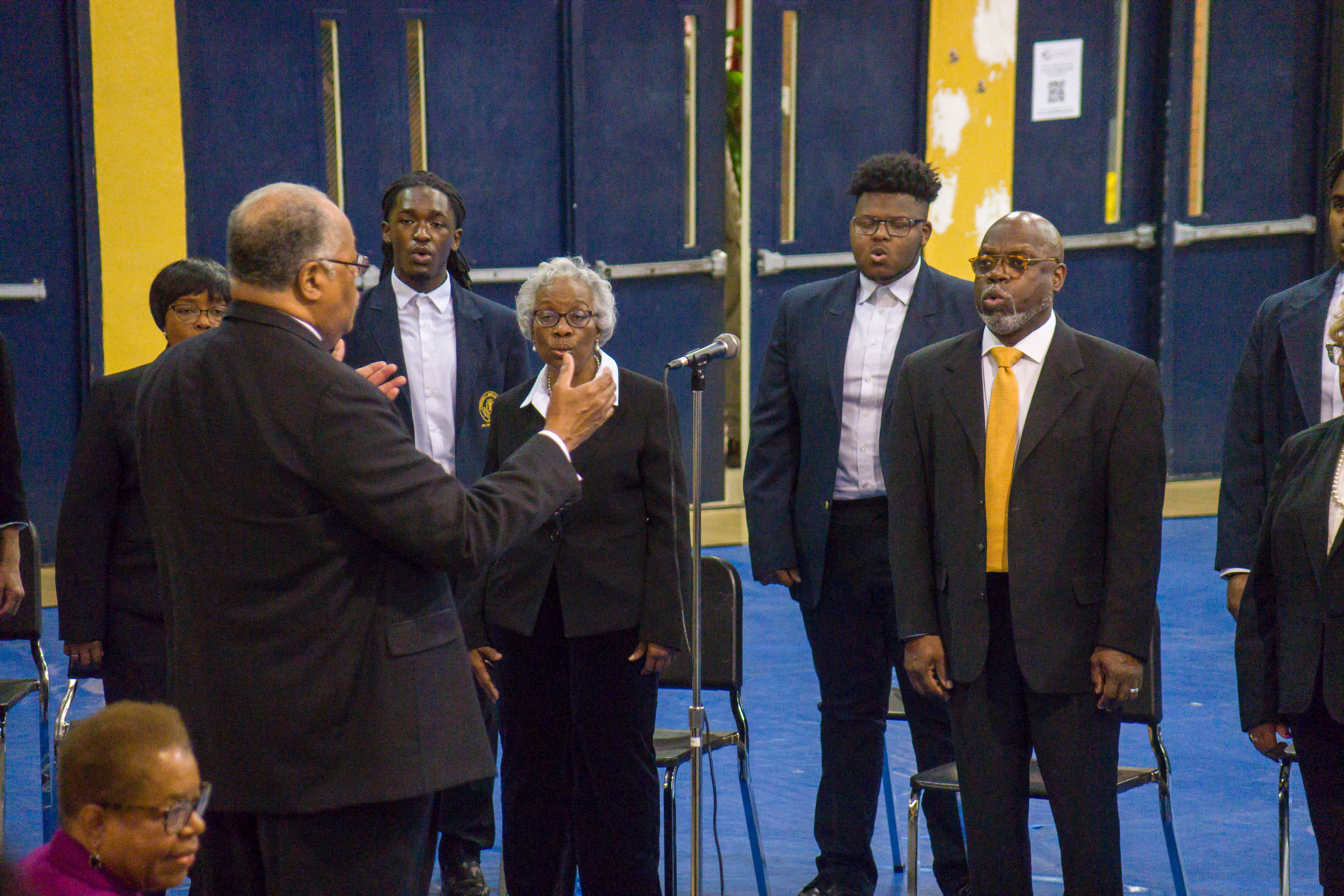
The effect was electrifying as the entire audience rose to their feet to honor the anthem. In Carter’s arrangement, there are instrumental sections before each of the three stanzas where James Weldon Johnson’s lyrics are set to J. Rosamond Johnson’s music. Each of these interludes affording sufficient space where an orchestra can shine while providing an orchestrator with engaging new melodic material. Of course, you also want the orchestra to actively support the choir each time it enters, so the new CSO orchestration added a dimension that has always been missing in the YouTube versions. Together, Charlotte Symphony and the Johnson C. Smith Concert lifted the impact of “Lift Every Voice.”2023~CSO at JCSU-29

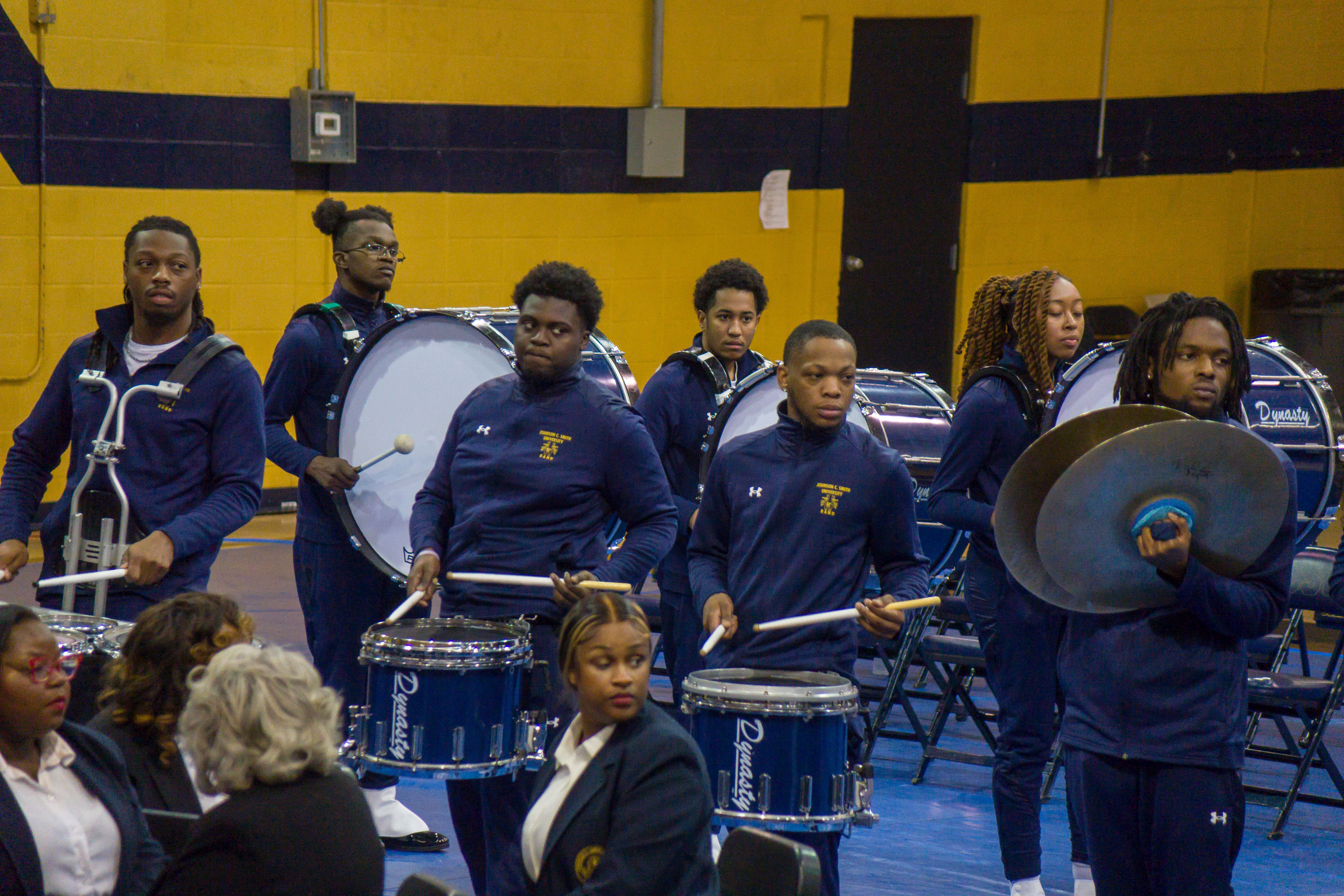
We weren’t quite done even now. Lees had hedged a bit in announcing that a surprise awaited us, probably remembering as he spoke that the JCSU Drumline, alias the Funk Phi MOB, was already mentioned in the digital program. But before they brought on the rhythm and the funk, we were all invited to participate in a lighter CSO-JCSU hookup. After a brief rehearsal of the seven-note melody, we all joined in on cue for vocal sections of Daniel Bernard Roumain’s La, La, La, La. Needless to say, the lyrics were not a challenge.

2023~CSO at JCSU-32

Amid this glee, Funk Phi MOB came marching in with their purely collegiate pandemonium, carrying me back to long-ago Saturday afternoons at the University of Iowa, the University of Oregon, and Williams-Brice Stadium where my shivers were alleviated or intensified by the fortunes of my hometown college football teams. This drumline was a bit more up-to-date than the drum corps I remember stationing themselves at midfield. Beside the customary bass drums and snare drums, a couple of these percussionists were outfitted with some sort of Yamaha hybrid, five or six flat shiny surfaces arrayed like a cross between timpani and a xylophone. If you’ve experienced how a stadium rocks during halftime, you can imagine the gymnasium version, peaking at a sensible 94dB according to my Apple Watch.

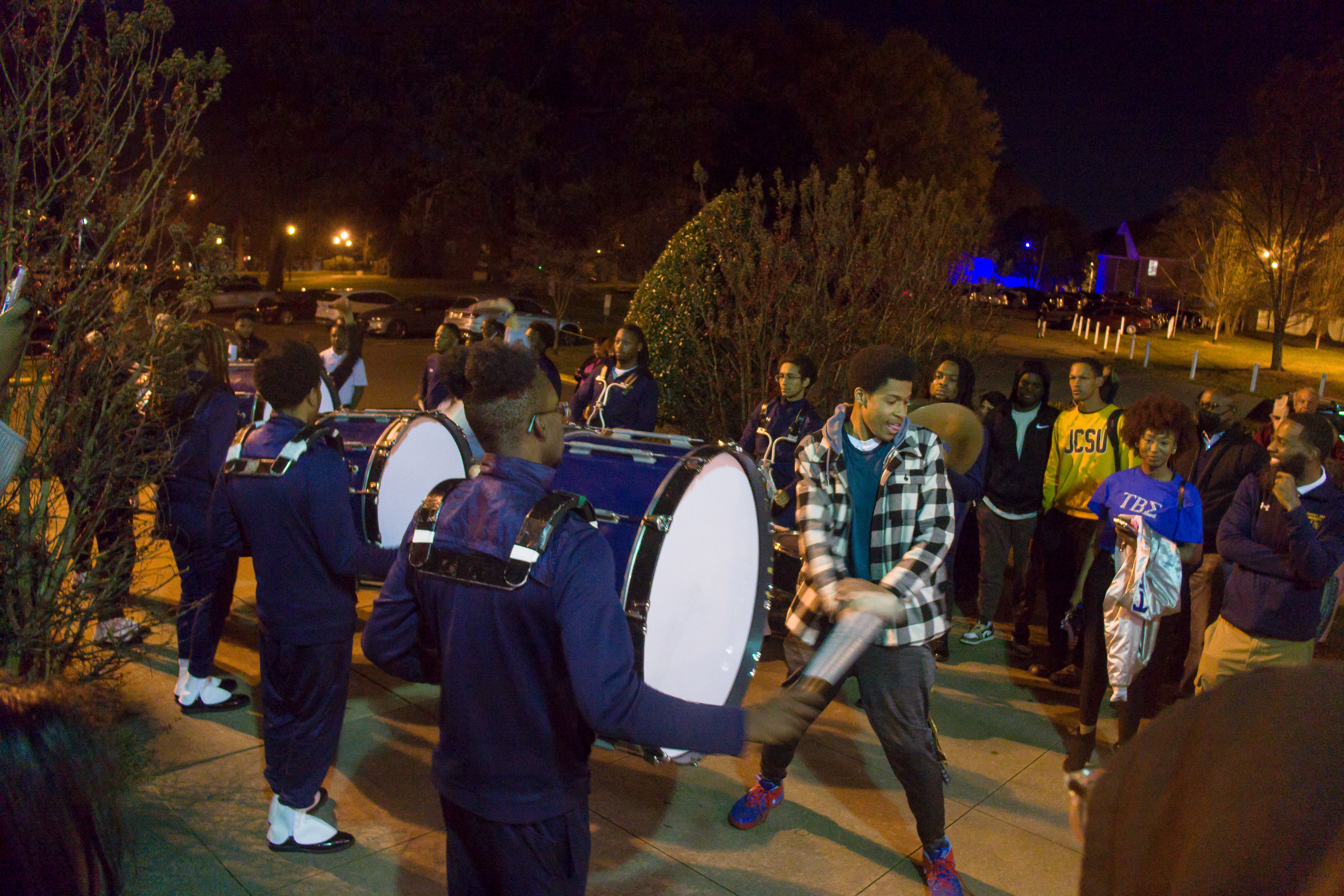
Topping off this mighty2023~CSO at JCSU-38mayhem, a drum major arrived with all his spirited, ceremonial, and high-stepping antics. Thanks for being here had been expressed long before this all-American climax, so without further adieus, the drum major could end the concert by leading the Drumline, Dr. White, and Lees out of the hall. When my wife Sue and I managed to navigate from our seats through the exiting audience and folks still milling on the court – conversing, posing for photos, and taking selfies – we emerged from the Brayboy Gymnasium and found that a drum party was still going on outside the entrance. Fortunately, I had brought my camera. Sue wouldn’t let me proceed to the parking lot until I took a few shots.

Mei-Ann Chen Rocks the Knight in CSO Debut

Review: Bruch’s Violin Concerto with Charlotte Symphony

By Perry Tannenbaum

2023~Bruch Violin-18We’ve been hearing about numerous identified and unidentified flying objects in recent weeks, emanating from numerous sectors of the globe, crossing over our nation’s territorial waters and seeking all sorts of military and meteorological intelligence. Less mysteriously, there have been precise predictions in recent months of astral objects whistling through our solar system, one of them brushing closer to dear Earth than the moon.

But until now, not a word about the meteor that struck the Knight Theater in the heart of Uptown Charlotte. Her name is Mei-Ann Chen, and we can only hope that the guest conductor now in our midst is vying for the vacant music directorship at the Charlotte Symphony. It would be grossly unfair, no doubt, but it wouldn’t a bad idea to sign her up before she left town.

Chen’s impact on – and appeal to – the Symphony’s musicians and subscribers was nothing short of electric.2023~Bruch Violin-09_Export

The orchestra had never performed Fanny Mendelssohn Hensel’s Overture in C Major before, yet they attacked the work zestfully, conveying its sharp contrasts and drama with unmistakable fervor. Flutist Amy Orsinger and principal oboist Hollis Ulaky excelled, jointly and separately, in the piece’s gentler moments. Although we had heard the CSO play the BRUCH VIOLIN CONCERTO as recently as 2016, Chen ignited the ensemble with fresh fire rather than receding to a subsidiary role behind concertmaster Calin Ovidiu Lupanu.

Instead of deferring to the soloist – or even seeking an agreeable balance between orchestra and violinist – Chen laid the gauntlet down to them both, so that Lupanu and Symphony spurred each other to greater heights vying for supremacy, achieving a higher level of parity through their combat. More adventurous now than I can recall, Lupanu was nearly note-perfect all the way through the treacherous terrain of the Allegro energico finale while his attack, confidence, and feeling were never better. His command was certainly impressive throughout the opening Allegro moderato, with a transition to the slow middle movement that was amorously smooth. Principal flutist Victor Wang helped to make this Adagio extra exquisite.

As the concerto climaxed, it might have been a toss-up to many in the audience whether Chen was inspiring the CSO or vice-versa. In respect for your colleagues, you’re not going to urge an orchestra too insistently to give us more during a performance – that has to have happened behind the scenes in rehearsal.

Our first glimpse of what that might have been like came right after the concerto, when Chen gestured to the audience to give Lupanu more love for his sterling performance. After the break, our impressions grew more vivid as Chen picked up a mic at the podium and greeted us. Not satisfied with our “Good evening!” Chen urged us to make a second try, somehow infusing this tired old emcee shtick with new energy and spontaneity – and getting results.2023~Bruch Violin-23

Speaking about the works on tonight’s program, Chen included info we could have gleaned from the program – a practice that Christof Perick and Christopher Warren-Green staunchly resisted – and made an effort to link the pieces together with a common theme. Faced with a crowd that was significantly more numerous than the crowd I’d seen three weeks earlier, but still significantly short of Knight’s capacity, Chen declared that Charlotte should be more supportive toward its Symphony.

That was a more compelling statement after delivering two examples of our musicians performing at their peak.

Chen rightly surmised that the main draw of the evening was the Bruch, since the César Franck Symphony in D minor, originally slated for its revival last March, hadn’t been heard in the Queen City since November 2003. Now that was a pitifully attended concert at Belk Theater, after striking CSO musicians had settled on a new contract and returned to work, so Symphony subscribers can pat themselves on the back for improving on that turnout.2023~Bruch Violin-10_Export

The main link between the two Francks that I’ve seen was the fine work by Terry Maskin on the cor anglais solo in the middle Allegretto movement. In the outer Allegro movements, our brass proved its mettle once again, though we’ve surely seen a Chening of the guard during the intervening decades. Associate concertmaster Joseph Meyer distinguished himself in the early Lento of the opening and principal French hornist Byron Johns had outstanding moments when the music quickened.

Chen improved most on the Perick performance of 2003 in the Allegretto, livening the effect of Maskin’s soulfulness on the English horn with more standout work from Johns and Andrea Mumm Trammell’s delicacy on the harp. Before the brass brought the finale to its brash climax, CSO’s principal harpist bubbled up tellingly in the symphony’s last calming episode.

Obviously content with her musicians’ handiwork, Chen gave the audience opportunity after opportunity to show the appreciation she had previously asked for. With unmistakable cues, Chen called upon us – already giving them a standing O – to really let the musicians hear it as she prompted them individually and collectively to take their well-earned bows. We did.

[If you missed Mei-Ann Chen in Charlotte, you can catch up with her on June 7, when the Chicago Sinfonietta music director conducts Antonín Dvořák’s “New World Symphony” at Spoleto Festival USA.]

Photos by Perry Tannenbaum

Jinjoo Cho and Joshua Gerson Make Impressive Belk Debuts

Review: Charlotte Symphony Plays Barber’s Violin Concerto

 By Perry Tannenbaum

2022~Barber Violin-20

March 25, 2022, Charlotte, NC – While Christopher Warren-Green’s tenure as music director at Charlotte Symphony winds down, as he transitions to the roles of conductor laureate and artistic adviser in seasons to come, the appearances of guest conductors at Belk Theater and Knight Theater are gaining an extra aura, an extra sparkle of excitement. For this stately parade of baton-wielders can now be construed as a prolonged set of auditions as audiences, Symphony execs, and orchestra musicians make up their minds on who should follow in maestro Warren-Green’s footsteps. Suddenly, everything going on behind the scenes at Symphony is freshly cloaked in intrigue.

Was the absence of Kwamé Ryan, listed on our own calendar as guest conductor, a last-minute indication that he is fielding offers elsewhere and withdrawing from candidacy? Was his replacement, Joshua Gersen from the New York Phil and the New World Symphony, a hot new prospect for our upcoming vacancy, or was Symphony’s substitution based on Gerson’s availability and preparedness for the planned program? With Jinjoo Cho slated to play Samuel Barber’s Violin Concerto as the headline piece, Gerson’s readiness needed to be on par with the musicians’ for that work, since they had presumably mastered their parts sufficiently to greet Cho and Gerson at rehearsals when they arrived.

No notice of the substitution came our way via email, but changes weren’t so last-minute that Symphony’s program booklet couldn’t be changed in time for Cho’s Charlotte debut with Gerson. Digital brochures, thankfully, can be altered more nimbly than printed editions, the pre-pandemic norm. Impressively enough, Gerson was able to conduct the preamble to Cho’s appearance, Errollyn Wallen’s Mighty River, a 2007 British piece that certainly isn’t standard rep. César Franck’s Symphony in D minor, however, had to be jettisoned, replaced after intermission by Robert Schumann’s “Rhenish” Symphony No. 3. Some of the answers about what was going on behind the scenes were answered – you have to pay attention, folks! – by the announcement of Symphony’s 2022-23 season earlier in the week. Ryan resurfaces as one of the 10 guest conductors who will continue the pageant of candidates, and Franck’s Symphony also resurfaces as part of next season’s classics playlist, but they are no longer linked on the same program.2022~Barber Violin-02

Subscribers who were not attuned to these program and performer shuffles probably didn’t notice any significant glitches. I’d have to say that Symphony’s musicians not only rose to the occasion but were energized by its challenges. If that didn’t happen before they assembled on the Knight Theater stage, then Gerson’s extended and enthusiastic introduction to the music could have provided the spark. As relaxed and genial as he was speaking to the audience, Gerson was as instantly intense when he faced away from us to his musicians.

Born in Belize in 1958, Wallen was commissioned to write a piece celebrating the bicentennial of the repeal of the Slave Trade Act. Since the British Parliament passed that landmark legislation on March 25, 1807, Charlotte Symphony’s first performance of the piece was a celebration in itself, staged exactly 215 years later. Principal French hornist Byron Johns, played no small part in assuring that the debut was a success, playing the affecting “Amazing Grace” melody that frames Wallen’s composition and often infuses it throughout. The title was Wallen’s affirmation of the flow of history toward freedom, driven by the yearning and pursuit of all who respond to their human instincts and nature’s law. Horns and strings wasted no time in percolating their evocations of that flow. Principal timpanist Jacob Lipham furnished the most distinctive landmarks along the way, with principal harpist Andrea Mumm Trammell adding vivid detail, supplemented by Erinn Frechette tweedling her piccolo. Wallen handed off solo honors to the oboe, flute, and other winds before handing it back to Johns, with principals Hollis Ulaky on the oboe and flutist Victor Wang making their colors count the most.2022~Barber Violin-19

We’ve seen both Joshua Bell and Elmar Oliveira playing the Barber concerto here in Charlotte over the past 25 years, so to say that Cho’s performance with Gerson eclipsed them both is no small claim. Head-to-head, Cho generated more electricity than Oliveira, and behind the glamorous violinist, Gerson and the Charlotte Symphony got out of her way more deftly than the Houston Symphony and Christoph Eschenbach were able to manage in 1998. Cho was sublime in the opening Allegro and seemed to summon a special ardor from Gerson and the orchestra in their response – I don’t think we ever did get enough of the catchy main theme.

In the hushed Andante that followed, Cho may have been even more magical, more transported by the score. The concluding Presto in moto perpetuo, rewritten according to Gerson to provide a greater challenge to the soloist, seemed to become a new and spontaneous challenge that Cho and the orchestra hurled back at each other. There actually was a pause for the native Korean to gather herself as the ensemble rushed on. After a visible deep breath, Cho’s fresh onslaught was even more fiery and swift.2022~Barber Violin-24

The power of the Barber drove a fellow critic and his spouse to the back of the hall after intermission, but the Schumann proved worthy of staying for, not at all an anticlimax. The zest and drive of the opening Lebhaft of the “Rhenish” were unlike anything I’d heard in live performances before – certainly better than anything on the complete set of Schumann symphonies by Roy Goodman and the Hanover Band, ballyhooed as the first complete recording on period instruments (and a complete RCA dud). No, you have to listen to the John Eliot Gardiner set on DGG, also on period instruments, to find an equal to the glories unfolded at Knight Theater by our Symphony.

Gerson didn’t quite achieve the lightning bolts you’ll hear from Gardiner in the opening movement, though he sustained a wondrous sense of expectancy in the relatively quieter section between the great pinnacles. The middle movements, culminating in the rich heraldry and solemnity of the penultimate Feirlich fourth movement, achieved parity with Gardiner’s benchmark recording for me. But it was the grand military Lebhaft finale where Gerson and Symphony surpassed what was previously on record, establishing a new highwater mark for the “Rhenish.”

Originally published on 3/27 at CVNC.org

Ukraine’s Colors Shine Through Charlotte Symphony Celebration

Review: Dona Nobis Pacem at Belk Theater

 By Perry Tannenbaum

2022~Dona Nobis Pacem-31

March 12, 2022, Charlotte, NC – When 57 musicians gathered at the Carolina Theatre on Tryon Street to present the inaugural Charlotte Symphony concert on March 20, 1932, none of them could have possibly predicted how the orchestra’s 90th anniversary would be celebrated in 2022. Three of the five pieces that Christopher Warren-Green conducted, nearing the end of his distinguished tenure as Symphony’s music director, hadn’t been written yet, and one of the composers hadn’t been born. Even last May, when CSO’s 2021-22 season was announced, Warren-Green himself couldn’t have predicted how grimly appropriate Ralph Vaughan Williams’ Dona Nobis Pacem would be for the occasion. As originally conceived, the program was an olive branch from England to America, three British composers conducted by one of the Crown’s finest, two of the pieces paying homage to Walt Whitman, our greatest poet.

A small dent in the all-English lineup turned up when Symphony’s Australian second trombone, Thomas Burge, finished enough of his to-be-continued “Charlotte Symphony Fanfare” for it to serve as a preamble to the orchestra’s celebration. What truly turned the tone of the anniversary festivities upside-down was Vladimir Putin’s horrific invasion of Ukraine, lending Dona Nobis Pacem – “Grant us peace” – unforeseen pertinence and meaning. With St. Patrick’s Day weekend revelers teeming along the sidewalks and spilling over onto Tryon and Fifth Streets, there was a dramatic contrast for concertgoers who became pedestrians shortly after hearing Williams’ Fantasia on a Theme by Thomas Tallis and the Dona Nobis at Belk Theater on Saturday night. The most festive of the night’s festivities were outside the hall.

Burge’s new composition will no doubt impress more when it takes its intended place at the launch of a future Symphony’s classics season and the composer’s showy post-pandemic staging can be realized: three brass choirs spread out across the Belk balcony. For the 90th, the brass battalion was confined behind the masked string sections, but the peep we had into the work-in-progress was sunny and glorious. Gustav Holst’s Walt Whitman Overture, a youthful piece completed in 1899 when the composer would turn 25, was arguably the most sustained celebration of the evening, though it might be somewhat deflating to learn that Holst had been dead for over 48 years when the piece was first performed in 1982. The transparent violins at the beginning, hovering over churning basses and cellos before flutes and brass peeped in, struck me more like Schubert than any American or British music. When the brass first broke through, however, there may have been a glint of Sousa, and the final swell of the piece was in a grand Victorian vein.

The Four Scottish Dances by Malcolm Arnold (1921-2006), premiered in 1957, were clearly the most winsome offering of the evening, shuttling between slow and fast tempos – not only between dances but sometimes within them. Inspired by Louis Armstrong more strongly than by Whitman, Arnold’s music displayed a more American élan, geniality, and broad humor than the other Brits’. If your head wasn’t spinning from the abrupt acceleration that Warren-Green called forth in the opening “Strathspey Pesante,” which ended with a pedestrian “shave and a haircut” phrase, then the slowdown in the ensuing Vivace (Reel), initiated by Joshua Hood galumphing on his bassoon, would certainly have caught your ear. And if that weren’t sufficient mischief, Warren-Green’s hambone slacking and slouching at the podium added a visual cue. Perish the thought that Maestro Warren-Green’s predecessor, Christof Perick, would ever have tainted himself with such levity.

After these pranks, which reminded me of the Western merriment in Copland’s folksier pieces, the work of principal harpist Andrea Mumm Trammell, principal flutist Victor Wang, and oboist Erica Cice was sublime in the penultimate “Hebridean Song,” shining through the shimmer of the strings. The concluding “Highland Fling” had as much Scottish flavor as the “Pesante,” rushing at us unabated with sudden shifts in volume, the tweedling of the high woodwinds answered by onrushes of orchestra colored with fiery alarms from the trombones.

If the customary programming conventions for galas were being observed, I’d strongly question the wisdom of delaying the comparatively solemn and serene Tallis Fantasia until after Arnold’s suite, which would have sent us off to intermission in a lighter mood. But Symphony president David Fisk had already solemnized the occasion by dedicating the concert “to Ukraine and the courage, strength, and resilience of its people,” a theme that would subsequently be echoed in the digital program and by Warren-Green, when he prefaced his performance of the Dona Nobis. By coincidence surely, Vaughan-Williams composed his 1910 Fantasia very similarly to Burge’s spanking new “Fanfare,” dividing his aggregation of strings into three parts, two string orchestras with a string quartet within the larger orchestra. Concertmaster Calin Ovidiu Lupanu had the last and most eloquent solo among those doled out to the four principal string players, but kudos should also go to principal violist Benjamin Geller, whose solo launched the memorable quartet episode.

What will stand out for me, however, was the extraordinary alchemy of this performance. Whether it has always been baked into Vaughan-Williams’ orchestration, maybe something special that Warren-Green was able to elicit from his musicians, or whether it was the unprecedented high placement of the small string orchestra on the platform where the Charlotte Master Chorale would soon sing, flush against the upstage vestigial pipes at the Belk… I could have sworn that there was a softly playing organ in the orchestral mix. Needless to say: amazing.2022~Dona Nobis Pacem-27

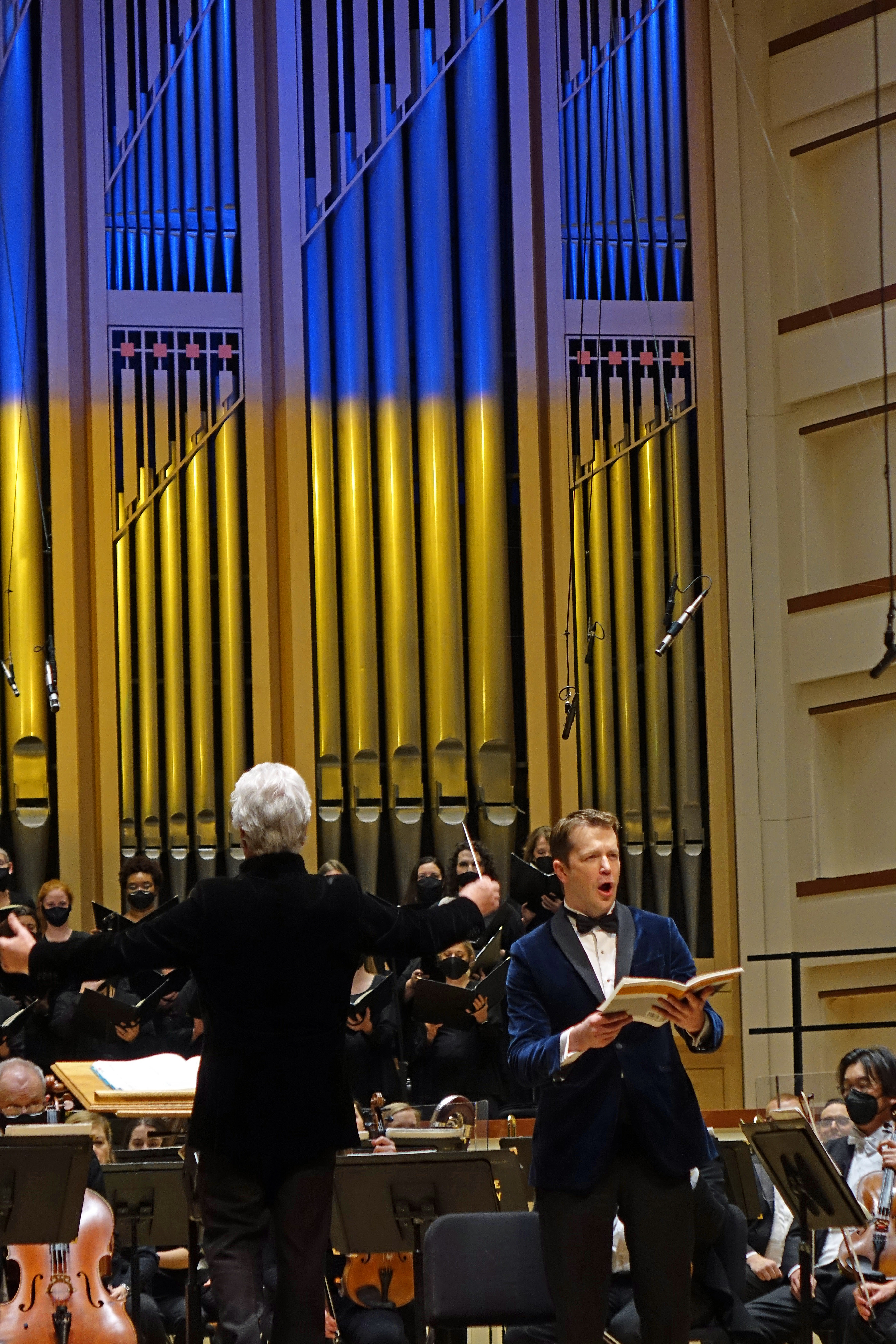
Those organ pipes were more verifiably involved in the culminating performance of the Dona Nobis Pacem, after more than 40 Master choristers filed in, followed by our two guest soloists: soprano Christina Pier and, in his Charlotte debut, bass-baritone Daniel Okulitch. It was then that Warren-Green dedicated this piece to the valiant, freedom-loving people of Ukraine. Between the moment that the maestro turned away from us and Symphony began to play, those silvery pipes, illuminated until then entirely in blue light, suddenly became halved into stripes of gleaming blue and yellow gold, the colors of the Ukrainian flag. A proud moment for us all.

Whether prescribed by COVID protocols, Warren-Green’s decree, or the unmasked singers’ personal preferences, Pier and Okulitch sat further apart than the vocal soloists we usually encounter at Symphony concerts. With Pier mostly singing the “Agnus Dei” refrain that contains the Latin title, and Okulitch confining himself in the middle movements in Walt Whitman’s English – and Old Testament translations in the Finale – the separation between the singers wasn’t awkward at all.

2022~Dona Nobis Pacem-24

Pier tended to sing with the orchestra and the choir, but there was an extended stretch where Okulitch, standing to Warren-Green’s right, was accompanied solely by Lupanu, seated to his left. So the tableau enhanced the intimacy of their duet. What was really unfortunate and compromising for us were the vast stretches of incomprehensible text from the chorus that Vaughan-Williams had scored so splendidly. If there had been supertitles above the stage or printed programs in our hands, the experience would have been even more powerful. Those of us who were able to download the digital program were adequately equipped, but the Blumenthal Performing Arts Center has had repeated problems with transmitting these copious, colorful, and informative materials.

In future performances where we’re expecting to follow along at the Belk, I will try to download the digital materials before I leave home. Clearest of all was the chorus’s mighty “Beat! Beat! Drums!” refrain from one of Whitman’s most metrical Civil War compositions. Even when we might be lost in the less familiar words of other war poems by the Good Gray Poet (“Reconciliation” and “Dirge for Two Veterans”), the music, the voices, and the colors of the fighting Ukrainians’ flag landed on us forcefully. It was thrilling.

Originally published on 3/14 at CVNC.org

Symphony Arrives at Sublimity, Amping Up Mahler to Heavy-Metal Decibels Along the Way

Review: CSO Plays Mahler’s Ninth Symphony

By Perry Tannenbaum

2022~CSO Mahler's Ninth-17

January 14, 2022, Charlotte, NC – When the new Compact Disc digital recordings were first heralded and released in the early 1980s, the mythic story began circulating from Sony and Philips that the dimensions and capacity of the new CD format were determined by its ability to present all of Beethoven’s Ninth Symphony on a single disc. Subsequent refinements to the technology increased the capacity of those discs from 74 minutes of music to 80, leaving Ludwig far out of the equation. The 80-minute capacity we see on today’s prerecorded discs and the recordable CD-Rs we might dub them onto is more suitable for containing Gustav Mahler’s Ninth Symphony – but only if conductor and orchestra are in a hurry. Only the very quickest of the many recordings of Mahler’s last completed orchestral work clock in at 79 or 80 minutes. Completing his Mahler Journey with the Charlotte Symphony Orchestra in his final season as music director, Christopher Warren-Green let it be known that his Ninth would be a more expansive 90-minute experience. There was no intermission at Belk Theater, and program booklets remain a strictly online affair.

Vaccination cards were scrutinized at both the outdoor entrances to the Blumenthal Performing Arts Center and at the indoor entrance from Founders Hall. My mom and I felt very comfortable with the social distancing downstairs in the orchestra section, but no such amenity was granted to subscribers who entered the hall from the lobby – in fact, I’ve never seen the Grand Tier more fully occupied, a gratifying affirmation of the Queen City’s Mahler enthusiasm. The balcony above looked similarly packed. Masking, of course, was compulsory, but ticketholders should chiefly be forewarned that vigilance was strictly enforced at the entrance to the orchestra section. Folks that were late for the first notes of the Mahler performance, between 7:35 and 7:40pm, were obliged to wait in front of TV monitors in the lobby until the conclusion of the opening Andante comodo movement at approximately 8:05.

Each of the outer movements, both preoccupied with mortality and dying, is as lengthy as the two inner movements combined. Only the second movement can be described as lighthearted, and all four are teeming with mood swings. Without adding audible gaps between episodes, recordings conducted by Leonard Bernstein and Herbert von Karajan with the Berlin Philharmonic are divided into 33 and 30 tracks respectively. Those seemed to be very conservative numbers when Warren-Green and Charlotte Symphony immersed themselves in the score, reveling in its seemingly countless contrasts. Emerging with the opening melody from a backdrop of cellos, basses, horns, and harp, the second violins emphatically signaled that all sections of the vast ensemble would have their chances to shine.

2022~CSO Mahler's Ninth-04

This was by far the most extensive instrumentation we had seen at either Belk Theater or Knight Theater since the beginning of the pandemic. From orchestra level, it was difficult to precisely count all the unmasked flute, clarinet, oboe, bassoon, French horn, and trumpet players arrayed behind the masked string sections. But the percussionists were plain enough when they stood up, either singly or as an ominous group, and there was additional space set aside, upstage and on the stage left wing, for the three trombones, two harps, and the tuba. Curving around stage right to the upstage was an armada that included timpani, a mighty bass drum, cymbals, a gong, snare drums, and tubular bells.

So the prospect of high-volume music was apparent before all the Symphony musicians were fully congregated. Yet when these expected Mahler explosions actually occurred, Mom and I were both taken aback by how loud they were. The difference between sitting at the rear of the grand tier late last spring and sitting in Row O below was compounded by the additional troops and artillery onstage. Earplugs weren’t quite necessary for these fortissimos, but rock-concert decibels weren’t far in the distance. Mom may have nodded off for a few seconds during Gershwin’s Lullaby last year or when Branford Marsalis luxuriated in the luscious Larghetto middle movement of Jacques Ibert’s Concertino da camera. Not this year. Onsets of trumpets, trombones, or percussion could be so sudden that, even if she didn’t revere Mahler, Mom wouldn’t dare close her eyes.

There were plenty of less aggressive surprises scattered across the lordly length of this symphony. In the epic Andante, the harpists reached out to pluck a bass line, and the mournful funereal dirge had the backbone of a military march, punctuated by the wan tubular bells. If you’re new to Mahler, the waltzing liveliness of the “Im Tempo eines gemächlichen Ländlers” (in the tempo of leisurely country dances) might catch you pleasantly off-guard – and what plan did the composer have for a triangle and cymbals playing in unison? The third movement Rondo-Burlesk was brimful of contrasts and contradictions as Warren-Green kept us on the lookout for the next twist. A busy, contrapuntal opening suggested a fugue with frolicsome and comical touches, but midway through this Burlesk, each of the orchestra’s sections seemed to have something soulful to say – not at all the path you would expect leading to a screaming conclusion.

2022~CSO Mahler's Ninth-15

Perhaps the biggest surprise of the evening came at the climax of the Adagio finale when a furious pounding of the big bass drum, topping off a majestic crescendo, suddenly gave way to – in the hushed blink of an eye – nearly total silence. This abrupt whisper of weepy violins, proved that Mahler’s precipitous subsidings can be almost as dramatic as his volcanic peaks. Most of Symphony’s principals distinguished themselves over the course of this epic evening, including oboist Hollis Ulaky, clarinetist Taylor Marino, cellist Alan Black, and concertmaster Calin Ovidiu Lupanu, but the final movement underscored the special praise earned by French horn principal Byron Johns and principal flutist Victor Wang. Even Johns’ one little wobble on the horn came at an ideally aching moment, and Wang was merely perfection in the sublime epilogue.

Originally published on 1/15 at CVNC.org