
“Eureka” and “Vanya” Agreeably Disagree

My dear old Mom was born and raised in Harlem over a century ago, when a massive African-American cultural and literary Renaissance named for Harlem had already begun, long after the fabled Manhattan district with its storied 125th Street had been a major destination for Northern Migration after Lee surrendered to Grant. Even then, it would hardly be respectful to change Harlem’s name to Little Africa after all these years.
Yet playwright Jocelyn Bioh in her 2023 drama, Jaja’s African Hair Braiding,set on the corner of 125th Street, had me considering whether Bioh would rather call her Harlem – or at least this salon – Little Africa. The vibe and culture of Jaja’s, in Three Bone Theatre’s outstanding QC premiere at The Arts Factory, had me feeling that I was in another country while it was unmistakably my own.
Staffed and patronized by locals who hail from Senegal, Ghana, Nigeria, and Sierra Leone, neither Harlem nor Africa were the best places for Jaja’s craftswomen to be on a hot summer day of 2019 when Bioh’s action takes place. Aside from a breakdown in the braiding shop’s air conditioning, ICE lurks in the background as another of the women’s worries. Our own US President, the most powerful man on Earth, has bunched their homelands into the dismissive category of “shithole countries.”
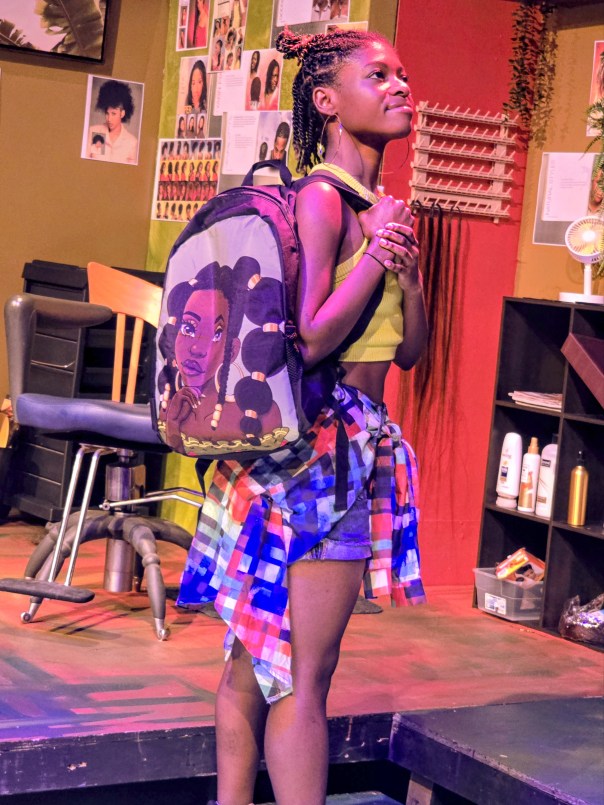
Jaja’s daughter Marie, a brilliant bundle of chaotic energy, is running the salon today because Mom is getting married later this afternoon to an unpopular landlord who will provide her – and Marie – with the shelter of citizenship. That will free Marie, a valedictorian at her high school using a borrowed identity, to apply to an Ivy League school worthy of her energy, talent, and potential.
From the deluge of Marie’s opening monologue onwards, we realize that Jaja’s is a place bustling with life. Music is in the air, sometimes compelling the women to dance. There’s bickering, jealousy, hostility, vanity, teasing, and earthy humor. Not a murderer or a rapist in sight among the immigrants. Not even a pet eater.
About the only big mistake we can accuse director Donna Bradby of making is not helping us to observe Bioh’s signposts – via a wall clock and/or projections – of the time of day and the specified year this long, hot workday unfolds. Otherwise, Jennifer O’Kelly’s scenic design, Toi Aquila R.J.’s costumes, and Rod Oden’s lighting immerse us completely in Jaja’s humdrum-yet-exotic world for all of the show’s 95 minutes.
A clock on the wall, for instance, would help us to appreciate how long young Jennifer, an aspiring reporter, is willing to sit at Miriam’s station in order for the patient artisan to outfit her with a full head of microbraids. And how long does the bossy, rude Vanessa fall asleep at Aminata’s stand before waking to her new look?

The visible excellence of Bradby’s cast is matched by the variety of Deborah Whitaker’s pre-, post-, and mid-weave hair designs. When blackouts happen between scenes, stage manager Megan Hirschy must have a huge chore in the small Arts Factory space helping the scurrying players reappear with the right hair when the lights come back up. We never just sit there tapping our feet during transitions. They’re almost lightning-quick.
Nor does it trouble Bradby that it’s impossible to keep track of who’s from Senegal, Ghana, or Sierra Leone. Venecia Boone was assigned the task of dialect coach anyway, a really nice touch.

Of Ghanaian descent and native to nearby Washington Heights, Bioh obviously knows her characters as much as she loves them. She is also a performer, so Deity Brinson as Marie will not be the last of her players to be gifted with a juicy monologue. Like Marie and the braiders, we will wait a long time before Myneesha King appears as Jaja – in wedding white, of course, with a queenly crown of braids – and delivers the most powerful monologue of all.
Meanwhile, it’s Valerie Thames as Bea, the most fashionable and contentious of Jaja’s employees who fuels the liveliest action, seemingly able to hatch a new grudge at the drop of a spray bottle. The salon was her idea, not Jaja’s. Should have been a full partner in the biz. Refugee newcomer Ndidi is stealing her customers rather than customers just dropping Bea. Thames seethes, fumes, and makes scenes with a steely righteous dignity that sets us up for the turnabout that reveals her deep-down goodness and sense of community.

Until then, the human warmth of the shop emanates from Kellie Williams as Miriam and Vanessa Robinson as Aminata. Williams, rightly stationed upstage at the Arts Factory black box, is mostly distanced from the main sparring during her morning-to-night transformation of Jennifer’s tresses. But there’s a distant man on Miriam’s mind throughout her labors, and she’s spending enough time in Jennifer’s hair to become quite chummy with the 18-year-old by evening’s end.
While her bestie and gossip buddy Bea seethes and sneers, Robinson mostly effervesces as Aminata. She knows that she doesn’t have the patience for a daylong immersion in microbraiding, so she’ll have none of Jennifer despite her youthful sunniness. But EJ Williams as Vanessa riles her almost to the point of losing her cool, a comical series of shticks that begins with the pushy customer objecting to house rules that require her to step outside the shop to negotiate Aminata’s fee. Then Vanessa insists that she be braided with the implements and spray she has brought from home.

Aminata’s man troubles are nearer-to-hand than Miriam’s, for her wayward ne’er-do-well husband James only circles back to the nest to take advantage of her. Righteously divorced, Bea insists that Aminata drop this loser, dismissing the love factor that keeps her from following through with her resolve. Can’t help it when Graham Williams as James drops by and pushes his wife’s buttons.
So these skirmishes between Thames and Robinson, before and after James’s invasion, are the most delicious that we witness. Aside from her dreamer worries, Brinson as Marie is occasionally thrust into the middle of disputes, laying down the law for the prissy Vanessa and stepping into the middle of Bea’s various tussles with Ndidi, Aminata, and her defecting customer, Michelle. At one point, Marie even exiles the incorrigible Bea to the street!
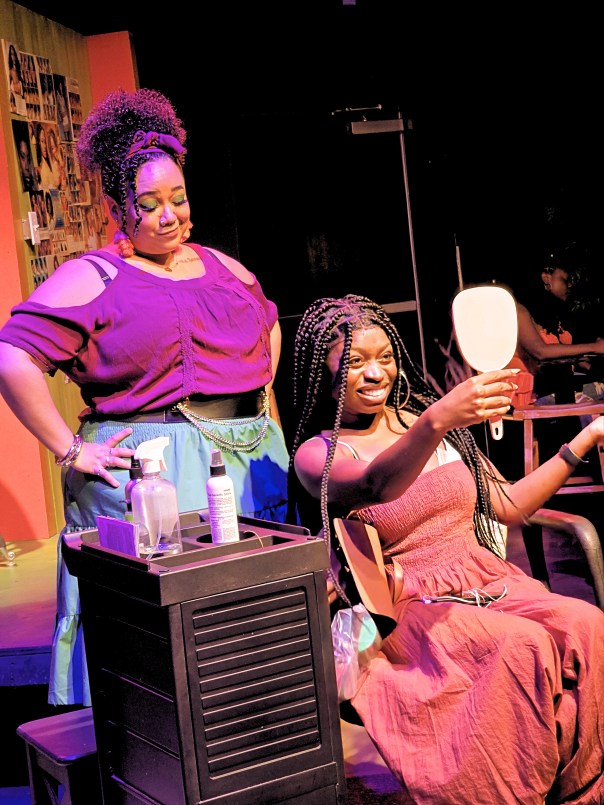
The younger folk are calmer and more acclimated to post-truth America than their diva elders. Before we know it, Aminata is asking Marie how to tune the smart TV to YouTube. Sarah Oguntomilade as Ndidi, the highest-grossing braider in the shop, is especially cool – thoughtfully equipped by Bioh with headphones and loud music to tune out Bea’s accusations and tirades. There’s a really nice interlude when Graham fawns over and flatters her as the Jewelry Man, lavishing her with freebies. This Nigerian cameo as Olu was at least as crowdpleasing as his subsequent turn as the roguish Ghanaian, James.
Graham’s most impactful role is as Eric, the DVD man, who serves as the caring eyes and ears of the community. But it would be cruel to divulge any more.
Things happen quickly at Jaja’s. Notwithstanding the oppressive summer heat, each new character changes the temperature in the shop. Less obtrusively than Graham, Germôna Sharp brings in a variety of flavors as three different customers. The most dramatic of these is the diffident Michelle, who thought she would be switching to Ndidi when Bea wasn’t there. Most comical is Sharp as Chrissy, wanting braids that will make her look like Beyoncé.
As if.
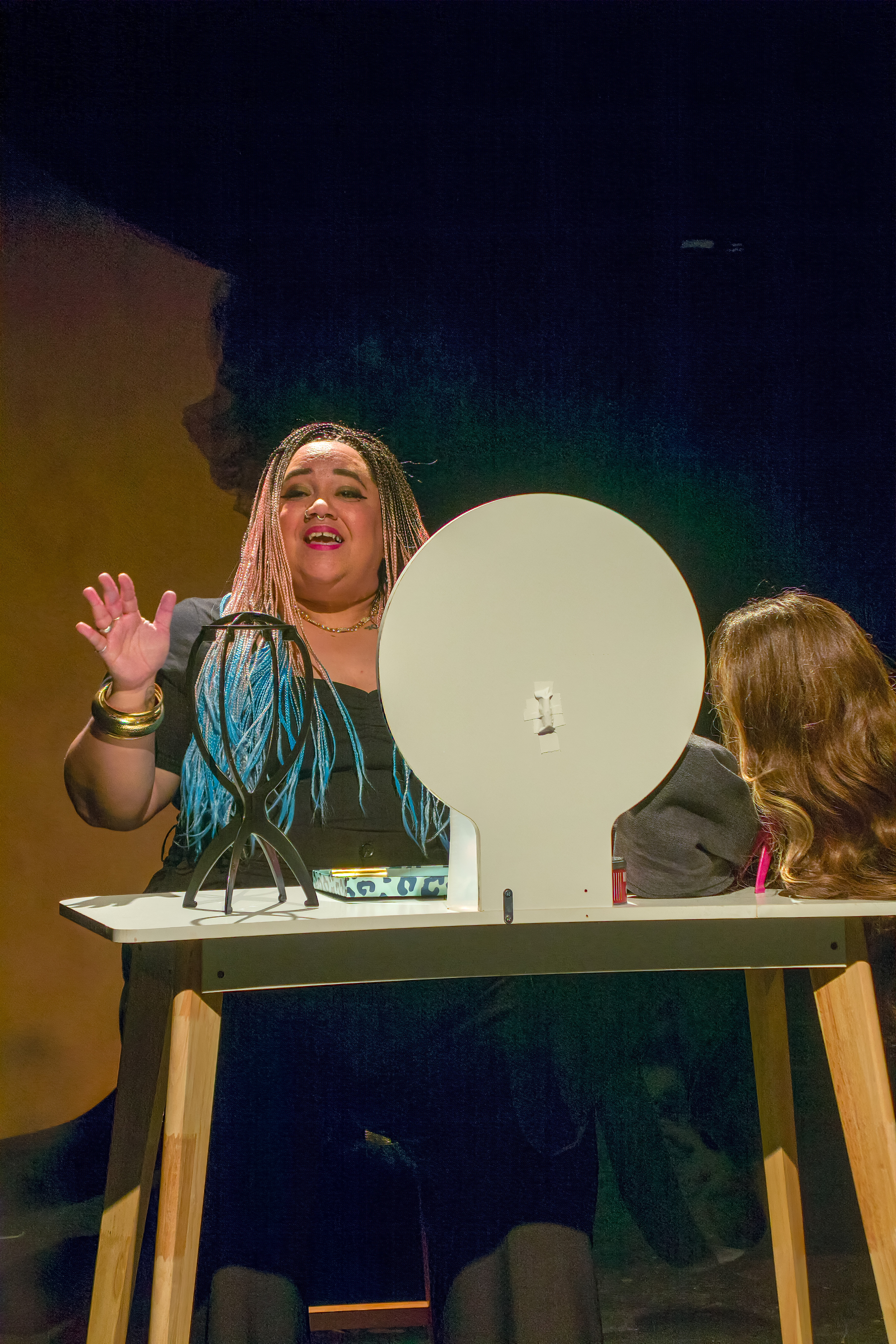
If you weren’t aware that Black women have a special relationship with their hair, Keli Goff’s THE GLORIOUS WORLD OF CROWNS, KINKS AND CURLS, now premiering at The Arts Factory, will set you straight. Although a streamed three-woman version of the show produced by Baltimore Center Stage aired in 2021, Three Bone Theatre is currently performing the first live production – with a six-woman cast.
Doubling the cast turns out to be a wise decision by director Tina Kelly, enabling costume designer Toi A. Reynolds Johnson and hair designer Blue Edmonds to show off more of their work, while allowing the sextet of actors to concentrate on their performances instead of how to manage frenetic backstage changes. With 20 different monologues, sketches, and rhymed rants along the way, there’s still plenty of material to go around.
Maybe Kelly and her artistic team decided to add players during the rehearsal process, for the distribution of acting chores certainly isn’t even – and the script came into their hands without the logistics of staging the show having ever been worked out in live performance. The impact of a larger cast performing for a live audience might also be a revelation for Goff when she comes down to the Queen City this coming weekend to witness Three Bone’s handiwork.
More heads of hair onstage seemed to add weight – maybe even universality – to their cumulative testimony, and the audience reaction layered on at the Sunday matinee I saw made their words gospel. Short of outright amens, there were a variety of audible affirmations.
Anxiety over black women’s hair seems to crop up most impactfully in the workplace, where long-ingrained attitudes and prejudices can affect hiring, performance evaluations, and advancement. Ashleigh Gilliam seems to get off to a wobbly start as she welcomes the audience to an experience beyond theatre, where we can hope to encounter humorous and engaging therapists, feel like we’ve met up with old friends, or maybe make new ones.
But there’s a finely calibrated stage fright in Gilliam’s delivery that had me worrying, until Goff had Gilliam flipping the script with a bit of sleight-of-hand. It turned out that her character was auditioning for her role. Then an unseen casting director makes it quite clear that the role will not be going Gilliam’s way – unless she does something with her hair to make it more “ladylike.”
While I knew that racism was ubiquitous, centuries old, and ongoing, it was revelatory for me to learn that all Black women – no matter what kind of hair they have or how much, whether they are rich or poor – have a story to tell about their “crown and glory.” Even more stunning, as three specific stories began the cavalcade of testimonies, all three women before us had stories of people who had the nerve to reach out, without permission, to touch their hair.
At work. On a date. On a yacht.
Recalling the horror, they reached out toward us in unison: “The hand!” “The hand!” “The hand!” The lady executive, the hip-hop producer, and the plutocrat yachtswoman were all the same. Rude, insensitive, and invasive.

“Don’t ever touch a black woman’s hair without her permission,” they finish in unison. By leaving out seven exclamation points and over 140 capital letters from Goff’s playscript, I don’t think I’m exaggerating her emphasis. But to the Sunday matinee crowd’s credit, there was a healthy amount of laughter mixed in with the affirmations as these horror stories climaxed and the lights went out.
The slights don’t all come from white people. In the ensuing monologue, “Dear God, It’s Me, Amaya,” the little girl has been told by a Black classmate that her hair is nappy. She prays for pretty hair for her eighth birthday. Dressed in purest white for her wedding, it’s Gabrielle in the next sketch who is still hearing her mom’s outrage and weeping – because she has opted for short hair – as she tells us her story.
Aside from cataloging the slings, slights, and chemicals that have assailed Black women’s hair over the years, Goff also creates an arc of progress and a hopeful outlook, fortified by her humor. Here we can fault Kelly and projection designer Will Jenkins for not including the date markers that the script calls for, blurring Goff’s somewhat faint timeline. Nor are Kelly and Gilliam quite helpful enough in cementing the full connection between Goff’s first scene and her last.
But there are also detours in between, like the prerecorded segment that informs us that Black moms often experience post-partum hair loss. An extended scene at a DC beauty parlor, “The Ball.” goes slack and loses its comical edge long before Goff attempts to rescue it with a notable historical context that grounds us in 2009. These are missteps that a playwright will notice more readily when she watches her work alongside a live audience. Goff’s visit may very well provide her with the first opportunity she’s had to remediate CROWNS, KINKS AND CURLS with that kind of precious feedback.
She will definitely enjoy the Three Bone ensemble. Only Vanessa Robinson has performed at The Arts Factory before as the down-to-earth social worker in Three Bones’ Andy and the Orphans back in February. Here she delivers impressively as a rape victim preparing to testify in “Chantal’s Fierce Magic.” Among various roles, Michelle Washington shines most memorably as Amaya in her debut, while Cailin Harrison is alternately poignant and adorable as Gabrielle, the conflicted bride.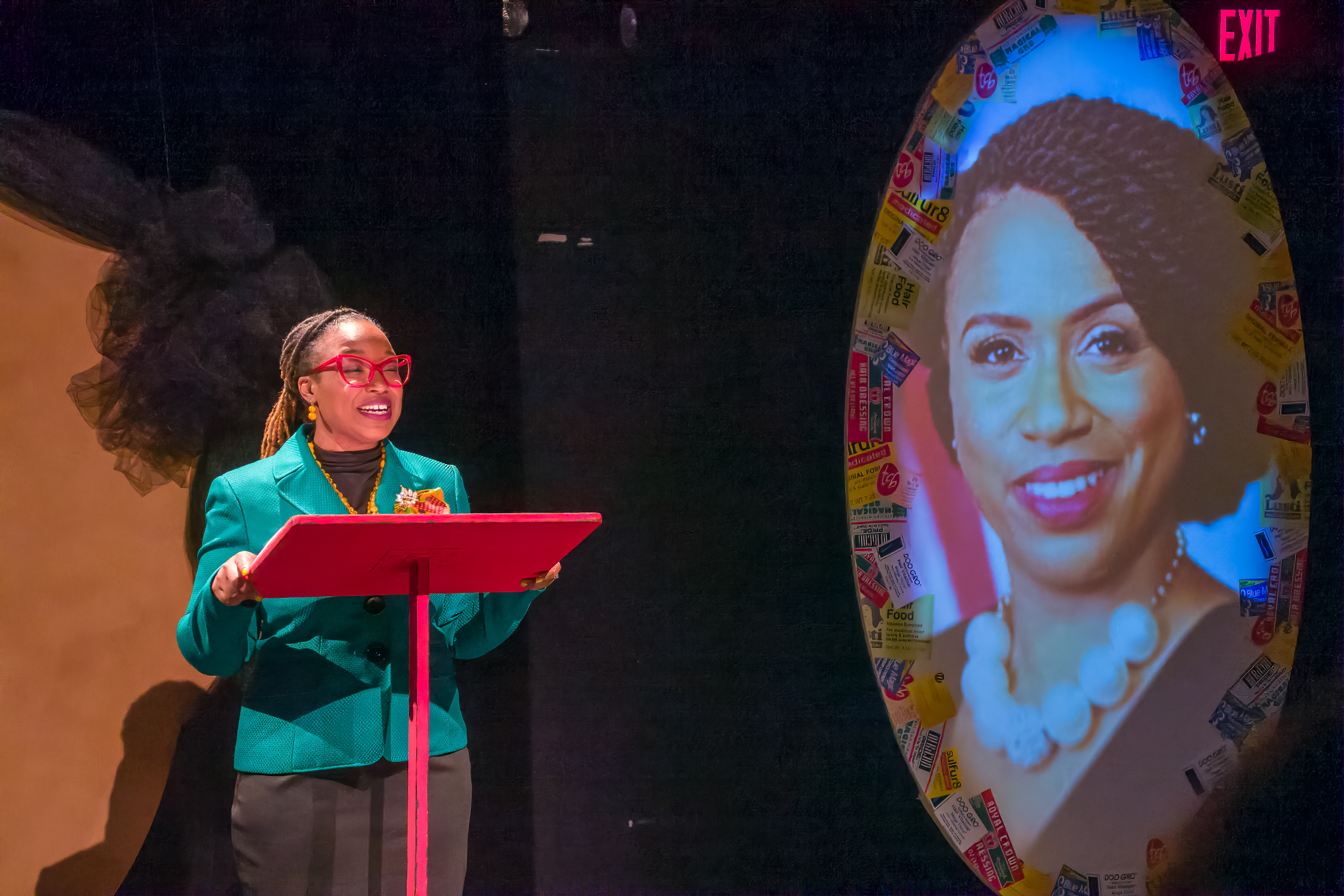
Dior Scott had one of the juiciest monologues in her debut, resplendently dressed for “Adaora and Her Little Princess,” perhaps Goff’s best segment. Yet Scott was a force to be reckoned with in multiple ensemble pieces, such as the “Don’t Touch!” freak-out and her confrontation with Washington in “Office Politics.” Ka’Shara Hall was stateliest as the Congresswoman in the “Pauline on When Hair Gets Political” monologue, but her give-and-take with Scott on “It’s Just Hair” crackled with vivacity, making Goff’s rhyming easier to swallow.
Goff plans to linger after the next Sunday matinee for a talkback. It will be interesting to hear her reactions to the live performance – and maybe find out if she’s having second thoughts about Adaora’s adoration of Meghan Markle.
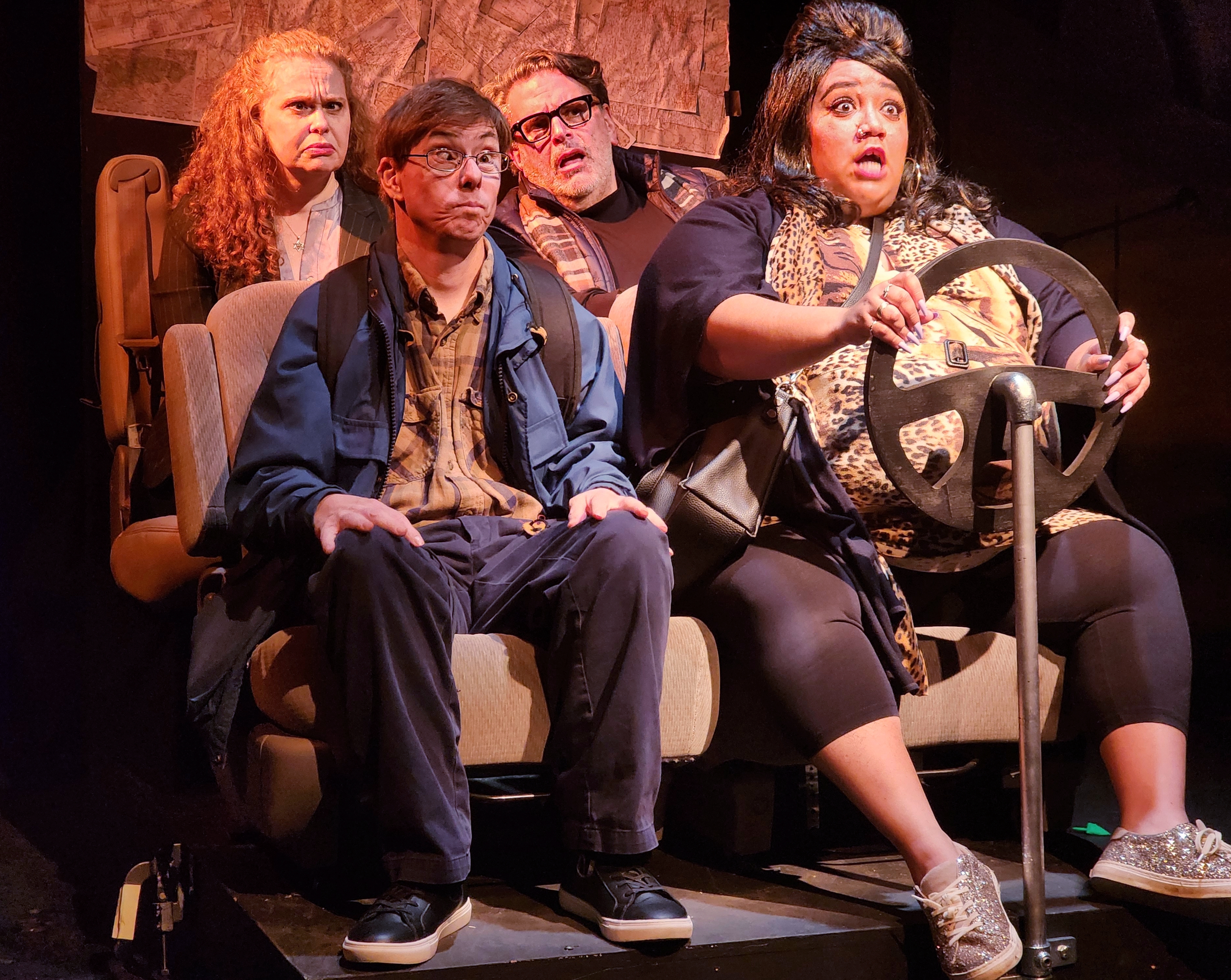
When playwright Lindsey Ferrentino wrote Amy and the Orphans about her Down Syndrome aunt Amy, she convincingly demonstrated that she didn’t need to write its fraternal twin, Andy and the Orphans. But the demonstration happened too slowly. Ferrentino and director Todd Haimes needed a second Down Syndrome actor to play the title role at matinee performances when the show opened for the Roundabout Theatre Company in 2018.
Presumably, Ferrentino thought that pickin’s would be slim after finding Jamie Brewer at a New York fashion runway, the first DS person to participate in Fashion Week, through a talent agency that specialized in performers with disabilities. So the playwright didn’t specify what gender her second DS actor should be. Along came Eddie Barbanell to step onstage as the matinee understudy, and along came Andy and the Orphans, the custom-tailored male version of Ferrentino’s tribute to her Aunt Amy.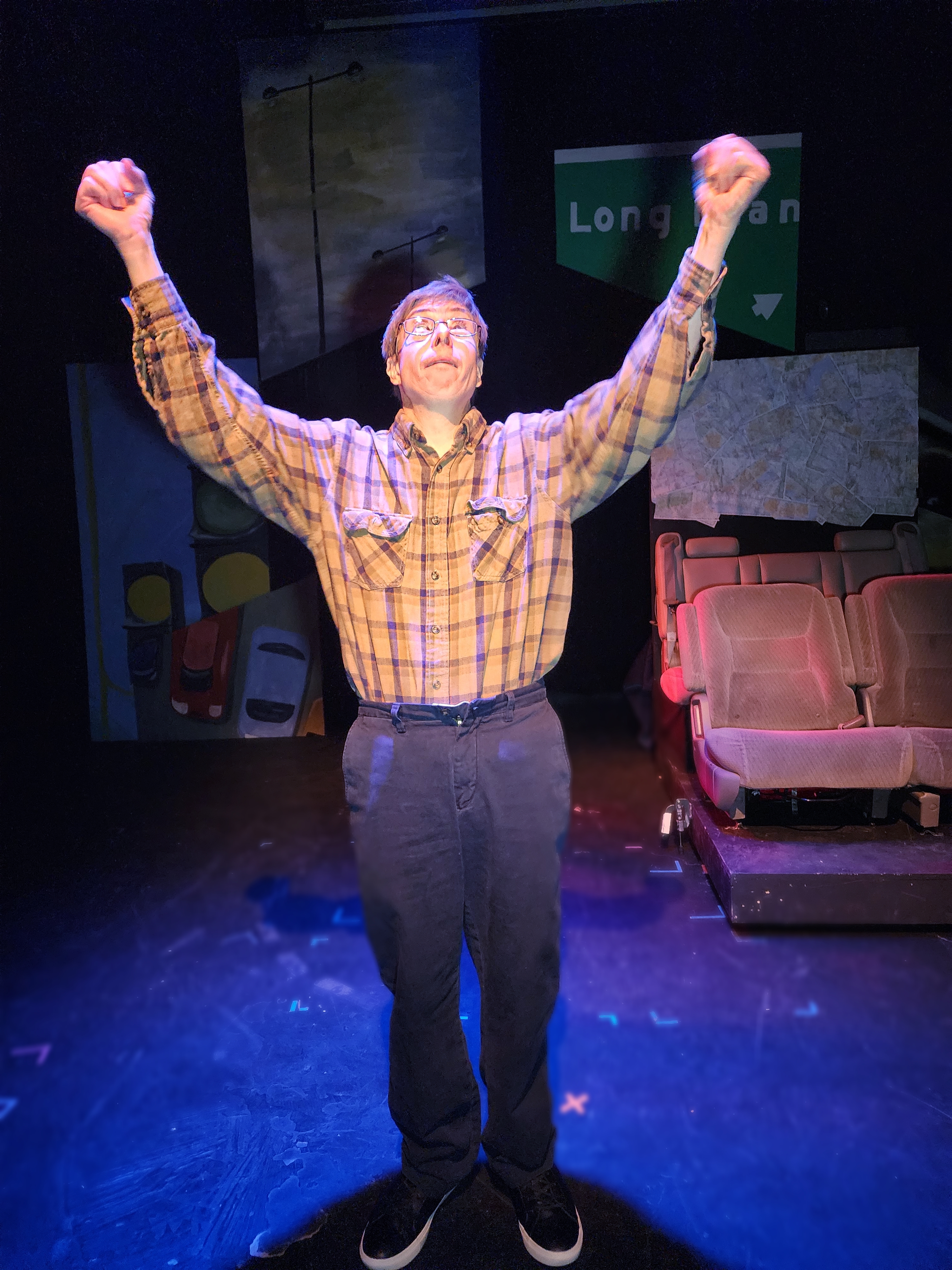
Five years later – and five years closer to Andy’s real age – Barbanell is here in Charlotte, wowing audiences at The Arts Factory in Three Bone Theatre’s production of Andy and the Orphans through February 25. Meanwhile, Ferrentino has learned, through versions of her work staged in London and Spain, that you can reliably find DS actors to play DS people onstage anywhere. The real stumbling block for DS performers is the lack of roles for them.
Three Bone was actually early to the Ferrentino party, bringing the playwright’s previous work, Ugly to the Bone, to Spirit Square’s Duke Energy Theater two years ago. It was another script that showed Ferrentino’s empathy with female castaways in our society and how they are treated. Then it was Jess, an Afghanistan War vet returning to her Florida home, disfigured and disabled physically while inwardly suffering from PTSD.
While the content of Amy/Andy is more autobiographical, the location moves away from the playwright’s native Florida to New York. Precise locations shift during the action, and Ferrentino is rather circumspect about where we are or when. Without the script in my hands, I guessed that at various times we were in Staten Island, outside LaGuardia or Kennedy Airport, at a group home in Queens or Long Island, on the road, and – quite memorably – at a Burger King. Andy, his elder siblings, and Kathy, the caretaker who must accompany Andy, are on a road trip to Dad’s funeral, past the end of the fabled Long Island Expressway (and Sunrise Highway afterwards) to Montauk, the eastern tip of New York.
Maggie and Jacob, when they aren’t bickering over whether their yearly meet-ups are Christmas or Chanukah visits, are worried over how they will break the news that Dad has died – and that Mom has already died awhile ago. This is the right comedy varnish to apply to a story that has a rather horrific dramatic core. Likewise, being overdue on telling their DS little brother that Mom and Dad are dead is a rather innocuous patina to apply to the family trait the characterizes Andy’s sibs and parents, a shocking abdication of their responsibilities toward him.
As this shabby trait becomes more and more exposed, the sideshow dinginess of Chip Davis’s traffic-themed set design becomes more and more apt for this story. It’s hard to escape the conclusion that director Danielle Melendez lucked out when Susan Cherin and David Catenazzo showed up for auditions. Cherin comes off as the kookier, more neurotic sib as Maggie, far more likely to be a fretful helicopter parent than her shambling brother. As Jacob, Catenazzo has the more Jewish name and delivers a more Jewish demeanor – compounding the comedy, since he’s the bible-toting convert who celebrates Christmas.
It’s really hard for us to be disgusted with either Cherin or Catenazzo until Maggie and Jacob are shown why they should be deeply disgusted with themselves. That’s why this key moment is such a gut punch for us.
Barbanell is extraordinary, giving us all that Ferrentino wrote into Andy and more. As an actor myself, I marveled at his cue pickup and his timing. We don’t need to be in his presence long for us to believe how he and Brewer blew away the playwright’s expectations for what a DS actor can do, or that they were the first Off-Broadway cast members to go off-book. Nor was I surprised by the end of the evening to read that Barbanell had burst into Shakespearean monologues by Romeo, Julius Caesar, and Puck the first time he met up with Ferrentino at a roadside diner, turning his interview into an audition and a theatre event. Each performance was “word perfect” by the playwright’s account.
Tacitly, then, she has admitted that she might have filled out Amy/Andy’s role more amply if she had known, going in, the full capability of DS actors. Critics who have faulted Ferrentino for not fleshing out her title character and letting us get to know him better may have overlooked just how pioneering this script is. Getting buffeted by myopic critics was the price she had to pay.
Nice thing is, Ferrentino has been asked by Netflix to adapt and direct a film version of Amy and the Orphans. That will allow her to reframe her story knowing her DS actors’ capabilities beforehand. Both Brewer and Barbanell have been tapped to be in the remake, so it’s probable we’ll get first look inside Amy and Andy’s group home. Maybe Andy’s unseen girlfriend, Tina Turner, will get thrown overboard in favor of Amy!
 Sarah Malloy and Nathan Morris are Sarah and Bobby – and the key reason why Ferrentino has moved her tale to the Staten Island vicinity. They are the parents of the title character, but it may take awhile before audiences catch on. My wife Sue, who taught special needs children for decades, got it the second time Sarah and Bobby locked horns. It didn’t come together for me, merely a special needs child’s elder brother, until maybe a half hour later.
Even then, notwithstanding the fine work from Malloy and Morris, I wondered why the playwright felt these dead parents needed to be onstage, in the story. There was something unsavory about both of them, that I can say, before the big reveal. Then the Staten Island connect became crucial.
[[Spoiler Alert: In the run-up to the upcoming Netflix film, it’s hard for me to predict whether the Willowbrook State School will remain a spoiler. Back in his day, Senator Robert F. Kennedy visited the facility. Not too long afterward, Geraldo Rivera dropped by with a TV crew, coming away with similar impressions. Decide for yourself by googling Willowbrook – or delaying that search – whether you wish to know about it before or after you see Andy and the Orphans. Will Netflix insist on showing us the place? Stay tuned.]]
Finally, it must be said that Vanessa Robinson’s sensational Charlotte debut as Kate has absolutely nothing to do with luck on Melendez’s part. She went way against script, where Kathy is described as Italian-American, in casting Andy’s pregnant social worker. With a down-to-earth quality that masks her admirable ability to tolerate all the Maggies and Jacobs she has dealt with over the years – and the Andys – Robinson shows us a different way to be “the walking embodiment of Long Island, New York.”
When they perform their big monologues, both Barbanell and Robinson hit it out of the park.
One of the things I had to ponder on our drive home was whether Ferrentino had been dealing from the bottom of the deck when she showed us how normal and everyday Maggie and Jacob were – not to mention Sarah and Bobby before them – in their interactions with Andy and each other. It’s only when you factor in how many hundreds and thousands of parents and siblings behaved the same way, for over four decades, that the monstrousness of such normality becomes clear.
Ferrentino is slowly, cautiously, and carefully cushioning us for a hard truth. All the time we’re thinking that we’re in on the big reveal Maggie and Jacob have in store for Andy, we are being set up with devastating circumspection.
The tables are turned suddenly. Jarringly.


 Art on My Sleeve