
“Eureka” and “Vanya” Agreeably Disagree

My dear old Mom was born and raised in Harlem over a century ago, when a massive African-American cultural and literary Renaissance named for Harlem had already begun, long after the fabled Manhattan district with its storied 125th Street had been a major destination for Northern Migration after Lee surrendered to Grant. Even then, it would hardly be respectful to change Harlem’s name to Little Africa after all these years.
Yet playwright Jocelyn Bioh in her 2023 drama, Jaja’s African Hair Braiding,set on the corner of 125th Street, had me considering whether Bioh would rather call her Harlem – or at least this salon – Little Africa. The vibe and culture of Jaja’s, in Three Bone Theatre’s outstanding QC premiere at The Arts Factory, had me feeling that I was in another country while it was unmistakably my own.
Staffed and patronized by locals who hail from Senegal, Ghana, Nigeria, and Sierra Leone, neither Harlem nor Africa were the best places for Jaja’s craftswomen to be on a hot summer day of 2019 when Bioh’s action takes place. Aside from a breakdown in the braiding shop’s air conditioning, ICE lurks in the background as another of the women’s worries. Our own US President, the most powerful man on Earth, has bunched their homelands into the dismissive category of “shithole countries.”
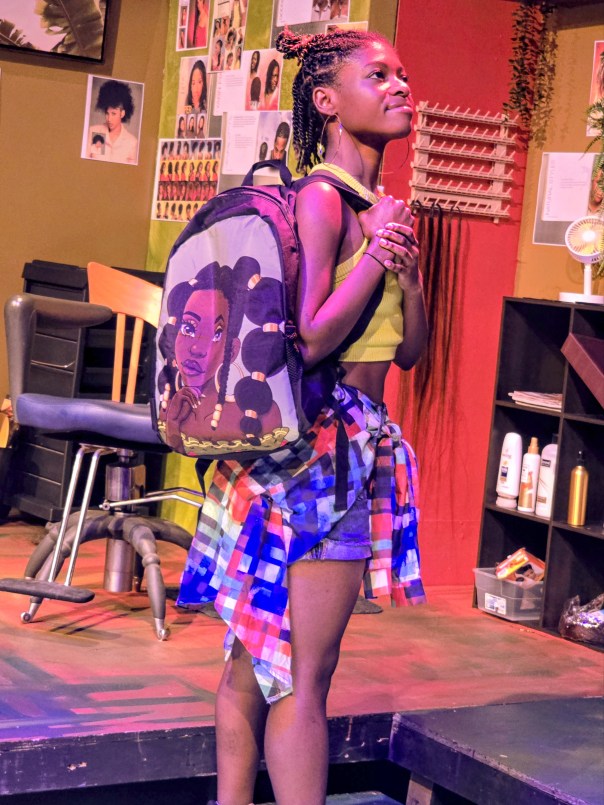
Jaja’s daughter Marie, a brilliant bundle of chaotic energy, is running the salon today because Mom is getting married later this afternoon to an unpopular landlord who will provide her – and Marie – with the shelter of citizenship. That will free Marie, a valedictorian at her high school using a borrowed identity, to apply to an Ivy League school worthy of her energy, talent, and potential.
From the deluge of Marie’s opening monologue onwards, we realize that Jaja’s is a place bustling with life. Music is in the air, sometimes compelling the women to dance. There’s bickering, jealousy, hostility, vanity, teasing, and earthy humor. Not a murderer or a rapist in sight among the immigrants. Not even a pet eater.
About the only big mistake we can accuse director Donna Bradby of making is not helping us to observe Bioh’s signposts – via a wall clock and/or projections – of the time of day and the specified year this long, hot workday unfolds. Otherwise, Jennifer O’Kelly’s scenic design, Toi Aquila R.J.’s costumes, and Rod Oden’s lighting immerse us completely in Jaja’s humdrum-yet-exotic world for all of the show’s 95 minutes.
A clock on the wall, for instance, would help us to appreciate how long young Jennifer, an aspiring reporter, is willing to sit at Miriam’s station in order for the patient artisan to outfit her with a full head of microbraids. And how long does the bossy, rude Vanessa fall asleep at Aminata’s stand before waking to her new look?

The visible excellence of Bradby’s cast is matched by the variety of Deborah Whitaker’s pre-, post-, and mid-weave hair designs. When blackouts happen between scenes, stage manager Megan Hirschy must have a huge chore in the small Arts Factory space helping the scurrying players reappear with the right hair when the lights come back up. We never just sit there tapping our feet during transitions. They’re almost lightning-quick.
Nor does it trouble Bradby that it’s impossible to keep track of who’s from Senegal, Ghana, or Sierra Leone. Venecia Boone was assigned the task of dialect coach anyway, a really nice touch.

Of Ghanaian descent and native to nearby Washington Heights, Bioh obviously knows her characters as much as she loves them. She is also a performer, so Deity Brinson as Marie will not be the last of her players to be gifted with a juicy monologue. Like Marie and the braiders, we will wait a long time before Myneesha King appears as Jaja – in wedding white, of course, with a queenly crown of braids – and delivers the most powerful monologue of all.
Meanwhile, it’s Valerie Thames as Bea, the most fashionable and contentious of Jaja’s employees who fuels the liveliest action, seemingly able to hatch a new grudge at the drop of a spray bottle. The salon was her idea, not Jaja’s. Should have been a full partner in the biz. Refugee newcomer Ndidi is stealing her customers rather than customers just dropping Bea. Thames seethes, fumes, and makes scenes with a steely righteous dignity that sets us up for the turnabout that reveals her deep-down goodness and sense of community.

Until then, the human warmth of the shop emanates from Kellie Williams as Miriam and Vanessa Robinson as Aminata. Williams, rightly stationed upstage at the Arts Factory black box, is mostly distanced from the main sparring during her morning-to-night transformation of Jennifer’s tresses. But there’s a distant man on Miriam’s mind throughout her labors, and she’s spending enough time in Jennifer’s hair to become quite chummy with the 18-year-old by evening’s end.
While her bestie and gossip buddy Bea seethes and sneers, Robinson mostly effervesces as Aminata. She knows that she doesn’t have the patience for a daylong immersion in microbraiding, so she’ll have none of Jennifer despite her youthful sunniness. But EJ Williams as Vanessa riles her almost to the point of losing her cool, a comical series of shticks that begins with the pushy customer objecting to house rules that require her to step outside the shop to negotiate Aminata’s fee. Then Vanessa insists that she be braided with the implements and spray she has brought from home.

Aminata’s man troubles are nearer-to-hand than Miriam’s, for her wayward ne’er-do-well husband James only circles back to the nest to take advantage of her. Righteously divorced, Bea insists that Aminata drop this loser, dismissing the love factor that keeps her from following through with her resolve. Can’t help it when Graham Williams as James drops by and pushes his wife’s buttons.
So these skirmishes between Thames and Robinson, before and after James’s invasion, are the most delicious that we witness. Aside from her dreamer worries, Brinson as Marie is occasionally thrust into the middle of disputes, laying down the law for the prissy Vanessa and stepping into the middle of Bea’s various tussles with Ndidi, Aminata, and her defecting customer, Michelle. At one point, Marie even exiles the incorrigible Bea to the street!
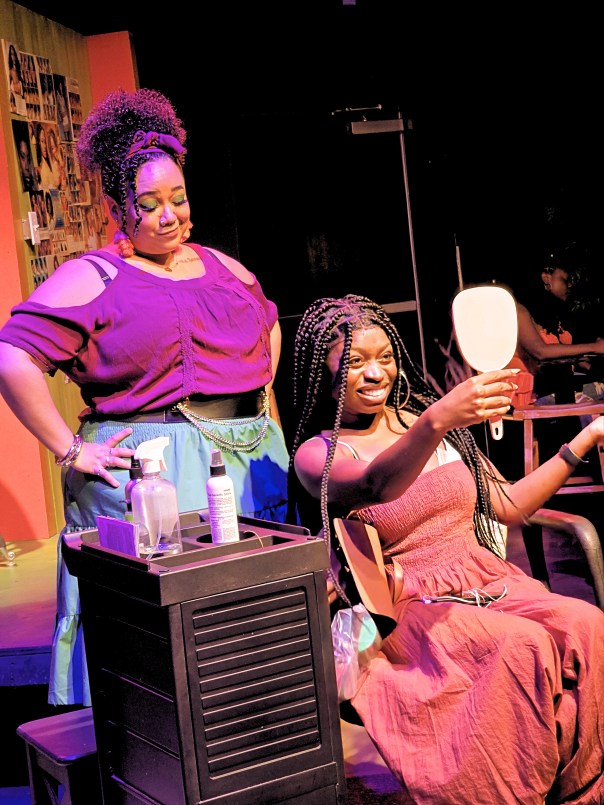
The younger folk are calmer and more acclimated to post-truth America than their diva elders. Before we know it, Aminata is asking Marie how to tune the smart TV to YouTube. Sarah Oguntomilade as Ndidi, the highest-grossing braider in the shop, is especially cool – thoughtfully equipped by Bioh with headphones and loud music to tune out Bea’s accusations and tirades. There’s a really nice interlude when Graham fawns over and flatters her as the Jewelry Man, lavishing her with freebies. This Nigerian cameo as Olu was at least as crowdpleasing as his subsequent turn as the roguish Ghanaian, James.
Graham’s most impactful role is as Eric, the DVD man, who serves as the caring eyes and ears of the community. But it would be cruel to divulge any more.
Things happen quickly at Jaja’s. Notwithstanding the oppressive summer heat, each new character changes the temperature in the shop. Less obtrusively than Graham, Germôna Sharp brings in a variety of flavors as three different customers. The most dramatic of these is the diffident Michelle, who thought she would be switching to Ndidi when Bea wasn’t there. Most comical is Sharp as Chrissy, wanting braids that will make her look like Beyoncé.
As if.
Review: Confederates at The Arts Factory
By Perry Tannenbaum
Symmetry, parallelism, continuity, and evolution are intricately interwoven throughout Confederates, Dominique Morriseau’s comical and sometimes farcical drama of 2022. The Charlotte premiere, now at the Arts Factory, comes to us less than two years after its Off-Broadway premiere in a highly polished, smartly aware Three Bone Theatre production.
Morriseau’s symmetry isn’t subtle: it hits us straight in the eyes the first time we see Zachary Tarlton’s scenic design. Split down the middle, the Arts Factory stage gives two eras and two institutions equal play in an intimate black box format. One side evokes Civil War slavery on a Southern plantation, while the other half introduces us to contemporary academia.

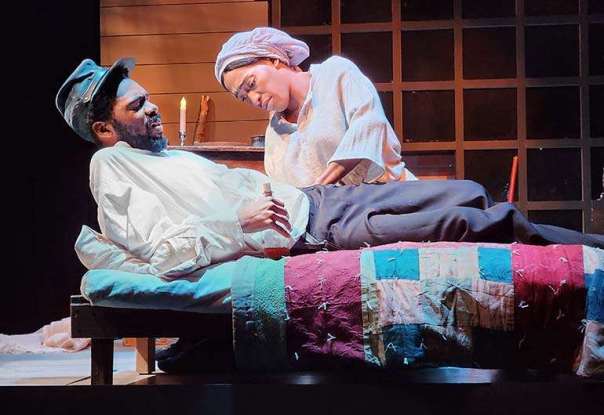
We alternate between settings, starting with Sandra, a modern tenured Black professor, proclaiming her outrage and sense of violation in vivid terms – yet with the poise and sleekness of a contemporary college lecture accessorized with slides. From that peep into scandal in present-day academia, we flash back to the slave quarters of Sara as her brother Abner sneaks into her bedroom through a concealed trap door.
Sandra has been maliciously targeted by a student or teacher who pasted a demeaning old Civil War photo of a bare-breasted black wetnurse suckling a white baby – with Sandra’s face photoshopped to replace the original slave’s. Jumping to conclusions or instinctively making connections, we’re apt to immediately believe that Sara was that nurse. Abner has volunteered for the Union Army and has been wounded in battle, so as she sews up Abner’s wound, the subject of Sara’s nursing skills is inevitably addressed.

Sara’s skills and ambitions extend further. Dangerously. She has already learned how to read, breaking one terrible white taboo, and she wishes to nurse and fight for the Union alongside her brother – to learn how to fire a rifle right now. That’s a pill Abner can’t easily swallow.
Otherwise, the two women have separate storylines until Morisseau split-screens them together at the end. Portraying Abner in his Three Bone debut, Daylen Jones is the first subordinate character to cross the invisible line between pre-Emancipation Dixie and the hope and refuge of modern-day academia. Shedding his rags and his Union blue greatcoat, Abner becomes the aggrieved Malik in today’s world. He’s obviously a gifted student, and his gripe with Professor Sandra is that she grades his papers more harshly because he’s Black, protecting her immunity from being charged with favoritism.

Seeing that there are only Black females on faculty – and no men – Malik feels doubly oppressed by bias in academe: racial bias compounded by gender bias. Notwithstanding her starchy professional manner, Sandra is more of a crusading sociologist than a sober judge. So she may indeed have fallen prey to the trope heaped upon oppressed races and genders that says, “If you wish to be treated as an equal, you need to be better.” Pragmatic? Sure. But for a gifted scholarship student seeking to maintain his A average, cold comfort.
We eventually see that there are four characters on each side of the time divide, three of whom repeatedly change costumes to play double roles. Before and after we can tally all this, director DonnaMarie and sound designer Tiffany Eck place two snippets from Nina Simone’s “Four Women” at strategic spots in their playlist, layering on extra meaning – and mythic aura – during scene changes.

If Jones can be labeled as two provocatively different militants as he roams back-and-forth from opposite sides of the stage, then Holli Armstrong (also on my radar for the first time) can be regarded as two variants of an imperfectly enlightened white racist. She is most exaggerated and hilarious on the Southern plantation as Missy Sue, the master’s daughter, when she comes back home as an undercover born-again Abolitionist. It is Morisseau as much as DonnaMarie who is prompting Armstrong to bring a Gone With the Wind air-headedness to Missy Sue – and a twisted lesbian desire for Sara – and she obliges with fiddle-dee-dee gusto.
She offers Sara a perk in exchange for executing a dangerous mission: if Sara will transcribe and transmit Master’s battleplans, she gets to live in the big house while Sue delivers Dad’s secret intelligence across enemy lines. Sure, that’s an appreciable upgrade for Sara, but she’ll still be a slave doing Missy Sue’s dirty work.
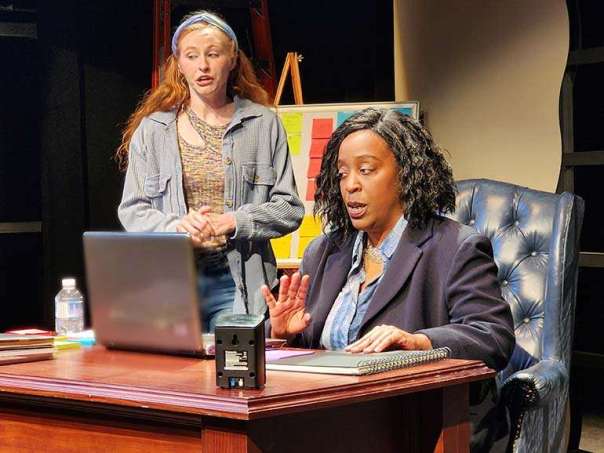
Armstrong discards Missy Sue’s pea-brained giddiness when she transitions to Candice, retaining her sycophant tendencies and much of her high energy as she haunts Professor Sandra’s office, working off her tuition debt and gathering gossip. Her true manipulativeness gradually emerges in successive office scenes, but Candice never becomes as juicy a role as Missy Sue is, for she somewhat downplays her suck-up moments with faculty.
Last to appear onstage, Jess Johnson draws the most balanced – and delicious – of the dual-role combos. As the master’s Black mistress, the opportunistic Luanne effortlessly sniffs out that Sara’s access to the master’s office and desk are coming at a price the newcomer must pay, possibly beyond accepting Missy Sue’s sexual advances. On the academic side, Johnson gets the most radical of costume designer Chelsea Retalic’s backstage makeovers when she becomes Jade. Professor Jade is more stylish and popular than Sandra because she’s chummier with her students and would never dream of hamstringing the Black ones.
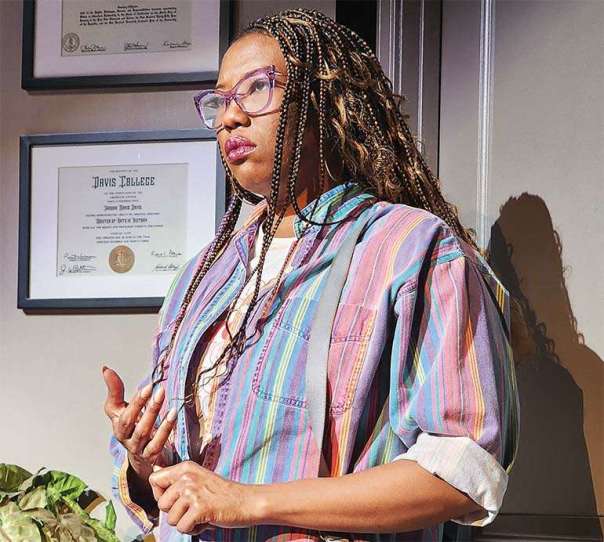
At both ends of the stage, Johnson gets to be a wily master of psychological warfare. Both Luanne and Jade want something vital from our protagonists. Luanne wants friendship from Sara and a path to freedom, but if Sara bars the way, she can work her charms on Abner. Needing Sandra’s endorsement, Jade doesn’t tiptoe around her differences with her superior, unleashing a torrent of scorn and chutzpah that took my breath away.
Indeed, Johnson unlocks Morisseau’s grimmest joke on her protagonists. Whether you’re at the bottom of the pecking order or at the top, you’re still the most oppressed person in the room. Times have changed, but not that much.
Sara is always being pulled at from multiple directions. Abner needs to be sewn back together, Missy Sue wants to recruit her as a spy, and Luanne wants her to plot an escape to freedom. Maybe that’s why the playwright stretched out Sara’s name to Sandra for the New Millennium! Our Professor is no less pressed upon, strongly urged to re-examine her grading philosophy, softly reassured that she is more admired than she really is, and arrogantly lobbied for tenure backing. Nobody seems to really care about the bare-breasted insult that was slapped on her office door.
Neither of these roles is fun-filled, but the challenges Sara and Sandra face allow them to grow in strength and stature before our eyes. Valerie Thames and Nonye Obichere are so fiery and authoritative in their separate roles that you can comfortably watch Confederates as two separate plays without constantly considering how meanings and brilliance bounce off the facets of the two gems. Not feeling compelled to track the finer points of Morisseau’s disquisition on racial or gender bias makes it all the easier for an audience to enjoy them.
Thames effortlessly takes on the self-assurance of an established TV guest whose knowledge and viewpoint are proven commodities, wearing Professor Sandra’s celebrity status with insouciant dignity. Just watch out when she bursts into flames! Maybe run for cover.
Although Sandra’s speeches frame the drama, Obichere gets to be a more physical presence as Sara – as nurse, spy, soldier, and lover – and she navigates a far wider character arc. Hers isn’t the funniest performance you’ll find this weekend at The Arts Factory. But it’s the most vivid, shocking, and memorable.
You may leave the theater convinced that both Sara and Sandra are depicted in that horribly racist slide. But it will mean more at the end than at the beginning. The magic of Morisseau and Photoshop are both at work.

August 19, 2023, Charlotte, NC – On the eve of the annual Charlotte Pride Festival & Parade, a series of LGBTQ+ events spread across the city in the coming week, Queen City Concerts has chosen a perfect moment to commemorate the Stonewall Riots of 1969, a watershed moment for gay liberation and empowerment. Best known for their resourceful reductions of big musicals to a more bare-bones concert format, Queen City has previously shattered their own template with a fine script-in-hand production of Tony Kushner’s Angels in America, Parts 1 and 2.
Three months later, after a return to form with Diana: The Musical late last month, the company has shown us that Angels wasn’t a fluke, staging the local premiere of Ike Holter’s Hit the Wall, a 2012 play with music that premiered in Holter’s hometown of Chicago before director Eric Hoff restaged his original Steppenwolf Garage production with a New York cast. That Off-Broadway production opened in the spring of 2013 at the Barrow Street Theater, not far from Christopher Park in Greenwich Village, where much of the original action went down.

Directing this concert version at The Arts Factory, J. Christopher Brown isn’t quite as resourceful or ambitious as he was with Angels in utilizing projections and costumes. Scenery and props are also less lavish, and there are no stage directions at all read aloud. With a rowdy rock trio roaring from one corner of the black box space, the experience remained richly visceral, though our awareness of where we are or who is speaking was sometimes delayed. We get an abbreviated staircase for the proverbial sidewalk stoop, where the “Snap Queen Team” of Tano and Mika hang out, and a couple of chairs occasionally appear.
Projections could have transported us inside the Stonewall Inn gay bar, but we only get the exterior, and a lamppost or a park bench could have transported us to Christopher Park more emphatically. It doesn’t take long to get the gist after scenes at these locations begin, but who is telling us in the opening tableau that “The reports of what happened next are not exactly clear”? Without a simple cop’s uniform on actor Nick Southwick, it takes a long while before we know how to digest this declaration.
Of course, a long while in a production that zipped through Holter’s script in less than 90 minutes wasn’t uncomfortably long. What Christopher continued to do extremely well was cut down on key moments when actors read from their scripts. For most of the production, actors were off-book and the booklets they clutched served as reminders of their cues rather than reading material. We were aware of the scripts onstage, but the flow of the action and the actors’ lively energy grabbed nearly all our attention. If anything, the occasional peep at a script reminded us how quickly and thoroughly this cast had mastered its essence with just a few rehearsals.

We should also understand that the sanctification of Stonewall over the past 54 years has partly happened as myth rushed in to fill in a vacuum of determined facts. It’s interesting to see the strategies Holter used to recreate Stonewall, chiefly by inventing a compacted community of fictionalized gay, lesbian, queer, and crossdressing people, from the neighborhood and from elsewhere, who gather at The Stonewall, owned by the mob but catering to this eight-person crowd.
As the Snap Queen Team, Lamar Davis as Mika and Zelena Sierra as Tano have attitudes, sometimes confrontational, about anyone who passes by. When Zachary Parham arrives as the queer Newbie, the Queens are not at all welcoming. But Holter’s style of hostility isn’t mean-streets raw or even ‘60s bohemian. Combats and putdowns come at us in the form of rap rhymes and poetry slams.

Aj White, arriving in high heels and a low-cut dress as Carson, is too much for the Snap Queens to handle despite his grieving over the recent death of Judy Garland. Yet he is visibly floored by the advances of lanky Neifert Enrique as the self-confident, draft-dodging, pot-smoking Cliff, a fatalistic drifter who assumes he will be dumped into the Viet Nam War the next time he is picked up in a raid. None of these core characters appear ripe for radicalization, though the tough Carson and roving slickster Cliff have agreed to meet at The Stonewall. Eric Martinez as the arrogant A-Gay further convinces us of the submissiveness that bonds the Newbie and the Queens. The Harvard grad lords it over all three.

Two catalysts for change are deftly stirred into the mix. Shaniya Simmons as Peg will combine with Carson in fomenting the police brutality at The Stonewall, and Valerie Thames as Roberta, an activist perpetually straining to draw a crowd, will finally be gifted with a galvanizing cause. Besides Southwick as the Cop, friction comes from Iris DeWitt as Madeline, a character who morphs from a concerned citizen to a disapproving sister. Music blasted by guitarist Daniel Hight, bassist Harley, and drummer Paul Fisher was most appropriate when we convened at The Stonewall and the bulk of our cast began to party.
Ironically, the music was most effective when it suddenly stopped as police commands triggered the raid. The music vibe and the slam poetry styling were shattered simultaneously. Soon we were in the ladies’ room watching the grim brutality. A little less riveting – but perhaps more emotionally fraught – was the climactic confrontation between the sisters after the raid.

Reports of what happened afterwards are unclear, but we do adjourn to the sidewalk stoop where the main point impacts the Queens who sit on it: there’s no turning back. Paired with Angels within three points, Hit the Wall reminds us that Kushner’s epic ended with a similar takeaway. The feeling that both dramas remain timely urgently underscores the fact that the Pride movement has more work to do.

After the morning press conference, there’s China, an international meeting on nuclear proliferation, followed by a photo op with blinded-and-maimed Iraq War vets, and a much-anticipated endorsement of a gubernatorial candidate somewhere out in the Midwest. Pretty typical day at the White House.
But in Selina Fillinger’s frenetic presidential comedy, POTUS, neither the man in the Oval Office nor the playwright’s viewpoint is typical. Fillinger made that clear in her subtitle, Behind Every Great Dumbass are Seven Women Trying to Keep Him Alive. At opening night of Charlotte Conservatory Theatre’s production of this romp, seven frantic women directed by Stephen Kaliski had their audience laughing nearly non-stop at Booth Playhouse.
It was the second consecutive Conservatory production that reminded many of us of the last resident company at the Booth, Charlotte Repertory Theatre, which expired way back in 2005. Members of Actors Equity are back in the mix, along with members of Stage Directors and Choreographers behind the scenes. Other professional groups are involved, including the local IATSE union and United Scenic Artists. Kaliski and Conservatory Theatre co-founder Marla Brown also harbor the long-term ambition of ascending to the highest rung of regional companies and becoming Charlotte’s first LORT (League of Resident Theatres) company since Rep’s demise.
Kaliski wasn’t behind the scenes for Conservatory’s debut at the Booth last August. No, he was onstage as a rather charismatic devil named Scratch in a surprisingly amorous faceoff with Elizabeth Sawyer. Jen Silverman’s Witch was the playwright’s fresh 2018 spin on The Witch of Edmonton, first staged in 1621, and Sawyer was a dramatization of a real-life woman burned for witchcraft earlier that same year. Brown wasn’t onstage in that “then-ish” setting, but her inclination toward making Conservatory a classics-flavored company definitely was.
With POTUS, it’s Brown who is taking the stage – nearly assuming the title role late in Act 2 as she prepares to take the place of her lookalike brother, the Prez, at a posh speaking engagement. Speaking with Brown for this story, I opined that the recent POTUS she most closely resembled was The Donald. Nope, she countered, it was Obama.
You can decide who’s right. For the Conservatory Theatre production, after closing at the Booth several weeks ago, reopens at the new Cain Center in Cornelius for another three-performance run on April 26.
Until her shocking transformation into formalwear, Brown as the drug-dealing presidential sib Bernadette looked to me like a punkish Rob Roy on the skids. Here Brown and I are in much closer agreement, since she has proclaimed, “I got that role because I can rock shorts that are hideous.”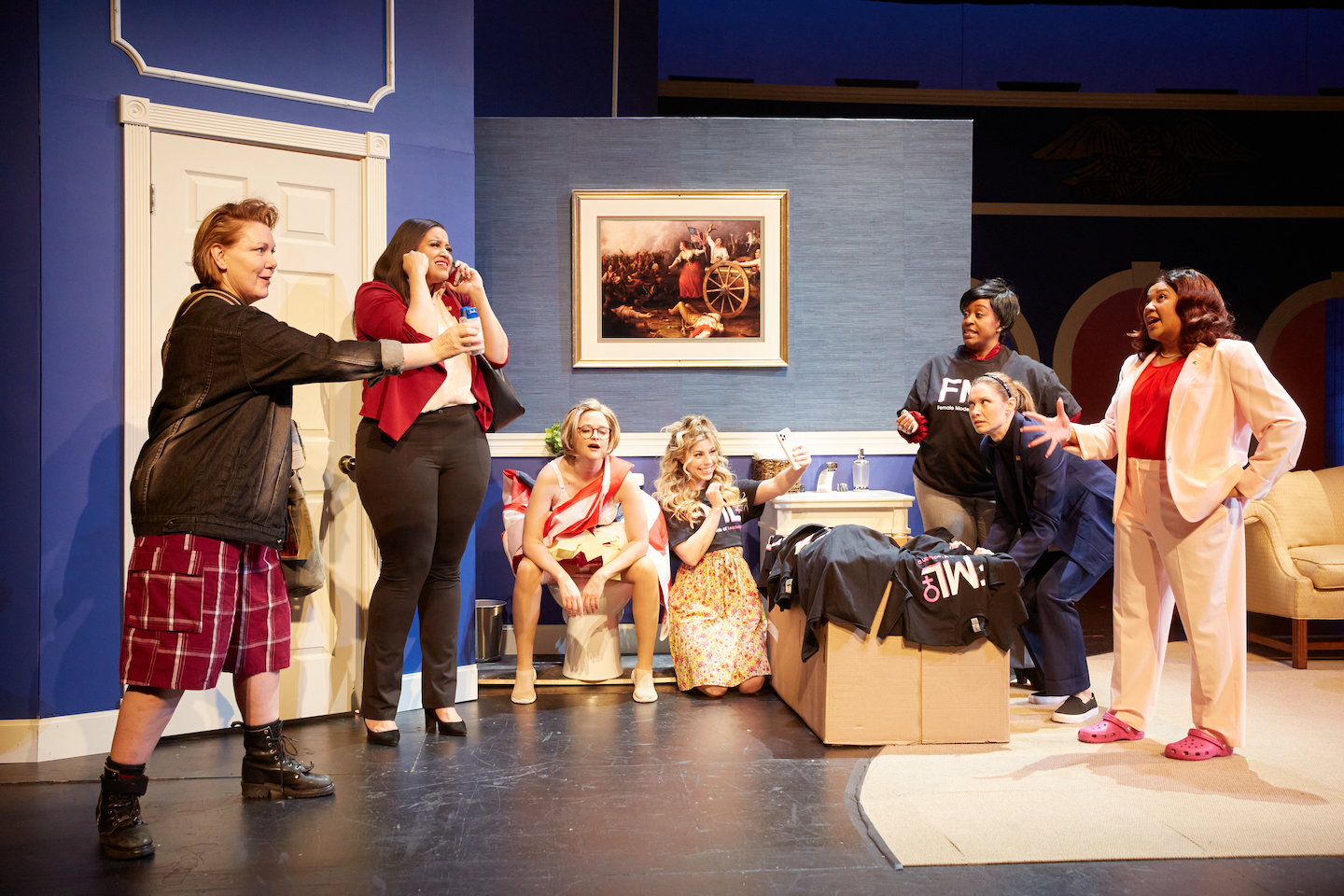
Yet Brown’s shorts may not be the most bizarre or hideous thing we saw at the Booth in POTUS. Iris DeWitt as Chris, a beat reporter fishing for a scoop, multitasked by sporting a pair of noisy breast pumps that reminded me of football fan craziness, helmets retooled to hold beer cans emptying into drinking straws. Katy Shepherd as presidential secretary Stephanie may be the queen oddball. After unwittingly sampling an overdose of Bernadette’s merchandise, Steph goes so far off the rails that, by intermission, she’s prancing around the West Wing dreamily with a pink swimming pool floating around her waist.
The zany, comical mayhem that brings POTUS to the end of Act 1, with all seven women in action and Chris somehow stealing focus from the ever-twirling-and-spacey Stephanie, is the closest equivalent I’ve seen in many years to the explosive circus that engulfs the stage at the second intermission of George S. Kaufman’s You Can’t Take It With You. And that fizzy moment was the only time in Fillingers’ comedy that I caught anything like a whiff of classical flavor.
Conservatory’s swerve from classicism has been both intentional and fortuitous in terms of POTUS coming here and moving up the road to Cornelius.
“We want to leave our options open in these early days,” Kaliski says, “so there was a consideration early on of, okay, we’ll always do something that has some sort of anchor in a classical story. Right now, the aesthetic we’re landing on is, you know, how can we be that company? The plays in New York that are either your non-touring Broadway shows or prestige Off-Broadway shows – we want to be the group that picks a lot of those off and brings them to Charlotte. And I think Actor’s Theatre filled this role.”
Yeah, it’s clear that the closure of Actor’s Theatre rocked this town – arguably harder than the shuttering of Rep, which left CAST (Carolina Actor’s Studio Theatre) and Actor’s Theatre in its wake. Now? We’ve devolved into a bunch of small black box theatre outfits, counterbalanced by the bigger BNS Productions. They all produce consistently fine work, but none of them can be called “that company.”
Actor’s and CAST hardly messed with the classics at all. BNS, when it isn’t producing works by its founder, Rory Sheriff, mostly does the classics by August Wilson. So there’s definitely a niche for a major company in Charlotte that plans to straddle recent hits and the classics. Or any major LORT company at all, since we’re probably the largest US market without one.
Even in its beginnings, Conservatory is flipping the script written by Queen City theatre behemoths that perished in the past. Whether suddenly or gradually, Rep, CAST, and Actor’s all disgorged their founders through actions of their boards of directors, who then proceeded to dissolve their companies – without alerting the public that they were in crisis, let alone appealing for aid.
Having founded The Warehouse up in Cornelius in 2009, Brown and her board have not liquidated her brainchild. Utilizing Warehouse’s non-profit 501c3 credentials, they have rebranded as Charlotte Conservatory, upsized their mission and ambition, and – here’s a twist – amicably disbanded their board.
“I love that space very much,” Brown still says of The Warehouse. “But I also knew that after ten years, if I continued to produce there, I would regret it. Because Charlotte has seen such a de-evolution of theatre since Rep’s demise, and such a de-evolution of our talent pool. Anybody who works on a professional level or who understands the craft either has to do it for very little money or they have to teach and then do it at theaters, other LORT companies at other cities, or they work for Children’s Theatre only.”
In the wake of COVID, which gave theatre companies plenty of time to pause and reflect; and in the wake of We See You, White Theatre, a scathing BIPOC indictment of American theatre companies’ lack of inclusivity; Conservatory Theatre is intent on being more open-ended – and more open-minded – as it continues to take shape.
Neither cliques nor permanent positions have formed as Conservatory blazes its new path.
“We didn’t start with, okay, here’s our artistic director and the managing director, and here’s our director of development, etc., etc.,” Kaliski explains. “We didn’t start with a typical organizational structure. We were kind of thinking, all right, we’re a collective in this room together, and we’re going to take it project by project to start, and each project can have its own set of showrunners, if you will, kind of like a TV show. And they’ll be in charge of that, and then we’ll kind of have a different group of showrunners or a different producing pod for the next one.”
That kind of inclusivity has allowed Kaliski and Brown to reach out, in Conservatory’s formative phase, to Matt Cosper, who still cranks out XOXO productions, and playwright/actor/director Brian Daye, a former member of the Warehouse board. Nor is this core group and others limiting their horizons to the Booth Playhouse and the Cain Center, especially since Conservatory doesn’t have the kind of sweetheart rental deal the would come with official residency at either venue.
Mint Museum, the Stage Door, and the new Parr Center are all in play for future reconnoitering and producing, along with whatever the epic renovation of Uptown’s Carolina Theatre winds up offering. Meanwhile at Cain Center, whose stage does not sport a fly loft, there’s a mutual feeling-out process as both newbie organizations find their bearings.
Both Brown and Kaliski were surprised and delighted that rights to perform POTUS became available so soon after the Broadway production closed last August. Many in their circle presumed there might be a national tour in the offing. But POTUS doesn’t make the most discreet or decorous entrance for a Cornelius audience, that’s for sure.
Brown had some trepidations when she approached Cain director Justin Dionne. “Okay, Justin,” she remembers thinking, “you understand that the first word is the C word. And I know you don’t want people coming and going, ‘This is not what we built the Cain center for.’” She squeals in a high falsetto, half-relishing this possibility.
Yes, before Fillinger’s action even begins, POTUS has used this word at his morning presser – in describing the First Lady, no less. In her presence. He doesn’t know she’s there, due to a couple of additional plot points – one, we’ll learn, involving anal sex – so he explains her absence by saying, “She’s having a cunty morning.”
So Valerie Thames as chief of staff Harriet opens the show by storming onstage and exclaiming the offending adjective in its root form. Instantly radiating dignity, morality, and competence – qualities that will not be attributed to POTUS – Thames authoritatively dumps this crisis of the day in Jean’s relatively cool hands. Slim and conceivably serene, Jennifer Adams as POTUS’s beleaguered press secretary wastes little time in convincing us that poor Jean likely holds the most combustible burnout position in the West Wing.
Harriet and Jean are the women most seriously invested in keeping the dumbass alive and the most adept at getting the job done. This often involves prodding Stephanie, quite intelligent beneath her scared-rabbit exterior, into action. Bernadette, ankle monitor on her leg, is also very interested in keeping her brother alive, if for no other reason than her nefarious enterprises will ultimately require a presidential pardon.
“Harriet,” Jean memorably informs Bernadette, “is the number one reason this country continues to function.” By this time, Jean has perpetrated a monumental screw-up of her own.
Wielding a blue slushy, Sarah Molloy makes an entrance as Dusty that rivals Harriet’s, rushing across the stage to vomit into a trashcan. Not the subtlest indication you’ll ever see that somebody is pregnant. Yet the West Wing brain trust struggles to put two and together. Bernadette sees it all rather quickly, though. You need to be truly family to understand POTUS.
Iesha Nyree as The First Lady sizes up Dusty nearly as quickly as his sister-in-law. Assailed by presidential insult and infidelity, Margaret is also complicit and invested in her dumbass husband’s political machinations. Never playing a victim card, Nyree makes Margaret formidable and conflicted. But while Fillinger flips the meaning of her subtitle upside down, hinting that impulsiveness and incompetence aren’t confined to POTUS or his gender, she spreads the inner conflict around: lurking among these ladies are two lesbians who will consider rekindling the old flames that once blazed secretly on the campaign trail.
“At least three of the characters must be women of color,” Fillinger prescribed in her script. “Actors can be cis or trans. Age is flexible. Beauty is subjective. So long as they’re fast, fierce, and fucking hilarious.”
Kaliski, Brown, and Charlotte Conservatory Theatre checked all of those boxes at the Booth. True, POTUS is a bit lightweight and more than a little over-the-top. But if you missed it in Charlotte, it’s worth the trip to follow this production up to the new Cain Center. Seeing how it all goes over with the Cornelius crowd might be an extra treat.
The question that he frames in all but words
Is what to make of a diminished thing.
–Robert Frost, “The Oven Bird”
Since their return to live performance last October, Three Bone Theatre has been contracting and then expanding as they adapt to The Arts Factory, their new base of operations on W. Trade Street. They were breathing in at first, perhaps, with a compact one-woman show, and now they’re breathing out. Open was smaller in every way than either of the two productions Three Bone had streamcast during the QC’s lockdowns, Prisoner 34042 and their New Black Playwrights Fest. Smaller cast, shorter running time, and probably smaller audience.
From what I’ve been able to discern, each of Three Bone’s 2022 shows has been bigger, longer, and better attended than the one before. With Lucy Kirkwood’s The Children back in March, we saw a larger cast, a longer show, and actual scenery. Meanwhile, armed with masks and vaccination cards, more theatergoers seemed ready to venture out into the night to see a relevant post-apocalyptic drama.
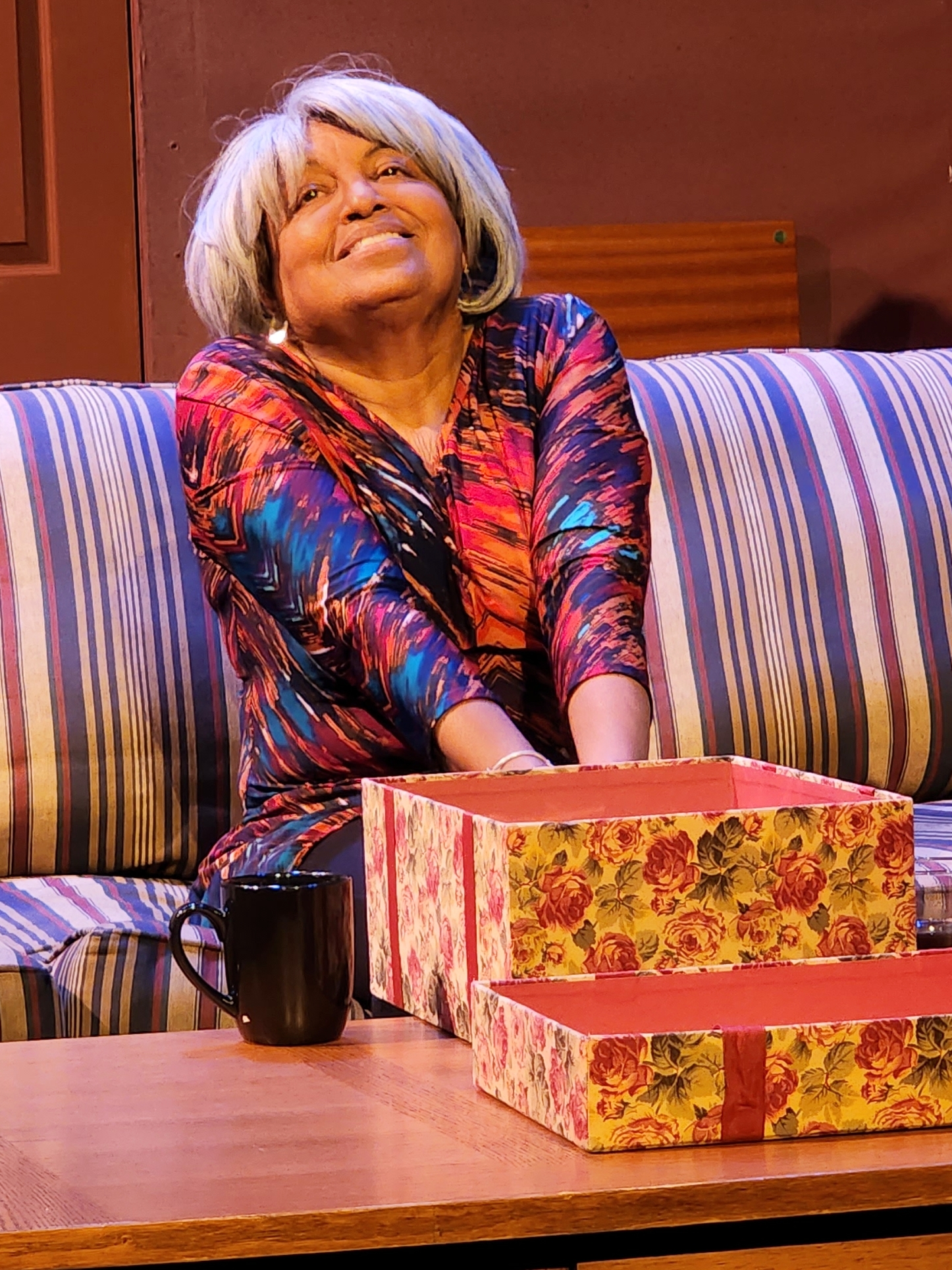
Colman Domingo’s Dot detains us longer and offers us more characters to consider, though it’s clear that Philadelphia matriarch Dottie Shealy is far and away the one that we – and her three children – should be most concerned about. It’s the Christmas holiday season in Philly, a time when the children converge around a tall spruce tree with enough lead time to collaborate on the decorations. Shelly, the eldest and a lawyer, is holding down the fort while her sibs, Donnie and Averie, have the freedom to flounder in their careers.
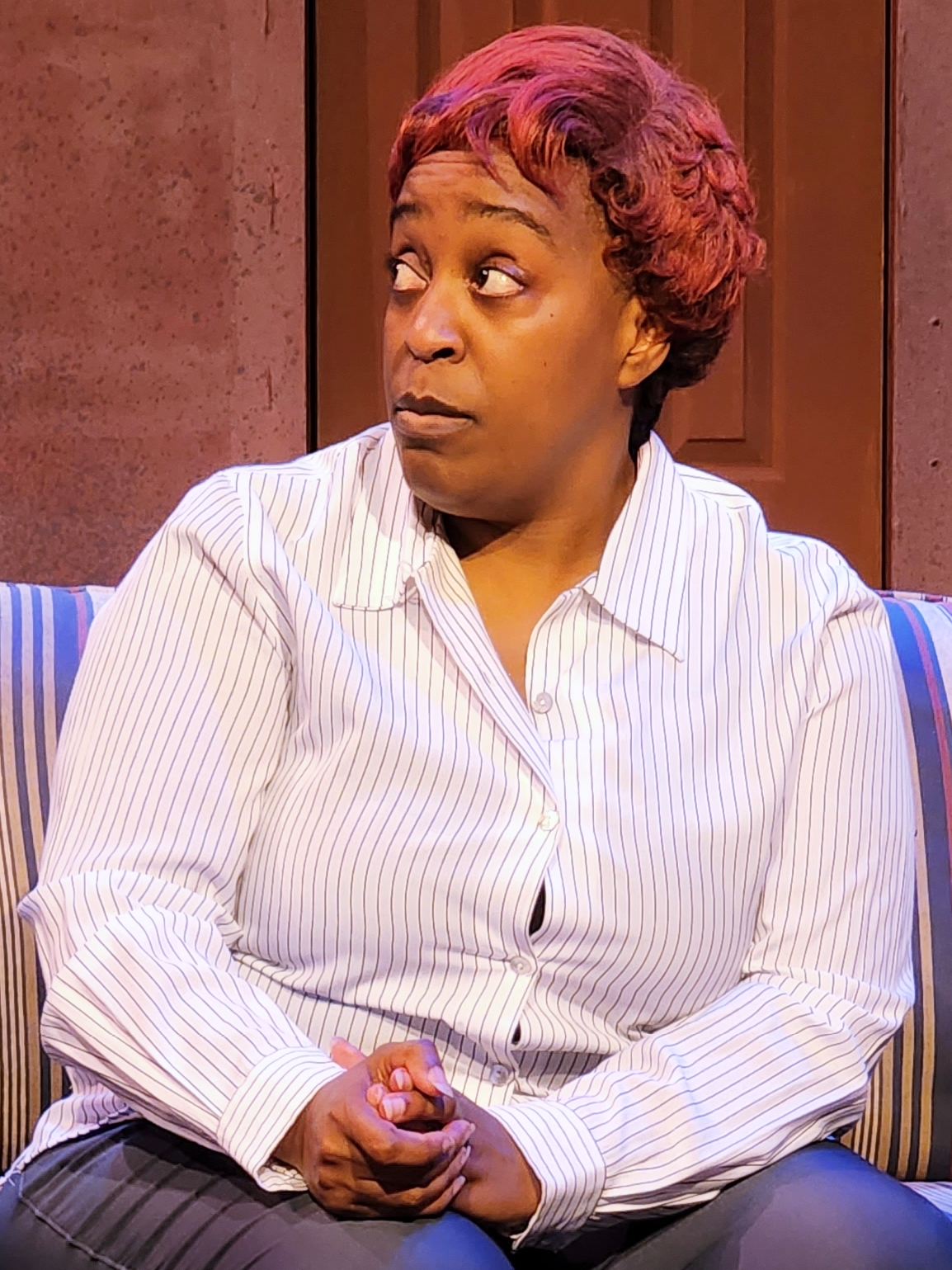
Shelly rightfully feels that she must watch her mom like a hawk. Ever since Dotty was hauled into a local police station after speeding at 95mph, unthinkable anywhere near Philly, Shelly has been unsure what bizarre lapse Mom might have next. With the onset of dementia and a diagnosis of progressing Alzheimer’s, Dotty shuttles between the self her children have always known and somebody prone to forgetting names and events, losing track of where she is and what time it is, or coming back from her kitchen with a bag of Oreos instead of the salt she went in for.
Unable to keep tabs on Dotty around-the-clock, Shelly has hired a gentle young Indian man, Fidel, to help her out. But Shelly is out of patience and out of her depth, so she has become a bit bossy and toxic. Not only has she hidden Mom’s car keys, she uses her disorientation to trick her into signing legal papers she doesn’t understand and going to bed in the middle of the day. Calling for a family conference with Donnie and Averie deep in Act 2, she locks Dotty in her bedroom, astonishing her sibs. Convinced that Mom is planning to kill herself – driving around at 95mph is a serious symptom – Shelly has also developed a paranoid attitude toward Fidel, suspecting him of helping Dotty to hatch her plan.
Woven into all this dramatic intrigue – and all of Shelly’s questionable choices – you’ll find that Domingo has provided plenty of opportunities for comedy. Shelly’s deceitful and aggressive coping mechanisms compromise her character for us long before her sibs arrive on the scene. So we can see why Donnie and Averie would both impugn her credibility and resent her bossiness, no matter how stressed she may be. Aside from that pushback, Dotty can be quite formidable herself when she’s lucid, with quite the sharp tongue on her.

Perceptive, too. She could always see that Donnie was “gay as giftwrap,” even before her daughters knew. Nor is Dotty totally blind to her own decline, despite all the resistance she puts up against Shelly. It’s hard to believe that Dotty would off herself on Christmas as a reaction to her own deterioration, when all the family is gathered ‘round, but there is definitely something secretive about her interactions with Fidel.
Navigating Dotty’s mood swings, mental lapses, and surreptitious plotting takes a performer over some tricky terrain, requiring sudden hairpin turns; but if you saw Lillie Ann Oden as the wary, savvy, and pragmatic wife in The Children, you’ll likely have little doubt that she can tackle this black Philly matriarch. With Corey Mitchell back as director, after an all-too-common two-year hiatus from the local scene, you might find that Oden still exceeds your high expectations with her saltiness, her increasing confusion, and her sheer naturalness.
While Dotty and her struggles are comparatively fresh onstage, experienced actors and theatergoers will likely recognize the regathering sibs as somewhat formulaic. It won’t be the first time we’ve seen one of a set of sibs turn out to be disagreeably disapproving and controlling, nor will it be a shock to see a sister or brother who is insouciantly adrift, unsettled, charismatic, and irresponsible. Kookiness is often in the mix. Domingo takes pains to give Valerie Thames as Shelly, Marvin King as Donnie, and Nasha Shandri as Averie distinctive personalities and detailed backstories for them to inhabit.
You’re still forgiven if you occasionally find yourself feeling that these capable actors are filling in time-tested sitcom slots or a template lifted from Crimes of the Heart and skillfully refurbished. Thames gets to switch during intermission from a pineapple hair color to a bright raspberry, signaling that she may be the responsible sister but has no intention of remaining anonymous – at the same time showing us that Shelly can be vulnerable, sensitive to Mom’s criticisms.
Long before Shandri has made her first entrance, we’re aware that Averie is the most outré and unbridled of the Shealys. Yet we’re very quickly aware that there’s a loving, conciliatory core to Averie. Over and over, we see that the estrangement between the two sisters is strictly one-sided. It’s Averie who counsels Shelly, with full persuasiveness of a sister, that changing hair colors isn’t quite the right path. She must ditch Andre instead, her hairdresser. Off-handedly and gradually, Shandri and King reveal to us that Shelly undervalues both her sibs.
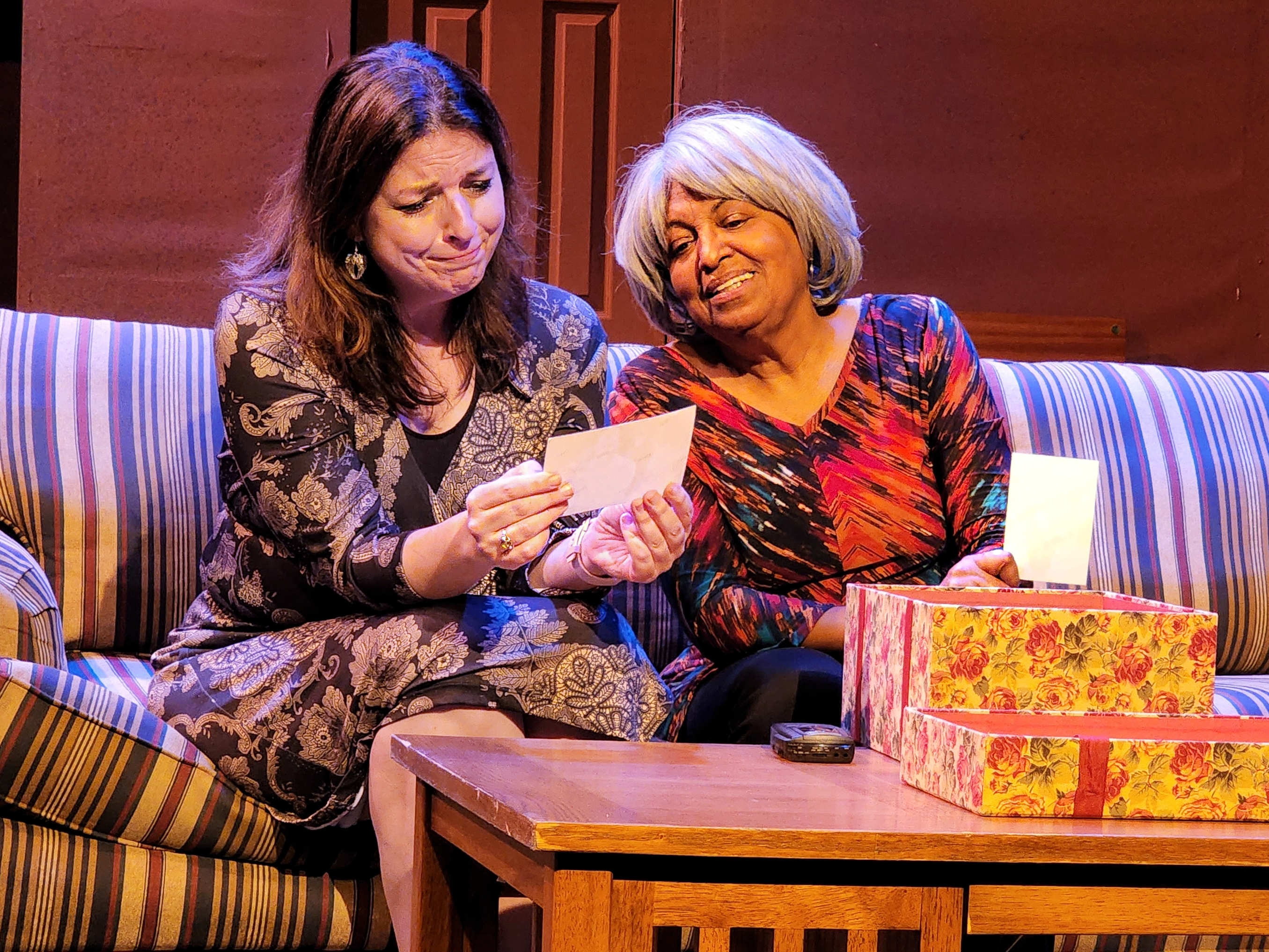
Likely an autobiographical creation from Domingo, Donnie is the sibling who most breaks the sitcom mold. King is a moderately daring casting choice from Mitchell, not reminding me of giftwrap at all, but he’s immensely likable without hardly trying. Although he never earmarks him as his parents’ favorite, Domingo clearly designates Donnie as the most beloved of the Shealys. Two additional characters are devoted to double-underlining this point, Tommy Prudenti as Donnie’s husband and Amy Dunn as his high school sweetheart.
Jackie, still carrying a torch for her old flame (among other things), is a useful character from the very beginning, long before she tries to come between Donnie and Adam. Frank conversations between Dotty and her children seem to have ceased years before her current aging crisis, and as the houselights go down, Shelly and her mom have no plausible reason to exchange information about each other that we need to know as quickly as possible. Jackie’s coming back home and catching up with her old flame’s mom, after years away in New York, opens up windows for us into what’s happening with both Dotty and Shelly.

Dunn’s slant on Jackie takes into account that she is not at all opposed to homewrecking, so she can be a bit brash and irritating, though she usefully questions the crueler aspects of Shelly’s caretaking. She brings out a lot from Dottie and Shelly in the beginning, but it’s Prudenti as Adam who really brings out the best in his mother-in-law, unexpectedly reminding her of her dead husband. Due to his marital issues with Donnie, we get to feel that we know Donnie nearly as well as Dottie and Shelly, though Domingo overestimates our interest in seeing them sort out their love lives.
Both Jackie and Adam, interestingly enough, are white, so there’s a refreshing lack of racial tension in Dot, though the meanness of Philly’s inner city lurks plainly enough in the background. In fact, Jackie is Jewish, further broadening the palette. In these matters, Domingo is most subtle, for there is a shared prejudice against Fidel among the younger Shealys, leading them to underestimate the foreigner, either through unwarranted suspicion or dismissiveness. Our dear Dottie is the first to properly gauge his intelligence and worth.
In his theatrical debut, computer science grad student Satheesh Kandula gives us a marvelously mild account of Fidel, diffident and polite but not at all servile. Kandula is hardly a credible target for xenophobia, but we’re not terribly surprised to see it happening – and it might give us pause if we consider the possibility that Fidel may understand Dottie better than anyone else onstage. What he and his co-conspirator wind up concocting for Christmas turns out to be the best lesson of the night.
Only Jackie calls Dottie “Mrs. Shealy,” and absolutely nobody presumes to call her Dot. So why is that Domingo’s title? I’ve yet to read a review that mulls that question over, though I consider the answers – pragmatic or literary – worth pondering. “Dottie” might hint too broadly that Domingo’s protagonist has gone crazy, a matter that the playwright would surely prefer to remain ambiguous.
The other reason for the title is about what Domingo does wish to say. He’s using the diminutive of Dorothy and Dottie to emphasize that Dottie, in her drift toward dementia and Alzheimer’s, is becoming different, “a diminished thing” as Robert Frost would say. At the same time, she remains the same. That’s the main point of Dot.

It’s been over three years since Actor’s Theatre of Charlotte actually staged their previous nuVOICES NEW PLAY FESTIVAL, but it may not seem like that long to fans of the company and fans of the festival. For one thing ATC commits to presenting the winner of the festival – as selected by audiences and/or a panel of judges who attend staged readings of the plays – in a full-length production the following season. ATC was unusually generous toward the four playwrights whose plays were read in 2016, for two of their works were presented two years later at Queens University in 2018, Meridith Friedman’s The Luckiest People in January and David Valdes Greenwood’s The Mermaid Hour last May.
Although nuVOICES languished for the next two seasons, ATC remained productive, managing to stage four shows during the 2016-17 season while landlords, landowners, and city inspectors screwed over them. Queens University opened their arms to the wanderers in the spring of 2017 as they searched for a new home, and by the start of 2017-18, the 30-year-old ATC became the university’s resident theatre company. Stability! For ATC’s fans, seeing the resumption of nuVOICES has taken a backseat to the satisfaction of their survival.
Well, in one respect, nuVOICES was not only back but better than ever, for the fifth edition of the festival won a sizable grant from the National Endowment for the Arts. The influx of NEA support seemed to raise the technical polish of the staged readings somewhat, for the handiwork of sound designer Kathryn Harding and lighting designer Evan Kinsley occasionally came into play.
Although seven of the 13 festival script readers were men, all four of the chosen scripts at nuVOICES 5 were by women. Yet there was plentiful ethnic diversity among the characters the playwrights presented onstage – and among the playwrights themselves.
First up was Nora Leahy’s Girl with Gun, a one-woman show starring Caroline Renfro as Lynette “Squeaky” Fromme. We caught up with Squeaky on Christmas Eve 1987 shortly after her escape from a prison in West Virginia. When apprehended, she had been on her way to rendezvous with Charles Manson, imprisoned (and seriously ailing) across the country in the California State Pen. Now as she speaks, occasionally to an unseen guard but usually to nobody in particular, she’s being detained at a ranger station, awaiting transport to Fort Worth.
We learned a few things about Squeaky that I hadn’t known, including her appearance as a kid on the Lawrence Welk Show, how she got her weird nickname, and that her bad behavior in prison also included bludgeoning a fellow inmate with a hammer. In the talkback after the show, conducted as a video call with a big-screen monitor, the playwright revealed that her play had been commissioned as a historical portrait and that she is thinking about adding 20 minutes to its current 55-minute length.
In their staged reading of Themba by Amy da Luz with Kamilah Bush, nuVoices broke with precedent by not having any talkback at all. Both the playwright and dramaturg were in town, making themselves available for a pre-show interchange with festival director Martin Kettling. A bad idea for numerous reasons. People who hadn’t already seen Girl with Gun at 6pm would not have gotten word that the customary playwright powwow was happening before the 9pm performance of Themba and not after. This likely deprived them of actually seeing the pre-show before Themba and definitely robbed them of their chance to have their questions answered afterwards. Or simply voicing their reactions.
Of course, the Bush-da Luz team also missed out on getting feedback from this Thursday night performance, though they would get a second opportunity at the twilight performance on Saturday. Really, the process should be uniform for everyone involved – audience, performers, and playwrights. If you’ve written a play that gets a nuVOICES reading, you should be able to commit to appearing in person at talkbacks.
Da Luz changed the title of her play after ATC announced their final four, so her team clearly viewed their time in Charlotte as part of a developmental process. Like Leahy’s study, Themba was a docudrama, oozing with personal stories and intensive research. At the unseen vortex of the story was Lola, a young African girl who is the beneficiary – and/or victim – of a missionary adoption in war-torn Uganda, which may not have been legal. That question comes up in a roundabout way after the adoptive father has died and his two sisters, evangelical Mary and theatre director Sarah, wrangle over who should get custody.
Ah, but the story doesn’t remain centered solely on the white adoptive family. To fortify her claim, Sarah brings her partner Fran, a Black playwright, into the fray. Fran sees that she’s being used, wonders how the father was approved, and begins to probe into the process, asking the Black adoption official Jelani some pointed questions. The probe widens, becomes a formal government investigation, and the four young women who have been lurking in the wings – until now detached from the main action but intermittently interrupting it to tell their stories – suddenly become factors in the main plot.
The four are certainly not a homogeneous group. Recognizing that they were likely rescued from poverty, slaughter, or disease, they are not universally comfortable with Christianity or the USA. Some of them are as antagonistic towards Jelani as Fran was – and the young women vented considerable animus toward each other. We had a lot to think about after Themba. In the nine-person cast directed by Heidi Breeden, Stephanie Gardner as Sarah, Lisa Hatt as Mary, Valerie Thames as Fran, and Angela Shannon as Jelani drew the juiciest roles. Nonye Obichere as an adoptee and Dennis Delamar as the sibs’ preacher dad delivered the tastiest cameos.
Friday night’s schedule went off without any further rule-breaking, beginning with Mingus, a two-hander by Tyler English-Beckwith. The basic structure reminded me fairly quickly of David Mamet’s Oleanna, with newcomer Amberlin McCormick portraying B Coleman, a college student who comes to the office of Harrison Jones, a distinguished professor of black studies portrayed by Ron McClelland. B hopes to get a letter of recommendation from Harrison and an assessment of an essay she’s planning to submit for a prestigious award.
Harrison’s acceptance is conditional. He’ll write the letter if, with his help, she sufficiently improves her essay. Thanks to Rory Sheriff’s crafty direction, we had to go very deep into this play trying to figure out who was exploiting whom, maybe misreading signals about who’s in love with whom and how that will ultimately affect their relationship. In Mingus, Harrison’s past is referenced in the title, for he aspired to play the bass like his jazz idol, Charlie Mingus, before joining the Black Panthers and being forced to alter his dreams. It may also serve as a marker for the spot where he allows his professional relationship to become personal. As in Oleanna, the student takes formal action against her mentor, but for most of us, I suspect the reason was a surprise. Final score: #MeToo 1, Patriarchy 0.
Last up was the most bizarre and comical of the nuVOICES 5 plays, Diana Burbano’s Ghosts of Bogota. Reunion plays are certainly not a rarity, and the friction between the two sisters, Lola and Sandy, was very much in the cosmopolitan-vs.-judgmental vein we had seen the night before from Sarah and Mary – with a generous sprinkling of Latinx spice. Only here the reunion is transcontinental, the Spanish-speaking sisters returning to their parents’ hometown in Colombia with their younger nightlife-loving, sleep-averse brother, who knows very little Spanish at all.
Ancient history bubbles up in Bogota as they prepare for the funeral of their grandfather. The old man, Lucho, was not beloved by any of the siblings, and he repeatedly abused Sandy. She needs to see the predator buried physically and spiritually, facing off with his ghost. Meanwhile Lola is upset because she feels she should have known what was going on and should have protected her younger sister. The ghost she needs to exorcise is her grandmother Teresa, the knowing enabler. Lucho may not be a nuanced pervert, mostly snarling when he appears, but Teresa, a product of her upbringing, is a different story.
Aside from the petty squabbles between drama queen Lola and prissy resentful Sandy, what tips this drama toward comedy is the living-the-dream insouciance of Bruno, who registers such hardships as Internet deprivation, and the scene-stealing exploits of a very lifelike head in a jar. Nothing can go terribly wrong with Creepy Jesus on the case. Kudos to Adyana De La Torre-Brucker as Lola, Glynnis O’Donoghue as Sandy, and newcomers Neifert Enrique as Bruno and Grant Cunningham as Jesus. Director Adrian Calabrese also made an auspicious debut.
nuVOICES 5 was presented at Queens University as a pay-what-you-can event, and by Friday Evening, Hadley Theatre was teeming with festival enthusiasts. An outdoor Midsummer Night’s Dream will run on the campus quad beginning on August 12, and ATC’s 31st season will begin with Silence! The Musical on August 15. The talent onstage at Hadley last week and the technical artistry behind the readings served as compelling inducements to check out those upcoming productions.

Down in Dallas, Fun House Theatre producer Bren Rapp and her co-founder, artistic director Jeff Swearingen, don’t do children’s theatre the usual way. The children at Fun House are the actors onstage and not necessarily the target audience. So when Rapp looked for an inspiration to challenge her students, David Mamet’s Glengarry Glen Ross wasn’t too far of a stretch. To translate the Darwinian struggles of real estate salesmen embroiled in a monthly sales contest into terms her actors could identify with – an annual Girl Scout Cookie drive – Rapp leaned upon Swearingen’s play writing skills.

The result in 2013 was a Dallas-Fort Worth theatre legend: The Daffodil Girls. In a further mutation five years later, Three Bone Theatre is currently premiering the first all-adult production of Swearingen’s script at Spirit Square.
Make no mistake, this is thoroughly Swearingen’s play, not just a servile rechanneling of Mamet’s testosterone-driven, potty-mouthed arguments through the lips of innocent preteens. Plot and dialogue only faintly echo Glengarry most of the time, language is relatively cleansed, and beware: complete sentences lie ahead. Another way to view the difference is to note that Swearingen lets plenty of air into the relatively claustrophobic world of Glengarry. Mamet only gave us three two-handed scenes before intermission. Swearingen admits more characters – and more of the world outside of the Daffodils’ treehouse.
According to Willa, who parallels Mamet’s Williamson, the entire Daffodil chapter has been endangered by their slumping cookie sales, not just the low person on the totem pole. Even before Shelly’s quest for hotter leads, in a humiliating confrontation with the officious Willa, we find Swearingen modernizing the story and infusing fresh air into the competition. Shelly is outdoors as the lights go up, on her cellphone first with her mom and then her dad, pleading with them to help boost her numbers.
Opening up his story, Swearingen doesn’t ease up on the stress that Mamet plunged us into, but he does manage to instantly wrap that stress into a more juvenile mindset. Parents at the Duke Energy Theater can only sigh. The Daffodils’ cookie quotas merely weaponize our children’s pre-existing propensity toward clinging, dependent querulousness, and cellphones help it go nuclear.

When she isn’t consulting her rules and charts – or obsequiously receiving Blayne, the regional Daffodil emissary with the motivational charms of a drill sergeant – Willa seems to live next door to the troop’s treehouse. All we see at stage right is Willa’s housefront, enough for her to peep out of and defer to parents lurking within. Flanking the treehouse interior in Ryan Maloney’s set design, a Peanuts-gone-to-seed affair, is that pillar of preteen commerce, a lemonade stand (with a crayon rental side hustle). There we will find Raimi, the top-selling Daffodil, closing in on a high-gross sale to hapless, sickly Jenny Link, who may be allergic to every ingredient in those cookies.
Raimi is modeled on Mamet’s sales ace, Roma, who circles his prey, Lingk, ever so circumspectly in the last Chinese restaurant scene of Glengarry prior to intermission. The real bridge to Act 2 in both dramas is the discussion about ransacking the sales office, ostensibly for cash and receipts, but really so the desperate accomplices can get their hands on those hot sales leads that are guarded so closely. In Glengarry, the conspirators were Dave Moss and George Aaronow, with Moss as the intimidator. Here the crooked bullying malcontent is Dana, bullying a kindergarten neophyte, Georgina.
Casting the women who will regress into girlhood in daffodil-colored uniforms, Three Bone director Amanda Liles leans on size in her casting when we need to differentiate between their purported ages. Layla Sutton as Dana towers over Kitty Janvrin as Georgina, conjuring up a Trunchbull-Matilda contrast more readily than any relationship Mamet set down. You’ll notice a similar disparity between the imposing Iris DeWitt as Blayne, the regional enforcer, and the comparatively petite Iesha Nyree as the deferential Willa.
Rather than playing down these contrasts, Liles encourages her actresses to play them up. Among them, Nyree gets the best opportunity to surprise, for Willa may be a worm and a suck-up, but she’s a cunning one, and her moment will come. In proving that crime doesn’t pay, Nyree gets to unleash a volcano of pent-up emotion that is quite consonant with Willa’s customary sliminess, but she only briefly wrests our primary attention away from the girls at the opposite ends of sales totem pole.
Kerstin VanHuss as the pathetic Shelly and LeShea Nicole as the regal Raimi give the performances you’ll remember longest. If Shelly would sweeten up, stop acting so spoiled, and show a little more initiative, she might shape up as the sort of underdog you could root for, like the chubby Tracy Turnblad in Hairspray. Yet in her pluckier moments, Van Huss succeeds in making this mopey, self-pitying Shelly more appealing than any of Mamet’s predators, so I did find myself rooting for her late in the action despite my better judgment.
Raimi oozes all the self-confidence, superiority, and staunch entitlement that Shelly lacks, and Nicole makes her so very slick, patient, and condescending as she sets about fleecing poor Jenny for over 20+ boxes of toxic cookies. The fruits of Raimi’s finesse make her a victorious queen when she finally deigns to return to the ransacked treehouse. Nobody is taking away her damn pony party, the prize that goes to the troop’s top seller, and you can hear Nicole playing the race card as she proclaims this – slapping that card down on the table with gusto, absolutely shameless. As in previous Nicole stage exploits, she’s intensely eccentric and laugh-out-loud funny, sometimes without even saying a word.
Of course, Nicole’s imperious cruelty is greatly augmented by the immense frailty of Valerie Thames as Jenny – though it must be said those breathing tubes sprouting from her nostrils give her a head start. To a lesser extent than Nyree as Willa, Thames will acquire the beginnings of a backbone in the Act 2 denouement when Jenny finally gets a word in edgewise.
Similarly, it isn’t just Willa who nudges us toward empathizing with Shelly. After her cameo as Blayne, DeWitt returns to belittle Shelly, her cookies and her Daffodils uniform as Lisa, a preppy girl who acts like giving Shelly the time of day is more than sufficient charity. Rounding out the cast is Tiffany Bryant Jackson as Cora. Mostly quiet as she runs the lemonade stand before intermission, Cora turns out to have quite a bossy streak in the heat of the great burglary investigation.
Maybe the biggest surprise in Swearingen’s fun-filled riff on Mamet’s Glengarry Glen Ross was how much plot and action the Dallas playwright squeezed into a script whose running time didn’t quite reach 80 minutes. Amazing what you can do with short speeches and complete sentences.


 Art on My Sleeve