Tag Archives: Tom Schrachta

“Sex, Lies, and a Sycamore Tree” Almost Goes for the Jugular

Review: Sex, Lies, and a Sycamore Tree

By Perry Tannenbaum

Away somewhere in Sycamore Grove, a subdivision in the burbs of a certain fast-growing New South city in the Carolinas, there’s a diversity problem. For the McLeans and the McDaniels, lily-white next-door neighbors in playwright Elaine Alexander’s new comedy, Sex, Lies, and a Sycamore Tree, there’s still too much of it.

Owners of an ostentatious year-old McMansion that the pushy missus already plans to expand, the McLeans project an image of wealth that clearly intimidates Tracy McDaniels as she enters her neighbor’s posh patio for the first time. She’s an English teacher who has lived in Sycamore Grove with her carpenter husband, Rick, since long before Hugh and Ali arrived next door, refugees from California’s wildfires, mudslides, and property taxes.

They don’t fit in.

The McDaniels can remember when the subdivision actually resembled its name, with more modest ranch houses like theirs and many more trees. On one memorable occasion, Tracy cussed out the greedy real estate developers who were heartlessly bulldozing the signature sycamores at a city council meeting. Now their sycamore is the only one left.

Alexander herself is directing the world premiere of her new script at The VAPA Center in the Charlotte’s Off-Broadway black box – a perfect vantage point for the playwright to gauge what’s working and what isn’t. She also designed the set. On opening night, Alexander could be seen among us in the front row, scrutinizing her brainchild. Likely, she discerned some needed touchups, but she could hardly have been dissatisfied with her sharp cast.

I’m not sure we had ever seen Elyse Williams in a role as declassee as Tracy before, so I was instantly wary. Her slacks and her wig, the flamboyant antitheses of down-to-earth, were not going to help me overcome my qualms. Keith Hopkins as the rugged and grizzled Rick, on the other hand, instantly clicked with his apt attire and Alexander’s crafty characterization.

For Rick, the McLeans’ invite is a bit of a godsend, a chance to visit one of these neighborhood McMansions as a guest rather than as a laborer or a handyman. Yet he comes armed with defenses against his hosts’ possible pretensions, carrying with him a six-pack of craft beer and a bag of Doritos – in case he is offered anything he can’t pronounce.

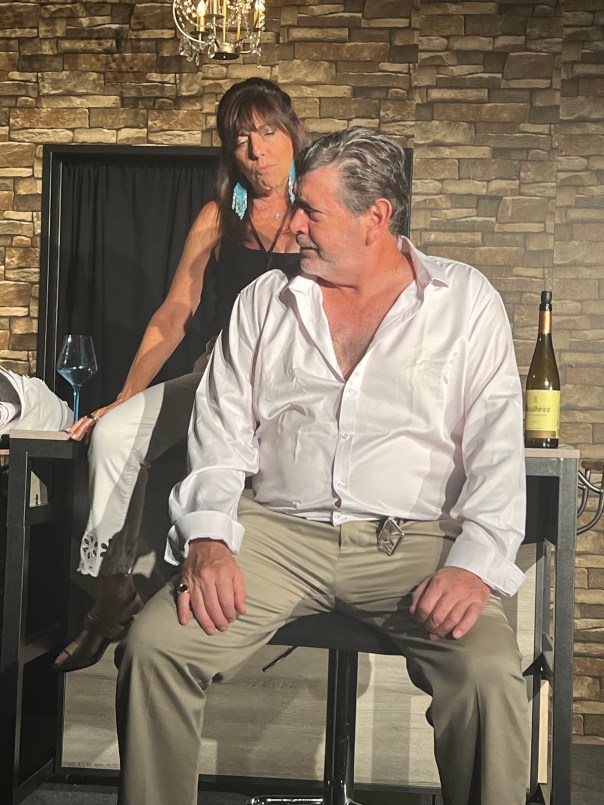
As we can quickly divine from the stemmed glassware and the spigot-less bar on Alexander’s set, Rick is right on-target with his premonitions. After a year in the neighborhood and their recent trip to Portugal, the McLeans will ply their dear neighbors with Portuguese wine, gazpacho, and a sprinkling of Portuguese idioms. The gallant Hugh has even saved a pocket-sized book of Portuguese poetry for the occasion.

Hugh’s gallantry and savoir-faire are driven by a fairly active libido, so Tom Schrachta has quite a juicy role in counterbalancing Rick’s savvy, crafty vulgarity. In addition to his newly acquired Portuguese, Hugh can hurl some choice Freudian jargon at Mr. Six Pack. Yet Hopkins can parry with choice verses from the King James Bible and the occasional Shakespearean quote on loan from his wife’s teaching curriculum.

The collision between California and the Carolinas – Old and New South – is sharply delineated in the men’s lifestyles. Yet Alexander has crosswired their presumed political leanings.

It’s that lone sycamore lurking behind the scenes that triggers the plot and unveils the main conflict.

Fran Kravitz gets to drive the plot as the fiendishly scheming Ali. She hasn’t belatedly invited her neighbors over to make friends, but rather to make amends for their tree’s trespasses. Nor does she wait until the first bottle of Alvarinho is emptied or the first beer can is crushed. Instinctively, both of the McDaniels come to the defense of their innocent centuries-old sycamore – earning Ali’s patrician scorn and the stigma of liberals.

Yeah, we get to hate Kravitz quickly, and the hits keep coming. Her initial hospitality at the beginning of her opening night performance was too big and loud for the room, so I had misgivings, but her subsequent belligerence and deceit were nicely calibrated, on par with Williams’ righteousness and occasional moral lapses. Kravitz meshed well in the Lies and Sycamore components of Alexander’s plot.

Plausibly motivated and ruthless, Kravitz was also the most convincing in the Sex sector. But Alexander layers on more sex, and it’s here where she is less artful than in the more compelling legal and moral struggles. It looks very early like Hugh and Tracy have a prior history – and that both are taken aback at encountering each other so close to home.

How this is possible after living as neighbors for a year is just the first thing we ought to have explained. By not fleshing out the details, Alexander allows these elements of the comedy and drama to remain noticeably slapdash. Although the playwright does contrive to set aside quality time for Hugh and Tracy, most of the meatiest time they have alone together happens during intermission.

When Hugh’s gallantries and jovial deflections ignite Rick’s jealousy, opening the gates to his choicest Scripture and Shakespeare, the sexual chemistry layered onto the conflict really does turn up the heat in a delightful way. As soon as we see Hopkins stalking in with the axe that Rick has discovered in the McLeans’ backyard, we can see comedy and drama beginning to teeter on the tip of the blade.

Furthermore, Hugh’s roving eye gives some common cause for Rick and Ali, providing extra leverage when she litigates and negotiates a mutually beneficial resolution to the matter of the McDaniels’ pesky sycamore. With so much lying, scheming, and betrayal going on around him, will Rick be the last to succumb?

No less suspenseful, we wonder if the two families can become good neighbors and if the two couples can remain intact. Slapdash or not, this is complicated.

Alexander’s instincts seem to tell her not to get too bogged down in the moral, political, economic, and environmental issues she brings up – no to be too dogmatic or preachy. That allows her drama, her comedy, and her audience to breathe more easily. It allows her to favor dramatic and comic impact over message and allows her plot and her characters to have more sway.

All to the good, especially with this cast in Alexander’s directorial hands. Yet I still wish for more eloquence and passion from both sides of the Sycamore controversy. I’m never sure that the playwright quite realizes the magnitude of what she has accomplished here.
She has greatly levelled the playing field in a debate that usually pits big business, real estate developers, grasping politicians, and banks in a one-sided battle against private homeowners and brainy conservationists. Here we have two families with these conflicting interests – with the McLeans retaining enough monetary advantage to keep it real. Let’s have Tracy, Rick, and Ali all fervently pleading their cases as if their futures depended on it, OK? And keep the sex (plus backstory) intact.

It’s hard to deny that if George S. Kaufman were working this material, now or 90 years ago, his slant would have ultimately been more progressive. Why should we be more cautious and regressive now?

Yes, we are in purple North Carolina rather than blue California, but who are we convening in these seats at this world premiere? Overwhelmingly, we are progressives and liberals who still get the gist of the US Constitution, the Bill of Rights, and settled science. That is the reality now and that will be the reality in the foreseeable future: whether or not PBS, NEA, CBS, and Stephen Colbert survive this disgusting decade.

Much of the Ambiance Is Trimmed from “A Time to Kill,” but the Mississippi Murder Trial Still Sizzles

Review:  A Time to Kill

By Perry Tannenbaum

Rupert Holmes has built a distinguished theatre career – and carved out his own special niche – by crafting mysteries for the Broadway stage. His Accomplice won an Edgar Award from the Mystery Writers of America when it played on Broadway in 1990, and after his Thumbs premiered successfully in Charlotte, it seemed Broadway-bound in 2001. Holmes’ most unique accomplishments are his two mystery musicals, The Mystery of Edwin Drood, adapted from Charles Dickens’ unfinished novel, and Curtains, a Holmes original. So it’s not at all surprising that Holmes would be the first playwright to adapt a John Grisham bestseller for the stage when he brought A Time to Kill to the Great White Way in 2013. As the current Theatre Charlotte production demonstrates, adapting Grisham’s first novel for the stage was a tall order.

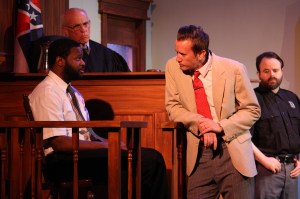
Admitting that film would be a more comfortable medium for this story, director Dave Blamy conspires with set and lighting designer Chis Timmons to wedge in some clips, prefacing the action with evocations of a horrific rape of a 10-year-old girl and, deep in the story, flashing the handiwork of the Ku Klux Klan on the darkened upstage wall. From the outset, you can presume that Timmons’ design for Judge Edwin Noose’s Mississippi courtroom isn’t going anywhere. It is so sturdy and stately that you may be tempted to rise when the judge enters to launch Act 1. But Timmons manages to swivel the entire courtroom 90° during intermission, adding a sidecar to the judge’s bench that serves – somewhat shakily – as a witness box. When we adjourned to the judge’s chamber, other parts of the courthouse, or defense attorney Jake Brigance’s home, there were discreet furniture shifts while the lights were dimmed. They worked well enough.

Unfortunately, Grisham’s canvas is larger. Though we watch Billy Ray Cobb and Pete Willard confess to the rape and attempted murder of little Tonya in vivid Mississippi detail, we never see her father, Carl Lee Hailey, taking vengeance upon these perverts. Thanks to Christy Edney Lancaster’s sound design, we can hear the chants of protesters outside the courthouse when Carl Lee goes on trial for murder, but we cannot see the mob’s fury. When hostilities break out between black supporters of the defendant and KKK racists, we’re shielded from the riot, and when the National Guard moved in… I wasn’t sure that was even mentioned in the script.

Clocking in at a hefty 2:17, plus a 20-minute intermission, the production won’t seem skimpy at all. Instead of any prolonged attention to the KKK, Holmes takes us more intently into Jake’s defense efforts behind the scenes, bringing extra emphasis to whip-smart legal assistant Ellen Roark, disbarred attorney Lucien Wilbanks, and the pillar of the defense’s case, Dr. W.T. Bass. The psychiatrist is recruited for the purpose of confirming that Carl Lee committed the double murder while suffering from temporary insanity, but it quickly became apparent that Wilbanks had made Bass’s acquaintance in a barroom during one of his frequent sprees. For better and worse, suspense and thrills now rest on the outcome of the trial, not on the survival of Carl and Jake in the face of KKK mob mentality. We’re also called upon to hate district attorney Rufus Buckley a little bit more, for his smarmy courtroom confidence and his undisguised political ambitions.

A slick, relatively bloodless package like this would have worked better if it were performed more slickly. Blamy pushes in that direction, but Grisham’s main characters are defined by their back-stories, and their development is further hampered by the formality that legal proceedings – arraignments, pleadings, motions, and trials – impose on dialogue. All combined, the length, formality, and pervasive legalese of A Time to Kill may account for the fact that actors were stumbling over their lines more frequently on this opening night than at any show I can remember at Theatre Charlotte.

Best at handling it was Jim Greenwood, who managed to add a bumbling element to Judge Noose’s crusty old persona. The opposing attorneys, both superbly cast, didn’t break character when struggling for their next phrases, but I could detect definite cracks. Tasked with sustaining a villainous patina, Conrad Harvey was more afflicted by these lapses as the DA, but all was well when he hopped back onto the rails and he flashed his Trumpian smile to the jury. Wonderfully loathsome. Costume designer Chelsea Retalic probably had Atticus Finch in mind when she drew up Jake’s courtroom attire for Tim Hager and the analogy was often apt when Hager grew simply eloquent. But he’d be better off drawing upon Jake’s fallibility when he falters.

Hager was at his best when Jake in maneuvering behind the scenes. Wheeling and dealing are not his style. Steadfast in his beliefs, Hager seemed to get that Jake wasn’t as comfortable in his skin as those surrounding him. As the brainy, beautiful, and ambitious Roark, Jennifer Barnette knew exactly what the legal assistant wants from her gig with Jake and why she finds him attractive. Both Tom Schrachta as Lucien and Rick Taylor as Dr. Bass projected their dissoluteness without too much exaggeration – but more than enough to merit Jake’s alarm – and both of them get tasty opportunities to sober up. Neither of them missed the comical lagniappe that came with their changes.

With so much of the Mississippi ambiance trimmed away like so much gristle, it was a godsend that the black players were all so right. Ronald Jenkins registered Sheriff Ozzie Walls’ conflicted loyalties beautifully, as committed to protecting Carl Lee and seeing that justice is done as he was to keeping his prisoner in custody. As a vengeful father, thoughtless husband, and a somewhat immature man, Jonathan Caldwell had a lot of different feelings to navigate as Carl Lee, from savage rage to sheepish regret, but he wisely stayed steadfast in his belief that murdering those two bragging racists was the right thing. Yet there was deep understanding in Tracie Frank’s portrayal of Gwen Hailey, Carl’s wife. Carl defies her when he chooses Jake to defend him instead of the NAACP, who are willing to come in and do it without a fee. Frank was out there alone to give Carl Lee’s defiance substantial weight. Without Frank’s steely strength, Jake’s victory – and Carl Lee’s vindication for choosing him – wouldn’t have been as sweet. Her quiet acknowledgement seals the verdict.

Soot of Sodom Chases the Joads in “The Grapes of Wrath”

Review: The Grapes of Wrath @ Theatre Charlotte

By Perry Tannenbaum

If you’ve ever read John Steinbeck’s sprawling masterwork, The Grapes of Wrath, you know that it’s framed with a seething anger as a picture of America’s unfulfilled promises, the cruel exploitation of the poor, and the undiminished aspirations of the Joad family. These dispossessed and determined Oklahoma sharecroppers believe in the dream.

But the Okies are tested before they reach the Promised Land of California and once they’ve arrived. Like the Israelites in the Old Testament, they must cross burning desert. Clutching onto the printed handbills promising work and honest wages, they must resist the report of a broken, disillusioned man who found California to be nothing like the handbills’ hype. They must endure attacks from anti-labor thugs who fear the latent strength of worker groups.

Perhaps most difficult of all, they must strive to hold together despite forces of attrition from within – disagreements, defections, and death. Manna doesn’t shower down upon them from heaven to ease the journey.

We easily presume, with their consuming hope of a Promised Land, that the Joads’ journey is an exodus, a liberation from the landowners who have burdened them with sufferings. Another biblical parallel suggests itself on Queens Road, where Frank Galati’s stage adaptation of Steinbeck’s novel is making its local debut at Theatre Charlotte – a mere 37 years in the wilderness after winning the 1980 Tony Award for Best Play.

Since vile bankers and beancounters cannot loom as large on the stage as they do on the vast canvas of Steinbeck’s pages, another biblical parallel emerges clearly. Under Ron Law’s direction, with severely weathered scenery by Chris Timmons, and stark, pitiful costume designs by Chelsea Retalic – Okie clothing and faces equally sooty – I couldn’t help sensing echoes of the destruction of Sodom and Gomorrah in this depiction of Dust Bowl devastation.

One faint echo is the drugging of Grampa Joad when he resists leaving, a parallel to how Lot’s daughters bamboozled their dad. The loudest echo came from Ma Joad, proving that she’s the antithesis of Lot’s Wife. You’ll recall that when Lot’s family was commanded not to look back while God was raining fire and brimstone on the sinful cities, Lot’s wife disobeyed and paid a famous price.

As the Joads embark, one of Ma’s kinfolk asks if she is going to take one last look back. Her no in response, with the aid of modest embroidery, is so emphatic that we take it as a philosophy. Ma Joad looks forward and moves forward. She lives by doing what needs to be done.

It’s an outlook that she successfully hands down to her daughter, Rose of Sharon, in the poignantly perverse pieta that ends the epic story.

With a performance like Paula Baldwin’s as Ma, we readily grasp that Steinbeck wished us to see her as the steadying bedrock of the family. The jut of Baldwin’s jaw and the tightened sinews of her neck were unlike anything I’d seen from her in her numerous leading roles. She’s unrelentingly purposeful, sternly nurturing, with all the patience and endurance of the ground she stands on.

Standing firm isn’t all that simple on the raked stage that Timmons has built. His pared-down design must accommodate campfires, a riverbank, and a ramshackle jalopy able to accommodate the whole clan. The skin-and-bones truck is altogether worthy of the ridicule it draws. Inspiration taken from the Little Engine That Could? You decide.

Vying with Ma for the right to be called the backbone of the family is the second-eldest son, Tom Joad, a volatile straight-shooter who is coming home from prison after serving his time for murder. It is so telling – about Tom and his fellow Okies – that everyone seems disappointed that Tom didn’t break out of jail. Easy to rile when he or his family is threatened, Tom is a seeker of truth, curious to learn how the system works.

Max Greger subordinates Tom’s volatility to his heartland wholesomeness in a promising Charlotte debut, holding his own when he shares the spotlight with Baldwin or the wild-eyed Andrew Tarek, who shambles brilliantly about as Jim Casy, a former preacher who feels like he has lost the calling. Yet in the same way that Tom is branded as an outlaw after killing in self-defense, Casy is branded as a holy man despite his renunciation – with Steinbeck’s approval, we presume, since four gospels were written about a man with the same initials.

Amid a dust cloud of bleakness and hopelessness, these running gags slightly lift the gloom.

And though there are strong unionist sympathies in the framework of Steinbeck’s yarn, you will also find an all-American emphasis on teamwork, which Law’s cast underplays enough to keep us from smelling Hollywood. Chris Melton has an adolescent randiness as Al Joad that augurs trouble and a shotgun marriage, but he also has a way with cars, performing the marvel of getting the Joads’ jalopy going. Between bouts of guilt, discouragement, and drinking sprees, Victor Sayegh as Uncle John often struck me as the most fatherly in the clan with a generous spirit.

With a cast of 23 trafficking back and forth on the sloped stage, Law needed to shape a deep ensemble that bonded together while divvying up two hours and 15 minutes of running time. Nor could he rely on the top tier of players to deliver all the little crevasses of comedy and poignancy that lurk in the wide tapestry.

Annette Gill and Rick Taylor are largely responsible for getting us off to a rousing start as the ever-bickering oldsters, Granma and Grampa Joad, portraying them as loud and slightly doddering. We get an interesting take on Pa Joad from Ryan Dunn, who doesn’t seem broken by his family’s rude displacement but rather gladly retired from the responsibility of it all, a bit dazed by the turn of events.

Zach Radhuber goes light on the simplemindedness of Noah Joad, yielding a touching moment when he sets off on his own, and Cole Pedigo gives a nerdy edge to the befuddlement of Connie Rivers, Rose of Sharon’s husband. In some ways, Ailey Finn represents the best of the new generation as “Rosasharn,” but it’s suffering that strengthens and ennobles her, and the mysterious smile that ends the novel can’t be incorporated into a stage adaptation.

Law keeps the concept of incidental music from the Broadway version but discards the content, switching from a Tin Pin Alley songlist to a folksy Woody Guthrie flavor. “California, Here I Come” steps aside for “This Land Is Your Land.” Strumming an appropriate guitar, Tom Schrachta attacks the material a bit harshly with his robust voice, but I grew fond of that discord. Schrachta also drew the acting chore of donning a rumpled trench coat (a hint of the spy parallel in the biblical exodus story) and delivering the bad news about California to the Joads.

That same harshness remained in Schrachta’s voice. Yet now it was mixing grief, discouragement, futility, and rage – very much what Steinbeck felt about the ruinous actions of America’s bankers when he wrote The Grapes of Wrath.