Tag Archives: Toi Aquila R.J.

Harlem Gets Braided at Jaja’s

Review: Jaja’s African Hair Braiding at The Arts Factory

By Perry Tannenbaum

My dear old Mom was born and raised in Harlem over a century ago, when a massive African-American cultural and literary Renaissance named for Harlem had already begun, long after the fabled Manhattan district with its storied 125th Street had been a major destination for Northern Migration after Lee surrendered to Grant. Even then, it would hardly be respectful to change Harlem’s name to Little Africa after all these years.

Yet playwright Jocelyn Bioh in her 2023 drama, Jaja’s African Hair Braiding,set on the corner of 125th Street, had me considering whether Bioh would rather call her Harlem – or at least this salon – Little Africa. The vibe and culture of Jaja’s, in Three Bone Theatre’s outstanding QC premiere at The Arts Factory, had me feeling that I was in another country while it was unmistakably my own.

Staffed and patronized by locals who hail from Senegal, Ghana, Nigeria, and Sierra Leone, neither Harlem nor Africa were the best places for Jaja’s craftswomen to be on a hot summer day of 2019 when Bioh’s action takes place. Aside from a breakdown in the braiding shop’s air conditioning, ICE lurks in the background as another of the women’s worries. Our own US President, the most powerful man on Earth, has bunched their homelands into the dismissive category of “shithole countries.”
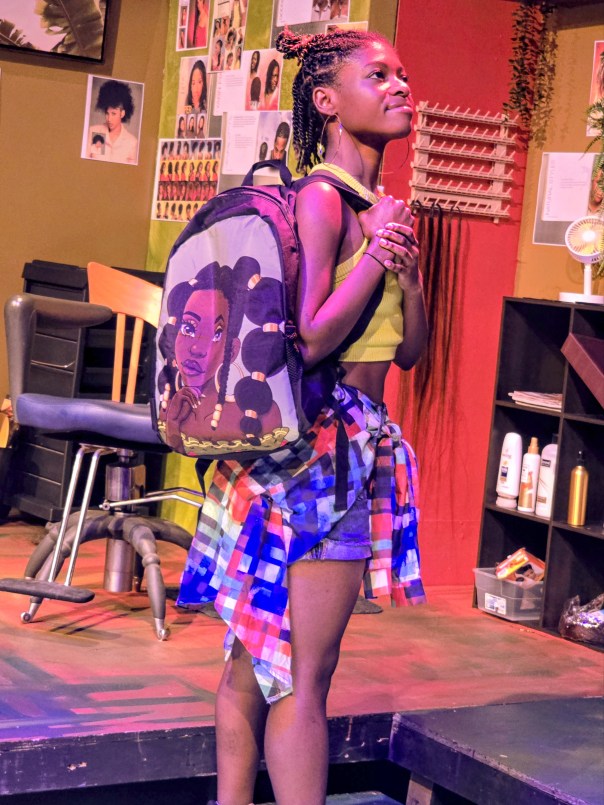
Jaja’s daughter Marie, a brilliant bundle of chaotic energy, is running the salon today because Mom is getting married later this afternoon to an unpopular landlord who will provide her – and Marie – with the shelter of citizenship. That will free Marie, a valedictorian at her high school using a borrowed identity, to apply to an Ivy League school worthy of her energy, talent, and potential.

From the deluge of Marie’s opening monologue onwards, we realize that Jaja’s is a place bustling with life. Music is in the air, sometimes compelling the women to dance. There’s bickering, jealousy, hostility, vanity, teasing, and earthy humor. Not a murderer or a rapist in sight among the immigrants. Not even a pet eater.

About the only big mistake we can accuse director Donna Bradby of making is not helping us to observe Bioh’s signposts – via a wall clock and/or projections – of the time of day and the specified year this long, hot workday unfolds. Otherwise, Jennifer O’Kelly’s scenic design, Toi Aquila R.J.’s costumes, and Rod Oden’s lighting immerse us completely in Jaja’s humdrum-yet-exotic world for all of the show’s 95 minutes.

A clock on the wall, for instance, would help us to appreciate how long young Jennifer, an aspiring reporter, is willing to sit at Miriam’s station in order for the patient artisan to outfit her with a full head of microbraids. And how long does the bossy, rude Vanessa fall asleep at Aminata’s stand before waking to her new look?

The visible excellence of Bradby’s cast is matched by the variety of Deborah Whitaker’s pre-, post-, and mid-weave hair designs. When blackouts happen between scenes, stage manager Megan Hirschy must have a huge chore in the small Arts Factory space helping the scurrying players reappear with the right hair when the lights come back up. We never just sit there tapping our feet during transitions. They’re almost lightning-quick.

Nor does it trouble Bradby that it’s impossible to keep track of who’s from Senegal, Ghana, or Sierra Leone. Venecia Boone was assigned the task of dialect coach anyway, a really nice touch.

Of Ghanaian descent and native to nearby Washington Heights, Bioh obviously knows her characters as much as she loves them. She is also a performer, so Deity Brinson as Marie will not be the last of her players to be gifted with a juicy monologue. Like Marie and the braiders, we will wait a long time before Myneesha King appears as Jaja – in wedding white, of course, with a queenly crown of braids – and delivers the most powerful monologue of all.

Meanwhile, it’s Valerie Thames as Bea, the most fashionable and contentious of Jaja’s employees who fuels the liveliest action, seemingly able to hatch a new grudge at the drop of a spray bottle. The salon was her idea, not Jaja’s. Should have been a full partner in the biz. Refugee newcomer Ndidi is stealing her customers rather than customers just dropping Bea. Thames seethes, fumes, and makes scenes with a steely righteous dignity that sets us up for the turnabout that reveals her deep-down goodness and sense of community.

Until then, the human warmth of the shop emanates from Kellie Williams as Miriam and Vanessa Robinson as Aminata. Williams, rightly stationed upstage at the Arts Factory black box, is mostly distanced from the main sparring during her morning-to-night transformation of Jennifer’s tresses. But there’s a distant man on Miriam’s mind throughout her labors, and she’s spending enough time in Jennifer’s hair to become quite chummy with the 18-year-old by evening’s end.

While her bestie and gossip buddy Bea seethes and sneers, Robinson mostly effervesces as Aminata. She knows that she doesn’t have the patience for a daylong immersion in microbraiding, so she’ll have none of Jennifer despite her youthful sunniness. But EJ Williams as Vanessa riles her almost to the point of losing her cool, a comical series of shticks that begins with the pushy customer objecting to house rules that require her to step outside the shop to negotiate Aminata’s fee. Then Vanessa insists that she be braided with the implements and spray she has brought from home.

Aminata’s man troubles are nearer-to-hand than Miriam’s, for her wayward ne’er-do-well husband James only circles back to the nest to take advantage of her. Righteously divorced, Bea insists that Aminata drop this loser, dismissing the love factor that keeps her from following through with her resolve. Can’t help it when Graham Williams as James drops by and pushes his wife’s buttons.

So these skirmishes between Thames and Robinson, before and after James’s invasion, are the most delicious that we witness. Aside from her dreamer worries, Brinson as Marie is occasionally thrust into the middle of disputes, laying down the law for the prissy Vanessa and stepping into the middle of Bea’s various tussles with Ndidi, Aminata, and her defecting customer, Michelle. At one point, Marie even exiles the incorrigible Bea to the street!
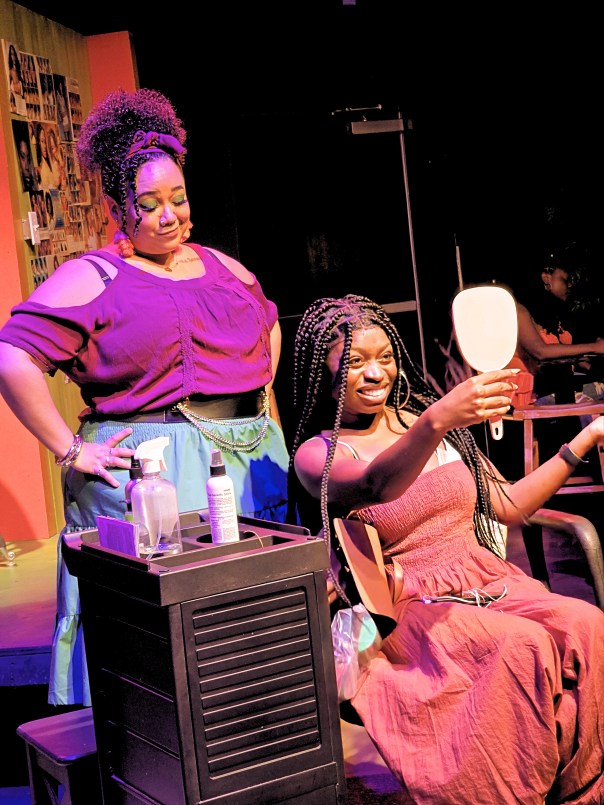
The younger folk are calmer and more acclimated to post-truth America than their diva elders. Before we know it, Aminata is asking Marie how to tune the smart TV to YouTube. Sarah Oguntomilade as Ndidi, the highest-grossing braider in the shop, is especially cool – thoughtfully equipped by Bioh with headphones and loud music to tune out Bea’s accusations and tirades. There’s a really nice interlude when Graham fawns over and flatters her as the Jewelry Man, lavishing her with freebies. This Nigerian cameo as Olu was at least as crowdpleasing as his subsequent turn as the roguish Ghanaian, James.

Graham’s most impactful role is as Eric, the DVD man, who serves as the caring eyes and ears of the community. But it would be cruel to divulge any more.

Things happen quickly at Jaja’s. Notwithstanding the oppressive summer heat, each new character changes the temperature in the shop. Less obtrusively than Graham, Germôna Sharp brings in a variety of flavors as three different customers. The most dramatic of these is the diffident Michelle, who thought she would be switching to Ndidi when Bea wasn’t there. Most comical is Sharp as Chrissy, wanting braids that will make her look like Beyoncé.

As if.

“Clyde’s” Serves Up a Delicious Seize-the-Food Message

Review: BNS Presents Clyde’s at the Parr Center

By Perry Tannenbaum

September 13, 2024, Charlotte, NC – Over a lazy Duke Ellington piano riff that becomes indelible almost as soon as you hear it, John Coltrane layers on the melody of “In a Sentimental Mood,” recorded 62 Septembers ago. Although we’re in a kitchen at a truck stop that doesn’t look nearly that old, somewhere along the highway in Berks County PA, it’s a fitting intro to the new BNS production of Clyde’s. Along with the mean and sassy owner of this diner, Clyde, we meet her star employee, the zen-like Montrellous, also described by two-time Pulitzer Prize winning playwright Lynn Nottage as “the John Coltrane of sandwich making.”

Nottage’s newest comedy-drama originally premiered in Minneapolis as Floyd’s in 2019, less than a full year before George Floyd was killed by local police – so it was prudent to change the title before the Broadway opening in 2021. Yet a police state haze still hovers over the action, since all the employees at Clyde’s are ex-convicts or parolees, including the owner. She’s not a criminal now, but something or someone has clearly hardened her. Montrellous believes that Clyde’s could be a smashing success if it served up extraordinary sandwiches. She wants to stick to basics, lay low, keep a low profile, and lower her costs on the ingredients her drones drop between two slices of bread.

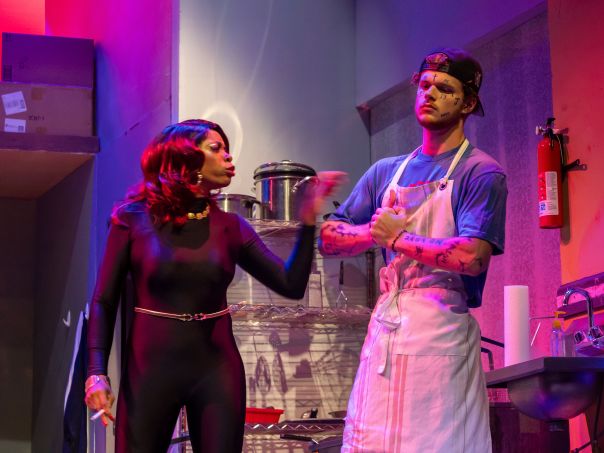
Limiting ourselves on food analogies, let’s say Clyde is one tough cookie, tightly wound to match the tight-fitting outfits costume designer Aneesah Taylor has tailored for her. You do not smile around Clyde, Montrellous warns newbie Jason, a recent parolee. He doesn’t listen. To his distress, he will learn the hard way that Clyde is the Captain Bligh or Queeg aboard this ship. Ah, but there is deeper wickedness to this boss: there is a Jezebel gene in her DNA, for Clyde is a toxic temptress. On a couple of occasions, the owner’s forays into her kitchen reminded me of Curley’s luscious wife sashaying among the farmhands in John Steinbeck’s Of Mice and Men.

The mice here mostly get to play when the boss isn’t peeping through the pickup station, hanging a barely legible order on a little carousel, and banging a bell. Director Dee Abdullah has her kitchen staff reveling in those moments when they aren’t wrapped up in a food prep frenzy. transforms the place. For him, sandwich making should never be drudgery. It is more like a mission, a calling, a crusade, an artform…or a lifelong quest for the perfect sandwich. Suffering and anger can seep into the food you make.

This ministry is not for Montrellous exclusively. When the pace in the kitchen slackens, all four workers lean over their prep stations and take turns chanting the ingredients of sandwiches never built before, swooning collectively over their imaginary deliciousness. In these moments, the kitchen is more like a studio or a writers’ room as the creators brainstorm ideas. And when the coast is really clear, Montrellous reaches into a low cabinet upstage center and extracts his latest masterwork, placing it reverently in the exact middle of the three prep stations. Since James Dukes’ lighting design accentuates the gleam of the Saran wrap around Montrellous’ newborn brainchild, the radiance turns Clyde’s kitchen into a holy temple of sorts. Epicures looking at the three stations centerstage at the Parr Center can be excused if they’re reminded of the Last Supper by Jennifer O’Kelly’s set design.

With this sacred imagery in mind, it’s hardly surprising that Montrellous’s precepts begin to transcend food preparation as we get to know more about him and about Clyde, Jason, slicer-and-dicer Letitia, and the man with the pans at the stove, Rafael. As much as Montrellous wants to convince Clyde to be more enterprising and adventurous – and less dogmatic and stingy – the adoring and adorable Rafael wants Letitia, forever stressed by her infant and her ex, to just give him and chance. Really, this romantic subplot occupies more space and time than the overarching struggle between Clyde and Montrellous, so we don’t think we’re watching supporting players when we see Lisandro D. Caceres-Zelaya in action as Rafael propositioning and wooing Toi Aquila R.J. as Letitia.

“Not enough salt, the flavor doesn’t come out; too much salt, it’s inedible,” Montrellous pronounces. Both women, taught by their past experiences, fend off new ideas and intimacies, fearing all because they’ve had too much before. Both are skeptical that being asked out could be motivated by any other reason than sexual exploitation, whether tender or forceful. Fortifying her resistance to anything Montrellous creates, Dominica Ivey as Clyde turns down every simple invitation to give it a taste. She wields her ever-present cigarette like a dagger, and her every exit is a devastating kiss-off, somewhat comical because she’s so decisive. You begin to wonder whether Ivy has any empathy for her ex-cons: maybe Clyde hires them because they can be bought cheaply.

To be sure, Ivy can string any male along in her wanton mode, but it’s Aquila as Letitia who gives off the most bi-polar vibes. When she isn’t sullenly brooding or crazily hacking lettuce as if she were Lizzie Borden, Aquila is shaking some fine booty and boogeying, reminding us of the charisma she radiated as Eartha Kitt last September. We have no difficulty understanding what Rafael sees in her, and Caceres-Zelaya lights up the stage with his sunny energy, evoking for me the irrepressible verve of Usnavy in Lin Manuel Miranda’s In the Heights.

When he isn’t presiding over the sacrament of sandwich making – and his apostles’ efforts to reach his lofty level – Zach Humphrey as Montrellous is largely a peacemaker. He intervenes with calm authority when Clyde and Jason come close to blows, and he’s a guiding light for both Letitia and Rafael as they gravitate toward one another. “Trust your ingredients,” he sagely says more than once. Everyone is different. People’s possibilities are as infinite as the varieties of sandwiches you can imagine.

Making his professional debut, Anthony Lonzo as Jason presents special challenges that audience members might struggle with, for the tats on his face and spew barbarity and hatred. Onstage, the tats are chiefly repellent to Latitia, but since Jason doesn’t speak much at first, we also need to delve beyond skin depth to grasp what he’s all about. Nottage gives each of the kitchen workers a juicy monologue to reveal what’s inside and in their rearview mirrors, and we’ll likely remember Lonzo’s nearly as vividly as Humphrey’s. But an unspoken maxim sprung to mind as Duke’s lighting finally sanctified Clyde in her memorable epiphany. It’s a wonderful little saying from the Psalms of David that I first learned from a book title by Denise Levertov: O Taste And See. At times the lesson is merely culinary. But ultimately, the message is experiential, about adopting an empirical attitude instead of hardening our prejudices. Above all, it’s an injunction to fully live our lives.

Photos by Perry Tannenbaum

Brooklyn Grace Receives a Classic Museum

Review: BNS Productions Presents The Colored Museum

By Perry Tannenbaum

CCC02899

In every decade since it premiered Off-Broadway at the Public Theater in 1986, George C. Wolfe’s The Colored Museum has had a homegrown revival here in Charlotte. GM Productions premiered it up in the Attic Theatre at the old Afro-Am Cultural Center on 7th Street in 1993, and Carolina Actors Studio Theatre brought it to their C.A.S.T. location out in Plaza-Midwood ten years later. On Q Productions finally smuggled Wolfe’s 11 vignettes – or “exhibits” – into an Uptown site at Spirit Square in 2011.

Now BNS Productions has brought Colored Museum to its unlikeliest location, the Brooklyn Grace Venue, alias the Grace AME Zion Church on S Brevard Street. Each new revival more fully cements Wolfe’s satire as a classic – Winthrop U and UNC Charlotte have also chimed in with productions since 2009 – and each new resurrection that I see strikes me as fresh and hilarious as the first.

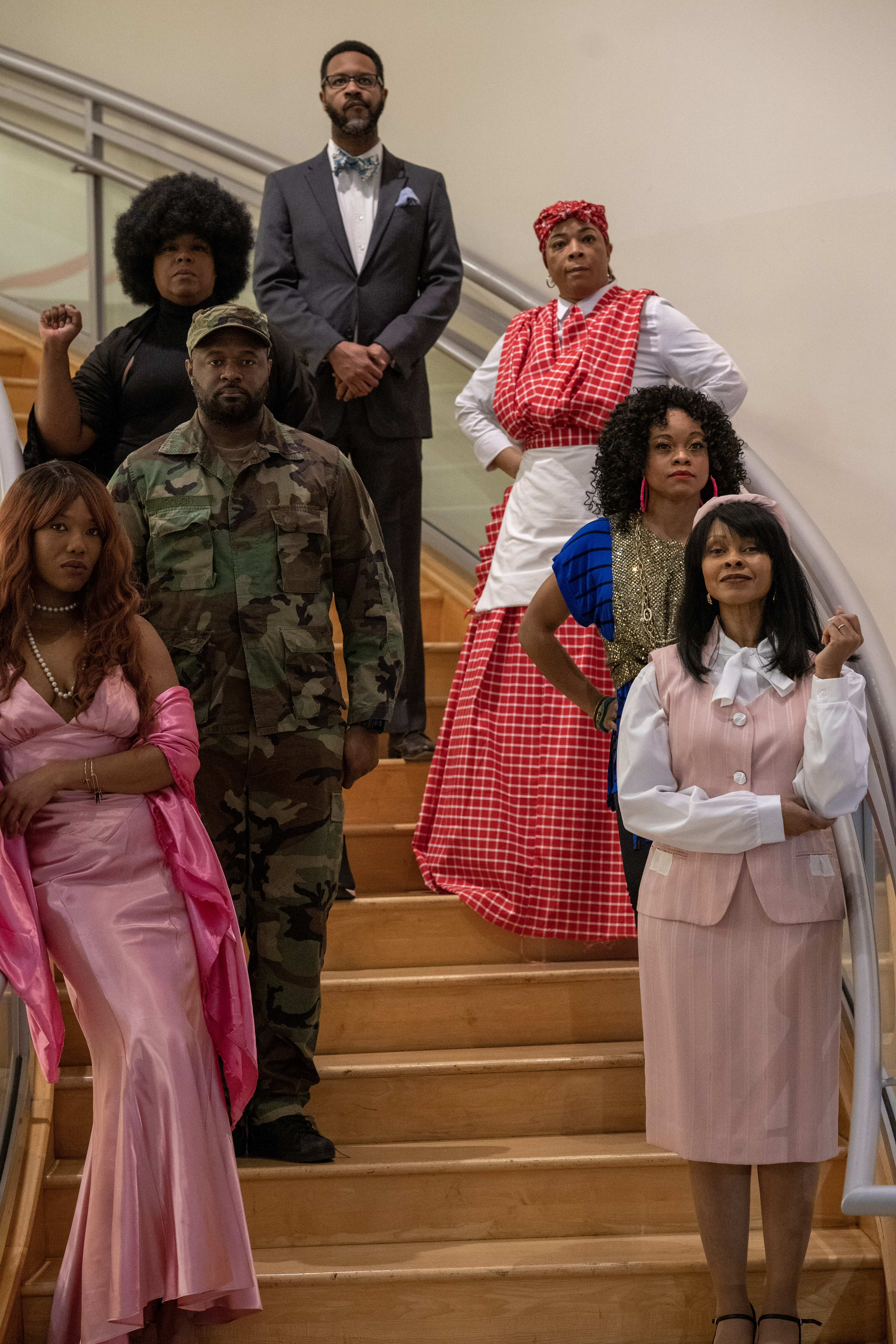
Of course, nothing compares with the edge and impact of your maiden encounter. Wolfe hurls a few choice barbs at white folk, mostly mocking their bland cruelty, but armed with an all-Black cast, it’s African-Americans and their culture that he assails with the most conspicuous gusto. All Colored Museum casts get to feast most hilariously on the sufferings and posturings of the Younger family in Lorraine Hansberry’s A Raisin in the Sun. Walter Lee’s wailings against “the man” in this “Last Mama-On-The-Couch Play” take a detour into Beau Willie Brown’s barbarity in Ntozake Shange’s for colored girls.CCC02756

Familiarity with those two stage gems helps you to savor Graham Williams, Sr.’s over-the-top brilliance as Walter-Lee-Beau-Willie, but his reappearance, immediately after intermission, as The Man only magnifies his triumph. For Wolfe delights especially in depicting the disfigurements that black people inflict upon themselves to survive and succeed in white America. The Kid, played by Jonathan Caldwell, must now disown and discard his Afro-comb, dashiki, autographed Stokely Carmichael photo, Afro-sheen, Jimi Hendrix and Sly Stone recordings, along with Eldridge Cleaver’s Soul on Ice – replaced, The Man tells him, by The Color Purple.

Black Power and protest must be tossed into the trashcan along with slavery if you wish to get to the top. The Kid is dismayed, incredulous, and beside himself when The Man reaches for… The Temptations Greatest Hits! Yes, if The Man is to feel totally comfortable in his black business suit and fully acclimate to white blandness, even “My Girl” must bite the dust.CCC02782

Women also get choice bits from Wolfe, beginning with Nasha Shandri as our prim stewardess, Miss Pat, welcoming us aboard Celebrity Slaveship and inviting us to fasten our shackles as we cross the Atlantic to Savannah. Dancing in the aisles seems to be allowed during our voyage – as long as we keep our shackles on – but “No drums!” Of course, we will get a bluesy cooking lesson from Sandra Thomas as Aunt Ethel, teaching us, with abundant historical ingredients, how to cook up “a batch of Negroes.” Uncanny Aunt Jemima resemblance here.

Shandri and Thomas both reappear in “The Last Mama-On-The-Couch,” with Thomas in the title role switching from cheery to grumpy and Shandri upbraiding Walter-Lee-Beau-Willie (and cataloguing her own sufferings) as Medea Jones, a subtle reminder that white folk are also known to drop babies from great heights. Most of this skit targets Raisin, of course, with Toi Aquila R.J. as Lady in Plaid serving as Shange’s leading Colored Girls emissary.

Meanwhile James Lee Walker, II, has a tasty role as our narrator, bestowing an Oscar-like statuette upon one actress after a heart-rending monologue and then ripping it out of her grasp when the next actress tops her.CCC02580

Walker has already topped himself as the regal, finger-snapping drag queen who imparts “The Gospel According to Miss Roj.” Revisiting Wolfe’s Museum, director Dee Abdullah limits herself to the crossdressing that’s in the script. In 2003, by contrast, Aunt Ethel and Last Mama were also done in drag. But Abdullah brings back Chris Thompson from the CAST production, so the West African choreography at Brooklyn Grace – and the forbidden drumming – have the same sparkle.CCC02717-1

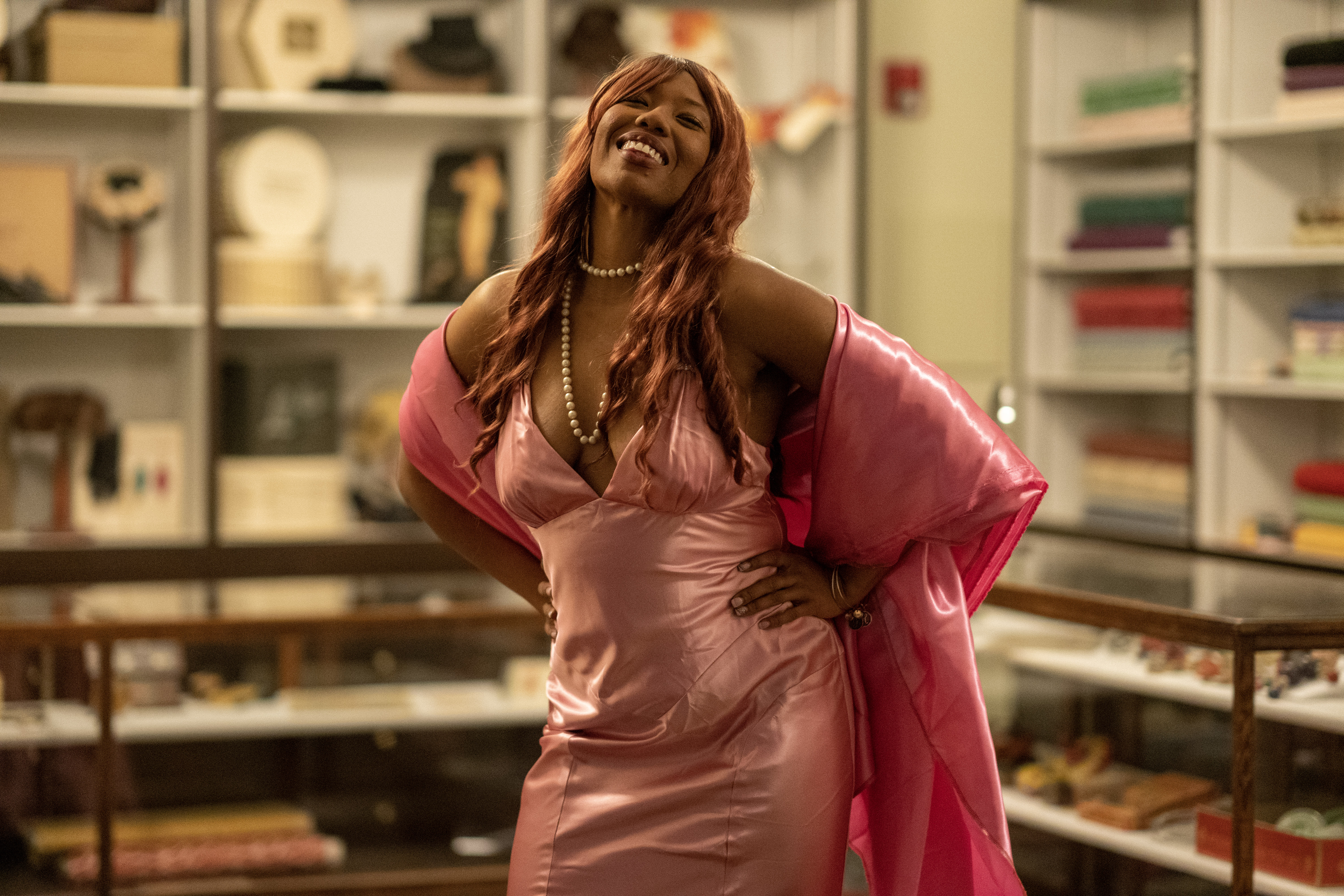
Acoustically, the Grace isn’t ideal for theatre, nor is the place outfitted for professional-grade lighting design. But Abdullah, Sandra Thomas, and Shacana Kimble compensate, teaming up for an admirable array of costumes, from the frumpiness of Last Mama to the imperious splendor of Roj – and on the other side of intermission, the voguish gown of LaLa Lamazing Grace, an expatriated Josephine Baker wannabe done with slaying disdain by Jess Johnson. Until her down-home roots are exposed.CCC02449

In “Hairpiece,” Shandri plays a woman who has literally burnt her roots. Or as Johnson puts it as LaWanda, “She done fried, dyed, and de-chemicalized her shit to death.” All to please the man that Shandri is now dumping. LaWanda is actually a talking wig stand, facing us on a makeup table (and presumably Shandri as well in a fourth-wall mirror). She’s debating whether her owner should be shaking her hot-pressed tresses back and forth when she irately gives her boyfriend the ax, or whether Janine, the Afro wig contemptuously advocated by LaTonya Lewis, should be the fearsome choice to make him shrivel.

While the wigs are debating whether Shandri is most powerful in her natural or chemicalized crown, it’s easy to forget the satirical barb that Wolfe has tossed toward the menfolk. The finally-dispensable boyfriend was a “political quick-change artist,” Janine dishes. Every time “he changed his ideology, she went and changed her hair to fit the occasion.”

Style is important, that’s for sure. Aside from Raisin, the most sacred cow that Wolfe takes down is Ebony Magazine, the barbershop bible of African-American life. Lewis and Williams are the supermodel couple of “The Photo Shoot” who have given away their lives to be beautiful and wear fabulous clothes month after month. Relentlessly smiling and feeling no pain.

Perhaps the wisest thing about Wolfe’s Museum – the good, the bad, the ugly, and the absurd – is that it’s simply there. Do with it as you wish.

“The ultimate questions from Wolfe apply with a fierce pertinence to all oppressed peoples,” I wrote in response to Abdullah’s 2003 production with CAST. “How do we carry the baggage of the past into the future without hampering and crippling ourselves? And how do we leave this baggage behind without discarding key parts of our culture, our heritage, and our identity? These grim questions go unanswered, but watching this energized ensemble wrestling with them will likely double you over with laughter.”

Can’t improve very much on those observations – unless I compress them for 2022 into Wolfe’s words. At the beginning of our journey and again at evening’s end, our stewardess, Miss Pat, tells us: “Before exiting, check the overhead as any baggage you don’t claim, we trash.”

That’s the key choice Wolfe aims to leave us with.