Tag Archives: Timothy Hager

Old Barn’s “Orient Express” Is a Clue-ful Poirot Treat

Review: Murder on the Orient Express at Theatre Charlotte

By Perry Tannenbaum

We can thank the Brits for the notion that passenger trains should run with absolute timeliness and precision. Now that Ken Ludwig’s meticulous adaptation has opened at the Queens Road Barn, we can also thank Agatha Christie, Britain’s most avidly read mystery writer, for her Murder on the Orient Express. Layer on Jill Bloede’s bubbly direction – and dialect coaching – and the treacherous trip rattles along with a savory continental flavor.

That soupçon of glitter and effervescence is greatly enhanced by Theatre Charlotte artistic director Chris Timmons’ fleet and fluid set design, an art deco wonder that transitions delightfully from an Istanbul hotel to a smoky train depot to the luxe interiors of the Orient Express. Since the landscape and snowscape outside the legendary train are also moodily conveyed by projections, it’s difficult to draw a precise borderline between Timmons’ scenic exploits and his lighting design.

While the paucity of professional theatre companies in the QC continues to account for the plethora of professional-grade acting talent we behold at the Barn, so does the opportunity to appear in opulent costumes such as those designed by Sophie Carlick – for hotel waiters, train conductors, and various glitterati who can afford a first-class sleeping compartment on a luxury transcontinental train.

Speed is beneficial in a murder mystery, especially as it plods along, contrary to real life, when we’re introduced to a multitude of suspects who have sufficient motive to commit the cold-blooded crime. Anyone who grew up watching the Perry Mason series on TV (or has binged on it more recently) knows the classic drill: the murder victim antagonizes a slew of enemies. So many enemies that we’re unsure who might have done the deed and more than mildly uncaring about the victim, no matter how brutally they were killed.

Ludwig admirably singles out our obnoxious victim-to-be and all the antagonisms he can spark while introducing us to Christie’s heroic protagonists, Constantine Bouc, owner of the Orient Express line, and peerless detective Hercule Poirot. There will be debate about Bloede’s decision to shitcan Poirot’s mustache wax and twirls in favor of a more conventional groom, but Brandon Samples’ initial entrance as the Belgian is star quality.

There’s a bit of aristocracy to Samples’ bearing that allows Poirot to fit in with his fellow passengers, including a princess, a countess, and a colonel. While Timothy Hager zestfully cements his repulsiveness as Samuel Ratchett, it’s also important for us to see that Poirot has sufficient dignity, discernment, and assets to reject Ratchett’s crass job offer.

Poirot also offers Samples a few brief episodes of befuddlement, for the culprit he is hunting leaves a blizzard of clues.

Unlike all of those complacent Perry Mason victims destined for the morgue and a court-ordered autopsy, Ratchett is keenly aware that he is being hunted. He’s willing to retain Poirot for a fabulous amount of money to protect him. Perry, you’ll remember, doesn’t arrive on the scene until after the wrong suspect is accused and arraigned. Here, Poirot is directly involved while the victim is alive. So when Samples shows no guilt or remorse for not accepting Ratchett’s offer after he is murdered, we’ll need further reasons for despising the playboy.

Christie piles them on and, in doing so, makes the bizarre solution to her mystery more plausible, for Ratchett is far more monstrous than he first seems to be.

Yet the elegance, hauteur, and glamor of the leading ladies would seem to instantly eliminate them from suspicion – or any close acquaintance with the vulgar victim. To think that Paula Baldwin as the Russian Princess Dragomiroff would deign to inflict eight stab wounds on the repellent Ratchett seems like sacrilege.

Likewise, Julia Howard as the serene and mysterious Countess Helena Andrenyi from Hungary seems worlds away from the slain playboy. The ethereal Gretchen McGinty as English governess Mary Debenham, also a smashing beauty, seems to live in an entirely different sphere, more involved with Scottish Colonel Arbuthnot (Ben Allen with a brash brogue) than the slain American.

As for Kathryn Stamas, as an esteemed actress traveling under the assumed name of Helen Hubbard, she is sufficiently brash, loudmouthed, and inconsiderate for us to worry whether Ratchett, trying to get some sleep next door and stewing with rage, will burst into her room and murder her. Murdering him would ruin her delight in riling him with her late-night singing.

However laudable it might be to murder Ratchett, three acts of God will prevent the ghoulish plan from eluding discovery: the unexpected arrival on board of legendary unraveller Hercule Poirot, the serendipitous intervention of Orient Express owner Constantine Bouc in securing a first-class compartment for Poirot, adjacent to the victim’s room. After these pieces are in place, with Bouc ready to serve as Poirot’s loyal sidekick, comes the fortuitous storm that halts the regal train in a snowbank out in the wilderness, giving Poirot sufficient time to investigate.

Bouc is obviously a key prong in Christie’s plotcraft, allowing Poirot to board the Orient Express and vesting him with the authority to investigate. Otherwise, our mustachioed sleuth wouldn’t be able to scan all our suspects’ passports or rummage through their luggage. Dramatically, he enables Poirot to interview all the suspects, another ritual of the mystery genre, corresponding to Perry Mason cross-examinations, that cries out for swift pacing.

The venerable Dennis Delamar would seem ideal for bestowing the requisite bonhomie on our gracious host and eager sidekick, except… for all his wholesome triumphs as Henry Higgins, Grandpa Vanderhoff, Kris Kringle, John Adams, Hucklebee, Jacob the Patriarch, and many more, has he ever done a French accent before? Maybe that was the question Delamar was asking himself on opening night when he uncharacteristically stumbled over a few of his opening lines.

Even for a semi-pro like me, those are lines you should be able to say in your sleep. Of course, Double D never broke character during his difficulties, so to neophytes in the audience, it may have seemed like the garrulous pensioner was stumbling over his English. Delamar’s imperturbability in this brief crisis only made Bouc more charming when he righted himself – and real panic was safely in reserve when the unsolved murder, right under his nose, threatened the image and prestige of his company.

Bouc also serves as a buffer between Poirot and the petty annoyances presented by our suspects, allowing Delamar to display his comedic chops. Samples, on the other hand, gets to revel in flipping over innocent façade after innocent façade in revealing the secret underbellies of his artful gallery of suspects. The parade of skeletons emerging from closets can’t help but add to our merriment.

So most of the actors on stage need to be adept not only in erecting their respective façades, but also in carrying off those deliciously satisfying moments when they are so disconcertingly exposed. Joshua Brand as Ratchett’s querulous secretary seems particularly innocent and above suspicion, while Emma Brand as the Princess’s trembling missionary ward is even further above. So pleasant when they fall.

Climb aboard this fatal train, and you’re likely to find the ride more fun than you expect.

Misery Loves the Queens Road Barn

Review: Misery at Theatre Charlotte

2023~Misery-1

Fame can be unsettling, painful. It can be dangerous, corrupting, or toxic. But it was Stephen King who had the marvelous idea, with Misery, that fame could also be a gripping horror story – and in case anybody had forgotten, immensely lucrative. The 1990 film, adapted for the screen by William Goldman and directed by Rob Reiner, snagged a few awards for lead actress Kathy Bates as Annie Wilkes, bestselling author Paul Sheldon’s #1 fan. Goldman also crafted the 2012 stage adaptation that opened on Broadway in late 2015, starring Laurie Metcalf opposite Bruce Willis.

That’s the version playing now at Theatre Charlotte. Metrolina has seen previous incarnations of Misery, by Rock Hill Community and Off-Tryon Theatre, but those adaptations were by British screenwriter Simon Moore. So this Willis-Metcalf vehicle, directed by former Theatre Charlotte executive director Ron Law, qualifies as a local premiere.

The main attraction of the Moore version, retained by Goldman, is that it turned the restrictions of a live stage presentation to our advantage, stripping away the outside world almost entirely and making the story more claustrophobic – no pig, no media, no fretful literary agent, and just one law enforcement agent. It’s very much like a first-person narrative by an immobilized writer who wakes up unexpectedly inside a torture chamber.

Chris Timmons builds a silhouetted two-story set that meshes well with his drab, gloomy, lightning-streaked lighting design, while Christy Edney Lancaster layers on plenty of thunderclaps in her sound design along with pop song recordings that sound like they originated on 78 rpm shellac (quite possibly the same Liberace cuts heard in the movie). It’s very creepy at the old Queens Road barn when lights dim out and our attention becomes centered on the light shining from Annie’s upstairs bedroom, framed by lightning flashes.

2023~Misery-3We seem to be in a macabre fairytale forest or wilderness, snowbound outside of Silver Creek, Colorado. Sheldon has been severely injured in a car crash, Annie has extricated him from his wrecked Mustang, and she has somehow carried him up from a deep ravine in a heavy snowstorm and brought him home, where she is nursing him back into shape with splints, pills, intravenous fluids, and injections. As Sheldon’s #1 fan, Annie must have obtained King’s permission to stalk her idol through the storm, making this whole yarn possible.
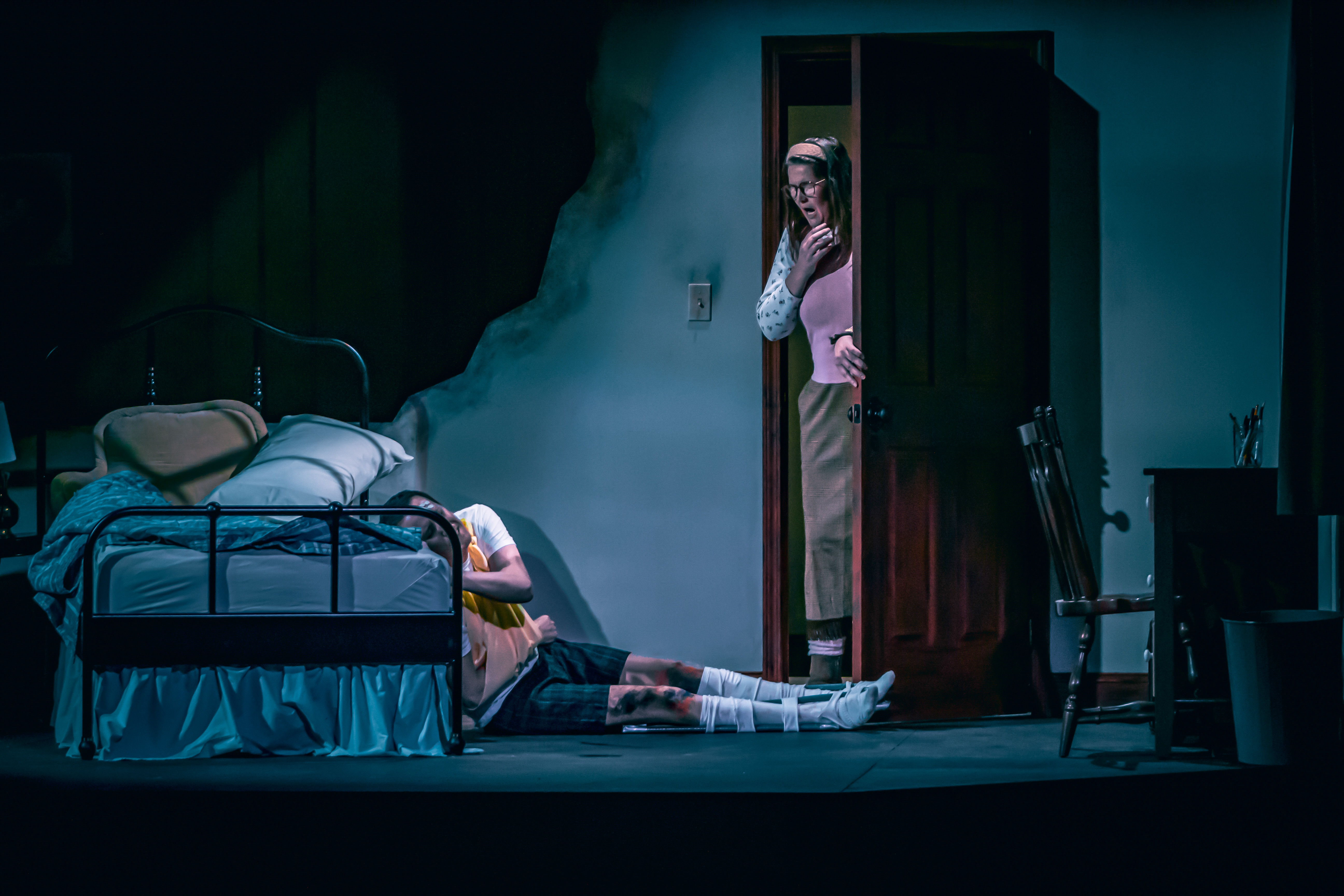

She is a nurse by trade, we quickly see, evidence of IV treatments still lingering in the bedroom Annie has selflessly devoted to Paul’s care. Yet as I observed in my review of the 2002 Off-Tryon production, this Annie is to nursing what Typhoid Annie was to food preparation. Whether she intends from very beginning to keep Paul on the premises as a companion to her pet pig, Misery, may be open to debate, but there are revelations that topple Annie’s already-shaky equilibrium.

Paul has decided that Misery’s Child, the newest installment in his popular Misery series, soon to arrive at bookstores everywhere, will be his last. The new manuscript in his briefcase, just finished at his nearby Colorado retreat, will be a total departure from those where Misery Chastain was his beloved protagonist, the woman who Annie credits for saving her life. Now that she has saved his life, she’s sees herself as entitled to disproportional payback from her captive. Autographing his new book for her will not be nearly enough.

She rips out the phone, fully cutting Paul off from the outside world and further plunging us into a nebulous bygone era. Devout enough to be outraged by the foul language in Paul’s manuscript, Annie can discard morality in the blink of an eye when it comes to granting her idol’s freedom. Anyone who has seen the film will vividly remember that violence is in her toolbag.

2023~Misery-2

Of course, sudden explosions can always blow Paul’s cunningest escape plans to smithereens in seconds, but the finest aspect of King’s plotcraft is the cerebral battle between the imaginative author and his fanatical, adulating nurse. Avidly following his books, scrapbooking multitudes of magazine articles about him, and maybe picking up inside dope about him from nearby locals in and around the Silver Creek Lodge, Annie is a formidable adversary. She controls his food and his medicine – and as Paul’s #1 fan, she compounds her advantage by knowing so much about him.

Paul must first recover health and mobility. Then he must watch and study his keeper closely if he hopes to prevail. Rescue is tantalizingly close each time Buster, the local sheriff, drops by. But Paul isn’t aware of the initial visits as his disappearance continues to be investigated. On your way home after the thrilling climactic scenes – or maybe days later – you may begin to surmise how Paul subtly aided the inquiry.

Not all of Paul’s stratagems work in this chess game, and the retributions Annie wields on her idol can be shocking. Even more shocking onstage, perhaps, because we never get a full peep at Annie’s scrapbook and her backstory. It’s got to be tricky role for Becca Worthington to pull off live, especially since she comes off as a little more rustic than Bates and a tad meeker. The range is broader without the Hollywood coquetry, and Worthington pitches her performance more darkly when Annie veers out of control, in keeping with the gloomy lighting scheme, where sunshine and snowbanks have no place.

Costume designer Sophie Carlick also darkens our portrait of Annie, discarding the crucifix necklaces and the prim nurse-like outfits, such as Julie Andrews might wear strumming a guitar in a meadow, in favor of more rugged clothes she can credibly wear indoors and out: boots, knit socks, and dumpy cardigans. Sadly enough, when Paul asks Annie to celebrate Misery’s rebirth with a romantic dinner, Worthington doesn’t have the time, in a no-intermission production, to elaborately glam herself up for the occasion.

2023~Misery-4

Timothy Hager has fewer rooms to navigate here as Sheldon than James Caan did in the movie, stealing contraband pills and a kitchen knife from the same room where his candlelight dinner scheme goes awry. Nor must he somehow emerge from a cellar – a fourth indoor location! – where he has been dumped because there is none. Yet Hager certainly manipulates his wheelchair with all the apparent difficulty of a newbie recovering from a separated shoulder, giving us the impression of an epic exploit. Without the benefit of closeup shots, he also makes sure that Paul’s fears are visible far beyond his eyes.

Effortlessly, Hager often radiates a shambling clumsiness in his attempts at hoodwinking Annie, a fallibility Caan hardly hinted at, endearing himself to us a bit pitiably in the darkness of this snakepit. Most importantly, Hager has a firm grip on the climactic typewriter scene where he precisely executes some truly nifty fight choreography.

2023~Misery-5

Transitioning to stage, Goldman most radically altered the role is Sheriff Buster, who only visited the Wilkes cottage once in Goldman’s screenplay. Law widens the discrepancies, casting Roman Lawrence as the lawman in an auspicious Charlotte debut. Buster is no less easygoing now, but he is conspicuously younger and less snoopy, no longer visible in scenes at the office with his wife, up in the sky in a helicopter, at the crash scene, at the lodge where Paul finishes his books, in a library researching, or at the general store. Lawrence is the closest thing in this show to sunshine, arriving each time without apparent urgency or suspicion. That sharpens the drama in the denouement.

Production levels have been a bit eye-opening in the first two shows at the Queens Road barn this year, a place we’ve never before compared with Children’s Theatre of Charlotte in terms of technical prowess. With Misery, Hollywood has arrived in Charlotte at the service of thrillers. Prep for King’s famed hobbling scene was impeccable, eliciting audible gasps from the audience, but that was mere prelude. Both blood splatters in the closing scenes were absolutely spectacular, worlds beyond what community theatre delivered in my day when we taped blood capsules to ourselves backstage and hoped for the best.

These more sophisticated spectacles were likely a collaboration between Timmons and all three of the players, possibly Carlick as well, and perhaps triggered by sound cues. Or Bluetooth! The difficulty of the tech was best demonstrated at a key moment when it went wrong – Play-That-Goes-Wrong wrong. A wastebasket began smoking before Hager could toss a kitchen match into it. Presumably unnerved, Hager then tossed a key manuscript page toward the basket instead of slam dunking it to be sure. He missed!

On a movie set, these screw-ups would become a hilarious outtake. But onstage, instead of cracking up, Hager and Worthington covered up. Good thing they did, for the next cluster of fight choreography and SFX followed immediately, the most challenging moment of all. It was perfect.

Spacious Setting at Halton Theater Creates Fresh Perspective for “You Can’t Take It With You”

Review: You Can’t Take It With You

By Perry Tannenbaum

THEA2021-DLV-0923-4498

Picking up our tickets for You Can’t Take It With You in the Overcash lobby outside Halton Theater, I was asked how many times I had seen this comedy by George S. Kaufman and Moss Hart before. Reflexively, I answered four or five times – discovering, to my surprise, that I was replying without a groan. My later researches proved my estimate to be correct, for I have now seen local productions on at least five occasions dating back to 1990, including presentations by Charlotte Shakespeare, Old Courthouse Theatre (1991), and two at Theatre Charlotte (2001 and 2016), along with the current Central Piedmont Theatre effort. Over the years, I’ve gradually warmed to the script, perhaps because it’s better-respected now than when the 1937 Pulitzer Prize winner was turned into a star-studded screwball extravaganza in the 1938 Oscar-winning film.

Each time I’ve beaten back my resistance to reviewing You Can’t Take It on recent occasions, I’ve found myself taking away something new. The last time I saw the comedy, just days after the 2016 election, I found myself imagining how in tune with public sentiment the Kaufman-Hart concoction must have seemed when it first premiered – after the 1936 election. Hardly shocked or even surprised anymore by the cavalcade of eccentricity in the Sycamore family and their outré circle, I found myself newly fascinated by patriarch Martin Vanderhof’s anti-government stance and the playwrights’ decidedly anti-Wall Street sentiments. Of course, I had no idea at that time how much I could come to loathe a President who boasted about not paying his income taxes.

Nearly five years later, the similarities – and dissimilarities – between Martin and The Donald have popped into sharper focus, creating a provocative tension. What struck me most forcefully this time around was how much You Can’t Take It With You is about the classic clash of New York values, the free-thinking Bohemian chaos at the Vanderhof home, around the corner from Columbia University, and the stuffy, moneyed callousness of Wall Street, the planet’s financial capital, still wobbling after the crash. Maybe the other thing that struck me with new force was also a result of the Trump Effect. This play is absolutely crawling with Russian influences: emigres, ballet, socialism, Stalinism, Trotskyism, and blintzes. No wonder at all why the place gets raided by G-Men.

Kaufman and Hart would have no doubt delighted in Jennifer O’Kelly’s vast set design, for they described this expanse as an “every-man-for-himself room,” where every member of the household has the freedom – and space – to do whatever he or she pleases. “For here,” they added, “meals are eaten, plays are written, snakes collected, ballet steps practiced, xylophones played, printing presses operated – if there were room enough there would probably be ice skating.” With admirable restraint, there is no Zamboni in sight under Paula Baldwin’s deft direction, and the wide vista of the O’Kelly’s set encourages players to move quickly to answer the front door at stage left, to step lively in reaching centerstage, and to speak loudly so that all might hear. Baldwin was also spied at the back of Halton Theater on a couple of occasions, perhaps after hovering near the soundboard, for the sound from body mics onstage was exceptionally problem-free. Sound design by Ismail Out, including cuts of Johnny Mercer’s “Goody Goody” from 1936, was also on-target.

THEA2021-DLV-0923-4527

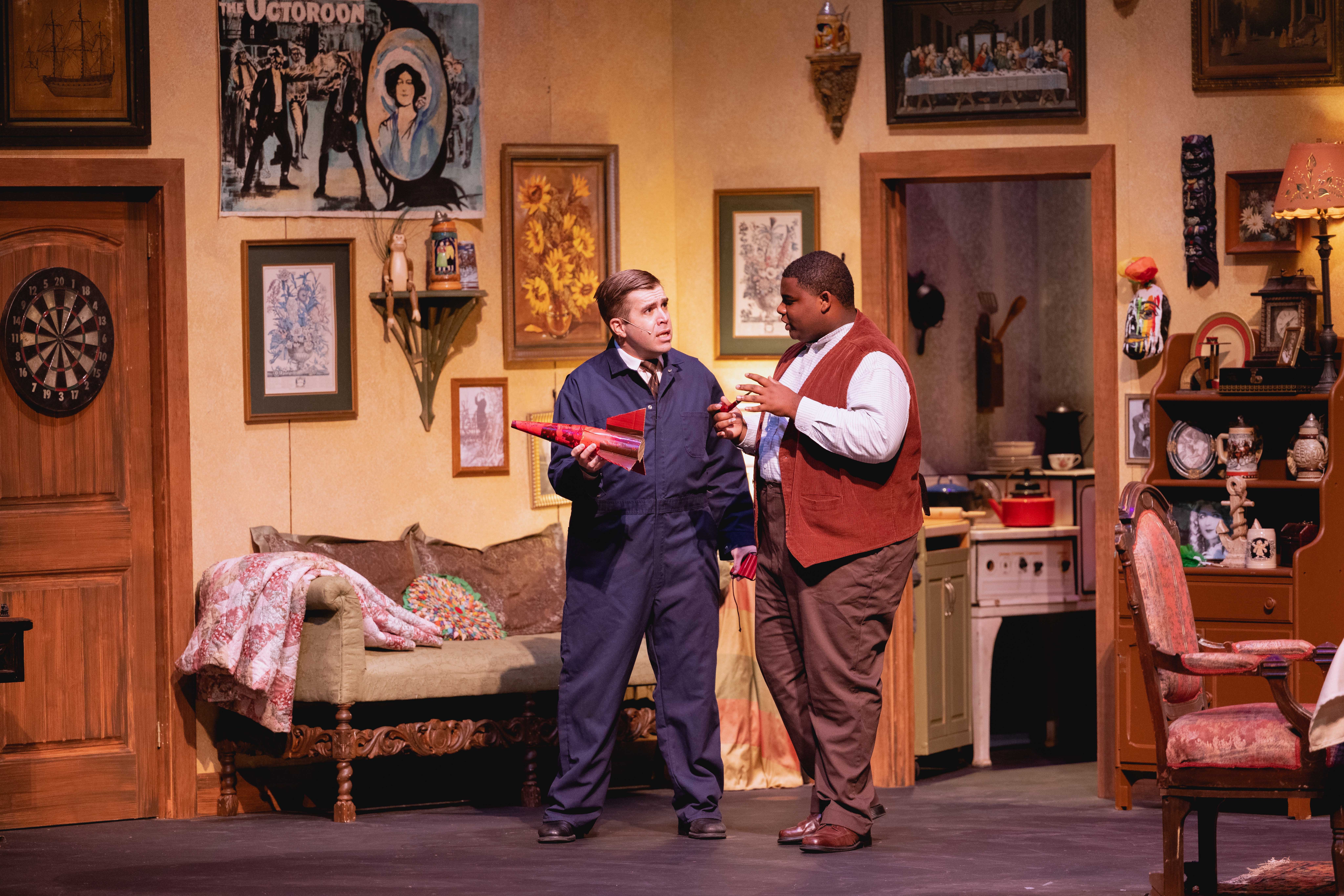
The plot revolves around the possible nuptials between Alice Sycamore, Martin’s granddaughter, and her Wall Street boss, Tony Kirby. As Alice sees it, the multitudinous eccentricities of the Vanderhof household are an insuperable barrier between her and the ultra-respectable Kirbys. Obviously, Alice is conflicted about her family, loving them all while seeing them with the clarity of the only household member in daily contact with the outside world. Tony, as it turns out, is no less attuned to the shortcomings of his own family, so he pushes for a meeting with Alice’s family and then for the inevitably explosive rendezvous between his folks and hers. Did we mention that Alice’s dad, Paul, fashions fireworks with his faithful assistant, Mr. De Pinna? No, because all of those chemical reactions happen down in the cellar, out of view.

THEA2021-DLV-0923-4629

Having to move so quickly across O’Kelly’s arena seems to endow all the residents of the Vanderhof home with an enthusiastic complacency, so engrossed are they all in their eccentricities. Pam Coble Newcomer is the restless artist of the family as Martin’s daughter, Penny Sycamore, working on a couple of her 11 unfinished playscripts as we watch, until she decides it’s time to resume work on painting a portrait of Mr. De Pinna posing in a Grecian tunic that she abandoned years ago. Abigail Adams is Penny’s eldest daughter, Essie, the perennial ballet student who also makes candies, and Braden Asbury is her husband, who mostly splits his time between the xylophone and the printing press in his nook. He also likes to make masks and serves as Essie’s candy seller and the family pamphleteer. Busy fella. So you’ll notice that Kaufman and Hart enjoy piling multiple enthusiasms on their characters.

THEA2021-DLV-0923-4561.jpg

Contrasts can be extreme, sometimes with a zany logic. As Boris Kolenkhov, Essie’s ballet teacher, John Sexton can beat a taskmaster’s cane on the floor in perpetual frustration, since Essie shows no promise whatsoever, and then, at the most inopportune moment, reveal his zest for wrestling. It’s a lot for the Kirbys to digest all at once, but other weirdos like Mr. De Pinna are likely to show up on the Vanderhof doorstep and never leave. Weirdest of these may be Corlis Hayes as Gay Wellington, a flamboyant actress who would steal every scene if she weren’t spending so much time passed out on the settee from excess drink. Of course, cameos from those government raiders and an overnight stay in jail didn’t improve the Kirbys’ first impressions of Alice’s family. Nor do the fireworks down in the cellar remain inert. As the elder Kirbys, Rick Taylor and Pamela Thorson were as starchy as can be, but Thorson was especially regal in taking affront.

THEA2021-DLV-0923-4325In the face of such humiliating catastrophe, Alice wished to exile herself to the Adirondacks, but Charlie Grass managed even here not to be overly annoying in her shame and mortification as the one “normal” member of her family. Love and practicality are nicely mixed in this Alice. Serene and optimistic as ever, Martin, Penny, and Paul are able to laugh off the misadventures of the previous night. Newcomer as Penny, Jeremy Cartee as Paul, and Dennis Delamar as Martin became especially endearing from this moment forward, maintaining their equanimity after this buffeting of adversity. Galumphing and awkward in the early going, in and out of his mad scientist coveralls, Cartee showed some touching solicitude toward the wife and daughter when crisis struck. Delamar, in his second go-round as Martin, has thoroughly mastered his dignity and glow, aided by Emily McCurdy’s costume design and James Duke’s lighting.

Whether or not Baldwin was looking for a James Stewart type in replicating the onscreen chemistry between Alice and Tony (judge for yourself when you see Grass’s hair), Timothy Hager brings some of the same height and charming gawkiness to the role. Although O’Kelly does her best to clutter up her set, there is never the sense that Tony is slumming because the space is so expansive. That spaciousness also tends to dilute whatever humble, homespun quality you might have associated with Vanderhof and his clan in past viewings.

THEA2021-DLV-0923-4455

With Baldwin’s staging, you’ll likely find that the wide-open space enhances Delamar’s eloquence when he delivers Martin’s signature monologue in the final act. If you can tear your eyes away from Delamar, you’ll notice that Newcomer has been deployed far to stage right, leaning forward on the sofa in rapt attention, beaming and proud of her daddy. Most other family members have been spread out around a stage that has more than a couple of times been teeming with tumult. All eyes are Grandpa, all the family are respectfully still, radiating pride and content. It gives a special moment an extra aura.