Tag Archives: Tim Baxter-Ferguson

Risen from the Dead, CAST’s Alabaster Is All About Artists in Crisis

Review: Alabaster at The Mint Museum

By Perry Tannenbaum
Google and Alexa will tell you if you ask: it’s a little bit more than a 17-mile drive from Bessemer to Alabaster, Alabama. Every source I’ve checked also confirms that Gip’s Place, the last backyard juke joint in America, was in Bessemer until its blues guitarist founder, Henry “Gip” Gipson, passed away in October 2019 at the age of 99. It’s useful to know that when we meet Weezy, the first character to speak at the Mint Museum – in the first Carolina Actors Studio Theatre production anywhere since its 2014 NoDa demise.

Weezy tells us that she lives at a small farm “right near” Gip’s Place in Alabaster.

True, we have ample reason to question Weezy’s veracity from the get-go, since she also introduces herself as a goat. Titling her comical drama Alabaster,playwright Audrey Cefaly could coyly blame her geographical inaccuracy on this cantankerous barnyard beast she created. But the choice, invoking the special malleability of a stone that has been reshaped by sculptors and artisans for millennia, is clearly an artist’s choice.

As we continue to follow the scrappy encounter between two artists in backwoods Alabama, one a celebrated photographer of celebrities and the other an unknown painter, we often find that Weezy – among other things – is Cefaly’s surrogate. In one meta moment you can look out for, Weezy even delivers a message from the playwright to one of our protagonists.

Mostly, Weezy serves as an irascible Jiminy Cricket for June, the one human survivor on the farm. When she isn’t offering up prompts and explanations channeled from Cefaly, she becomes June’s better self, the self that is wishing to break free of her self-imposed isolation and artistic obscurity. When sweet optimism sours into clear-eyed skepticism and cynicism, Weezy becomes the painter’s inner voice: June’s worst critic.

And sometimes, she’s a goat, caring for her ailing mama. Weezy is fluent in English and goat. Occasionally, she’s also clairvoyant.

Both Bessemer and Alabaster are prone to tornadoes. Cefaly’s tornado has radically reshaped June, demolishing her farm and turning the entire left side of her body into a relief map of scars, patches, pocks, and swirling melty skin. Playing the role of June, Zoe Matney has a l-o-o-o-o-ng pre-show routine, for she must spend much more time than usual backstage getting director/makeup designer Michael Simmons’ concept applied – front and back, from torso upwards – with help from assistant director/makeup artist Dee Abdullah.

Then she is onstage as the audience arrives, long before lights dim and Weezy enters.

If Weezy weren’t there, we must also remember, we wouldn’t have a reason to hear from June, though her first response to the goat’s prodding is no more than a well-chosen finger. Fortunately, we are quickly liberated from the confines of an inner dialogue by June’s distingué visitor, Alice.

Acquainted, you can bet, with Annie Leibovitz and no further than a light meter’s distance from Demi Moore, Alice’s career has recent taken a hairpin turn to the scarred-women project she’s working on now. June is her seventh subject, and Alice works in multiple media. Trying to reach the traumatized inside of her subjects – all women – while finding the dignity and beauty mixed with the deformity outside, Alice documents them in video interviews and, when the time and light are right, by snapping coffee-table-quality portrait photos.

Are these scars a form of artwork?
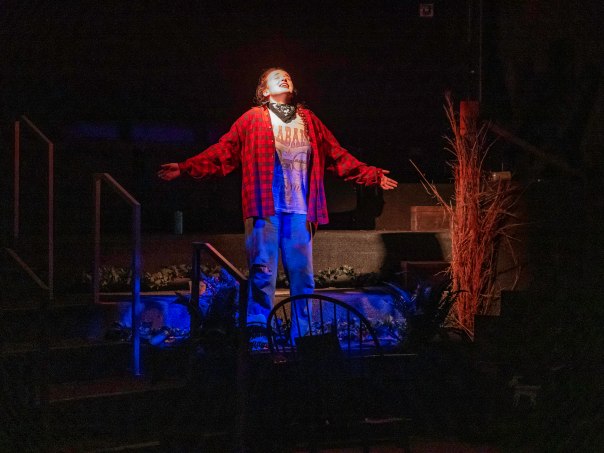
A fresh aspect of artist’s choice comes into play with Cynthia Farbman Harris as Alice. Alabaster premiered in December 2019, just two months after Gip’s passing, in Fort Myers, Florida – the first stop in a “Rolling World Premiere” presented at 11 member companies of the National New Play Network, a rollout spanning from New Jersey to Oregon. The QC had a company in that Network, Actor’s Theatre of Charlotte, which had rolled with some of these co-op premieres before.

When asked about the switch away from glamor assignments, Alice deflects at first. She only gives herself away slightly when asking June about her “accident” – a word more apt for her own trauma – and when, egged on by June’s questioning, she scrolls back far enough among places she’s been before Alabaster to her rehab.

So it shouldn’t be too surprising to learn that Actor’s Theatre was scheduled to premiere Alabaster in the latter half of its 2022-23 season, just over two years ago. More of you will remember that Actor’s Theatre did not make it to the end of 2022, planting its gravestone among the most honored companies in Charlotte’s theatre cemetery before the halfway point of its 34th year.

For Harris, who auditioned for that abortive ATC production, it was a matter of not forgetting. She had worked with Simmons at CAST, with a variety of other stints at Moving Poets, Queen City Theatre, and Theatre Charlotte – including a pair of diva roles, Maria Callas in Master Class and Blanche DuBois in A Streetcar Named Desire. If the role of Alice stuck with her after ATC’s demise, there must have been plenty of meat on the bone.

With an eye toward reviving the edgy theatre vibe that reigned while ATC, CAST, and QC Theatre were all up and running, Cynthia and her husband, actor Michael Harris, have founded Actors Collaborative Theatre to help make it happen. The new ACT is an associate producer of Simmons’ rebirth, while Moving Poets and Charlotte Contemporary Theatre are among the companies listed in the digital playbill on CAST’s thank-you list.

If you know how long ago Harris starred as Blanche, then you know Alice is bit of a stretch, no matter how much she wanted it. We’re not just talking about the yoga scene. With Abdullah serving as intimacy director, June’s master bedroom becomes more than an artist’s studio. Scars and all, June brashly inquires whether Alice is gay, before we learn the photographer’s full backstory.

Somehow, Matney and Harris make their love-hate relationship work altogether naturally and spontaneously. It only becomes a little more cerebral than Cefaly imagined it. They lean into the age difference a little instead of pretending it doesn’t exist. But they do traverse the long, rugged terrain to the primal mode. The two artists debate whether their meeting is like The Bridges of Madison County or not. Yet they could also debate whether they are both hostile animals locked in cages of their own making – while the liberating keys are always in their hands.

Actually, they do talk about that.

Matney’s performance is every bit as stunning as Harris’s, if for no other reason than June is so moody and mercurial. Ambivalent about having her paintings exposed to outside world, June is living with desperate intensity in her present isolation, hoping for a sunnier future – she has invited Alice here, though she is wary – while repeatedly tortured by her past trauma.

Something as trivial as the beep of Alice’s camera can trigger flashbacks to the worst. Adding to the inner psychological circuitry are the stresses of fresh lightning and thunder – plus the partial nudity at the start of the photo session. Matney calibrates her various disturbances well when her hurting is raw, and she channels energy convincingly into compensatory actions when June is striving to appear calm and well-adjusted. She also leaves room for just the right amounts of flirtation and coquetry.
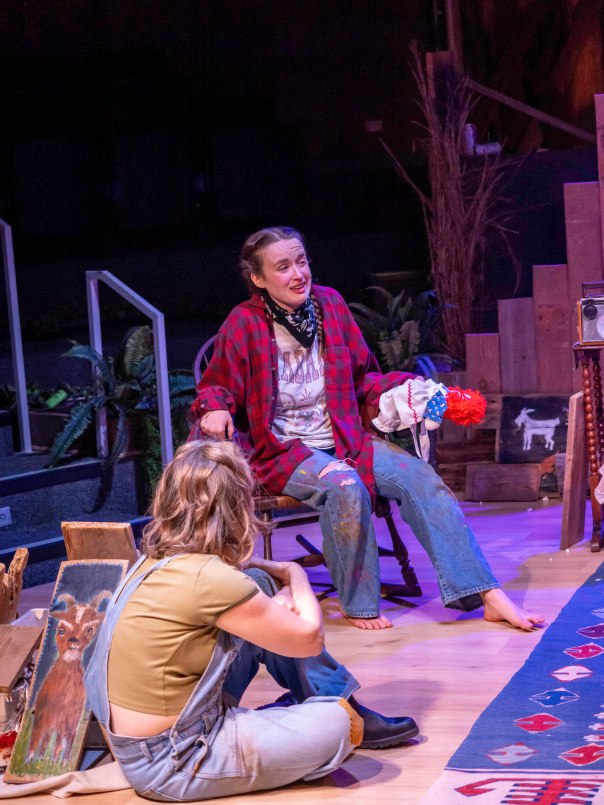
Kelly Mizell, who plays Weezy, can tell you how long ago Harris sashayed into Nawlins as Blanche, for she was an outstanding Stella Kowalski in that same Theatre Charlotte Streetcar way back when. Given the opening entrance, this talking goat decisively demonstrates that she can still command a stage before discreetly receding into the background, sometimes as a handy guide, sometimes as an annoyance, and sometimes as a mind-reader.

Mizell gets to show Weezy’s tender side caring for Bib, her mostly pallet-of-hay-ridden “Mmaaahaaaahaaaa… maaaaaah!” You can see Harris wanting to play Alice enough to partly bankroll and publicize a production, but with so much stage time and so little spotlight (or vocabulary) as this old goat, Debbie Swanson had to really want this Mama Bib role. She’s wonderful when her moment comes.

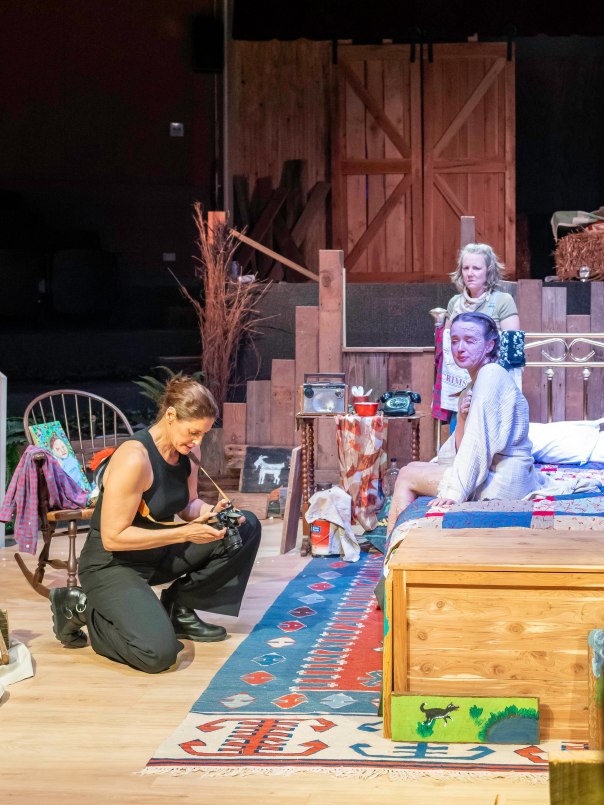
Otherwise, there are remarkably few signs that Simmons and the Harrises are doing all this on a shoestring. Lighting design by Dave Meeder easily ranks with the best we’ve seen at the Original Mint’s Van Every Auditorium on Randolph Road. Tim Baxter-Ferguson, another name we fondly associate with a bygone era, installs a marvelously rusticated twin-level set design that simultaneously gives off vibes of woodsiness, springtime color, and irreversible damage.

Sophie Carlick’s costumes don’t have to be lavish, but they enable June, Weezy, and Alice to radiate an outdoorsy aura. Cleverly enough, June’s bedroom outfit hides her preoccupation with painting as decisively as her splotched overalls proclaim it, but the goat costumes also strike a perfect note. So do the many artworks fashioned for June’s artistic oeuvre on barnwood, to be auctioned off when Alabaster completes its run.

Simmons’ sound design and special effects are on-point, but I wish they had impacted more: louder, with more lightning crackle and windy sweep. Nor was the ringtone on Alice’s cell as ugly as Cefaly intended. As a photographer, I had to chuckle at the sadly unprofessional equipment we were seeing, including a camera with an onboard flash. Yet I could empathize with Harris – and admire her all the more – when she had to keep that lame videocam running and the still camera showing snaps on its screen.

When Alice instructs June on how to use a smart phone, when she shows her how to trip the shutter, and how to review the photo portraits on the wee screen… Quiet moments like these resonate with us, because they are part of a bonding process, two healing processes intertwining. Two resurrections. Three if you count the rehab June and Alice join in on with those barnwood scraps.

Good reasons to smile as we left the Mint. Along with the resurrections of CAST and a vital drama Actor’s Theatre never got to present.

Simon Says, Be Shocked and Shaken

Review: Actor’s Gym presentation of Chapter Two

By Perry Tannenbaum

Chapter Two 3

As Neil Simon tells us in The Play Goes On, the second of his two memoirs, Chapter Two was inspired by a turning point in his life, moments after he had threatened to leave Marsha Mason, his second wife. She fought back. “Marsha came to me with a torrent of words that flowed out with such anger, but such truth, that she never missed a beat, never tripped over a single syllable or consonant,” Simon wrote. “I knew it was spontaneous, that it was coming from the bottom of her heart and soul, her one last chance to save something good.”

Chapter Two would be a turning point in his career, the first time that he really poured his own painful experiences into one of his comedies. Simon paraphrased Mason’s speech and inserted it deep in Act 2, where Mason eventually paraphrased herself co-starring in the film of the 1977 Broadway hit with James Caan. It’s one of two singularly heavy moments for Simon, who is so often celebrated for his one-liners, his strung-together skits, and his extended sitcoms.

George Schneider and Jennie Malone are the onstage counterparts for Simon and Mason. In his current Actor’s Gym presentation at Duke Energy Theater, director Tony Wright wisely resisted the temptation to look for co-stars who would bring the most sparkle to the snappy banter that marks the whirlwind romance of his protagonists. Wright prioritizes chemistry, casting Bill Reilly as George and Jennifer Barnette as Jennie, two performers mostly noted for drama until Wright cast Barnette in Noël Coward’s Fallen Angels last fall.Chapter Two 4

George, a writer, is trying to get back into circulation after the sudden death of his first wife, but finds it difficult to put an end to his grieving. A soap opera actress, Jennie is still shell-shocked by the end of her six-year marriage to a football player.

She’s definitely wary of repeating past mistakes, quietly on the lookout for something different. When she finds him, she will know.

Getting them together is where Simon can infuse some broader comedy into his script, for it’s George’s big brother Leo, a Broadway press agent, who keeps trying to set our lovelorn hero up with female prospects until he strikes Jennie gold. Pushing from the other end is Jennie’s bestie, soap opera queen Faye Medwick.

Chapter Two 2

A couple of sitcom ironies give the story extra spark. While pushing George and Jennie together, both Leo and Faye are unhappy in their own marriages – leading to a side order of illicit romance between them. Meanwhile, when romance sparks between George and Jennie, both Leo and Faye are alarmed that the spark has become a bonfire, that their matchmaking has succeeded beyond expectations, with the lovebirds rushing towards matrimony.

Plenty of latitude here for two immense screwball performances, and Wright is just as unerring here. Fresh off her outré performance opposite Barnette in Fallen Angels, Karina Caparino plumbs deeper depths of daffiness as Faye, nailing a New York accent and making a meal out of the soap diva’s paranoid fear of discovery. Wright gives Trent Merchant even wider latitude in his local debut as Leo. Whether coaxing George out of his funk or wooing the skittish Faye, Merchant goes big, brash, and boorish, Davita Galloway’s costumes helping us to distinguish Leo as the most crass and déclassé of these New Yorkers.

So when Merchant draws Simon’s other dramatic monologue, detailing George’s despondency after the death of his first wife, it’s no less surprising than Jennie’s big outburst will be. Desperately urging Jennie to slow it down on the eve of her hasty wedding, Leo shows us how much he cares for his brother even as he goes about it in such a gauche way.

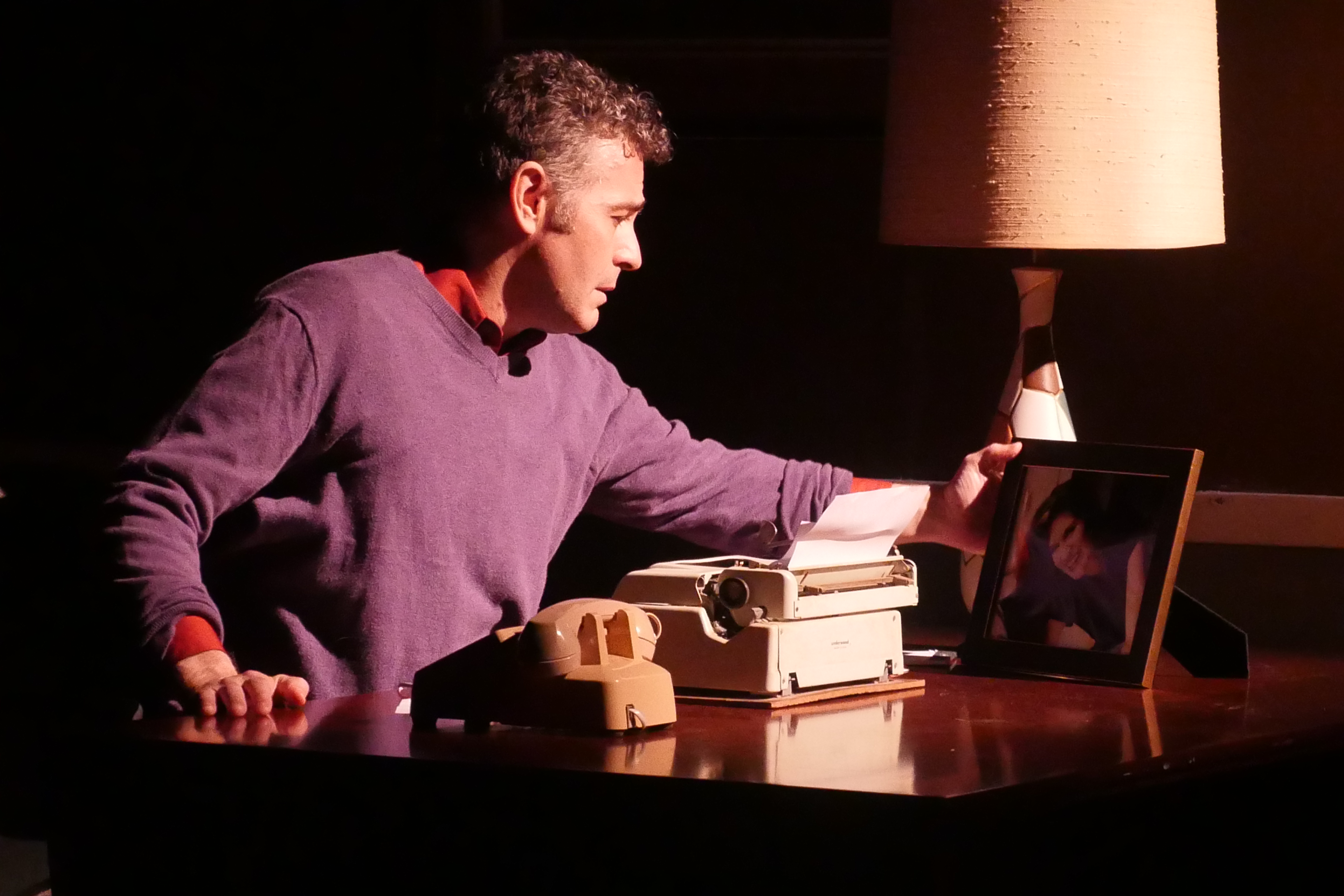
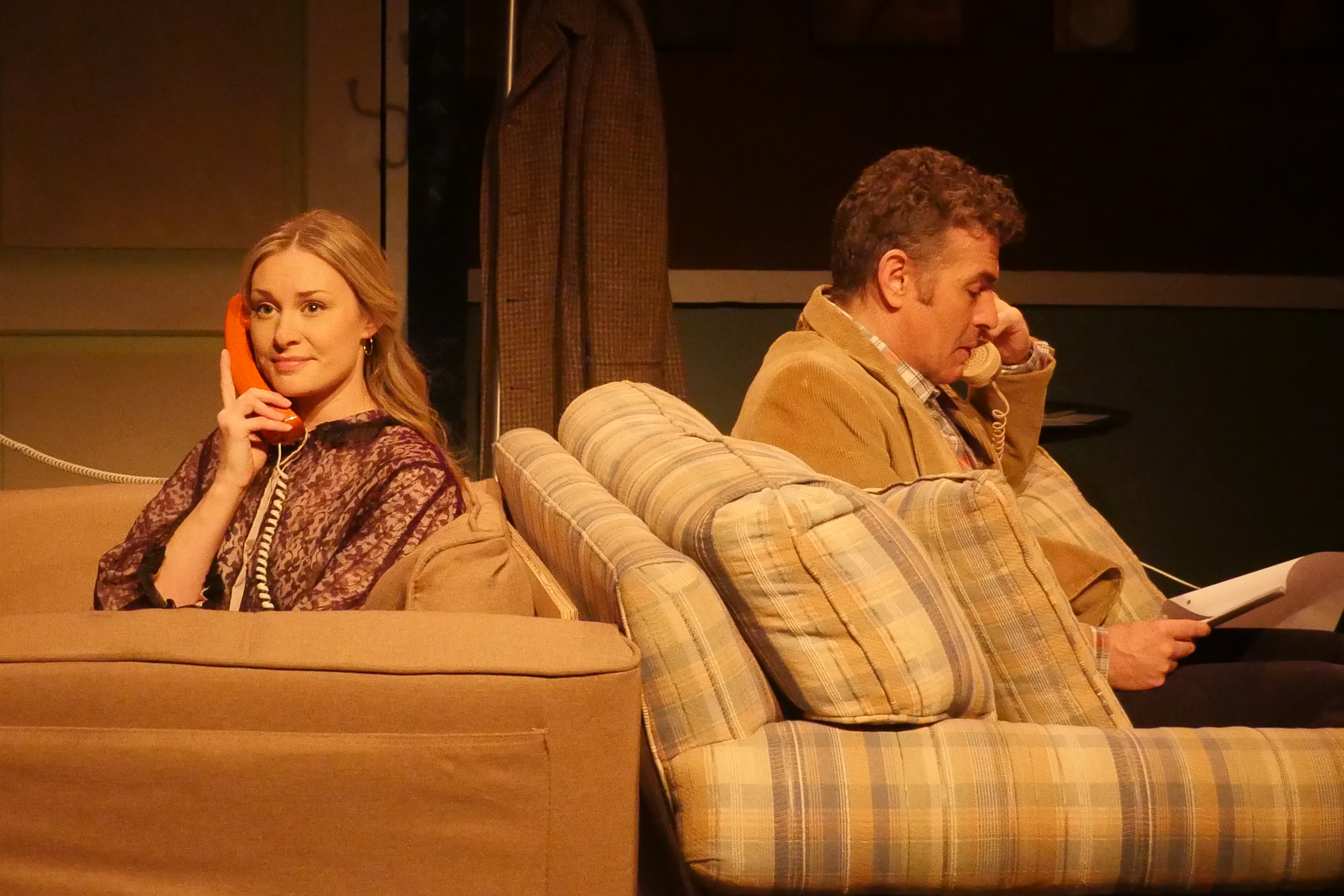
While not exactly swank, Tim Baxter-Ferguson’s set design splits the stage convincingly into two apartments, so that when George speaks to Jennie on the phone, there is credible separation even when they’re virtually back-to-back. Reilly turns out to be very good at rendering George’s lingering grief and his romantic awkwardness. Getting on the phone for the first time with Jennie – unintentionally – George turns this first telephone encounter into a typical Simon shtick.

But Wright and Reilly are keenly attuned to the difference. So many of the moments here are about “one last chance to save something good.” In George’s case, they are mixed with moments when he’s an endearing wit or a mopey jerk.

Chapter Two 1

Barnette firmly establishes Jennie’s forbearance in the first barrage of phone calls from George with just a twinkle of archness. There is so much that Jennie must indulge from George, from Faye, and from Leo – her sponsor! – that you wonder where and if Barnette’s saintly serenity will end. The explosion shouldn’t seem inevitable, but when it comes, it should seem in character.

Most of all, Barnette must nail it, and she does. Part of the essence of Jennie’s spontaneity is that she will be a little shocked and shaken herself by what has just flowed out of her. On opening night, Barnette was. So was I.

Actor’s Gym Unearths a Gem in “Fallen Angels”

Review: Fallen Angels

By Perry Tannenbaum

When a playwright puts the finishing touches on his or her latest comedy, it’s without any knowledge about how prevailing attitudes and expectations might change out in the audience over the next 93 years. No playwright has ever had the chance to look back that far, and that includes Noël Coward, whose Fallen Angels is playing at Duke Energy Theater in an Actor’s Gym production directed by Tony Wright.

Knowing Noël, I’d say he’d either gasp or laugh out loud. Opportunity knocks for Coward’s protagonists, Julia Sterroll and Jane Banbury, when their husbands head off on a golfing weekend just when an old flame of both ladies, Maurice Duclos, sends them billet-doux saying that he’ll be arriving back in London after an absence of many years –so many years that the husbands, Fred and Willy, have no idea of who Maurice is nor any knowledge of his torrid affairs with their wives.

After Fred’s departure, Julia is momentarily left alone with her new smarty-pants maid, Saunders. That’s when Jane arrives at the Sterrolls’, all aflutter with the news. Julia, who was just a few minutes earlier discussing with Fred exactly how much fire was left in their mellowing marriage, hadn’t yet read her note from Maurice. It quickly becomes evident, as the women discuss Maurice, that those flames still burn brightly, perhaps more brightly than ever. They’re a little scared.What will they do when he arrives?

Their first impulse is exactly what an audience would expect – in 1925: to flee as quickly as they can to protect their honor, which presumably cannot withstand Maurice’s irresistible charms. A mere 35 years after Oscar Wilde had declared, “The only way to get rid of temptation is to yield to it,” such an outlook was still wicked, irresponsible, and risqué.

Nowadays, coaxed by Madison Avenue, amoral leaders, social media, and longstanding American traditions of fierce individuality, we find ourselves – regardless of gender – inwardly urging Julia and Jane, Go for it! Whereas we’re taken aback in 2018 by the ladies’ knee-jerk-prissiness, their eventual decision to stay and face Maurice was immoral enough to give London’s censors pause before allowing Fallen Angels to be performed.

Once Julia and Jane have opted for what we perceive as the road-more-taken, you might expect that attitude adjustment becomes far less necessary. Yet in more subtle ways, the presumption of wickedness works its way deeply to the bones of Coward’s comedy. Instead of building his comedy upon Julia and Jane’s rekindled romances – and their wacky or delicious maneuverings to keep their husbands in the dark – we find an unexpected amount of time devoted to maintaining their wicked resolve. Here our complications arise from the women’s resorting to martinis and champagne to sustain their courage during their excited vigil.

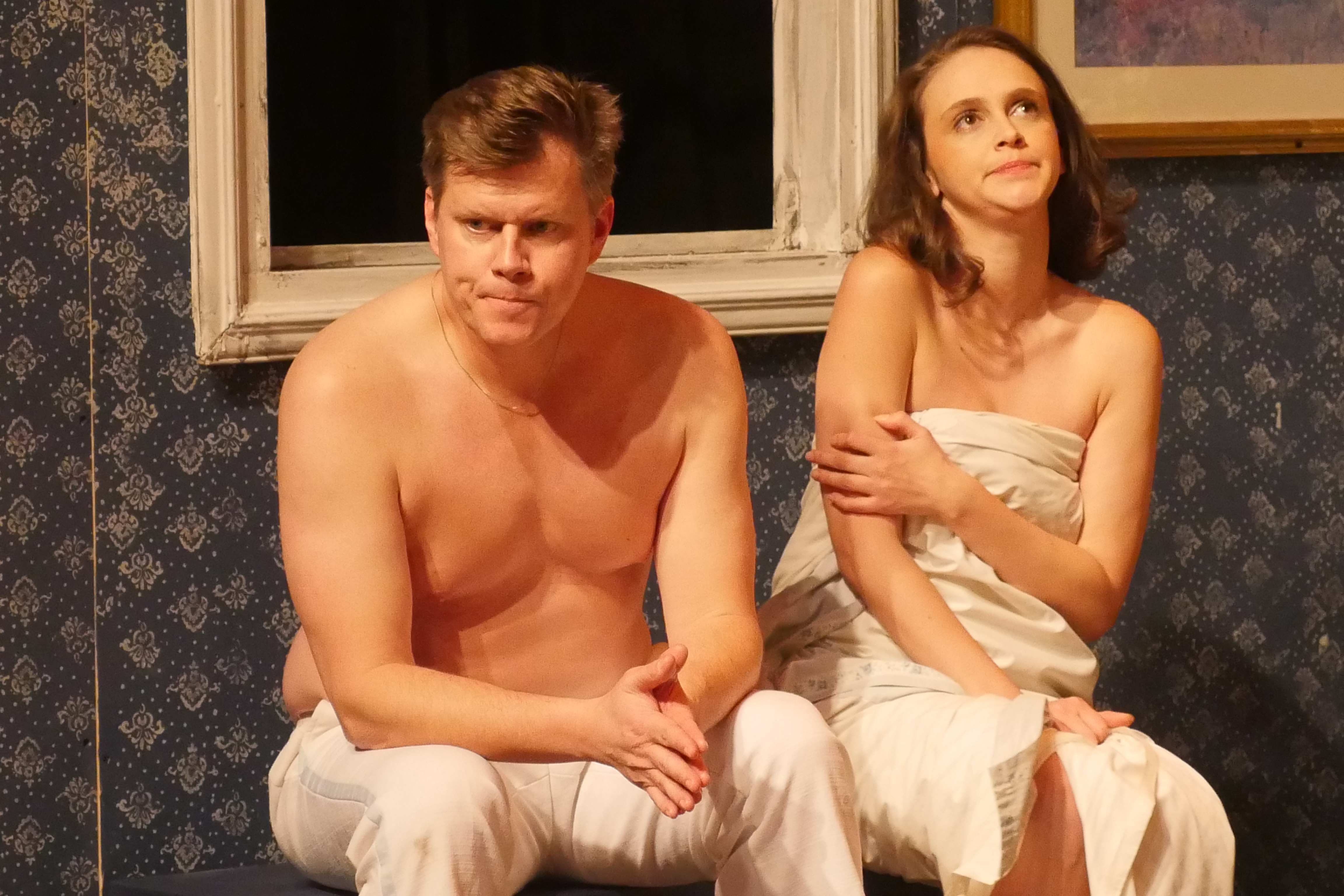
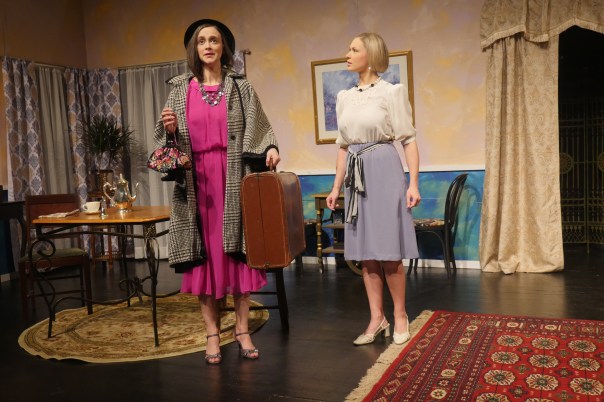
So it’s helpful that Tony Wright and his design team keep reminding us that the people onstage are living indifferent times. While Tim Baxter-Ferguson’s set design isn’t the ultimate in elegance, the requirements of a British drawing room are met, including a baby grand where Saunders will upstage Julia. Davita Galloway’s costumes, particularly the flapper-flavored outfits for the partying ladies as they sip their martinis, stamp the era most decisively.

The women must dominate this comedy,and Wright has found a marvelously varied trio. Originally played by Tallulah Bankhead, Julia is the formidable serenity that is serially agitated by Saunders, Jane, and Maurice to comical effect. Jennifer Barnette takes that serenity to a loftier, more angelic plane, slightly muting her discomfiture and giving more space for the eccentricities of Saunders and Jane to shine. Karina Caporino pounces on her opportunity as Jane with frenetic energy, more brittle and midlife than we’ve ever seen her, which easily makes Jane the most screwball of her trademark neurotics.

Erin Darcy as Saunders is possibly the most vivid period trimming in this whole confection, a servant who is more knowledgeable, widely traveled, and skilled than the mistress she serves, aware of her superiority and maybe a little bit haughty about it. Saunders’ sophistication lays bare the delusion that the Sterrolls or the Banburys are living lives of consequence. Perhaps it’s Darcy’s aplomb at the piano that gives Barnette her best episode of humiliation.

In this context, Emmanuel Barbe is a perfect choice as Maurice. He is suave and self-assured, with a savoir-fair that is unmistakably French, yet he doesn’t quite have the polish and youth that would make knees buckle in high society. Barbe’s down-market elegance is still more than enough to make David Hensley as Fred and Michael Anderson as Willy seem gullible, dimwitted, and humdrum. Hensley as Fred seems to be the sort who feels like he’s fulfilling his destiny by opening a newspaper at the breakfast table, while Anderson, once he reconciles with Fred and Jane, gives Willy exactly the smiling insouciance that Wright wants for his ending.

I have to go back to 2005 and The Tempest to find the last Actor’s Gym production I reviewed. It’s great to have Wright and his Gym back on the scene, especially when the Gym unearths a gem like this.