Tag Archives: Stuart Spencer

“Violet” Comes from Country in a Musical Teeming with Blues and Gospel

Review: Violet at Theatre Charlotte
By Perry Tannenbaum

So here’s something we’ve learned over the past month on the Charlotte theatre scene. There are two schools of thought on how to portray a horrifically scarred woman onstage. Back in late February, Carolina Actors Studio Theatre took the cinematic approach at the original Mint Museum on Randolph, painstakingly applying makeup to their leading lady, Zoe Matney, before every performance of Alabaster, down the entire left side of her body from head to ankle.

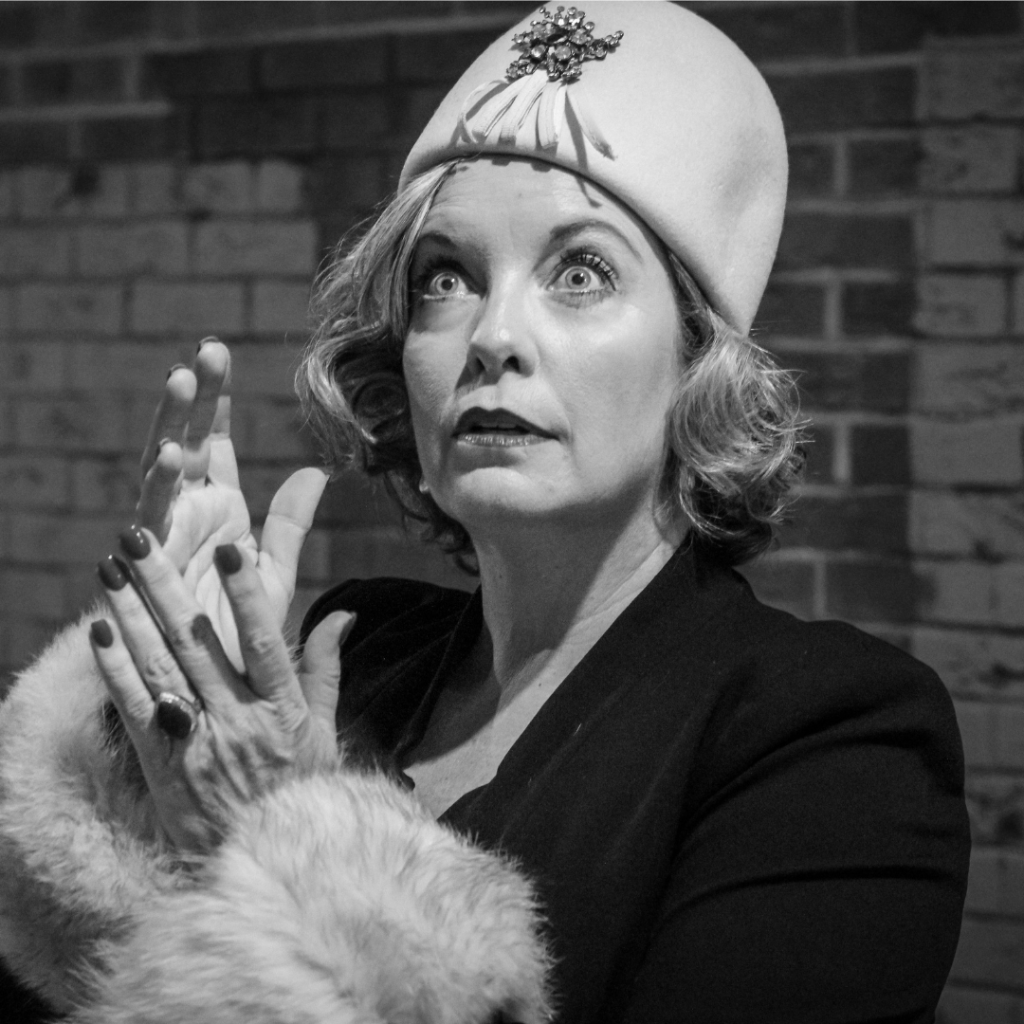
Now we have the Violet approach at Theatre Charlotte, where Destiney Wolfe stars in the title role with a hideous scar that looks more like a fine line drawn with a red ballpoint pen than a shocking horror. So it was – minus the fine red line – when Lauren Ward originated the role in 1997 on Broadway and when Sutton Foster revived it there in 2014.

Besides the risk of an Emperor’s New Clothes moment from an innocent child (“But Mommy, Violet doesn’t have any scar!”), it figures to be more effortful to watch Wolfe without the scar everybody onstage is talking about and constantly having to imagine a scar we are not seeing. That’s different from reading “The Ugliest Pilgrim” by Doris Betts, the short story that this Jeanine Tesori-Brian Crawley musical is based on.

Until the fourth page, the scar isn’t explicitly mentioned. Once the word is seen, it quickly becomes the center of the story – the reason why Violet is on a bus from Spruce Pine, NC, to Tulsa, where she ardently believes a venerated TV preacher will heal her terrible affliction. Nothing on the remaining 25 pages contradicts the image engraved in our imaginations.

Within the blissful two dimensions of a book, we don’t need to keep imagining what isn’t. Perhaps more subtly, as demonstrated by Matney’s portrayal of June in Alabaster,we can gradually get used to the disfigurement, look past it, and see the person. Along the way, we could also find plenty of relief looking at June’s unscathed side.
Notwithstanding her terrible scar and her pathetic reliance on Oral Roberts – oops, I mean the famed Oklahoma preacher – Violet is clearsighted enough to grasp her most valid reason for boarding the bus. Spruce Pine is a very small-minded town. Her elders stare at her in pity and her peers are worse, shunning her, mocking her, and pranking her.

As the saying goes, she needs to get out and meet people. Spruce Pine isn’t the place for it.

Betts had Violet saying that in a more biblical way: “Good people have nearly turned me against you, Lord. They open their mouths for the milk of human kindness and boiling oil spews out.”

Told objectively by Crawley rather than in first-person by Betts’s Violet, we see the townsfolk clearly sooner rather than judging them on a single casual quote. Scarred or not, Crawley and Betts agree on one key point: Violet is way too thin-skinned.
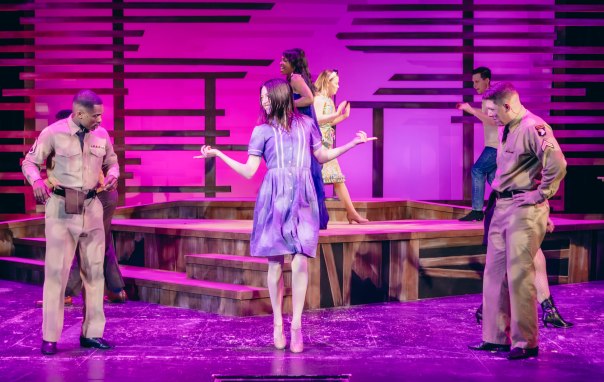
Meanwhile, reasons for dismissing Violet’s self-pity – and doubting her self-awareness – are multiplying. Before the bus reaches Arkansas, she has hooked up with two military men who are quickly captivated by her. Both of them, one black and one white, are eager to show their ardor on a stopover in Memphis, where they spend a night out together.

So the necessity of imagining that hideous scar becomes more urgent for us.

Thankfully, the Memphis sojourn allows Tessori to naturally widen her musical palette, welcoming us to the blues along with the Beale Street underbelly of town. Violet’s dream of healing and her actual Oklahoma encounters with the Preacher are welcome prompts for Tessori to branch out further into righteous, stomping, spirit-of-the-Lord gospel.

A five-piece band led from the keyboard by Danielle Barnes Hayes leaned into the gospel music at the Preacher’s revival meeting as lustily as the more countrified tunes that had gone before. Our eagerness to hear those gospel strains was certainly piqued and primed last Saturday when a seven-voice choir greeted us in the lobby of the old Queens Road Barn, accompanied by a wee electric keyboard, singing hymns and shouts for a half hour before showtime.

While director Stuart Spencer skimps on makeup design, he is deeply attuned to the material, having been part of the Davidson Community Players cast when Violet had its regional premiere in 2010. Was it a makeup job on Cassandra Howley Wood that gave me such a favorable impression of her local debut and the show? Or was it simply the intimacy of Armour Street Theatre, bridging the gap between first-person narrative and Broadway musical?

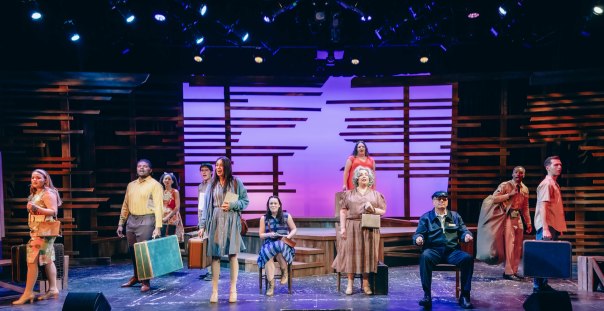
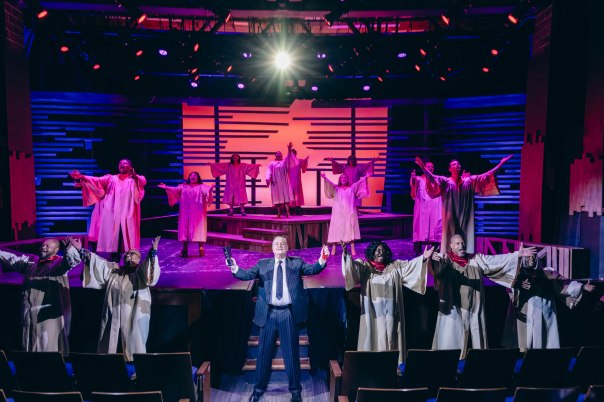
At the bus station where Violet embarks on her odyssey, at the Memphis music hall where Asley Benjamin belts a couple of songs, and at the Tulsa TV revival, a bigger stage is surely better. More space for more people and more decibels! More opportunities for lighting designer Gordon Olson to colorize costumer Sophie Carlick’s shiny robes for the Preacher’s hallelujah choir – and to add pizzazz to Sharlie Duncan’s choreography!

To their credit, neither of the soldier boys seriously believes that Violet will look any better after her Oral rendezvous in Tulsa when she reboards her Greyhound bus, heads back home to Spruce Pine, and stops off in Arkansas for another meet-up. With Sean Bryant as Flick and Ethan Vatske as Monty, the interracial relationship and rivalry between the soldiers occasionally becomes more compelling and suspenseful than Violet’s cosmetic quest.

Bryant gets the advantage of a more instructive interracial relationship between Flick and Violet. On the way to learning that her inner scars are more debilitating – and curable – than her outer ones, it’s necessary for her to appreciate that there are other, more serious skin problems in life. Beginning with pigment. In the Betts story, there’s one other huge hurdle in Violet’s spiritual growth that we don’t hear about onstage: her use of the N-word. More of Spruce Pine needs to be exorcized from her soul than she realizes.

On top of that, this thin-skinned Violet is stubborn, too. As dynamic as Wolfe’s vocals are, her adamant refusal to believe that anyone besides her daddy could love her is the most startling aspect of Violet we must encounter. We recognize this trait in people we’ve met, maybe in ourselves. Violet’s stubbornness goes so irrationally deep that it not only prolongs her path to enlightenment, it obliges Crawley to pile on a flashback recalling a cruel prank that was played on her by her schoolmates.

Counterbalancing Bryant’s shyness and vulnerability as Flick, Vatske draws the luxuries of being the more cocksure and aggressive Romeo. Just sitting down to play poker with Flick and Violet softens us up to Monty, and confident as he is, Vatske keeps us a little in suspense about with whether he’s playing with the lass or serious. The way Vatske is playing him, you’re not sure whether Monty is sure himself.

This upsized Violet is a special boon for Henk Bouhuys, who draws two plum roles, the sometimes surly, sometimes avuncular Bus Driver and the charismatic Preacher. Never mind that that the Preacher is surrounded by a fervid Gospel Choir, both in the TV flashback and in Tulsa, Bouhuys dominates the stage with his fiery motormouth exhortations.

It’s awesome enough to make his backstage powwows with this pilgrim unexpectedly tender and poignant – a quietly dazzling reality check – and allows Wolfe to enlarge upon Violet’s devotional and delusional traits.

Unfortunately, on a big musical stage, Bouhuys’s dazzle and the decadence of Memphis nightlife tend to cast the flashback scenes between Young Vi and her Father into comparatively dreary shadow. To put it bluntly, when Tessori worked with the multiple Allisons of Fun Home in 2015, she had a superior book and lyrics from Lisa Kron.

So Spencer, Abigail Sharpe as Young Vi, and Nick Southwick as her dad are doing the best they can with the weak hand they are dealt here. It’s heartwarming to see the widower dad teaching Young Vi how to play poker in order to jumpstart her math skills. “Luck of the Draw,” blending this flashback with Violet’s cardplaying triumph over Monty and Flick, puts Sharpe and Southwick to their best use.

But these flashbacks, before and after the catastrophic accident that scars Violet, are also the best reason why we never see that scar on the face of either protagonist. It would need to be applied to Young Vi during the show, a fearsome hurdle for a makeup artists and stage managers.

The script and the dumpy cardigan sweaters the Violets wear supply a wonderful way to differentiate between the two. When we first see Wolfe huddled at the bus station and boarding her bus, she looks more homeless than scarred. It’s only after dark in Memphis, when she’s escorted to the music hall by two strapping soldiers, that Wolfe tosses her cardigan aside and shows signs of full-blooded womanhood.

Miracle of miracles, she becomes flirty!

Rendezvous With Our “Sunset Boulevard” Diva

Interview: Allison Rhinehardt

By Perry Tannenbaum

After an amazing reading stage production of Angels in America in Matthews this past spring, followed by a regal Diana: The Musical up in NoDa this summer, nothing seemed to be beyond the grasp of Queen City Concerts. Their unique concert style has seemingly been bent to the breaking point, with actors mostly going off-book while more and more scenery and costumes have been layered on.

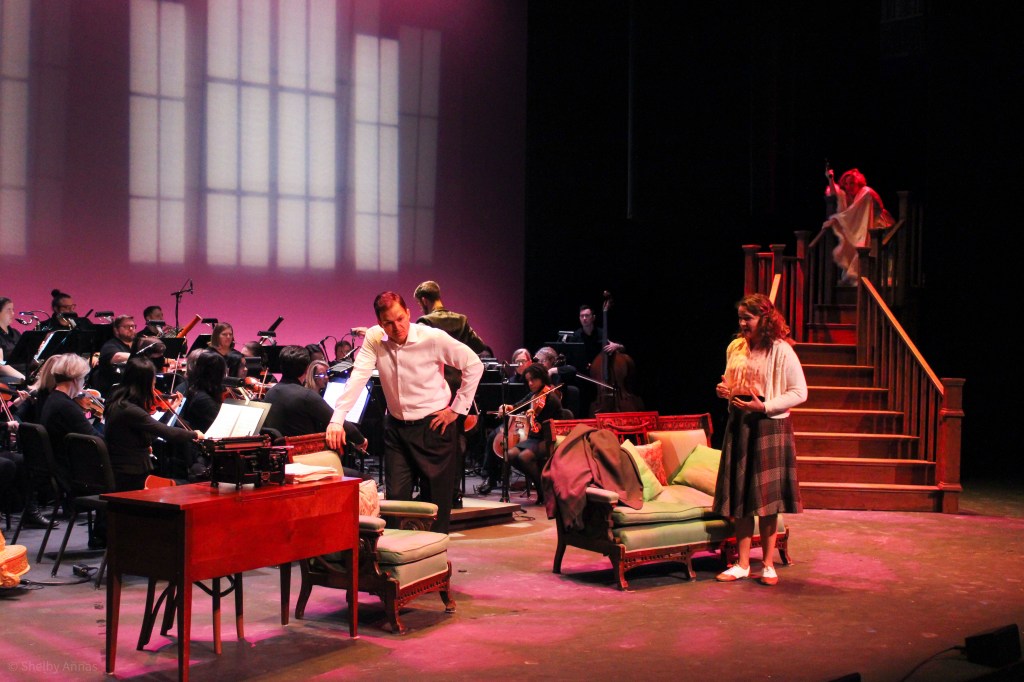
Yet the upcoming Sunset Boulevard this weekend takes everything that Zachary Tarlton and his sensational company have done so far to an even higher level. Onstage with diva Norma Desmond, her youthful paramour, Joe Gillis, and the legendary Cecil B. DeMille will be a 40-piece orchestra led by Tarlton, the first band of that size to play the full Andrew Lloyd Webber score since the 2017 Broadway revival starring Glenn Close.

“When I got the email out of blue asking to talk about the possibility of me directing it,” says Stuart Spencer, “I did have to read it a couple times before it sunk in.”

It’s a preciously short and intense opportunity for performers and audiences alike. Rehearsals are few and audiences will only get three shots at witnessing this glorious Sunset, perhaps Lloyd Webber’s very best musical. With 40 musicians onstage with his cast, Stuart’s time and space are severely cramped as opening night approaches.

“With fewer rehearsals, I have to be more specific and move faster,” Spencer admits. “A few times, I thought ‘if I had more time, I’d run that again… but we have to keep moving.’ In the end, you have to trust that your actors will do the extra work on their own to keep us moving.”

As Norma, Charlotte diva Allison Rhinehardt will be the performer that Spencer must trust the most. We had this exchange with Rhinehardt about the role, her prep, and the whole giddy experience.

QC Nerve: Is Norma Desmond the role of roles for you, or does the concert format – and the brevity of both the process and the run – dampen your enthusiasm?

Allison Rhinehardt: Norma Desmond isn’t just the role of a lifetime, it’s the role of a generation. I had never even considered taking on this role as a possibility in my life, so spending these last several weeks studying Norma, singing her iconic songs, retorting: “I am big, it’s the pictures that got small,” and watching this entire cast bring 1,000% has been both my honor and sheer delight. I think you will find this concert format to be different from past QC Concerts. This is fully staged and costumed with set pieces and props. Everyone is off-book, which was definitely a feat for some of us! Would I like more time? Absolutely. But not just for me. This show is something incredibly special. I would love to be able to share it with as many people as possible.

What in your mind makes Norma unique?

I love Norma Desmond. She is wonderfully complex. She is bursting with passion, and despite her grandeur, there is insecurity and need for validation. As a working actor in Charlotte, one of my gigs is working as a simulated patient for Atrium. This program gives med students and nursing students the opportunity to practice in a safe environment of simulated situations to help with diagnosis and patient care. One of my regular characters is exhibiting signs of mania with bipolar disorder. The character is undiagnosed and just living her life at this point. I am not a doctor and certainly wouldn’t try to diagnose anyone, but I see a lot of similarities in both characters.

Norma’s emotions swing wildly between elation and despair. She clings to “what once was” instead of forging ahead during a time of big change. Falling in [a perverted co-dependent version of] love with Joe, is just the current obsession that the audience witnesses. You get to have a 6-month living room view of a decades-long “normal.”

If you’ve experienced the performances of Patti LuPone, Glenn Close, or Betty Buckley in the role, is it a struggle not to be intimidated by the challenge – and to resist emulating at least one of them?

I have studied A LOT since being cast in this iconic role. I read an interesting book (Close-Up on Sunset Boulevard by Sam Staggs) which was a fascinating retrospective on the darkness of Hollywood dreams and the actresses that may have inspired the character Norma Desmond. I also had a trip to London the beginning of October, so I went to see the reimagined Sunset Boulevard starring Nicole Scherzinger in the West End (a whole separate interview, haha!).

Naturally, as a musical theatre person, I have always adored Betty Buckley, Glenn Close, and Patti LuPone (I saw her when I was child in Evita!). It’s impossible not to be influenced by these Broadway divas in general, but I have made a conscious effort to make my performance my own and to not rely on those before me. You may find a vocal nod to Stephanie J. Block or Elaine Paige, but Norma Desmond is such a rich and complex character, she deserves genuine authenticity which requires one to be fully immersed and present in the moment.

Am I intimidated? A month ago I would have said “intimidated” wasn’t a strong enough word (Zack and Stuart can tell you when I got the casting offer, I emailed back making sure they knew it was me they had sent it to). But now, I almost feel like I’ve joined a sisterhood of strong women telling a tragically beautiful story…or is it beautifully tragic? Am I still intimidated? Of course. I always am with any role honestly. If you’re not a bit afraid, then there’s no risk, nothing to fight for, and you’ve lost your edge.

Is the point for you to penetrate beyond the musical divas and Gloria Swanson to your own authentic Norma Desmond, or must you stop at Gloria’s iconic screen performance, obviously Lloyd Weber’s inspiration, and transfuse Swanson’s screen Norma into a fresh musical Norma?

I think it’s important to understand that while this story is on a grand scale, it is not a fairytale. The movie came out in 1950, yet it’s a tale as old as time, still relevant today. I remember distinctly the moment I was made aware that I was no longer in consideration for the ingénue; that I had moved on to the more matronly roles. It hurt. A LOT. I myself struggled with identity. Who I had always been, I no longer was, and never would be again. There were still roles I wanted to play, but had somehow “aged out of.”

As a woman in her 50s, who has been in the business for nearly 5 decades and is now looking for where I fit, I absolutely empathize with Norma. I understand her. I love Gloria Swanson’s embodiment in the movie. I love Glenn Close’s embodiment in the musical. My goal is to bring the story to life through Andrew Lloyd Webber’s words and music having not just my own decades of experiences, but also having whispers with me of all the Glorias, Glenns, Bettys, Diahanns, Pattis, Stephanies, Elaines…all the actresses “of a certain age” in my life.

What excites, frustrates, or frightens you about working in the concert stage format? How much will you be able to abandon script and score to become Norma?

What I love about the concert format that Zack has created is the trust between the creative team and the actors. We may only have a handful of official rehearsals, but that doesn’t mean work is not being done outside that time. The entire cast received the script before rehearsals began. On day one of rehearsal we were running and staging songs because everyone had done their homework, everyone came in knowing the music.

Trusting the actors to do what good actors do is what makes it work. While my script and score have been an extension of my right arm for weeks now…it goes everywhere I go and is currently sitting right next to my laptop…I’ve been off-book for at least a couple of weeks and able to really concentrate on nuance. Of course moving into the Booth on Wednesday and gaining a 40-piece orchestra on the stage will present new logistical challenges, but that is par for the course in theatre. I think theatre folk roll with the punches better than most. As Little Red so aptly put it, I’m “excited and scared.”

More rehearsal time would help, right?

More rehearsal time for a show this size certainly wouldn’t hurt, though I firmly believe things can (and often are) over rehearsed. I wish we could run the show for more than 3 performances over 2 days after putting so much heart and hard work into it. We have to work within the reality many theatre groups in Charlotte face. Rehearsal space takes money. Performance space takes money. Charlotte is a vibrant city with an incredible network of talented artists. Support and funding for the arts in Charlotte is imperative to the community.

Fun fact: This 40-piece symphonic orchestration production is only the 2nd of its kind in the country with the first being the 2017 Broadway revival with Glenn Close. So New York’s Broadway and now Charlotte, NC? That is cool. The Booth holds about 400 seats, so over our three performances, 1,200 people in a city of nearly 1 million will get to see Sunset Boulevard. That is Zachary Tarlton and QC Concerts’ gift to the city of Charlotte…

Weepy and Upbeat Church Singing at The Great Aunt Stella Center

Review: Theatre Charlotte’s Smoke on the Mountain

By Perry Tannenbaum

IMG_1248 

February 24, 2022, Charlotte, NC – There’s a bit of a Tar Heel tug-of-war going on between two small towns east of Charlotte, Mount Pleasant and Mount Olive, for the honor of having the best claim on being the site of Smoke on the Mountain, a homegrown musical that has maintained its popularity since 1988. Geographically, Mount Pleasant has the far stronger claim, due to its closer proximity to Charlotte, which is explicitly mentioned numerous times in the script, and because the Mount Pleasant Baptist Church is officially ordained as our setting in Connie Ray’s book.

Yet in terms of flavor, smell, and story in Alan Bailey’s original concept, Mount Olive and its famed pickle factory cannot be dismissed, for there are twin accidents near the pickle works that figure prominently in the opening scenario. Gawking at the gherkin spillage from the plant, the Sanders Family has tipped over its van and is therefore late in arriving to the church, where they are scheduled to lead a sing-along before a music-and-dance-averse congregation. Original musical arrangements were by Mark Craver, longtime member of the Red Clay Ramblers, and Mark Hardwick. Since both Craver and Ray hail from North Carolina, those roots run deep in the story and in the music.

Pastor Mervin Oglethorpe has invited the Sanders Family to sing at the Church in June 1938, part of his stealth campaign to lighten up – and modernize – his congregation, and the songs were chosen to evoke that era. “No Tears in Heaven” by Robert S. Arnold, for example, was written in 1935, and Albert E. Brumley’s “I’ll Fly Away” was penned in 1929. When Theatre Charlotte last presented this musical in 2010, they were able to build better scenery at their Queens Road than I had seen three years earlier at a Pineville Dinner Theater production. A fire at that barn in December 2020, however, has turned Theatre Charlotte’s 94th season into an extended road trip, stopping at various locations around the city.

If the company’s mid-December production of A Christmas Carol seemed more than a little dwarfed by Halton Theater on the campus of Central Piedmont Community College, the current location at The Great Aunt Stella Center could hardly be more ideal. With a full set of organ pipes upstage to frame the Sanderses and Pastor Oglethorpe, and with cushioned pews for the audience to sit in, The Great Aunt Stella hardly needs to pretend at all to be accepted as a church. In fact, we’re entitled to think that Auntie Stella determined the choice of Smoke on the Mountain rather than the other way around.

As stage director and music director, Kristin Graf Sakamoto has done a fine job in taking advantage of the venue – and of the cast, since she reports prevailing on members to pick up instruments they had never seen before. That certainly tamps down the bustle onstage I’ve seen in previous productions that were burdened with a house band and adds to the homespun authenticity of this Mountain. We may be a little confused and disoriented when the Sanders Family hurriedly makes their belated arrival, for all of their instruments are already onstage – guitars, bass, mandolin, and assorted percussion instruments.

June Sanders is the first to arrive as Pastor Oglethorpe stalls for time. Emily Nageotte does a fine job in giving us the comical pickle catastrophe backstory, explaining her parents’ and siblings’ delay while portraying herself as the odd duck in the family. Instead of singing with them, she will sign for the deaf – whether or not there are hearing-impaired people in the audience. Eventually, June will sometimes make more noise than other members of the family as, one by one, she removes a wacky assortment of percussion instruments – including washboard, spoons, and cowbells – from their hiding places during the course of the concert.IMG_1551

We’re in a church, so the evening’s program turns out to be a mix of homespun musicmaking and spontaneous testifying. As you might suspect, the Sanderses are a rusticated bunch, so a backwoods Mayberry shyness befits them all – with the exception of Liz Waller as Vera, the mama, affecting something close to a Minnie Pearl effervescence. Now there was also a proud and ornery side to Vera when her views didn’t coincide with Pastor Oglethorpe’s. Instead of coming to blows, they hurled Bible quotes at each other, citing chapter and verse for extra emphasis. Fretting with all kinds of picayune worries, Stuart Spencer as Oglethorpe keeps a perpetual crackle of tension in the air, heightened when his scriptural erudition is disputed, released only when he yields to the music. At first, he merely sings along at the top of his lungs, but when the spirit truly hits, he runs back to a cloakroom and fetches a harmonica.

The friction between the pastor and the Sanders Family (his singing contributions aren’t received enthusiastically), especially Vera, make for a needed dramatic undercurrent to spice up the singing and testifying until the hubbub that brings on our intermission. Burl, the genial patriarch of the family, seemed to be the peacemaker in Mike Cheek’s papa-bear portrayal, loyal to his wife Vera and all their cubs. It’s his brother Stanley, the black sheep of the family, who stomps out of the hall in a huff, and it’s Burl who must coax him to return.IMG_1728

After this kerfuffle, while Pastor O is having a couple of words with the Sanders girls, the stage is set for the most dramatic testimony of the night, when the wayward Stanley returns. Apparently the only Sanders to have tasted the fermented fruit of the vine or the distillery, Jake Yara is wonderfully quiet and penitent in Stanley’s testimony, humbled yet not shamed. His earnest confessional seemed to spur Molly Neal as Denise, the younger Sanders twin, to unburden her heart and reveal that she had once run away from home – to Charlotte! – in a poignant tale of teen heartbreak. Neal upstaged her younger twin with her abortive foray into showbiz, but Gray Ryan as Dennis had a simpler, more comical testimony, aspiring to fulfill the calling of a preacher despite his terror of public speaking.

The acoustics at Great Aunt Stella are better for music than theatre, so it’s fortunate that Sakamoto placed such a high premium on the voices in her cast delivering the two dozen songs we hear. Backup vocals are as meticulously rehearsed as harmonies, and the instrumental performances are quite serviceable. Some might prefer the weepy and morbid repertoire like “Meet Mother in the Skies,” “Everyone Home but Me,” and “Whispering Hope.” Among these Christian hits, I’ll take the quirky and the upbeat any day. Give me more like “Christian Cowboy,” “I Wouldn’t Take Nothing for My Journey Now,” “Angel Band,” “I’ll Fly Away,” and “I’m Using My Bible for a Roadmap.”

2020 or Not 2020

Review: A Half-Masked Christmas Carol at Theatre Charlotte

By Perry Tannenbaum

2020~A Christmas Carol-28 

Luckily, the Ghost of Christmas Present in Charles Dickens’ A Christmas Carol, so friendly and jolly with his glowing torch, was more than 175 years removed from 2020 when he made his first oxymoronic appearance in print. Christmas of 1843 may not have been the best ever as it greeted Dickens’ original readers, but it had to be more festive than 2020, the gloomiest in centuries.

While it’s possible to retreat into the nostalgia of numerous movie and TV adaptations of the Yuletide classic, Charlotte is one of hundreds of cities where watching live theatrical adaptations has become a holiday tradition. So it’s fascinating, even revelatory to see how Theatre Charlotte is adapting to the unprecedented circumstances of 2020 in presenting its 14th annual production of A Christmas Carol.

It’s a remarkable chameleon, adapted by Julius Arthur Leonard and co-directed by Stuart Spencer and Chris Timmons. This is truly a to-be-or-not-to-be effort: Live and virtual, at Theatre Charlotte on Queens Road and not, set in Dickens’ London in the 19th century and unmistakably invaded by COVID-19 and the constraints of the pandemic. 2020 or not 2020.

2020~A Christmas Carol-21

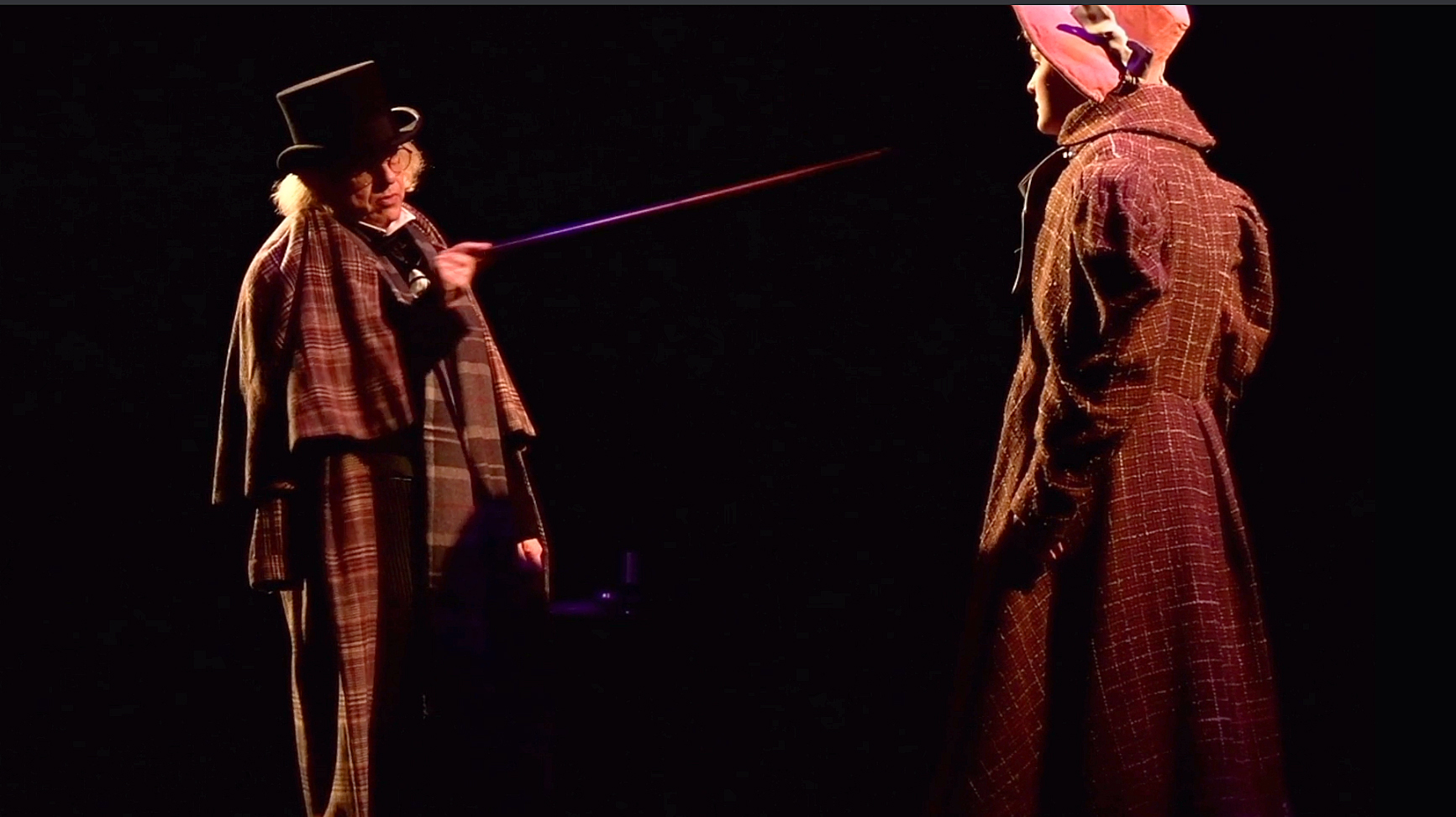
Watching the virtual version recorded at the Queens Road barn, I was surprised to find how Dickens’ characters, in period costumes designed by Chelsea Retalic, replicated daily life today. While Marley and the three famous Christmas Ghosts wore masks, others – including Scrooge, his nephew, and the Cratchits – did not. No wonder poor Tiny Tim is dying!

Live outdoor performances of Theatre Charlotte’s pandemic edition of Dickens premiered at Christ South’s Old Dairy Farm in Waxhaw on Reid Dairy Road, which may account for some of the anomalies we see when we tune in to the indoor version. Outdoors, winter is upon us, so Spencer and Timmons may not have wished their Scrooge to change into his jammies. Besides that, an outdoor shift in scene from the Scrooge & Marley counting house to Ebenezer’s bedroom may have been unwieldy out on the farm.

So all of the action, aside from the Ghosts’ travels, is confined to Scrooge’s office until he sallies forth on Christmas day. To achieve this economy and consistency, Spencer and Timmons alter the plot just a little, sending Scrooge outdoors for dinner and having him realize that he has forgotten his pocket watch at his office. That’s where Marley and the Ghosts will now do their haunting. Nor do our directors forget about Ebenezer’s watch or his watch chain, elegantly transforming it into a fresh plot point without changing any of the dialogue.

IMG_0654

The uncredited set design, likely by Timmons, is very spare, silhouettes of city and government buildings in the background, connected to the Scrooge & Marley firm by a stunted staircase and a front door. No walls or windows obscure our view of the sidewalk outside the office or the silhouetted figures that traverse it. Inside, we never need more at Scrooge’s HQ than desks for Ebenezer and his oppressed drone Bob Cratchit. Bedtime is never observed, so there’s no longer any need for a bed. When we visit the Cratchits or Scrooge’s nephew Fred, as much as a cushioned chair and a wee table are necessary, so that Fred’s wife may have a glass of wine and a decanter nearby, but that is all.

Sound design by Timmons and Vito Abate only blunders with the opening and closing of Scrooge’s front door. Opening it lets in a hullabaloo of street sounds and closing it silences the noise – except we can clearly hear the footsteps of whoever departs on the sidewalk. Grander and more successful are the sounds heralding the supernatural entrances of Marley and the three Christmas Ghosts, while lighting by Rick Wiggins brashly suggests that all three of Scrooge’s guides have celestial origins.

2020~A Christmas Carol-07

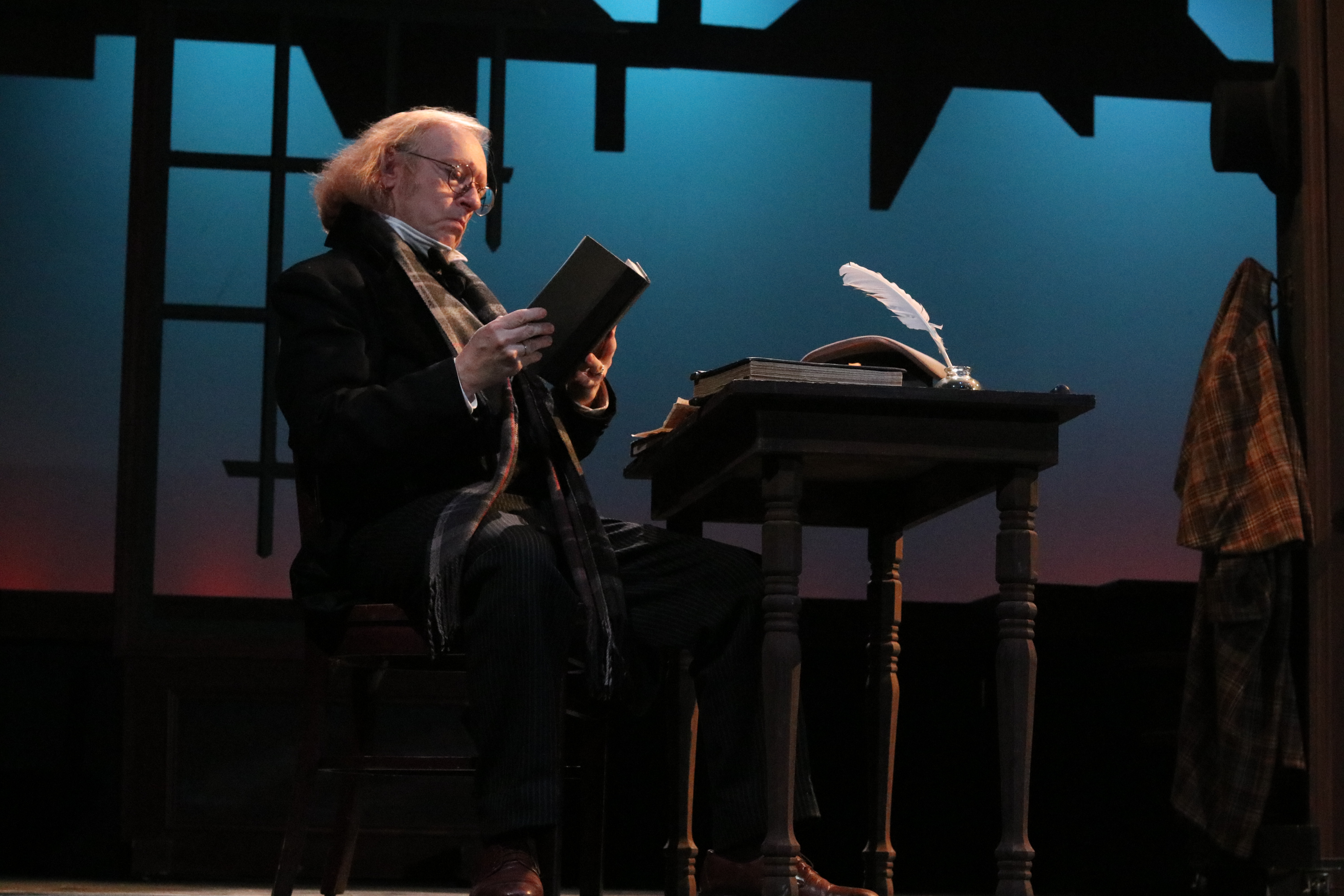
Hank West, mostly prized around town for his comedy exploits, is not a complete stranger to mean roles, having portrayed the Marquis de Sade in 2003. There’s nothing missing of Scrooge’s flinty cantankerousness in the opening scene. West’s rebuffs of a charitable solicitor (just one this year instead of two) and his nephew Fred are even more repellent than his tyranny and resentment toward Cratchit. It’s when we approach West’s comedic wheelhouse where we find him woefully hamstrung. Deprived of Scrooge’s bedclothes and his dopey nightcap – the lone accessories that make Ebenezer vulnerable or adorable through five-sixths of the story – West must accompany the Ghosts in business attire.

Worse than that, West must give us a Scrooge who dances with glee, realizing that he hasn’t missed Christmas morning, dressed up like an adult going to work rather than as a child waking from – and to – a fabulous holiday dream. Missing this parcel of Dickens’ visual genius, we can appreciate it more, for the nightcap and bedclothes are also as indispensable to the distinctive flavor of Scrooge’s supernatural journeys as the Ghosts’ personalities.

2020~A Christmas Carol-39

West’s comedy isn’t totally eclipsed, peeping out in his retorts to Cratchit and the Solicitor, in his timing of remarks after visitors exit, and in his sunny sallies around town making his many amends. Of course, the final prank on Cratchit when he comes in late on the 26th is handsomely done, though I was a little surprised by West’s decision to underplay Scrooge’s mischievousness and glee as he did Ebenezer’s playacting.

More women than men are seen onstage here, with Andrea King tipping the balance as Bob Cratchit. At work, she is purely deferential toward Scrooge, and King’s entrance on the 26th has a stealth worthy of Chaplin or Lucille Ball. We probably notice that at home, King’s Cratchit as a husband and a father comes off as less of a patriarch than we’re accustomed to. Can’t say that I minded much – am I becoming too evolved?

2020~A Christmas Carol-11

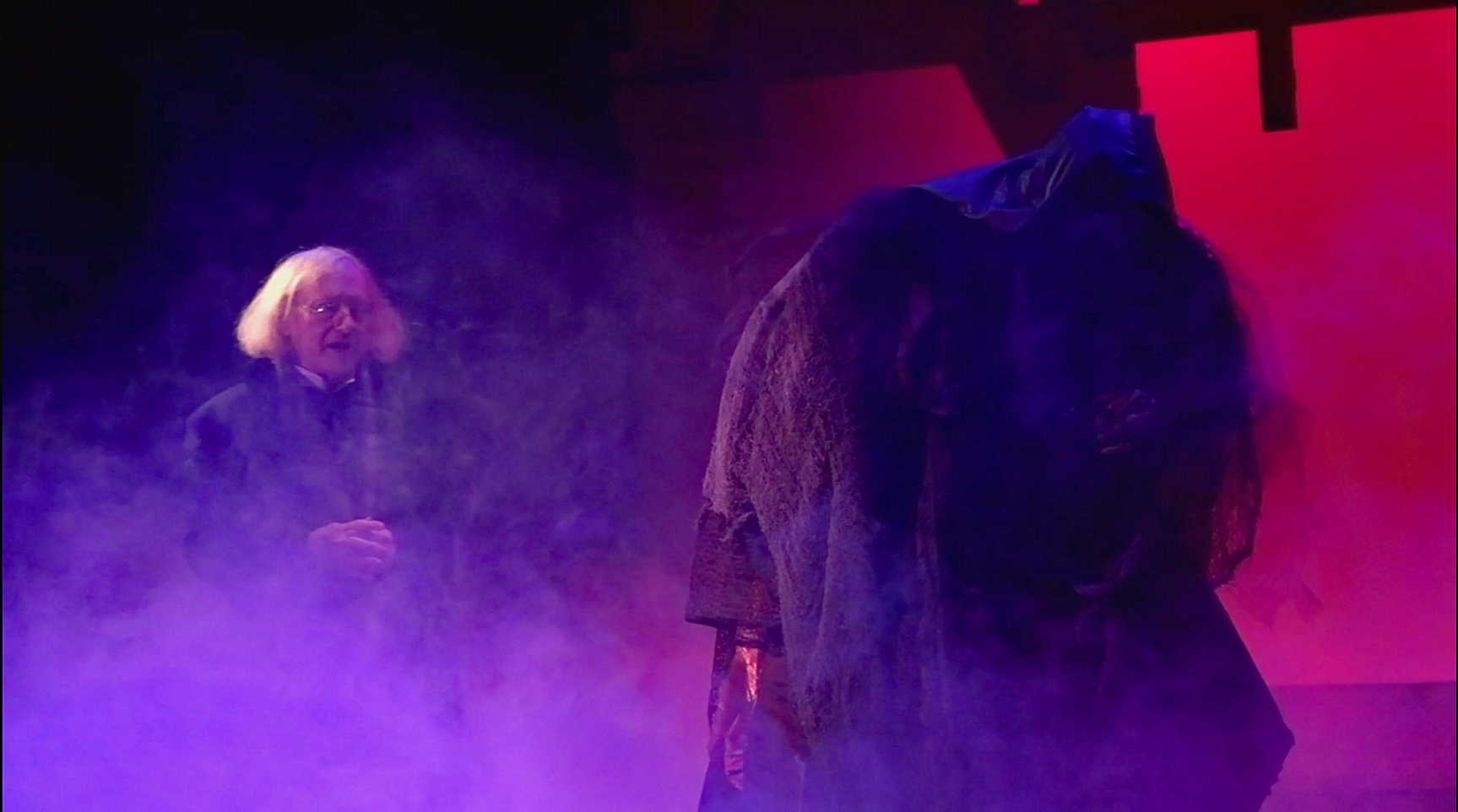
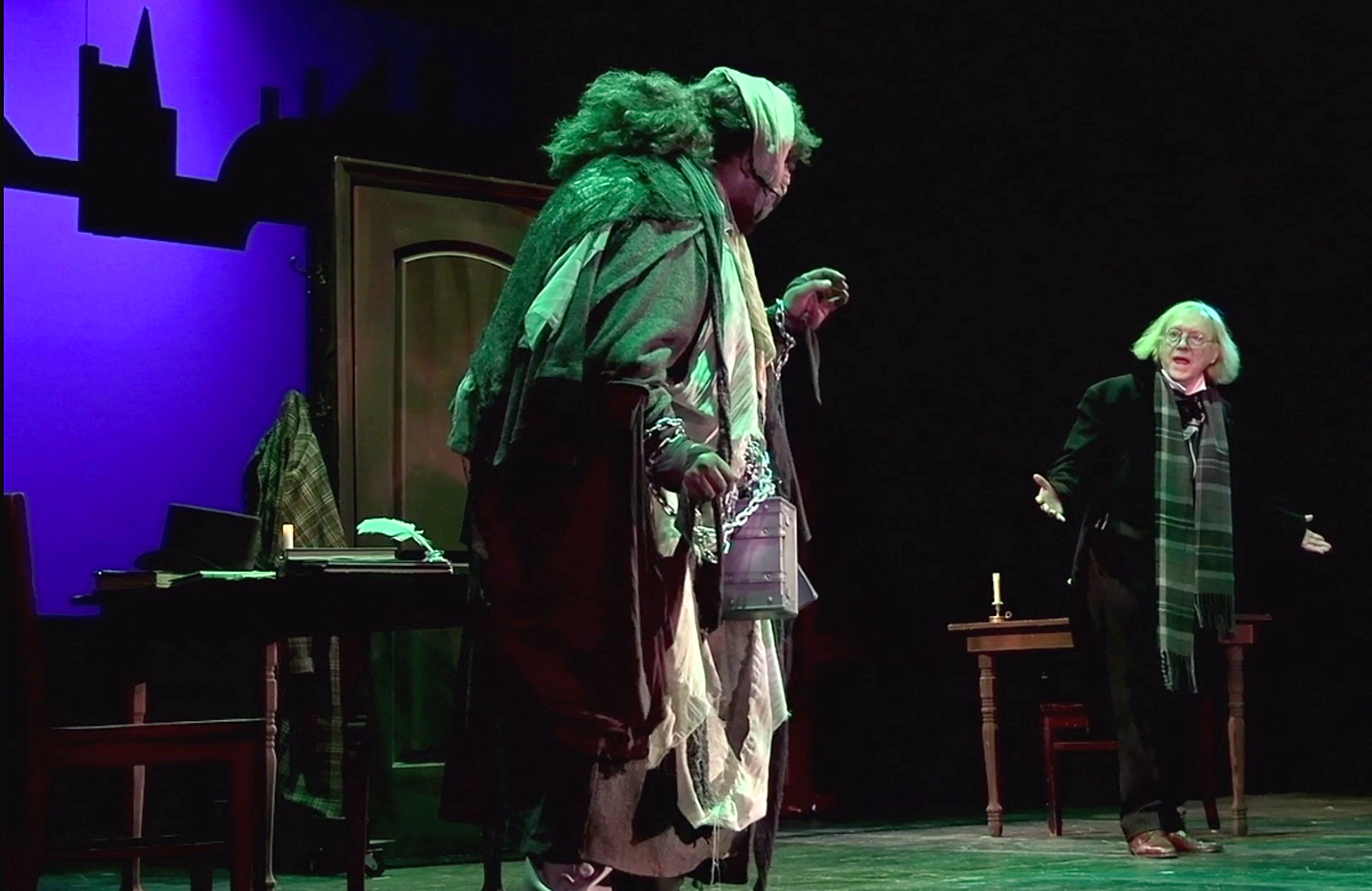
Seeing both Allen Andrews as Christmas Yet to Come and Josh Logsdon as Marley’s Ghost wearing masks hardly detracted from their portrayals. Logsdon’s mask had an orifice that seemed rimmed with teeth, he was bundled up with enough rags under his chains to look like a leper, and a huge gray wig affixed to his head with a shroud-like kerchief made him even more loathsome. Notwithstanding Scrooge’s doubts, when Logsdon bemoaned his fate and issued Marley’s warnings, there was far more grave than gravy in this ghost.

More noticeable were the alterations that masks imposed on the women Ghosts. Reprising her role as Christmas Past, Anna McCarty had a veiled look in her gleaming white gown, Arabian or ecclesiastical in its modesty. Yet when she needed to be strong and authoritative, McCarty didn’t disappoint, even though she seemed more socially-distanced than her castmates. Lechetze Lewis as Christmas Present was free to mingle more in her garrulous London tour. Her lively interaction with Fred and his wife, Andrews and Mary Lynn Bain, offered the most spectacular display of Retalic’s costume designs this side of Marley.

Andrews’ entreaties that Uncle Scrooge come dine with Fred were nearly as foundational in establishing the Christmas spirit on Queens Road as Cratchit’s sufferings and goodwill. Bain was also more impactful when she doubled as Belle, Scrooge’s sweetheart in the flashback, particularly when she returns her engagement ring, releases Ebenezer from his obligations, and decries his worship of Mammon.

2020~A Christmas Carol-22

Little moments like this, Cratchit applauding Fred’s advocacy of Christmas, and the perfect view we get of Cratchit sneaking in late after the holiday are among the many testaments we get to the work of Megan Shiflett and Nick Allison behind the cameras – delivering the best angles from the best distances. Theatre Charlotte may not have the resources that CPCC can boast in video gear, but they’re outstripping every live video I’ve seen from the college, because Spencer and Timmons are so deftly cuing their cameras where to be and when.

Amid the special hardships of 2020, local theatre companies are substantially sharpening their video techniques and their cinema savvy, good tidings that will pay dividends when COVID-19 is conquered.

With Jill Bloede executing the Narrator’s role in such a ceremonious British style, and with the likes of Tom Ollis and Rebecca Kirby as the Fezziwigs, quality runs deep in this cast – as deep as you’d expect with productions running twice the five performances this one is getting. There’s plenty of mileage left in the virtual version, which continues its on-demand run through January 2.