Tag Archives: Sophie Carlick

Old Barn’s “Orient Express” Is a Clue-ful Poirot Treat

Review: Murder on the Orient Express at Theatre Charlotte

By Perry Tannenbaum

We can thank the Brits for the notion that passenger trains should run with absolute timeliness and precision. Now that Ken Ludwig’s meticulous adaptation has opened at the Queens Road Barn, we can also thank Agatha Christie, Britain’s most avidly read mystery writer, for her Murder on the Orient Express. Layer on Jill Bloede’s bubbly direction – and dialect coaching – and the treacherous trip rattles along with a savory continental flavor.

That soupçon of glitter and effervescence is greatly enhanced by Theatre Charlotte artistic director Chris Timmons’ fleet and fluid set design, an art deco wonder that transitions delightfully from an Istanbul hotel to a smoky train depot to the luxe interiors of the Orient Express. Since the landscape and snowscape outside the legendary train are also moodily conveyed by projections, it’s difficult to draw a precise borderline between Timmons’ scenic exploits and his lighting design.

While the paucity of professional theatre companies in the QC continues to account for the plethora of professional-grade acting talent we behold at the Barn, so does the opportunity to appear in opulent costumes such as those designed by Sophie Carlick – for hotel waiters, train conductors, and various glitterati who can afford a first-class sleeping compartment on a luxury transcontinental train.

Speed is beneficial in a murder mystery, especially as it plods along, contrary to real life, when we’re introduced to a multitude of suspects who have sufficient motive to commit the cold-blooded crime. Anyone who grew up watching the Perry Mason series on TV (or has binged on it more recently) knows the classic drill: the murder victim antagonizes a slew of enemies. So many enemies that we’re unsure who might have done the deed and more than mildly uncaring about the victim, no matter how brutally they were killed.

Ludwig admirably singles out our obnoxious victim-to-be and all the antagonisms he can spark while introducing us to Christie’s heroic protagonists, Constantine Bouc, owner of the Orient Express line, and peerless detective Hercule Poirot. There will be debate about Bloede’s decision to shitcan Poirot’s mustache wax and twirls in favor of a more conventional groom, but Brandon Samples’ initial entrance as the Belgian is star quality.

There’s a bit of aristocracy to Samples’ bearing that allows Poirot to fit in with his fellow passengers, including a princess, a countess, and a colonel. While Timothy Hager zestfully cements his repulsiveness as Samuel Ratchett, it’s also important for us to see that Poirot has sufficient dignity, discernment, and assets to reject Ratchett’s crass job offer.

Poirot also offers Samples a few brief episodes of befuddlement, for the culprit he is hunting leaves a blizzard of clues.

Unlike all of those complacent Perry Mason victims destined for the morgue and a court-ordered autopsy, Ratchett is keenly aware that he is being hunted. He’s willing to retain Poirot for a fabulous amount of money to protect him. Perry, you’ll remember, doesn’t arrive on the scene until after the wrong suspect is accused and arraigned. Here, Poirot is directly involved while the victim is alive. So when Samples shows no guilt or remorse for not accepting Ratchett’s offer after he is murdered, we’ll need further reasons for despising the playboy.

Christie piles them on and, in doing so, makes the bizarre solution to her mystery more plausible, for Ratchett is far more monstrous than he first seems to be.

Yet the elegance, hauteur, and glamor of the leading ladies would seem to instantly eliminate them from suspicion – or any close acquaintance with the vulgar victim. To think that Paula Baldwin as the Russian Princess Dragomiroff would deign to inflict eight stab wounds on the repellent Ratchett seems like sacrilege.

Likewise, Julia Howard as the serene and mysterious Countess Helena Andrenyi from Hungary seems worlds away from the slain playboy. The ethereal Gretchen McGinty as English governess Mary Debenham, also a smashing beauty, seems to live in an entirely different sphere, more involved with Scottish Colonel Arbuthnot (Ben Allen with a brash brogue) than the slain American.

As for Kathryn Stamas, as an esteemed actress traveling under the assumed name of Helen Hubbard, she is sufficiently brash, loudmouthed, and inconsiderate for us to worry whether Ratchett, trying to get some sleep next door and stewing with rage, will burst into her room and murder her. Murdering him would ruin her delight in riling him with her late-night singing.

However laudable it might be to murder Ratchett, three acts of God will prevent the ghoulish plan from eluding discovery: the unexpected arrival on board of legendary unraveller Hercule Poirot, the serendipitous intervention of Orient Express owner Constantine Bouc in securing a first-class compartment for Poirot, adjacent to the victim’s room. After these pieces are in place, with Bouc ready to serve as Poirot’s loyal sidekick, comes the fortuitous storm that halts the regal train in a snowbank out in the wilderness, giving Poirot sufficient time to investigate.

Bouc is obviously a key prong in Christie’s plotcraft, allowing Poirot to board the Orient Express and vesting him with the authority to investigate. Otherwise, our mustachioed sleuth wouldn’t be able to scan all our suspects’ passports or rummage through their luggage. Dramatically, he enables Poirot to interview all the suspects, another ritual of the mystery genre, corresponding to Perry Mason cross-examinations, that cries out for swift pacing.

The venerable Dennis Delamar would seem ideal for bestowing the requisite bonhomie on our gracious host and eager sidekick, except… for all his wholesome triumphs as Henry Higgins, Grandpa Vanderhoff, Kris Kringle, John Adams, Hucklebee, Jacob the Patriarch, and many more, has he ever done a French accent before? Maybe that was the question Delamar was asking himself on opening night when he uncharacteristically stumbled over a few of his opening lines.

Even for a semi-pro like me, those are lines you should be able to say in your sleep. Of course, Double D never broke character during his difficulties, so to neophytes in the audience, it may have seemed like the garrulous pensioner was stumbling over his English. Delamar’s imperturbability in this brief crisis only made Bouc more charming when he righted himself – and real panic was safely in reserve when the unsolved murder, right under his nose, threatened the image and prestige of his company.

Bouc also serves as a buffer between Poirot and the petty annoyances presented by our suspects, allowing Delamar to display his comedic chops. Samples, on the other hand, gets to revel in flipping over innocent façade after innocent façade in revealing the secret underbellies of his artful gallery of suspects. The parade of skeletons emerging from closets can’t help but add to our merriment.

So most of the actors on stage need to be adept not only in erecting their respective façades, but also in carrying off those deliciously satisfying moments when they are so disconcertingly exposed. Joshua Brand as Ratchett’s querulous secretary seems particularly innocent and above suspicion, while Emma Brand as the Princess’s trembling missionary ward is even further above. So pleasant when they fall.

Climb aboard this fatal train, and you’re likely to find the ride more fun than you expect.

Risen from the Dead, CAST’s Alabaster Is All About Artists in Crisis

Review: Alabaster at The Mint Museum

By Perry Tannenbaum

Google and Alexa will tell you if you ask: it’s a little bit more than a 17-mile drive from Bessemer to Alabaster, Alabama. Every source I’ve checked also confirms that Gip’s Place, the last backyard juke joint in America, was in Bessemer until its blues guitarist founder, Henry “Gip” Gipson, passed away in October 2019 at the age of 99. It’s useful to know that when we meet Weezy, the first character to speak at the Mint Museum – in the first Carolina Actors Studio Theatre production anywhere since its 2014 NoDa demise.

Weezy tells us that she lives at a small farm “right near” Gip’s Place in Alabaster.

True, we have ample reason to question Weezy’s veracity from the get-go, since she also introduces herself as a goat. Titling her comical drama Alabaster,playwright Audrey Cefaly could coyly blame her geographical inaccuracy on this cantankerous barnyard beast she created. But the choice, invoking the special malleability of a stone that has been reshaped by sculptors and artisans for millennia, is clearly an artist’s choice.

As we continue to follow the scrappy encounter between two artists in backwoods Alabama, one a celebrated photographer of celebrities and the other an unknown painter, we often find that Weezy – among other things – is Cefaly’s surrogate. In one meta moment you can look out for, Weezy even delivers a message from the playwright to one of our protagonists.

Mostly, Weezy serves as an irascible Jiminy Cricket for June, the one human survivor on the farm. When she isn’t offering up prompts and explanations channeled from Cefaly, she becomes June’s better self, the self that is wishing to break free of her self-imposed isolation and artistic obscurity. When sweet optimism sours into clear-eyed skepticism and cynicism, Weezy becomes the painter’s inner voice: June’s worst critic.

And sometimes, she’s a goat, caring for her ailing mama. Weezy is fluent in English and goat. Occasionally, she’s also clairvoyant.

Both Bessemer and Alabaster are prone to tornadoes. Cefaly’s tornado has radically reshaped June, demolishing her farm and turning the entire left side of her body into a relief map of scars, patches, pocks, and swirling melty skin. Playing the role of June, Zoe Matney has a l-o-o-o-o-ng pre-show routine, for she must spend much more time than usual backstage getting director/makeup designer Michael Simmons’ concept applied – front and back, from torso upwards – with help from assistant director/makeup artist Dee Abdullah.

Then she is onstage as the audience arrives, long before lights dim and Weezy enters.

If Weezy weren’t there, we must also remember, we wouldn’t have a reason to hear from June, though her first response to the goat’s prodding is no more than a well-chosen finger. Fortunately, we are quickly liberated from the confines of an inner dialogue by June’s distingué visitor, Alice.

Acquainted, you can bet, with Annie Leibovitz and no further than a light meter’s distance from Demi Moore, Alice’s career has recent taken a hairpin turn to the scarred-women project she’s working on now. June is her seventh subject, and Alice works in multiple media. Trying to reach the traumatized inside of her subjects – all women – while finding the dignity and beauty mixed with the deformity outside, Alice documents them in video interviews and, when the time and light are right, by snapping coffee-table-quality portrait photos.

Are these scars a form of artwork?

A fresh aspect of artist’s choice comes into play with Cynthia Farbman Harris as Alice. Alabaster premiered in December 2019, just two months after Gip’s passing, in Fort Myers, Florida – the first stop in a “Rolling World Premiere” presented at 11 member companies of the National New Play Network, a rollout spanning from New Jersey to Oregon. The QC had a company in that Network, Actor’s Theatre of Charlotte, which had rolled with some of these co-op premieres before.

When asked about the switch away from glamor assignments, Alice deflects at first. She only gives herself away slightly when asking June about her “accident” – a word more apt for her own trauma – and when, egged on by June’s questioning, she scrolls back far enough among places she’s been before Alabaster to her rehab.

So it shouldn’t be too surprising to learn that Actor’s Theatre was scheduled to premiere Alabaster in the latter half of its 2022-23 season, just over two years ago. More of you will remember that Actor’s Theatre did not make it to the end of 2022, planting its gravestone among the most honored companies in Charlotte’s theatre cemetery before the halfway point of its 34th year.

For Harris, who auditioned for that abortive ATC production, it was a matter of not forgetting. She had worked with Simmons at CAST, with a variety of other stints at Moving Poets, Queen City Theatre, and Theatre Charlotte – including a pair of diva roles, Maria Callas in Master Class and Blanche DuBois in A Streetcar Named Desire. If the role of Alice stuck with her after ATC’s demise, there must have been plenty of meat on the bone.

With an eye toward reviving the edgy theatre vibe that reigned while ATC, CAST, and QC Theatre were all up and running, Cynthia and her husband, actor Michael Harris, have founded Actors Collaborative Theatre to help make it happen. The new ACT is an associate producer of Simmons’ rebirth, while Moving Poets and Charlotte Contemporary Theatre are among the companies listed in the digital playbill on CAST’s thank-you list.

If you know how long ago Harris starred as Blanche, then you know Alice is bit of a stretch, no matter how much she wanted it. We’re not just talking about the yoga scene. With Abdullah serving as intimacy director, June’s master bedroom becomes more than an artist’s studio. Scars and all, June brashly inquires whether Alice is gay, before we learn the photographer’s full backstory.

Somehow, Matney and Harris make their love-hate relationship work altogether naturally and spontaneously. It only becomes a little more cerebral than Cefaly imagined it. They lean into the age difference a little instead of pretending it doesn’t exist. But they do traverse the long, rugged terrain to the primal mode. The two artists debate whether their meeting is like The Bridges of Madison County or not. Yet they could also debate whether they are both hostile animals locked in cages of their own making – while the liberating keys are always in their hands.

Actually, they do talk about that.

Matney’s performance is every bit as stunning as Harris’s, if for no other reason than June is so moody and mercurial. Ambivalent about having her paintings exposed to outside world, June is living with desperate intensity in her present isolation, hoping for a sunnier future – she has invited Alice here, though she is wary – while repeatedly tortured by her past trauma.

Something as trivial as the beep of Alice’s camera can trigger flashbacks to the worst. Adding to the inner psychological circuitry are the stresses of fresh lightning and thunder – plus the partial nudity at the start of the photo session. Matney calibrates her various disturbances well when her hurting is raw, and she channels energy convincingly into compensatory actions when June is striving to appear calm and well-adjusted. She also leaves room for just the right amounts of flirtation and coquetry.

Kelly Mizell, who plays Weezy, can tell you how long ago Harris sashayed into Nawlins as Blanche, for she was an outstanding Stella Kowalski in that same Theatre Charlotte Streetcar way back when. Given the opening entrance, this talking goat decisively demonstrates that she can still command a stage before discreetly receding into the background, sometimes as a handy guide, sometimes as an annoyance, and sometimes as a mind-reader.

Mizell gets to show Weezy’s tender side caring for Bib, her mostly pallet-of-hay-ridden “Mmaaahaaaahaaaa… maaaaaah!” You can see Harris wanting to play Alice enough to partly bankroll and publicize a production, but with so much stage time and so little spotlight (or vocabulary) as this old goat, Debbie Swanson had to really want this Mama Bib role. She’s wonderful when her moment comes.

Otherwise, there are remarkably few signs that Simmons and the Harrises are doing all this on a shoestring. Lighting design by Dave Meeder easily ranks with the best we’ve seen at the Original Mint’s Van Every Auditorium on Randolph Road. Tim Baxter-Ferguson, another name we fondly associate with a bygone era, installs a marvelously rusticated twin-level set design that simultaneously gives off vibes of woodsiness, springtime color, and irreversible damage.

Sophie Carlick’s costumes don’t have to be lavish, but they enable June, Weezy, and Alice to radiate an outdoorsy aura. Cleverly enough, June’s bedroom outfit hides her preoccupation with painting as decisively as her splotched overalls proclaim it, but the goat costumes also strike a perfect note. So do the many artworks fashioned for June’s artistic oeuvre on barnwood, to be auctioned off when Alabaster completes its run.

Simmons’ sound design and special effects are on-point, but I wish they had impacted more: louder, with more lightning crackle and windy sweep. Nor was the ringtone on Alice’s cell as ugly as Cefaly intended. As a photographer, I had to chuckle at the sadly unprofessional equipment we were seeing, including a camera with an onboard flash. Yet I could empathize with Harris – and admire her all the more – when she had to keep that lame videocam running and the still camera showing snaps on its screen.

When Alice instructs June on how to use a smart phone, when she shows her how to trip the shutter, and how to review the photo portraits on the wee screen… Quiet moments like these resonate with us, because they are part of a bonding process, two healing processes intertwining. Two resurrections. Three if you count the rehab June and Alice join in on with those barnwood scraps.

Good reasons to smile as we left the Mint. Along with the resurrections of CAST and a vital drama Actor’s Theatre never got to present.

Misery Loves the Queens Road Barn

Review: Misery at Theatre Charlotte

2023~Misery-1

Fame can be unsettling, painful. It can be dangerous, corrupting, or toxic. But it was Stephen King who had the marvelous idea, with Misery, that fame could also be a gripping horror story – and in case anybody had forgotten, immensely lucrative. The 1990 film, adapted for the screen by William Goldman and directed by Rob Reiner, snagged a few awards for lead actress Kathy Bates as Annie Wilkes, bestselling author Paul Sheldon’s #1 fan. Goldman also crafted the 2012 stage adaptation that opened on Broadway in late 2015, starring Laurie Metcalf opposite Bruce Willis.

That’s the version playing now at Theatre Charlotte. Metrolina has seen previous incarnations of Misery, by Rock Hill Community and Off-Tryon Theatre, but those adaptations were by British screenwriter Simon Moore. So this Willis-Metcalf vehicle, directed by former Theatre Charlotte executive director Ron Law, qualifies as a local premiere.

The main attraction of the Moore version, retained by Goldman, is that it turned the restrictions of a live stage presentation to our advantage, stripping away the outside world almost entirely and making the story more claustrophobic – no pig, no media, no fretful literary agent, and just one law enforcement agent. It’s very much like a first-person narrative by an immobilized writer who wakes up unexpectedly inside a torture chamber.

Chris Timmons builds a silhouetted two-story set that meshes well with his drab, gloomy, lightning-streaked lighting design, while Christy Edney Lancaster layers on plenty of thunderclaps in her sound design along with pop song recordings that sound like they originated on 78 rpm shellac (quite possibly the same Liberace cuts heard in the movie). It’s very creepy at the old Queens Road barn when lights dim out and our attention becomes centered on the light shining from Annie’s upstairs bedroom, framed by lightning flashes.

2023~Misery-3We seem to be in a macabre fairytale forest or wilderness, snowbound outside of Silver Creek, Colorado. Sheldon has been severely injured in a car crash, Annie has extricated him from his wrecked Mustang, and she has somehow carried him up from a deep ravine in a heavy snowstorm and brought him home, where she is nursing him back into shape with splints, pills, intravenous fluids, and injections. As Sheldon’s #1 fan, Annie must have obtained King’s permission to stalk her idol through the storm, making this whole yarn possible.
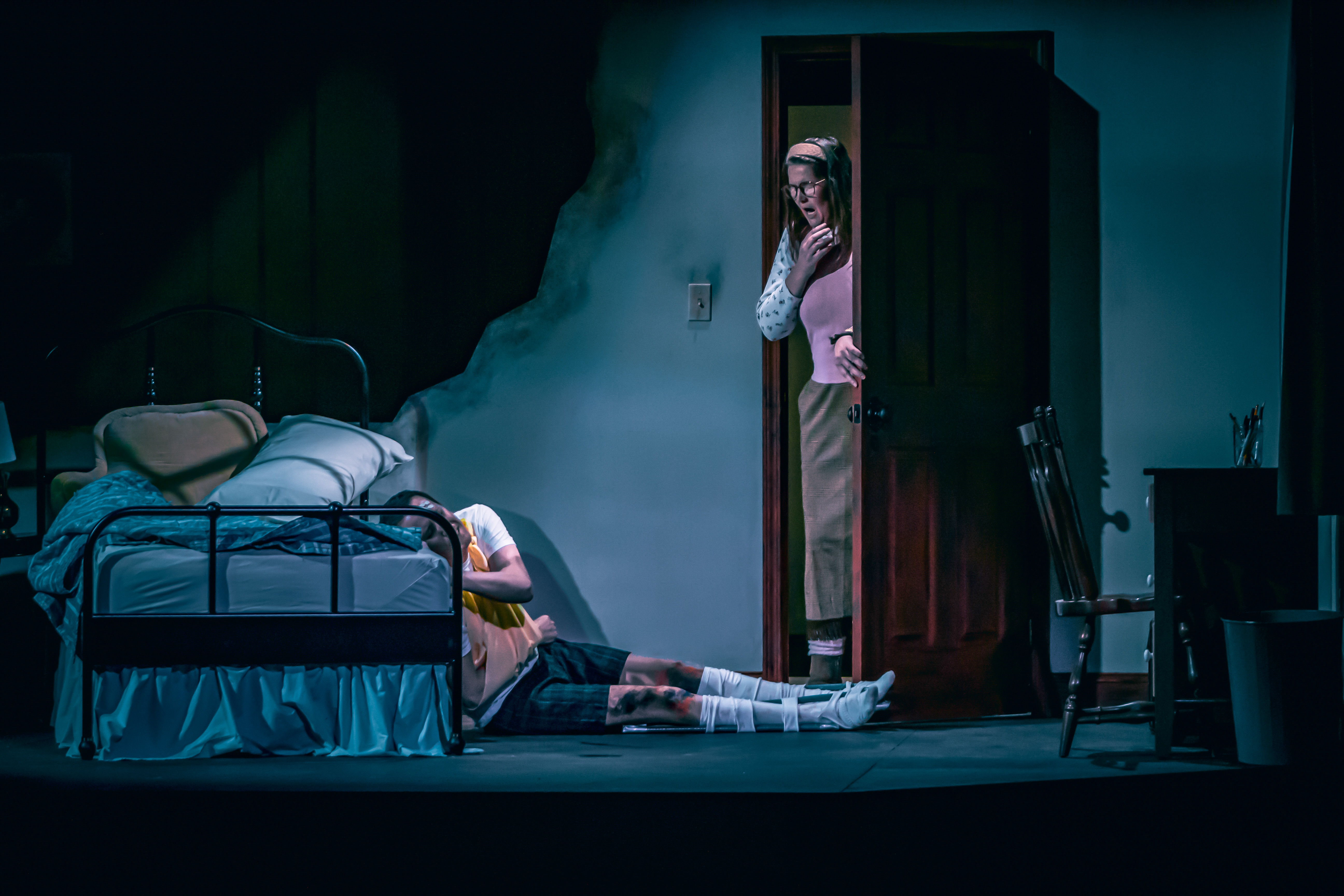

She is a nurse by trade, we quickly see, evidence of IV treatments still lingering in the bedroom Annie has selflessly devoted to Paul’s care. Yet as I observed in my review of the 2002 Off-Tryon production, this Annie is to nursing what Typhoid Annie was to food preparation. Whether she intends from very beginning to keep Paul on the premises as a companion to her pet pig, Misery, may be open to debate, but there are revelations that topple Annie’s already-shaky equilibrium.

Paul has decided that Misery’s Child, the newest installment in his popular Misery series, soon to arrive at bookstores everywhere, will be his last. The new manuscript in his briefcase, just finished at his nearby Colorado retreat, will be a total departure from those where Misery Chastain was his beloved protagonist, the woman who Annie credits for saving her life. Now that she has saved his life, she’s sees herself as entitled to disproportional payback from her captive. Autographing his new book for her will not be nearly enough.

She rips out the phone, fully cutting Paul off from the outside world and further plunging us into a nebulous bygone era. Devout enough to be outraged by the foul language in Paul’s manuscript, Annie can discard morality in the blink of an eye when it comes to granting her idol’s freedom. Anyone who has seen the film will vividly remember that violence is in her toolbag.

2023~Misery-2

Of course, sudden explosions can always blow Paul’s cunningest escape plans to smithereens in seconds, but the finest aspect of King’s plotcraft is the cerebral battle between the imaginative author and his fanatical, adulating nurse. Avidly following his books, scrapbooking multitudes of magazine articles about him, and maybe picking up inside dope about him from nearby locals in and around the Silver Creek Lodge, Annie is a formidable adversary. She controls his food and his medicine – and as Paul’s #1 fan, she compounds her advantage by knowing so much about him.

Paul must first recover health and mobility. Then he must watch and study his keeper closely if he hopes to prevail. Rescue is tantalizingly close each time Buster, the local sheriff, drops by. But Paul isn’t aware of the initial visits as his disappearance continues to be investigated. On your way home after the thrilling climactic scenes – or maybe days later – you may begin to surmise how Paul subtly aided the inquiry.

Not all of Paul’s stratagems work in this chess game, and the retributions Annie wields on her idol can be shocking. Even more shocking onstage, perhaps, because we never get a full peep at Annie’s scrapbook and her backstory. It’s got to be tricky role for Becca Worthington to pull off live, especially since she comes off as a little more rustic than Bates and a tad meeker. The range is broader without the Hollywood coquetry, and Worthington pitches her performance more darkly when Annie veers out of control, in keeping with the gloomy lighting scheme, where sunshine and snowbanks have no place.

Costume designer Sophie Carlick also darkens our portrait of Annie, discarding the crucifix necklaces and the prim nurse-like outfits, such as Julie Andrews might wear strumming a guitar in a meadow, in favor of more rugged clothes she can credibly wear indoors and out: boots, knit socks, and dumpy cardigans. Sadly enough, when Paul asks Annie to celebrate Misery’s rebirth with a romantic dinner, Worthington doesn’t have the time, in a no-intermission production, to elaborately glam herself up for the occasion.

2023~Misery-4

Timothy Hager has fewer rooms to navigate here as Sheldon than James Caan did in the movie, stealing contraband pills and a kitchen knife from the same room where his candlelight dinner scheme goes awry. Nor must he somehow emerge from a cellar – a fourth indoor location! – where he has been dumped because there is none. Yet Hager certainly manipulates his wheelchair with all the apparent difficulty of a newbie recovering from a separated shoulder, giving us the impression of an epic exploit. Without the benefit of closeup shots, he also makes sure that Paul’s fears are visible far beyond his eyes.

Effortlessly, Hager often radiates a shambling clumsiness in his attempts at hoodwinking Annie, a fallibility Caan hardly hinted at, endearing himself to us a bit pitiably in the darkness of this snakepit. Most importantly, Hager has a firm grip on the climactic typewriter scene where he precisely executes some truly nifty fight choreography.

2023~Misery-5

Transitioning to stage, Goldman most radically altered the role is Sheriff Buster, who only visited the Wilkes cottage once in Goldman’s screenplay. Law widens the discrepancies, casting Roman Lawrence as the lawman in an auspicious Charlotte debut. Buster is no less easygoing now, but he is conspicuously younger and less snoopy, no longer visible in scenes at the office with his wife, up in the sky in a helicopter, at the crash scene, at the lodge where Paul finishes his books, in a library researching, or at the general store. Lawrence is the closest thing in this show to sunshine, arriving each time without apparent urgency or suspicion. That sharpens the drama in the denouement.

Production levels have been a bit eye-opening in the first two shows at the Queens Road barn this year, a place we’ve never before compared with Children’s Theatre of Charlotte in terms of technical prowess. With Misery, Hollywood has arrived in Charlotte at the service of thrillers. Prep for King’s famed hobbling scene was impeccable, eliciting audible gasps from the audience, but that was mere prelude. Both blood splatters in the closing scenes were absolutely spectacular, worlds beyond what community theatre delivered in my day when we taped blood capsules to ourselves backstage and hoped for the best.

These more sophisticated spectacles were likely a collaboration between Timmons and all three of the players, possibly Carlick as well, and perhaps triggered by sound cues. Or Bluetooth! The difficulty of the tech was best demonstrated at a key moment when it went wrong – Play-That-Goes-Wrong wrong. A wastebasket began smoking before Hager could toss a kitchen match into it. Presumably unnerved, Hager then tossed a key manuscript page toward the basket instead of slam dunking it to be sure. He missed!

On a movie set, these screw-ups would become a hilarious outtake. But onstage, instead of cracking up, Hager and Worthington covered up. Good thing they did, for the next cluster of fight choreography and SFX followed immediately, the most challenging moment of all. It was perfect.