Review: BNS Productions Presents The Colored Museum
By Perry Tannenbaum
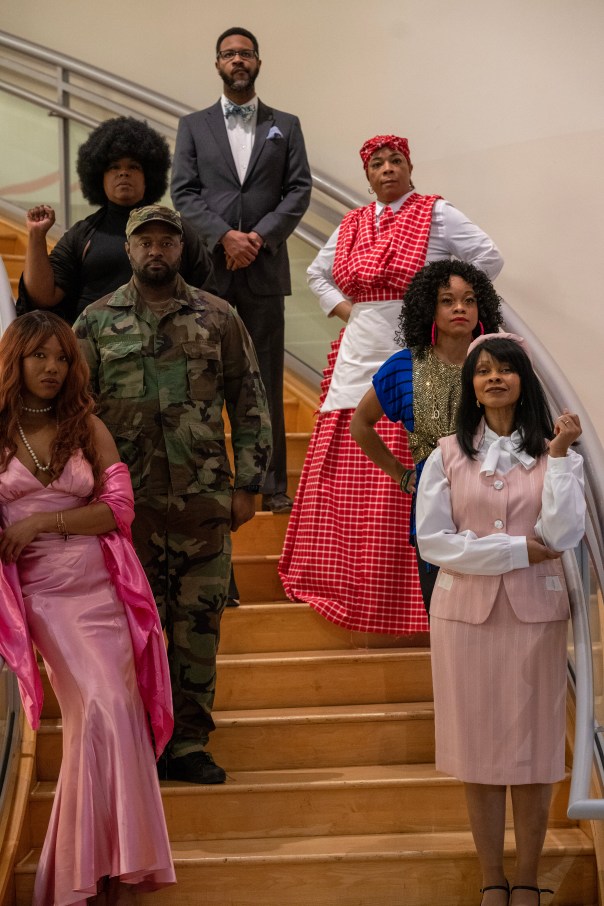
In every decade since it premiered Off-Broadway at the Public Theater in 1986, George C. Wolfe’s The Colored Museum has had a homegrown revival here in Charlotte. GM Productions premiered it up in the Attic Theatre at the old Afro-Am Cultural Center on 7th Street in 1993, and Carolina Actors Studio Theatre brought it to their C.A.S.T. location out in Plaza-Midwood ten years later. On Q Productions finally smuggled Wolfe’s 11 vignettes – or “exhibits” – into an Uptown site at Spirit Square in 2011.
Now BNS Productions has brought Colored Museum to its unlikeliest location, the Brooklyn Grace Venue, alias the Grace AME Zion Church on S Brevard Street. Each new revival more fully cements Wolfe’s satire as a classic – Winthrop U and UNC Charlotte have also chimed in with productions since 2009 – and each new resurrection that I see strikes me as fresh and hilarious as the first.
Of course, nothing compares with the edge and impact of your maiden encounter. Wolfe hurls a few choice barbs at white folk, mostly mocking their bland cruelty, but armed with an all-Black cast, it’s African-Americans and their culture that he assails with the most conspicuous gusto. All Colored Museum casts get to feast most hilariously on the sufferings and posturings of the Younger family in Lorraine Hansberry’s A Raisin in the Sun. Walter Lee’s wailings against “the man” in this “Last Mama-On-The-Couch Play” take a detour into Beau Willie Brown’s barbarity in Ntozake Shange’s for colored girls.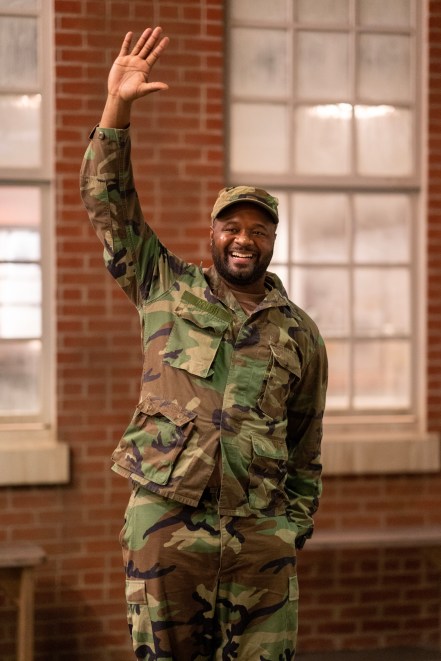
Familiarity with those two stage gems helps you to savor Graham Williams, Sr.’s over-the-top brilliance as Walter-Lee-Beau-Willie, but his reappearance, immediately after intermission, as The Man only magnifies his triumph. For Wolfe delights especially in depicting the disfigurements that black people inflict upon themselves to survive and succeed in white America. The Kid, played by Jonathan Caldwell, must now disown and discard his Afro-comb, dashiki, autographed Stokely Carmichael photo, Afro-sheen, Jimi Hendrix and Sly Stone recordings, along with Eldridge Cleaver’s Soul on Ice – replaced, The Man tells him, by The Color Purple.
Black Power and protest must be tossed into the trashcan along with slavery if you wish to get to the top. The Kid is dismayed, incredulous, and beside himself when The Man reaches for… The Temptations Greatest Hits! Yes, if The Man is to feel totally comfortable in his black business suit and fully acclimate to white blandness, even “My Girl” must bite the dust.
Women also get choice bits from Wolfe, beginning with Nasha Shandri as our prim stewardess, Miss Pat, welcoming us aboard Celebrity Slaveship and inviting us to fasten our shackles as we cross the Atlantic to Savannah. Dancing in the aisles seems to be allowed during our voyage – as long as we keep our shackles on – but “No drums!” Of course, we will get a bluesy cooking lesson from Sandra Thomas as Aunt Ethel, teaching us, with abundant historical ingredients, how to cook up “a batch of Negroes.” Uncanny Aunt Jemima resemblance here.
Shandri and Thomas both reappear in “The Last Mama-On-The-Couch,” with Thomas in the title role switching from cheery to grumpy and Shandri upbraiding Walter-Lee-Beau-Willie (and cataloguing her own sufferings) as Medea Jones, a subtle reminder that white folk are also known to drop babies from great heights. Most of this skit targets Raisin, of course, with Toi Aquila R.J. as Lady in Plaid serving as Shange’s leading Colored Girls emissary.
Meanwhile James Lee Walker, II, has a tasty role as our narrator, bestowing an Oscar-like statuette upon one actress after a heart-rending monologue and then ripping it out of her grasp when the next actress tops her.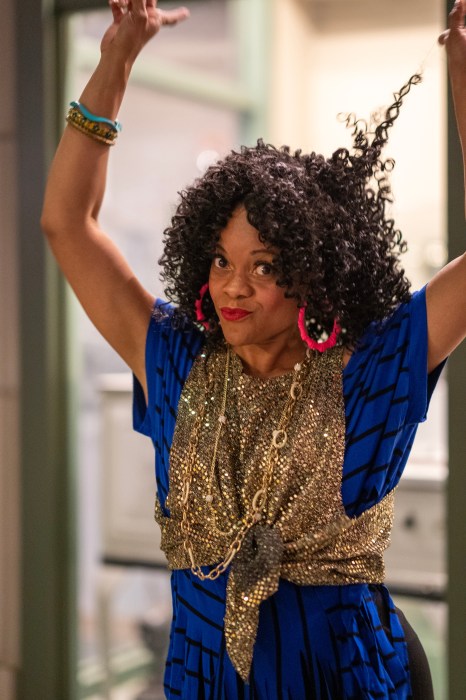
Walker has already topped himself as the regal, finger-snapping drag queen who imparts “The Gospel According to Miss Roj.” Revisiting Wolfe’s Museum, director Dee Abdullah limits herself to the crossdressing that’s in the script. In 2003, by contrast, Aunt Ethel and Last Mama were also done in drag. But Abdullah brings back Chris Thompson from the CAST production, so the West African choreography at Brooklyn Grace – and the forbidden drumming – have the same sparkle.
Acoustically, the Grace isn’t ideal for theatre, nor is the place outfitted for professional-grade lighting design. But Abdullah, Sandra Thomas, and Shacana Kimble compensate, teaming up for an admirable array of costumes, from the frumpiness of Last Mama to the imperious splendor of Roj – and on the other side of intermission, the voguish gown of LaLa Lamazing Grace, an expatriated Josephine Baker wannabe done with slaying disdain by Jess Johnson. Until her down-home roots are exposed.
In “Hairpiece,” Shandri plays a woman who has literally burnt her roots. Or as Johnson puts it as LaWanda, “She done fried, dyed, and de-chemicalized her shit to death.” All to please the man that Shandri is now dumping. LaWanda is actually a talking wig stand, facing us on a makeup table (and presumably Shandri as well in a fourth-wall mirror). She’s debating whether her owner should be shaking her hot-pressed tresses back and forth when she irately gives her boyfriend the ax, or whether Janine, the Afro wig contemptuously advocated by LaTonya Lewis, should be the fearsome choice to make him shrivel.
While the wigs are debating whether Shandri is most powerful in her natural or chemicalized crown, it’s easy to forget the satirical barb that Wolfe has tossed toward the menfolk. The finally-dispensable boyfriend was a “political quick-change artist,” Janine dishes. Every time “he changed his ideology, she went and changed her hair to fit the occasion.”
Style is important, that’s for sure. Aside from Raisin, the most sacred cow that Wolfe takes down is Ebony Magazine, the barbershop bible of African-American life. Lewis and Williams are the supermodel couple of “The Photo Shoot” who have given away their lives to be beautiful and wear fabulous clothes month after month. Relentlessly smiling and feeling no pain.
Perhaps the wisest thing about Wolfe’s Museum – the good, the bad, the ugly, and the absurd – is that it’s simply there. Do with it as you wish.
“The ultimate questions from Wolfe apply with a fierce pertinence to all oppressed peoples,” I wrote in response to Abdullah’s 2003 production with CAST. “How do we carry the baggage of the past into the future without hampering and crippling ourselves? And how do we leave this baggage behind without discarding key parts of our culture, our heritage, and our identity? These grim questions go unanswered, but watching this energized ensemble wrestling with them will likely double you over with laughter.”
Can’t improve very much on those observations – unless I compress them for 2022 into Wolfe’s words. At the beginning of our journey and again at evening’s end, our stewardess, Miss Pat, tells us: “Before exiting, check the overhead as any baggage you don’t claim, we trash.”
That’s the key choice Wolfe aims to leave us with.


![f1f6ae4a6746c91b636ceb3f8a6f3ad1.jpeg[4]](https://artonmysleeve.net/wp-content/uploads/2019/12/f1f6ae4a6746c91b636ceb3f8a6f3ad1.jpeg4_.jpg?w=531&h=354)
![efd8703eb37b1c8e19b483746e1d6515.jpeg[8]](https://artonmysleeve.net/wp-content/uploads/2019/12/efd8703eb37b1c8e19b483746e1d6515.jpeg8_.jpg?w=540&h=810)
![1c0906c97b0deab102cd3ec5f253f8c4.jpeg[8]](https://artonmysleeve.net/wp-content/uploads/2019/12/1c0906c97b0deab102cd3ec5f253f8c4.jpeg8_.jpg?w=560&h=373)
![DSC05462[4]](https://artonmysleeve.net/wp-content/uploads/2019/12/dsc054624.jpg?w=534&h=356)

 Art on My Sleeve