Tag Archives: reviews

Harlem Gets Braided at Jaja’s

Review: Jaja’s African Hair Braiding at The Arts Factory

By Perry Tannenbaum

My dear old Mom was born and raised in Harlem over a century ago, when a massive African-American cultural and literary Renaissance named for Harlem had already begun, long after the fabled Manhattan district with its storied 125th Street had been a major destination for Northern Migration after Lee surrendered to Grant. Even then, it would hardly be respectful to change Harlem’s name to Little Africa after all these years.

Yet playwright Jocelyn Bioh in her 2023 drama, Jaja’s African Hair Braiding,set on the corner of 125th Street, had me considering whether Bioh would rather call her Harlem – or at least this salon – Little Africa. The vibe and culture of Jaja’s, in Three Bone Theatre’s outstanding QC premiere at The Arts Factory, had me feeling that I was in another country while it was unmistakably my own.

Staffed and patronized by locals who hail from Senegal, Ghana, Nigeria, and Sierra Leone, neither Harlem nor Africa were the best places for Jaja’s craftswomen to be on a hot summer day of 2019 when Bioh’s action takes place. Aside from a breakdown in the braiding shop’s air conditioning, ICE lurks in the background as another of the women’s worries. Our own US President, the most powerful man on Earth, has bunched their homelands into the dismissive category of “shithole countries.”
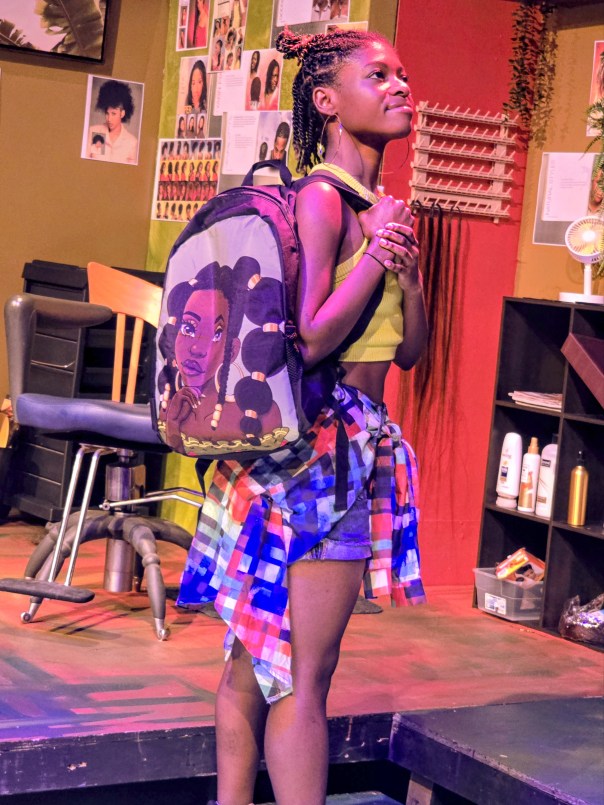
Jaja’s daughter Marie, a brilliant bundle of chaotic energy, is running the salon today because Mom is getting married later this afternoon to an unpopular landlord who will provide her – and Marie – with the shelter of citizenship. That will free Marie, a valedictorian at her high school using a borrowed identity, to apply to an Ivy League school worthy of her energy, talent, and potential.

From the deluge of Marie’s opening monologue onwards, we realize that Jaja’s is a place bustling with life. Music is in the air, sometimes compelling the women to dance. There’s bickering, jealousy, hostility, vanity, teasing, and earthy humor. Not a murderer or a rapist in sight among the immigrants. Not even a pet eater.

About the only big mistake we can accuse director Donna Bradby of making is not helping us to observe Bioh’s signposts – via a wall clock and/or projections – of the time of day and the specified year this long, hot workday unfolds. Otherwise, Jennifer O’Kelly’s scenic design, Toi Aquila R.J.’s costumes, and Rod Oden’s lighting immerse us completely in Jaja’s humdrum-yet-exotic world for all of the show’s 95 minutes.

A clock on the wall, for instance, would help us to appreciate how long young Jennifer, an aspiring reporter, is willing to sit at Miriam’s station in order for the patient artisan to outfit her with a full head of microbraids. And how long does the bossy, rude Vanessa fall asleep at Aminata’s stand before waking to her new look?

The visible excellence of Bradby’s cast is matched by the variety of Deborah Whitaker’s pre-, post-, and mid-weave hair designs. When blackouts happen between scenes, stage manager Megan Hirschy must have a huge chore in the small Arts Factory space helping the scurrying players reappear with the right hair when the lights come back up. We never just sit there tapping our feet during transitions. They’re almost lightning-quick.

Nor does it trouble Bradby that it’s impossible to keep track of who’s from Senegal, Ghana, or Sierra Leone. Venecia Boone was assigned the task of dialect coach anyway, a really nice touch.

Of Ghanaian descent and native to nearby Washington Heights, Bioh obviously knows her characters as much as she loves them. She is also a performer, so Deity Brinson as Marie will not be the last of her players to be gifted with a juicy monologue. Like Marie and the braiders, we will wait a long time before Myneesha King appears as Jaja – in wedding white, of course, with a queenly crown of braids – and delivers the most powerful monologue of all.

Meanwhile, it’s Valerie Thames as Bea, the most fashionable and contentious of Jaja’s employees who fuels the liveliest action, seemingly able to hatch a new grudge at the drop of a spray bottle. The salon was her idea, not Jaja’s. Should have been a full partner in the biz. Refugee newcomer Ndidi is stealing her customers rather than customers just dropping Bea. Thames seethes, fumes, and makes scenes with a steely righteous dignity that sets us up for the turnabout that reveals her deep-down goodness and sense of community.

Until then, the human warmth of the shop emanates from Kellie Williams as Miriam and Vanessa Robinson as Aminata. Williams, rightly stationed upstage at the Arts Factory black box, is mostly distanced from the main sparring during her morning-to-night transformation of Jennifer’s tresses. But there’s a distant man on Miriam’s mind throughout her labors, and she’s spending enough time in Jennifer’s hair to become quite chummy with the 18-year-old by evening’s end.

While her bestie and gossip buddy Bea seethes and sneers, Robinson mostly effervesces as Aminata. She knows that she doesn’t have the patience for a daylong immersion in microbraiding, so she’ll have none of Jennifer despite her youthful sunniness. But EJ Williams as Vanessa riles her almost to the point of losing her cool, a comical series of shticks that begins with the pushy customer objecting to house rules that require her to step outside the shop to negotiate Aminata’s fee. Then Vanessa insists that she be braided with the implements and spray she has brought from home.

Aminata’s man troubles are nearer-to-hand than Miriam’s, for her wayward ne’er-do-well husband James only circles back to the nest to take advantage of her. Righteously divorced, Bea insists that Aminata drop this loser, dismissing the love factor that keeps her from following through with her resolve. Can’t help it when Graham Williams as James drops by and pushes his wife’s buttons.

So these skirmishes between Thames and Robinson, before and after James’s invasion, are the most delicious that we witness. Aside from her dreamer worries, Brinson as Marie is occasionally thrust into the middle of disputes, laying down the law for the prissy Vanessa and stepping into the middle of Bea’s various tussles with Ndidi, Aminata, and her defecting customer, Michelle. At one point, Marie even exiles the incorrigible Bea to the street!
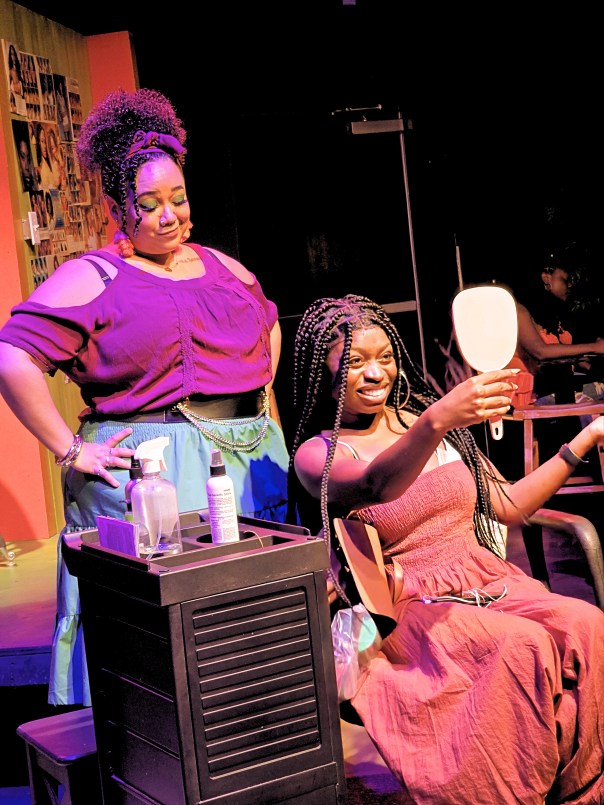
The younger folk are calmer and more acclimated to post-truth America than their diva elders. Before we know it, Aminata is asking Marie how to tune the smart TV to YouTube. Sarah Oguntomilade as Ndidi, the highest-grossing braider in the shop, is especially cool – thoughtfully equipped by Bioh with headphones and loud music to tune out Bea’s accusations and tirades. There’s a really nice interlude when Graham fawns over and flatters her as the Jewelry Man, lavishing her with freebies. This Nigerian cameo as Olu was at least as crowdpleasing as his subsequent turn as the roguish Ghanaian, James.

Graham’s most impactful role is as Eric, the DVD man, who serves as the caring eyes and ears of the community. But it would be cruel to divulge any more.

Things happen quickly at Jaja’s. Notwithstanding the oppressive summer heat, each new character changes the temperature in the shop. Less obtrusively than Graham, Germôna Sharp brings in a variety of flavors as three different customers. The most dramatic of these is the diffident Michelle, who thought she would be switching to Ndidi when Bea wasn’t there. Most comical is Sharp as Chrissy, wanting braids that will make her look like Beyoncé.

As if.

“The Humans” Is More Haunting Than Ever

Review: The Humans @ Armour Street Theatre

By Perry Tannenbaum

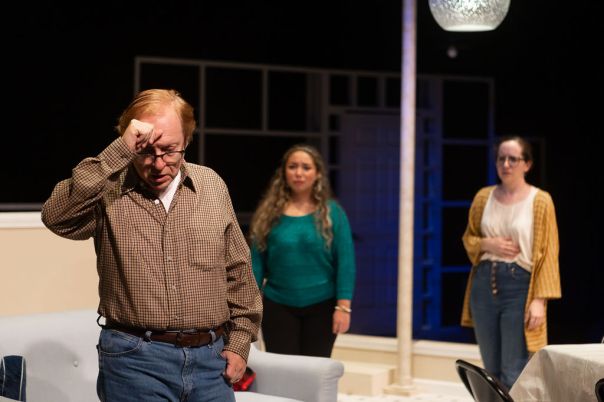
Thanksgiving in Chinatown, in the shadow of the fallen Twin Towers – Stephen Karam’s spooky, mystifying, and hilarious The Humans hands us a world teeming with paradox. For an afternoon in a creaky old two-story apartment, newly rented by Brigid Blake and her boyfriend Richard Saad, her family gathers to celebrate, the whole lot of them nursing open wounds – and their Alzheimer’s-stricken elder, “Momo” – trying to heal from recent setbacks.

First staged in the QC at Knight Theater in a 2018 touring production starring Richard Thomas as family patriarch Erik Blake, Davidson Community Players brings us a downsized reprise in the first locally-produced staging, with the venerable Hank West in the lead.

Haunted by his return to the vicinity of Ground Zero and by his recent misdeeds, tormented by a deadly mix of sleeplessness and nightmares, Erik vies with elder daughter Aimee for which of the Blakes is suffering the most. Since last Thanksgiving, Aimee has come down with ulcerative colitis and taken major hits to her love life and her career as a Philadelphia lawyer – with major surgery looming on the horizon.

Yet Erik fires a wicked one-liner at Brigid, whose gripe, like his wife Deirdre’s, barely hovers above the “suck it up” level compared with his own. “If you’re so miserable,” he asks the health food fanatic, “why are you trying to live forever?” Inside negativity, Karam can be equally trenchant and funny when Aimee philosophizes about her recent breakup: “Maybe loving someone long-term is more about deciding whether to go through life unhappy alone or unhappy with someone else.”

Only Deirdre and Erik have an agenda for the afternoon, subtly suggested in a couple of brief dialogues. We’re mostly watching Karam’s keen observations of family interactions – their bonds, their tensions, their little quirks, and their tectonic divides. These appear all the more chaotic because dialogue often overlaps and action is happening simultaneously upstairs and in the more commodious basement.

Knight Theater probably gave us an oversized impression of Brigid and Richard’s love nest, while DCP’s Armour Street can’t help look both height- and space-challenged. Remarkably, Evan Kinsley’s more cramped set design lessens the struggle of viewing multiple tracks of action and family intrigue. Yet Karam and director Glynnis O’Donoghue are still able to provide enough compelling distraction at a key moment to allow the aged Momo to disappear without our noticing.

Even without two-story height, Kinsley’s set has an alleyway leading to an elevator shaft to accommodate the wheelchair-bound Momo’s transit between the two floors. The slice of set that serves as the upstairs somehow has enough space for the front door, an entrance to a bathroom (Aimee’s frequent retreat), and the only window looking out on the city. When the apartment’s oddities need to impact, Kinsley’s set and Sarah Provencal’s sound design deliver.

The divides between the Blakes will be familiar to anyone who has grown up in a family of siblings. Although Brigid would never consider living in Philly, the geographical divide is as important here as the generational difference, for neither of the daughters would ever think of moving back to Scranton, PA – except to a summer home that Erik tells us can move towards construction once there’s a sewer system near their pristine plot.

Those anticipated PA pilgrimages will not bring either of the sibs back into the bosom of the holy church. Nor will it erase the fact that these country folks’ children are irremediably citified, one a lawyer and the other an aspiring composer. Safety, religious, and lifestyle concerns plague the homespun parents. Ahead of their Thanksgiving visit, Deirdre has sent a care package that includes a statue of the Virgin to protect Brigid’s new home. Meanwhile, Aimee can expect an email any time a lesbian commits suicide.

Karam provides plenty for the Blakes to discuss in their near and distant back histories, with a handful of stunning updates. If things get dull, he serves up a choice collection of singularly awkward moments that would instantly embed themselves in family lore ever after, lovingly and mockingly retold at holiday dinners and special celebrations.

There’s even a “pig smash” ritual unique to Blake Thanksgivings, a nice spotlight for Richard. Often the aspiring social worker serves as our ears in his role as outsider, giving the Blakes the chance to explain all that is long-known among themselves.

These moments reverberate warmly within us, but the most haunting vibes, from Erik’s dreams and experiences, touch us all, nonchalantly invoking 9/11 and Superstorm Sandy – specters of terrorism and climate change. Over and over, whether Deirdre wheels Momo around or Aimee summons an Uber with her cell, we hear an eerie, insistent whisper from the playwright emanating from his vivid, painstakingly detailed dream: this is how we live.

On Davidson’s compacted stage at Armour Street, the natural flow of The Humans, the lack of powerhouse confrontations that shake us to the core when we witness such American classics as August: Osage County, Who’s Afraid of Virginia Woolf? or The Little Foxes, reminds us of Chekhov’s more placid classics. Rich and funny and touching as all the action is, we will likely struggle to discern a solid plot until Erik’s big reveal.

Inexperienced theatergoers are therefore advised to ignore any FOMO anxieties they may be experiencing and surrender themselves to the many delights, laughs, shocks, and epiphanies that West and his castmates deliver.

On the page, Karam’s script doesn’t pop out at you with the color and verve that O’Donoghue gets from this ensemble. West actually comes onstage with a couple of key advantages over Richard Thomas. We more readily accept West as an ordinary janitor-turned-equipment-manager, and he can bring out a curmudgeonly edge to Erik that I’d never noticed before.

No less surprising is the bubbly, goofball likability that Breanna Suarez brings to Brigid, though she is often the family contrarian and party-pooper in the script. The vibrant energy she exudes somehow turns pure negativity into simple immaturity, emphasizing Brigid’s spoiled qualities. As our genial hostess, Suarez tunes in on Brigid’s side hustle as a bartender, so she’s the life of the party while subtly fueling the true plot, endearingly committing a faux pas for the ages along the way.

Portraying West’s wife for the first time since 2005, when they both earned best actor honors in Coyote Ugly, Anne Lambert makes the wait worthwhile. Although Citizen Trump famously descended his escalator in June 2015, between the time that The Humans opened Off-Broadway and when it reappeared on Broadway with a completely new cast and director, Deirdre likely struck the late-2015 Broadway crowd as a MAGA maniac.

Interestingly, Karam could have taken Hillary Clinton as his model if he had written his tragicomedy 20 years earlier, but Lambert still strikes me as a MAGA nutjob even if that couldn’t have been the playwright’s intent. The religious zeal, the paranoia, and the constant moralizing are almost non-stop, so thanks to Lambert’s implacable disapproval, Deirdre winds up ennobling Erik and humanizing her daughters – just by enduring her. Yet there is an unmistakable sincerity to this steely, troubled soul.

Deirdre’s relatively spurious sufferings also brighten Aimee’s halo. Her woes are certainly the most tangible, so Alyssa Whitting has the freedom to add some hard edges to her performance, aiming her best zingers at Brigid with an assortment of barbs for the rest of the fam. Ascending and descending DCP’s imaginary staircase for extended poops, Whitting makes a pungent impression when she’s with us. She’s the slick urban professional among the Blakes, getting better reception on her cell than Dad and handling all the key calls.

Preoccupied with the cooking, Ryan Miles as Richard is also frequently on-leave from the family flow, but he’s a fine audience surrogate when we need things explained. Without fuss or bravado, Miles keys into the fact that Richard is the most laid-back, financially secure person in the room – the one lifelong New Yorker – in between Brigid’s age and Erik’s, accentuating his unique perspective.

Momo’s lines are annoyingly repetitive and approximately 85% gibberish to my ear, meticulously transcribed by Karam word-by-nonsensical-word. So if Wandy Fernandez is accurately delivering Momo’s babblings as written without considerable improvisation, she has performed one the most prodigious feats of memory in the history of theatre. There is wonderful variety in her performance with a lovely little miracle in the middle, which of course gratifies Erik and Deirdre the most. Words or not, the woman can also throw a fit.

The cryptic ending of The Humans, where the thin thread of Karam’s plot crystallizes, was clearer to me the second time around. Along the way, it’s helpful to note the circular shape of the Blakes’ history, the dream Erik divulges stage by stage, and the explanation Richard offers. Erik’s worries, sadly enough, are suddenly more topical in the Carolinas than ever before. After Sandy, the fact that Chinatown was a Zone A flood zone was fearfully real. Now that Asheville is isolated, adrift from interstate highways until next year, we can legitimately wonder what zone is not a flood zone after all the climate damage humans have done.

Richard says it succinctly, recalling a comic book he loved as a kid: “horror stories for the monsters are all about humans.”

“Girl from ther North Country”: A Dream Dispelled

Review: Girl from the North Country at Belk Theater

By Perry Tannenbaum

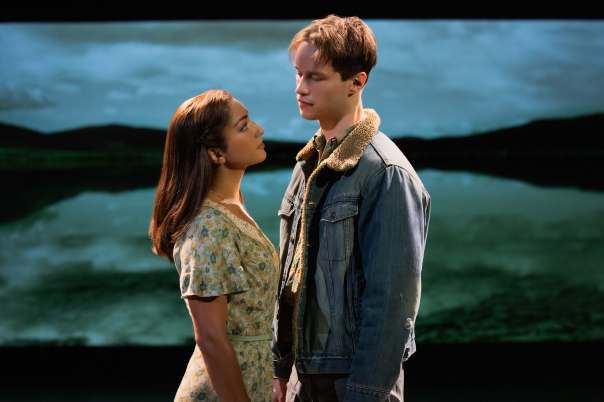
When it premiered in 2017 at The Old Vic in London, Girl from the North Country must have seemed like the fruition of a musical theatre dream team. The original book would be by acclaimed Irish playwright Conor McPherson, who would freely roam amidst the vast catalogue of music and lyrics by Bob Dylan, the 2016 Nobel Prize Laureate, to choose his songlist. By most surviving accounts and reviews, Girl from the North Country was must-see theatre in two successive London productions, Off-Broadway in 2018, and on Broadway in 2020.

Previous peeps at the show on the road, chronicled in regional sections of BWW, have only been slightly less enthusiastic. So opening night at Belk Theater earlier this week was a massive shock when the national tour touched down here for the 28th of its 30 scheduled stops.

The first stunner was the sparsity of the crowd. Often sold out on opening night for brand-name shows, the Belk was less than half-filled for the Charlotte premiere. Traffic to the Uptown was no lighter than usual, and blackouts had already been a non-factor for previous events I had covered in Plaza Midwood and Davidson. Were fervid Dylan fanatics, among the most loyal anywhere, diverted by the WNBA Playoffs? Were they glued to their TV sets, watching the Walz-Vance debate?

Whatever reason the stay-aways may have had, the biggest shocker was that the no-shows were so right. The dream team is merely a mirage on the road, though the esteemed playwright is still listed as the stage director.

As much as we both love Dylan – my wife Sue and I held hands when the mighty “Hurricane” was sung – Girl from the North Country never fully connected with us. The boxer and escaped convict in McPherson’s script is Joe Scott, we’re in 1934 Duluth (three years before Rubin “Hurricane” Carter was born), and when Warren Nolan Jr.* plunges into the song, he must segue into “All Along the Watchtower” long before the tale of the framed boxer reaches its epic, cumulative power and intensity.

This is not the story of the Hurricane. Yet the connection of this suddenly anachronistic song, unlike the decisively irrelevant “Watchtower” or “Idiot Wind” that complete the medley, is stronger than nearly all the others we hear. At its worst, the beginning of Act 2 at Nick Laine’s dingy Duluth boarding house devolves into a chaotic Dylan concert with no forward-moving drama at all, the most inert and aimless musical theatre I’ve seen since Cats purred back from its intermission.

Action revolves around the innkeeper, his bipolar wife Elizabeth Laine, his alcoholic and artistic son Gene, and his adopted black daughter Marianne, five months pregnant. Curiously, Nick is the musical eye of this stormy family, the only member who never gets a solo to sing. John Schiappa is devoted to his demented wife, whom he dutifully feeds though she might slap the plate out of his hands, but he cares more for his longtime boarder, Carla Woods as Mrs. Neilsen, a possible financial lifeline if her late husband’s ever gets out of probate.

As Elizabeth, Jennifer Blood gets the most outré actions from McPherson – even when she’s brooding at an upright piano – and a royal gem from the Dylan songbook at the end of each act, “Like a Rolling Stone” followed “Forever Young.” These briefly sounded like echoes from the days of Janis Joplin reign as rock’s blues queen. Days of mad incense and love. Elizabeth has more reasons to be jealous of her admirably stable and ruggedly handsome husband than justifications for her relentless resentfulness and orneriness.

Yet even this most powerful of McPherson’s roles never quite bridges the gap between the footlights and our hearts. My most generous theories for why this was so on opening night are the sheer size of the Belk, double the seating capacities of the houses where North Country played London and New York, and the wretchedness of the sound, a chronic Blumenthal ailment.

Come back to us, MJ! – or at least send your sound crew.

Sharaé Moultrie gives a velvety smooth voice to Marianne and, despite her precarious position as an unwed mother-to-be, enough serenity for us to occasionally suspect that her conception was immaculate. She gets her share of solos, if not the choicest harvest. Dramatically, Marianne is the calm center of a vortex, with love and affection swirling around her from at least three different men.

Concerned about her future, Nick seeks to wed her to the financially secure – but elderly – Mr. Perry, portrayed by Jay Russell with humility, gentleness, and heart. Manuel as Joe is almost immediately smitten by Marianne, no doubt imagining himself as her redemption and she as his. She has reason to be impressed, for when he was challenged to a fight by her drunken brother Gene, Joe reluctantly yielded to the challenge and floored Gene with a single blow.

Prodded by Nick to get a job to help steady the Laines’ finances and avert foreclosure on the guesthouse, Aidan Wharton* as Gene sees his hopes of becoming a writer fading away. More sorrows to drown in drink are triggered by his ladylove, Chiara Trentalange as Kate Draper, when she announces that she is already engaged to be more pragmatically married. The ensuing Wharton-Trentalange duet on “I Want You” was probably the most dramatically apt of the evening.

Might have been more impactful in a smaller house with cleaner sound.

McPherson puts plenty of life onstage that never quite projects to Belk’s empty upper balconies. Aside from Mr. Perry; a wild bible salesman with a frayed clerical collar arrives with Joe, Jeremy Webb as Reverend Marlowe; and our sometime narrator, Alan Ariano as Dr. Walker, pops up periodically at the boarding house, making his rounds. Of the two, Webb as Marlowe is far more dangerous – almost dramatic – for his fugitive status and his poverty make his sales pitches aggressively hard-sell and his fingers tend to get sticky when he thinks nobody is looking.

With so many plots already brewing in Duluth, McPherson thoughtfully adds a family from the outside world that tends to add variety to the inbred local atmosphere of seediness and decay. The well-dressed Burkes are a fallen uppercrust family, as iconic during the Great Depression as the downtrodden wanderers crossing the Dust Bowl to sunny California.

Both Mr. Burke, who lost his business during the Great Crash, and Mrs. Burke, who lost a chunk of her patrician trust and self-confidence as a result, are on the lookout for new opportunities, not necessarily with each other. Both David Benoit and Jill Van Velzer, playing the elder Burkes, also sit down occasionally to play the drums, adding a new musical level to the evening while expanding the social context of North Country. Benoit gets to be more decadent, proposing to manage a ring comeback for Joe.

The couple’s son Elias has some sort of learning problem, so D’Marreon Alexander* gets a breakout moment in Act 2 – parallel to Blood’s with “Rolling Stone” in Act 1 – when Elias suddenly emerges from his cognitive cocoon with “Duquesne Whistle.” Doubly surprising for me, for “Duquesne” hurtles forward with the drive of Dylan’s best work and because I’d never heard the 2012 composition before. Wow.

I wish I could praise any of McPherson’s dramatic moments as highly. We’re not likely to experience a theatre week such as the current one for ages to come. Two living playwrights who have translated works by Anton Chekhov – and do not hesitate to use his methods – have pieces running simultaneously in Metrolina. Arguably, McPherson’s book, repeatedly stressing the consequences of inaction, has more of the Russian master’s most distinctive flavor.

But Stephen Karam’s The Humans, set in post-9/11 and post-Hurricane-Sandy Chinatown, will rock your world. Anyone torn between the two would be best-advised to bypass the Broadway Lights production at the Belk and head up Interstate 77 to Davidson, where Karam’s masterwork is playing at the Armour Street Theatre.

*Note: On opening night, Wharton, who normally portrays Elias, replaced Ben Biggers (sick all week ) as Gene. Alexander replaced Wharton as Elias and Nolan Jr. subbed for Matt Manuel.