Review: Opera Carolina’s Carmen at Belk Theater
By Perry Tannenbaum
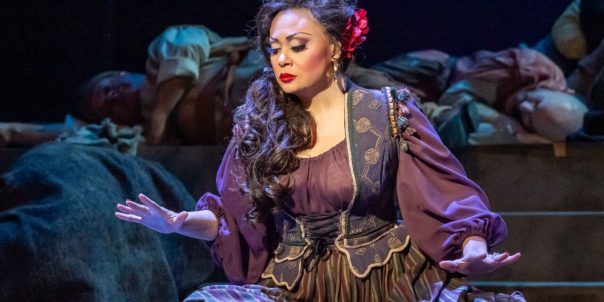
“Prends garde à toi!” You better watch out when la Carmencita gazes at you lovingly. The queen of Seville’s cigarette girls proclaims this insolent challenge – to the men she slinks past in the town square and a detachment of lascivious soldiers lazing on guard duty – almost as soon as we see her in Bizet’s Carmen. Differences between her and Micaëla, Corporal Don José’s fiancée, are artfully shown to go much deeper than city-girl brunette and country-girl blonde. When the drooling men in uniform offer their hospitality to Micaëla while she awaits Don José’s arrival, the chaste damsel skitters away in distress, promising to return later. Carmen quickly proves to be much different: shameless, seductive, and fearless, a wicked brew of beauty, passion, playfulness, and gypsy flair.
And yet we’ve still haven’t seen all the colors and facets of her portrait – or realized the full depths of what we’ve already seen in the eleven French scenes of Act 1. Alyson Cambridge, striking in appearance and lithe as ever in her movement, satisfied almost instantly at Belk Theater on opening night in reprising her Opera Carolina triumph of 2019, igniting and seething sooner as she built to the frenzy of the “Chanson Bohème” (“Les triangles des sistres tintaient”) that torches the opening of Act 2. Cambridge is as much the temptress now as she was in 2016 when she took on a title role in the special 40th Anniversary production of Porgy and Bess at Spoleto Festival USA. If anything, she’s more brazen and confident than she was as Tosca late in 2022, when she also seemed to be saving her strength for the more tempestuous final acts.
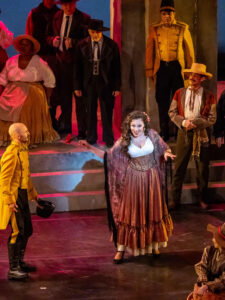
Certainly, stage director Dennis Robinson, Jr. deserves some of the credit for this higher-voltage Carmen, but so does the contrast so vividly framed by soprano Melinda Whittington as the sweetheart Micaëla, quaintly relaying a kiss to Don José from his dear ailing mother back home. Each of Whittington’s plaintive arias in the first three acts is a gem, wafting an anthemic lyricism from Micaëla’s native countryside over the stage and threatening to steal Carmen’s thunder. Cambridge must respond! Yet the new dimension for me came from the men who capture Carmen’s flitting fancy, tenor Jonny Kaufman as Don José and baritone Daniel Scofield as Escamillo, the dashing bullfighter.
No disrespect to tenors Ramón Vargas and the charismatic Roberto Alagna, both extremely capable vocalists that I’ve seen at the Metropolitan Opera as José, but neither was a hulking or intimidating presence. With or without his pearly smile, Kaufman does stand out among his fellow dragoons. Discarding the smiling ease of his welcome to Micaëla for the torments of love and passion that Carmen arouses, Kaufman is already anguished by the end of Act 1, two months before the deeper agonies of Act 2. Between this José and this Carmen we saw a battle between fidelity and wanton caprice. That’s what we expect from Bizet’s masterwork, and it escalated through Act 4 when Carmen’s fatal presentiments were fulfilled.
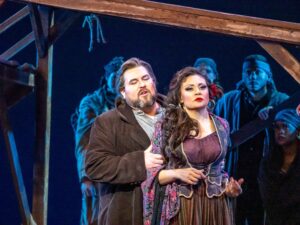
What comes into focus more sharply in this Opera Carolina revival, on top of the palpable danger of loving a woman who flouts soldiers, hangs out with smugglers, and dishes out a mean lap dance, is that Carmen is drawn to formidable strong men – able to see the violence lurking within before we do. She embraces the scent of danger. She loves the hunt, the capture, the freedom, the risk, and the danger of a wild predatory life. We saw a Carmen bent on living life on her terms, willing to die for it.
Scofield delivers the goods better than most of the Escamillos we’ve seen at the Belk parading into Pastia’s Tavern with his torchlit “Toreador Song,” but while all Josés we’ve seen are credible as the great matador’s fans, none have been as formidable as adversaries. That makes the outcome of the Act 3 knife fight between the rivals, by far the best of Dale Girard’s fight choreography here, as credible as José’s candid admiration. Carmen can see what this soldier is capable of in this production, believe in the terrible fate that her deck of cards predicted, and spit in his face anyway.
A production this well-staged, acted, and sung deserves a grander set design than the one we see here from Annabelle Roy, but the costumes by Susan Memmott Allred – on loan from Utah Opera – go far in making up for the colorlessness of this Seville. In fact, the yellow-gold of the dragoons’ uniforms vividly reminded me of the amazing clay surface of the Plaza de Toros and its dazzling buttery hue, where bulls and bullfighters shed their blood, more like Seville for me than Roy’s standard-issue arches.
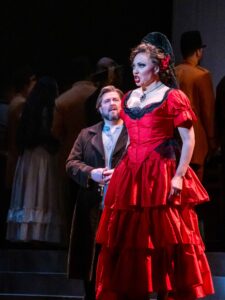
When performances are this committed and intense, whether from conductor James Meena and the Charlotte Symphony or from Cambridge as the Gypsy temptress, even a moment of slackness can be instantly telling. Such a moment happened on opening night when the trumpets’ retreat was sounded – seemingly from backstage – summoning José back to his barracks right in the middle of Carmen’s quiet, sexy, up-close dance for him alone. Riled up by Kaufman’s impulse to depart in mid-enchantment, Cambridge yielded up to Carmen’s full insulted fury – except when she took off her castanets and carefully set them down on a nearby café table instead of flinging or slamming them down, breaking character for nearly a full second. By the time she flung José’s saber and hat to the floor, she was fully returned to raging diva mode. Kaufman was just one among multitudes in the house who would now follow Cambridge anywhere.

 Art on My Sleeve