Tag Archives: Oliver Kot

Charlotte Symphony Heralds the New Year in All-American Style

Review: Koh Plays Mazzoli at Knight Theater

By Perry Tannenbaum
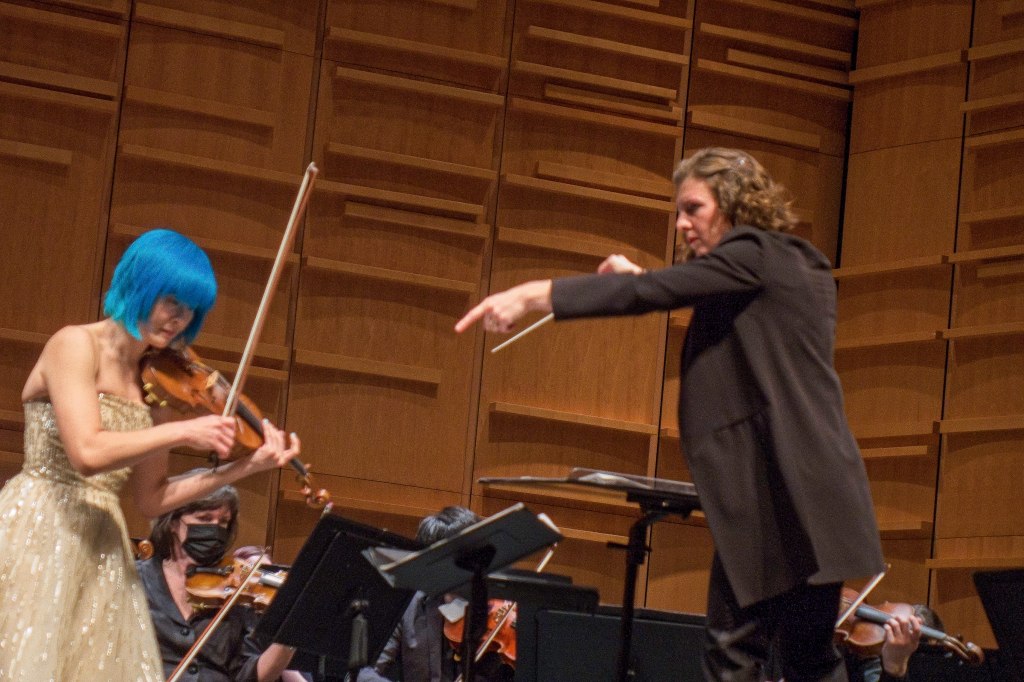
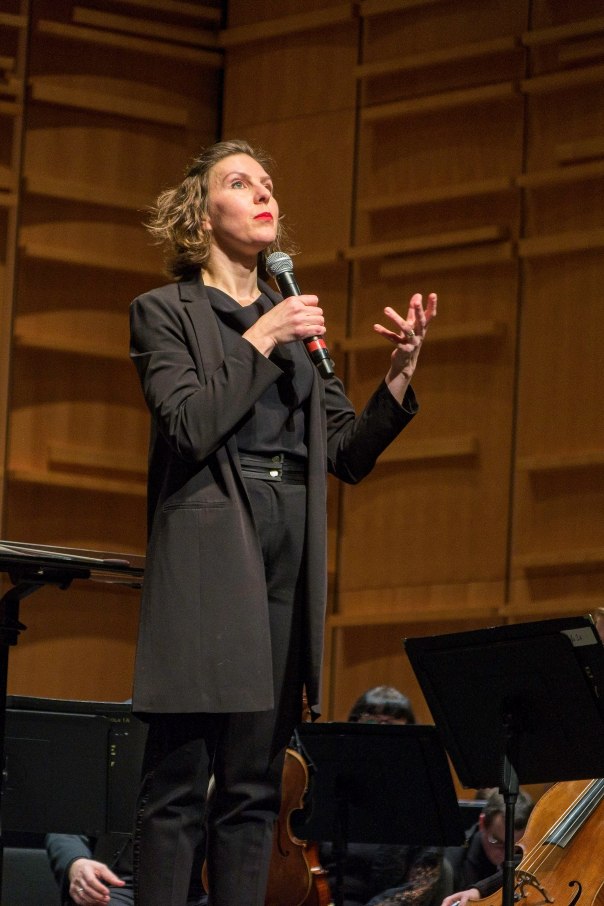
January 19, 2024, Charlotte, NC – Just a little more than a year after Kwamé Ryan guest directed an all-American program at Belk Theater featuring violinist Bella Hristova, Charlotte Symphony (after naming Ryan as the music director designate for 2024-25) greeted guest conductor Lidiya Yankovskaya to the Knight Theater podium, with violinist Jennifer Koh making her debut in another all-American program. This year’s explosion of Americana came four days after MLK’s birthday instead of two days before. The Adams-Korngold-Copland program of 20th century pieces could be counted as a bold advance in 2023, but the current offerings, with two 21st century compositions by American women, Jennifer Higdon and Missy Mazzoli, getting equal playing time with the 20th century composers, Samuel Barber and Aaron Copland, is arguably even more diverse and inclusive.

Distilled from Higdon’s opera, Cold Mountain, of 2015, and co-commissioned by Charlotte Symphony, the new Cold Mountain Suite could credibly be categorized as a concerto for orchestra by virtue of its length, variety, and profusion of solo instrumental passages. Like many opera suites you may have heard, Cold Mountain takes a serpentine route through the score rather than a sequential path, using the opening of Act 2 and the close of Act 1 as its bookends in repackaging eight snippets from the score.
On my first hearing, I could distinguish seven distinct sections and some fine soloing not only from string principals – cellist Jonathan Lewis, violist Benjamin Geller, second violinist Oliver Kot, and associate concertmaster Joseph Meyer – but especially from acting principal oboist Erica Cice and principal trombonist John Bartlett. The most memorable section of the piece was the “Storm Music” with its swirling strings and the atonal whistling of the high winds, but the ending, launched by the reunion scene between Ada and Inman was authentically stirring, with soaring work by principal trumpeter Alex Wilborn heralding the closing crescendos.

Since Mazzoli’s Procession Violin Concerto was commissioned by Koh, the music remained in-house until intermission. Notwithstanding her outré blue hair, Koh is actually a few years older than the composer, with a recording career extends more than 25 years. The former Chicago prodigy still plays with a youthful zest and a frenetic edginess – but not immediately in “Procession in a Spiral,” the opening section that unfolds slowly in a keening treble and increases its tension about 3/4 of the way into the section. The thinnest ethereal note from Koh’s violin bridges the gap into the unexpectedly calm beginning of “St. Vitus,” but the onset of intensity comes sooner here, still without the manic speed we might have expected from this title. The weepiest of the sections, “O My Soul,” has the most sustained of Koh’s thin harmonics and she hangs out with the flute and piccolo before breaking into more neurotic bowing.

A nice orchestral swell transitioned us to “Bone to Bone, Blood to Blood,” the most dramatic section, spiced with a series of whipcracks and a sprinkle of percussion. Jollity never prevailed in this rather somber concerto, nor was there an Allegro. “Procession Ascending” began rather unexpectedly for a finale with some lovely solo work from principal bassoonist Joseph Merchant, dramatizing how high Koh would need to ascend on her violin. If I were Koh, I’d pay Mazzoli a few more bucks to extend her struggles to take flight, blocked by the cellos and the double basses. She seems to clear this viny undergrowth too soon and too easily for the music to reach its full dramatic intensity, but I loved how briefly her freedom lasts and how cruelly it ends.

While there is a fine Baltimore Symphony account of Barber’s Second Essay for Orchestra in my collection, I cannot confirm ever hearing the piece performed live, though it was scheduled for a Symphony concert in April 2008. Hard to imagine that I snubbed it in my review, though Dvorak’s New World, ballet excerpts from Mozart’s Idomeneo, and Barber’s Violin Concerto were also on the bill. The music really is sumptuous, with oboe and clarinet illuminating the opening, viola mixing into additional oboe action later on, and some tasty propulsive percussion triggering its climax. It came across as a fresh and welcome discovery for me.

Of course, Copland’s Billy the Kid Ballet Music was the most familiar nugget on the program, revived at the Knight after an absence of less than four years. We’ve all been through a lot since February 2019, so I suspect more of the mournfulness of Copland’s “Introduction: The Open Prairie” and more of the fleeting, elegiac pathos of the penultimate “Billy’s Death” will land on listeners. Merriment is similarly magnified, with the clopping woodblocks of “Street in a Frontier Town” and even more heartily in the marching band energy, fueled by the woodwinds, of the gala “Celebration (after Billy’s Capture).” For the youngest buckaroos, the warring timpani and snare drum tattoos of “Gun Battle” will likely be the hugest delight.

On Your Toes for a Lively Mix of Mozart, Meyer, and Wirén

Review: Burgeoning optimism could be found in Symphony’s most recent Mozart + Wirén concert

By Perry Tannenbaum

2021~Mozart + Wirén-01

Unless a fourth wave of COVID-19 takes us by surprise and the 2020-21 season has to be “reimagined” yet again, Charlotte Symphony seems to be moving slowly, cautiously back towards full-sized concerts with their entire orchestra. Later this month, principal harpist Andrea Mumm will be reunited with the string players, taking a lead role in Debussy’s Danses sacrée et profane, and next month, we can look forward to Mozart’s beloved Symphony No. 40, presumably with a full complement of woodwinds. As I sit down to write, Haydn’s Symphony No. 64 has been announced for May, bringing us oboes and horns. Meanwhile a fresh series of five outdoor concerts has been scheduled this spring at the NoDa Brewing Company, all on Tuesdays, with a discreet 7:00pm starting time, improving our chances of keeping warm.

2021~Mozart + Wirén-14 copy

Another harbinger of spring and burgeoning optimism could be found in Symphony’s most recent Mozart + Wirén concert. Back in February at the Holst + Elgar concert, only Holst’s St. Paul Suite was lively and sunny enough to get musical director Christopher Warren-Green jumping up and down on the podium. Check out the webcast of the Mozart + Wirén program, still replaying online, and you’ll find that both of these composers had the same effect, Mozart with his Divertimento for Strings in D major and Swedish composer Dag Wirén with his Serenade for Strings. In between these two, Warren-Green offered the Charlotte premiere of Jessica Meyer’s Slow Burn, a piece originally devised two years ago to accompany a burlesque dancer in Saratoga. Jumping was probably not the proper response.

Mozart wrote no fewer than five Divertmenti in D Major, so it’s necessary to add that this was the earliest, K. 136, written at the age of 16 – or that it’s the one Divertimento that Yehudi Menuhin recorded in his Mozart collection for Virgin Classics, leading the Orchestre de Chambre de Lausanne. The youthful energy of the piece burst immediately upon us in the opening Allegro, with churning propulsion from the lower strings and lithe buoyancy from the violins and violas. Dynamics undulated with the floating grace of a glider as the steady churning continued below in rhythmic waves. The sound of the Knight Theater space added the faintest echo, and the airiness of the sound recording was close to the standard set for this piece by the Seiji Ozawa recording of 1994.

2021~Mozart + Wirén-15

Coming after this sunny effervescence, the middle Andante was so sweet and nostalgic, reminding me of one of the first Mozart pieces I was able to master on the piano more than 60 years ago. Lovely as it is, it was the only one of the three movements that could be imagined as royal background music, which is how a divertimento is normally regarded – and what resident conductor Christopher James Lees warned us against expecting in his introductory remarks. Attcked by the strings with at least as much zest as the Allegro, the closing Presto commanded attention, six staccato notes followed by the kind of explosive ignition we associate with Mozart’s Eine Kleine Nachtmusik, which Symphony performed just a month ago. Along with the exciting flux of dynamics, there were also zigs and zags of tempo navigated by Warren-Green, layers of repetition from the three main string sections overlapping one another. The ensemble surpassed themselves with their legerity and clarity in long, swift sweeps of melody.

2021~Mozart + Wirén-05

Slow or not, Meyer’s dancer evidently preferred to ply her trade in a steady 4/4 time as the piece began, with suggestive gestures from principal violist Benjamin Geller, principal second violin Oliver Kot, and concertmaster Calin Lupanu. Action halted before these solo voices – and after slaps on the double basses that sounded like whip cracks. Resuming the Burn, the music slid into swooning glissandos that allowed the dancer to surrender as much as her audience. Urgency and fury crept in as the tempo accelerated with frequent slaps on the basses, alternating with jazzy pizzicatos. The next halt gave way to a longer statement from Geller on viola that triggered a more frantic acceleration from the orchestra than before, this final gallop prodded by a constant cracking on the necks and sides of the two basses. What a dancer would do at this climax was enticing to imagine. Certainly it would be more like a flamenco flowering than a bump and grind.

Wirén had never crossed my radar before this Charlotte Symphony debut. He merits only a brief paragraph in my two music cyclopedias and only three entries in my last copy of the Penguin Guide, which did declare Wirén’s Serenade of 1937 to have been his greatest international hit. Apple Music is a better place than Spotify to hunt for it, but Symphony’s account was as exemplary as its previous two performances. Lees peeped in for another intro, describing the piece as a blend Mozart lightness and 1930s Paris, where Wirén studied composition. With long sweeping melodic phrases from the violins conveying Mozartian lightness, the opening Preludium had the urban bustle of Gershwin’s Paris – or the Londons evoked by Eric Coates and Noël Coward – and Symphony was not at all tentative about zooming into the cityscape. The cellos and double basses actually injected a heavy, foreboding undertow at times, as if a spot of rain were on the way or the specter of a traffic jam.

The rustic quality presaged by Lees in his intro was further delayed by the Andante espressivo, which began softly with pizzicatos spanning the Knight stage followed by an outbreak of melancholy from the second violins. First violins only intensified the poignancy when they layered on with their bowing, taking us further into solemnity and coloring it faintly with regret. A second round of pizzicatos from the lower strings led into deeper keening from the violas, intensified by another onset of the violins. Cellos blended with violins before a concluding pizzicato hush. The ensuing Scherzo was where Wirén finally fulfilled Lees’ rustic description, though I’d have to guess that the composer had Beethoven’s Pastoral Symphony closer to heart than anything Mozart wrote, and a few notes struck up by the second violins had a kinship with “Willow Weep for Me,” written five years earlier by Ann Ronell and dedicated to Gershwin. Amid the hairpin turns of this impetuous movement, interspersed with the laughter of the violins, the cellos took over briefly with their sobriety.

2021~Mozart + Wirén-12

With violas, cellos, and basses beating their bows on their strings, the beat of the final grand march began, reminding me most vividly of Coates’s British pomp. But here we swerved dramatically, slowing down for our first genuine B section of the evening before circling back to the forceful main theme. This Marcía is the movement that is most excerpted from this most popular Wirén work, and there’s nothing subtle about its appeal. Little strums from the basses thicken its pulse and there are moments when the beat is so strong that you could suspect a drum or two lurking somewhere offstage. Its giddy spirit had Warren-Green on his toes, waving his arms with the sweep of it all, and ultimately jumping. For joy, no doubt.

A Transcendent New Perspective on Verdi’s Requiem – as Sung by Jewish Prisoners Earmarked for Extermination by the Nazis

Review: Defiant Requiem: Verdi at Terezín

By Perry Tannenbaum

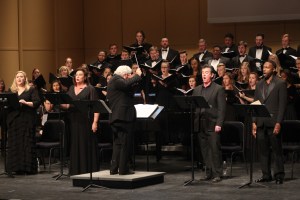
Ever since Verdi’s Requiem was first presented in 1874, singers and musicians have often observed that the composer, not a particularly religious man, steered the text of the Roman Catholic funeral mass in the direction of opera. Considering that Verdi had begun this work as a tribute to Rossini shortly after his death in 1868, those observations may be precisely what Verdi intended. Arranger/conductor Murry Sidlin offered a new perspective in Defiant Requiem: Verdi at Terezín with his new version of the Requiem for chorus, soloists and piano that premiered at the Anne R. Belk Theater on the UNC Charlotte campus. His pared-down instrumentation was not an arbitrary choice. Sidlin was aiming to pay tribute to Rafael Schächter, the Holocaust victim who organized and led the choir of Jewish prisoners that performed for the International Red Cross during their infamous inspection of the Theresienstadt concentration camp in June 1944.

In a miracle that faintly echoes the Hanukkah miracle, Schächter only had a single musical score – for piano and chorus – when the pianist-conductor arrived at Terezín. From that one little musical light, Schächter forged a chorus that offered solace to its members at evening rehearsals after hard days of labor at the concentration camp. And in the text of the Requiem, he found a massive voice that would “sing to the Nazis what we cannot say to them.”

Interspersed with a recreation of the 16 performances that Schächter conducted for the edification and delight of their fellow prisoners (there is no evidence that the Nazis in attendance were ever entertained or that those Red Cross emissaries were ever enlightened), Sidlin has interspersed clips from Defiant Requiem, a documentary that tells the story of the Theresienstadt Chorus with help from filmed interviews of its living survivors. There were also segments where Sidlin himself, turning towards us after conducting a section of the Requiem, would add his voice to the narrative. If that weren’t enough to evoke the presence of Schächter and the role he played at the original performances, one of the two actors who stepped out of the chorus and participated in this unique concert drama also portrayed Schächter.

Defiant Requiem: Verdi at Terezín has been around since 2002 and has twice been presented at New York’s Lincoln Center in Avery Fisher Hall. But those 2013 and 2015 performances at the home of the NY Philharmonic were with full orchestras. What we saw at the Anne R. Belk may have literally proven that less is more, for the replication of Schächter’s performances was certainly more faithful with just a single piano – plus a violin – replacing the orchestra at a more intimate venue. Nor was the drama diminished when we learned that the final Theresienstadt Requiem for the Red Cross was performed by a depleted choir of about 60 members: the choral group standing before us, from The University Chorale and We Are Sine Nomine, numbered 62 according to our program booklets.

Stripped down to these essentials, and replenished with the contexts supplied by Sidlin and the documentary, what usually sounds devotional and fearful now felt, by turns, poignant and defiant, dripping with vengeful fury. The “Kyrie eleison” (Lord, have mercy on us), sung first by tenor soloist Brian Cheney and followed by bass Carl DuPont, soprano Christina Pier, and mezzo Victoria Livengood sounded less like a supplication than a demand.

When the full chorus broke in with their first “Dies irae” (Day of wrath), the performance actually increased in its defiance. Prior to the ensuing “Tuba mirum” chorale, an extended solo from Arlene Shrut firmly established that the piano wasn’t to be limited to passive comping. The hushed pianissimos after DuPont softly uttered his last “Mors stupebit” (Death shall stand amazed) had a solemn eeriness that was unprecedented in the performances and DVD that I’d previously witnessed. Livengood, more reliably dramatic than on-pitch, was regally up to her supreme moment of defiance in “Liber scriptus” (Written book), where she proclaimed – with prophetic volume and fury – that on the Day of Judgment, “what is hidden shall be made manifest, nothing shall be unavenged.”

Spitting defiance in the face of the Nazis and obliquely sending an SOS to the Red Cross were the most important aspects of Schächter’s payload, but the intervening narrative gave us more nuance. There were Jews at Terezín who objected to the embrace of a Catholic Mass – and to the danger that the conductor was subjecting his choristers to should their defiant message be fully grasped by the Nazis. These nuances came from the lips of the survivors on film, who clearly viewed Schächter as an inspiration, a godsend, and even a lifesaver.

idlin’s concert drama also drove home the point that, for the Terezín singers, the “Libera me” (Deliver me) was no longer a plea to be spared from fires of hell sometime in the indeterminate future but a plea to be delivered now from their monstrous captors. Another set of testimonies told us of the uplift that the choristers felt singing the “Sanctus” (Holy, holy, holy) section of the Requiem. Somehow it escaped Sidlin that the first two lines of this section are translated from one of the most sacred Hebrew prayers, when pious Jews not only rise to recite the words but also rise on tiptoe for each of the three “Holies.”

There was plenty of engaging lagniappe to make up for this omission, including a memorable evocation of the artistic beehive of musical activity happening nightly at Theresienstadt, intertwining wisps of Schubert’s “Trout” with “Bei Mir bist du Schoen” and the bittersweet Russian Yiddish folksong, “Tumbalalaika.” But the most sobering addition that Sidlin made to his drama came in the coda that he added on after the Requiem. Instead of the customary applause, we were prompted to remain silent as the musicians filed down the aisles through hall and out into the lobby.

Violinist Oliver Kot was the only musician who remained onstage, and the exit music that he played was the melody to another prayer, the “Oseh Shalom.” It’s not only the most frequently uttered sentence in synagogue, it’s also the ending to two of our most important prayers, the “Amidah” and the various permutations of the “Kaddish” – half, full, teachers’ and mourner’s. “The maker of peace in his high places, he will make peace for us and for all Israel, and let us say, ‘Amen.’” Iconic last words, for it is customary to say them in Hebrew while taking three steps backwards, as if taking leave of a king.

Poster_Art

The new ending (a clarinetist had played it in previous orchestral performances) doubly evoked Fiddler on the Roof for me. All productions of Fiddler begin with the sound of a single violinist and many end that way. When I played Motel the Tailor in a 1987 production by Rock Hill Little Theatre at Winthrop University, it was my honor, under the cover of all the helter-skelter of Jews leaving Anatevka by decree of the Russian Czar, to light a single candle. That candle remained lit – on Tevye the Dairyman’s wagon – after the entire cast had left the stage, our tribute to the Six Million. Sidler’s staging could be taken the same way or as a direct tribute to Schächter and the Theresienstadt choristers who didn’t survive the Holocaust. We learned that Schächter had been deported to Auschwitz in October 1944, four months after the Red Cross Requiem. He survived his time there, but in the spring of 1945, he died in a death march, a month before Czechoslovakia was liberated. With that last “Oseh Shalom” tacked on, Sidler succeeded in creating the illusion that we had just witnessed something tantalizingly close to the promising conductor’s final performance.

Of course, we had the luxury of listening to better singers who had musical scores and could read them. I was most impressed overall by Cheney, who excelled in the “Ingemisco” (I groan) tenor aria. Pier sang very sweetly but was occasionally underpowered compared to some of the divas who have taken on the soprano role, so her best moment wasn’t in the powerful entrance to the “Libera me” but later on after the final “Dies irae” thunder from the chorus. Cheney’s “Requiem aeterna dona eis” (Grant them eternal rest) was nothing less than sublime, floating ethereally over the hushed chorus, a timeless little capsule that reminded me how live performance can triumphantly transcend any recording.