Tag Archives: Neifert Enrique

“Electricidad” Electra-fies!!

Review: Three Bone Theatre’s Electricidad at The Arts Factory

By Perry Tannenbaum

Maybe by now we’re numbed to the truth. You know how it is: 30 dead, 57,000 acres burned, 18,000 homes and buildings burned to the ground, and 200,000 people evacuated. Not enough problems already in California? Let’s call in masked men from ICE and the National Guard!!

The upheavals out West are almost enough to deflect our attention away from the all-important Jeffrey Epstein files. Los Angeles is on fire! And we shrug it off.

From what I’ve seen so far in Three Bone Theatre’s first two installments of The Greek Trilogy by Luis Alfaro, Mojada: A Medea in Los Angeles last August and Electricidad now, the plan is to keep the flames burning high and out of control from beginning to end. At peak visceral heat.

Alfaro grew up as a queer Chicano in LA and came of age before Rodney King and the infamous 1992 riots. Electricidad was actually the playwright’s first dip into Sophocles in 2003, six years after he won the MacArthur “Genius” Fellowship. So you might expect this youngest Greek modernization to be Alfaro’s angriest, fieriest, and most rebellious.

You would be right, but watch out: so far, Electricidad is also the funniest.

That can be a problem for director Glynnis O’Donoghue and her powerhouse cast at the intimate JCSU Arts Factory on West Trade. When Electricidad, Alfaro’s reincarnation of Sophocles’ Electra, describes her chola quarter of the LA barrio as the recognized pharmacy of the area, I was able to hear the air-quotes that surround the playwright’s text and laughed out loud.

Portraying the title princess, Melissa Lozada seemed a bit surprised and perturbed at the laughter. But her father, the venerated Agamenón (“El Auggie”), whose corpse lies enshrined in the front yard of Electricidad’s home, was the drug lord of the barrio. Her kingdom, which she plans to somehow usurp from her murderous mother, Clemencia, is built on drugs and community “protection.”

Or as one of the gossipy local Greek Chorus members puts it, “We don’t dial the 911 no more.”

More than in last year’s Mojada, the pretensions of our protagonists are repeatedly mocked and deflated. Ifigenia, E’s younger sister, is now a born-again Christian because she discovered that the meals served at her convent are far better than those she got in jail. Having taken over her abusive husband’s kingdom, Clemencia wants to sell rather than rule. She has Century 21 on speed dial and hopes to move to Pasa-fucking-dena.

In place of the ancient Greek gods, we have the modern monoliths: Target, Sears, 7-Eleven, Payless, and Oprah. Agamenón’s grieving mother, Abuela, exemplifies the warrior chola pride handed down through the generations, boasting that she pulled off her first shoplifting exploits from her baby carriage.

Brooding and vengeful, Electricidad stands apart from her family, even in her religiosity. You won’t find her praying to Jesus or the Blessed Virgin. To her, Auggie’s corpse is a sacred object, defiled by Forest Lawn, which would allow her father’s body to lie in state overnight with nobody watching.

She and Abuela whisked the body to the front yard, where she stands vigil, a squatter on her own property. E prays to her father’s spirit and talks to it, occasionally lifting her prayers to the severed head of ancient Aztec daughter Coyolxuahqui, better known as the moon.

No, Electricidad doesn’t think her devoted vigil, her seething rage, or any of her impassioned ravings are funny. Nor is she looking for a good laugh, even if her fanatical love for her father may be more than a little pathological. So Lozada’s glaring, combustible intensity is Electra, whether it’s Sophocles’, Hugo von Hofmannsthal’s, Jean Giraudoux’s, Jean Paul Sartre’s, or Eugene O’Neill’s. The laxity and corruption that surround her only increase Electricidad’s saturnine glow.

And a supremely hopeless mourning it is, for the bloody vengeance she is craving is unseemly for a woman – and Electicidad is as faithful to the old cholo ways as she is to her papá.She doesn’t realize that her brother Orestes, after being exiled to Las Vegas, where dear Clemencia ordered a hit on him, is still alive. His mentor, Niño, has thwarted the hit and is carrying on with his mission to toughen the kid up so he can take over the House of Atridas and continue in the king’s footsteps.

Although Jennifer O’Kelly’s lurid set design and projections combine with Madison King’s lighting to give the impression that LA’s el barrio is ablaze 24-7, the Arts Factory space is too limited to back up the idea that Clemencia’s check from Century 21 will be a huge fortune. It is Isabel Gonzalez as Clemencia who makes the House of Atridas formidable in a towering performance to savor every moment she’s onstage.

Even in the opening scene, as the speechless Electricidad dominates our attention sitting next to the shrine she has fashioned from Agamenón’s shrouded remains, Gonzalez lurks restlessly in the shadows in the corner of the room, a dynamo of nervous energy. The arrogance and majesty only emerge later when she paces the front room, caged in her own castle, chain-smoking, and unable to purge the terror squatting in her front yard.

Coming out to confront her sleek, gimlet-eyed daughter, Clemencia has a robust arsenal of tactics, from sweet cajoling and bribery to fierce, defiant, threatening, screaming, thundering rage. What a pair! For in retelling the fall of the House of Atreus, Alfaro has not only resurrected Agamemnon’s sacrificed daughter, Iphigenia, but he has also blotted out Aegisthus – Clytemnestra’s lover, protector, and partner in crime, ruler of Argos while the original Auggie was out of town, winning the Trojan War.

For feminists and progressives, Clemencia is unquestionably the strongest Clytemnestra of all that have been presented onstage since Aeschylus fathered the Greek rep that has survived the ages. When Gonzalez faces off against Lozada, as she did last week at the VIP dress rehearsal, we can also crown Alfaro’s Clemencia as the best of the Clytemnestras conceived for stage or opera (Hofmannsthal’s script became the libretto for Richard Strauss’s Elektra).

She certainly stands on higher moral ground than any of her predecessors, and if you hadn’t recognized Gonzalez as the diva of Hispanic actors in the QC until now, your mind will likely be changed by this hot gem. Lozada’s “Electra-fying” debut will stamp the Venezuelan spitfire no less convincingly as this year’s most exciting QC newcomer. Yes, there is spitting in el barrio.
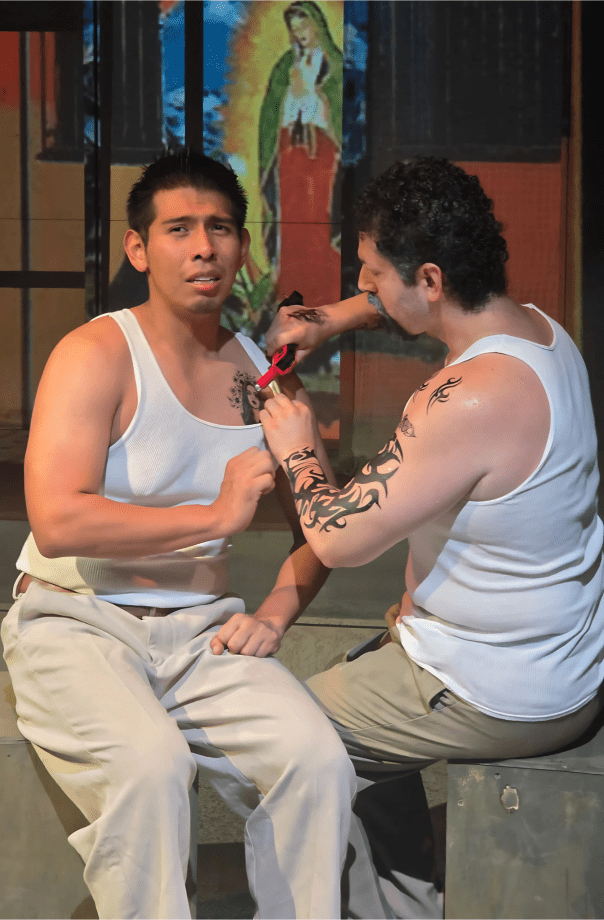
Just don’t overlook the quieter, nuanced magnificence of Eduardo Sanchez in capturing Orestes’ mix of innocence, steely nobility, and self-doubt – prodded along by Luis Medina’s sometimes proud, sometimes slightly exasperated Niño patiently punching and tattooing his pupil into manhood. Sanchez is more than soft enough when we first encounter him to justify his skepticism about filling his father’s shoes and wearing his crown.

Matricide?!? That’s a terrifying prospect when he returns from Vegas to LA and learns what’s what. Even Mom understands his hesitance, calling him “My most sensitive one.”

O’Donoghue was still tinkering with pacing on the night we attended. Too fast and you can miss Alfaro’s choicest quips, especially with Mariana Corrales, Allison Graham, and Marcella Pansini as the Chicano chorus of street sweepers, not the best players in the lineup. Slow it down, and the comedy threatens to take over.

But when it comes to the key moment, that spark-gap instant when Orestes becomes who he was destined to be, O’Donoghue nails it with hardly a single prompt from Alfaro’s script. It’s a kind of magic, a key superpower Alfaro also preserves from ancient times for his Medea in Mojada.

As Orestes returns to Clemencia’s living room, where mamá is smoking and watching TV, she begins chanting: “Find the courage. Find the rage. Find the darkness.” This chant becomes a background incantation as Celemencia deals with the shocking reunion and Orestes copes with the enormity of his mission.

Until Electricidad screams out. It’s as if the live-wire transformer decreed by Alfaro at the top of his script, humming and crackling in the background all evening long, bursts into flame. As if Electricidad is triggering Orestes’ actions by remote control.

There’s only scant proof for my theory about O’Donoghue’s concept. Aside from The Penguins’ “Earth Angel,” specified by name in the playscript, sound designer Neifert Enrique inserts Santana’s “Black Magic Woman” as a perfect foreshadowing. You did not live the ‘70s if you don’t know it.

The pesky and complaisant sister usually assigned to irritate Electra is most often named Chrysothemis, so Michelle Medina Villalon is drawing a fairly thankless role as Ifigenia. But Alfaro perks her up a bit as Ifi really is iffy to the core, trying to get her elder sister and her mom to make peace, let bygones be bygones, and trying out Christianity as an alternative to whatever kept landing her in jail. Still sporting vivid tattoos from her past, Ifi carries around a little statue of the Blessed Virgin as a security object: to pray to, to purify her living, and maybe to mark her territory if she decides to move back permanently.

Villalon also carries around a distinctively blank and traumatized look about her – maybe a prophecy of what Orestes and Electricidad will soon become. The earth here seems to be so scorched that both the sanitation department and the police stay clear. There’s no more likelihood that the siblings will face legal consequences for their crime than Clemencia faced for hers.

As one of the street sweeper gossips tells us, this is the wild, wild ouest. The only repercussions to assail the Atridas family for all their crimes are inward – the pains of guilt, regret, and that mark that has branded our species since the days of Cain. Drugs? Expelled from the equation.

Abuela remembers the good old days, reminiscing with Niño briefly upon his return before luring him to her place. With Banu Villadares embodying the tough and pragmatic Abuela, who didn’t weep at her son’s funeral because it would mar her makeup, we can understand why she is the only person on the planet who can make Electricidad laugh. Or momentarily rescue her from her own darkness.

You just gotta love her indomitable sass. Especially in a world that’s on fire.

Hohenstein Gets Greedier in His Second Go-Round With “Peter and the Starcatcher”

Review: Peter and the Starcatcher at Matthews Playhouse

By Perry Tannenbaum

July 12, 2025, Matthews, NC – Though their names are similar and they’ve both written about Peter Pan, the temperamental gap between James M. Barrie and Dave Barry would seem to be as wide as oceans. Barrie created Peter in 1904 as an embodiment of eternal youth and the spirit of noble adventure. A century after Peter made his stage debut (played by a woman, of course), Barry teamed up with Ridley Pearson to write a novel-length prequel, Peter and the Starcatchers, keeping the non-fantasy base of the story in Victorian England while snatching Neverland from up among the stars and plopping it down on an earthly ocean.

What Rick Elice seems to have done, in returning the Barry-Pearson preteen page-turner to its stage origins, is to worshipfully replicate all the seagoing pirate action of Starcatchers along with Barry’s choicest quips. Then to supercharge the effect, Elice seems to concentrate it all so that it flies by in a blizzardy blur, all the more frenetic because scenery is stripped so bare – people become doors, ropes become ocean waves, and flag streamers are crocodile teeth – that we’re exercising sizable hunks of imagination to fill out what’s actually happening before our eyes.

Barrie fairies were jubilantly diced and desecrated by Barry’s mischief and mirth: or so it seemed the first three times I saw Elice’s Peter and the Starcatcher – on Broadway, on tour, and at Theatre Charlotte, directed by Jill Bloede. Having read Barry’s Pulitzer Prize-winning humor pieces for decades, I was so sure of my familiarity with America’s beloved joke-and-quip machine that I never bothered to read a single page of his Starcatchers. My naïve conclusion was that Elice had simply let the Barrie-Barry mashup work its magic with as little intervention – and budget – as possible.

My fourth encounter with Starcatcher at Matthews Playhouse, once again directed by Bloede, helped to enlighten me. In her previous work with the script, the evanescence of the budding relationship between Peter and Molly Aster – and the poignancy of their parting – felt more touching to me than previously. That’s significant compensation for anyone who adores Barrie’s original story, whose magic can seem drowned in humor, wit, and shtick when first encountering Starcatcher.

This time around at Matthews Playhouse, another thematic thread struck me for the first time: Elice’s orphaned Peter reaches puberty without ever having a first or last name. By now, it will only come with his consent. At the other end of the moral spectrum, Black Stache has been searching throughout his pirate career for a hero antagonist who will perpetuate his fame.

So their first grand meeting and tussle have biblical Israel-Angel proportions and consequences, or Robin Hood-Little John echoes if you prefer a secular, literary parallel. Two combatants become permanently linked and one of them emerges with a new name. Bloede’s staging here, when Peter gets his name from Stache – and later when Pan is added on – brought a new aura to those moments.

That’s what sent me to the web in search of Barry-Pearson’s actual text. Elice’s wit and humor seemed to chime with the belly laughs Barry’s newspaper columns repeatedly deliver. But is the class clown who grew up no less jokey truly capable of such yiddishe flavor and mythic depth? My suspicions were confirmed in the very first sentence of Barry’s saga: it already includes Peter’s name! An even more amazing revelation awaits if we read on. The jokey Barry tone we know and love is nowhere to be found in the opening chapters we can sample at Amazon. Instead, Barry and Pearson were following along on the dark gallows humor path that Lemony Snicket had pioneered with his Series of Unfortunate Events books for kids.

Deep breath. In my previous reviews of Starcatcher, I repeatedly gave Barry too much credit and blame for what I had seen and much too little to Elice. Both the jokiness and the mythic dimensions of Starcatcher can be credited to Elice – with additional bravos for how thoroughly he convinces us that this is how Barry would tell the origin story of Peter Pan.

Meanwhile, community theatre in Davidson, Charlotte, and Matthews continue to reap the dubious benefit of having so little professional-grade theatre in the Queen City. What a cast Bloede has assembled! Before the show began, representatives from the North Carolina Theatre Conference presented artistic director Sarah Bumgardner with their Theatre of the Year Award for 2024. So the folks backstage with their costumes on, waiting overtime for the ceremonies to conclude, were obviously under extra pressure to deliver. Even Bloede was nervous!

No matter how good your cast is, there’s plenty of stage business to be nervous about in running Starcatcher.Actors must move all the props and furniture around and keep track of all the many Yvette Moten costumes they must find and change in and out of as we move from a London dock to two sailing ships to a faraway island with a beach, a mountain, and a jungle. Stage manager Jessie Hull had to be preternaturally adept. Molly must float in the air. Peter and some nameless alley cat must fly. A lot going on while the quips shoot out at us, many of them newly minted to mock Myers Park and nearby country clubs.

Nearly all of these players were newcomers to Starcatcher, beginning with Joshua Brand as Peter and Emma Brand as Molly, presumably arriving on the Fullwood Theater stage with ready-made chemistry. Their boy-girl antipathy is no less charming than their tentative stabs at intimacy, and both can seem fueled by the promise of adventure and ignited by its thrill. The only holdover from Bloede’s 2018 cast is Johnny Hohenstein, who in bygone days crossdressed to portray Mrs. Bumbrake, Molly’s flirtatious nanny.

With even more liberties, including more than a slight leftover effeminacy from Bumbrake, Hohenstein burst into full flower as the carnivorous Black Stache, heartily devouring the scenery in Stache’s emblematic amputation scene. His eyes shone greedily as he attacked the hambone bits, and yet a queer kind of avuncular calmness came over him as he finally met his predestined antagonist and named him. For some reason, Hohenstein drew the only problematic microphone on opening night but remained unflustered by its fussiness.

Of course, one of the glories of Peter Pan is its superabundance of meanies and piratical buffoons, and we do not lack them here. In her latest crossdressing exploit, Andrea King was the perfectly servile and supercilious Smee, with glints of valor and wickedness. Chip Bradley was the wily Slank, Captain of the Neverland,who steals the precious trunk full of starstuff from under the nose of Lord Aster, the Queen’s devoted ambassador and most eminent Starcatcher. Andrew Pippin portrayed the austere Aster with sufficient British crust, entrusted with the mission of transporting the precious starstuff cargo to Rundoon, where the trunk can be dumped into a nearby volcano and kept out of evil hands.

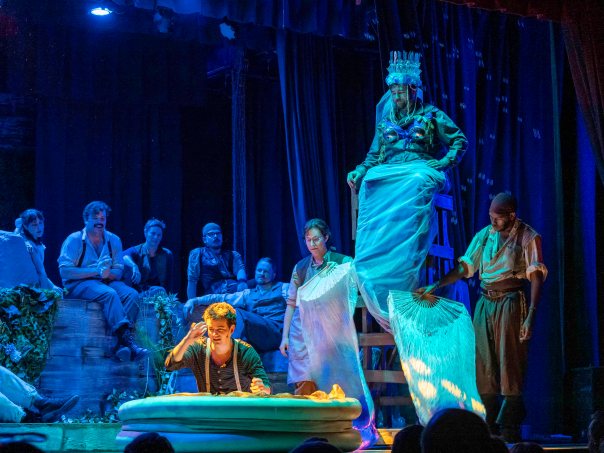
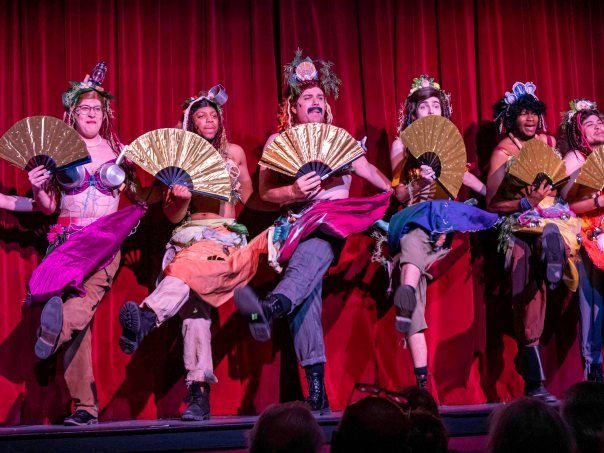
When we reach the faraway island where Peter and the trunk of starstuff serendipitously wash ashore, we will find that Neifert Enrique is the outré and eccentric King Fighting Prawn, monarch of the Mollusk natives. Was this the wildest of Moten’s costumes, or was it Hohenstein’s at the start of Act 2 during his brief song-and-dance as one of the Mermaids? Maybe Ryan Caulley snatches the prize toward the very end as Teacher, a salmon magically transformed into a Mermaid sage atop a lifeguard’s chair. It was a fitting reward for Caulley after a full evening gagged as Captain Scott from the first moment we saw him aboard his ship, the Wasp.

Ben Allen as Prentiss and Alijah Wilson as Ted were more individualized than Peter’s fellow orphans had been in previous productions I’d seen, and Miles Thompson was more rounded and nuanced as Alf, the smelly sailor who woos and distracts Molly’s nanny. Davis Hickson wasn’t as giddy and over-the-top as Hohenstein had been as Bumbrake at Theatre Charlotte in days of yore, so the Alf-Bumbrake thing (with Alf breaking most of the wind) was less orgiastic now and more genuinely warm.

“Young Frankenstein” Delivers Excess, Glitz, and Glorious Shtick

Review: Young Frankenstein at Matthews Playhouse

By Perry Tannenbaum

July 12, 2024, Matthews, NC – Just turned 98, Mel Brooks has overachieved in every way possible, including longevity. Yes, he wrote the music and lyrics in adapting his own Oscar-winning script, The Producers, into a Broadway musical. If that 2001 megahit was the most prodigious and successful transformation of his career – already past 50 years as a writer, comedian, and actor – then his 2007 follow-up, Young Frankenstein, was the most natural.

Mel had already stolen Irving Berlin’s “Puttin’ on the Ritz” and Victor Herbert’s “Ah, Sweet Mystery of Life” to gild two of the most shining moments of the original film, shot in retro black-and-white. Composing his musical adaptation, Brooks stole some more, changing the ardent lyrics of “One Song” from Disney’s Snow White into a deliciously salacious “Deep Love” after the Broadway edition’s third coital climax.

There are some rather filthy connotations strewn throughout our horrific romp through Transylvania, enough for Matthews Playhouse to caution parents against bringing youngsters under 13 to the current production. But stage director Jill Bloede presents each granule of this glorious filth with bawdy, bodacious, and childish glee at Fullwood Theater. Scenic designer Marty Wolff, costume designer Yvette Moten, lighting designer Jeffrey Childs, and choreographer Emily Hunter are all let loose to fashion fresh layers of excess and glitz.

A whole second stage opens up behind the teeming downtown Transylvania downstage when we reach Victor Frankenstein’s secret laboratory hidden behind the mad scientist’s library – an installation that permits special effects designer Roy Schumacher to make the moments of creation and coition inside the lab more spectacular.

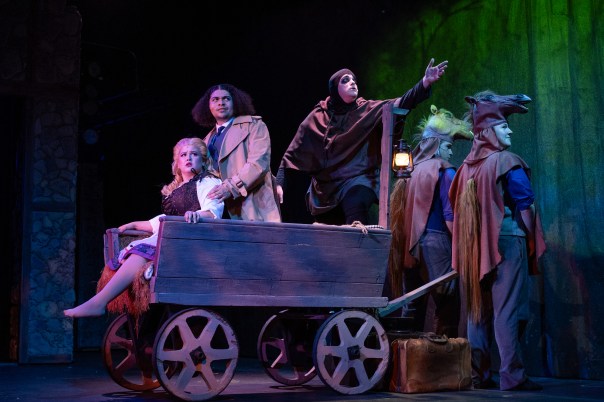
Brooks’s venerated comedy reputation and Bloede’s every-shtick-in-the-book approach have drawn a bounty of professional grade talent to this cast. Wearing a frizzy Gene Wilder hairdo, Neifert Enrique cements his elite credentials as Dr. Frederick Frankenstein, grandson of Mary Shelley’s “Modern Prometheus,” bringing a youthful wonderment to the role that makes all the lead women’s roles a little plumier. If you missed Nick Culp’s outdoor exploits as Columbia in The Rocky Horror Picture Show during the pandemic, one of Actor’s Theatre’s valedictory efforts, his Matthews debut as Igor will likely come as a revelation, though he looked way closer to Fester Addams than to a hump-backed Marty Feldman. Lungs of steel and a wicked comedy flair.

With Mary Lynn Bain as noli-me-tangere New York socialite Elizabeth Benning and Gabriella Gonzalez as Inga, the cheery and buxom Transylvania peasant, the contrast between “Please Don’t Touch Me” and “Roll in the Hay” is as radical as any horny Frankenstein could wish. Bridging this chasm is The Monster, endowed by Brooks with a super-virility that surely would have drawn a polite giggle from Ms. Shelley. Hulking Matthew Corbett, roaring and bellowing with the best, makes Elizabeth’s deflowering a special joy, for while he is melting Bain’s ice maiden inhibitions, Brooks cooly has him overcoming his fear of fire.

Now we easily can find on YouTube that Peter Boyle actually danced in the Hollywood version, but the “Ritz” extravaganza concocted by Hunter is arguably more demanding, with Moten outfitting a good chunk of the Transylvanian peasantry in white tuxes. Top hats and canes for all the gents! We can’t call him Bojangles just yet, but Corbett contributes handsomely to the tap segments.

With leading roles in The Producers, La Cage aux Folles, Cabaret, and Ruthless! over the past 30 years, the charismatic Steve Bryan is a bit of overkill for his cameo as the Hermit. Decked out like a medieval monk, with a wig worthy of Joan Crawford in her dotage, Bryan is perfection as The Monster’s blind and bumbling host, not a trace of a smirk as he scalds his starving guest with soup – a comical affirmation of the beast’s docility as we delight in Corbett’s bellowing. Typical of his elegance, Bryan didn’t milk the last drop of deathless pathos out “Please Send Me Someone” before Corbett’s on-cue arrival answered his lonely prayers. True, Bryan got down on his knees begging, but he never once cried out for his mammy. Maybe next week.

“Hit the Wall” Reminds Us of the Continuing Relevance of the Stonewall Riots

Review: Hit the Wall at The Arts Factory

By Perry Tannenbaum

August 19, 2023, Charlotte, NC – On the eve of the annual Charlotte Pride Festival & Parade, a series of LGBTQ+ events spread across the city in the coming week, Queen City Concerts has chosen a perfect moment to commemorate the Stonewall Riots of 1969, a watershed moment for gay liberation and empowerment. Best known for their resourceful reductions of big musicals to a more bare-bones concert format, Queen City has previously shattered their own template with a fine script-in-hand production of Tony Kushner’s Angels in America, Parts 1 and 2.

Three months later, after a return to form with Diana: The Musical late last month, the company has shown us that Angels wasn’t a fluke, staging the local premiere of Ike Holter’s Hit the Wall, a 2012 play with music that premiered in Holter’s hometown of Chicago before director Eric Hoff restaged his original Steppenwolf Garage production with a New York cast. That Off-Broadway production opened in the spring of 2013 at the Barrow Street Theater, not far from Christopher Park in Greenwich Village, where much of the original action went down.

Directing this concert version at The Arts Factory, J. Christopher Brown isn’t quite as resourceful or ambitious as he was with Angels in utilizing projections and costumes. Scenery and props are also less lavish, and there are no stage directions at all read aloud. With a rowdy rock trio roaring from one corner of the black box space, the experience remained richly visceral, though our awareness of where we are or who is speaking was sometimes delayed. We get an abbreviated staircase for the proverbial sidewalk stoop, where the “Snap Queen Team” of Tano and Mika hang out, and a couple of chairs occasionally appear.

Projections could have transported us inside the Stonewall Inn gay bar, but we only get the exterior, and a lamppost or a park bench could have transported us to Christopher Park more emphatically. It doesn’t take long to get the gist after scenes at these locations begin, but who is telling us in the opening tableau that “The reports of what happened next are not exactly clear”? Without a simple cop’s uniform on actor Nick Southwick, it takes a long while before we know how to digest this declaration.

Of course, a long while in a production that zipped through Holter’s script in less than 90 minutes wasn’t uncomfortably long. What Christopher continued to do extremely well was cut down on key moments when actors read from their scripts. For most of the production, actors were off-book and the booklets they clutched served as reminders of their cues rather than reading material. We were aware of the scripts onstage, but the flow of the action and the actors’ lively energy grabbed nearly all our attention. If anything, the occasional peep at a script reminded us how quickly and thoroughly this cast had mastered its essence with just a few rehearsals.

We should also understand that the sanctification of Stonewall over the past 54 years has partly happened as myth rushed in to fill in a vacuum of determined facts. It’s interesting to see the strategies Holter used to recreate Stonewall, chiefly by inventing a compacted community of fictionalized gay, lesbian, queer, and crossdressing people, from the neighborhood and from elsewhere, who gather at The Stonewall, owned by the mob but catering to this eight-person crowd.

As the Snap Queen Team, Lamar Davis as Mika and Zelena Sierra as Tano have attitudes, sometimes confrontational, about anyone who passes by. When Zachary Parham arrives as the queer Newbie, the Queens are not at all welcoming. But Holter’s style of hostility isn’t mean-streets raw or even ‘60s bohemian. Combats and putdowns come at us in the form of rap rhymes and poetry slams.

Aj White, arriving in high heels and a low-cut dress as Carson, is too much for the Snap Queens to handle despite his grieving over the recent death of Judy Garland. Yet he is visibly floored by the advances of lanky Neifert Enrique as the self-confident, draft-dodging, pot-smoking Cliff, a fatalistic drifter who assumes he will be dumped into the Viet Nam War the next time he is picked up in a raid. None of these core characters appear ripe for radicalization, though the tough Carson and roving slickster Cliff have agreed to meet at The Stonewall. Eric Martinez as the arrogant A-Gay further convinces us of the submissiveness that bonds the Newbie and the Queens. The Harvard grad lords it over all three.

Two catalysts for change are deftly stirred into the mix. Shaniya Simmons as Peg will combine with Carson in fomenting the police brutality at The Stonewall, and Valerie Thames as Roberta, an activist perpetually straining to draw a crowd, will finally be gifted with a galvanizing cause. Besides Southwick as the Cop, friction comes from Iris DeWitt as Madeline, a character who morphs from a concerned citizen to a disapproving sister. Music blasted by guitarist Daniel Hight, bassist Harley, and drummer Paul Fisher was most appropriate when we convened at The Stonewall and the bulk of our cast began to party.

Ironically, the music was most effective when it suddenly stopped as police commands triggered the raid. The music vibe and the slam poetry styling were shattered simultaneously. Soon we were in the ladies’ room watching the grim brutality. A little less riveting – but perhaps more emotionally fraught – was the climactic confrontation between the sisters after the raid.

Reports of what happened afterwards are unclear, but we do adjourn to the sidewalk stoop where the main point impacts the Queens who sit on it: there’s no turning back. Paired with Angels within three points, Hit the Wall reminds us that Kushner’s epic ended with a similar takeaway. The feeling that both dramas remain timely urgently underscores the fact that the Pride movement has more work to do.

Downsizing “Sister Act” Pays Big Dividends at Matthews Playhouse

Review: Sister Act at Matthews Playhouse

By Perry Tannenbaum

2022~Sister Act-11

A full flowering of onstage success has somehow scurried away from Iris DeWitt in recent years. Just last April, pandemic restrictions and a wretched recording rig trapped her inside a masked, malodorous production of Sense and Sensibility at Central Piedmont Community College. Patchy intelligibility also wrecked DeWitt’s previous outing in the badly-miked production of Chess in 2020. Until 2022 rolled in, you’d have to go back to 2019 if you wanted to claim to have seen DeWitt anywhere near her imposing potential, when she played prominent roles in Beehive and Little Shop of Horrors.

Neither of those CPCC Summer Theatre productions obliged DeWitt to show us much of her acting or dancing skills. Beehive was totally bereft of plot, and while Iris’s undeniable vocal power was manifest in Little Shop, no full flowering was evident there, either. We had to settle for the most memorable who-did-she-play performance in recent Charlotte history, for DeWitt was a flower in that musical, hidden in the cavernous depths of Audrey 2 in Little Shop.

This year, the script is flipping and momentum building as DeWitt has figured prominently in Ghosts of Bogota, when Actor’s Theatre returned to Queens University, and Love, Loss and What I Wore in the recent Theatre Charlotte production at Camp North End. Paula Baldwin, who directed that sloppily streamed S&S adaptation of Jane Austen last year, clearly retained enough confidence in DeWitt to see her as Deloris Van Cartier, the lead role in Sister Act. Ron Chisholm, choreographer for this Matthews Playhouse extravaganza at The Fullwood Theatre, probably also saw some potential waiting to blossom in DeWitt’s previously untested dancing feet.2022~Sister Act-10

We’re not so sure when we first see Deloris and her backup singers onstage. The vocals are sufficiently electric but not full voltage, while the doo-wop moves are nowhere near Supreme. I’m guessing that Baldwin and Chisholm have asked DeWitt to cool her jets on “Take Me to Heaven” because Deloris is nervous about auditioning for her paramour, Curtis, an intimidating mobster, at his club. But why on earth should Curtis, a man of highly questionable character, be even a little justified in thinking that Deloris and her crew aren’t ready for a recording contract and the bright lights?

Apparently, writers Cheri and Bill Steinkellner thought that their protagonist needed a crisis of confidence in the early stages of her spiritual journey, one that Paul Rudnick found unnecessary in his original screenplay for the 1982 movie starring Whoopi Goldberg. There, Deloris and crew had all the polish of the Supremes from the start, singing a doo-wop medley in the bowels of a Las Vegas casino owned by her mobster boyfriend, drawing two claps and a stare from a late-night audience of gamblers.

Now they’re in some undisclosed Philadelphia dive, where the only audience is Curtis, his three henchmen, and us. Curiously enough, the transfer from the glitz of Vegas to the dumps of Philly makes Sister Act more at home in a community theatre setting than on the big stages of London’s West End, Broadway, or at Ovens Auditorium – not to forget Halton Theater, where it was staged in yet another CP production back in January 2013.

As soon as Deloris and her crew began to regroup in “Fabulous, Baby!” we had our first glimpses of all that DeWitt can be onstage. My own realizations, beyond her trusty vocal powers, were split between her ability to dance – gliding disco or righteous gospel – around the stage she commanded and the thoroughly professional depth of her acting. Watch DeWitt’s reactions for a while and you eventually find it difficult to take your eyes off her until she makes an exit.

And don’t fret about any missed opportunity with “Take Me to Heaven”: DeWitt and most of the ensemble get a grand do-over at the end of Act 1.

After the additional indignity of being gifted with a garish hand-me-down fur coat previously owned by Curtis’s wife, Deloris has the misfortune of witnessing the club owner brutally gunning down a snitching henchman in cold blood. On the run from her ex, Deloris leaves Curtis in the lurch for the better part of the night as the saloon singer is placed in a witness protection program and sequestered in a midtown convent. That calls for a new counterweight for Deloris to provide the plot with some fresh friction, a call sternly answered by the convent’s Mother Superior, the role played by Maggie Smith opposite Goldberg in the film.2022~Sister Act-04

Oh, and by the way, Baldwin herself played that Maggie Smith role at CP in 2013, so she’s directing a show that she knows intimately from the inside. Maybe she already envisioned what I had yet to perceive in a smaller venue, that what the Steinkellners sought most earnestly in their adaptation of the movie was to make the story more character-driven and less of an action comedy. Building upon Mother Superior’s most familiar film epigram, “God sent you here for a reason – take the hint,” the Steinkellners, along with songwriter Alan Menken and lyricist Glenn Slater, team up to give greater voice to her spiritual crisis.

Both of Menken’s ballads for Mother Superior, “Here Within These Walls” and “I Haven’t Got a Prayer,” sit nicely in Carol Weiner’s vocal range and sternness is Weiner’s prime onstage métier, so she eclipses anything we’ve seen from her before, including her starchy turns in Big River, Bonnie and Clyde, and Oliver! There’s more than a hint of Menken’s “Beauty and the Beast” lurking inside of “Within These Walls,” and Weiner allows its warmth to radiate through Mother Superior’s gradual softening toward Deloris.2022~Sister Act-09

More personal crises are layered over the thinner movie scenario. Young apprentice nun Sister Marie Robert, beguiled in the film by the bar where Deloris finds refuge from the convent’s cheerless monotony, now questions whether she should be leaving the real world for a convent – netting Melissa Lozada two cracks at the novice’s power ballad, “The Life I Never Led.” The dreamboat cop who whisked Deloris out of town in the movie, not even letting his colleagues know where she was, is now the hesitant, self-doubting Sweaty Eddie, relegated to a desk job when he wouldn’t fire his gun out on the beat.Photo1 @ Tom Henderson Photography

Saddled with a lingering crush on Deloris that goes back to high school, Eddie draws “I Could Be That Guy” to cry out his anguish, slightly more comical than Lozada’s plaints but hardly less of a showstopper for Griffin Digsby, who swoops down into Barry White territory in voicing his romantic aspirations. Also going there, surprisingly enough, is Mike Carroll as Monsignor O’Hara, who presides over Sunday services and surprisingly turns out to be a Deloris groupie when she revamps the convent’s choir.

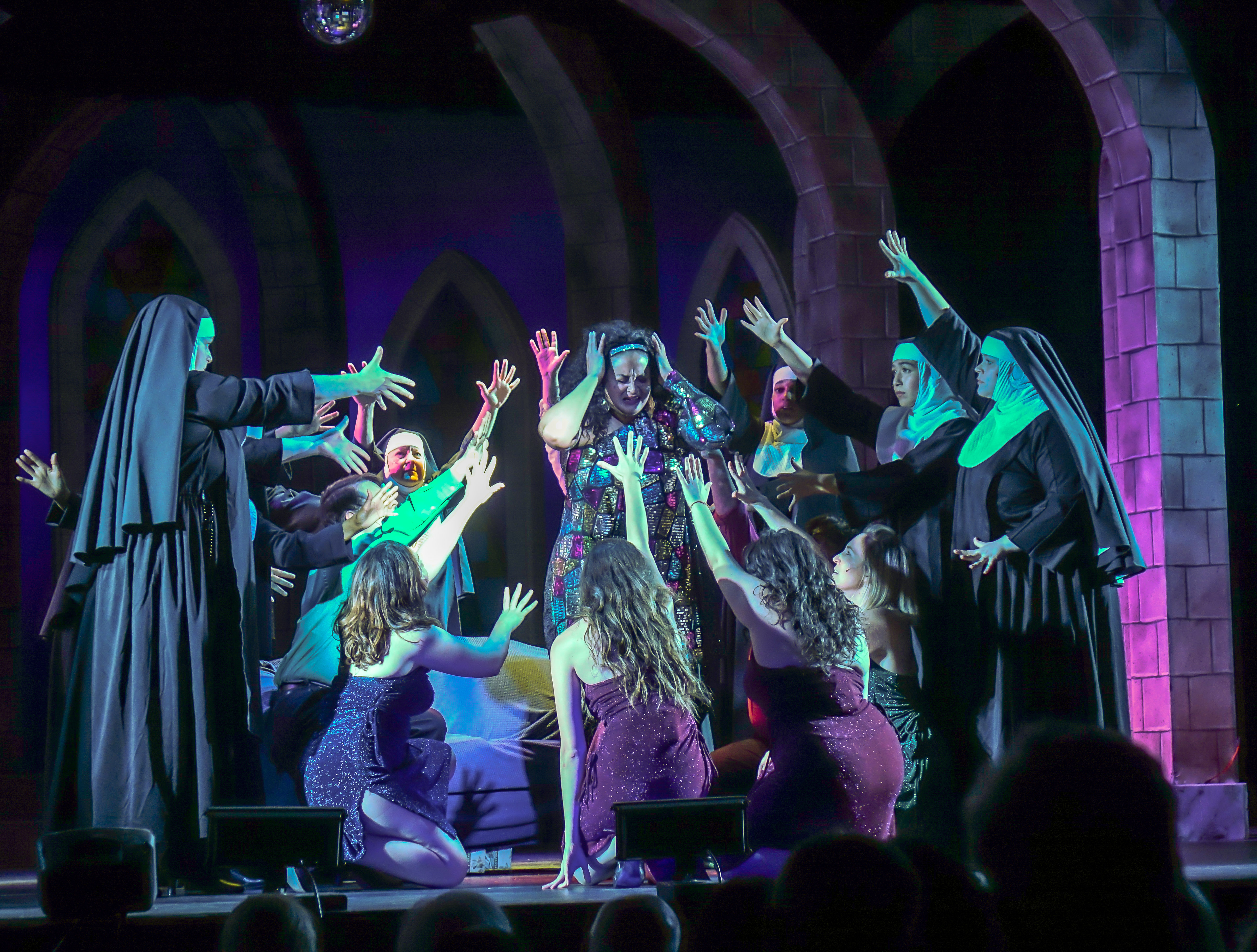
Baldwin and Chisholm not only draw strong players down in Matthews, but they also get strong design and technical backup. Debbie Scheu’s designs for the nuns’ habits grow more spangled and outré as the convent choir grows in prestige and popularity. The glossy, reflective dress Deloris wears in her Van Cartier persona complements the stained-glass backdrop that scenic designer Marty Wolff has provided for the church. Four sets of translucent arches that inch closer together as we move upstage change colors during the glitzier scenes climaxing the action, as Jeffrey Childs’ lighting design adds excitement to Chisholm’s choreography.

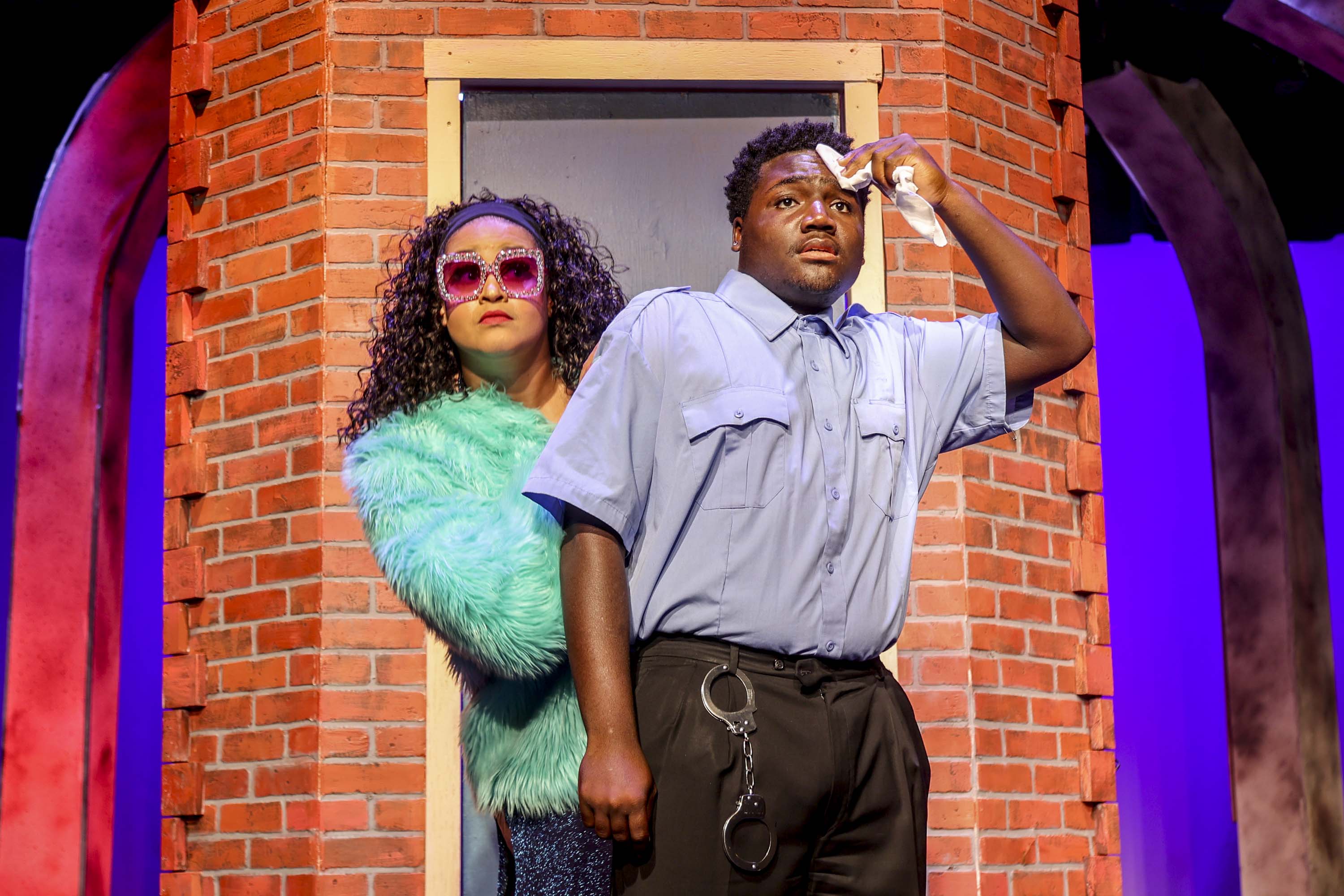
Amazingly, the only scene where downsizing doesn’t work at Fullwood Theatre is the squalid bar scene. The room is simply too small for Curtis’s henchmen not to notice three nuns when they enter – or for Deloris to overlook these motley thugs for more than five seconds. Then again, Menken had worked at least three Disney musicals before attempting SISTER ACT in 2011, so he hadn’t yet mastered the Harvey Keitel gravitas we might expect from real dons and heavies (A Bronx Tale would come more than five years later).Photo2 @ Tom Henderson Photography

Jamaas Britton, Ra’Saun Elliott, and Neifert Enrique play these street urchins with all the menace of the Lion King hyenas. They get a spotlight – or a lava lamp – shortly after intermission, when they spar over the best way to romance a Sister in “Lady With the Long Black Dress,” Elliott explicitly espousing the Barry White approach. Edgier than his goons, Kristopher Loretz as Curtis gets to riff sardonically, in “When I Find My Baby,” on the penitent reconciliation serenades that scamps have been wooing women with for ages, replacing the customary promises of hugs and kisses with vows of knives and guns.

All of these bottom feeders are portrayed with the same assurance as the principals, to the delight of the Sunday matinee audience, who loudly gave them all a standing O. It was likely exciting for the energized crowd to be back at Matthews Playhouse watching a musical – and maybe amazing for them to see production values as high, or perhaps higher, than ever.

CP’s “Joseph” Connects With Talent and Style, Frustrates With Ongoing Audio Woes

Review:  Joseph and the Amazing Technicolor Dreamcoat at Halton Theater

By Perry Tannenbaum

THEA2021-DLV-0708-2138

Before this weekend, Halton Theater hadn’t opened its doors to a theatre crowd since February 2020, and Central Piedmont Community College Summer Theatre had been dark since July 2019, when they closed their five-show season with A Gentleman’s Guide to Love and Murder. Returning to the Halton stage as guest director of Andrew Lloyd Webber’s Joseph and the Amazing Technicolor Dreamcoat, Tom Hollis posed a poignant question during his introductory remarks. Does it really count as a season when a company offers its audience just one production? Even the most loyal Central Piedmont supporter can’t buy a 2021 season ticket, that’s for sure. And until Central Piedmont Community College completes its recovery from a debilitating ransomware attack this past winter, they won’t be able to accept credit card payments at their Overcash ticket windows. Cash or checks for walk-ups, plastic for online sales only.

Opening night at Halton was a cautious first step back toward pre-pandemic norms – with a Delta-be-damned giddiness to it as COVID protocols were loosened at last. For most of the crowd mingling in the Halton lobby before and after the show, this was probably the first public event they had risked in at least 16 months, a milestone moment. For the theatre folk scattered among us, it was an emotional reunion – an affirmation.

Last season was originally envisioned as Hollis’s grand valedictory after nearly four decades at Central Piedmont, his latter years as theatre department chair. An encore reset of the lost 2020 season was rumored for a while as Central Piedmont scrambled with their winter programming, so Joseph is a double surprise – not among the shows announced for the lost 47th Central Piedmont Summer Theatre season and the only show replacing them. Previously mounted in Summer 1993 and revived in Summer 2001 at the now-demolished Pease Auditorium (the CPCC Theatre production of 2008 at the Halton was a wintertime affair) – with rousing success on all occasions – Joseph is likely more bankable than Footloose, lighter on the budget than The Music Man, and far better-known and cheaper to produce than Something Rotten! Additionally, there is likely a finely calculated ecology in a true Central Piedmont Summer season that allows the college the biggest bang for their bucks when auditioning and casting their overall troupe of performers and designers. These discarded musicals, plus Peter Pan Jr. and a Ken Ludwig comedy, might conceivably be in cold storage, slated for resurrection in 2022.THEA2021-DLV-0708-1267

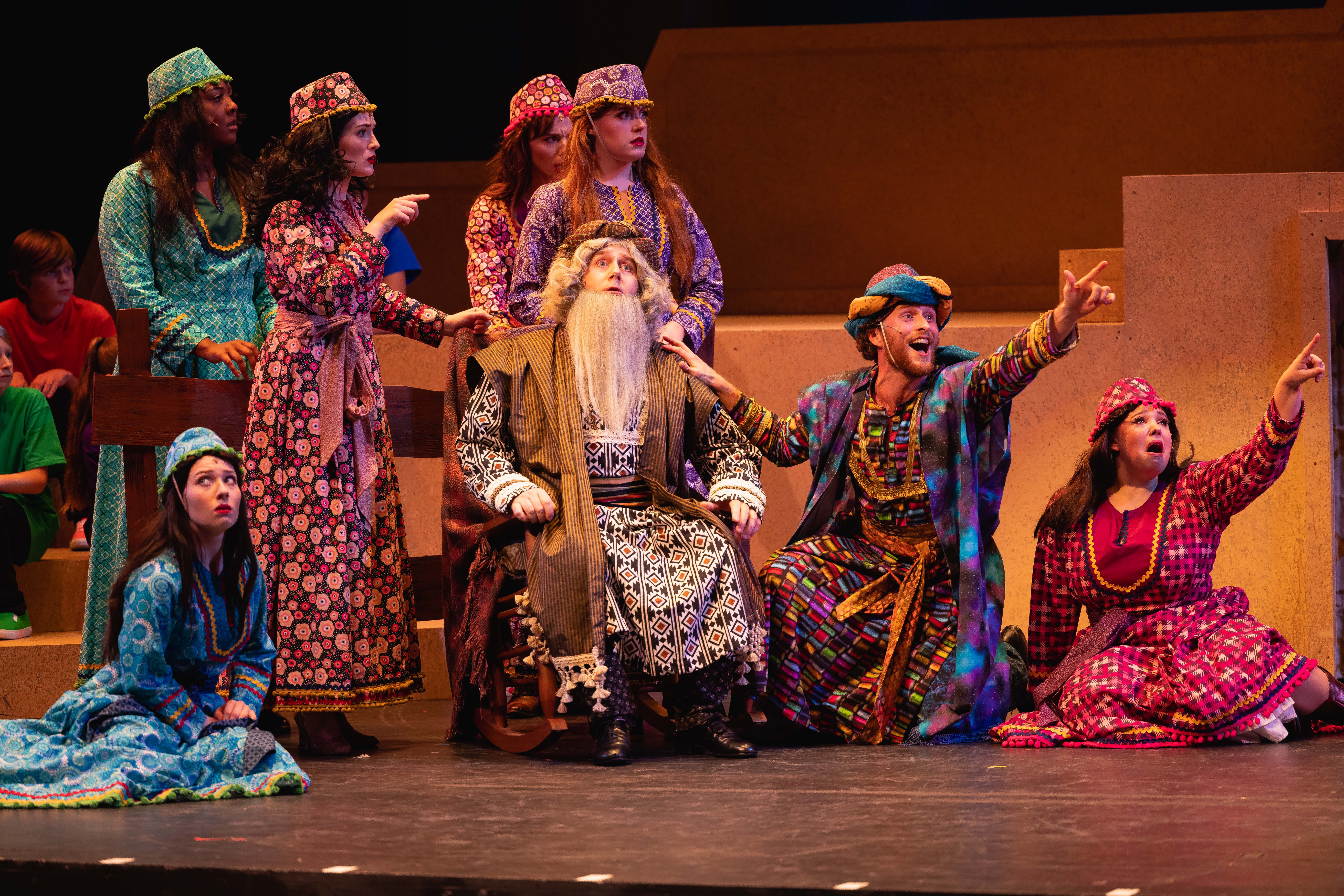
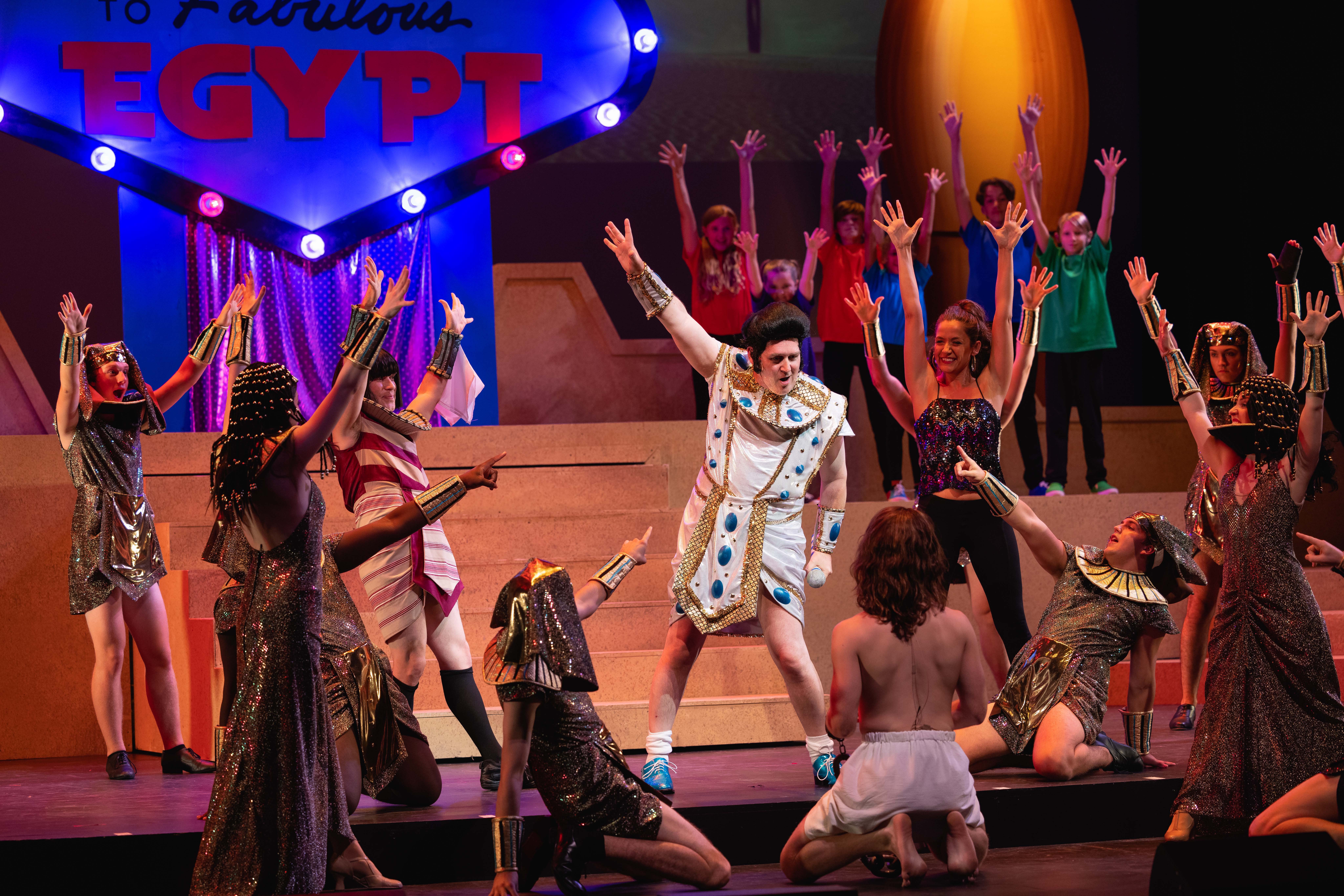
Sitting in Row K, I only noticed one gentleman taking a restroom break during this intermission-free presentation, and I was somewhat surprised that the cast began taking their bows a mere 71 minutes after the show commenced. Another eight minutes came packaged in a “Megamix” reprise of Webber’s most bodacious songs – or parodies, since the composer delights in shuttling among an unlikely array of genres in retelling the most epic tale from the Book of Genesis, aided by Tim Rice’s lyrics. The news of Joseph’s demise is delivered to his doting father, Jacob, in the form of a sobbing lone-prairie cowboy song. Pharaoh is transformed into a pre-historic Elvis as he rocks his account of his prophetic dreams. The poverty of Joseph’s 11 brothers during the years of famine takes on the nostalgic air of a sad French café, complete with Apache dancer, and Naphtali’s pleas for the innocence of little brother Benjamin come in the form of a Caribbean calypso.THEA2021-DLV-0708-1815

Curiously, the irreverence and multitudinous anachronisms of this Webber-Rice concoction, not to mention the narrative alterations of Holy Writ, have never seemed to spark any massive public outcry from Judeo-Christian clergy. Maybe the outright anachronisms, beginning with the Technicolor in the title, insulate all the irreverence and textual tinkering from being taken seriously. James Duke’s scenic design and Bob Croghan’s costume design underscore the assurance that we are not in the immediate vicinity of ancient Egypt or Canaan, fortified by the equally anachronistic projection designs by Infante Media. No, this is more like a Disney or a Las Vegas style of Egypt, with Duke taking full advantage of the lordly height of the Halton stage compared with Pease’s pancake panorama. Our Elvis is also a Vegas version, clearly the sequined, jumpsuited, decadent superstar of his latter days. The Duke-Infante collaboration is so glittery and colorful that it is only slightly upstaged by Croghan’s creations for Pharaoh and Joseph.THEA2021-DLV-0708-1357

You don’t often get the chance to design a costume that is hyped in the title of a show, and Croghan, on the Charlotte scene even longer than I, doesn’t disappoint. The impact of this mid-pandemic return to live theatre caught me off-guard several times. Each time a major character made his or her first entrance – Lindsey Schroeder as our Narrator, Rixey Terry as Joseph, and J. Michael Beech as Pharaoh – I had that tingling sensation of recognizing something basic and exciting that had been missing in my life for over a year.

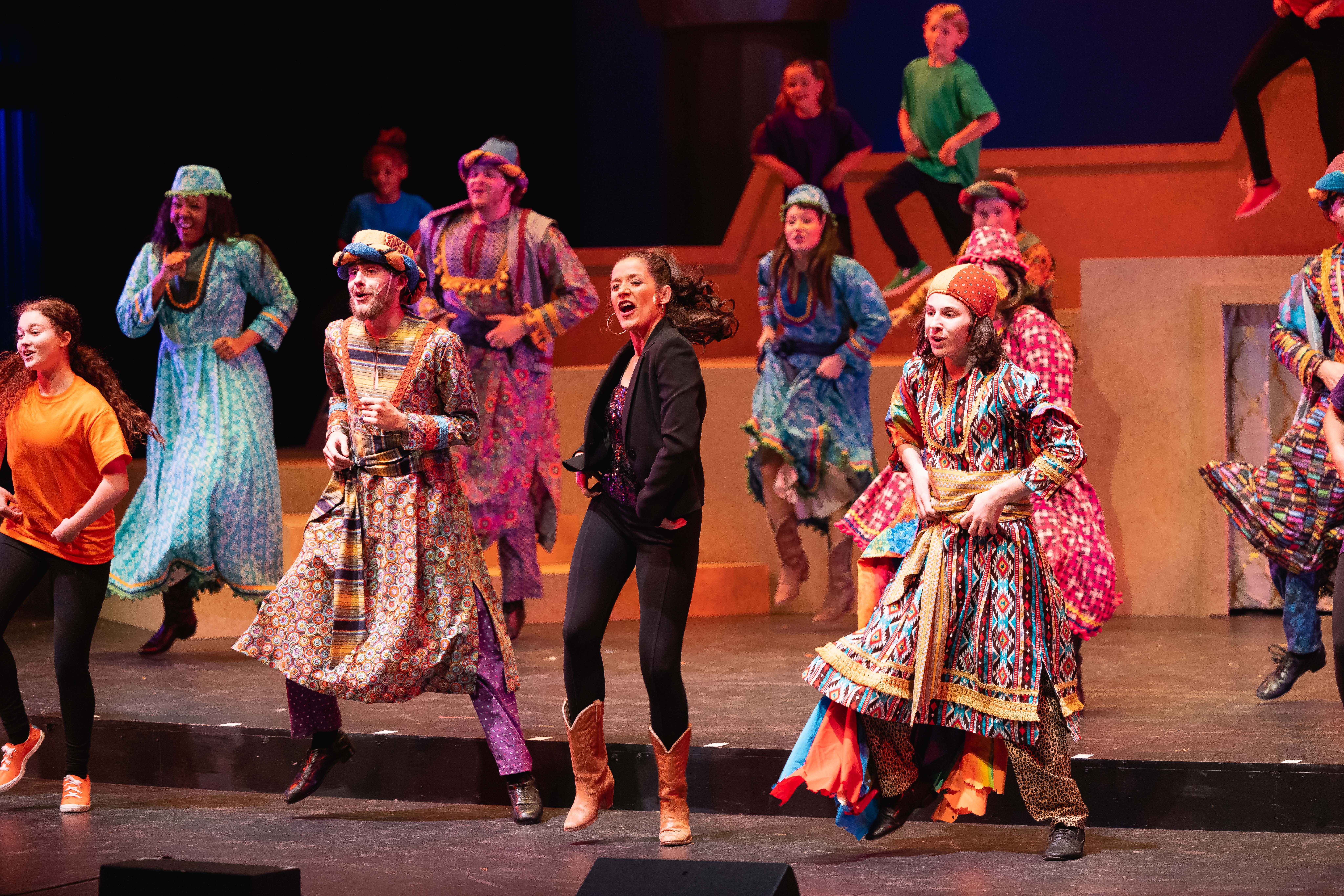
My biggest surprise, a frisson of renewal, came from the audience when they reacted to the most iconic moment in Joseph, when the brothers picked up the skirts of Croghan’s knockout dreamcoat so that it formed a pinwheel around Rixey, spinning around as he, Schroeder, and the ensemble sang “Joseph’s Coat.” Anybody even glancingly familiar with musical theatre anticipates this moment before it happens, or at least recalls it fondly from a previous encounter. But part of the audience at Halton erupted in delighted and surprised laughter, recalling what the first London and Broadway and high school audiences must have experienced when Joseph was new and reminding me of my own delight back in 1993.THEA2021-DLV-0708-1130

Rixey walked a treacherous tightrope, blending innocence with vanity as beautifully and energetically as any Joseph I’ve ever seen, lacking the cloying wholesomeness that only true Donny Osmond fans will miss. Maybe a plunge or two into that saccharine syrup might make Rixey more memorable in “Any Dream Will Do,” but I would prefer that he add a sprinkling of excess to those melodramatic moments when he is unjustly imprisoned, crying out his “Close Every Door.” Lighting designer Jeff Childs does come to the prisoner’s rescue, adding some spiritual gravitas.

Schroeder was brimful of brilliance as the Narrator, infusing enough energy into her string of recitative that it never devolved into tedious singsong, though she was often unintelligible. Beech’s misfortunes with his microphone were even more egregious as Pharaoh, including intermittent sonic dropouts, but his audio setup was likely jostled over the course of the evening, since he donned different costumes and headgear for his other roles – Jacob, Potiphar, and the doomed Baker.

Admittedly, it’s churlish of me to keep harping on Central Piedmont’s defective sound equipment and the cavalcade of professional-grade technicians who have failed to tame it. North of $115 million are being spent on replacing Pease, originally a lecture hall, with a genuine theatre facility, while Central Piedmont’s audio woes have gone unaddressed since 2005, when the Halton was new. But new generations come to the Halton every year, and new summer visitors from afar get their first taste of Charlotte theatre there – and they still need to be cautioned. By the time the “Megamix” came around on opening night, Beech’s “Song of the King” was only fitfully audible and Schroeder’s mic was intermittently dropping out.

THEA2021-DLV-0708-1993

More power, then, to the performers onstage who merrily soldiered through. Even the charade of the brothers’ mournful moments was untarnished. All of the cameo solos hit their marks. Matthew Howie was hilariously rusticated as Reuben delivering the bad news to Jacob with “One More Angel,” and Neifert Enrique as Simeon – aided by his brothers and Emma Metzger’s scene-stealing table dance – brought a boulevardier’s wistful regret to “Those Canaan Days,” with more than a soupçon of self-mockery in his lamentations.

Even more THEA2021-DLV-0708-2049irrepressible and irresistible was the calypso lightness and joy that Griffin Digsby brought to the “Benjamin Calypso” as Naphtali. Around the third or fourth time Digsby reached the “Oh no! Not he!” refrain, I had to stop myself, for I had started to sing along. Just another adjustment I’ll need to make after 16 months of consuming theatre in front of my computer monitor and TV set. It was hard to be displeased by anything that accompanied this welcome change.

nuVOICES NEW PLAY FESTIVAL Bucks the Patriarchy

Review: Actor’s Theatre of Charlotte staged their nuVOICES NEW PLAY FESTIVAL

By Perry Tannenbaum


BWW Review: nuVOICES NEW PLAY FESTIVAL Bucks the Patriarchy


It’s been over three years since Actor’s Theatre of Charlotte actually staged their previous nuVOICES NEW PLAY FESTIVAL, but it may not seem like that long to fans of the company and fans of the festival. For one thing ATC commits to presenting the winner of the festival – as selected by audiences and/or a panel of judges who attend staged readings of the plays – in a full-length production the following season. ATC was unusually generous toward the four playwrights whose plays were read in 2016, for two of their works were presented two years later at Queens University in 2018, Meridith Friedman’s The Luckiest People in January and David Valdes Greenwood’s The Mermaid Hour last May.

Although nuVOICES languished for the next two seasons, ATC remained productive, managing to stage four shows during the 2016-17 season while landlords, landowners, and city inspectors screwed over them. Queens University opened their arms to the wanderers in the spring of 2017 as they searched for a new home, and by the start of 2017-18, the 30-year-old ATC became the university’s resident theatre company. Stability! For ATC’s fans, seeing the resumption of nuVOICES has taken a backseat to the satisfaction of their survival.

Well, in one respect, nuVOICES was not only back but better than ever, for the fifth edition of the festival won a sizable grant from the National Endowment for the Arts. The influx of NEA support seemed to raise the technical polish of the staged readings somewhat, for the handiwork of sound designer Kathryn Harding and lighting designer Evan Kinsley occasionally came into play.

Although seven of the 13 festival script readers were men, all four of the chosen scripts at nuVOICES 5 were by women. Yet there was plentiful ethnic diversity among the characters the playwrights presented onstage – and among the playwrights themselves.

First up was Nora Leahy’s Girl with Gun, a one-woman show starring Caroline Renfro as Lynette “Squeaky” Fromme. We caught up with Squeaky on Christmas Eve 1987 shortly after her escape from a prison in West Virginia. When apprehended, she had been on her way to rendezvous with Charles Manson, imprisoned (and seriously ailing) across the country in the California State Pen. Now as she speaks, occasionally to an unseen guard but usually to nobody in particular, she’s being detained at a ranger station, awaiting transport to Fort Worth.

We learned a few things about Squeaky that I hadn’t known, including her appearance as a kid on the Lawrence Welk Show, how she got her weird nickname, and that her bad behavior in prison also included bludgeoning a fellow inmate with a hammer. In the talkback after the show, conducted as a video call with a big-screen monitor, the playwright revealed that her play had been commissioned as a historical portrait and that she is thinking about adding 20 minutes to its current 55-minute length.

In their staged reading of Themba by Amy da Luz with Kamilah Bush, nuVoices broke with precedent by not having any talkback at all. Both the playwright and dramaturg were in town, making themselves available for a pre-show interchange with festival director Martin Kettling. A bad idea for numerous reasons. People who hadn’t already seen Girl with Gun at 6pm would not have gotten word that the customary playwright powwow was happening before the 9pm performance of Themba and not after. This likely deprived them of actually seeing the pre-show before Themba and definitely robbed them of their chance to have their questions answered afterwards. Or simply voicing their reactions.

Of course, the Bush-da Luz team also missed out on getting feedback from this Thursday night performance, though they would get a second opportunity at the twilight performance on Saturday. Really, the process should be uniform for everyone involved – audience, performers, and playwrights. If you’ve written a play that gets a nuVOICES reading, you should be able to commit to appearing in person at talkbacks.

Da Luz changed the title of her play after ATC announced their final four, so her team clearly viewed their time in Charlotte as part of a developmental process. Like Leahy’s study, Themba was a docudrama, oozing with personal stories and intensive research. At the unseen vortex of the story was Lola, a young African girl who is the beneficiary – and/or victim – of a missionary adoption in war-torn Uganda, which may not have been legal. That question comes up in a roundabout way after the adoptive father has died and his two sisters, evangelical Mary and theatre director Sarah, wrangle over who should get custody.

Ah, but the story doesn’t remain centered solely on the white adoptive family. To fortify her claim, Sarah brings her partner Fran, a Black playwright, into the fray. Fran sees that she’s being used, wonders how the father was approved, and begins to probe into the process, asking the Black adoption official Jelani some pointed questions. The probe widens, becomes a formal government investigation, and the four young women who have been lurking in the wings – until now detached from the main action but intermittently interrupting it to tell their stories – suddenly become factors in the main plot.

The four are certainly not a homogeneous group. Recognizing that they were likely rescued from poverty, slaughter, or disease, they are not universally comfortable with Christianity or the USA. Some of them are as antagonistic towards Jelani as Fran was – and the young women vented considerable animus toward each other. We had a lot to think about after Themba. In the nine-person cast directed by Heidi Breeden, Stephanie Gardner as Sarah, Lisa Hatt as Mary, Valerie Thames as Fran, and Angela Shannon as Jelani drew the juiciest roles. Nonye Obichere as an adoptee and Dennis Delamar as the sibs’ preacher dad delivered the tastiest cameos.

Friday night’s schedule went off without any further rule-breaking, beginning with Mingus, a two-hander by Tyler English-Beckwith. The basic structure reminded me fairly quickly of David Mamet’s Oleanna, with newcomer Amberlin McCormick portraying B Coleman, a college student who comes to the office of Harrison Jones, a distinguished professor of black studies portrayed by Ron McClelland. B hopes to get a letter of recommendation from Harrison and an assessment of an essay she’s planning to submit for a prestigious award.

Harrison’s acceptance is conditional. He’ll write the letter if, with his help, she sufficiently improves her essay. Thanks to Rory Sheriff’s crafty direction, we had to go very deep into this play trying to figure out who was exploiting whom, maybe misreading signals about who’s in love with whom and how that will ultimately affect their relationship. In Mingus, Harrison’s past is referenced in the title, for he aspired to play the bass like his jazz idol, Charlie Mingus, before joining the Black Panthers and being forced to alter his dreams. It may also serve as a marker for the spot where he allows his professional relationship to become personal. As in Oleanna, the student takes formal action against her mentor, but for most of us, I suspect the reason was a surprise. Final score: #MeToo 1, Patriarchy 0.

Last up was the most bizarre and comical of the nuVOICES 5 plays, Diana Burbano’s Ghosts of Bogota. Reunion plays are certainly not a rarity, and the friction between the two sisters, Lola and Sandy, was very much in the cosmopolitan-vs.-judgmental vein we had seen the night before from Sarah and Mary – with a generous sprinkling of Latinx spice. Only here the reunion is transcontinental, the Spanish-speaking sisters returning to their parents’ hometown in Colombia with their younger nightlife-loving, sleep-averse brother, who knows very little Spanish at all.

Ancient history bubbles up in Bogota as they prepare for the funeral of their grandfather. The old man, Lucho, was not beloved by any of the siblings, and he repeatedly abused Sandy. She needs to see the predator buried physically and spiritually, facing off with his ghost. Meanwhile Lola is upset because she feels she should have known what was going on and should have protected her younger sister. The ghost she needs to exorcise is her grandmother Teresa, the knowing enabler. Lucho may not be a nuanced pervert, mostly snarling when he appears, but Teresa, a product of her upbringing, is a different story.

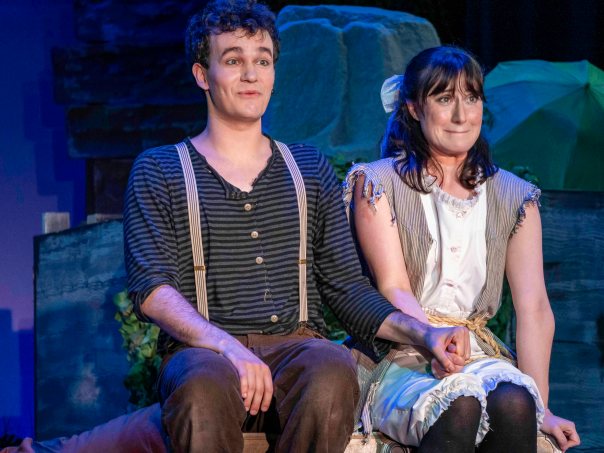
Aside from the petty squabbles between drama queen Lola and prissy resentful Sandy, what tips this drama toward comedy is the living-the-dream insouciance of Bruno, who registers such hardships as Internet deprivation, and the scene-stealing exploits of a very lifelike head in a jar. Nothing can go terribly wrong with Creepy Jesus on the case. Kudos to Adyana De La Torre-Brucker as Lola, Glynnis O’Donoghue as Sandy, and newcomers Neifert Enrique as Bruno and Grant Cunningham as Jesus. Director Adrian Calabrese also made an auspicious debut.

nuVOICES 5 was presented at Queens University as a pay-what-you-can event, and by Friday Evening, Hadley Theatre was teeming with festival enthusiasts. An outdoor Midsummer Night’s Dream will run on the campus quad beginning on August 12, and ATC’s 31st season will begin with Silence! The Musical on August 15. The talent onstage at Hadley last week and the technical artistry behind the readings served as compelling inducements to check out those upcoming productions.