Review: Wink at Booth Playhouse and Warehouse PAC
By Perry Tannenbaum
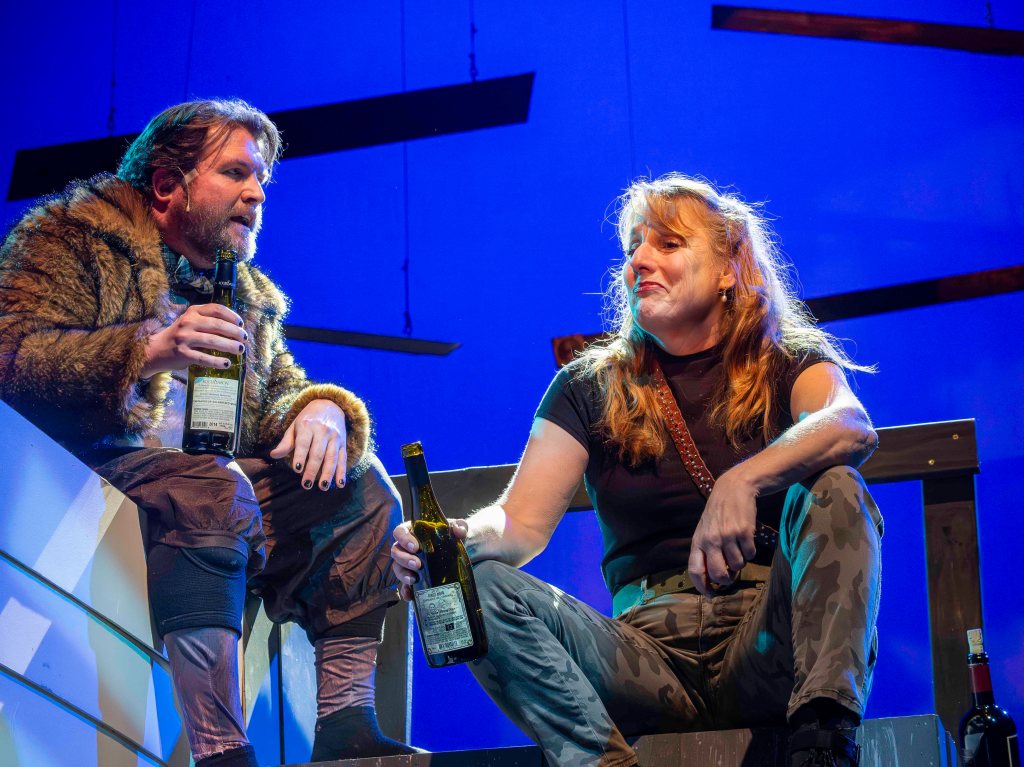
If you love cats, you already know the open secret of their appeal: they are all wild thangs. Yes, we can declaw them or inflict various mutilations on their genitalia to superficially tame them. But they will still swat at things floating in the air, still hiss when cornered, still religiously stalk, crouch, bide their time, creep stealthily closer to their prey, and pounce.
And they purr.
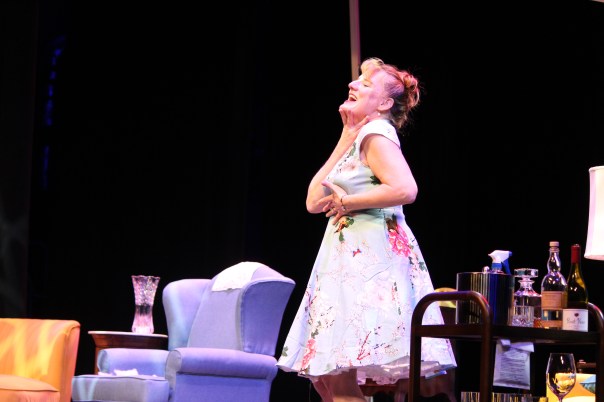
In Jen Silverman’s Wink, there is no purring. Now in transit from its opening weekend at Booth Playhouse to the comparably compact Warehouse PAC in Cornelius, Wink may be tough to catch in the wake of its positive word-of-mouth. Reactions at the Booth to the sight gags rank with the loudest, most vociferous, and gob-smacked I’ve heard in the QC.
Spearheading this flawless Charlotte Conservatory Theatre production – at an admirably brisk pace – director Marla Brown has cast real-life husband and wife Steven Levine and Shawnna Pledger as Sofie and Gregor, the caretakers of the title feline. The couple has radically opposing views on Wink. Sofie adores her AWOL pet, while Gregor strives to veil his murderous antagonism.
The unscientific ploy that Sofie uses to partially pierce Gregor’s defenses in this staid opening scene is unmistakably feminine and devastatingly clever. Such fancifulness, heterodoxy, and cleverness suffuse this 75-minute gem.
It’s not glaringly obvious in the sedate, passive-aggressive early moments, but Gregor and Sofie could likely benefit from some top-notch marriage counseling. It’s already too late. Separately, with complete confidentiality, they are seeing the same psychologist, the profoundly lonely and disciplined Dr. Frans, beautifully calibrated by Dan Grogan.
He’s a perfect fit for both Sofie and George. Perhaps too perfect, since the remedy he insists upon for both their ills is the same: tamp down and conquer your outré impulses. Oh, and go on vacation with your spouse as a healthier release of your tensions. It’s a prescription for George and Sofie to go on doing what they’ve done for their entire adult lives.
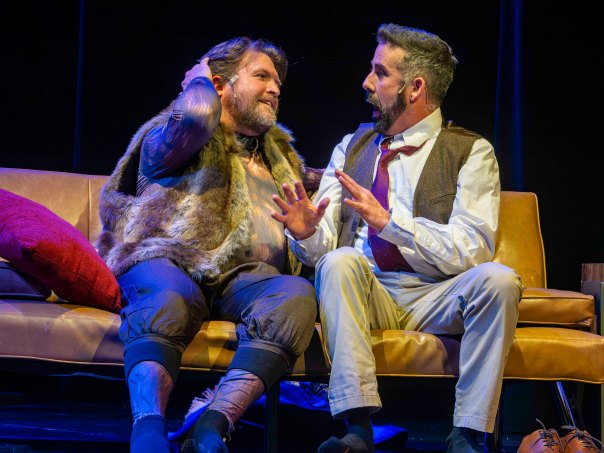
Played with an edgy insouciance by Nathaniel Gillespie, Wink also goes to see Doc Frans, but not as a patient. Every word from Wink, and every move, indicates that he is – or was – purr-fectly comfortable in his own skin. Out of his skin, Wink remains a hunter, but now, like a snake, he’s a coil of vengeance, poised to lash out.
But what is Wink at this point? Answers at this point will vary among audience members, who may see him as a projection of Gregor’s guilt, a Doc Frans nightmare, a monstrous cat succubus, or a surreal Saturday morning cartoon. Maybe a Saturday night cartoon, since Silverman is delivering a dark comedy and Gillespie can never be mistaken for a comedian.
If I haven’t pussyfooted sufficiently around Silverman’s plot, my apologies for the spoilers. At about this point, I looked at reviews of previous productions and discovered they disclose less, zeroing in on each of the humans’ problems, and not always troubling to include Wink as a character or how he’s portrayed. That’s pretty much how Charlotte Conservatory’s press release handled it, so I was expecting a breezy little comedy, maybe a Sylvia Redux with breeds and genders switched on the title pets.
It would be interesting to hear Silverman’s advice on how much to divulge. In her playscript, she lets the cat out of the bag in her character descriptions, before the action even begins. There’s plenty more electricity to come.
The script is not bossy, very spare in its stage directions, so the shtick we encounter in the opening scene is Brown’s. One thing you’d only detect in the script is its layout, occasionally abandoning its prosaic paragraphs and laying out like poetry – but only after Wink makes his first sinewy and sensational entrance.
How much of the Booth Playhouse audience expected to see Wink? If you caught Gillespie’s photo on Facebook, on a lobby poster, or downloaded the playbill from the posted QR code soon enough, you would know. For those savvy few, the costume design by Allison Collins (and “Group Effort”) provides the needed extra jolt when the spotlight hits him.

The hits keep coming as Sofia and Gregor transform in sudden lurches, arriving at a kind of Peanuts absurdity. With wine. Set design by Chris Tyer, with the unblissful couple’s house at stage left and the doc’s office at stage right, should compress neatly enough at the renovated Warehouse PAC, but somebody will need to confirm for me whether the gratuitous use of the Booth flyloft will be replicated up in Lake Norman. Modifications could also dawn on David M Fillmore, Jr.’s shrewd lighting design.

At its essence, Wink explores what can happen when we rashly, spontaneously, and completely yield to our impulses. It wouldn’t be so frightening – or so much hilarious fun – if we didn’t have a conscience about it all, if we didn’t recoil from our own audacity. On balance, Gregor’s and Sofie’s cover-ups are funnier than their crimes, and both Levine and Pledger play it that way. Silverman layers on additional new obsessions for Gregor and new deceits for Sofia that ironically show us how similar they are as they drift apart.
Are they losing their minds or becoming more self-aware? Silverman has provided a double edge here.
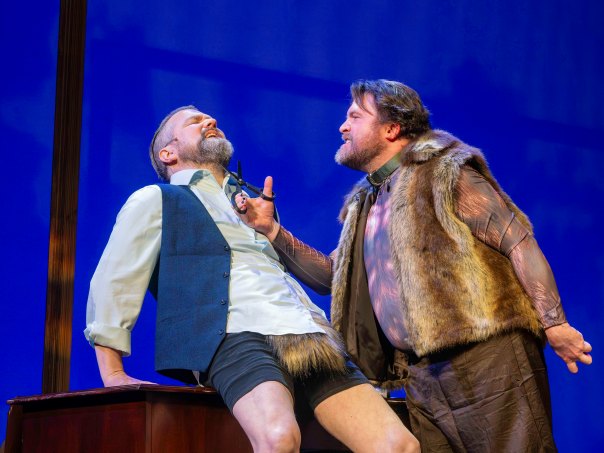
The evolution between Wink and Doc Frans is vastly quieter and quirkier, though there are playful moments. Gillespie and Grogan can play at teaching and learning from each other. Since there’s always a couch to our right, Brown yields briefly, unbidden by the script, to the temptation of redefining their doctor-patient relationship – with Frans reclining on the sofa.
With all the hairpin twists, sudden surprises, and belly laughs, you can reach the end of this whirlwind evening asking yourself, “What did I just see?”: a rare and thrilling experience at the theater. There’s so much wrong with Doc Frans’ preachings of discipline and such excesses in Sofia’s and Gregor’s escalating impulses that we can easily imagine that Silverman wants us to be dizzily ambivalent.
She probably does. It’s the kind of “You just gotta see this” reaction a playwright lives for.
Take a few extra moments, then, to consider Wink as a role model. His hunting routine, repeated more than once, is a blend of discipline and savagery, keen calculation and patience before taking your shot.
Expect that of a dog? Their lack of self-control and stealth is why they hunt in packs. You can train a dog to stop on a dime when it gets a first sniff of its prey, but then it just dopily points its nose in the air towards your quarry. Still imprecisely.
There may be nothing happier than a contented dog; that’s true. Give the enlightened Wink a bottle of wine, and he’s still cool. Cheers!
Photo by Perry Tannenbaum


 Yes, I’d advise doubling and tripling the roles of the staffers. Then Josh Logsdon would have more to do than Mondale’s brooding fatalism, the criminally underused Berry Newkirk could more fully display the full spectrum of his talents, and Paul Gibson as Jordan could flub a more interesting variety of lines. That tack would also present ways of sneaking in more background info about 1979 America and let us outside of the White House West Wing bubble that Hatem creates. With those enrichment opportunities missed, Greg Paroff as Hertzberg, both avuncular and ambivalent, emerged as the most compelling performer in a supporting role while Nathaniel Gillespie was convincingly cringeworthy as Caddell.
 Art on My Sleeve