Tag Archives: Myers Park Presbyterian Church

Monteverdi Validated at Myers Park With Venetian Vespers

Review: Venetian Vespers with Bach Akademie Charlotte

 By Perry Tannenbaum
2023~Venetian Vespers-03

March 4, 2023, Charlotte, NC – You might gasp audibly upon learning that The Oxford Dictionary of Music proclaims that Claudio “Monteverdi’s place in the history of Renaissance music can justly be compared to Shakespeare’s in literature.” That high regard was echoed stateside by Ted Libbey in The NPR Listener’s Encyclopedia of Classical Music: “To paraphrase his contemporary Shakespeare, he bestrode the musical world like a colossus.” Yet many at the Myers Park Presbyterian Church; where Bach Akademie Charlotte presented their latest concert, Venetian Vespers conducted by Scott Allen Jarrett; were probably witnessing a live performance of Monteverdi’s music for the first time. Others had likely never heard Monteverdi anywhere but in church and/or on recordings in their entire lives.

As far as I can tell, the Renaissance colossus has never had a hearing at Belk Theater or Knight Theater in Charlotte. I’m fairly certain that my first live encounter with Monteverdi was at Spoleto Festival USA in 1991, when L’Incoronazione di Poppea was presented at Dock Street Theatre. Before then, my revelations had happened at local libraries in Columbia and Charlotte, where I could borrow and fall in love with vinyl recordings of Monteverdi’s Madrigals (there are nine books of them) followed by my discovery of L’Orfeo, the first masterpiece in opera history.

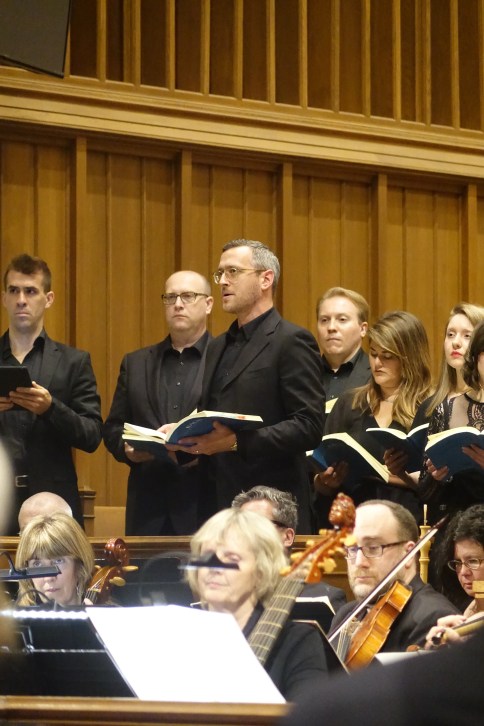
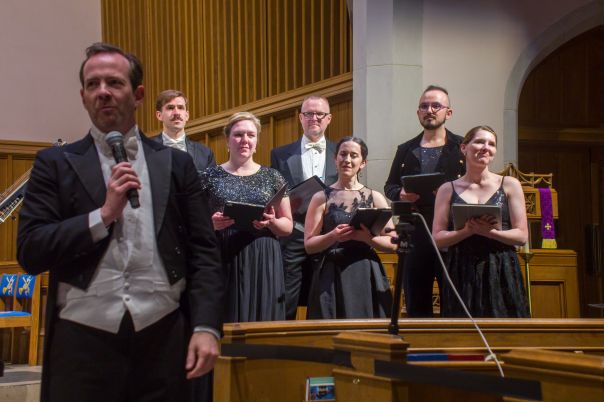
In keeping with the tone of the venues where Bach Akademie usually performs – and the liturgical spirit of their marquee composer – Jarrett, with a small chorus of six voices and an instrumental quintet, focused on two major sacred works that bookended Monteverdi’s career, his Vespro della Beata Vergine (1610) and his Selva morale e spiritual (1641). Sensing a general unfamiliarity with Monteverdi’s music and his importance, Jarrett spoke at length on both, stressing the cultural eminence of Venice at the peak of the Renaissance and Monteverdi’s towering influence over how composers would write for voice after he upended traditional practice by prioritizing text over music.

The texts that Bach Akademie performed were mostly scriptural and liturgical Latin, but Jarrett and his musicians also dipped into the “moral madrigals” found in the Selva collection, with Italian texts written by Francesco Petrarch and Angelo Grillo. In fact, Jarrett’s selections were admirably proportional to the original collections: we had twice as many excerpts from the Selva as we heard from the Vespro, and the Italian songs gave us a balanced representation of the larger collection, which on complete recordings is just over twice the size of the 1610 Vespers.

2023~Venetian Vespers-17

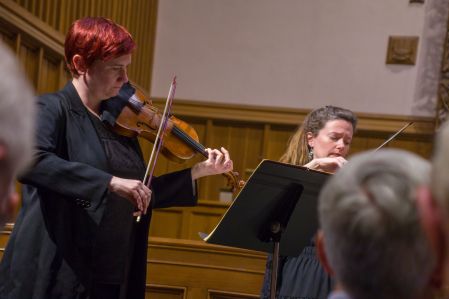
We began and ended the concert with full ensemble pieces from the Selva, starting with “Laudate Dominum” (second version). Sopranos Margaret Carpenter Haigh and Arwen Myers blithely chimed the opening exhortation – “let us praise” – over and over, interspersed with full choral and instrumental passages, along with a couple of merry exchanges between tenors Nick Karageorgiou and i. Four of the six Selva selections were originally for accompaniment by two violins, slots ably filled by two mainstays of Boston’s exemplary Handel and Haydn Society, concertmaster Aisslinn Nosky and Fiona Hughes.
2023~Venetian Vespers-32

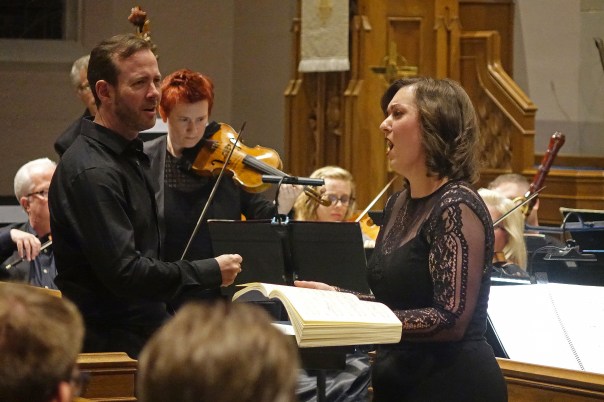
Replacing the four trombones in the score as well as playing their own parts, Nosky and Hughes figured more prominently in the “Gloria” that followed Jarrett’s impressive disquisition. This larger-scaled composition also offered more opportunity for the vocalists to shine, the tenors declaiming the title word most often before the sopranos dominated with their filigree on the recurring “Domine.” Thanks to Jarrett’s intro, we were also on the lookout for the heavenly harmony lavished on the stately “peace on earth” passage, enriched by Edmund Milly’s bass-baritone, cellist Guy Fishman, and organist Nicolas Haigh.

2023~Venetian Vespers-13

Accompanied solely by Deborah Fox on theorbo, Myers and Margaret Haigh gave us a marvelous first sampling of the Vespro, “Pulchra es,” set to two amorous verses from the Song of Solomon, delicately straddling the borderline between chastity and seduction as they sang from opposite sides of the chancel. Both sopranos rejoined the male vocalists as we returned to the Selva with “Laudate pueri” (first version). The men harmonized sweetly to launch this setting of Psalm 113 before the sopranos quickened the tempo and lifted the music to joy and jubilation.

I wondered how Jarrett and Bach Akademie planned to handle “Duo Seraphim,” the next Vespro selection, since it was written for three tenors, according to the program booklet, and the conductor deployed Karageorgiou and Wilson to opposite ends of the stage. Akademie’s artistic director must have also anticipated some suspense in the room, for it wasn’t until halfway through the piece that the third tenor walked to his place upstage, behind organist Nicolas Haigh – Milly, the bass! While Milly’s tessitura didn’t need to reach quite as high as the two other tenors’, he did quite well, actually sounding louder than his comrades on a few notes. Of course, there’s another way of construing the drama of Jarrett’s staging. At the exact point where the text departed momentarily from its familiar Isaiah 6 refrain, and the heavenly witnesses to the seraphs’ “Holy, holy, holy” call were cataloged as “the Father, the Word, and the Holy Spirit,” Milly took his spot upstage before the three were said to be one.

Composed while Monteverdi was still in service to the Duke of Mantua, the “Dixit Dominus” for six voices and instruments seemed to be specially crafted for the acoustics of the Venetian Basilica of San Marco where he would later serve as the chapel maestro. John Eliot Gardner’s recording of the complete Vespro at San Marco with the English Baroque Soloists in 1986 implicitly made that point, and Jarrett, both in his introductory remarks and with the ensemble’s performance, made that point explicitly at Myers Park Presbyterian.

2023~Venetian Vespers-31

Although she didn’t get much of the vocal spotlight, alto Laura Atkinson picked up a microphone to preface the remaining three Selva selections. Both of the poems that followed, written by Monteverdi for the other five voices, proved worthy of the pulpit, as their translated titles indicated: Petrarch’s “O blind ones! What use is all your toiling?” and Grillo’s “This life is a flash of lightning.” Reminding us that this was Bach Akademie and that the Charlotte Bach Festival is slated for its return on June 10-17 (if interim managing director Garrett Murphy’s fundraising goal is met), Jarrett and company gave us a small-scale preview of the plenty to come with Johann’s “Sanctus in D.” Not the swiftest version you’ll ever hear, but light, lively, and irresistible.

“Beatus vir” (first version), set to Psalm 112, was an apt finale to this Venetian Vespers concert, carrying forward the festive mood of the penultimate Bach with invigorating vocal counterpoint – Monteverdi writing here for six exactly voices at last – and providing Nosky and Hughes, as the two violinists also prescribed by the score, with their best opportunities to shine. But it wasn’t until the music slowed down, where the Psalmist spoke on the steadfastness of a god-fearing man in the face of evil tidings, that the finale became truly grand. The sheer massiveness of the sound summoned up the church to mix its harmonies, reminding us that we were in a house of worship.

A Well-Proportioned “Passion” Caps the Charlotte Bach Fest

Review: St. Matthew Passion at the Charlotte Bach Festival

2019~Charlotte Bach Fest-201

By Perry Tannenbaum

The most dramatic moment at the second annual Charlotte Bach Festival may have been a moment of silence – at the climax of the St. Matthew Passion, after Bach’s Evangelist had declared that Jesus had died. Festival conductor and artistic director Scott Allen Jarrett maintained that silence longer than any I could remember on a recording or at a live performance, including Jarrett’s own with the Charlotte Symphony in November 2013.

After this loaded interlude at Myers Park Presbyterian Church, like the world itself coming to a halt, the BA|Charlotte Cantata Choir was exquisitely empathetic and hushed singing, “Wenn ich einmal soll scheiden, So scheide nicht von me” (When I depart one day, do not depart from me). The chilling desolation of this reaction was all the more poignant because of the power that the 25 singers in the Cantata Choir had poured forth just minutes earlier in mocking and taunting the crucified Jesus as he was dying on the cross.

2019~Charlotte Bach Fest-221

There had also been power aplenty from the soloists, as we were quickly reminded after the prayerful choral lament, when tenor Stephen Soph as the Evangelist continued Matthew’s narrative – with the rending of the Holy Temple, the earthquake, the opening of graves, and the rising of the dead upon Jesus’ death. No less powerful as Jesus, baritone Jason Steigerwalt’s most memorable singing had come in his Part I recitatives, at the Last Supper and during the subsequent episodes leading up to his arrest on the first day of Passover. Of course, his last words, “Eli, Eli, lama asabthani?” had a special plaintiveness.

With Jarrett’s past and present connections to the Oregon Bach Festival, the Handel and Haydn Society, Seraphic Fire, and Charlotte Symphony, the high quality of the Cantata Choir – and the instrumental and vocal soloists he can lure to Charlotte – is not at all surprising, even if their power and dynamic range can sometimes come as a shock. All 22 of the core members were accorded extended bios in the rear of the festival program booklet. Additional space was carved out for the four Vocal Fellows who fortified the Choir during the Passion and figured prominently in the midweek, midday Bach Experience performances of two Michaelmas cantatas, Nos. 19 and 149.

2019~Charlotte Bach Fest-194

Since both the core singers and fellows were chosen by Jarrett from nationwide talent pools, it wasn’t surprising that soloists singing the Passion arias were on the same level as those who had sung for Jarrett in 2013. What astonished me more was what soloists from a reduced core Choir had achieved the previous Saturday night when they performed Bach’s Magnificat at the festival’s Opening Celebration. Overall, performances at the more intimate Christ Church by sopranos Sarah Yanovitch and MaryRuth Lown, mezzos Elizabeth Eschen and Kim Leeds, tenors Patrick Muehleise and Gene Stenger, and baritone Steigerwalt had equaled or surpassed those I’ve heard on recordings conducted by Helmuth Rilling, John Eliot Gardiner, and Masaaki Suzuki.

There were additional soloists awaiting their turns at the Celebration when another Michaelmas cantata, No. 130, followed the Orchestral Suite No. 2. These included the sweet-voiced tenor David Kurtenbach, who would sing the recitative and aria at the Matthew Passion during the High Priests’ interrogation of Jesus, and – more impressive yet – bass-baritone Charles Wesley Evans, who would take the stage at the Passion in the wake of Judas’ remorse and suicide, transforming after the touching “Gebt mir meinem Jesum weider!” (Give me my Jesus back!) into the role of Pontius Pilate.

2019~Charlotte Bach Fest-208

Other superb choristers stepped forth at Myers Park Presbyterian who had not soloed during the Opening Celebration. Most conspicuous was countertenor Jay Carter, whose recitatives and arias suffused the most intense episodes of Part II with sublimity and pathos, during the scourging of Jesus and at Golgatha, the site of the crucifixion. Edmund Milly, who hadn’t sung at the Celebration, didn’t get his first solos until Simon of Cyrene carried the holy cross, lavishing his rich bass-baritone on “Komm, sübes Kreuz” (Come, sweet Cross), with a viola da gamba obbligato from Gail Schroeder. We had no sampling of soprano Margaret Carpenter Haigh’s silvery lyricism until Jesus was brought before Pilate and she sang her recitative and the “Aus Liebe will mein Heiland sterben” (Out of love my Savior wants to die) aria, with traverso flutist Colin St. Martin playing the intro and obbligato. St. Martin’s work at the Celebration in the Orchestral Suite No. 2 had been even more substantial and impressive.

2019~Charlotte Bach Fest-110

Five other members of the North Carolina Baroque Orchestra played obbligatos with Cantata vocalists, none more ballyhooed than concertmaster Aisslinn Nosky, who made gorgeous music together with Leeds in the mezzo’s “Erbarme dich” (Have mercy) aria. Following in the footsteps of cellist Guy Fishman, Nosky had been the second Handel and Haydn Society principal in successive years to perform at Charlotte Bach’s Visiting Artist Recital Series. In partnership with the American Guild of Organists, the festival presented Isabelle Demers as their other recitalist. The big improvement here was a change from the Uptown location at St. Peter’s Episcopal, where Bálint Karosi had performed, to Myers Park United Methodist. Not only did the chocolatey organ sound marvelous, it was at the front of the sanctuary, where we could actually see Demers play without having to turn around awkwardly in our seats.

Keeping with the precedent set by last year’s recitalists, both Demers and Nosky expanded the scope of the festival beyond all-Bach. Demers branched out into organ works by Alkan and Widor, and Nosky brought us a Fantaisie for Solo Violin by Telemann as well as two sections from Stand Still, a piece written for her by Michael Oesterle. Funkier by far, Charlotte Symphony trombonist Tom Burge inaugurated a new Bach at the Brauhaus event in the back room of Free Range Brewing on a wee stage that seemed, with its string of carnival bulbs and crimson curtains, best suited for magic acts or stand-up comics. Between sips of the pub’s brew – and banter from the audience – Burge played a Bach transcription, selections from Bone Kill by Michael Davis, and after slyly fishing out a euphonium from behind the curtain, Paganini’s most famous Caprice.

2019~Charlotte Bach Fest-151

Nosky’s appearance was another kind of departure from last year, extended so that she could linger and gently whip the NC Baroque’s strings into sharper shape for the Passion – and to help in spreading the festival to Chapel Hill, where the masterwork was given at University United Methodist before its closing night performance in Charlotte. The were fewer hired guns brought in from afar to fortify NC Baroque than came to sing with the Cantata Choir, and the Passion ensemble was a lean-and-mean 32, including Nosky and organist Nicolas Haigh.

The anemic organ Haigh contended with was the only fault I found with the Baroque Orchestra, not their SlimFast number. Playing on period instruments, the company places a greater premium on authenticity – and precision – than on raw power, which is fine with me. When added muscle was needed, Steven Marquardt and Josh Cohen shared leadership of a corps of valveless baroque trumpets that bloomed gloriously in the Magnificat to launch the festival and in three Michaelmas cantatas afterwards. And just before the halfway mark at the Passion, a 10-voice children’s choir from Charlotte Latin School briefly appeared.

Never too big, and never too small. When the Cantata Choir and the Orchestra reached the final “Wir setzen uns mit Tränen neider” (We sit down with tears) of the Passion, there was soothing lullaby aspect to the music that overshadowed the usual community lamentation we hear from larger groups. Tuning in to the “rest gently” motif later in this chorus, Jarrett likely had that restful aim in mind when he hushed his forces once again. That was also fine with me. Very fine.