Tag Archives: Michael Harris

Risen from the Dead, CAST’s Alabaster Is All About Artists in Crisis

Review: Alabaster at The Mint Museum

By Perry Tannenbaum
Google and Alexa will tell you if you ask: it’s a little bit more than a 17-mile drive from Bessemer to Alabaster, Alabama. Every source I’ve checked also confirms that Gip’s Place, the last backyard juke joint in America, was in Bessemer until its blues guitarist founder, Henry “Gip” Gipson, passed away in October 2019 at the age of 99. It’s useful to know that when we meet Weezy, the first character to speak at the Mint Museum – in the first Carolina Actors Studio Theatre production anywhere since its 2014 NoDa demise.

Weezy tells us that she lives at a small farm “right near” Gip’s Place in Alabaster.

True, we have ample reason to question Weezy’s veracity from the get-go, since she also introduces herself as a goat. Titling her comical drama Alabaster,playwright Audrey Cefaly could coyly blame her geographical inaccuracy on this cantankerous barnyard beast she created. But the choice, invoking the special malleability of a stone that has been reshaped by sculptors and artisans for millennia, is clearly an artist’s choice.

As we continue to follow the scrappy encounter between two artists in backwoods Alabama, one a celebrated photographer of celebrities and the other an unknown painter, we often find that Weezy – among other things – is Cefaly’s surrogate. In one meta moment you can look out for, Weezy even delivers a message from the playwright to one of our protagonists.

Mostly, Weezy serves as an irascible Jiminy Cricket for June, the one human survivor on the farm. When she isn’t offering up prompts and explanations channeled from Cefaly, she becomes June’s better self, the self that is wishing to break free of her self-imposed isolation and artistic obscurity. When sweet optimism sours into clear-eyed skepticism and cynicism, Weezy becomes the painter’s inner voice: June’s worst critic.

And sometimes, she’s a goat, caring for her ailing mama. Weezy is fluent in English and goat. Occasionally, she’s also clairvoyant.

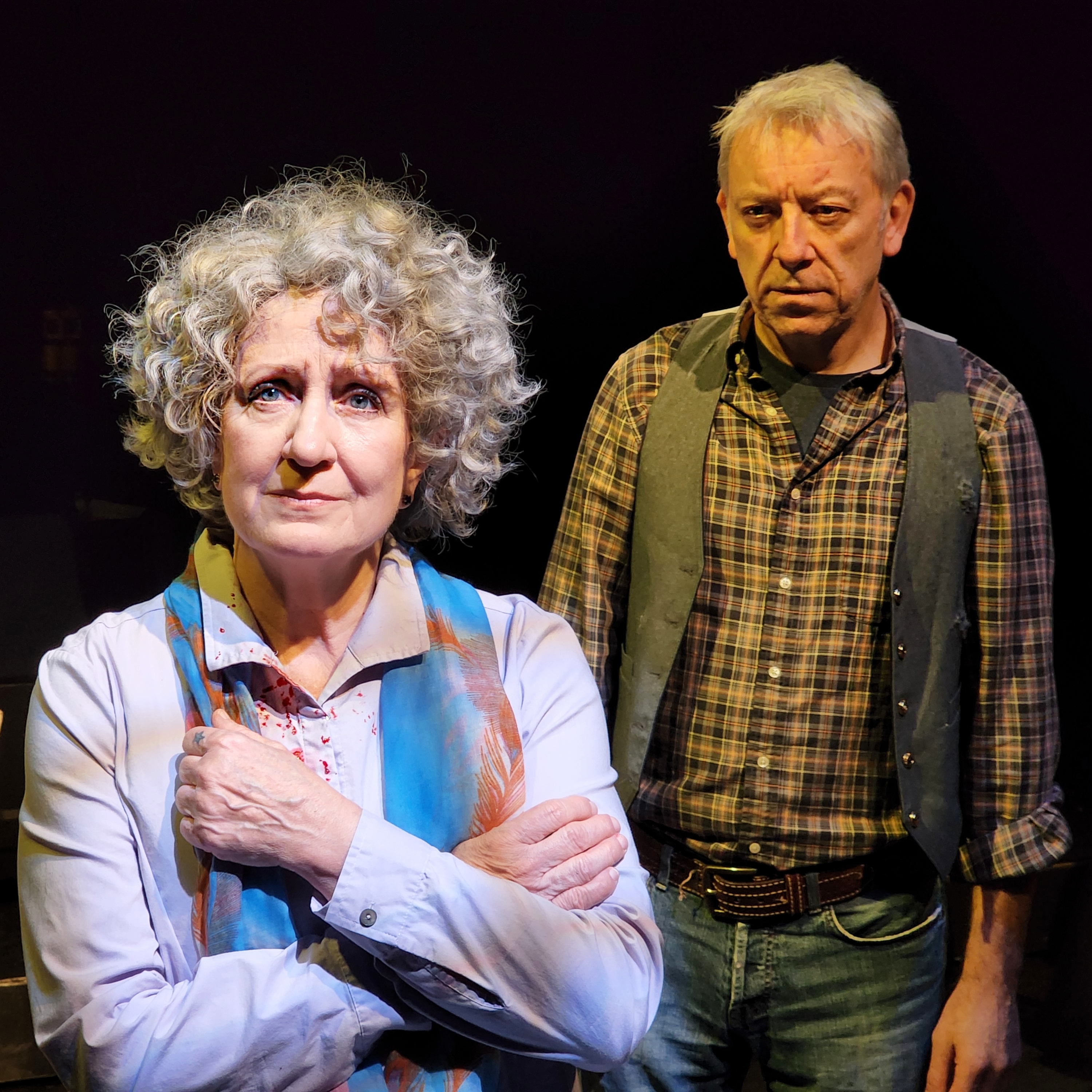
Both Bessemer and Alabaster are prone to tornadoes. Cefaly’s tornado has radically reshaped June, demolishing her farm and turning the entire left side of her body into a relief map of scars, patches, pocks, and swirling melty skin. Playing the role of June, Zoe Matney has a l-o-o-o-o-ng pre-show routine, for she must spend much more time than usual backstage getting director/makeup designer Michael Simmons’ concept applied – front and back, from torso upwards – with help from assistant director/makeup artist Dee Abdullah.

Then she is onstage as the audience arrives, long before lights dim and Weezy enters.

If Weezy weren’t there, we must also remember, we wouldn’t have a reason to hear from June, though her first response to the goat’s prodding is no more than a well-chosen finger. Fortunately, we are quickly liberated from the confines of an inner dialogue by June’s distingué visitor, Alice.

Acquainted, you can bet, with Annie Leibovitz and no further than a light meter’s distance from Demi Moore, Alice’s career has recent taken a hairpin turn to the scarred-women project she’s working on now. June is her seventh subject, and Alice works in multiple media. Trying to reach the traumatized inside of her subjects – all women – while finding the dignity and beauty mixed with the deformity outside, Alice documents them in video interviews and, when the time and light are right, by snapping coffee-table-quality portrait photos.

Are these scars a form of artwork?
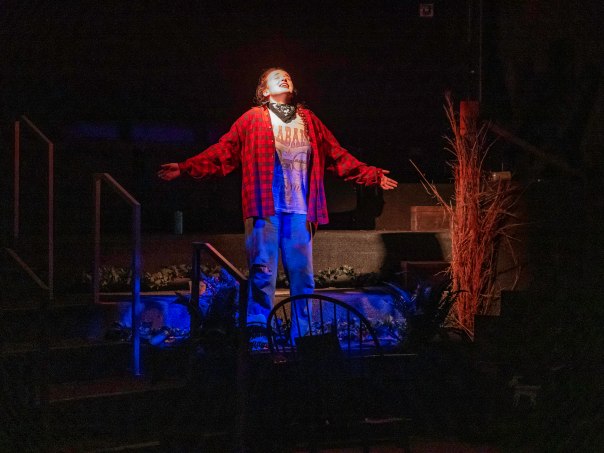
A fresh aspect of artist’s choice comes into play with Cynthia Farbman Harris as Alice. Alabaster premiered in December 2019, just two months after Gip’s passing, in Fort Myers, Florida – the first stop in a “Rolling World Premiere” presented at 11 member companies of the National New Play Network, a rollout spanning from New Jersey to Oregon. The QC had a company in that Network, Actor’s Theatre of Charlotte, which had rolled with some of these co-op premieres before.

When asked about the switch away from glamor assignments, Alice deflects at first. She only gives herself away slightly when asking June about her “accident” – a word more apt for her own trauma – and when, egged on by June’s questioning, she scrolls back far enough among places she’s been before Alabaster to her rehab.

So it shouldn’t be too surprising to learn that Actor’s Theatre was scheduled to premiere Alabaster in the latter half of its 2022-23 season, just over two years ago. More of you will remember that Actor’s Theatre did not make it to the end of 2022, planting its gravestone among the most honored companies in Charlotte’s theatre cemetery before the halfway point of its 34th year.

For Harris, who auditioned for that abortive ATC production, it was a matter of not forgetting. She had worked with Simmons at CAST, with a variety of other stints at Moving Poets, Queen City Theatre, and Theatre Charlotte – including a pair of diva roles, Maria Callas in Master Class and Blanche DuBois in A Streetcar Named Desire. If the role of Alice stuck with her after ATC’s demise, there must have been plenty of meat on the bone.

With an eye toward reviving the edgy theatre vibe that reigned while ATC, CAST, and QC Theatre were all up and running, Cynthia and her husband, actor Michael Harris, have founded Actors Collaborative Theatre to help make it happen. The new ACT is an associate producer of Simmons’ rebirth, while Moving Poets and Charlotte Contemporary Theatre are among the companies listed in the digital playbill on CAST’s thank-you list.

If you know how long ago Harris starred as Blanche, then you know Alice is bit of a stretch, no matter how much she wanted it. We’re not just talking about the yoga scene. With Abdullah serving as intimacy director, June’s master bedroom becomes more than an artist’s studio. Scars and all, June brashly inquires whether Alice is gay, before we learn the photographer’s full backstory.

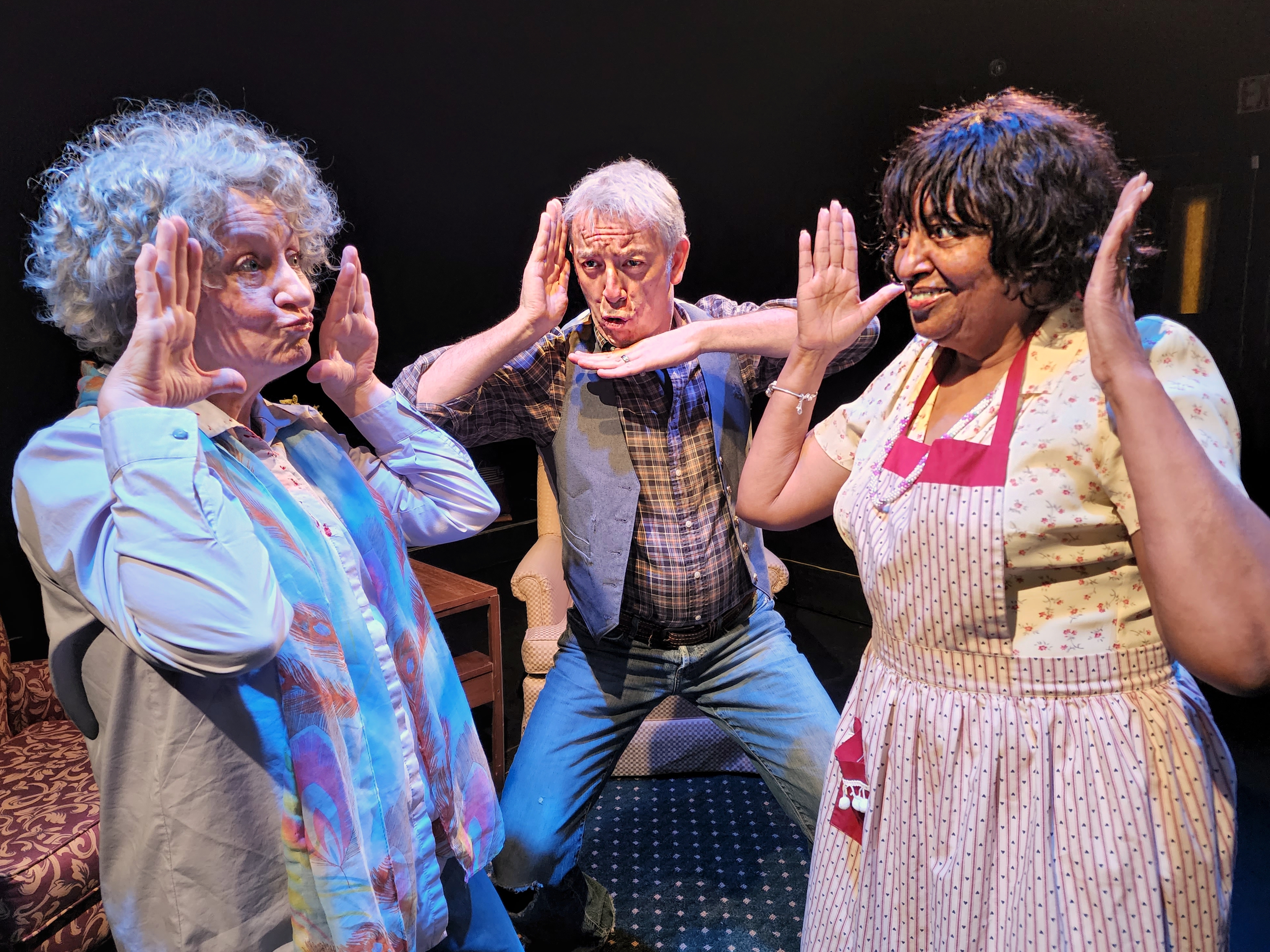
Somehow, Matney and Harris make their love-hate relationship work altogether naturally and spontaneously. It only becomes a little more cerebral than Cefaly imagined it. They lean into the age difference a little instead of pretending it doesn’t exist. But they do traverse the long, rugged terrain to the primal mode. The two artists debate whether their meeting is like The Bridges of Madison County or not. Yet they could also debate whether they are both hostile animals locked in cages of their own making – while the liberating keys are always in their hands.

Actually, they do talk about that.

Matney’s performance is every bit as stunning as Harris’s, if for no other reason than June is so moody and mercurial. Ambivalent about having her paintings exposed to outside world, June is living with desperate intensity in her present isolation, hoping for a sunnier future – she has invited Alice here, though she is wary – while repeatedly tortured by her past trauma.

Something as trivial as the beep of Alice’s camera can trigger flashbacks to the worst. Adding to the inner psychological circuitry are the stresses of fresh lightning and thunder – plus the partial nudity at the start of the photo session. Matney calibrates her various disturbances well when her hurting is raw, and she channels energy convincingly into compensatory actions when June is striving to appear calm and well-adjusted. She also leaves room for just the right amounts of flirtation and coquetry.
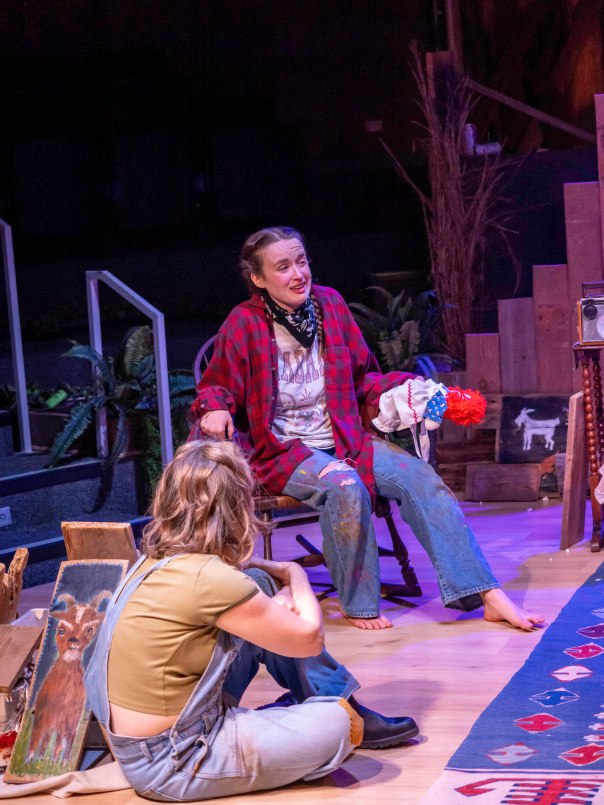
Kelly Mizell, who plays Weezy, can tell you how long ago Harris sashayed into Nawlins as Blanche, for she was an outstanding Stella Kowalski in that same Theatre Charlotte Streetcar way back when. Given the opening entrance, this talking goat decisively demonstrates that she can still command a stage before discreetly receding into the background, sometimes as a handy guide, sometimes as an annoyance, and sometimes as a mind-reader.

Mizell gets to show Weezy’s tender side caring for Bib, her mostly pallet-of-hay-ridden “Mmaaahaaaahaaaa… maaaaaah!” You can see Harris wanting to play Alice enough to partly bankroll and publicize a production, but with so much stage time and so little spotlight (or vocabulary) as this old goat, Debbie Swanson had to really want this Mama Bib role. She’s wonderful when her moment comes.

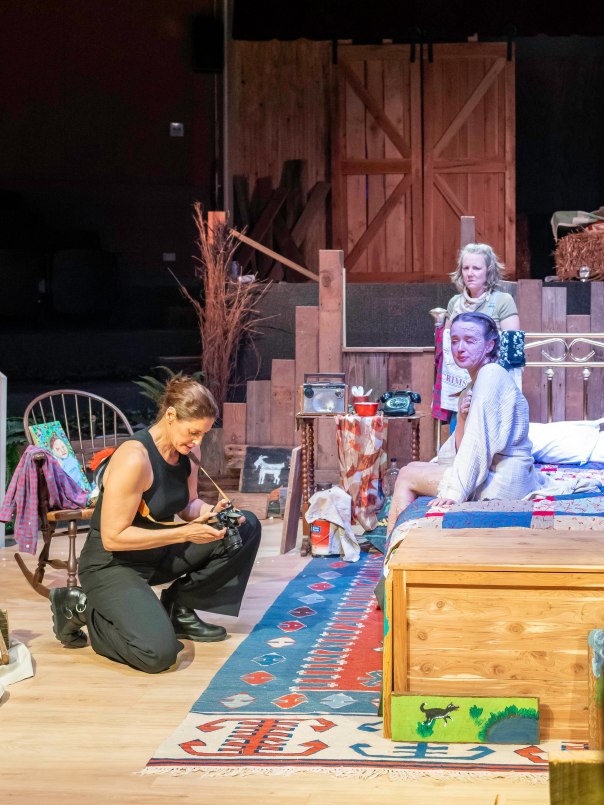
Otherwise, there are remarkably few signs that Simmons and the Harrises are doing all this on a shoestring. Lighting design by Dave Meeder easily ranks with the best we’ve seen at the Original Mint’s Van Every Auditorium on Randolph Road. Tim Baxter-Ferguson, another name we fondly associate with a bygone era, installs a marvelously rusticated twin-level set design that simultaneously gives off vibes of woodsiness, springtime color, and irreversible damage.

Sophie Carlick’s costumes don’t have to be lavish, but they enable June, Weezy, and Alice to radiate an outdoorsy aura. Cleverly enough, June’s bedroom outfit hides her preoccupation with painting as decisively as her splotched overalls proclaim it, but the goat costumes also strike a perfect note. So do the many artworks fashioned for June’s artistic oeuvre on barnwood, to be auctioned off when Alabaster completes its run.

Simmons’ sound design and special effects are on-point, but I wish they had impacted more: louder, with more lightning crackle and windy sweep. Nor was the ringtone on Alice’s cell as ugly as Cefaly intended. As a photographer, I had to chuckle at the sadly unprofessional equipment we were seeing, including a camera with an onboard flash. Yet I could empathize with Harris – and admire her all the more – when she had to keep that lame videocam running and the still camera showing snaps on its screen.

When Alice instructs June on how to use a smart phone, when she shows her how to trip the shutter, and how to review the photo portraits on the wee screen… Quiet moments like these resonate with us, because they are part of a bonding process, two healing processes intertwining. Two resurrections. Three if you count the rehab June and Alice join in on with those barnwood scraps.

Good reasons to smile as we left the Mint. Along with the resurrections of CAST and a vital drama Actor’s Theatre never got to present.

Kirkwood’s “The Children” Asks Hard Questions of Good, Smart, Caring People

Review: Three Bone Theatre Presents The Children

 By Perry Tannenbaum

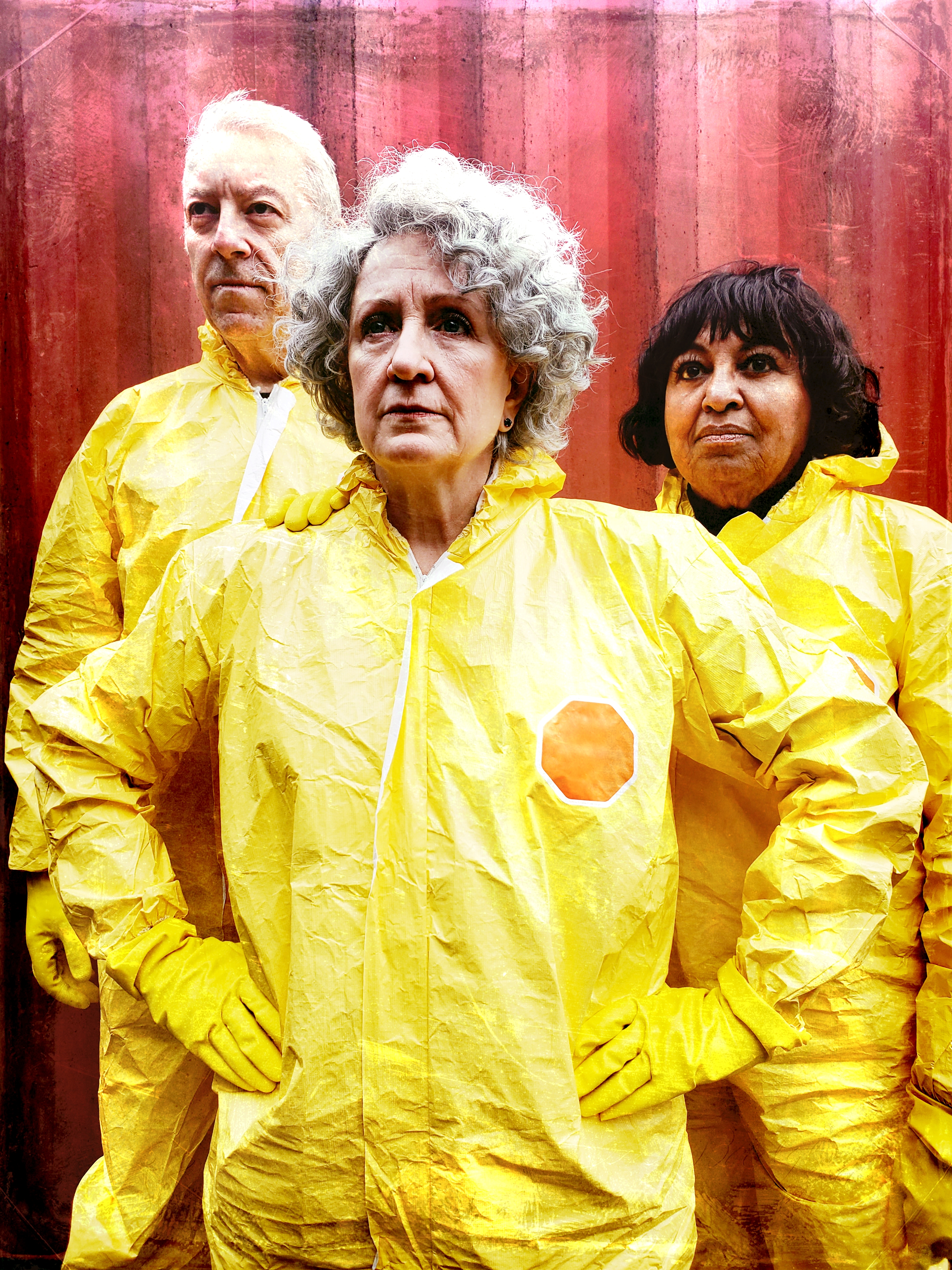
The Children1

March 13, 2022, Charlotte, NC – Two retired nuclear physicists, a husband and wife both in their sixties, have taken up residence in a cozy coastal UK cottage, where they are visited without receiving prior notice by a former co-worker they haven’t seen in some 38 years, also in her sixties. These are the only characters we see in Lucy Kirkwood’s acclaimed drama, now playing at The Arts Factory in a taut Three Bone Theatre production – and I can’t say that any of the three physicists ever mentions his or her parents. Nor are there any flashback scenes in this 90-minute one-act that take us back four decades or more to when these over-the-hill atomic whizzes were young and previously together. So why exactly has Kirkwood called her dystopian drama The Children?The Cast of The Children

It’s the sort of question that rewards repeated asking as the plot proceeds and we learn more and more about the past that Hazel, Robin, and Rose have shared – and the daunting future ahead of them. There are a couple of substantial answers that gradually emerge, the subtler of these turning out to be personal and intimate. For the lives and careers of all three retirees have been shaped by past decisions to have or not to have children. More obvious, and more to the point, are the decisions that must soon be made in the wake of a disaster at the nuclear plant where all three of these physicists used to work, decisions that will impact not only their children, but also, locally and globally, the children – depending on how guilty, responsible, or obligated they feel.

We’re obviously dealing with a catastrophe on a scale equal to those at Chernobyl in 1986 and, even more pertinently with the earthquakes and tsunamis enfolded into Kirkwood’s concept, Fukushima in 2011, five years before the commissioned piece premiered in London. The cottage where Hazel and Robin are living is perilously close to the fenced-off area surrounding Ground Zero, which remains destabilized. Amid the brevity of Rose’s visit, Kirkwood manages to spread a veil of nebulosity over the extent and permanence of the damage inflicted by the catastrophe. There’s an ongoing rationing of food and electricity, but the couple’s isolation and their aversion to the Internet puts a lid on the info we get. Hazel and Robin are retired, yes. But in light of their isolation, ignorance, and apathy, we might also say – as Rose probably would – that they are resigned, not really thinking about how they might best use their remaining time.

Certainly, the cottage dwellers aren’t stressing over their culpability for the devastation that surrounds them when Rose intrudes. They would seem to be following Candide’s example at the end of Voltaire’s wicked, wicked novel, tending to their own gardens – or in Robin’s case, their fields, where he makes his daily escape before coming home to dine on Hazel’s homegrown salads. After 38 years, Hazel and Rose still have each other sized up rather well, Hazel knowing more about Rose’s attachment to her husband – and vice versa – than he would believe, and Rose knowing something about Robin’s wife that he never even suspected. As Kirkwood interweaves these personal revelations with the possible global crisis engulfing them, we began to understand how a group of nuclear physicists could have been blind for so long to the fiery red flags signaling so clearly to them that nuclear catastrophe was at hand. In their personal and professional lives, they have seriously miscalculated.The Children- Robin and Hazel

Directed by Three Bone co-founder Robin Tynes-Miller, with set design by Ryan Maloney and props by Jackie Hohenstein, this Charlotte premiere huddles the audience around the action in an intimate stadium layout like a miniaturized Circle in the Square on Broadway. The humble coziness of the setting, not at all contradicted by Davita Galloway’s costume designs, make this cottage look more rusticated than most production photos that come up on a Google search. Likewise, Lillie Ann Oden and Michael Harris have a more weathered look than the London and Broadway marrieds, as if they had aimed their portraiture toward farmers in their sixties or physicists in their seventies.

This rustic approach actually has some advantages, for Mitzi Corrigan as their visitor seems slightly younger, more active, more enlightened, and more modern than her hosts at first blush. She claims to have forewarned Hazel and Robin via email before appearing at their doorstep, and the laptop she is toting backs her up, looking out of place here in this back-to-basics abode. When it becomes apparent that Rose has been around the neighborhood for some time on her personal crusade, we cannot be surprised that this couple – steeped in stasis – has been unaware.The Children- Hazel and Rose

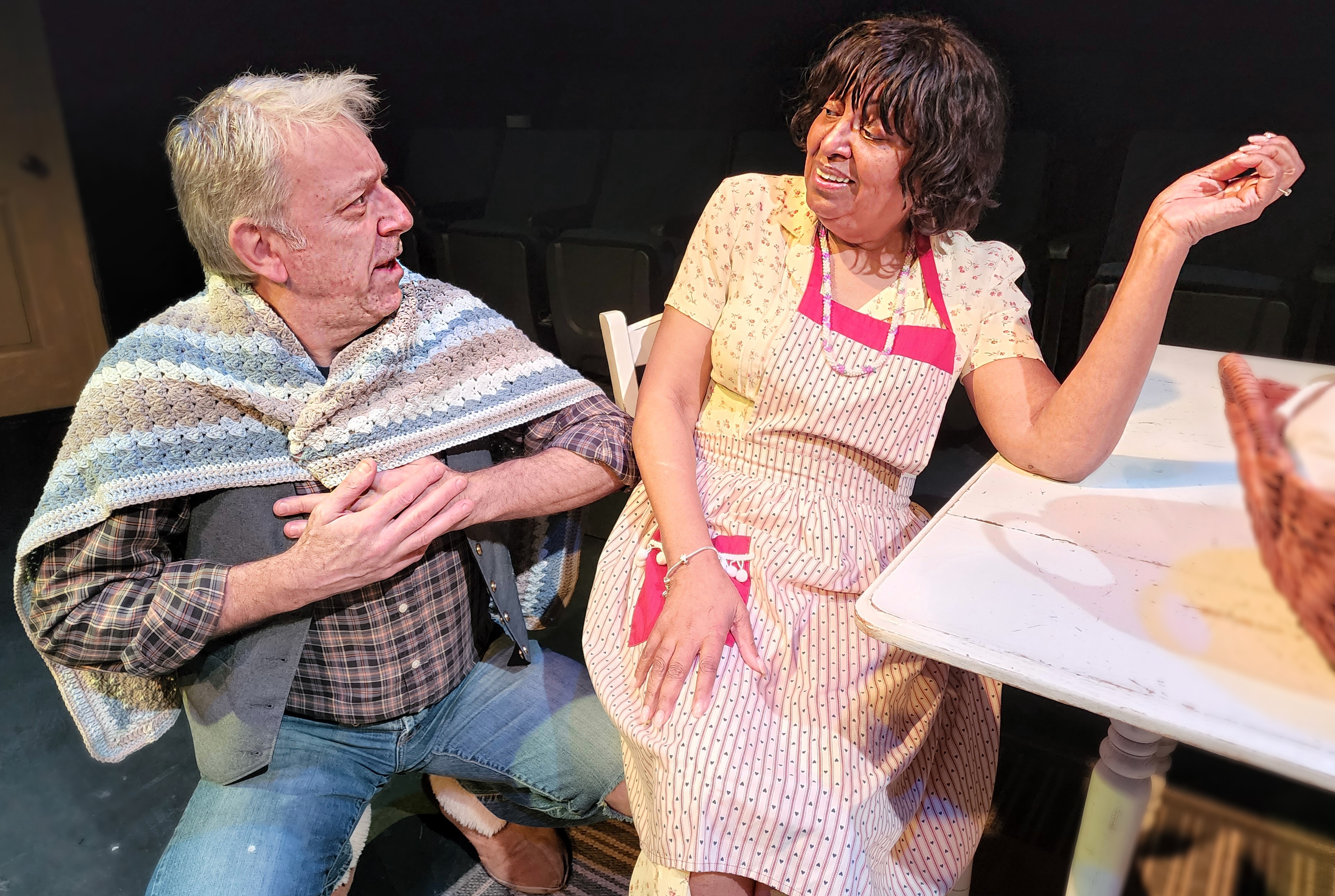
Another key thing that Tynes-Miller gets right, despite the longstanding hurts and grudges that will emerge among these former co-workers, is that all of them are good people, bonded together by the preventable tragedy that has broken them all. Oden has an edge to her as Hazel, dealing with the most guilts, savvy enough to be wary of Rose, yet the defensive chip on her shoulder is more like a light skillet held behind her back than a double-barrel shotgun dangling under her arm. She is polite, she is friendly, even loving, but you’ve got to coax it out of her now. As the former Don Juan of the nuclear plant, Harris mixes a shrunken amount of confident swagger into Robin and an occasional urge to dance into his prevailing disillusion, disappointment, and bitterness – with more to swallow heading his way. Beneath the crusty brooding, he’s tenderer, more considerate than his spouse, still sharp enough to be shocked and to make a quick decision.

Rose has had the most hurt to deal with over the years, yet Corrigan poured a sheen of insouciance and quiet purpose over her – until the old hurts and grudges spurted to the surface. She needed to be impressive in tamping down these emotions, with clear-eyed pragmatism and poise to succeed in her ultimate mission of persuasion. Or was it seduction that motivated her, as Hazel had good reason to suspect?The Children- Rose and Robin 1

Sadly, we cut all these people a hefty amount of slack because there is so much more than the overly hasty development of nuclear energy befouling our planet. Other industries are complicit in building a multitude of time bombs we constantly hear ticking around us, and many governments have dirty hands. Chernobyl and Fukushima have receded into the past, our gazes drawn to other filthy objects and humans. These ordinary people, for all the wrong they have done to each other, all the mess they have left for their children to clean up, are questioning whether they should continue sitting back, enjoying their retirement years, and doing absolutely nothing about it.

Maybe they’re the ones who should pitch in and help, despite the fact that no one person living in a toxic irradiated wasteland can even begin to turn the global tide. No, these fine actors are telling us as we look over their shoulders: many, many more ordinary people need to be doing the asking – and the acting.

Enjoying Is Easier Than Understanding “The Pride”

IMG_4165[1]

Review:  The Pride

By Perry Tannenbaum

Back in the late 1950s, Philip has decided that his deep feelings for Oliver are a repugnant disease rather than a natural attraction. But in Alexi Kaye Campbell’s The Pride, there is another Philip, 50 years later in 2008, who is also crazy about Oliver. Since there are no longer any prohibitions or taboos against homosexuality, Philip now wishes to have a strong and exclusive relationship with Oliver, who still loves him.

Yet as we quickly see in the Queen City Theatre Company production, now at Spirit Square through Saturday, there is still a catch. Exclusivity is under siege. When we first encounter the modern-day Oliver, Philip will walk in on him moments after a casual hookup has gone sour with a sex worker who has dressed up in a Nazi uniform for their sadistic tryst. Finding his wayward partner in this compromising state hardens Philip’s resolve to move out of the apartment they’re sharing, so he leaves.

More radical measures are necessary in 1958. Philip goes to a Doctor who will crush the so-called perversion that lurks inside. Obviously, there is something sinister about this Doctor, augmented by Emily Eudy’s lighting design. We might find a more pointed message embedded in Campbell’s curious 1958-2008 juxtapositions: he means us to see that the sexual adjustment Doctor is a kind of Nazi – because he and the sex worker both reinforce Philip’s feeling that his relationship with Oliver is wrong, and because they are both played by the same actor.

And there you have The Pride in a nutshell, a colorfully told pair of stories, liberally sprinkled with humor, which yields up its messages obliquely through its strange juxtapositions. Because the same actors do both Philips and both Olivers, we likely assume they’re the same souls in two different eras. If they stand before us more than speculatively, reincarnated in our current millennium, then those 1958 blokes need to hurry up and die in order to reach their late 20s or early 30s just 50 years later.

Trouble is, for anybody who wishes to “get” The Pride, Campbell is as content to leave the question of what we’re seeing as open as the question of what our takeaway should be. Enjoying the show comes more easily, for director Glenn T. Griffin has brilliantly cast his men. Steven Buchanan brings an urbane twinkle to the free-spirited Olivers, yet there is a predatory edge to his persistent pursuit. We see something more intense than resistance from Cory Collins as the two Philips in reaction to the Olivers, closer to absolute loathing – some of it directed toward himself.

So this tightly-wound, comparatively starchy guy will snap unexpectedly, and Collins, Buchanan, and Griffin conspire to stage that moment superbly. What often cools the momentum established by Buchanan and Collins are the scenes with the two Sylvias. In 1958, she’s Philip’s wife, instrumental in bringing her husband close to Oliver, a children’s book author that she’s illustrating for; and in 2008, she’s an actress and Oliver’s close confidante.

Wearing two different Barbi Van Schaick wigs that help us to quickly differentiate between the two eras, Katie Addison is credible enough as the two Sylvias – but she’s only fitfully intelligible. Sifting through Addison’s British accent is so difficult that I could fully lose my grasp on what was happening when she was onstage.

No such problems when Michael Harris came along for his two bizarre roles. When Harris’s arms and wrists go limp as he switches from Nazi role-playing to the sex worker’s everyday personality, it’s an absolute hoot, amplified by Beth Killion’s radically contrasting costume designs. On the other hand, Harris was slightly terrifying as The Doctor, hardly better than Nazis in his steely contempt for gays.

This is how it was in most of the ostensibly civilized world 50+ years ago, and this is what we could be going back to in the era of HB2.

Writing Tips and Serial Seductions

Theater Review: Seminar @ Spirit Square

20160809166652467

By Perry Tannenbaum

We all know that politics, connections, and strategic socializing often figure into securing Hollywood production budgets and achieving Hollywood stardom. We’re apt to think of the proverbial casting couch as Tinseltown’s exclusive domain. But can the same tools also work in the literary world, where writers aspire to lucrative publication and enduring prestige?


You better believe it, playwright Theresa Rebeck tells us in Seminar, a surprisingly steamy — and sometimes dark — comedy that brings Three Bone Theatre to Spirit Square for the first time. The veneers of artistry, aesthetics, and collegiality rapidly disintegrate in successive encounters with a famed writer and his very exclusive fiction-writing class. Izzy, Douglas, Martin, and Kate all scrape together $5,000 apiece for the privilege of being praised, critiqued, berated, and mentored by Leonard in weekly sessions at Kate’s posh Upper West Side apartment.

Kate has been honing her story about a narrator obsessed with Jane Austen for so long that cleverness and craft are all that remain. Izzy’s writing, on the other hand, is so laced with sensuousness and sexuality that it rouses mighty urges in every man in the room — and she knows exactly what she’s doing. Douglas arrives with a fine literary pedigree, key connections, and a manuscript that is already under consideration by The New Yorker.

Martin has had the toughest time scraping up the necessary cash for tuition, so tough that he has been evicted from his apartment. He wouldn’t need to pay any rent if he could crash in one of Kate’s many extra bedrooms, but he’s oblivious to the possibility that Good Samaritan impulses might not be the primary reason why Kate says yes. There are more than a couple of things that Martin is oblivious to, and he’s very guarded about showing his writing to anyone, so he’s a useful person for Rebeck to have around for expositional purposes. So much must be explained to him until he becomes central to the story.

Meanwhile, it’s Izzy and her serial seductions that stir the pot and drive the plot. There’s actually an admirable amount of balance in Rebeck’s script, but in the Broadway production directed by Sam Gold, the important character seemed to be movie star Alan Rickman as Leonard, while the students often seemed to be mundane minnows swimming in his orbit.

Leonard is a revered writer who is still globetrotting on reporting assignments despite his literary decline, so Rickman’s aging celebrity was not amiss. And Rebeck delves so deeply into the mysteries of teaching and mentoring writers that our fluctuating assessment of Leonard’s efficacy emerges as more important than any other subject Seminar tackles. But Rickman’s aura, for better or worse, made Leonard appear above the politics, the exploitation, and the literary logrolling.

With Michael Harris in the role (and probably in the best form of his life), the fault lines in Leonard’s character — and his redeeming humanity — are more readily evident. Three Bone director Steven Levine doesn’t have the luxury of imposing a huge gulf between Leonard and his students from a celebrity standpoint, so we also discover who Leonard’s costar is a bit earlier in the game. Rickman’s fame — and stage presence — really didn’t allow for an equal in the Broadway production.

A subtler aspect of Rickman’s magisterial stature on Broadway was the stylish domain where Leonard held court. Ryan Maloney’s set design for Kate’s living room, flowing silk sheets for walls and simple furnishings, has an unmistakable elegance, not a word I’d apply to any of Three Bone’s previous efforts in NoDa over the past four years. But it’s Maloney’s evocation of a ratty artist’s apartment later in the action, complete with its telltale writer’s clutter, that had me flashing back to the Broadway production.

Outside of ivied university walls and politically correct quads, taboos against student-teacher hookups obviously don’t apply, but with Three Bone’s comparatively leveled playing field, it’s easier to see that Izzy is playing the guys to her advantage — and actually less apparent that Leonard is playing her. Karina Caparino augments the difference by emphasizing Izzy’s wantonness and her frolicsome spirit. The Asian who played Izzy on Broadway was a little brainier, cosmopolitan. This Izzy is Bohemian with more raw and exposed emotions.

That chimes well with Harris’s more vulnerable approach to Leonard. I found myself paying far closer attention to Leonard’s big monologue, where he addresses his past disgrace. For me, it was less of a rueful confession and more of a bitter outcry of victimhood this time around, accentuated by some deft lighting cues by designer Carley Walker. Unexpectedly, it’s the previously meek Martin who pushes the esteemed writer to open up.

Michael Harris and Scott Miller in Seminar.

So yes, I can declare that Martin, in his painful — at times, infuriating — evolution demands a performance on a par with Leonard’s, and Scott A. Miller certainly delivers. I’m sure it isn’t a coincidence that Levine elicits an outing from Miller that’s as extraordinary as what we see from Harris, arguably eclipsing Miller’s stellar work earlier this year at Children’s Theatre of Charlotte in the title role of Danny, King of the Basement.

I’m only wondering how Levine did it. It’s easy to suppose that Levine enabled Miller and Harris to look inside themselves and find things they had never discovered before. That’s a typical mythology applied to directors. But here I suspect that Levine opened up new depths in Rebeck’s text, for I must admit that I thought it was a far slicker piece when I left John Golden Theatre in 2012 than I did at last Thursday night’s opening.

Beth Killion’s costume designs for Douglas aren’t as loud as those I saw on Broadway, making the well-connected student less of an object of derision. I found that new twist as enjoyable as the others, but with three of Charlotte’s best actors bringing their A games to this local premiere, Paul Gibson’s shortcomings as Douglas were more glaring than they might be otherwise. To mesh better with this ace cast, Gibson’s cue pickup needs to be swifter and his delivery surer. When he settled down — conquered his opening night jitters? — Gibson offered us a nuanced rendering of Douglas’s sense of entitlement and his nonchalant insider’s knowledge, not cartoonish at all. But his difficulties had come when he needed to dominate.

Our hostess Kate has more complexities than Izzy, and she can be even more irritating than Martin with her stubbornness and preciousness. Becca Worthington is better at Kate’s priggishness than she is at projecting the embarrassment of her privileged wealth, but there are hidden dimensions to this Kerouac hater that go undetected by Martin until the scene changes — and Worthington is marvelously attuned to those devastating surprises.

Reunited and It Plays So Good

Theater review: Constellations

By Perry Tannenbaum

You might say the stars have aligned. Last week, reviewing Fly by Night at Actor’s Theatre of Charlotte, I wrote that the writing team of that musical was playing with the idea that everything that has ever happened was pre-ordained from the moment that the Big Bang birthed the star stuff we are made of. Well, now Nick Payne’s Constellations has opened at the Warehouse PAC in Cornelius, and one of its two protagonists is a Cambridge University cosmologist. At one point, she floats that same idea to her beau.

But Payne is playing differently, more elaborately, with Marianne and Roland, leaning on string theory to present their love story with multiple beginnings and middles, concluding with one last U-turn and never really giving us an ending. Or a simple way to understand what we have witnessed. We could be glimpsing multiple outcomes playing out in multiple universes. But despite the fancy quantum theory, every scene bears a kinship with the “Sure Thing” skit from David Ives’s All in the Timing, where another man and woman play out all the things that can go wrong on a first encounter before the couple clicks.

In this 80-minute show, Payne takes us beyond the first meeting to moving in together, possible infidelities, a breakup, reunion and marriage, and a possible cancer diagnosis. You could say they’ve shared a lifetime as their relationship unfolds in echoing and overlapping vignettes. Yet along the way, Marianne sends out the idea that time doesn’t really exist, loosing the possibility that everything happens simultaneously – and dealing hammer blows to the vaunted dating of the Big Bang (and the title of Ives’s potpourri).

Luckily, such nonsense is refuted by the play itself, which starts out with seeming frivolity as Roland repeatedly misfires with Marianne but grows more and more serious as their shared history develops – whatever we might imagine that to be, since each stage has many variants. Credit director Marla Brown’s finely gauged pacing and her stars, Cynthia Farbman Harris and Michael Harris, for making sure this Constellations evolves so gracefully from cute triviality to profundity.

Often over-the-top and old fashioned when he first turned up in Moving Poets and CAST productions – or more recently as the heavy in Arsenic and Old Lace at Theatre Charlotte – Michael proves once again at the Warehouse (where he shone in Stones in His Pockets four years ago) that he can do intimate and natural just as effectively. Here he’s subdued and awkward enough for us to believe he truly is a humble countrified beekeeper, and the midlife aspects that he brings to Roland texturize his romance rather than twisting it askew.

Married offstage as well as on, the Harrises have obviously benefited from the extra rehearsal time that their protracted proximity enables. Not a single line was bobbled last Saturday night as rain pelted the building. Even in radically different takes of the same scene, Michael and Cynthia managed the paradoxical feat of remaining the same people even if they were different from one blackout to the next. No, there weren’t multiple continuities in their multiple universes, but previous versions of the Roland-Marianne romance couldn’t be altogether discarded as we moved along.

The other benefit of the marriage is Michael’s Brit upbringing, obviously rubbing off onto Cynthia with a very convincing accent. Not a stranger to cold, cocksure roles, Cynthia adroitly mixes the intellectual superiority of a Cambridge cosmologist with Marianne’s vulnerabilities, both in her health and sociability. So there’s rich complexity when Marianne fends Roland off, when she yields to him, and when she drifts into dependency.

Individually, I don’t think either of the Harrises has been better onstage. Together, they’re quite special in a fascinating piece.