Review: Innovative Works at Center for Dance
By Perry Tannenbaum
 Charlotte Ballet’s reveal wasn’t as dramatic as the recent return of the renovated Old Barn on Queens Road with a full-fledged Theatre Charlotte musical. But after the COVID shutdowns, postponements and cancellations, and the abrupt departure of artistic director Hope Muir after barely five years – the last two during the pandemic – it was hard to feel that Charlotte Ballet was all the way back until last weekend. Until we had seen some choreography by the new AD, Alejandro Cerrudo. Extra frustrating for me, since I had declared his work a perfect fit for CharBallet when I had first seen it at Spoleto Festival USA in 2014, had been the absence of his imprint on the Fall Works program at Knight Theater last October.
With Cerrudo now hosting the annual Innovative Works wintertime program, contributing a fine piece that crowns an invigorating evening at the McBride-Bonnefoux Center for Dance, we can let it all seep in. A new era has emphatically begun at the Center for Dance, with a new AD starting to reshape the company’s identity, working with a mix of familiar dancers, new dancers, and dancers who have matriculated to the varsity through the satellite Charlotte Ballet II troupe.
The state of Charlotte Ballet, to coin a phrase, is strong.
Jennifer Archibald’s vowel-starved HdrM and Helen Simoneau’s The Details Are the Meaning, both world premieres, preceded Cerrudo’s no-less-cryptic Silent Ghost. Silence was a subtle motif: It’s been awhile since Charlotte Ballet presented an entire evening of dance works that were devoid of storyline, song lyrics, or voiceovers. Taking on the hosting chores, Cerrudo recalled his takeaway from the first time he squired his daughter to a set of modern dance pieces. Comprehension was no problem at all, as it turned out. Just let it seep in was the core of his message.
On this occasion, anyway, Cerrudo discarded the introductory videos that have enhanced the studio ambience at past Center for Dance programs, where the evening’s choreographers, projected on screens flanking the audience, would talk about their works before we saw them, or dancers would give us their insights. Instead of those slick videos – all three “Behind the Ballet” videos are available at Charlotte Ballet’s website – we contented ourselves with Cerrudo’s remarks and a strange, mysterious welcome from CharBallet dancer Maurice Mouzon Jr. in a flowing black costume. Three quarters bacchante conjuration and one quarter airline steward pantomime, the conjuration was so absorbing that I really didn’t pay attention to the voiceover until Mouzon pointed out the exits to us.
That shtick was another great ice breaker, arguably the most amusing of the night.
Like the other dances that followed, HdrM didn’t readily disclose its intentions, but Archibald offers a couple of useful hints in our program booklets. Her subject is environmental psychology, questioning whether society has a responsibility to humanize architecture. What the choreography takes aim at is “hard architecture,” as explored in Robert Sommer’s Tight Spaces: Hard Architecture and How to Humanize It (1974). Since there is no scenery with the fledgling piece, nor any projections, we can decide among several kinds of hard architecture that Sommer was concerned with: prisons, classrooms, asylums, hospitals, or zoos.
Kerri Martinson’s drab costumes seem to narrow that field to secure buildings for human adults, with no further clues provided by the music of Federico Albanese, Ludwig Ronquist, and Heilung. What I found most enjoyable here was Archibald’s struggling, yet never agonized, language of movement – a mixture of sensual interaction between the eight dancers and self-absorbed precision. Likewise, there were episodes when the dancers connected intimately with the flow of the music, interrupted by abrupt mechanical disconnects from the soundtrack.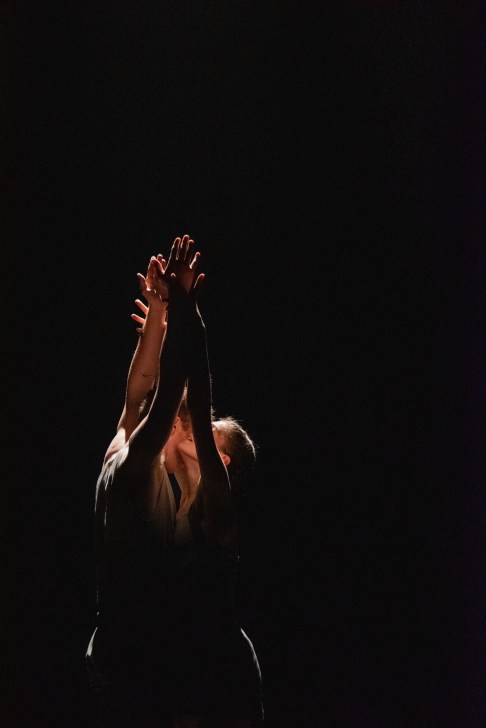
While the eight dancers never evoked a prison or an asylum, they brought us a dark, broken world. The moments of trauma were less common and affecting than the flow of brave, resolute striving. If the other choreographies reached these levels of intensity and artistry, I knew that the evening’s experience would be unforgettable.
Dressed in a different set of Martinson costumes, these in various colors with sheer unisex skirts, Simoneau’s The Details Are the Meaning showcased six fresh dancers whom we hadn’t seen in the previous piece. Though collections of Caroline Shaw compositions played by the Attacca Quartet have won two Grammy Awards since 2019, the music that Simoneau had selected was badly overmiked on Saturday night – far past the point of clarifying detail, if that was the point.
Movements in Simoneau’s setting were more classical and conventional than Archibald’s had been, with a greater tendency toward traditional partnering: Anna Mains with newcomer Oliver Oguma, Sarah Hayes Harkins with Rees Launer, and Isabella Franco with Mouzon. Beautifully executed lifts were no more lively or original, and I missed the point of the static, I-could-also-do-that poses in the middle of the piece. Combined with the wayward potting of the audio and the unsexy unisex outfits, this piece struck me as calling for more time in the workshop and more polish.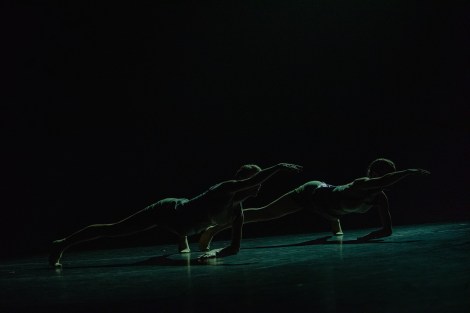
Silent Ghost felt very consonant with the two premieres that had preceded it, so Cerrudo had been judicious in calling upon Michael Korsch to provide lighting design for the new works after serving as Cerrudo’s original designer back 2015, when Ghost premiered in Santa Fe. Saving his own work for last was also a sensible idea, for it presented more CharBallet dancers for our scrutiny and delight than either Simoneau or Archibald had engaged.
Yet as Cerrudo’s numinous title indicates, the mood was far from celebratory or triumphant, as you might expect capping an Innovative program. The ambiance hinted at in the ghostly title was perhaps best approximated by the music of Jon Hopkins and Kenny Anderson (King Creosote) – a dimly recorded household conversation mixed over New Age piano. The opening track, by Dustin Hamman, presented a similar profile with fuzzy guitar chords strummed over intermittently intelligible vocals. Additional tracks were by Ólafur Arnalds and Nils Frahm.
Costumes by Branamira Ivanova were even more monochromatic than Martinson’s for HdrM, but smarter somehow and more fun to wear and dance in. While Cerrudo’s style of movement never struck me as either edgy or outré, which Archibald’s choreography definitely had, the style was markedly individual, comfortably at odds with tradition rather than defiant of it. Silent Ghost flowed no less naturally than HdrM. There was no perceivable strain on the ensemble in clothing themselves with the choreographer’s movements, and they were all perpetually wedded to the soundtrack, no matter what combination was onstage.
These combos were often pas de deuxs pairing Sarah Hayes Harkins with Oguma or Mains with newcomer Luke Csordas, always excellent. To my understanding, past ADs at Charlotte Ballet haven’t given new company members so much spotlight so soon, tending to give the impression that there was an unofficial hierarchy. I applaud Cerrudo’s audacious impulse: it makes his new era of leadership feel more exciting and unpredictable.


![Chelsea Dumas_Journey Home_Peter Mazurowski & Elizabeth Truell_Photo by Taylor Jones[1]](https://artonmysleeve.net/wp-content/uploads/2020/02/chelsea-dumas_journey-home_peter-mazurowski-elizabeth-truell_photo-by-taylor-jones1.jpg?w=536&h=340)


 Art on My Sleeve