Tag Archives: Luke Csordas

“Beyond the Surface” Amazes and Parties-Down

Review: Beyond the Surface at McBride-Bonnefoux Center

By Perry Tannenbaum
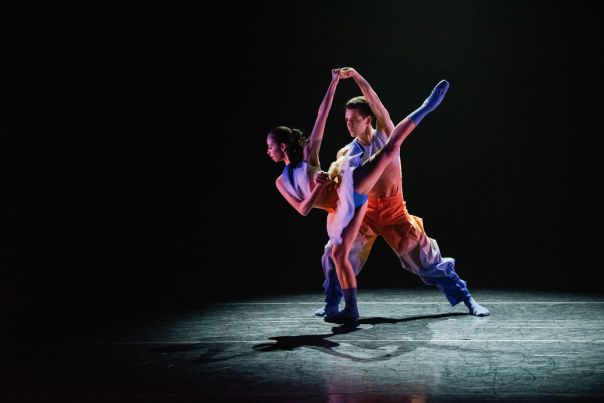
The new Charlotte Ballet season is off to a blazing beginning. Presenting Beyond the Surface at the McBride-Bonnefoux Center for Dance through October 26, the troupe looked fresher and younger than ever. But the choreography was far, far younger: two world premiere hatchlings that emerged from their shells last Thursday from Omar Román de Jesús and Mthuthuzeli November, and a third Charlotte Ballet commission by Jennifer Archibald that had its premiere less than two years ago in the same studio.

On that auspicious occasion, Archibald’s fledgling was at the top of the Innovative Works program, sparking hopes that the pieces that followed would reach the same high level. This year, HdrM is nestled in the middle of the program – and my 2023 hopes were already realized again in 2024 with the premiere of De Jesús’s Balúm.

Yes, the first dance of the night easily merited a climactic spot in any evening of premieres: beautiful, complex, mysterious, symbolic, intricate, moving, epic, and surreal. Music by OKRAA, Ola de Luz, was relentlessly propulsive, with random noises at random intervals littered around the main core, a minimalist loop with a harp-like timbre. Once that core cleared the noisy interference, like a spiraling starship navigating through a belt of asteroids, a sudden hypnotic calm and spaciousness prevailed – and the wonder of this dance multiplied, lending it an uncanny glow.

De Jesús has indicated that he is exploring our interactions with the air that engulfs us, from the moment we are born until we take our last breaths. Or maybe that emergence from the noise field near the beginning of the piece is an expulsion from the womb, our birth after a pre-natal prelude. The Puertorriqueño choreographer also has a hand in scenic design and Branimira Ivanova’s costume designs, for she has some specific prompts to execute in fashioning the dancers’ outfits and props.

The most notable of these are black: Two umbrellas that conjure up the surrealism of René Magritte and the fearfully magnificent ambiguity worn by Rees Launer. One of the umbrellas starts upstage center, held by one of the dancers seated on a bench, and it gets passed from dancer to dancer during the action, frequently cycling back to its starting position. The other is held stolidly by a woman on a side bench who resolutely faces away from the action until the stunningly gorgeous denouement – when we get to see the air!

At various moments when Launer grips our attention, we can have different conjectures about what his stern character represents. A raging fire-and-brimstone preacher? a demon? a witch? the Angel of Death? Launer will be a member of two of the three ensembles that get to present Balúm during its current 16-performance run. Another standout in the opening weekend’s seven-member ensemble, Maurice Mouzon Jr., will be in all the performances of this piece.

The liquefied movement of the dancers – along with some robotic intertwining – was juxtaposed with no-less-idiomatic lifts that were more horizontal than vertical. Like chapter markers at the end of episodes, the ensemble would gather and swirl around the stage in an evocative oval parade. Autumn leaves swirling in the wind. Often two or three subgroups performed simultaneously before an ensemble swirl would resolve the dissonance.

What amazed me most was that synchronized entrances and overlapping actions were so precise when there were seemingly no musical cues to give the dancers a toehold. If you’ve heard music by Philip Glass, you know that minimalism is not particularly danceable music. Musicians playing it and maestros conducting it must concentrate intently on the score to keep their bearings amid the repetitiveness. I’m still gobsmacked by how this Charlotte Ballet team pulled this off.

Following Balúm, a piece so untethered from every aspect of its music except for OKRAA’s tempo, Archibald’s HdrM struck me from an altered perspective. Archibald’s ability to mesh expressive movement to a soundtrack of musical compositions by Ludwig Ronquist, Heilung, and Federico Albanese stood out more boldly than ever after the more abstract and surreal De Jesús piece – though these intimate bonds in HdrM could be broken by abrupt mechanical disconnects from the score.

Two other conflicting factors came into play. Most welcome was the opportunity to see the Canadian-born choreographer’s work reprised by three of the eight dancers who performed at the 2023 premiere, Raven Barkley, Luke Csordas, and Shaina Wire. The piece looked more natural and “lived-in” twenty months later, so its internal contrasts were sharper and its sensual moments more relaxed. Barkley, in particular, stood forth dramatically, as sensual, captivating, and devastating as we’ve ever seen her. Nor can you fail to notice the ‘do.

Here, more than in any other dance of the evening, the ensemble bought into the “Unfiltered” theme of CharBallet’s 2024-25 season with their spirited, lyrical work. My only worry was off the dance floor and in the program booklet, where Archibald’s useful explanatory remarks where no longer in print. There in 2023, she was concerned with environmental psychology and posed a pointed question: “Is there a social responsibility to humanize architecture?”

Just asking that question helps us to connect with Archibald’s struggling language of movement. It also hints at the likelihood that Kerri Martinsen’s drab costumes are intended as institutional, such as clothing worn in hospitals, prisons, or mental wards. Aside from the contrast between lithe and mechanical movement, HdrM holds our gaze with a nice balance of ensemble, individual, and pair segments that flow naturally into one another.

Like many finales we’ve seen before from CharBallet, November’s Vibes and Variations is the most celebratory and carefree piece of the night. After last year’s From Africa With Love, it’s also the second consecutive November premiere to kick off a season at the McBride-Bonnefoux Center. Where Africa was surprisingly serene and monochromatic, preoccupied with mauve-colored ostriches from his South African homeland and their exquisite fragility, Vibes seems to wander westward to South America, to samba, tango, and carnivale.

Ivanova’s costumes burst with pastel cotton-candy colors and outré pleating, what my late mom in her saltiest Yiddish would call ongepochket, crassly over-decorated. The bulges on the men’s costumes give them seahorse legs and the frilly women look like spinning tops in a color scheme that matches the men’s harlequin-like rigs. The music starts off rather quietly with Gaby Moreno singing the first vocal on the program, her cover of “Cucurrucucu Paloma” over a simple acoustic guitar accompaniment, smoldering with bossa nova intimacy and sadness.

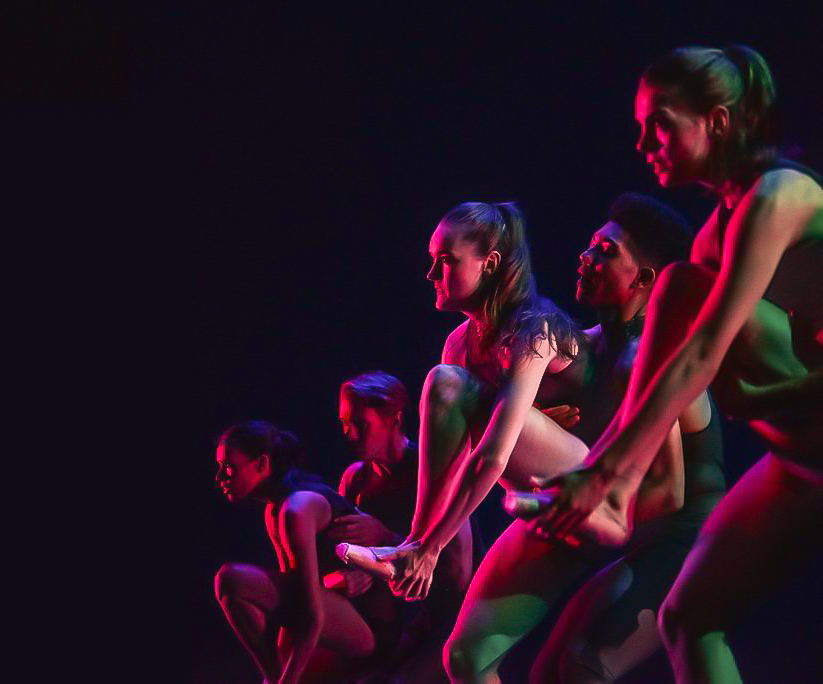
Things intensify as the 15-person ensemble digs into the Bang on a Can All-Stars’ version of David Lang’s strangely percussive – and minimalist – “cheating, lying, stealing.” But the most intense partying launches when we arrive at beatmaker Jamie xx and MC Moose performing the brash, irresistibly mindless “Gosh.” Catching my eye most compellingly were Csordas and Fuki Takahashi, each of whom will be in two of the three rotating ensembles performing November’s piece throughout its current run.

If I have to predict who will land the title role in Carmen next spring when artistic director Alejandro Cerrudo and CharBallet unveil their Vegas-showgirl update, my guesses would be Takahashi or Barkley. Since that Charlotte premiere will be running for two weekends, both temptresses could take turns at it.

Cerrudo Is Boldly Breaking Boundaries – at the CharBallet Studio and in the Lobby

Review: Breaking Boundaries at McBride-Bonnefoux Center for Dance

By Perry Tannenbaum

With a lineup that has repeatedly included Fall Works, Spring Works, Innovative Works, and Nutcracker over recent seasons, it isn’t too harsh to say that Charlotte Ballet’s programming could stand a refresh – or at the very least, a more dynamic approach to its marketing. They’ve been pouring mostly new wine into those old bottles in recent years, bit an aroma of predictability was beginning to seep in.

Now in his second year as artistic director – and fielding the first full season he has chosen himself – Alejandro Cerrudo is starting to shake things up. “Works” must not have been working, for Cerrudo has banished all three from CharBallet’s 2023-24 lineup.

Starting out the season at the McBride-Bonnefoux Center for Dance instead of waiting until winter, Cerrudo is setting the tone with Breaking Boundaries, running through October 28. It’s more than a name change: Cerrudo is innovating how the Center’s studio and lobby spaces are used. Partnering with Middle C Jazz and the Charlotte Art League, he’s also extending intermission and making it a more integral part of the experience. Afterwards, assigned seating goes away.

For that reason and others, the world premiere of Mthuthuthzeli November’s From Africa With Love is actually the more conventional choreography now on display at the McBride-Bonnefoux. That is not at all to discount or belittle the beauty, deep emotional resonance, and cohesiveness of November’s artistry, including his costume design and musical composition.

Nor should you think that less of an assault on boundaries implies none. What we might expect From Africa are eye-popping colors, primitive revelry, jungle cats, or savannah beasts, syncopated with intensive drumming. What inspires the South African-born choreographer and costume designer instead are mauve-colored ostriches from his native land that CharBallet’s dancers’ grace will have you associating with flamingoes. First the women dance quietly into the intimately-lit studio space with their matching mauve skirts and leotards, almost floating across the floor.

Mildly surprising, the men join in shortly afterwards wearing similar outfits, their skirts destined to serve as their plumage in the final tableau. Initially, they are different from the women but the same, whether we view them as human or animal. November pointedly freezes the ensemble for a moment or two in a formation without symmetry or geometry, so we behold their randomness, diversity, and harmony like a vast meadow teeming with life, peacefully grazing, somehow safe from predators. Lighting design by Aaron Muhl adds mystery and magic.

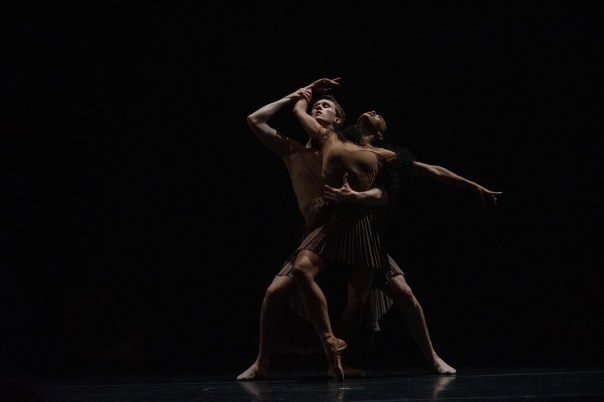
A couple of tracks, “Ibuyile l’Africa (Africa Is Back)” and “Qhawe (Hero),” from South African cellist Abel Selaocoe’s debut Where Is Home album, animate most of the movement and define its range once the full ensemble gathers. There is ethereal solemnity when the tempos are halting; while singing, exultation, and defiant guttural exhortation drive the quickened choreography over a pulsating drumbeat and handclaps. Seamlessly, our attention narrows to a single couple, Evelyn Robinson, more consistently at the center, and Luke Csordas, who will lift his partner several times but remain the only dancer who briefly leaps into the air. Three other duos rotate during the 15-performance run.

Earthbound, with a seething impulse to soar, From Africa With Love is haunting. It’s impossible for me to be sure whether November views its lively yet fragile beauty as emerging or fading.

You will need to abandon your seat – and the McBride-Bonnefoux studio – during intermission. You will also be asked to change your seat when you return and give some thought to the question of whether you wish to sit in the front row. My wife Sue, the tender-hearted Tannenbaum, was concerned that the elderly and disabled who normally populate the front row would be displaced, forced to climb stairs to reach the rows behind them.

My faith in Charlotte Ballet was not shaken. Or to put it another way, I was not at all worried. After intermission, my faith was vindicated. Not only were there greatly expanded opportunities to grab a front-row seat, the other natural option, to return to our original seats, was eliminated. They were gone.

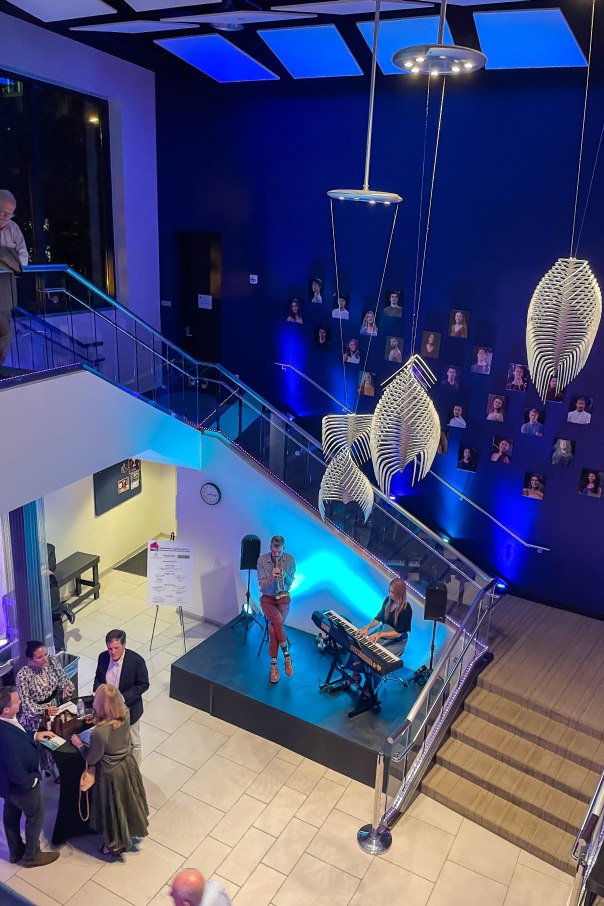
While this exciting transformation was happening behind closed doors, Patt and Sara, alias trumpeter Matt Postle and keyboardist Jess Borgnis, nestled into the Center for Dance lobby in front of the stylish staircase, framed by rows of purple lights as they played. Past the headshots of the CharBallet dancers, at the top of the staircase, we could look down at the cool jazz duo from the balcony or appreciate the artworks mounted on the walls behind us.

Sadly, my heartlessness extends beyond the elderly and physically challenged to the artists representing the Art League and the jazz duo. Other than enjoying the art and the music or noting that all was quite good, I observed an intermission of my own from reviewing and whipped out an iPhone to help me document the stylish ambiance. No other local company even strives to match the hospitality at the McBride-Bonnefoux, and only the Music @ St. Alban’s series up in Davidson seems to have stumbled upon similar possibilities of desserts and extra entertainment for all their patrons.

Yet the fullest impact of Breaking Boundaries was undoubtedly reserved for after intermission. The grandstand where our seats had been was now collapsed into the rear wall. Instead of one front row facing the studio performing space, there were now four rows of benches boxing it in. We made a beeline for a bench with a back rest, noticing along the way that there were spaces marked “Reserved”: our first hint.

It wasn’t long before the 15 dancers performing Ohad Naharin’s Kamuyot, dressed in loud woolen plaid skirts and slacks, settled into those designated spaces. By this time, the reason for the front-row caution was clear enough. If you don’t mind being invited to join the dancers on the floor – or you don’t mind turning down such an invitation – you’re OK. Otherwise, second row. Those who experienced second-row remorse could remedy their plight with a little extra exertion when the time came, capturing a dancer’s attention and an invite.

Even translated from the Hebrew as “Quantities,” Naharin’s title didn’t offer much of a clue to what might follow. There were no song titles in the program, but the list of 22 composers and artists, ranging from John Tavener and L. V. Beethoven to Lou Reed and The Ventures, broadly hinted at a bumpy ride. Indeed, the delight of unpredictability was sustained throughout the piece as single dancers or couples from all four sides of the stage took their turns on the floor and returned to their places. From the randomness of the order of dancers seizing the spotlight and yielding it, a certain inevitability set in if we were noticing who hadn’t yet risen and performed.

From then on Kamuyot was more of an ensemble piece. Distilled from previous works, Naharin aimed this work specifically at young audiences and, logically enough, created it for The Young Ensemble of the company he founded in Tel Aviv, Batsheva. The work has been staged across Israel in school gymnasiums, so the work aligns more closely with the studio space than most of the choreography we have previously seen staged at the McBride-Bonnefoux. On the other hand, staging the work at night in front of an adult audience alters Naharin’s calculus and the whole atmosphere of the dance.

Instead of encouraging kids to get involved with dance and experience its joys, Kamuyot now stretches out its hands to adults and old-timers to bridge the gap between themselves and their youth. With a soundtrack that ranges from the opening bars of Beethoven’s Kreutzer Sonata to The Ventures’ “Theme Song from Hawaii Five-O,” Naharin’s lively, kaleidoscopic work encourages traffic in both directions, for nothing is dumbed-down for his intended family audiences, ages 6 and up.

When dancers stand silently in front of you, or when they beckon you to join them on the floor, you know exactly what Cerrudo meant when he named this rousing season-opening program Breaking Boundaries. I would rate my own performance, when I answered the dancers’ calls, as rather wretched – but I surrendered my objectivity and the ability to even view the entire spectacle as soon as I entered it. What I gained in exchange for those losses was the full flavor of the experience.

I invite you to try it, and to bring a child along with you.

Cerrudo Revives Innovative Works With Fresh Excitement

Review: Innovative Works at Center for Dance

By Perry Tannenbaum

The Deatils Are the Meaning by Helen Simoneau - full cast - photo by Taylor Jones Charlotte Ballet’s reveal wasn’t as dramatic as the recent return of the renovated Old Barn on Queens Road with a full-fledged Theatre Charlotte musical. But after the COVID shutdowns, postponements and cancellations, and the abrupt departure of artistic director Hope Muir after barely five years – the last two during the pandemic – it was hard to feel that Charlotte Ballet was all the way back until last weekend. Until we had seen some choreography by the new AD, Alejandro Cerrudo. Extra frustrating for me, since I had declared his work a perfect fit for CharBallet when I had first seen it at Spoleto Festival USA in 2014, had been the absence of his imprint on the Fall Works program at Knight Theater last October.

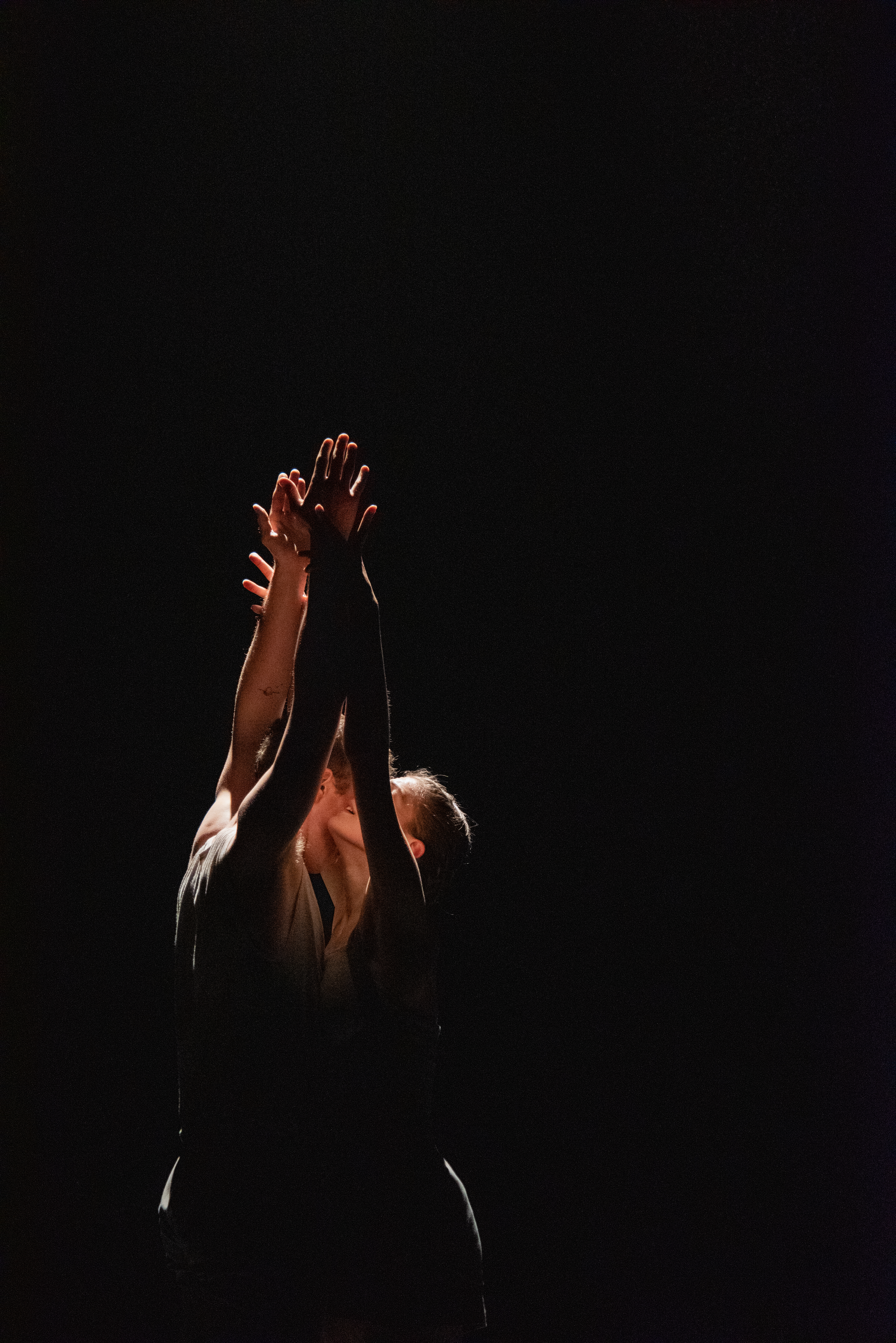
With Cerrudo now hosting the annual Innovative Works wintertime program, contributing a fine piece that crowns an invigorating evening at the McBride-Bonnefoux Center for Dance, we can let it all seep in. A new era has emphatically begun at the Center for Dance, with a new AD starting to reshape the company’s identity, working with a mix of familiar dancers, new dancers, and dancers who have matriculated to the varsity through the satellite Charlotte Ballet II troupe.

The state of Charlotte Ballet, to coin a phrase, is strong.HdrM by Jennifer Archibald - Olivr Oguma and Amelia Sturt-Dilley - photo by Taylor Jones

Jennifer Archibald’s vowel-starved HdrM and Helen Simoneau’s The Details Are the Meaning, both world premieres, preceded Cerrudo’s no-less-cryptic Silent Ghost. Silence was a subtle motif: It’s been awhile since Charlotte Ballet presented an entire evening of dance works that were devoid of storyline, song lyrics, or voiceovers. Taking on the hosting chores, Cerrudo recalled his takeaway from the first time he squired his daughter to a set of modern dance pieces. Comprehension was no problem at all, as it turned out. Just let it seep in was the core of his message.

On this occasion, anyway, Cerrudo discarded the introductory videos that have enhanced the studio ambience at past Center for Dance programs, where the evening’s choreographers, projected on screens flanking the audience, would talk about their works before we saw them, or dancers would give us their insights. Instead of those slick videos – all three “Behind the Ballet” videos are available at Charlotte Ballet’s website – we contented ourselves with Cerrudo’s remarks and a strange, mysterious welcome from CharBallet dancer Maurice Mouzon Jr. in a flowing black costume. Three quarters bacchante conjuration and one quarter airline steward pantomime, the conjuration was so absorbing that I really didn’t pay attention to the voiceover until Mouzon pointed out the exits to us.

That shtick was another great ice breaker, arguably the most amusing of the night.HdrM by Jennifer Archibald - Nadine Barton and Oliver Oguma - by Taylor Jones (1)

Like the other dances that followed, HdrM didn’t readily disclose its intentions, but Archibald offers a couple of useful hints in our program booklets. Her subject is environmental psychology, questioning whether society has a responsibility to humanize architecture. What the choreography takes aim at is “hard architecture,” as explored in Robert Sommer’s Tight Spaces: Hard Architecture and How to Humanize It (1974). Since there is no scenery with the fledgling piece, nor any projections, we can decide among several kinds of hard architecture that Sommer was concerned with: prisons, classrooms, asylums, hospitals, or zoos.

Kerri Martinson’s drab costumes seem to narrow that field to secure buildings for human adults, with no further clues provided by the music of Federico Albanese, Ludwig Ronquist, and Heilung. What I found most enjoyable here was Archibald’s struggling, yet never agonized, language of movement – a mixture of sensual interaction between the eight dancers and self-absorbed precision. Likewise, there were episodes when the dancers connected intimately with the flow of the music, interrupted by abrupt mechanical disconnects from the soundtrack.Silent Ghost - Anna Mains and Luke Csordas - photo by Taylor Jones

While the eight dancers never evoked a prison or an asylum, they brought us a dark, broken world. The moments of trauma were less common and affecting than the flow of brave, resolute striving. If the other choreographies reached these levels of intensity and artistry, I knew that the evening’s experience would be unforgettable.

Dressed in a different set of Martinson costumes, these in various colors with sheer unisex skirts, Simoneau’s The Details Are the Meaning showcased six fresh dancers whom we hadn’t seen in the previous piece. Though collections of Caroline Shaw compositions played by the Attacca Quartet have won two Grammy Awards since 2019, the music that Simoneau had selected was badly overmiked on Saturday night – far past the point of clarifying detail, if that was the point.

Movements in Simoneau’s setting were more classical and conventional than Archibald’s had been, with a greater tendency toward traditional partnering: Anna Mains with newcomer Oliver Oguma, Sarah Hayes Harkins with Rees Launer, and Isabella Franco with Mouzon. Beautifully executed lifts were no more lively or original, and I missed the point of the static, I-could-also-do-that poses in the middle of the piece. Combined with the wayward potting of the audio and the unsexy unisex outfits, this piece struck me as calling for more time in the workshop and more polish.Silent Ghost - Sarah Hayes Harkins and Sarah Lapointe - photo by Taylor Jones

Silent Ghost felt very consonant with the two premieres that had preceded it, so Cerrudo had been judicious in calling upon Michael Korsch to provide lighting design for the new works after serving as Cerrudo’s original designer back 2015, when Ghost premiered in Santa Fe. Saving his own work for last was also a sensible idea, for it presented more CharBallet dancers for our scrutiny and delight than either Simoneau or Archibald had engaged.

Yet as Cerrudo’s numinous title indicates, the mood was far from celebratory or triumphant, as you might expect capping an Innovative program. The ambiance hinted at in the ghostly title was perhaps best approximated by the music of Jon Hopkins and Kenny Anderson (King Creosote) – a dimly recorded household conversation mixed over New Age piano. The opening track, by Dustin Hamman, presented a similar profile with fuzzy guitar chords strummed over intermittently intelligible vocals. Additional tracks were by Ólafur Arnalds and Nils Frahm.

Costumes by Branamira Ivanova were even more monochromatic than Martinson’s for HdrM, but smarter somehow and more fun to wear and dance in. While Cerrudo’s style of movement never struck me as either edgy or outré, which Archibald’s choreography definitely had, the style was markedly individual, comfortably at odds with tradition rather than defiant of it. Silent Ghost flowed no less naturally than HdrM. There was no perceivable strain on the ensemble in clothing themselves with the choreographer’s movements, and they were all perpetually wedded to the soundtrack, no matter what combination was onstage.

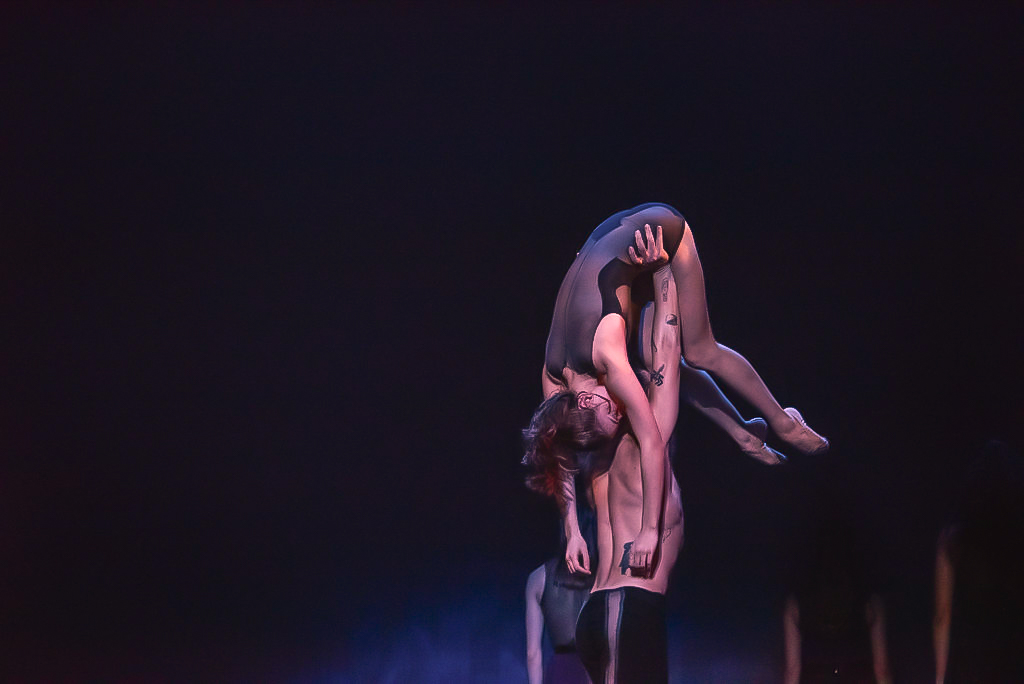
These combos were often pas de deuxs pairing Sarah Hayes Harkins with Oguma or Mains with newcomer Luke Csordas, always excellent. To my understanding, past ADs at Charlotte Ballet haven’t given new company members so much spotlight so soon, tending to give the impression that there was an unofficial hierarchy. I applaud Cerrudo’s audacious impulse: it makes his new era of leadership feel more exciting and unpredictable.

Charlotte Ballet Roars into a New Era With FALL WORKS

Review: Fall Works by Charlotte Ballet

By Perry Tannenbaum

Under the Lights_Taylor Jones

Knight Theater should have been abuzz last Friday night. Yet somehow, a year after Charlotte Ballet’s 50th-anniversary celebration – celebrated a year after the company’s actual 50th anniversary – my excitement wasn’t reflected by the community at large. A night after Opera Carolina had opened its 2022-23 season at Belk Theater to an empty upper balcony and a disappointing crowd, the curtain went up on Ballet’s new era with a similarly sparse turnout.

Our takeaways from this phenomenon need not be terribly dire, for it may be up to OpCar and CharBallet to learn a simple lesson: don’t open your seasons on the same night! Or on the night that a megahit like Hamilton – or the NBA season – is opening down the block. Your two companies collaborate every December on The Nutcracker, so you ought to be able to ace October.

It can be disheartening for performers to see the curtain rise on a hall pocked with vacant seats, but the effect seemed more noticeable on the soloists singing Tosca than on the dancers bringing us FALL WORKS. Understandable. Charlotte Ballet is a more resident company, devoid of prima donnas who swoop into town for one rehearsal and one weekend, they’ve worked hard perfecting their moves at their own studio, and nearly 40% of them have been in the company for less than two years.

They can be as excited to be working with new comrades and new partners as we are to see the diverse new faces. Implacable prerecorded music – synced to crucial interactions with other corps members – keeps them in step, and they don’t need to worry whether their voices will betray their nerves. Or hold up through Act III.

We can question the wisdom of reprising two works that premiered here within the past three years. Both Helen Pickett’s IN Cognito and Crystal Pite’s A Picture of You are fascinating, edgy pieces, neither one saddled with music we might readily recall months or years afterward. Although the choreographies jogged my memory, the freshness of the experiences was enhanced by watching different dancers perform them, especially after missing opening night to attend the opera.

OK, so I must admit a little frustration that, more than six months after he was named CharBallet’s new artistic director, we still haven’t seen any of Alejandro Cerrudo’s choreography here in Charlotte. After all, it’s over eight years since I lobbied specifically for our most prestigious performing arts company to take up Cerrudo’s work when I first saw it at Spoleto Festival USA, tabbing it a “winner” after witnessing Hubbard Street Chicago’s staging. Nor have I yet seen Cerrudo onstage to address his company’s loyal audience.Anna Mains_Ben Ingel_UTL_by Taylor Jones

Instead, we could take consolation in getting the local premiere of Under the Lights by Christopher Stuart, the new director of Charlotte Ballet II. After the heaviness and intensity before intermission, Stuart’s medley, set to nine tunes by Johnny Cash and June Carter Cash, was a light and lively chaser. A couple of dancers from Ballet II occasionally infiltrated the frontliners in this entertaining suite, adding their youth to the bustle and effervescence onstage.

Similar incursions occurred over the course of Pickett’s IN Cognito, which proved to be the most free-flowing work of the evening, hardest to follow, and by far the easiest to forget. As a result, the impact for me was almost as fresh as Stuart’s piece, a good thing, and I didn’t find myself comparing the dancers of 2022 with those who gave the world premiere performance in 2019. Only one of the nine I saw on Friday had danced it two years ago. I hardly ever knew what was coming next, but when it came, it usually struck me as familiar – and the flow of the piece seemed far more organic this time.

So much was going on with the dancers, in multitudinous permutations moving hither and thither, that I often lost track of the props and furnishings whisked onto the stage and then off to the wings. One of the two table lamps would suddenly be missing, lounge chairs might multiply while the sofa exited, or a quartet of mismatched chandeliers might arrive randomly from the fly loft without reason. The dancer hiding behind the shrub – incognito? – would exit elaborately, crossing the entire upstage to the opposite wing, making herself absurd.

Sarah Lapointe_Ben Ingel_UTL_by Taylor JonesDancers communicated and coordinated. They partnered, interacted, and created beauty together. Yet they never connected, perhaps incognito to each other and to everyone else. Busy and beautifully baffling, very much like the modern world.
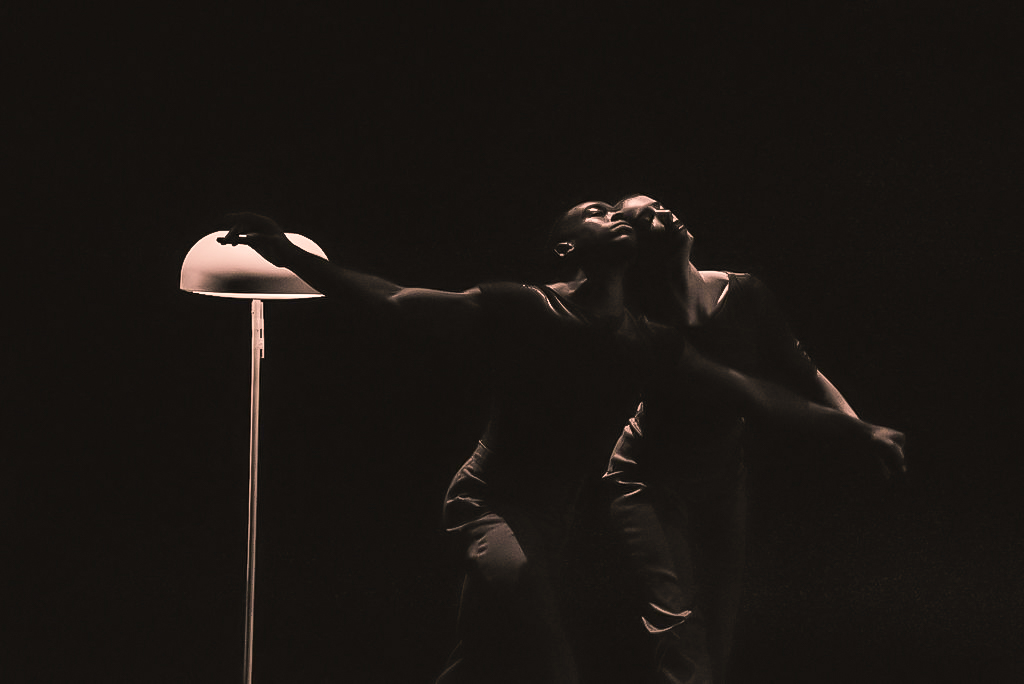
A Picture of You Falling, with choreographer Pite also supplying the biting prerecorded text, was edgier, more satirically impersonal. At times catatonically repetitive, this strange pas de deux imprints itself readily and deeply – an almost sinful delight, since it lays bare the careless ways we talk about love and romance. Sarah Lapointe and Ben Ingel first connect by accidentally bumping into one another. We’re speaking literally here, as they walk in opposite directions across a geometrical space outlined at regular intervals by strobe lights.

When Ingel falls, he literally falls, and his heart literally hits the floor when he is smitten and when the makeshift couple breaks apart. Unlike the score that Pickett cobbled together to move and regulate her dancers, the original music by Owen Belton never seems to register as a pulse or an emotional coloring, particularly when Pite tells us “This is the place” and “This is how it happens” – over and over.

What lighting designer Robert Sondergaard creates with his symmetrical formation of strobes is emphatically not a space. Nor can we be sure whether Pite is telling us again and again and again that this is how this ephemeral intimacy happens or whether – in some kind of condensed or looping timeframe – it’s actually happening again and again. Focus does shift for a while from Ingel to Lapointe in the moments of intimacy leading to the breakup, but this is ultimately the man’s story. Or a picture of what men have made out of love.Maurice Mouzon Jr_Shaina Wire_IN Cognito_by Taylor Jones

We confronted a couple of filters between ourselves and the music of the Cashes in Under the Lights. The least discordant of these was Stuart’s choreography, which briefly stumbled with his blithe setting for “Folsom Prison Blues,” when his five men carried on merrily during the vocalist’s confession that he “shot a man in Reno just to watch him die,” a jarring disconnect. More problematic were the recordings of The Man in Black’s signature songs by Sugar + the Hi-Lows, most egregiously lightweight when they missed the gravitas and drama of “Hurt,” leaving Nadine Barton little to work with, though she worked it well.

James Kopecky got us off to a charismatic start with “I Walk the Line” as it dawned on us what we would have to cope with from the Bi-Los. Anyone who had heard a definitive rendition of “Ring of Fire” or “Jackson” could empathize with the struggles Stuart faced, but Sarah Hayes Harkins didn’t flinch at all as she joined Kopecky for the coolish “Fire,” and a couple of winsome couples, Isabella Bertolotti with Humberto Ramazzina and Meredith Hwang with Oliver Oguma, redeemed the Mississippi superficiality.

Sugar plus or minus the Hi-Lows was hard for me to swallow, which may account for my liking Stuart’s settings best for songs I was least familiar with. “Two Day High” offered us three dynamic duos, Isabella Franco with Maurice Mouzon Jr., Shaina Wire with Luke Csordas, and Olivia Parsons with Juan Castellanos. With “I’ve Got You Covered,” we got a glimpse of Amelia Sturt-Dilly partnered with Kopecky, just one night after she danced A Picture of You, the CharBallet commission she premiered a year ago. Stuart’s best pas de deux by far.

“Tennessee Quick” was the most attractive track I heard from Sugar +, complemented by some really rousing ensemble work from Stuart and a swarm of 14 dancers. Couldn’t imagine Johnny singing that one. That harmonious taste of “Tennessee” was a perfect setup for Stuart’s stomping ensemble finale, “God’s Gonna Cut You Down,” fronted by Kopecky, the hardest-working man in Charlotte that night. Johnny didn’t get to that golden nugget until late in his career, so it wasn’t among his best recordings, but to hear the Hi-Lows attacking that traditional come-to-Jesus song with an electric guitar was almost as much of a kick as Kopecky and his backups.