Tag Archives: Lisa Smith Bradley

Let “The Drowsy Chaperone” Hypnotize You

Review: The Drowsy Chaperone at Theatre Charlotte

By Perry Tannenbaum

My advice for best enjoying The Drowsy Chaperone at Theatre Charlotte is to listen to the Man in the Chair – and yield to his pitch-dark hypnosis. Yes, before the lights even go up at the old Queens Road barn, he’s in his chair speaking to his audience and conjuring up what we should hope and pray for: “I just want to be entertained. Isn’t that the point?”

As the show unfolded, brilliantly directed by Billy Ensley with what must be the local cast of his dreams, I realized that, as a critic, I shou

ld heed that hypnotic suggestion devoutly. Discard my usual pointy critical and analytical tools. What’s more, I came to believe more and more strongly that, if actors and directors of previous Drowsy Chaperones I’d seen had followed that simple mantra, I would have fallen in love with the show long before last Friday night.

When the lights came up a few minutes deeper into the Man in Chair’s monologue, we saw him locking the front door of his humdrum apartment with four or five assorted deadbolts and chains. It’s a bit of an abrupt swerve, but we’re suddenly aware that this Broadway musical devotee is a recluse and a bit paranoid. Each time the phone rings, we’ll see that the Man in Chair fails to answer, yet another confirmation of these traits.
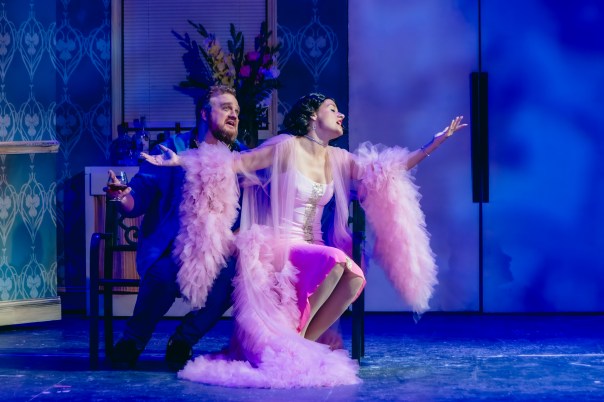
By the time the title character of the fictional “Drowsy Chaperone” is a few wobbly notes into her showstopping “As We Stumble Along,” we already should know that the Man in Chair is gay, which accounts for Lisa Smith Bradley delivering the song as a living fetishization of Ethel Merman and Judy Garland – Merman’s vibrato wedded to Garland’s glitter, slacks, and drug dependency.

Yet when we’re watching Kyle J. Britt as our genial host, we need not attribute his reclusiveness or paranoia to being a gay man. As a Broadway musical fanatic, this Man in Chair identifies more readily as a New Yorker with Innerborough hangups. Meanwhile, Bradley is sufficiently over-the-top as both gay icons – especially Merman – to be accused of impersonating a female impersonator.

We might say that Ensley & Co. have decided that being gay in 2024 isn’t nearly the leaden weight it was in 2006 when Drowsy Chaperone premiered in the Big Apple or in 1996 when Angels in America tore the QC apart and made us a laughingstock. Pretentiousness, solemnity, and subtlety really are inimical to this delicate relic. Britt handles it with audiophile care as removes the vinyl disc – a rare original cast recording of his favorite 1928 musical – from its LP sleeve and gives both sides a loving once-over with a Discwasher brush before lowering his treasure onto a turntable.

The same can be said of size and scale, which may also have muffled my enjoyment of productions at Belk Theater in 2007 and Halton Theater. There’s something so right about our little séance in the dark at the Old Barn on Queens Road that it cannot attain in a more modern and spacious hall where the Man in Chair must project his spell into a distant balcony. The homeliness of the Man’s urban dwelling also sits better on Queens Road than in the bowels of a bank building on Tryon Street.

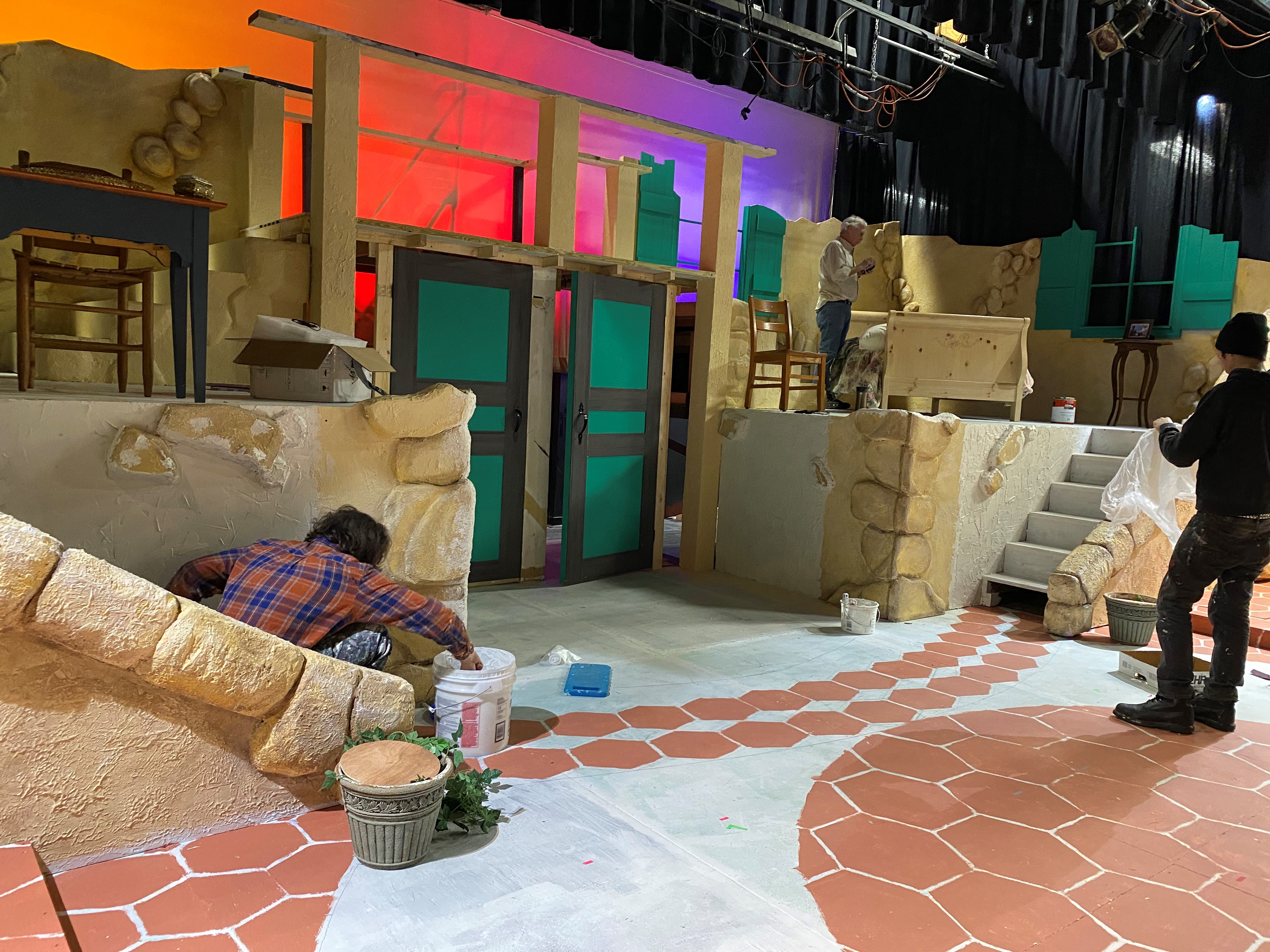
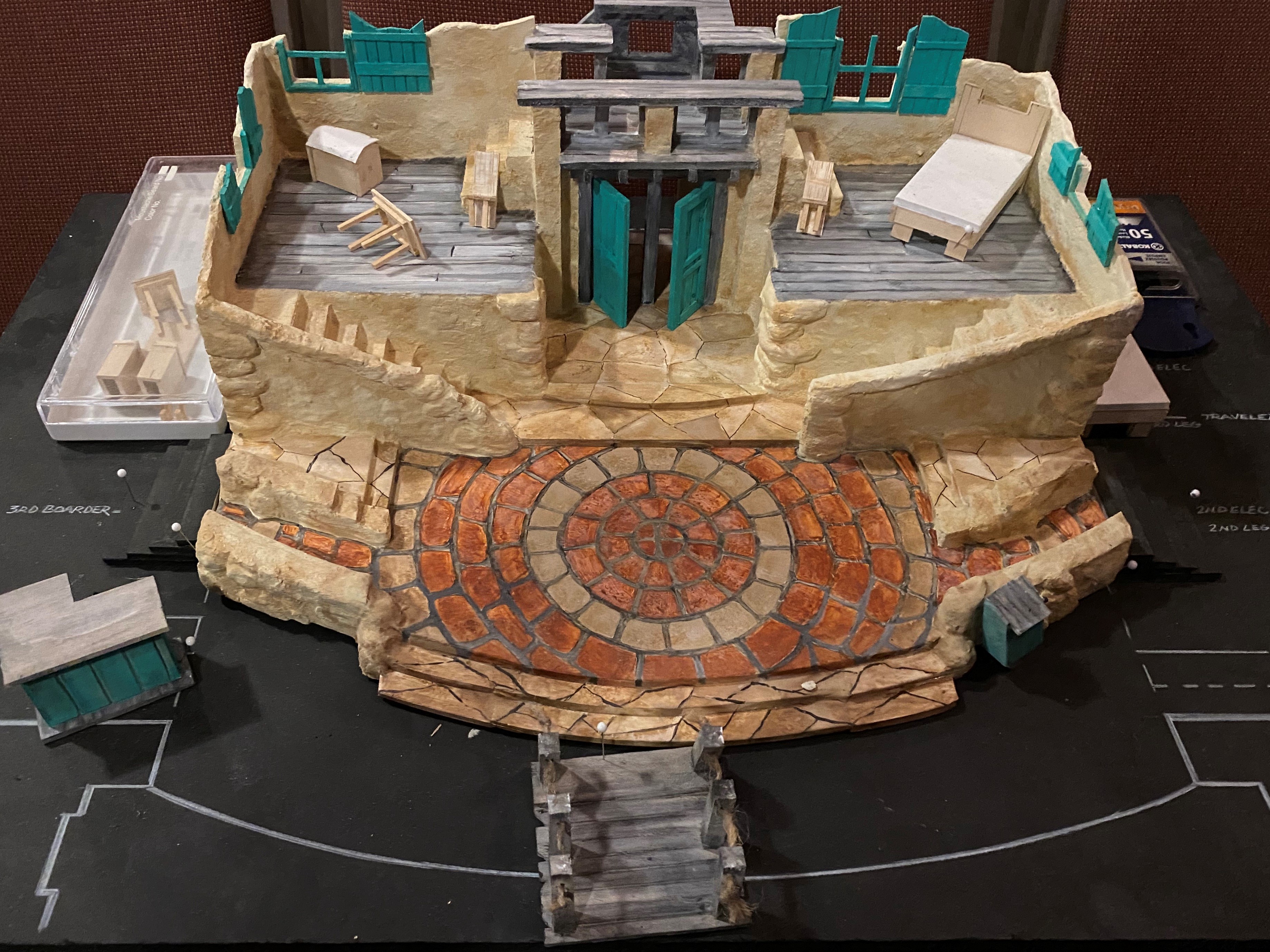
To be honest, it’s Broadway Lights and the late CP Summer Theatre that should apologize for not matching the unpretentiousness of Josh Webb’s scenic design. Of course, it would be nice if Webb’s scenery could transform spectacularly into Broadway splendor when the stylus of our host’s turntable comes down – with its signature thump – onto the vinyl and the mythical “Drowsy Chaperone” comes to life. In the less-is-more world on Queens Road these days, these shortcomings are comedy assets, part of the overall charm.
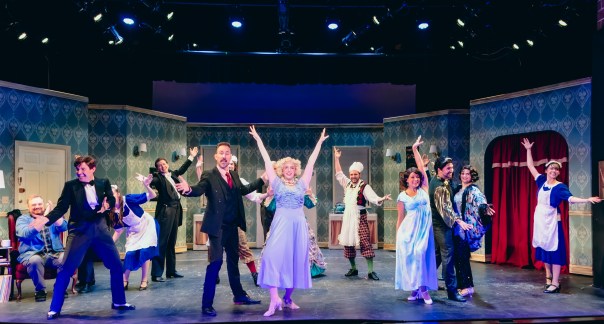
On the other hand, our time travels to 1928 get a softer landing thanks to the costumes by Beth Killion, notable for their flair, their formality, and their discreet dashes of color. We’re awaiting the wedding of Robert Martin and Janet van de Graaf, so there are actually multiple levels of time travel here, for Bob Martin actually co-wrote the Drowsy Chaperone book with Don McKellar – and starred in the original Broadway production as Man in Chair – while he was married to the real-life Van de Graaf.

In fact, this originally Canadian work, which eventually layered on music and lyrics by Lisa Lambert and Greg Morrison, was gestated at Martin’s stag party in 1997, nearly 70 years after these fictional nuptials. More reasons not to view this lark as a gay cri de cœur.

Rare as his vinyl treasure may be, Britt comes across less as a scholar or a critic than as a fanboy, occasionally panting like an eager puppy as he presumes to approach his fantasy idols more and more closely. More than once, the principals will obligingly freeze for him. Nor does this Man in Chair seem to favor the men over the ladies with his adoration, only tipping the scales just before the final bows. Charmingly enough, there are overtones of scholar and critic as he dishes tasty trivia about the fictitious “Drowsy” cast members or advises us to be on the lookout for some truly dreadful lyrics.

These glamorous, theatrical, servile, and criminal characters are all blissfully ignorant of the nerd who has conjured them up, preoccupied with their conflicting efforts to carry off the planned wedding or ruin it. The bride herself, Lindsey Schroeder as Janet, seems to be grandly ambivalent about becoming Robert’s wife, sacrificing her glittery stage career and the adoration of millions, while suppressing her basic instinct to “Show Off.” Love is at comical war with vanity. Carried away by the swiftness of this whirlwind romance, Andy Faulkenberry as Robert also has his doubts.

Aside from Janet’s drunken chaperone, politely labelled as Drowsy, there are a butler Underling, an eccentric Mrs. Tottendale, and Robert’s best man George shepherding the loving lambkins to the altar. Only Zach Linick as George seems to be afflicted with any degree of competence or reliability. More importantly, he and Faulkenberry make up a formidable tapdancing duo. (Thank-yous to choreographer Lisa Blanton.) Allison Rhinehart as a frilly, bustling Tottenham and Darren Spencer as the gray and starchy Underling are no less inevitably channeled toward blithe entertainment.

Counterbalancing the fragile determination of the bride and groom, compounded by the flimsy protection of their good friends, we have an exquisite mix of bumbling baddies trying to sabotage the wedding. These are led by Joe McCourt as Broadway producer Mr. Feldzeig (Feldzeig Follies ring a bell?), under pressure from his mobster backers, who consider Janet to be the cash cow of the Feldzeig franchise. The sneering McCourt is bedeviled by Gangster 1 and Gangster 2, armed emissaries – Titus Quinn and Taylor Minich – masquerading as hired chefs to ensure a catastrophe.

Ah, but it isn’t simply muscle aimed at swaying the maiden and returning her to showbiz. Somehow, a predatory Lothario is among the wedding guests – although he has never met anyone else there. Mitchell Dudas is this egotistical Adolpho, far more arrogant than Feldzeig, a mixture of Erroll Flynn and Bela Lugosi with a thick Iberian accent. Feldzeig has no trouble at all convincing Adolpho that he was born to seduce the bride-to-be.

Equally dumb, Autumn Cravens as Kitty is a ditzy chorine, constantly nagging her boss and wedding escort Feldzeig to let her fill Janet’s shoes in his next Follies. Effortlessly, Dudas will outperform Cravens in thwarting Feldzeig’s schemes. Love conquers all, but it would be a huge spoiler to say how many times when we reach this very happy ending.

Just one more wild card is needed to tie up all the festivities. Be on the watch for Trinity Taylor as Trix the Aviatrix, who descends from the skies at just the right moment with a voice of thunder. For a few moments, she even upstages Britt and Schroeder who are so fabulous.

It would be a mistake to miss the craftmanship lavished on this plot with its stock characters by Martin and McKellar, brought out so brilliantly by Ensley and his dream cast. For instance, think how perfectly 1928 was chosen: between Lindbergh’s transatlantic flight, Babe Ruth’s 60 homers, The Jazz Singer of 1927 and the Wall Street Crash of 1929. A brief last window of bliss before global misery. In the real world, the parade of yearly Ziegfeld Follies revues would be halted after 1927 – until 1931.

Matthews Mamma Mia! Mixes Summer Romance and Autumn Regret

Review: Mamma Mia! is playing this ABBA hit parade

By Perry Tannenbaum

Promo.1

There’s typical teenybopper inanity – and melodrama – in the lyrics of ABBA tunes that infiltrated the pop charts during the glam rock supergroup’s heyday, 1974-82. It’s all about desire, baby, followed by intense workouts on the hormonal treadmill of adolescence. Prospecting for ABBA gold, you’re rewarded with the age-old cycle of blissful acceptance or bitter ejection, romantic pleasure and conflict, burnout and breakup, cynicism and regret, all rendered in the elegantly engineered shorthand of a Top-40 hit.

Something interesting happened in 2001, after even the youngest member of ABBA had turned 50 and the quartet’s jukebox faves were cunningly transformed into a hit Broadway musical. You can feel it at Matthews Playhouse of the Performing Arts, where Mamma Mia! is playing through February 9. Writing the book for this ABBA hit parade, Catherine Johnson gave most of the songs to characters we could presume were nearly her own age, almost 44 on opening night. Old enough to have teenybopper kids of their own.

When a teenybopper pout is transformed into a midlife lament, regret takes on a whole new coloration in the title song as Donna Sheridan sings:

Yes, I’ve been brokenhearted,

Blue since the day we parted.

Why, why did I ever let you go?

The “day we parted” isn’t two melodramatic weeks ago. Not anymore. It’s over two decades ago, long enough for Donna to be experiencing the autumnal chill of lost youth. But hold on, Donna! You’re on a colorful Greek Isle, with lively cabana studs serving your taverna’s drinks, bikini-clad nymphs frolicking everywhere, dazzling eternal sunshine – and your darling daughter Sophie is getting married tomorrow!

It was easier to see Mamma Mia! from Sophie’s point of view in its Broadway days, pre-Meryl Streep, for Sophie really kickstarts the plot by prying into Mom’s secret diary and inviting all three of her possible dads to her wedding. Imagine if your three exes showed up unexpectedly for your daughter’s wedding. Sophie might as well have hired a skywriter to spell it all out: MOM, I READ YOUR SECRET DIARY AND INVITED ALL THREE OF MY POSSIBLE DADS TO MY WEDDING. Donna probably wouldn’t have looked up and noticed.

Promo.3

Presumably, Mamma is preoccupied with wedding preparations, but Donna compounds her distractions by inviting two of her old chums, Tanya and Rosie, to the festivities. Plenty of catching up to do, but conveniently, the three women were a glam rock vocal trio back in their salad days, Donna and the Dynamos, so they can provide the party entertainment. With this makeshift guest list and its ‘90s setting, the prevailing outlook of the story shifts emphatically toward the baby boomers, ABBA’s perennial demographic.

Directing the show, Billy Ensley clearly gets the boomer drift, and more than a couple of seasoned Charlotte musical stars ride the wave with him to the Matthews Playhouse stage. With a richly detailed scenic design by John Bayless and a sumptuous array of costumes by Lisa Altieri – including a surprise set of glam rock duds for the dads – it’s likely that all of these vets appreciated the warmth of their welcome.

We don’t need to wait around for all these elders to gather in the Mediterranean sun before the excitement begins, for Ensley has found newcomer Alexis Thomas to ignite the action as the nubile Sophie. Thomas quickly proves she’s a precocious belter, bookending Act 1 with lead vocals on “Honey, Honey” and “The Name of the Game.”

Having deceptively invited her three possible dads – Sam, Bill, and Harry – using Mom’s letterhead, Sophie must also subject each of the candidates to an impromptu paternity test, inviting all three to give her away at tomorrow’s wedding. The hurried brevity of these scenes would make any self-respecting playwright blush, but Thomas carries them off as if they were hallowed Broadway formalities, codified as cliché. Which they are. Spencer Ellis doesn’t get nearly as much opportunity to shine as Sky, Sophie’s fiancé, but he makes his big moment in Act 2 count, letting Sophie know that he feels her quest for her true dad is a bigger thing to her than their wedding.

Of course, the ABBA songs, stirred by island breezes and mixed with the celebratory vibe of the oncoming nuptials, become a cocktail that takes all six of the mid-lifers sip by sip from the tipsiness of nostalgia to the full inebriation of regression and reawakening. The women are the most intoxicated here, each arriving at her own pace. Burdened with a mother’s cares and saddled with the bitterness of a jilted sweetheart, Lucia Stetson as Donna travels the longest path – though the magic is there from the moment she sees Sam.

Promo.4

Stetson staunchly deals with the fact that Donna is prone to some truly stupid-ass choices, flexing the same regal star-quality insouciance that carried her through the title role of Evita a couple of summers back. Notwithstanding the baggy overalls she wears early on, we’re not surprised that she’ll soon emerge as a “Dancing Queen” and a “Super Trouper” – singing lead vocals, of course. You wonder a bit at first about Lisa Smith-Bradley, sporting a pair of mousy eyeglasses as Rosie, a far cry from the charismatic Mama Rose she brought to Theatre Charlotte seven years ago.

Never fear, Ensley and Smith-Bradley are cooking up a startling mouse-to-tigress rejuvenation as Rosie sets her sights on Bill, sinking her slinky claws into him in their “Take a Chance on Me” duet. Lisa Blanton talks like the bawdiest woman onstage as Tanya, but is it all talk? No, it is definitely not as we watch Blanton’s cougar rampage on “Does Your Mother Know?” Blanton pulls double duty at Matthews, doubling as the production’s choreographer, captaining her own carnivorous showcase with obvious gusto.

Aside from Thomas, a young talent to watch, the most promising of the young Greeks is Adrian White as Pepper, prime target for Tanya’s predations in “Does Your Mother Know?” – agile and slightly bewildered. He’s the dancing king here, for none of his elders, aside from Blanton, was chosen for hoofing prowess.

We’ve seen all the middle-aged guys before in Charlotte, Bob Mauney most recently starring in The Music Man at Theatre Charlotte, Steven B. Martin in Evita and Bridges of Madison County, and Patrick Ratchford in anything he has ever auditioned for over the last 25+ years, most recently 1776, Ragtime, and Charlotte Squawks! The Ratchford voice is still in peak condition, mostly held in reserve until Sam’s “S.O.S.” duet with Donna in Act 2, an all-out cri de Coeur in the top-40 world. Those smooth baritone tonsils also wrap themselves around two other hit singles, “Knowing Me, Knowing You” and – spoiler alert – the climactic “I Do, I Do, I Do, I Do, I Do” duet.

Sam isn’t the most comical of Donna’s exes, just the most interesting: the last he heard from her before Sophie’s faux invite was that she didn’t want to see him again. Understandably, he’s a bit uncomfortable and ambivalent when Sophie admits the subterfuge, but like the other guys who are also residually fond of Donna in various degrees, the possibility of being Sophie’s father keeps him hanging around in hopes of closure – and maybe making amends.

Martin as Harry and Mauny as Bill follow parallel tracks, not called upon to do much singing. Neither squanders his opportunity, Martin in a nostalgic “Our Last Summer” duet in Donna’s bedroom (here we go again?) and Mauny as Rosie’s willing prey in their “Take a Chance on Me” tête-à-tête. Bill claims to be an adventurer, so a tigress should be just right up his Aussie alley.

Like Panoramic Pease, “Music of the Night” Was Fun While It Lasted

Review:  The Music of the Night: An Andrew Lloyd Webber Revue

By Perry Tannenbaum

If you’ve never heard of Andrew Lloyd Webber – or you’re aching to become reacquainted – don’t blame Blumenthal Performing Arts, Charlotte Symphony, or CPCC. Three times in last nine years, Blumenthal’s Broadway Lights series has brought us touring versions of Phantom of the Opera with visits from Evita, Joseph and the Amazing Technicolor Dreamcoat, and School of Rock sprinkled in-between. CP brought us one of the first local productions of Phantom anywhere in 2015 and has kept enthusiasms stoked for Lord Lloyd with productions of Joseph and Jesus Christ Superstar over the past decade and Evita earlier this year.

Denial and deprivation have become harder to sustain in recent months. Broadway Lights brought Love Never Dies, Webber’s sequel to Phantom, to Belk Theater in early September, and both Charlotte Symphony and CP piled on with Andrew Lloyd sequels in late October. Symphony’s “Music of Andrew Lloyd Webber and More” opened last Thursday and encored the following evening, but the melodies of CP’s The Music of the Night: An Andrew Lloyd Webber Revue linger on after opening on the same night.

The current revue marks a farewell to panoramic Pease Auditorium, which is slated to be demolished along with the school’s library in early 2019. As you might expect, the fondness of the farewell comes from numerous actors and artists who have kept the theatre tradition thriving at Pease, regathering at ground zero where the CP program started in 1972.

At the helm, directing and choreographing, is Ron Chisholm, whose local pedigree goes back to 1990. Susan Roberts Knowlson, Patrick Ratchford, Lisa Smith Bradley, and Kevin Harris qualify as distinguished veterans handpicked for this 13-member cast, while Ryan Deal and Lucia Stetson have the creds to be labelled the new establishment. Watch out for a few of the others, though. There were stars on the ascendant in my telescope.

With a running time of less than 73 minutes, nobody onstage gets a truly full workout except the musicians led by the versatile Lucia Stetson, who has acted, directed, and conducted both musicals and operas over the years at CP. Why such a miserly songlist with so many singers onstage and so many songs to choose from? With a decent bouquet of your fave CP singers on hand to deliver, it would have nice to claim that you’d be hearing all your fave Andrew Lloyd Webber songs.

There are 20 songs, or there would have been if one hadn’t been skipped last Saturday. Most generously represented are Evita and Phantom of the Opera – not surprising when you consider that Lucia Stetson and Ryan Deal, who starred in the title roles at CP, are on hand to handle their reprises. This they do with panache, for Chisholm knows where to place his chips when he ponders his staging. Stetson is festively dressed by costume designer Ramsey Lyric for the brash “Buenos Aires” and backed with enough vocalists to evoke a carnivale – and she really is dressed to the nines when she does Evita’s anthemic “Don’t Cry for Me, Argentina.”

As the ghoulish, predatory Phantom, Deal can only fully come into his own when paired with his prey – the more beautiful, the better. Deal breathes heavily enough to be truly sinister in singing “Music of the Night,” but he’s most commanding when he torments Knowlson in the title song. Squat as Pease is, scenic designer James Duke does provide twin staircases flanking his final Pease set. The one at stage left is definitely an asset when Deal makes his dominant melodramatic exit. “Sing!” he bellows as Knowlson sustains high notes we haven’t heard from her in years. I’m guessing that’s the rest of the ensemble forming an offstage chorus for this duet, intensifying its power.

Taking up the Raoul role, Ratchford struck up the more consoling duet with Knowlson, “All I Ask of You.” All that chemistry was still there, no doubt kindling widespread nostalgia among those in the audience who remember the multiple times Knowlson and Ratchford shared top billing at CP in the past. With the entire ensemble singing “Masquerade” and Knowlson soloing on “Wishing You Were Here,” you will gather that Chisholm & Company’s Music of the Night is wringing maximum mileage from Phantom.

Even before the selections already cited, Brittany Currie Harrington and Traven Harrington were a more age-appropriate Christine and Raoul in “Think of Me.” Traven’s voice is the mellower at his low end, but Brittany was sensational at her uppermost in an unforeseen cadenza at the end of their duet. Each of the Harringtons logged an additional solo before the revue was done, Brittany reprising the title song from Love Never Dies and Traven taking us way back to the title song of Starlight Express.

Do you remember There’s A Light at the End of the Tunnel from that same rollerskating musical? Me neither, but Kevin Harris – perhaps signaling that he’ll be back for Showboat next summer? – reminds us how righteously rousing it is in bringing us to intermission, with backup support that matches the liveliness of “Buenos Aires.” Of the remaining cast members, I most fancied Ron T. Diaz and Emily Witte, both of whom I wished were better showcased.

Witte was saddled with the lackluster “Another Suitcase” from Evita before being obliged to timeshare “I Don’t Know How to Love Him” from Jesus Christ Superstar with Sarah Henkel and Karen Christensen. Diaz continues the Superstar momentum into the final bows, getting a better split on that title song, with J. Michael Beech sharing the spotlight and everybody in celebratory form backing up.

Lisa Smith Bradley bore the burden of beginning the evening with “Memory” from Cats, a song that I loathe from a show I despise. As we moved onward – and inevitably upward – I could be thankful that this irritation had been immediately disposed of. But I remain peeved at the evening’s brevity and the songs from other shows that remained AWOL. If we could dip into Joseph for Ratchford’s Elvis-like “Song of the King” and Harris’s “Close Every Door to Me,” surely there could be space for more than the peeps we had into Song & Dance and Whistle Down the Wind.

Maybe it’s okay to skip past The Woman in White, Aspects of Love, and Tell Me on a Sunday, but surely we must sample the Tony Award-winning Sunset Boulevard and Sir Andrew’s triumphant comeback, School of Rock, which wowed this town back in January. A couple of songs from each of those hits would expand the running time past the 90-minute threshold – and sound more like a respectable survey of this composer’s work.

Written in the Stars

Theater Review: Fly by Night

Jerry Colbert as Narrator and Lisa Smith Bradley as Miriam in Fly by Night. (Photo by George Hendricks Photography)

By Perry Tannenbaum

Is everything pre-ordained by a higher power? Or might everything that happens simply be the inevitable outcome when the algorithms of time and space work upon the star stuff that materialized in the wake of the Big Bang? If not, might a lucky ring or a soothsayer’s gaze into a crystal ball shift the gears of an oncoming fate? These are a few of the notions that Kim Rosenstock was playing with when she conceived Fly by Night, the last musical Actor’s Theatre of Charlotte will ever stage at 650 E. Stonewall Street.

Will Connolly and composer Michael Mitnick joined Rosenstock’s writing team, producing a storyline that revolves around two South Dakota sisters who fall in love with the same New York slacker, Harold McClam, a full-time sandwich maker and songwriter. Daphne and Miriam are as radically different as sisters can be. Daphne is impatient to leave Hill City behind and become a Broadway star, while Miriam is perfectly content to stick around home and pour coffee for the townsfolk at her waitressing job.

But Miriam already is a star in the sense that, listening to her dearly departed dad, she has absorbed the notion, during fondly remembered stargazing sessions, that we all come from that star stuff they were counting in the nighttime sky. Aspirationally, there is a link between Harold and Daphne, who meet first at the clothing shop where she clerks and again across his sandwich counter. Vocationally and temperamentally, Harold has a kinship with Miriam. They spark more instantaneously, more intensely, and more lastingly. Trouble is, they meet at the Brooklyn diner where Miriam works when Harold is already engaged to marry Daphne.

Hovering over the action, as a kind of providential presence with avuncular Our Town overtones, the Narrator frequently shape-shifts into some of the orbiting characters in his tale, including both of the sisters’ parents and the eccentric soothsayer. We actually begin the main story on November 9, 1964, with the funeral of Harold’s mother – exactly one year before his dad’s abortive suicide attempt.

There will be a certain providence in Mr. McClam’s survival, to be sure, but until then, his morose appearances can be somewhat trying and tedious. Each of the three central characters is being tormented by a livelier, more interesting nemesis. Daphne has Joey, a commercially successful playwright who’s getting serious about his craft by writing a play just for her. With plenty of revisions, stretching out the rehearsal process. Harold is bedeviled by the sandwich shop owner, Crabble, a quintessentially cranky New Yorker. The only inkling we get that Crabble has a heart is his chronic hesitation to fire Harold for all his delinquencies and screw-ups.

Miriam has the most important tormentor, that kooky soothsayer who gives her the most improbable set of omens for determining her destined true love, wrapped into a prophecy that promises bliss and catastrophe. All of them begin to recur when Harold walks into her life, sending Miriam scurrying back to South Dakota when the two are on the verge of connecting.

Fleeing fate is no less futile for Miriam than it was for Macbeth or Oedipus. She holds out the hope that her doom isn’t settled until time stands still. That will happen on November 9, 1965 – twice.
Three significant events will happen on that date, only one of them anticipated: the postponed opening of Daphne’s play. Ironically, the only stars shining on Broadway that night will be those that twinkle mockingly in the sky.

With Chip Decker directing and Jerry Colbert narrating, Fly by Night moves along briskly with plenty of verve and heart. Colbert has aged gracefully into the paternal wisdom that the Narrator and Miriam’s dad deliver, yet there is comical extravagance each time he becomes the Brooklyn soothsayer or the South Dakota mom. This Narrator seems to become most personable when he stops the action to guide us into a prefatory flashback, so we appreciate Colbert more and more as these time loops proliferate.

Colbert himself loops back to his heydays, flying by night to some fairly high notes and singing with an ease we haven’t heard from him since, oh, maybe 1997 in the 1940’s Radio Hour. Perhaps he’s inspired or rejuvenated by his co-stars. The sisters, Cassandra Howley Wood as Daphne and Lisa Smith Bradley as Miriam, are aptly cast, already ablaze in their early pair of star songs. Wood repeatedly chants “I’m a star!” with Broadway conviction belting out her anthemic “Daphne’s Dream” as she begins navigating the New York rat race, and there’s a cute Avenue Q silliness to her “More Than Just a Friend” duet with Harold.

Bradley simply torches her calling card, “Stars I Trust,” creating a wider gulf between the sisters than you’ll find on the original cast album, and there’s a greater maturity to her lighter “Breakfast All Day” sequel as she settles into Brooklyn, with less of a shuffling rock beat from the three-piece band directed by Ellen Robison. So easily grooved into a humdrum rut, it’s surprising how unnerved Miriam becomes when the soothsayer sings his “Prophecy” – in two parts – and when her eyes first meet Harold’s. Bradley, Colbert, and Christopher Ryan Stamey make it all work.

Stamey cut his teeth at Actor’s Theatre as their go-to wild man in trashy treasures like Slut and The Great American Trailer Park Musical, so to watch him mellowed into the relatively colorless Harold could be jarring to those who have witnessed his vintage exploits. But he actually nails it as both the nerdy Romeo and the mistake-prone sandwich drone. Best of all, he’s the adult in the room in his ultimate showdown with Miriam, “Me With You,” tapping into who he is and what we all believe must be right in the face of implacable destiny.

FLY 4[11]

Supporting roles all draw superb performances. Stephen Seay is wonderfully hyper as Joey when he first pursues his muse Daphne in “What You Do to Me” – and still spoiled rotten, revision after revision. James K. Flynn captures the working class vulgarity of Crabble with a poifect accent, combining with Stamey in “The Rut,” a paean to workplace hopelessness and drudgery. Perpetually toting a wee record player and a vinyl recording of La Traviata in his pathological grief, Rob Addison eventually gets to break out of his stonefaced depression as Mr. McClam. Toward the end, he decides to actually go see that opera and later, when someone finally has the time to listen, he pours out his sad, sad love story, “Cecily Smith.” Which just happens to rhyme with one of the best lines of the night: “Who cares what you are listening to? It’s who you’re listening with.”

The design team, Dee Blackburn for the set and Carley Walker for the lights, give us a nice off-Broadway sense of the various locations, efficiently transporting us to Miriam’s yard and front porch in South Dakota, the seedy nightclub where Harold tries out his song, Crabble’s misspelled sandwich shop, and McClam’s bathtub.

When we get to Penn Station and Times Square, however, an SOS goes out to our imaginations. After “At Least I’ll Know I Tried,” a tasty quintet ushering in the eventful denouement, I prophesy you’ll answer that SOS willingly.