Tag Archives: Kristin Graf Sakamoto

Weepy and Upbeat Church Singing at The Great Aunt Stella Center

Review: Theatre Charlotte’s Smoke on the Mountain

By Perry Tannenbaum
IMG_1248 

February 24, 2022, Charlotte, NC – There’s a bit of a Tar Heel tug-of-war going on between two small towns east of Charlotte, Mount Pleasant and Mount Olive, for the honor of having the best claim on being the site of Smoke on the Mountain, a homegrown musical that has maintained its popularity since 1988. Geographically, Mount Pleasant has the far stronger claim, due to its closer proximity to Charlotte, which is explicitly mentioned numerous times in the script, and because the Mount Pleasant Baptist Church is officially ordained as our setting in Connie Ray’s book.

Yet in terms of flavor, smell, and story in Alan Bailey’s original concept, Mount Olive and its famed pickle factory cannot be dismissed, for there are twin accidents near the pickle works that figure prominently in the opening scenario. Gawking at the gherkin spillage from the plant, the Sanders Family has tipped over its van and is therefore late in arriving to the church, where they are scheduled to lead a sing-along before a music-and-dance-averse congregation. Original musical arrangements were by Mark Craver, longtime member of the Red Clay Ramblers, and Mark Hardwick. Since both Craver and Ray hail from North Carolina, those roots run deep in the story and in the music.

Pastor Mervin Oglethorpe has invited the Sanders Family to sing at the Church in June 1938, part of his stealth campaign to lighten up – and modernize – his congregation, and the songs were chosen to evoke that era. “No Tears in Heaven” by Robert S. Arnold, for example, was written in 1935, and Albert E. Brumley’s “I’ll Fly Away” was penned in 1929. When Theatre Charlotte last presented this musical in 2010, they were able to build better scenery at their Queens Road than I had seen three years earlier at a Pineville Dinner Theater production. A fire at that barn in December 2020, however, has turned Theatre Charlotte’s 94th season into an extended road trip, stopping at various locations around the city.

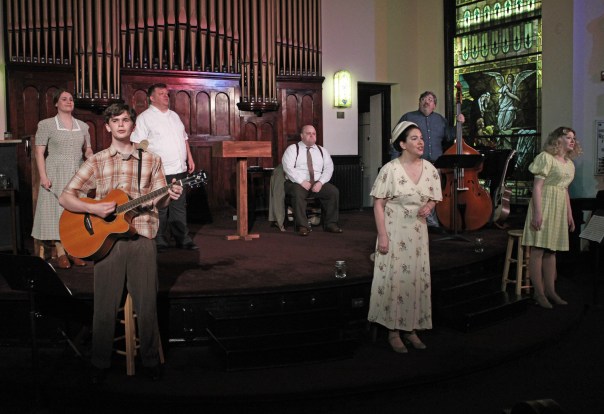
If the company’s mid-December production of A Christmas Carol seemed more than a little dwarfed by Halton Theater on the campus of Central Piedmont Community College, the current location at The Great Aunt Stella Center could hardly be more ideal. With a full set of organ pipes upstage to frame the Sanderses and Pastor Oglethorpe, and with cushioned pews for the audience to sit in, The Great Aunt Stella hardly needs to pretend at all to be accepted as a church. In fact, we’re entitled to think that Auntie Stella determined the choice of Smoke on the Mountain rather than the other way around.

As stage director and music director, Kristin Graf Sakamoto has done a fine job in taking advantage of the venue – and of the cast, since she reports prevailing on members to pick up instruments they had never seen before. That certainly tamps down the bustle onstage I’ve seen in previous productions that were burdened with a house band and adds to the homespun authenticity of this Mountain. We may be a little confused and disoriented when the Sanders Family hurriedly makes their belated arrival, for all of their instruments are already onstage – guitars, bass, mandolin, and assorted percussion instruments.

June Sanders is the first to arrive as Pastor Oglethorpe stalls for time. Emily Nageotte does a fine job in giving us the comical pickle catastrophe backstory, explaining her parents’ and siblings’ delay while portraying herself as the odd duck in the family. Instead of singing with them, she will sign for the deaf – whether or not there are hearing-impaired people in the audience. Eventually, June will sometimes make more noise than other members of the family as, one by one, she removes a wacky assortment of percussion instruments – including washboard, spoons, and cowbells – from their hiding places during the course of the concert.IMG_1551
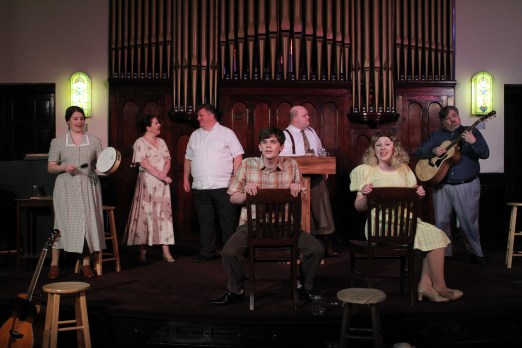
We’re in a church, so the evening’s program turns out to be a mix of homespun musicmaking and spontaneous testifying. As you might suspect, the Sanderses are a rusticated bunch, so a backwoods Mayberry shyness befits them all – with the exception of Liz Waller as Vera, the mama, affecting something close to a Minnie Pearl effervescence. Now there was also a proud and ornery side to Vera when her views didn’t coincide with Pastor Oglethorpe’s. Instead of coming to blows, they hurled Bible quotes at each other, citing chapter and verse for extra emphasis. Fretting with all kinds of picayune worries, Stuart Spencer as Oglethorpe keeps a perpetual crackle of tension in the air, heightened when his scriptural erudition is disputed, released only when he yields to the music. At first, he merely sings along at the top of his lungs, but when the spirit truly hits, he runs back to a cloakroom and fetches a harmonica.

The friction between the pastor and the Sanders Family (his singing contributions aren’t received enthusiastically), especially Vera, make for a needed dramatic undercurrent to spice up the singing and testifying until the hubbub that brings on our intermission. Burl, the genial patriarch of the family, seemed to be the peacemaker in Mike Cheek’s papa-bear portrayal, loyal to his wife Vera and all their cubs. It’s his brother Stanley, the black sheep of the family, who stomps out of the hall in a huff, and it’s Burl who must coax him to return.IMG_1728
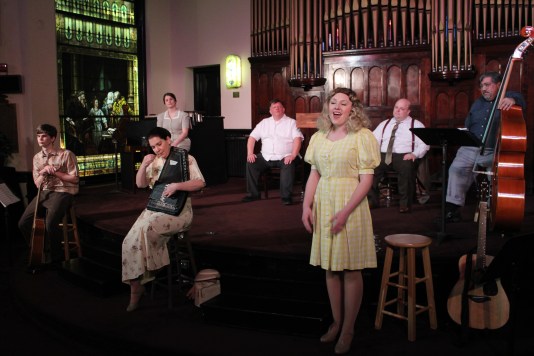
After this kerfuffle, while Pastor O is having a couple of words with the Sanders girls, the stage is set for the most dramatic testimony of the night, when the wayward Stanley returns. Apparently the only Sanders to have tasted the fermented fruit of the vine or the distillery, Jake Yara is wonderfully quiet and penitent in Stanley’s testimony, humbled yet not shamed. His earnest confessional seemed to spur Molly Neal as Denise, the younger Sanders twin, to unburden her heart and reveal that she had once run away from home – to Charlotte! – in a poignant tale of teen heartbreak. Neal upstaged her younger twin with her abortive foray into showbiz, but Gray Ryan as Dennis had a simpler, more comical testimony, aspiring to fulfill the calling of a preacher despite his terror of public speaking.

The acoustics at Great Aunt Stella are better for music than theatre, so it’s fortunate that Sakamoto placed such a high premium on the voices in her cast delivering the two dozen songs we hear. Backup vocals are as meticulously rehearsed as harmonies, and the instrumental performances are quite serviceable. Some might prefer the weepy and morbid repertoire like “Meet Mother in the Skies,” “Everyone Home but Me,” and “Whispering Hope.” Among these Christian hits, I’ll take the quirky and the upbeat any day. Give me more like “Christian Cowboy,” “I Wouldn’t Take Nothing for My Journey Now,” “Angel Band,” “I’ll Fly Away,” and “I’m Using My Bible for a Roadmap.”

Dangerous and Delicious London – With a Twist

Review: Oliver! at Theatre Charlotte

By Perry Tannenbaum

IMG_1349

Ron Law will be retiring when his 15th season as executive director at Theatre Charlotte comes to an end next spring, but he sure isn’t retiring – or even receding into the background – right now. The spotlight will shine brightest on Law in December when he stars for the first time ever as Ebenezer Scrooge in the annual revival of A Christmas Carol at the Queens Road barn. Meanwhile he’s had other things besides bookkeeping on his mind for the past month or so, since the 92nd season at Theatre Charlotte is kicking off with a different Dickens, Lionel Bart’s Oliver! and Law is the stage director.

Thanks to some impressively weathered scenic design by Josh Webb and a juicy mix of dignified and low-life costumes by Melody Branch, the current production looks vibrant and fetching before we even reach the title song, though purists will recoil at the sound of the prerecorded orchestra. Your first favorable impressions will be sustained by the fine set of adult principals that Law has gleaned from the rich Queen City talent trove that showed up for auditions. Yet the mean rigidity of Mr. Bumble, the terror of Bill Sikes, the acquisitive cunning of Fagin, and the conflicted kindness of Nancy would be largely wasted if they were directed at an Oliver who didn’t win us over.

IMG_1318

Atticus Ware passes his first key test as Oliver Twist simply by standing up after dinner has been served at the workhouse and having the cheek to say, “More, please!” We’ve actually seen an Oliver at Children’s Theatre long ago who looked the very antithesis of orphaned malnourishment, and it was hard to suppress a laugh. Easily two years younger than any Oliver to appear in a local production – except for Andrew Kenny in 2001 – Ware also passes muster when Bumble reassures the Sowerberrys, morticians he has sold Oliver to, that the lad will surely grow bigger.

There are prudential reasons past directors haven’t opted for an Oliver as young and small – and maybe considered cutting Bumble’s room-to-grow remark. Without a body mic, it’s hard for a middle-schooler to sing Oliver’s angelic “Where Is Love?” or his wonderstruck “Who Will Buy?” and make himself heard across an orchestra and an audience. Nicely miked-up, Ware holds up as beautifully as Andrew Griner did in Theatre Charlotte’s last Oliver! in 2007, and he adds palpable charm when he takes his turns in “I’ll Do Anything.”

Of course, the main reason why Oliver! is being offered in the metro Charlotte area for the sixth time this century is Bart’s amazing score. No fewer than a dozen of the songs have engraved themselves in my mind so that I can agreeably recall their main hooks without assistance. Familiarity can tempt directors and actors to deviate from established Oliver Twist expectations – or, in the practice of casting girls at the workhouse and in Fagin’s band of thieving urchins, widening our expectations.

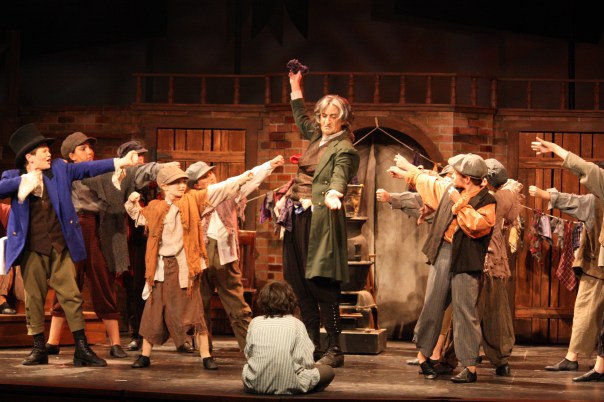
Law has presented enough iterations of Christmas Carol to value and preserve the Dickensian spirit of Oliver while loosening casting requirements where the envelope has already been pushed. Johnny Hohenstein immediately stands out as a fierce and booming Mr. Bumble, while Geof Knight as Fagin and William Kirkwood as Sikes are among the best we’ve seen. Together they form an adult triumvirate who remind us that greed and corruption aren’t simply confined to the underworld.

Hohenstein is as titanic as a beleaguered husband as he is when he’s a tyrannical beadle, a definite asset. I find ample menace and intimidation in Sikes when Kirkwood delivers his growling “My Name,” and I like the sliminess that Knight brings to “You Got to Pick a Pocket or Two” – and the grim calculation of his “Reviewing the Situation.” You couldn’t get me to dispute that any of these three gave the best auditions for their respective roles.

It’s just that I want to see a craven factor, a fear of Sikes’ violent volatility that would give an extra dimension to Fagin’s craftiness. From there, the chemistry between the two rogues can be further textured by their one-time mentor-apprentice relationship. Knight just doesn’t have the appearance of a cerebral weasel, which would make these layers relatively easy and self-evident. Here it needs work.

When it comes to Sikes’ abusive relationship with Nancy, Bart gives Kristin Graf Sakamoto all that she needs to get to its heart. Even if Nancy isn’t liberated, she’s spirited, best seen in Sakamoto’s interactions with the youngsters and in her lusty, boozy rendition of her “Oom-Pah-Pah” polka. Nancy faces some grim choices with Oliver, yet Sakamoto makes it clear that fidelity to Sikes is infused with fear – propped up by fear, you could say – when she repeats her signature “As Long as He Needs Me.”

So the Sikes-Nancy-Oliver drama and suspense develops beautifully from the first moments that we see Sakamoto. There’s already a glint of welcoming light when the Artful Dodger accosts Oliver after he has escaped Bumble and the Sowerberry mortuary. Bailey Wray ignites a “Consider Yourself” welcome as Dodger, assisted by Lisa Blanton’s choreography, that seems to engulf the whole city of London. Wray himself radiates a city-sized energy all by himself. Dodger’s precocious top hat is a couple of sizes too large, a plausible wardrobe choice, but I suspect that Law has elected to keep it that way in order to keep Wray’s hyperactive hands partially occupied.

Later there’s lively bustle in Fagin’s lair when the master puts his kids through their pickpocketing drill, and a new flowering of Blanton choreography when Oliver awakens at the home of his benefactor, Mr. Brownlow. the greatness of Britain beams at us like a sunshiney day, for Ware isn’t the only vocalist in “Who Will Buy” as it swirls with increasing anthemic force. Consonant with this cornucopia of wholesomeness, Rick Taylor is upright and trusting, a quiet affirmation that goodness and kindheartedness can rise above the miasma that swallows up Bill and Nancy.

Aside from the cloudy Sikes-Fagin chemistry, Law only loses focus at the end when Fagin and Dodger make their final exits – seemingly without any emphasis or attitude. Maybe bringing them downstage would help, but it’s a moment that deserves more fiddling with and agonizing over. Last impressions are as important as our first.

IMG_1338

It’s still quite sensible to hurry over to Queens Road, where the corruption and goodness of humanity are as exquisitely balanced as night and day. At its core, Oliver’s journey is a progression from secluded, deprived oppression to the centers of opportunity and civilization. Performances are almost universally fresh and decisive among over 40 onstage participants, and it’s hard to overpraise the work of musical director Ryan Deal in keeping his singers fresh and precise through a long rehearsal process.

Of course, the excitement of opening night added a jolt of energy to the performance, especially for the 13 actors – plus a dog – who were making their Theatre Charlotte debuts. If you’ve never experienced Oliver! before, you will likely feel a similar jolt of discovery.