Tag Archives: Kenney Potter

Duruflé and Respighi Are an Unexpectedly Dynamic Duo at Belk Theater

Review: Charlotte Symphony Plays Respighi’s Pines of Rome

By Perry Tannenbaum

November 14, 2025, Charlotte, NC – Neither Maurice Duruflé nor Ottorino Respighi would rank high among composers that Charlotte Symphony subscribers most wish to hear. The orchestra’s previous two music directors, Christopher Warren-Green and Christof Perick, never performed Respighi as part of the orchestra’s classics series – he remained the province of guest conductors – and the Duruflé Requiem, after concerts by the old Oratorio Singers and Carolina Voices early in the century, hadn’t surfaced at all locally since 2007.

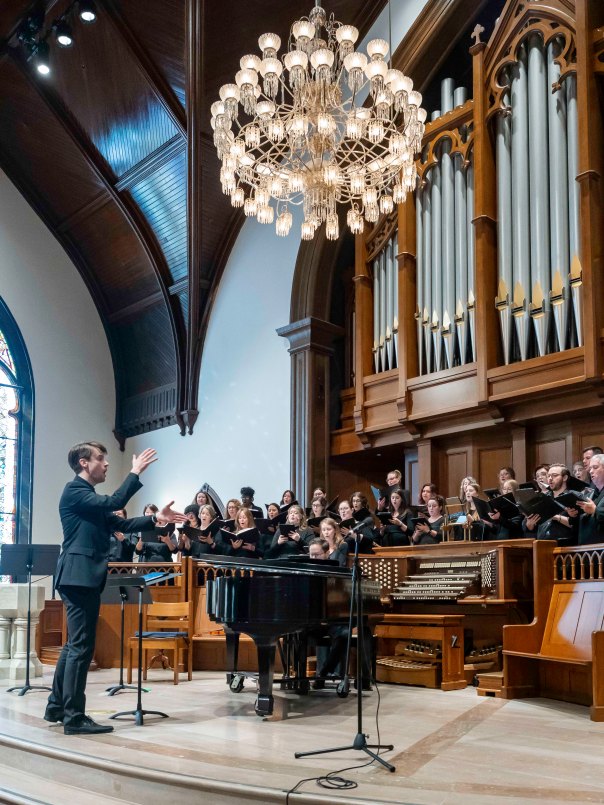
So a pairing of Duruflé’s most highly regarded work with two Respighi favorites, The Pines of Rome and The Fountains of Rome, didn’t figure to fill Belk Theater with rabid enthusiasts. Yet the sheer scale of the Requiem, calling forth the Charlotte Master Chorale under Kenney Potter’s leadership, made the Belk an obvious choice over the snugger Knight Theater.

Although our current music director, Kwamé Ryan, brought us Respighi’s Roman Festivals last spring, a guest conductor was once again on the podium for these more beloved Roman delights by the Italian icon. While a Duruflé-Respighi pairing will never be boffo box office, starting with the Requiem – which likely drew hundreds of the choristers’ family members to these performances – made the host of Master Chorale choristers onstage before intermission available to swell the audience for the Fountains and Pines afterwards. Adding to the electricity in the house, guest maestro Francesco Lecce-Chong deployed two groups of brass players upstairs to opposite sides of the grand tier for the final “Appian Way” section of The Pines.

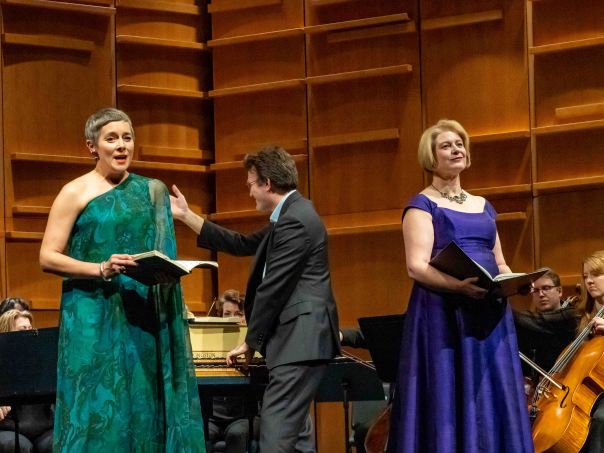
Based on Gregorian themes from the Mass of the Dead, the Requiem sounded like the oldest piece on the program, though it was the newest. Fortifying that impression was the dominant role of the Chorale compared to the two soloists, mezzo-soprano Megan Samarin and baritone Eleomar Cuello. Most of us likely felt that Cuello’s noble bearing and vocals in the “Domine Jesu Christe” section were all too brief: even there, the choir had the larger share of the singing.

Samarin’s conquest in the middle “Pie Jesu” section, an ethereal solo, also seemed too fleeting, though here the Chorale was silent. Sampling recorded versions of the Requiem on Spotify and Apple, you’ll probably conclude that the orchestral version performed at the Belk packs more wallop than the organ scoring, which was probably the version that Carolina Voices chose 18 years ago at the Friendship Missionary Baptist Church. Another reason for the guest vocalists to make a more muted impression this time.

The fourth section, the “Sanctus,” decisively upstaged Cuello as Lecce-Chong rallied the forces of the orchestra and the Chorale together, but the baritone returned for a second cameo during the first half of climactic “Libera Me,” fueling the fires of the choral “dies irae” that followed. Somehow, the sublimity of the concluding “In Paradism” doused those fires. The beatific loveliness of the women’s voices certainly made for a heavenly arrival, yet the men miraculously eclipsed them in their visionary entrance, truly a mystic chorus of angels.

Instrumental excellence peeped in occasionally during the Requiem, chiefly in Timothy Swanson’s oboe obbligato for the “Kyrie” section, in bassoonist AJ Neubert’s “Lux Aeterna” intro, and in the exquisite welcome to “In Paradisium” from yet another principal, harpist Andrea Mumm Trammell. Even more play was afforded to the players in the Respighi pieces with all their resplendent colors and shadings.

Memories of hearing Respighi are invariably more sugary to me than the actual music, which under Lecce-Chong’s baton, especially in The Fountains of Rome, was refreshing and exhilarating – and, of course, effervescent. Neubert probably made an even stronger impression on oboe in his lovely, languid sketching for “The Fountain of Valle Giulia at Dawn,” with principals Taylor Marino on clarinet, Jon Lewis on cello, and Victor Wang on flute following eloquently in the same opening section.

The sunnier middle sections, depicting “Triton Fountain” and “The Fountain of Trevi,” were more impressively orchestral and brassy, Triton’s horn issuing an early proclamation at the beginning of his section and a rampage of brass, chiefly trombones, heralding midday at Trevi, Rome’s most majestic fountain. No doubt the audience was a bit surprised by the delicacy of the Fountains finale, “The Villa Medici Fountain,” and its sprinkling of percussion, celesta, and soft chimes, simulating a distant church at twilight.

My mind had first been changed on Respighi way back in 1997 when Daniele Gatti had led the London Royal Philharmonic into town with diva pianist Alicia de Larrocha. His rendition of The Fountains with the Londoners was sufficiently revelatory for me to place a rush order for Gatti’s recording of Respighi’s complete Roman trilogy, where additional revelations awaited: Roman Festivals and Pines of Rome were both more powerful, varied, and grand. Though The Pines had popped up on my calendar at the dearly departed Eastern Music Festival in 2011, this was my first opportunity to hear – and compare – Fontane di Roma and Pini di Roma in the same live concert.

With a feel as sure for Respighi as Gatti’s, Lecce-Chong’s performance was worth the long wait. “The Pines of the Villa Borghese” had a marvelous orchestral bustle before principal trumpeter Alex Wilborn was dispatched to the wings for the signature eerie effect in the solemn “Pines Near a Catacomb.” Even more quietude came with “The Pines of the Janiculum” as piano, clarinet, cellos, and a soft oboe anthem enhanced the magic. But the epic build and variety of “The Pines of the Appian Way,” seasoned with prerecorded nightingale chirruping and crowned, at the end of a satisfyingly long and majestic crescendo, with the outbreak of brass from the balcony, surpassed the grandeur of the Respighi we had heard before and joined the peaks of the Master Chorale as the pinnacles of the evening.

Berko’s “Sacred Place” Is the Chief Revelation at Master Chorale’s Wholeness Concert

Review: Wholeness Concert at First Presbyterian Church

By Perry Tannenbaum

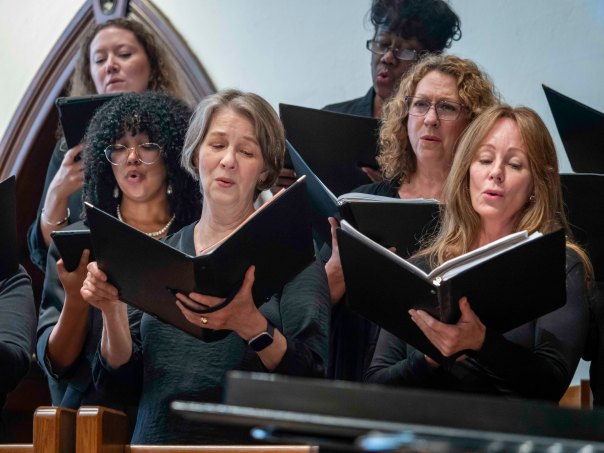
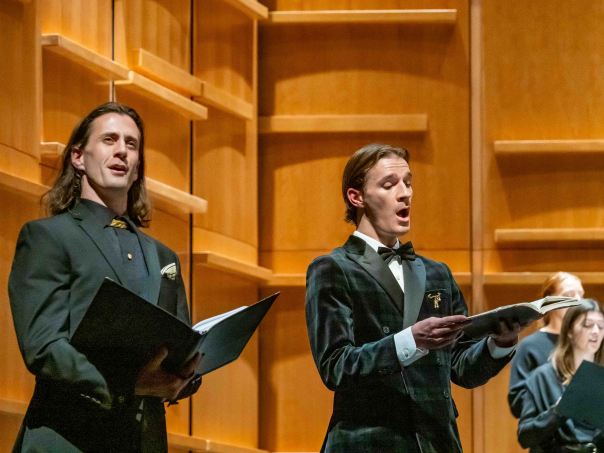
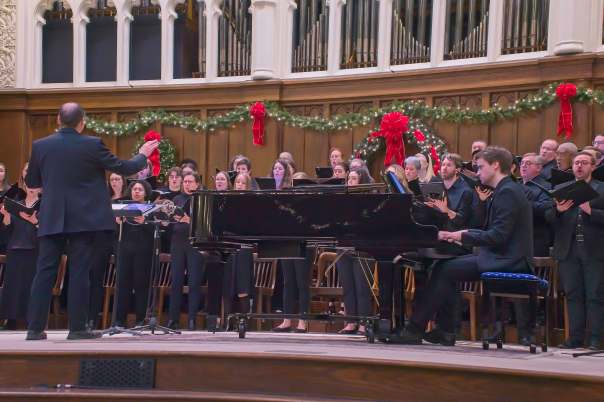
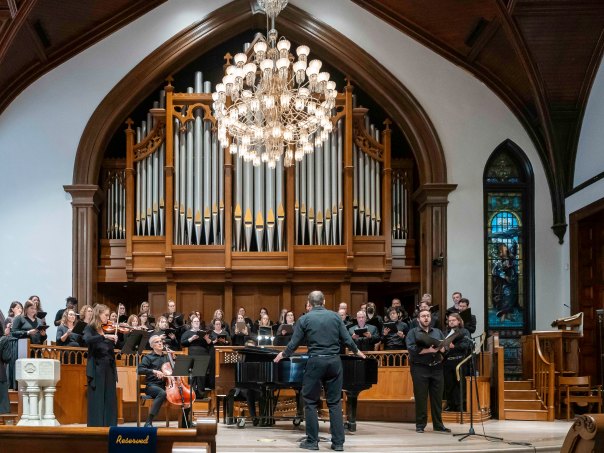
May 17, 2025, Charlotte, NC – Noted singer, conductor, and educator Helen Kemp (1918-2015) was most concerned with the musical training and development of children through children’s choirs when she coined her beloved mantra, “Body, mind, spirit, voice. It takes the whole person to sing and rejoice.” But in times of widespread warfare, terrorism, societal fracturing, and political upheaval, the Charlotte Master Chorale aptly adopted these words to subtitle its final concert for the 2024-25 season. Their “Wholeness” concert, conducted by Kenney Potter and Philip Biedenbender, affirmed the First Presbyterian Church of Charlotte as a place of healing, harmony, and communal gathering.
With Alex Berko’s Sacred Place as the centerpiece of the program, ecumenical engagement became the most salient feature of Wholeness for me. Between Shabbat morning services at Temple Israel of Charlotte and a Charlotte Symphony concert at dusk with works by Jewish composers Bernstein and Copland topping the marquee, Wholeness – and especially Sacred Places – proved to be a surprisingly perfect bridge. Berko’s six-part service is modeled on Jewish liturgy, with four of the six sections bearing the Hebrew title of a foundational prayer. These core elements of this prayerful suite were framed by an identical opening and closing prayer, excerpted from Wendell Berry’s 1966 poem, “The Porch Over the River.”

The prayers became a distillation of the poem, where Berry’s porch was the most benign human intrusion upon the primeval serenity of nature at a wooded riverfront. As for the Jewish service, texts chosen by Berko were only obliquely connected to the original Hebrew – actual connection in the instance of “Amidah” vestigially retained only in the composer’s introductory note. The music echoes the transition in Berko’s chosen texts from the hushed tranquility of Berry’s riverscape to John Muir’s evocations of majesty and glory in his eloquent description of Yosemite. It was originally sent to Theodore Roosevelt, urging the president to preserve this magnificent temple of nature. Only the connection between text and the literal meaning of “Amidah,” mostly a silent prayer said while standing, remained obscure.

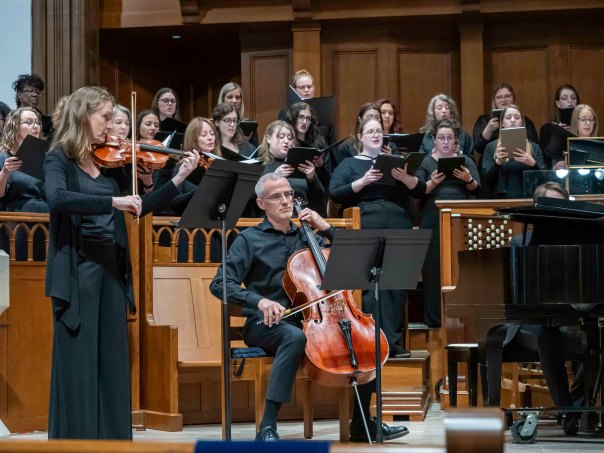
Musically ranging from solo vocals to grand choral proclamations – accompanied by violinist Sarah Case and cellist Peter Case, with Biedenbender at the keyboard – the “Amidah” was only slightly eclipsed by the ensuing “Shema,” which superbly referenced the cornerstone of all Jewish prayer. Orthodox Jews will have the words of the “Shema” on all their doorposts and say them at least two times daily, if not three, biblically enjoining Israelites to listen and hear that the Lord is their god and the Lord is one. For this pivotal section, Berko chose William Stafford’s 1961 poem, “In Response to a Question: ‘What Does the Earth Say?’” Unlike the voice of the Lord, thundering from the peak of Mount Sinai and proclaimed by Moses to the people below, Stafford strains to hear what the earth says. Presumably, the poet has divined its message: “The earth says have a place, be what that place requires…” So again, Berko’s music roars and whispers.

Text for the “Mi Shebeirach” had a smidge of Hebrew in it, but contrary to Berko’s belief, it was not a translation of the actual prayer. Instead, it was taken verbatim from a setting that Debbie Friedman had written for the prayer in 1993, using the English she had interspersed with the original Hebrew. The Friedman version has amazing popularity, widely replacing the original “Mi Shebeirach” prayer across the English-speaking world, so Berko’s mistake is not unusual. Nor is it the worst.

A drama that was judged for the 2013 Jewish Plays Project, The Man in the Sukkah, presumed that the song, with its mishmash of Hebrew and English, was sung by persecuted Jews during the days of the Holocaust. When Berko’s setting reached the brief Hebrew phrase in Friedman’s lyric – “Bless those in need of healing with r’fuah sh’leimah” – the section, which had been more like recitative until this point, swelled with melody and feeling. The section that followed, “Kaddish,” retreated briefly toward the quietude of “Closing Prayer” with a snippet from Rabidranath Tagore’s Stray Birds (No. 273). It was good to have the delayed final words, “at the margin of starry silence,” printed out in the program booklet for the sake of clarity – and to fully savor the music’s sublimity.

Although the other nine pieces on the program didn’t benefit from the favor of being printed out – or credited, when the lyricist was not the composer – they were all worthy of the Wholeness theme. None of them were at all too brief, cute, or at all bouncy. The closest to rejoicing was Reginal Wright’s “We Are the Music Makers.” Less facile and more propulsive was the Adam and Matt Podd arrangement of “How Can I Keep from Singing,” with touches of melancholy throughout, especially in its concluding decrescendo.

The most intimate and solemn of the short works was Don Macdonald’s “When the Earth Stands Still,” with lyrics by the composer that merited inclusion alongside Berko’s texts. But the most remarkable piece of the afternoon was arguably Craig Hella Johnson’s beauteous, slightly sugary “Psalm of Life,” set to one of Mattie J.T. Stepanik’s Heartsongs. Before succumbing to a rare form of muscular dystrophy at the age of 13, the astonishing prodigy appeared on TV with Larry King, Oprah Winfrey, with former president Jimmy Carter on Good Morning America, and on New York Times bestseller lists on multiple occasions with his books of poetry and essays. Like all the other composers and writers behind the Wholeness concert, I’d never been acquainted with Stepanik before. He was a revelation to me among revelations.

Review: “Messiah” at Knight Theater

Handel’s Messiah Rejoices Greatly with Charlotte Symphony

By Perry Tannenbaum

December 13, 2024, Charlotte, NC – While I’m not as faithful to the Yuletide visitations of George Frideric Handel’s Messiah as I was ages ago at Queens College CUNY, where I attended free concerts at least three of my four years, my diligence has lately improved. In the last decade, I’ve seen four performances, counting the one that launched this weekend’s run at Knight Theater, with Kenney Potter preparing the Charlotte Master Chorale and guest conductor Julian Perkins leading the Charlotte Symphony. I’d actually had my heart set on a Messiah performed at the Teatro Colón in early November, but an unresponsive press office and an unexpected dress code, discovered at the box office after we had landed in Buenos Aires, thwarted our plan.

Wrapped into our plans were an opportunity to hear how a Bach choir flying in from Stuttgart would handle the King’s English, and how the vocalists would compare with our esteemed Chorale and guests. Not to mention the fabled acoustics of Teatro Colón. Lacking those Argentinian comparisons, I can still say that the Chorale was a match for any chorus I’ve heard in Messiah, and that the guest vocalists were the best I’ve heard in recent memory, including those who performed with the New York Philharmonic in 2015. Those who look for a massive orchestra might have reason to pause before rushing to the Knight, for the scale of forces led by Perkins seemed more like the North Carolina Baroque Orchestra that performed with the Chorale at First United Methodist in 2018 than the band we saw at the Knight in 2017. Over a dozen different orchestrations evolved during Handel’s own performances of Messiah over 17 years, from 1742 to 1759, so Perkins could easily match a version to the number of his orchestral recruits.

Leading from behind a harpsichord – pretty novel in itself – Perkins had some interesting ideas on staging, deploying the brass to the balcony for their dramatic entrance into “For unto us a Child is Born” and then after intermission, bringing principal trumpeter Alex Wilborn downstage for a climactic “The Trumpet Shall Sound” confrontation with bass baritone Hadleigh Adams. Otherwise, it would seem presumptuous to say that Perkins, for all his Handel and Baroque expertise, directed any of the four guest soloists at all. Each one of them was magisterially confident and self-assured. Hadleigh was not the least of them in that regard, striding auspiciously to centerstage for the first time and quaking the hall with his “Thus saith the Lord” proclamation. After delivering his towering “Why do the nations so furiously rage together?” rebuke at the crest of Part 2, Hadleigh loudly clapped his book shut and stormed back to his seat.

Richard Pittsinger was not quite so flamboyant, for the tenor wore his hair the same way before and after intermission. But his impact came sooner with supremely creamy accounts of the “Come ye, my people” recitative and the “Ev’ry valley shall be exalted.” He truly made the “rough places plain” again and again with soft floating glides that never strained his breath control. Drama was definitely in his arsenal, just before the climactic “Hallelujah” chorus, when he delivered one of the more militant verses of the Psalms, “Thou shalt break them with a rod of iron.”

It was no less difficult deciding whom to love most among the women. Mezzo-soprano Diana Moore sang her first air, “But who may abide the day of His Coming,” so richly and dramatically that I could hardly wait for her return in “O Thou, that tellest good tidings to Zion” so she could conquer its challenging low notes. Even the QR code on the program sheet doesn’t lead to the text, so Moore faced a more amusing hurdle when she came to the “spitting” in her “He was despised and rejected of men” air near the beginning of Part 2. Pronounced too diffidently, the audience might wonder what was said – too emphatically and you risk laughter. Passing that test, she went on to a satisfying Part 3 duet with Pittsinger in “O death, where is thy sting?”

Less tasked and dramatic but far more lyrical, soprano Anna Dennis dazzled in each of her airs, especially in her first splash late in Part 1, “Rejoice greatly, O daughter of Zion!” Here the refrain ideally exemplified how spectacularly Handel brought his lyrics to life. Equal to the joy she delivered here was the sanctified tenderness Dennis lavished upon “I know that my Redeemer liveth” launching Part 3. The effect was all the more ethereal for the effortless way that Dennis reached her highest notes.

Of course, the “Hallelujah” and the closing “Amen” fugue make the mightiest, most lasting impressions, but the Chorale delivered drama and delight all evening long. They were hardly accompanied by more than the harpsichord and organ until the brass and sawing violins exploded into “Wonderful! Counsellor!” in the incomparable “For unto us a Child is born.” The dynamic was no less dramatic toward the end of the evening when they reached the shuttling between gloom and jubilation in “Since by man came death.” Most exquisite, perhaps, was the delicacy Potter and Chorale endowed upon “All we, like sheep, have gone astray” seemingly more staccato than we’d ever heard it before. A disagreement seemed to arise whether it was “glorify” or “purify” when the Chorale broke into so many contrapuntal groups for “And He shall purify.” Any other blemish in the evening was almost impossible to detect.
Photos by Perry Tannenbaum

Ryan Clicks with the Master Chorale in a Walloping CSO Debut

Review: A German Requiem at Belk Theater

By Perry Tannenbaum

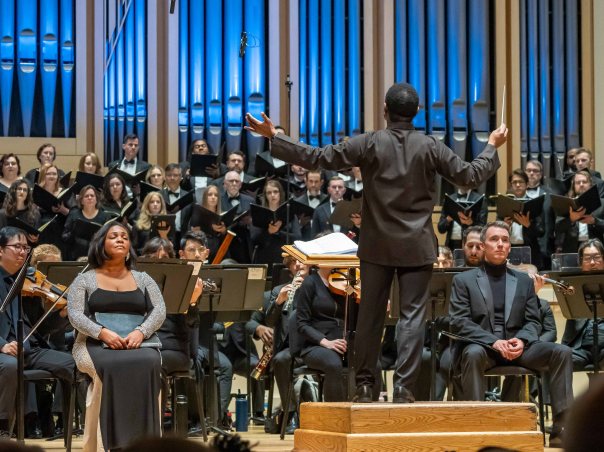
November 22, 2024, Charlotte, NC – In Kwamé Ryan’s first full season as the new music director of Charlotte Symphony, we aren’t getting to see him perform as much as we would hope, but when we do see him onstage at Knight Theater or Belk Theater, he always appears to be overjoyed to be here. Ryan was absolutely beaming as he took the Belk’s centerstage for the first time as CSO’s leader – and he certainly didn’t wear out his warm welcome, delivering a walloping performance of Johannes Brahms’ Ein deutches Requiem. Even before Ryan’s arrival, the new season has proven to be adventurous and diverse in its programming, showcasing fresh repertoire and youthful guest soloists.

Subscribers can judge for themselves whether Ryan’s outré intro to his debut program, coupling the Brahms with Latvian composer Pēteris Vasks’ Musica Dolorosa, was a sign of confidence or a symptom of nervousness. Whether or not my recollection can be trusted, Ryan’s scripted intro was unprecedented. Some intros we may have seen in the past could be dismissed as gratuitous – or countenanced as witty fluff. Here, Ryan’s intro was necessary, for we needed to be prepped for how the program would be delivered: without a pause between the music of the two composers. That would also be fairly unique. Our new maestro was crafting an experience.

Indeed, Ryan’s preface was necessary for another reason. Vasks’ piece flowed into the Brahms so smoothly it was as if they were written in collaboration and in the same key. Outside that merging point, the two pieces were quite different in the ways that they dealt with death. Responding to his sister’s untimely death, Vasks voiced his personal despair and compounded his feelings with grieving for his nation, still subject to Soviet rule when the Dolorosa premiered in 1984. Written for string orchestra, the mood of the opening section of Dolorosa may put you in mind of Barber’s Adagio. But the Vasks elegy eventually transcends the sameness and the hypnotic monotony of Barber’s dolor with louder and more piercing pain.

As the lower strings tap and strum percussively, Vasks gradually quickens the pace and turns up the volume as the beat becomes more insistent and dramatic. Once the dynamics peak, the strings, now smoothed out with a cessation of the percussion, become even more disturbing, tossing away pleasant tonality in a disciplined cacophony of fearsome chaos. The slashing lower strings, however, hadn’t been vanquished. They punctuated this harshness and dissonance at its height, seemingly puncturing it, for the noise homogenized into the sound of a diminishing wind or a siren receding into the distance – clearing the way for the quietest and most memorable episode in the Dolorosa. Principal cellist Jonathan Lewis, echoing the opening bars, played an eloquent lament from his downstage seat, accompanied only by the low mysterious hum – like a bass clarinet or a contrabassoon – emanating from upstage, hidden from my sight. The higher strings now took up the cello’s increasingly bold cry and built it to raw anguish.

The slightly hushed and abrupt ending of the Dolorosa nicely conformed with Ryan’s concept, and it dispensed with the shuffling of chairs usually necessary for the transition to full orchestra with winds, brass, and drums. Nor were the troops of the Charlotte Master Chorale obliged to parade in from the wings and settle into their perches above the Symphony. That honor was reserved for the guest vocalists, soprano Janai Brugger and baritone Alexander Birch Elliott, gracefully delayed until well after the transition between the Dolorosa and A German Requiem. The Brahms is not new to the CSO, last given by Christopher Warren-Green almost exactly 10 years ago – after his predecessor, Christof Perick, had presented it (already for the second time this century) in 2005.

With its consoling attitude, the Requiem is not at all a bad fit for the holiday season. You’re likely to recognize more than a couple of verses from the Brahms, conveniently projected in supertitles, as German translations of verses from Handel’s Messiah, the most beloved musical birthday celebration that we have. Most notably, you’ll get an Oktoberfest taste of “The trumpet shall sound.” Maybe sitting down in the orchestra, as opposed to the Grand Tier Circle, accounted for the heightened thunder of Ryan’s rendition, but Symphony somehow sounded crisper. The sudden sforzandos struck like a punch to the jaw, yet Ryan kept the ensemble under strict control, never threatening to overwhelm the hall with volume, emphatically relishing the work’s percussive moments.

Both Brugger and Elliott shone in their debuts. There was a noticeable Renee Fleming-like milkiness and sheen to Brugger’s voice, most appropriate for the motherly comfort she delivered in “Ihr habt nun Traurigkeit (You now have sorrow).” Elliott was even more impressive in his larger workload, a more pleading “Herr, lehre doch mich (Lord, teach me),” bolstered by a lusty Chorale response, before he delved into the “trumpet shall sound” mystery and affirmation of “Denn wir haben hie keine bleibende Statt (For here we have no everlasting city).” Belatedly, Music Chorale artistic director Kenney Potter was summoned onstage to share the credit for his singers’ brilliance and verve. He was absolutely beaming with delight.

Photos by Perry Tannenbaum

“Christmas: Home” Shows Off Charlotte Master Chorale and T. Oliver Reid in Sublime Light

By Perry Tannenbaum

December 8, 2023, Charlotte, NC – We’ve reached that season when the arts calendar fills with a cluster of productions that reprise Dickens’ Christmas Carol, Handel’s Messiah, and Tchaikovsky’s Nutcracker – a rather traditional season not noted for novelty or wild innovation. So it’s nice to survey the Yule schedule and find events that even gently push the envelope and attempt to trailblaze with new styles like cirque or soul, or entertain the possibility that, come December, we’re not completely averse to secular fare.

Better yet, amid a thicket of Nutcracker and Christmas Carol variants, we could find Charlotte Symphony venturing beyond its customary Holiday Pops medleys to a “Soulful Christmas” or Charlotte Master Chorale taking a thematic approach with “Home.” Although I prefer the acoustics at Symphony’s venue, Knight Theater, over First United Methodist Church, guest artist T. Oliver Reid tipped the balance for me in favor of Chorale’s “Home,” where he shared the pulpit with the choir, conducted by Kenney Potter, and pianist Philip Biedenbender.

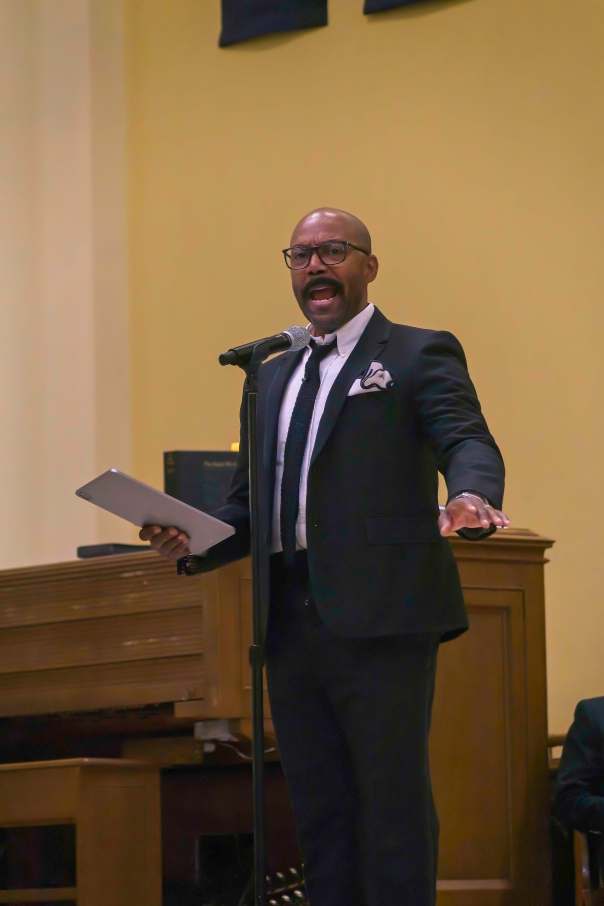
Very likely, I’d seen Reid long before he took over the role of Hermes in the Broadway production of Hadestown for nearly three months in 2022, since he figured in productions of Thoroughly Modern Millie, La Cage aux Folles, and After Midnight that I had witnessed over the years (in 2002, 2004, and 2014) during my pilgrimages to the Great White Way. A native of Metrolina who appeared in Shenandoah at Little Theatre of Gastonia long, long ago, Reid may have traveled far to participate in this holiday gig, but he could certainly identify with the homespun theme. In his bag of goodies, Reid brought a couple of songs from The Wiz, including his opener, “Soon as I Get Home,” and his finale, “Home.” With a silken voice that stretched lower and more richly beyond my expectations, Reid hit home runs with both these songs that are usually belted by Dorothy.

Potter’s programming for “Christmas with the Charlotte Master Chorale: Home” consistently accommodated this kind of generous latitude. Of course, there were seasonal favorites tailored for the theme, including “I’ll Be Home for Christmas,” Mel Tormé’s “The Christmas Song,” and – presented as a Biedenbender instrumental – “Home for the Holidays.” Nobody onstage at First United displayed any liking for the Christmas songs I dread and loathe, so we were never assaulted with the annoying fun of “Jingle Bells” or the torturous tedium of “The Little Drummer Boy.” Nor were the unexpected readings from Reid overladen with saccharine or sentimentality. Sara Teasdale’s “A Winter Night” and Ella Wheeler Wilcox’s “The Year” were both somber and seasonal. Even the excerpt from the Dickens classic, “Ignorance and Want,” refrained from depicting a vapid, gleeful wonderland.

“Christmas Dreams,” “Be Born, O God,” “Lost in the Night,” “Prayer of the Children,” and “Music in My Mother’s House” were all new to me. Similarly, I doubt that composer Alan Menken figures prominently on many Spotify songlists for Christmas, but Potter, Biederbender, and the Chorale dipped into his catalogue twice, for “God Bless Us Everyone” from his musical version of A Christmas Carol and – far more unexpected – “Someday” from The Hunchback of Notre Dame, written with Stephen Schwartz.

For me, Schwartz actually upstaged his collaborator with his other selection, “Through Heaven’s Eyes” from The Prince of Egypt, since it sprinkled the program with the right amount of levity along with Jerry Herman’s “We Need a Little Christmas” from Mame. Musically, “Through Heaven’s Eyes” took us closer to Jerusalem than Rome, for the sound had unmistakable klezmer flavoring. “Simcha” from the same musical where Moses is the protagonist, might have had a little more Jewish flavor and the liberating spirit of Chanukah, but “Through Heaven’s Eyes” was the most extravagant entertainment of the evening – and the Master Chorale clearly delighted in backing Reid up with their syncopated, klezmer-kissed la-las.

After an acapella rendition of “The Christmas Song” by the Chorale – with Reid repeating the final bars – the program built to a simple and sublime climax as Biedenbender accompanied Reid in a fervid rendition of Adolphe Charles Adam’s glorious “O Holy Night.” I’d never known that the song had three stanzas in English, compared to just two in the original French lyric by Placide Cappeau that inspired Adam. We can thus forgive a Celine Dion for only singing two, but for Reid to sing a second and a third stanza provided a wonderful surprise and a singular experience.

Master Chorale Excites and Excels With Superior Renditions of Dett & Bernstein

Review: Dett & Bernstein at the Cain and Gambrell Centers

By Perry Tannenbaum

September 28 and 30, 2023, Cornelius and Charlotte, NC – Historically, a collaboration between Charlotte Symphony and the Charlotte Master Chorale is far from a groundbreaking event, since the two organizations had been joined for a while before breaking apart when Symphony absorbed the original Oratorio Singers of Charlotte after many years of proud collaboration. But when the rebranded Master Chorale not only partners with Symphony but also with two additional choirs, the Queens University Chamber Singers and The University Chorale of UNC Charlotte, something special must be brewing. Bring in five guest solo vocalists and expectations rise to Mahlerian proportions. That wasn’t the kind of extravaganza that the longtime collaborators had in mind, however, when they conceived their Dett & Bernstein program and reached out so dramatically.

Less intimidating, the event at Gambrell Center, on the Queens University campus, was a welcoming epic of diversity and inclusivity. For all the ensembles never gathered grandly together in symphony-of-a-thousand fashion. R. Nathaniel Dett rightfully headlined the bill, for The Ordering of Moses (1937) is more than double the length of Leonard Bernstein’s Chichester Psalms (1965) and armed with more vocal soloists and instrumental artillery. In something of a tune-up for the Gambrell event, the Master Chorale and Symphony had performed both of the headliner pieces at the new Cain Center in Cornelius two nights earlier. Neither of the University ensembles made the trip up I-77 to Cornelius, but tenor Jason Dungee, who would sing the title role in Dett’s oratorio, is also director of UNCC Chorale, so a couple of his prize students mysteriously appeared as two of the four adult solo singers in Chichester Psalms, obviously smuggled onto the tour bus.

Losing out on seeing the full University choirs, missing the opportunity to hear the gems by Adolphus Hailstork and Margaret Bonds that kicked off the Saturday program at Gambrell, the Cain Center still had the honor of hosting the North Carolina premiere of The Ordering of Moses. Commissioned by the May Festival Chorus, who premiered the piece in Cincinnati, the piece triumphed in front of the festival audience, but its live national NBC radio broadcast was abruptly snatched from the airwaves about 40 minutes into the performance, clearly a craven cave-in to a few racist listeners. Righting this wrong, if not the subsequent neglect of Dett’s oratorio, Moses was revived by the Cincinnati May Festival in 2014 and given a Carnegie Hall premiere a few days afterward – adorned with a live broadcast by WQXR that was not aborted.

As the Bridge recording of that concert demonstrated, the revival conducted by James Conlon was well-deserved. Hearing the live performance with Chorale artistic director Kenney Potter conducting the Charlotte Symphony was a very different experience from the sonorous broadcast version on the Bridge label, longtime champions of American composers. From the start, the work of Symphony’s assistant principal cellist Allison Drenkow stood out more boldly in relief, yielding a better grasp of how Dett structured his piece, for there are cello solos strewn throughout the piece, acting as friendly bookmarks, that she gorgeously performed with gossamer tone. Nor were the vocal soloists less than the equals of their Carnegie Hall counterparts, mezzo Sarah Brauer bringing wondrous elan to The Voice of Israel, soprano Anne O’Byrne fortifying Miriam in her biblical song and in duets with brother Moses with her fervor, and bass-baritone Marques Jerrell Ruff thundering The Word and afterward The Voice of God – with rumbling timpani quaking the earth around him.

In his introductory remarks during a pre-show segment, Dr. Marques L.A. Garrett had us looking out for the core of Dett’s music, the two themes of “Go Down, Moses.” The famous refrain theme peeps in behind a veil of different melodies, most notably the keening “When Israel was in Egypt land” theme before the full chorus breaks forth – after a vocal trio from Brauer, O’Byrne, and Ruff followed by a swirl of cellos and a bassoon – with the fortissimo command, further developed with fugal filigree. Yes, Ruff’s Voice of God is a tough act to follow, but who knew that Dungee, rising from his seat with the aid of a cane, had such a piercing, rafter-cracking tenor voice to answer the Almighty’s call? The dialogue between God and Moses was a thrilling highlight, enough for me to justify attending the second North Carolina performance as well as the first.

Fresh rewards awaited me at the Gambrell that lived up to my expectations. The Master Chorale is a large chorus, too large to share the Cain Center stage with Symphony, so they doubly split on both sides of the audience on two levels of the building. Gambrell Center has a more commodious hall and stage, but only one side level for deploying the choristers, so the Master Chorale waited to make their appearance while the two University choirs gathered on opposite sides of the audience, spilling onto short flights of stairs the led up from the orchestra to the sloped exit aisles. To our right, Dundee led the UNC Charlotte ensemble in two songs by Hailstork (b. 1941). Crucifixion or not, “My Lord, What a Moanin’” had a grace and energy worthy of a program finale or an encore. The hushed and reverent “Blessed Is the Man” was written as a gift specially for Dungee, who chose Hailstork as the subject of his doctoral dissertation, and the tenor’s fondness for the piece suffused his choir’s performance.

Not to be outdone by her UNC Charlotte colleague, soprano Sequina DuBose has had a song cycle written by Maria Thompson Corley for her recent Blurred Lines: 21st Century Hybrid Vocal Works recording on the Albany label, reviewed at this site earlier this year. You could say she crossed the line when she appeared as a guest soloist with the Queens U Chamber Singers in excerpts from Credo by Margaret Bonds (1913-1972) – if there were a rivalry between the two schools rather than hospitality and fellowship. Set to a prose poem by W. E. B. Du Bois, the posthumous Credo was premiered by Zubin Mehta and the LA Symphony shortly after Bonds’ death but not recorded until earlier this year on a magnificent Avie Records release by the Dessoff Choirs and Orchestra.

Presented at Gambrell with a spare piano accompaniment, the performance was admirable for its promptness, but it gave only a hint of the work’s full grandeur when heard unabridged with a full orchestra behind it. At Gambrell, pianist Brenda Fernandez provided all the accompaniment. The complete work, now that it has conquered with a brief foretaste, should be on top of Charlotte Symphony’s short list of new and newly-discovered pieces to be programmed at their Uptown venues.

Nor was DuBose to be outdone in her rendition of the second song in the six-song suite, “Especially Do I Believe in the Negro Race.” If you’ve heard her luminous performance of “Summertime” in two extended runs of Porgy and Bess in Charlotte, most recently with Opera Carolina back in January, or her Elvira in Don Giovanni, you won’t be surprised to learn that the smoothness of her tone and the clarity of her diction far eclipse what you might hear on Spotify in the world premiere recording.

Recordings do have an influence on repertoire selection, which may be why I’ve never heard Charlotte Symphony perform Chichester Psalms before – and why I haven’t heard a performance of Bernstein’s paean to peace in the Queen City since 2009, when Carolina Voices’ Festival Singers brought a slimmed-down version of the work to Temple Beth El for a Yom HaShoah commemoration, accompanied by piano, percussion, and harp. Marin Alsop’s version of the work on Naxos with the Bournemouth Symphony and Chorus is only slightly less wretched than Bernstein’s own version on DGG with the Israel Philharmonic and the Vienna Boys Choir.

Both of their engineering teams failed them miserably in the pivotal middle movement, where Bernstein juxtaposes the incandescent Psalm 23, “The Lord Is My Shepherd,” sung by a boy soprano, with the angry Psalm 2, sung by the Master Chorale in a sudden crescendo. The Hebrew text is probably most familiar to us via the powerful aria in Handel’s Messiah,“Why do the nations rage so furiously together, and why do the people imagine a vain thing?”

To replicate the dynamic range so easily rendered at the Cain and Gambrell Centers, you’ll need to turn your volume knob to the one or two o’clock position to make out the boy soprano faintly in the outer sections of this movement – and hurriedly turn back to the 11 o’clock position for the midsection to avoid waking your wife and neighbors when the full chorus unleashes their fury. Even sitting at the front end of these halls, I never felt assaulted by the fortissimos: acoustic balances and clarity were always tight. It was a joy to hear Calvin Potter singing the soprano part so clearly, stealing nervous glances at his dad on the podium as he awaited his cues. The boy was nearly perfection on the Hebrew until his unfortunate gaffe in the final line, mispronouncing the penultimate word at both performances.

Immediate consolation gushed forth after the Potter lad departed, for the final Chichester section, set to the warm and placid Psalm 131 with a sprinkling of 133, is preceded by a gorgeous orchestral lament that brought out Symphony’s best playing of the night. The transition between these last two Psalms was also treasurable, a lovely cello quartet. A wonderful vocal quartet – including those two UNC Charlotte imports – led into the final sublime fadeout, dominated by the women’s treble. Again: the last minute of Chichester Psalms was divine in live performance, but turn your hi-fi volume past 12 o’clock at home.

Mozart Requiem Clashes With Sunny Salieri Symphony

Review: Charlotte Symphony “Mozart and Salieri”

By Perry Tannenbaum

It’s been 40 years since Peter Shaffer’s Amadeus vilified, ridiculed, defamed, and demonized Mozart’s less-gifted contemporary, Antonio Salieri, presenting the prolific composer and conductor as Wolfgang’s fiendish murderer. Shaffer wasn’t the first to riff on this unfounded smear, for the great Russian poet Alexander Pushkin peddled it in Mozart and Salieri, his 1830 verse play.

Although he omitted his villain’s name from his title, Shaffer has proven equally bountiful to both composers, humanizing Mozart and bringing fresh life to Salieri’s name. Ian McKellan won a Tony Award as Salieri in the 1980 Broadway production and F. Murray Abraham repeated the triumph in the 1984 Miloš Forman film, winning the Oscar over Tom Hulce, who was a runner-up playing the title role.

So it’s altogether fitting that Salieri’s 1775 Symphony in D “Il giorno onamstico,” likely marking the Italian’s Belk Theater and Charlotte Symphony debuts, should be in the shadow of Mozart’s Requiem. During the composition of this work, which remained unfinished at his death, it was Mozart who first voiced the suspicion that he was being poisoned and that his mysteriously commissioned Requiem was diabolically planned for his own funeral.

Mozart later scoffed at his own poisoning paranoia, and the Requiem wasn’t premiered until late 1793, two years after his death, completed by his student, Franz Xaver Süssmyer. But the baseless murder accusation affixed itself to Salieri. And why not take advantage of Shaffer’s preposterous mythologizing if it draws more people to the music? Symphony was only too glad to borrow the indelible Amadeus poster art for this concert’s prepublicity. “Poor Salieri!” said Charlotte Symphony music director Christopher Warren-Green, upon picking up a hand mic to introduce Antonio’s piece.

That was after a reprise of Nkeiru Okoye’s “Charlotte Mecklenburg,” which received its world premiere last September, kicking off the current season. The encore was triply justified: the piece was originally performed one night only at a special opening night gala and not part of the season’s subscription, we’re still celebrating the 250th anniversary of the city’s incorporation, and the piece – commissioned by Symphony – is non-threatening to traditionalists and worth a second hearing.

It was easier for me to ascertain on my second go-round that the opening theme, very much in the Aaron Copland manner of evoking Appalachia and the American heartland, was something that Okoye would circle back to near the end of her historical portrait. What came in between statements of her “Queen City Hymn” was more daring and original. There was urban bustle and cacophony mixed with a mountain lilt, snatches of a Scottish fiddle tune and a post-Civil War protest song, and an unexpected glance southward.

A brief marimba concerto popped up, then a muted trumpet and a cool samba beat. Okoye’s objective of portraying the city’s multiethnicity was more successfully reached than her objective of depicting our racial tensions. The codetta, beautifully played by harpist Andrea Mumm Trammell, expressed hopes for the future residing in the innocence of our children. Or that was Okoye’s stated intent. For an affirmation, it was notably faint.

Not at all saturnine like Salieri’s stage and screen image, his Symphony in D was sunny and cheerful from the outset, the opening Allegro launched with a lively flourish of horns and winds. Both of the middle movements offered opportunities for principal bassoonist Olivia Oh. The charming Larghetto remained summery in spite of its weepy violins, and the Minuet alternated attractively between mellow and anthemic themes. Warren-Green vigorously pushed the pace of the closing Allegretto, lightly carried forward by the strings when the winds weren’t adding body and zest.

When the entire orchestra joined together toward the end of “The Name Day,” the music briefly grew joyous and grand. It was almost as if Salieri was apologizing for this outburst when the strings alone crept around stealthily in staccato phrases, but the whole orchestra came back for a crisp, good-humored finish.

Warren-Green’s programming effectively flipped the Hulce-Abraham characters we remember from Hollywood’s Amadeus, assigning all the frivolity to Salieri, but he didn’t mess with the awesome impression of Mozart’s Requiem that lingers after we have seen the film. Unlike some of the Mozart performances we’ve seen before from Warren-Green and his predecessor, Christof Perick, a robust assembly of musicians, guest soloists, and the Charlotte Symphony Chorus filled the Belk stage.

If the occasionally fierce reading that emerged from this formidable congress didn’t totally accord with Mozart’s accepting intentions, there was no doubting its power. The “Dies irae” rang out impressively, taut with terror, and the “Tuba mirum” was a fine spotlight for all four guest vocalists, particularly bass Adam Lau, smoothly accompanied by principal trombonist John Bartlett before giving way to tenor Isaiah Bell. Having already distinguished herself in the soprano section of the opening “Requiem aeternum” segment with the Chorus, Margot Rood floated in gracefully over mezzo Sofia Selowsky toward the end of the “Tuba.”

Overshadowed here somewhat, Selowsky had better opportunities further along in the mass, leading off the “Recordare” and “Benedictus” sections when all the solo vocalists stood up again. Still it was Rood who shone brightest, drawing the opening moments of the concluding “Lux aeterna” and sprinkling her loveliness all over before the music grew grander and fugal with the full ensemble joining in.

The orchestra made its presence known most emphatically when the brass and timpani underscored the most dramatic choral moments. Aside from the whiplash “Dies irae,” there was ringing majesty at the start of the “Rex tremendae” that contrasted affectingly with the hushed women when we reached the “salve me” pleas. Symphony Chorus showed more finesse in the “Lacrimosa,” beginning softly over the orchestra’s keening strings, with some satisfying crescendos preceding the satisfying “Amen.”

Warren-Green and chorus director Kenney Potter may have been thinking more of Buckingham Palace than a church when they prepared Symphony Chorus for the climactic “Sanctus.” Both the orchestra and the choir suffused the repeated holies with a pomp and fervor of “God Save the Queen” proportions. Or maybe they had Westminster Abbey in mind. Warren-Green has played that joint as well.

Newly-Minted Charlotte Master Chorale Couples with NC Baroque for Wonderful “Messiah”

Review: Handel’s Messiah

By Perry Tannenbaum

Backed by the Charlotte Symphony Chorus, formerly the Oratorio Singers of Charlotte, performances of Handel’s Messiah by the Symphony have been a fairly consistent holiday staple over the years. Since 2002, the only gaps on my calendar have occurred in 2009, 2011, 2012, and 2016. Until this year, when Symphony passed on performing the Handel masterwork, Symphony Chorus would also sit out. But with the new Charlotte Bach Festival spreading its wings here, in Gastonia, and in Winston-Salem over a full week in June, piloted by former Oratorio Singers music director Scott Allen Jarrett, there’s a new Baroque fervor in the air – and evidently new connections for the Charlotte Symphony Chorus and current Symphony director of choruses Kenney Potter to explore. As a result, Symphony Chorus, newly rebranded for the holidays as the Charlotte Master Chorale (with a PO box in Matthews, so stay tuned), is giving three Messiah performances under Potter’s direction. Joining them for two of the performances at First United Methodist Church – and the third in Gastonia – is the North Carolina Baroque Orchestra, which certainly enhanced its stature at the June festival.

The concerts mark the return of the Chorale to First United, performing Messiah there for the first time since they were still the Oratorio Singers in 2004, but it obviously represents a departure as well, for the 24-member NC Baroque performs on authentic period instruments, including two valveless trumpets and a double-necked theorbo, and its musicians adhere to Baroque performance practices. Though originally presented in a concert hall, I couldn’t help feeling that the church, the authentic instruments, and the reduced orchestra brought us closer to the Messiah that Handel originally imagined – and what amazed Dubliners actually heard in 1742. Compared to Belk Theater, which flings the sound of the Chorus at us, First United seemed to cuddle, warm, and slightly mute Master Chorale’s sound before it wafted over the musicians’ heads. From beginning to end, they were ideal, exactly what you would hope for in a city known for its churches.

Perhaps the best example of the Baroque Orchestra’s mettle was in its effortlessly fleet introduction to Master Chorale’s “For Unto Us a Child Is Born” and in the gritty churning of the strings that underpinned the climaxes at “Wonderful! Counselor!” The ensemble’s jubilation was thrilling and infectious, but they also showed their affinity for sacred music when they dug into the intro and accompaniment for “I Know That My Redeemer Liveth.” Individually, I would single out the work of first trumpeter Doug Wilson in the triumphant “The Trumpet Shall Sound.”

Of course, the biggest variables at annual iterations of Messiah are the solo vocalists. How would Potter fare on recruitment? Here we had the best news of all, for all four of the guest performers were eager, strong, confident, and at ease. Soprano Awet Andemichael and countertenor Timothy Parsons were seated on the audience left side of the stage, with tenor David Vanderwal and bass baritone Jesse Blumberg at our right. Evaluating their performances is largely a matter of cataloguing what each of them sang and lauding the pure tone, genuine feeling, and impeccable breath control they brought to each piece, with the possible exception of Vanderwal, who only had one extended chance to shine and hit his home run on “Thou Shalt Break Them” late in the evening, making his mark with the rigor of his attack on the verbs, break and dash.

Andemichael was the most facially expressive and theatrical of the soloists, showcasing her soothing declamatory capabilities in the “I bring you good tidings” recitative and the suppleness of her coloratura in “Rejoice, Greatly.” Listening to Parsons on “Thou That Tellest Good Tidings,” I admired his ability to reach the low note of “Judah” without scooping, as many contraltos do, but I worried whether he would be able to attack the “He Was Despised and Rejected” air with the necessary forcefulness. Not only did he render “He gave His back to the smiters” with true grit, he also managed to negotiate “spitting” without sounding pompous or silly.

Here it should probably be mentioned that the vocalists were refreshingly uncommitted to authenticity, adding the extra syllable at the end of past-tense verbs only when the melody compelled it. Blumberg especially gratified me when he didn’t add the extra syllable to “The People That Walked in Darkness” every time he repeated the verb. A relaxed, America manner is not amiss here. From the moment we began to hear Blumberg’s well-rounded low notes, I knew that he could rank among the best basses I’ve heard live in Messiah since I first became enamored of it in the late ‘60s up in New York at Queens College. While I might have liked to hear the conspiratorial decrescendos some more theatrical singers employ to add a little twinkle to “all nations” – after a mighty “shake the heavens” – the range, authority, and sheer beauty of Blumberg’s singing were nonpareil. Coupled with Wilson’s virtuosity, Blumberg’s was the best “Trumpet Shall Sound” I’ve heard anytime, anywhere.


Warren-Green’s Reading of Mahler’s “Resurrection” Stamps It as an Instant Favorite

Review:  Mahler’s “Resurrection” Symphony No. 2

By Perry Tannenbaum

We’ve had quite a week in and around Charlotte for jubilant choral symphonies, first with A Sea Symphony up in Davidson and now with Mahler’s stirring “Resurrection” capping Charlotte Symphony’s 85th season. Turnout at Belk Theater for the grand work was robust, especially when the many latecomers were seated after the opening Allegro maestoso. Of course, the stage was heavily populated as well, the presence of the Charlotte Symphony Chorus pushing the musicians downstage and a sizeable contingent of freelance musicians further cramping their space – extra percussion, extra woodwinds, extra brass, second harp, second timpani, and lurking somewhere offstage, four more French horns. Mezzo-soprano Maya Lahyani made her entrance halfway into the third movement for the fourth movement “Urlicht (Primal Light)” alto solo, and soprano Kathleen Kim entered during the final Scherzo to join in singing Mahler’s setting of Friedrich Klopstock’s “Auferstehungslied (Resurrection Song).”

Beyond the executive decisions to beef up the orchestra and enable the horn players to follow his baton (presumably with a video installation), music director Christopher Warren-Green was artistically faultless in managing the pacing, the dynamics, and the overarching structure of Mahler’s music. There was plenty of muscle from the double basses in the opening bars, burrowing their way toward the dazzling entrance of the brass, who were as powerful and incisive as I’ve ever heard them. The winds worked well with the brass once the basses faded, and there was lovely work from the oboes, the upper strings, and – with the only imperfections of the night – the onstage horns. Percussion during the climactic explosion was thrilling, yet the strings retained a soft, kinetic excitement in the sudden hush afterwards.

Maybe the only questionable call Warren-Green made all evening was heeding Mahler’s call for a five-minute pause between the first two movements. The break was a welcome spot after more than 20 minutes of music to finally seat those patient latecomers (watching a performance on the big screens in the lobbies is far from ideal). But the audience treated the interval like an intermission, applauding what they had already heard and, in some instances, rushing for the exits for assorted urgencies. Mahler and Warren-Green undoubtedly thought the pause was a time for reflection, a grace period to accommodate the changing mood of the second Andante moderato movement, rather than an applause cue. If Warren-Green is rethinking the pause idea after its first trial, he certainly didn’t need to question whether his orchestra communicated the contrast that followed. The opening episode was suave and urbane, radically different from the thunderous and heart-rending Allegro that had preceded, until we reached a percolating section that could remind listeners of the vivace second movement of Beethoven’s “Choral” Symphony No. 9 – not andante at all. Principal flutist Victor Wang sounded ebullient over pizzicato strings, and principal harpist Andrea Mumm provided a nice sheen over another delicate ending.

The whirling motion of the third movement could lull listeners into thinking that Mahler was revisiting the waltzing “Un Bal” movement of Berlioz’ Symphonie fantastique, but there are sudden outbreaks of brass that give this “In calm, flowing motion” movement more jagged edges. Charlotte Symphony’s brasses were undeniably forceful but never overdone, and the brassy blends in the tranquil section of this movement were outstanding. Distant horns camping out backstage until their moment were as fine as the visible players, coming into view after the last big explosion of the movement – and a pair of beautifully articulated solo spots from principal trombonist John Bartlett and principal trumpeter Richard Harris.

I could assemble a fairly lengthy list of so-so mezzos who have sung with the Charlotte Symphony over the past 25 years, but I wouldn’t include the Israeli-born Lahyani on that list. From her first sweet exclamations, “O red rose!” and “Man lies in greatest need,” there was no doubting the purity and control of this voice, perfectly pointed in a hopeful, yearning direction. Beautiful fills by principal oboist Hollis Ulaky, concertmaster Calin Lupanu, and – in the faceoff between the singer and a heavenly angel – principal flutist Wang added to the delight.

Before we reach the dazzling resurrection light of the final Scherzo, there is a tumultuous instrumental drama that is longer than the previous two movements combined. A long crescendo of portentous percussion flowed naturally into the first volley of brass. Amid the general turmoil that followed, the French horn quartet departed once more with a percussionist. Sadly, these offstage voices would be more audible than a tubular bell that was misstruck by an errant mallet about three feet above all the other instruments. But the other onstage percussion during the hushed middle of the movement, a soft bass drum tattoo under the hidden horns, was absolutely spellbinding, and the piccolo filigree from Erinn Frechette was beguiling.

Entrances by the Symphony Chorus and soprano Kim were nothing short of magical, swelling up out of thin air with their wakening affirmation: “Rise again, yes, you will rise again, My dust after a short rest!” For the last sublime six minutes or so, the voices and instruments grew in strength, conviction, and triumph until all were jubilant together, cresting with a burst of brass, cymbals, a gong, and – no misfiring this time – repeated poundings of the tubular bell. It isn’t easy to shoulder aside the various Beethoven masterworks that comprise the core of Charlotte subscribers’ favorite symphonies, but with this milestone performance from Warren-Green and his musicians, Mahler’s “Resurrection” has clearly broken through to claim its place alongside the Beethoven hegemony. The spontaneity and fervor of the standing, cheering ovation that showered down on the singers, the musicians, and the directors – including Chorus director Kenney Potter – stamped this concert as one that will be talked about and remembered for a long time.

Four Guest Soloists Combine With Charlotte Symphony and Chorus in a Walloping Bruckner “Te Deum”

Reviews:  Bruckner’s Te Deum and Psalm 150, Wagner’s “Overture to Tannhaüser,” and Strauss’s “First Waltz Sequence from Der Rosenkavalier

Georgia Jarman, soprano, performs in Rigoletto by Giuseppe Verdi in the Venetian Theater at Caramoor in Katonah New York on July 19, 2014. (photo by Gabe Palacio)

By Perry Tannenbaum

The cramped look of the Charlotte Symphony onstage at the Belk Theater clearly confirmed to me that the music we were about to hear would be similarly dense and weighty, particularly when the Charlotte Symphony Chorus arrived to fill the many empty chairs at the rear of the stage. Before those mighty liturgical choral salvos from Bruckner, we had a couple of suitable preambles gleaned from operatic scores.

Placement of the orchestra at the Belk has a noticeable impact on how they sound. Rising out of the pit, the sound of the Symphony was satisfactory enough last month when they played Rossini’s score for the Opera Carolina production of The Barber of Seville. Yet if you had seen them spread out onstage the previous weekend for performances of Beethoven’s Symphony No. 2 and Liszt’s Piano Concerto No. 1, the ensemble now sounded comparatively muzzled. A similar constriction – but not nearly so pronounced – was evident last night when music director Christopher Warren-Green launched the Symphony into Wagner’s “Overture to Tannhäuser.” With Bruckner’s Psalm 150 and his Te Deum yet to come, the Wagner overture really would seem like a prelude by evening’s end.

In between the densities of Wagner and Bruckner, maestro Warren-Green made an excellent programming choice in inserting the “First Waltz Sequence from Der Rosenkavalier” by Richard Strauss. The flatulent French horns and trombones at the beginning of the piece, followed by a tumult of the violins reminiscent of Strauss’s Till Eulenspiegel, formed a witty bridge back to the Wagner overture. A welcome oasis of comparative quietude featured some fine work principal clarinetist Eugene Kavadlo and a lilting solo from concertmaster Calin Lupanu as we leisurely traveled to the grand dancehall of Strauss’s big waltz. Warren-Green adroitly varied tempos as the familiar waltz slowly, gorgeously developed from a tentative bud to a giddy frolic before bursting forth in its full orchestral bloom.

paul-popup

Easily the shortest piece on the program, the full éclat of the Psalm 150 manifests itself almost immediately with the hallelujahs of the chorus, a battering of timpani, and flourishes of the trumpets. Lupanu exceled on a tender interlude as we transitioned from the thunder of the chorus to the sweetness of the soprano soloist, Georgia Jarman. The contrast between the chorus and the single female voice had the impact of a descent from the heavenly host of angels praising the Lord’s mighty firmament to the simple awe of a solitary human extoling his mighty deeds. Somehow the juxtaposition of that sweet episode with the finale, where all living things give praise to their creator, was even more awesome, introduced by a second volley of hallelujahs and whipping up from there to a divine frenzy. All creation seemed joined in a jubilant tribute.

530b8ba206611-preview-620After hearing the glorious conclusion of the Psalm 150, it was hard to grasp that an even grander work was yet to come, but the return of Jarman for the Te Deum with three other vocalists – including mezzo Jennifer Johnson Cano, tenor Paul Appleby, and bass baritone Davóne Tines – certainly fueled our anticipation. Like Psalm 150, the Te Deum shoots its volleys of chorus and brass from the start, but the onslaught isn’t as prolonged. Duos between Appleby and Jarman proved to be the most memorable moments of the opening Allegro moderato section, as Appleby distinguished himself with the purest, most penetrating voice. Cano participated in some trio episodes before the mighty return of the chorus, but she really wasn’t a legitimate rival for either Jarman or Appleby.

index

On the other hand, I was mostly impressed when Tines made his contributions later on. Though he didn’t project the lowest notes as fully and confidently as I would have hoped, Tines’s warm solo in the penultimate “Salvum fac” section of the prayer remained a thing of beauty. In the fifth and final “In te, Domine speravi” section, the interplay of the solo voices was effectively mirrored – and magnified – by the interplay of the men’s and women’s sections of the chorus. Under the leadership of Kenney Potter, Symphony Chorus delivered some of their most thrilling moments as we hurtled toward Bruckner’s concluding supplications. Backed by the full orchestra, most notably the trumpets, the liturgical piece remained piously devotional. Yet it became electric with affirmation and thunderous with finality.