Review: A Doll’s House, Part 2 at The Mint Museum
By Perry Tannenbaum
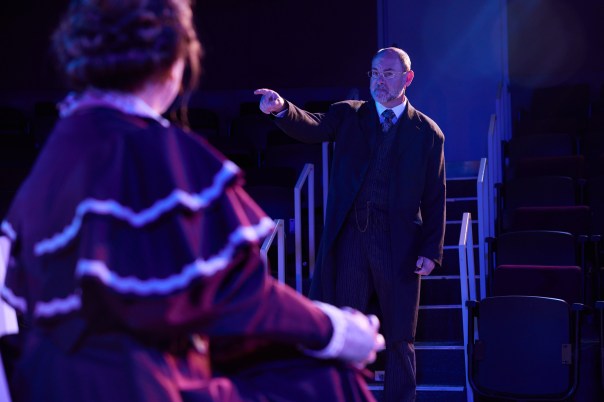
If you make a brief study of Henrik Ibsen’s original script – going beyond the Wikipedia write-up – you can get a good understanding of how playwright Lucas Hnath went about imagining his 2017 sequel, A Doll’s House, Part 2. Crack open the 1879 original, published the same year it was premiered, and you’ll find that Hnath plays fast-and-loose with the text, even before Ibsen’s characters speak. The architecture of the house is changed when Nora Helmer returns 15 years later to the place where she delivered the feminist “door slam heard around the world.” That iconic door is now emphatically displayed, rather than concealed, in Hnath’s reimagining of the scene where Nora liberated herself by simply walking out on her husband Torvald and their children.
This time, she knocks insistently rather than daintily ringing a doorbell offstage. Once she enters, received by her antique nanny Anne Marie, she notices several items are gone, including her piano, an old cuckoo clock, a cabinet with trinkets, and a portrait of Mom. But only the piano was actually there when Ibsen set the scene, and Hnath is treating Henrik’s stage directions as cavalierly as a modern stage director.
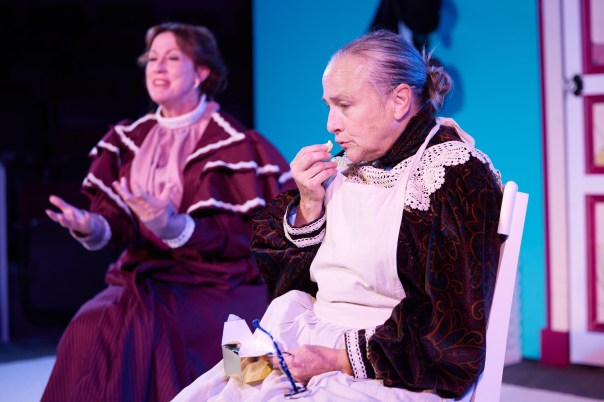
At the Mint Museum on Randolph, where Charlotte Conservatory Theatre is presenting the Queen City premiere, director Matt Cosper accurately gauges Hnath’s irreverence toward the papa of mod drama. But that doesn’t hinder Cosper from pushing the envelope a little further, by unleashing Gina Stewart to be the most skittish and hyper-fretful Anne Marie we can imagine – with a bit of hyperventilating slathered on. As the limping, desiccated nanny of yore becomes Nora’s sounding board once again, every juicy and exotic disclosure that Kellee Stall makes in the role about her tribulations and triumphs over the intervening 15 years becomes exponentially more scandalous, outre, and delicious by virtue of the old crone’s overreactions.
Cosper gives Stewart some extra business to accent her energy and curiosity, some laundry drudgery for starters as Nora is knocking on the door. Then as the wanderer opens up to her, Anne Marie is hungrily chewing on munchies or nibbling on the luxurious chocolate bonbon Nora has brought her, visibly devouring each scrap of news she hears. There’s a nibbling squirrel in both Ibsen’s Doll’s House and Hnath’s, but this time it isn’t Nora.
So exactly how has Nora thrived over these past years? For Stall arrives in a dress so resplendent, thanks to costume designer Beth Killion, that she evokes the majesty of a Macy’s Parade float or the Chrysler Building. Stretching the suspense, Nora asks Anne Marie to guess. This is fun, she remarks, bringing back more memories of Ibsen’s opening scene.
In Anne Marie’s first guess and in Nora’s subsequent revelation, we get keen glimpses into how deeply Hnath dived into Ibsen’s creation. Once you skim the Wikipedia write-up, after all, you realize that Nora is based on the marital turbulence of a writer, Laura Kieler, whom Ibsen knew well. By revealing Nora as a successful writer, Hnath is taking his cue from Ibsen, and by stealing Ibsen’s story, he exacts revenge on Kieler’s behalf, for the Norwegian novelist always resented the Norwegian playwright’s use of her story. (In real life, Mr. Kieler had his missus committed to an insane asylum.)
It’s kind of tasty.
Never guessing that her dear Nora had literary talent, Anne Marie guesses that she became an actress – a shrewd and prescient guess that will mirror Hnath’s thinking when Nora and Torvald thrash out their failed marriage. For the great fault – or fault-line – in Ibsen’s play has always been the wide gulf between the cheery and complaisant little magpie who charms Torvald in Acts 1 and 2 only to become an unbending and defiant crusader against her husband and society after the second intermission.
Famed New York Times theatre critic Walter Kerr pointed out this chasm in his analysis of the 1971 Broadway revival of the play, and he celebrated Claire Bloom’s approach to Nora as an effective way to bridge the gulf. What Kerr inferred from Bloom’s performance is pretty much what Hnath has Nora saying out loud in her final showdown with Torvald: the cheery, charming Nora that her husband remembers so fondly was largely a mix of playacting and manipulation, subterfuges that the new Nora disdains.
Shawn Halliday is as stodgy and respectable as the Torvald Helmer of old, but Hnath has given him fresh insights and self-delusions to play with – and to help Hnath in texturizing Nora a bit further. Ironically, the woman who went on to writing books that have espoused the end of marriage, inspiring other wives to walk out on their husbands, has soured Torvald on the idea of marriage simply by walking out and staying away.
“You sorta killed that for me,” he confesses.

There’s also 15 years of hurt for Halliday to harp on – and for Stall to coolly deflect. Cosper allows Halliday to play the victim card way past the brink of comedy as he turns his chair away from Stall, like a pouting child who will not speak until Nora explains why she has returned. With the exception of the elaborately decorated front door, Tom Burch’s simple set design veers as much toward hospital waiting room as it does toward a doll’s house. But when the two simple white chairs, seemingly stolen from a patio or a beach, come into the action on a matching white rug, the smallness of the Mint stage accents the husband-and-wife role reversal beautifully, especially Master Torvald’s regression.
Clearly, the best of Torvald’s grievances goes straight to her walkout. Disarmingly, he admits that Nora had made some good points before she left, but if they really hadn’t had a serious conversation on a serious subject during their whole marriage, it should have been imperative for them both to attempt to have an adult conversation right then, on the spot, aimed at building the marriage that should have been.
Nora doesn’t wish to have the what-about-the-kids conversation, but Hnath doesn’t let her off the hook. The passage of time allows him to bring Emma Helmer, Nora’s daughter, to maturity as essentially a fresh creation. It’s another plum role, and Laura Scott Cary makes a scintillating debut in it, offering Nora the most devastating pushback she gets all evening.
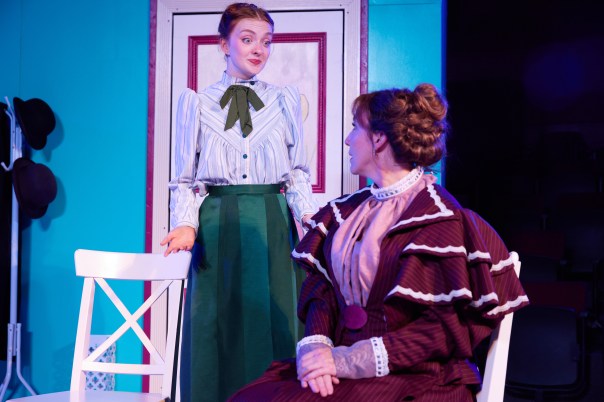
When Emma claims she bears no ill will toward her mom, Cary is so intelligent, poised, and tastefully dressed that we can’t be sure if she’s telling the truth. A wee bit doll-like? It would be easy to presume that Emma has been molded by the strictures Anne Marie and Torvald live by, perhaps processed through the smarts and spirit she inherited from Nora. Yet Cary lets us see with steely clarity that she is not intimidated by her notorious mom. Better yet, she lets Nora see that her absence, more than anything else, has cemented her daughter’s belief in the benefits of marriage and family.
Poof, Nora’s claim that marriage will be an extinct institution within 30 to 40 years, which instantly draws laughs from the audience as Hnath leverages history, now deflates before Nora’s eyes in the confines of her old doll’s house. Quite a supreme irony for someone who has picked up a torch on a mission to change society.
Every time somebody onstage lets loose with an f-bomb, we’re reminded that Hnath’s historical perspective fuels this dramatic comedy. Ibsen denied that he intended A Doll’s House as a feminist play, but Hnath hardly needs to bother making this claim. If anything, he might need to defend himself against the charge that, as exemplified by Anne Marie and Nora, he’s telling us that women don’t know what they want. No, you will not find the answer to why Nora returns in this review. The best way to find out what is driving Nora – and to experience all the shocks she delivers and receives – is to watch how Hnath’s rewarding sequel unfolds at the Mint Museum Randolph. Perhaps the better question to ask, after seeing this beautifully balanced Charlotte Conservatory Theatre production, is whether Nora will ever take yes for an answer



 Art on My Sleeve