Tag Archives: Justin Levine

Feeling Like an Outsider at “The Outsiders”… and I Like It

Review: The Outsiders at Blumenthal PAC

By Perry Tannenbaum
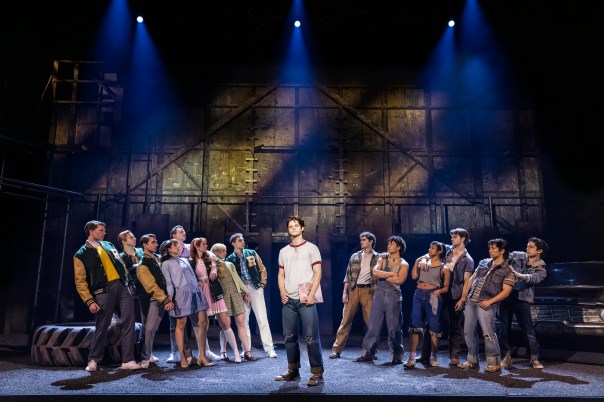
Belk Theater will likely still be rockin’ for days after the national tour of THE OUTSIDERS strikes its deceptively simple set and rolls on up to Chicago for a two-week run. If it weren’t Charlotte Symphony already booking the space next weekend, this gritty, steady rocker could have easily played a second week here without losing momentum. And possibly more.

Opening night was an eye-opener for anyone who had never been swept up in the rite-of-passage tidal wave generated by S.E. Hinton’s 1967 novel and Francis Ford Coppola’s 1983 film adaptation. Traffic to the College Street parking garage was so intense that, when we finally found a place on Level 8 to park, we needed to take a down elevator to exit at the bridge across to the Bank of America tower, where Blumenthal PAC has its performing spaces.

Usually, we hit the up button to go two or three floors up to Level 6.

After pausing to validate my parking stub in the lobby, we found that we were just in time as we saw the usher close the theater door behind us. It was only when we took our seats that we realized that the place wasn’t just packed… it was a sell-out. So an usher confirmed when I ambled up to the front of the house, turned around, and beheld eager theatergoers all the way up to the uppermost rows of the top balcony.

This was near-Hamilton fervor, eclipsing the receptions we’ve recently seen for such recent Tony Award-winners as Kimberly Akimbo, The Band’s Visit, Moulin Rouge, and even Hadestown. While we can all quibble and passionately argue which of these distinguished visitors should win a tournament of champions playoff, the production quality of The Outsiders was definitely top-tier, from Cody Spencer’s tight sound design to Jeremy Chernick and Lillis Meeh’s splashy special effects.
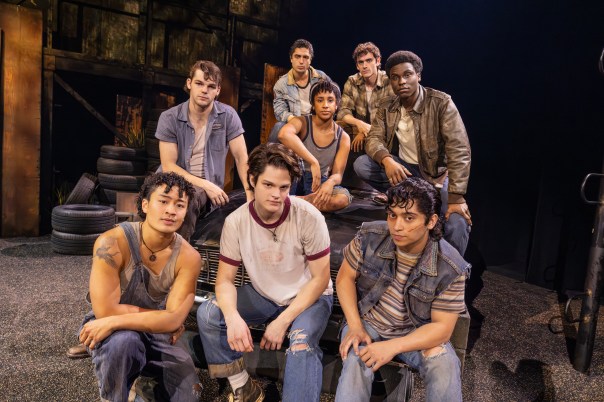
While some of the buzz that I was hearing about this Tulsa tale likened the animosities between the Greasers and the Socialites, or Socs, to the Jets and the Sharks of West Side Story, Ponyboy Curtis and his fellow Greasers are far more déclassé than their Hispanic counterparts, let alone the Montagues of Shakespeare’s Romeo and Juliet. There are no Greaser girlfriends in this grim picture, an apt barometer of these dudes’ hopelessness.
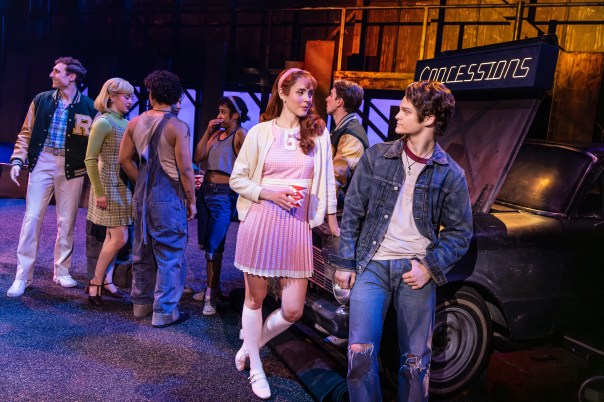
Nor is Ponyboy actually poaching on one of the Soc girls. After taking a beating for watching a movie on Soc turf, he escorts the Alpha Soc girl, Cherry, to a concession stand at a drive-in movie on neutral ground. They strike up a long conversation, enjoy each other’s company, but there’s no petting or romance.

Even so, this crosses the line for Cherry’s ultra-possessive boyfriend, Bob, and his chums. They gang up on Ponyboy and his bestie, Johnny Cade, not realizing that Dallas Winston – the Greasers’ spiritual leader and an ex-con – had recently gifted Johnny with a switchblade and taught him how to use it. Like Romeo before him, Ponyboy and Johnny Cade must flee town to avoid the law, Dallas acting as their Friar Lawrence.
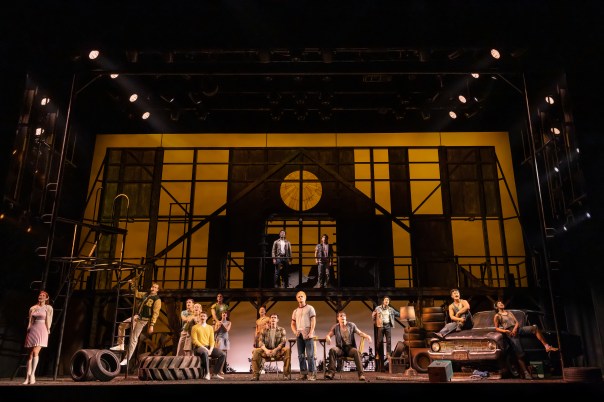
The score by Jamestown Revival and Justin Levine is as consistently intense and authentic as Leonard Bernstein’s, but not nearly as varied. Nor with Levine’s arrangement for guitars, keyboard, cello, bass, violin, reeds, and drums, does it aspire to the same amplitude and agony as West Side Story. That’s about right: Amid the gloom and despair of Greaserdom, there’s a glimmer of hope emanating from Ponyboy, who has read Robert Frost and Great Expectations.

After Johnny Cade’s exhortation to “Stay Gold” in the face of Frost’s “Nothing Gold Can Stay,” Ponyboy’s favorite poem, that glimmer is not extinguished.

Unlike the Coppola movie, Nolan White as Ponyboy doesn’t sport the has-it-made Hollywood looks of C. Thomas Howell or the future superstar hunks – Matt Dillon, Patrick Swayze, Rob Lowe, and Emilio Estevez, for starters – surrounding him. More like Micky Dolenz of Monkees fame. That gives this stage version, directed by Dayna Taymor, about a million-mile head start on the film.

The other homies are no less homely (except the stunning Corbin Drew Ross as Sodapop Curtis), which is a good thing. Bonale Fambrini as Johnny Cade and Tyler Jordan Wesley as Dallas never look like they’re slumming. They sing and act as if they’re to-the-gutter-born, dressed accordingly by costume designer Sarafina Bush.

We can also gush over the glamor and drama that Emma Hearn and Mark Doyle bring to Cherry and preppy Bob. Or the family struggles, sacrifices, frustrations, and domesticity that Travis Roy Rogers brings to the action as one-time pro football hopeful Darrel, Ponyboy’s eldest brother.
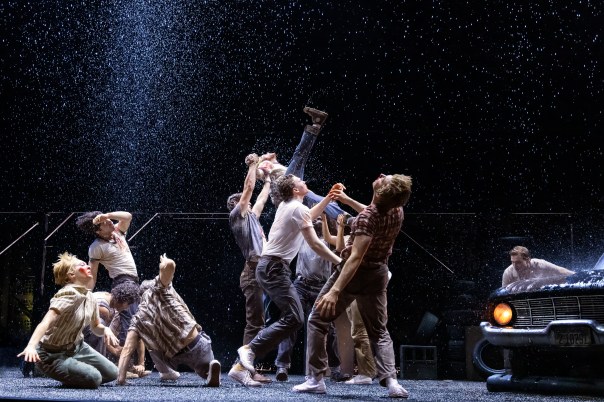
But as good as Adam Rapp’s book is at capturing the striated inertia of Hinton’s Tulsa, the propulsive electricity of The Outsiders comes from its score and the flair of Rick & Jeff Kuperman’s jagged choreography. Even this isn’t enough for Taymor. The hoofers send up bursts of plastic pellets from the floor, and the climactic rumble between the gangs brings down storm showers from above. Once all of these elements began cranking up, the fanaticism of the pre-sold audience was irresistibly contagious. I listened to the acclaimed original cast album when I returned home, but it wasn’t nearly as exciting as the live

Moulin Rouge! Welcome to the Megamix of Pops and Plots

Review: Moulin Rouge! The Musical! at Belk Theater

By Perry Tannenbaum

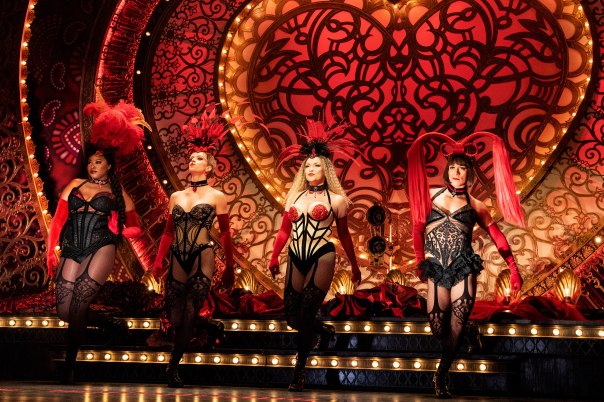
Even before the first downbeat, the musk of forbidden fruit fills the air at Belk Theater each night as Moulin Rouge! The Musical! readies to detonate. Against a scarlet backdrop and under a proscenium studded with vanity bulbs and panning red spotlights, scantily-clad chorines slink onstage, showing limbs and cleavages like ladies in Amsterdam’s red-light district slyly advertising their merch. Elegant tuxedoed gentlemen puffing on cigarettes enter at the opposite end, consumed by each other nearly as much as by the ladies’ legs.

The ban on taking photographs, policed by Belk’s ushers wielding official signage, is already in force as soon as the first glove and high-heeled shoe come into view.

Like our more raucous welcomes to Cabaret and La Cage aux Folles, what follows in leering silence is sexy and showbizzy,. The aroma of illicitness only increases when the music kicks in – unmistakably purloined from the Top 40 pops charts as soon as we hear “Voulez-vous couchez avec moi, ce soir?” for the first time. Why trouble to compose fresh tunes, like John Kander or Jerry Herman, when you can steal or lease pure gold from a multitude of hitmakers and hire a team of co-orchestrators led by arranger Justin Levine to stitch them together?

That’s what book writer John Logan has done in adapting and updating Baz Luhrmann’s gaudy 2001 film, with costume designer Catherine Zuber and choreographer Sonya Tayeh adding their sinful embroidery and panache. All of this talented team knows that mercenary greed is as much at the heart of Moulin Rouge as glitter and concupiscence. Labelle’s “Lady Marmalade” will soon be followed – inevitably – by Barrett Strong’s “Money (That’s What I Want).”

Our beautiful and consumptive heroine, Satine, wants to sell herself to the lecherous Duke of Monroth, but only because she mistakes the handsome young Christian, a budding songwriting genius from Ohio, for her buyer. Christian is no less smitten by Satine, but his prime motive for invading her boudoir, after witnessing her killer cabaret act, is to sell her on a musical show he has written with Henri de Toulouse-Lautrec and Santiago, a dashing Argentinian dude.

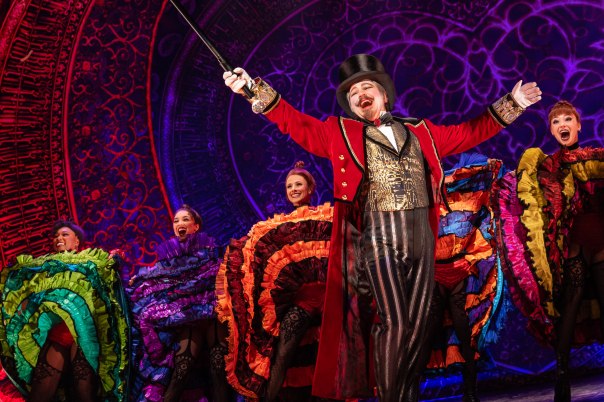
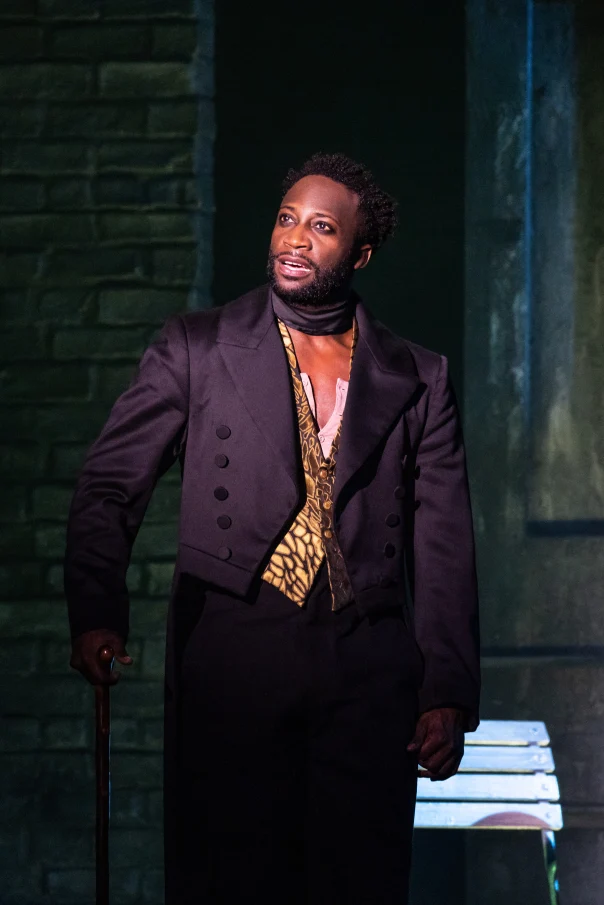
The nightclub glitz is interrupted by a detour to Bohemia, where we catch up on the Christian’s backstory with Toulouse-Lautrec, and preceded by the commerce behind-the-scenes between the two charismatics in the story – the predatory Duke and club owner Harold Zidler, our wicked emcee. Zidler, portrayed with garrulous savoir-faire by Robert Petkoff, hypes and sells his jewel’s charms, wheedling and boasting as he pimps. Since the financial fate of Moulin Rouge now depends on Satine’s success as a temptress, Zidler’s domineering mode is reserved for her.

Petkoff is marvelously matched with Andrew Brewer as the Duke. With a sinister sneer, Brewer aristocratically assesses and stalks his prey, hardly troubling himself to move around or give up his proprietary lounging position. Until he strikes like a snake when he takes his turn backstage in milady’s boudoir. In the wake of Satine’s onstage glitter – including “Diamonds Are Forever” morphing into “Diamonds Are a Girl’s Best Friend” before swerving into “Material Girl” – the Duke answers brutally with a Rolling Stones medley. Brewer pounces on “Sympathy for the Devil” and builds from there with “You Can’t Always Get What You Want” and a climactic “Gimme Shelter,” maybe the most savage and primal track in the history of rock.

If that weren’t enough contrast to dramatize the Duke’s first big splash, consider the sweetness of Christian Douglas as Christian, serenading Satine with Bizet, Offenbach, and “La Vie en Rose” during his pitch. That’s the business end of his visit after springing a new song on Satine that he has written just for her, Elton John’s “Your Song.” Christian is also a crack lyricist. Back in Montmartre, he’s doctoring a Toulouse throwaway into promising shape as “The Sound of Music.”

Lowered from the flyloft on a decorous trapeze after her extended build-up, Gabrielle McClinton gets every lift she could possibly need from director Alex Timbers’ staging to bedazzle the Duke, Christian, and her breathlessly salivating audience. To me, she’s a letdown in more ways than one. Given a megamix that evokes Marilyn Monroe, Madonna, and Beyoncé in a matter of minutes, Satine should be a goddess who commands the leading men’s adoration. But instead of mesmerizing, McClinton is… meh.

It would be hugely consoling to be able to report that McClinton’s tearjerking efforts as the dying Satine are any more riveting than her diva moments. But there’s a bit of a plot megamix going alongside the pop megamix, so McClinton’s opportunities to rouse our empathy don’t quite keep pace with Mimi’s in La Bohème or Violetta’s in La Traviata. Christian has framed what we’re watching as his story and Zidler wants everyone to care that the fate of the Moulin Rouge hangs by a thread.

Our wicked emcee is augmented by the lowlife charms of Nick Rashad Burroughs as Toulouse, Danny Burgos as Santiago, and Sarah Bowden as Nini, Satine’s sexy sidekick: reminding us that love and art desperately for sale. So there would be barely enough room for Satine to be both Mimi and Sally Bowles – or Violetta and Gypsy Rose Lee – even if there weren’t more than 70 songs on the playlist to navigate.

But there are more than 70 songs swirling at us, some on replays. Paradoxically that’s what saves this Moulin Rouge superstorm from itself despite the vacuum at its vortex. The fun is not only in the pacing, the spectacle, and the jets of confetti that that tops off Zidler and Luhrmann’s circus style of cabaret. It’s in our efforts as well, episode after twisted episode, to keep up with the anachronistic onslaught of melodies and lyrics that pelt us throughout the evening. By hearkening back to 19th century hits at one end of the spectrum and contemporary sounds at the other end, this epic playlist is cunningly engineered to confound.

Whether you are old or young, devoted to pop hits or the classics, whether or not you remember when rock was young or even have a clue what Tin Pan Alley was, you will face moments at Belk Theater when you’re asking yourself: have I ever heard this song before? and what the hell are they playing now? Because its score thrusts you far outside of how you normally absorb a musical, casting you out into the realm of memories, half memories, and speculation, Moulin Rouge succeeds at sucking you in. There’s no songlist in the playbill to cling to as you swim this ocean.

Even if you’re fully versed in Luhrmann’s film, you will likely be cast adrift or taken by surprise, for Logan and Levine haven’t stood pat. Not only Beyoncé, but also Pink, Sia, Lorde, Katy Perry, Britney Spears, Rihanna, Adele and others are mixed into the fresh brew. And Lady Gaga!?!

If you’re a Broadway or jukebox musical maven, there’s another sort of question you’ll be asking yourself. How did Elton John’s “Your Song” get in here when Sir E never had the chutzpah to put one of his megahits in any of his own musicals? Good grief, they actually got the rights to perform part of a Beatles song?

Teasing you out of thought on your drive home, you will likely continue pondering what you heard or may have missed inside the lacy valentine world of Moulin Rouge. Yes, Elvis and the Everly Brothers were covered, but what about Gershwin and Cole Porter, Charlie Chaplain and Fats Domino? Likely you’ll shuttle back to remembering that Nat King Cole and Whitney Houston were enfolded in this musical’s fond embrace. There were whiffs of Marilyn Monroe and Madonna.

That’s when you realize that Satine and the Moulin Rouge nightclub – the red windmill, if you need a translation – swept you away after all.