Tag Archives: Joe McCourt

Let “The Drowsy Chaperone” Hypnotize You

Review: The Drowsy Chaperone at Theatre Charlotte

By Perry Tannenbaum

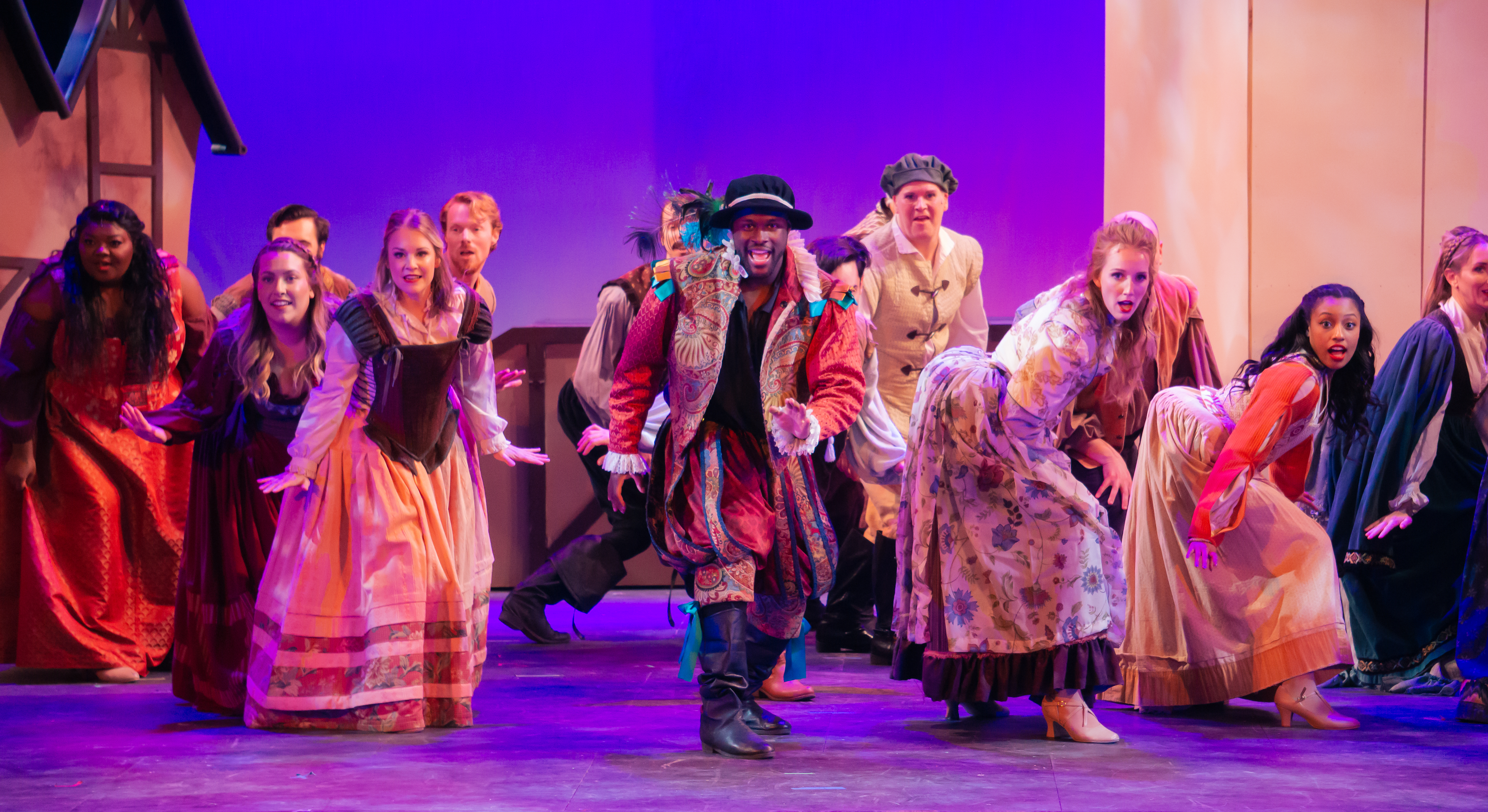
My advice for best enjoying The Drowsy Chaperone at Theatre Charlotte is to listen to the Man in the Chair – and yield to his pitch-dark hypnosis. Yes, before the lights even go up at the old Queens Road barn, he’s in his chair speaking to his audience and conjuring up what we should hope and pray for: “I just want to be entertained. Isn’t that the point?”

As the show unfolded, brilliantly directed by Billy Ensley with what must be the local cast of his dreams, I realized that, as a critic, I shou

ld heed that hypnotic suggestion devoutly. Discard my usual pointy critical and analytical tools. What’s more, I came to believe more and more strongly that, if actors and directors of previous Drowsy Chaperones I’d seen had followed that simple mantra, I would have fallen in love with the show long before last Friday night.

When the lights came up a few minutes deeper into the Man in Chair’s monologue, we saw him locking the front door of his humdrum apartment with four or five assorted deadbolts and chains. It’s a bit of an abrupt swerve, but we’re suddenly aware that this Broadway musical devotee is a recluse and a bit paranoid. Each time the phone rings, we’ll see that the Man in Chair fails to answer, yet another confirmation of these traits.
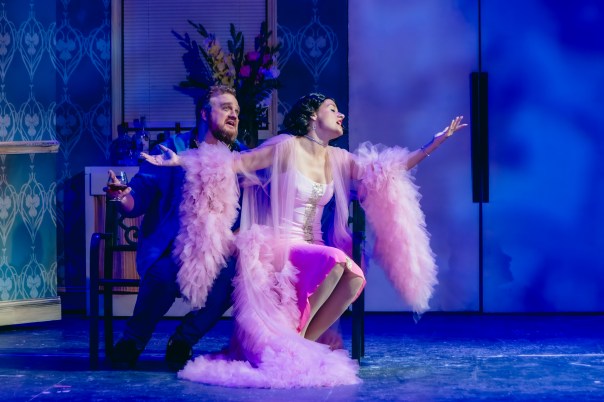
By the time the title character of the fictional “Drowsy Chaperone” is a few wobbly notes into her showstopping “As We Stumble Along,” we already should know that the Man in Chair is gay, which accounts for Lisa Smith Bradley delivering the song as a living fetishization of Ethel Merman and Judy Garland – Merman’s vibrato wedded to Garland’s glitter, slacks, and drug dependency.

Yet when we’re watching Kyle J. Britt as our genial host, we need not attribute his reclusiveness or paranoia to being a gay man. As a Broadway musical fanatic, this Man in Chair identifies more readily as a New Yorker with Innerborough hangups. Meanwhile, Bradley is sufficiently over-the-top as both gay icons – especially Merman – to be accused of impersonating a female impersonator.

We might say that Ensley & Co. have decided that being gay in 2024 isn’t nearly the leaden weight it was in 2006 when Drowsy Chaperone premiered in the Big Apple or in 1996 when Angels in America tore the QC apart and made us a laughingstock. Pretentiousness, solemnity, and subtlety really are inimical to this delicate relic. Britt handles it with audiophile care as removes the vinyl disc – a rare original cast recording of his favorite 1928 musical – from its LP sleeve and gives both sides a loving once-over with a Discwasher brush before lowering his treasure onto a turntable.

The same can be said of size and scale, which may also have muffled my enjoyment of productions at Belk Theater in 2007 and Halton Theater. There’s something so right about our little séance in the dark at the Old Barn on Queens Road that it cannot attain in a more modern and spacious hall where the Man in Chair must project his spell into a distant balcony. The homeliness of the Man’s urban dwelling also sits better on Queens Road than in the bowels of a bank building on Tryon Street.

To be honest, it’s Broadway Lights and the late CP Summer Theatre that should apologize for not matching the unpretentiousness of Josh Webb’s scenic design. Of course, it would be nice if Webb’s scenery could transform spectacularly into Broadway splendor when the stylus of our host’s turntable comes down – with its signature thump – onto the vinyl and the mythical “Drowsy Chaperone” comes to life. In the less-is-more world on Queens Road these days, these shortcomings are comedy assets, part of the overall charm.
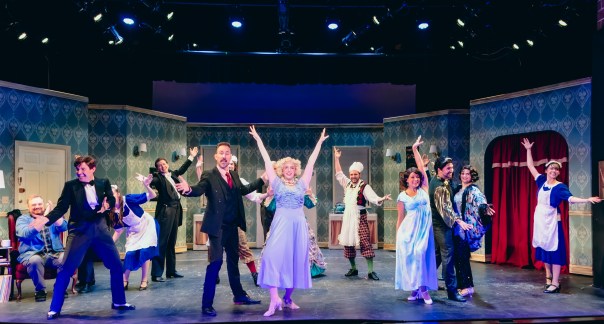
On the other hand, our time travels to 1928 get a softer landing thanks to the costumes by Beth Killion, notable for their flair, their formality, and their discreet dashes of color. We’re awaiting the wedding of Robert Martin and Janet van de Graaf, so there are actually multiple levels of time travel here, for Bob Martin actually co-wrote the Drowsy Chaperone book with Don McKellar – and starred in the original Broadway production as Man in Chair – while he was married to the real-life Van de Graaf.

In fact, this originally Canadian work, which eventually layered on music and lyrics by Lisa Lambert and Greg Morrison, was gestated at Martin’s stag party in 1997, nearly 70 years after these fictional nuptials. More reasons not to view this lark as a gay cri de cœur.

Rare as his vinyl treasure may be, Britt comes across less as a scholar or a critic than as a fanboy, occasionally panting like an eager puppy as he presumes to approach his fantasy idols more and more closely. More than once, the principals will obligingly freeze for him. Nor does this Man in Chair seem to favor the men over the ladies with his adoration, only tipping the scales just before the final bows. Charmingly enough, there are overtones of scholar and critic as he dishes tasty trivia about the fictitious “Drowsy” cast members or advises us to be on the lookout for some truly dreadful lyrics.

These glamorous, theatrical, servile, and criminal characters are all blissfully ignorant of the nerd who has conjured them up, preoccupied with their conflicting efforts to carry off the planned wedding or ruin it. The bride herself, Lindsey Schroeder as Janet, seems to be grandly ambivalent about becoming Robert’s wife, sacrificing her glittery stage career and the adoration of millions, while suppressing her basic instinct to “Show Off.” Love is at comical war with vanity. Carried away by the swiftness of this whirlwind romance, Andy Faulkenberry as Robert also has his doubts.

Aside from Janet’s drunken chaperone, politely labelled as Drowsy, there are a butler Underling, an eccentric Mrs. Tottendale, and Robert’s best man George shepherding the loving lambkins to the altar. Only Zach Linick as George seems to be afflicted with any degree of competence or reliability. More importantly, he and Faulkenberry make up a formidable tapdancing duo. (Thank-yous to choreographer Lisa Blanton.) Allison Rhinehart as a frilly, bustling Tottenham and Darren Spencer as the gray and starchy Underling are no less inevitably channeled toward blithe entertainment.

Counterbalancing the fragile determination of the bride and groom, compounded by the flimsy protection of their good friends, we have an exquisite mix of bumbling baddies trying to sabotage the wedding. These are led by Joe McCourt as Broadway producer Mr. Feldzeig (Feldzeig Follies ring a bell?), under pressure from his mobster backers, who consider Janet to be the cash cow of the Feldzeig franchise. The sneering McCourt is bedeviled by Gangster 1 and Gangster 2, armed emissaries – Titus Quinn and Taylor Minich – masquerading as hired chefs to ensure a catastrophe.

Ah, but it isn’t simply muscle aimed at swaying the maiden and returning her to showbiz. Somehow, a predatory Lothario is among the wedding guests – although he has never met anyone else there. Mitchell Dudas is this egotistical Adolpho, far more arrogant than Feldzeig, a mixture of Erroll Flynn and Bela Lugosi with a thick Iberian accent. Feldzeig has no trouble at all convincing Adolpho that he was born to seduce the bride-to-be.

Equally dumb, Autumn Cravens as Kitty is a ditzy chorine, constantly nagging her boss and wedding escort Feldzeig to let her fill Janet’s shoes in his next Follies. Effortlessly, Dudas will outperform Cravens in thwarting Feldzeig’s schemes. Love conquers all, but it would be a huge spoiler to say how many times when we reach this very happy ending.

Just one more wild card is needed to tie up all the festivities. Be on the watch for Trinity Taylor as Trix the Aviatrix, who descends from the skies at just the right moment with a voice of thunder. For a few moments, she even upstages Britt and Schroeder who are so fabulous.

It would be a mistake to miss the craftmanship lavished on this plot with its stock characters by Martin and McKellar, brought out so brilliantly by Ensley and his dream cast. For instance, think how perfectly 1928 was chosen: between Lindbergh’s transatlantic flight, Babe Ruth’s 60 homers, The Jazz Singer of 1927 and the Wall Street Crash of 1929. A brief last window of bliss before global misery. In the real world, the parade of yearly Ziegfeld Follies revues would be halted after 1927 – until 1931.

Ensley and Schroeder Check All the Beautiful Boxes in Matthews

Review: Beautiful The Carol King Musical at Matthews Playhouse

By Perry Tannenbaum

When you think of singer/songwriter Carole King and Broadway musicals, there’s an instant disconnect: the humble simplicity of King’s Tapestry album cover clashing with the glitz and blare of the Great White Way. So a Broadway musical about King’s career is more of a stylistic stretch than a biomusical about most rock stars, pop stars, or jazz & blues divas. Everyone involved behind the scenes of the original 2014 production of Beautiful The Carol King Musical seemed keenly aware of the dichotomy, including director Marc Bruni, orchestrator/arranger Steve Sidwell, and scriptwriter Douglas McGrath.

Their idea of coping with the problem was by leaning into it. Not too subtly, they conspired to make the early stages of King’s career seem crass and commercial, as if she were trapped in the dog-eat-dog maw of the pop music industry. King and her writing partner, lyricist Gerry Goffin, write the songs while producer Don Kirshner finds the singers and the groups who will cut the singles – the likes of Bobby Vee, Little Eva, The Drifters, and The Shirelles. Yet somehow the hierarchy is flipped in the famed Brill Building in NYC.

Carole and Gerry are slaving for Kirshner, a genial industry mogul and taskmaster, and the couple’s best early music loses a lot of its luster when it’s farmed out, especially when “Up on the Roof” falls into the hands of The Drifters and “Will You Still Love Me Tomorrow?” is butchered by The Shirelles, thanks to excessively ornate Sidwell arrangements that would be more at home on Broadway or Vegas than Motown. These excesses helped Jessie Mueller to shine all the more brightly in the original cast – and for her sister, Abby Mueller, to shine equally when the touring version hit the QC in April 2016.

So a downsized production, like the one currently running at Matthews Playhouse, actually has the potential to be better than the Broadway and touring versions – with the right personnel and sufficient pizzazz. With Billy Ensley directing and Lindsey Schroeder leading a heavyweight cast, both those boxes are checked. The Broadway ensemble sheds two of its three keyboards nestling into Matthews, one its two guitars, and one of its percussionists. The slimming helps. No longer smothered by their orchestrations, Neil Sedaka’s “Oh! Carol,” Gene Vincent’s “Be Bop a Lula,” and Little Eva’s “Loco-Motion” sound more like rock music and less like mockeries.

Ensley targets the megahit by the King-Goffin duo’s friendly rivals, Barry Mann and Cynthia Weil, for his most farcical treatment. Not only is the arrangement of “You’ve Lost That Lovin’ Feelin’” garishly distorted, amped up from the swampy-echoey-churchy vibe of the original single, but the gulf between the bass and tenor voices of the Righteous Brothers is greatly emphasized, exaggerated, and comically exploited by Johnny Hohenstein and Zach Linick.

McGrath’s book is most affecting when it deals directly with King, though there’s bold poetic license in his voodoo, historically speaking. Pressured by Kirshner to come up with a new hit overnight for The Shirelles (in real life, they only had one hit record so far), King writes the music and goes to bed with Goffin. Perfect setup. Wouldn’t you like to wake up in the morning and find the handwritten lyrics for “Will You Still Love Me Tomorrow” perched on your piano – and be the first person on Earth to read and sing them?

No disrespect to the great Bobby Vee, but we’ve suddenly ascended more than a few notches above “Take Good Care of My Baby.” This moment still grabs me, but there are more moments like this after intermission, when “You’ve Got a Friend” and “A Natural Woman” are unveiled, that choke me up even more – as King breaks away from the Brill Building and starts to do her own thing. Schroeder replicates the sandy sound of Carole’s voice from the beginning, but as she transforms from a demo singer behind an upright piano to a chart-topping performer, watch out.

Schroeder can not only belt – she can tear your heart out.

McGrath’s dramatization heightens the magic most memorably when “You’ve Got a Friend” is reframed as a not-quite-farewell song, when King embarks for her solo career in LA with Kirshner’s blessing, and both Barry and Cynthia gather round the old upright with her to sing this newborn masterpiece. The song didn’t really come out until her second album, but who’s counting, right?

Nick Southwick as Barry and Sophie Lanser as Cynthia (get that woman a more reliable mic!) deliver polished performances all evening long, but they also grow more gravitas after intermission. Lanser sheds the frivolity of a “Happy Days Are Here Again” parody and “He’s Sure the Boy I Love” and joins Southwick – previously mired in the silliness of “Who Put the Bomp” and the wrong-key version of “You’ve Lost That Lovin’ Feelin’ – in a heartfelt “Walking in the Rain” duet.

Then if you haven’t started weeping with Schroeder’s “It’s Too Late,” you’re at the mercy of “You’ve Got a Friend” when Lanser and Southwick join in on the quivering-lip goodbyes. After playing Kirshner with avuncular savvy throughout King’s formative years, Ryan Dunn sprinkles some welcome laughter into this maudlin scene with a (purposely) bad attempt at vocalizing.

I’d forgotten that Carole had Aretha’s 1967 hit in her hip pocket when she cut Tapestry out on the Left Coast in 1971, so I found myself suddenly suppressing sobs when “A Natural Woman” began. Here it felt very right that Sidwell’s arrangement brought added vocalists and brass to beef up the simplicity of King’s version – and freed Schroeder to narrow the gap between Carole and the Queen of Soul with some fervent belting.

Marty Wolff’s simple two-story set design, with four wide strips of stained-glass paneling running vertically upstage in front of the eight-piece band led by Ellen Robison from the keyboard, needs only JP Woodey’s lighting to give it a rockin’ modernistic zing. Lisa Blanton’s choreography is devout doo-wop, most praiseworthy for how well the groups stay in sync, and Chelsea Retalic likely cranked out between 75 and 100 costumes for this large cast – all of them, from the sleekest to the grungiest, on point.

And the wigs! The only misfire here, among dozens of triumphant coifs – several for Schroeder – was the oceanic profusion of waves that perched on Joe McCourt’s head as Gerry Goffin, making him virtually unrecognizable. McCourt, a musical mainstay in the QC since his debut in 2008 as the lead in Godspell, has suavity to spare to spare and, in contrast with Southwick’s quirky neuroses as Barry, gets a nice and bumpy character curve as the only troubled soul we see.

This image has an empty alt attribute; its file name is beautiful24-139.jpg

As for the Afro-American doo-woppers… my, oh my! By bringing Nehemiah Lawson aboard to take over “Some Kind of Wonderful” from Schroeder and McCourt and then to bring him back again and again to sing “Up on the Roof” and “On Broadway,” the latter one of Weil & Mann’s best, Ensley and Robison signal that they have no plans of dissing The Drifters. Meanwhile, two lead singers are embedded among Ensley’s Shirelles. As Janelle Woods, the Shirelle who denigrates “Will You Still Love Me” as “too country” before fronting the breakthrough single (first Billboard #1 for an African-American girls’ group), Brianna Mayo gets a chance to show that her acting chops are as strong as her singing skills.

Shortly afterwards, Raven Monroe emerges from the backup Shirelles to become Little Eva and ignite “The Loco-Motion.” Until then, she moonlights as King’s babysitter during the leading lady’s brief marriage to the restless Goffin.

There’s a formulaic circle to McGrath’s storytelling that’s not at all displeasing, starting and ending with King as a star behind a grand piano singing a song from Tapestry. We flash back to her youth in Brooklyn and eventually touch down at Carnegie Hall, surely a kind of Jerusalem for a humble Jewish girl. Alongside her at the beginning and at the end is Carol Weiner as Genie Klein, King’s mother. Both were abandoned by her no-good father, steeled by adversity. Along the way to Carnegie, Weiner peeps in with a couple of overprotective warnings, a few salty quips, and a proud Mama’s lie.

If McGrath can embellish a good story, why shouldn’t she

Shakespeare Is a Thieving Magpie in Theatre Charlotte’s “Something Rotten!”

Renovated Queens Road Barn is ready for its closeup

By Perry Tannenbaum

Something Rotten

 We are all stupid and silly – and we all love smart-ass musicals that tell us so. That’s the deep message of Something Rotten! Theatre Charlotte’s brash, big-ass extravaganza that’s raising the curtain for the grand reopening of the iconic Queens Road barn.

Yeah, it’s been awhile since a musical opened at our venerable community theatre’s home. That was early September 2019, when Oliver! launched what would have been the 2019-20 season. But COVID-19 shut everything down in early March, before auditions or rehearsals could even begin for Dreamgirls, scheduled to open in late spring. Then a latenight fire in the waning hours of 2020 gouged a huge hole in the theater floor, smoked the ceilings, and fried all the precious electronics – lights, audio, AC, computers – and kicked the company out of their house.

For over two years, while more than $1 mil in repairs, renovations, and new equipment requisitions could be authorized and completed, artistic planning continued while navigating insurance adjustments and jumping municipal hurdles. While the new 501 Queens Road gestated and marinated for more than two years, the company hit the road, resuming production in September 2021 and hopscotching the city to keep Theatre Charlotte alive in Charlotte. The Palmer Building, Halton Theater at CP, and the Great Aunt Stella Center were the first three stops on the season-long 2021-22 road trip.

Now there have been five or six shows at the old barn, in play or concert format, since Oliver! closed back in 2019, including two iterations of A Christmas Carol, a Theatre Charlotte gotta-do-it tradition. But nothing short of a musical, one with an authentic exclamation point yelling out its title, can truly show off a theater’s brand-new bells and whistles – or put them to their ultimate test.

Of course, there had to be some extra drama, an extended drumroll, before Something Rotten! could give the renovated Queens Road barn its much-anticipated relaunch. Scheduled for its closeup last October, the revamped site wasn’t going to be ready for opening night. The 2022-23 season had to be reshuffled, and the wondrous Shakespearean mashup of a musical was postponed.

A construction project. In Charlotte! Can you believe it wasn’t finished on time??

Billy Ensley, after directing the first little musical away from TC’s home, The Fantasticks, now pilots the first leviathan since the company’s return. Three of his mates from that Palmer Building gem back in 2021 are on board with Ensley for this new voyage, all of them playing major roles and all of them delivering.

I was fairly bowled over by the brash irreverence of Something Rotten! when I first encountered this Karey and Wayne Kirkpatrick concoction on Broadway in 2016. You might wonder if the Kirkpatricks had the zany antics of The Compleate Wks of Wllm Shkspr (Abridged) on their minds when they decided to take aim at the Bard of Avon and musicals.

Certainly the methods of their madness can be traced to the Reduced Shakespeare Company – with genetic material from Forbidden Broadway and The Producers also in the DNA. The Kirkpatricks discard the merely dubious ideas that Shakespeare’s works were written by someone else, or that his awesome greatness was only fully appreciated after he died. They ignore the reality that there’s only faint, sketchy traces of the man over the course the grand Elizabethan Era.

No, all those tropes are toast. The Kirkpatricks, with John O’Farrell collaborating on the book went full-bore misinformation and alternate reality. Months before The Donald descended the Trump Tower escalator.IMG_2969-2

Shakespeare is no longer a dim peripheral figure on the Elizabethan cultural scene. He’s a full-blown superstar, recognized and wildly adored wherever he goes. Mobbed by his rabid fans, he gives outdoor spoken-word concerts to sustain the mass hysteria.

The secret of the Bard’s genius is revealed. Like the Reduced Shakespeares, Forbidden Broadway, and the Kirkpatricks after him – not to mention The Donald – the real Shakespeare was a thieving magpie. Not only did he steal from ancients like Plutarch and Ovid, predecessors like Chaucer and Boccaccio, and contemporaries like Christopher Marlowe, he cribbed from unknown wannabes and the man or woman on the street.

Case in point: after defecting from Nick Bottom’s struggling theatre company, Will takes his former boss’s name with him and dumps it into A Midsummer Night’s Dream. Another case in point: Sniffing out the possibility that Nick is working on something revolutionary for the stage, Shakespeare embeds himself in his former company, where he swipes the complete manuscript of Hamlet from its true author, Nigel Bottom. Because big brother Nick has astutely told him that “to be or not to be” is trash. Not to be.IMG_2417

A hapless mediocrity, Nick is our hero. In his crazed search for the next new thing in theatre, Nick seeks out a soothsayer to look into the future, a rather Shakespearean ploy. The eccentric soothsayer that Nick picks, Nostradamus, turns out to be a genuine visionary, but his inner crystal ball seems to be afflicted with astigmatism. Skipping over the breakthrough artform of opera on the near horizon, soon to be birthed in Italy, Nostradamus is himself amazed to see… a musical!

So powerful is this concept that Nostradamus cannot even say the word without a vatic, conjuring sweep of his right arm. He wants Nick – and us – to see it clearly, too. Nick, poor thing, doesn’t have as juicy a role as the raving Nostradamus, who must convince his skeptical client that such an impossibility can be created, believed, and become universally popular. He’ll be able to bring my play to a complete stop and have my speaking characters suddenly start singing? And he’ll be able to interrupt this blatant interruption with a whole crowd of people dancing? Tap dancing?IMG_2703

Yes, yes, and yes, Nostradamus prophesies, and audiences will lap it up. We do see, for we were living proof of this seeming insanity at the Queens Road barn, just like I was at the St. James Theatre in 2015.

Over and over, the Kirkpatricks reinforce the idea that the road from brilliant concept to acclaimed masterwork is strewn with pitfalls. Nick begins with a colossal misstep, an upbeat number called “The Black Death,” which strives to match Mel Brooks’ “Springtime for Hitler” in utter tastelessness.

So Nick hurries back to his soothsayer. What will Shakespeare’s greatest triumph be, he asks, determined to beat the Bard to the punch. Pushing away invisible cobwebs between him and the future, Nostradamus proclaims, Omelet, the Musical is the future, confident he’s setting Nick on the right track.

With creditors and prudish censors dogging his way, Nick has ample complications to overcome. The backbreaker is Nigel’s resistance. Instead of sticking to the yolks and the big egg picture, Nigel is spouting useless lines like “To thine own self be true.”

Another Shakespearean device comes into play with little brother, the double plotline. While tasked with writing the world’s first libretto, Nigel is smitten by Portia, the lovely daughter of Brother Jeremiah, the most sanctimonious and censorious Puritan in London. Avid admirers of Shakespeare, both Portia and Nigel can see the parallel between their star-crossed plight and the tragedy of Romeo and Juliet, their idol’s newest hit.IMG_3812

Ensley’s eager, able, well-drilled cast of 25 can seem like a teeming city in the confines of a barn, heartily welcoming us to two Renaissances, really, with Nehemiah Lawson as the Minstrel leading the ensemble’s bustling greeting – to the refurbished theater and olden days – when the curtain rises. They can form a credible mob around Will when he struts upon his stage.

Along with such teeming scenes, Ensley and choreographer Lisa Blanton and headshot sketch artist Dennis Delamar can pour in numerous references to familiar, beloved musicals we all know. Explicit references to Phantom, Les Miz, Cats, Sound of Music, and Chess are in the Kirkpatrick-O’Farrell script, but what about the sly nods to Annie, A Chorus Line, The Producers, and West Side Story?

There are more Broadway allusions than I’ve mentioned and still more that I may have missed. Ensley keeps the pace brisk.

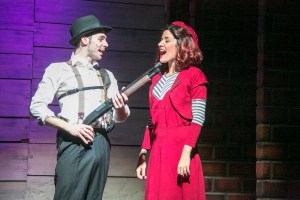
Twice cast as Jesus at Theatre Charlotte in past seasons; along with leads in Rent, Memphis, and Arsenic and Old Lace; Joe McCourt steers us through Nick’s sea of troubles. Folks out in Matthews would remember McCourt’s exploits in Bonnie and Clyde more vividly, his first team-up with Ensley. The Arsenic and Old Lace agitation as Mortimer, when McCourt strayed from musicals into comedy, served as a nice precedent for his work here. When he leans away from straight-man chores opposite Will and Nostradamus, and into Nick’s showpieces, McCourt flashes his confident charisma – with comical seasoning – when he fumes “God, I Hate Shakespeare.”

McCourt is no less in command when he brings down the curtain for intermission with “Bottom’s Gonna Be on Top,” though his best soufflé may rise when he greets his troupe for the first Omelet rehearsal, absurdly exclaiming “It’s Eggs!” Yet this wannabe turn is decisively upstaged by the conceited rockstar and the wild-eyed prophet.

Perfectly cast at the Palmer in The Fantasticks, Mitchell Dudas and Kevin Roberge are even more smashing now. Dudas was a wonderfully swashbuckling El Gallo, the beguiling Fantasticks narrator, but he’s far slicker and more self-absorbed here, shining in his wicked showpieces, “Will Power” and “Hard to Be the Bard.” And the sheer arrogance of him when Dudas flashes his Shakespearean smile! You expect little LEDs to twinkle at the edges of his teeth.

Since “The Black Death” is an ensemble slaying, it’s Roberge who gets the killer solo of the night, “A Musical,” indoctrinating McCourt so thoroughly that the conjuring sweeps of Nick’s arm become nearly as prophetic. After his portrait of the more blustery Fantasticks dad, Roberge turns up his leonine energy more than a few notches. And the hair! Far more eccentric than the Einstein in Verizon ads. Think Charlton Heston on top of Sinai in The Ten Commandments.

Matt Howie, the naïf swain from Ensley’s Fantasticks, and Cornelia Barnwell mesh beautifully as the confidence-challenged Nigel and the overprotected Portia. But they’re overshadowed by a slew of quirkier characters who don’t sing nearly as much. Who comes first? Maybe Lindsey Schroeder as Bea, Nick’s proto-feminist wife, who fills out the contours of Shakespeare’s Portia in a memorable courtroom scene.

Certainly Hank West vies for the honor of favorite minor character as the shifty and resourceful Shylock, who remains a moneylender in Shakespeare’s world but transforms into the first theatre producer in Nick’s troupe and the New World. Delamar, our sketch artist and longtime Theatre Charlotte idol, gets props here for portraying a pair of pomposities: Lord Clapham, Nick’s skittish financial backer, and the Judge who must sentence Nick for his trumped-up crimes.

If there’s space for a feminist, a theatre producer, and a rockstar in this Renaissance makeover, there’s also room for a gay preacher and an outré transvestite. J. Michael Beech’s homosexuality as Brother Jeremiah is hardly latent at all as he strives to keep himself closeted with indifferent success, and we can presume that Paul Reeves Leopard as Robin gets the pick of the women’s roles in the Bottoms’ troupe, perennially dressed and simpering for the part.

Brave New World!

If the players I’ve named thus far decided to form a professional theatre company, I’d only be mildly surprised by their audacity. The new Old Barn made them all look good, first with the opulence of Chelsea Retalic’s period costumes – and the stark anachronism of Shakespeare’s glitter. Chris Timmons’ set designs didn’t look like he was working on a shoestring budget, either, indoors or out.

Better yet, the renovated 501 Queens Road facility has remained true to itself, in its lobby and its theater space. In the lobby, there are new, more modern-looking ceiling fans, which sit admirably flush to the upgraded ceiling. There were still extensive lines to the restrooms, so my inspections of the toilet – and the new backstage – must await visits to come.

In the theatre hall, the skeleton of the new scaffolding isn’t fleshed out at all with sheetrock, so the roofbeams are visible all the way to the bricks that meet it at the proscenium wall. More like a beloved old barn than ever! Artistic director Timmons, wearing his second hat as acting executive director, told me that the renovations made it possible to raise the stage proscenium. Yet there was a shower of confetti to climax the finale, where the “Welcome to the Renaissance” melody completes its last rebirth as “Welcome to America.”

Can’t remember the last time, if ever, that I had seen evidence of a functional fly loft at the Queen Road barn.

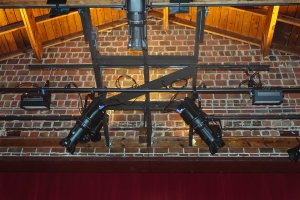
Best of all, there was a profusion of theatre lights shining in many colors, along with strategically spaced audio speakers. All are discreetly black, of course, so I couldn’t resist taking flash photos to confirm that all this equipment is spanking new. Everything worked flawlessly, including Theatre Charlotte’s soundboard. Nor did I notice any coughing or humming from the heating system. All was bliss, best feet forward, with nothing rotten except the show’s title.

Don’t be shocked to find that Something Rotten! is sold out for the rest of its current run. The show, the production, and the newborn theater are all that good. Timmons & Co. may need to add performances to meet the well-deserved demand.

Celebrity Pistol-Packing Rogues Deliver Guilty Pleasures in “Bonnie & Clyde”

Review: Bonnie & Clyde

By Perry Tannenbaum

Since the days of his greatest successes, with Jekyll & Hyde (1997-2001) and The Scarlet Pimpernel (1997-2000), most of Frank Wildhorn’s Broadway musicals haven’t run more than a month. That includes a revival of Jekyll, Wildhorn’s longest-running show, in 2013 and Bonnie & Clyde, which somehow couldn’t make it through the end of December – the highest grossing month of the year – in 2011. Hearing that the short-lived Bonnie & Clyde was coming to Matthews Playhouse of the Performing Arts roused a morbid curiosity for me: how could a notorious story that won six Oscars in 1968, including Best Picture, flame out so spectacularly in a musical adaptation? Knowing that Billy Ensley, one of Charlotte’s best, would be directing sealed my resolve to investigate.

With the appearance Bonnie Parker and Clyde Barrow as children at the top of the show, it quickly became apparent that Ivan Menchell’s book was not an adaptation of the sensational film. Unlike the Bonnie portrayed by Faye Dunaway, Menchell’s is a ravishing redhead rather than a blond. There’s never really a Barrow Gang, and though this Clyde aspires to fancy clothes, his dream didn’t come true in Matthews. Most puzzling of all, we don’t see Bonnie and Clyde snapping photos of each other – their most modern trait! – although the authentic period projections go way beyond mugshots. So it’s plausible to me now that the Broadway version of this musical didn’t strictly flop on its merits. Boomers expecting to see the style and gore of the iconic film were disappointed, while it’s very likely that younger theatergoers had never even heard of Bonnie and Clyde.

Armed with a reported $6 million budget, there were presumably more costume changes up in New York than Matthews designer Lisa Altieri provides for Bonnie, but with 20 people in the cast, four of them in multiple roles, Altieri is far from idle and contributes some very fine work. What really made this community theatre effort look like a million bucks was the scenic team of designer John Bayless and scenic change artist Beth Aderhold. Weathered wooden slats span the Fullwood Theatre stage, trisected by two sturdy vertical beams. The columns of slats can be raised like window shades, keeping the flow of action going cinematically as the slats rise to reveal new scenes – or slide back downwards to serve as rustic screens for the old-timey projections, mostly of newspaper headlines, mugshots, and snapshots of our celebrity public enemies. At critical moments, a two-seat jalopy showed up in the middle of it all, no less realistic than the photos I’ve seen of the Broadway roadster.

Not only did Ensley brilliantly contrive to keep the action moving, he brought ace talent to the lead roles and beyond. Joe McCourt, who plays Clyde’s vacillating older brother, Buck Barrow, has starred in numerous musicals at Theatre Charlotte in recent years, including Memphis and Avenue Q. Embittering Buck’s every breath, Emily Witte is his very Christian wife Blanche, after playing a similar spoiler role as Amneris in the Disney Aïda at Theatre Charlotte last fall. This bickering pair would have upstaged the title players if Ensley hadn’t found such strong protagonists as Steven Buchanan and Lindsey Schroeder.

Buchanan was definitely in his comfort zone performing edgier fare, for he played prominent roles in Queen City Theatre Company’s The Pride and Actor’s Theatre of Charlotte’s American Idiot last year. Here he sported a hairdo that was halfway between Hitler and punk, looking lean, Brando mean – in a tank top undershirt – and dangerous. Scene work with Bonnie is a tasty mix of tender and raw, but Buchanan is somewhat monochromatic under arrest or during his larcenous, murderous rampage, barking his commands and forsaking the Warren Beatty charm offensive of the film. Ensley should have occasionally reined him in a bit and reminded him that he’s wearing a microphone as well as a pistol.

Opening in the ensemble of Evita at CPCC Theatre the weekend after her last performance as Bonnie Parker, Lindsey Schroeder is the one new find among the principals. She takes to every aspect of Parker, most especially to her thrill-seeking, her narcissism, and her lust for Hollywood and pinup fame. Schroeder can belt too, so watch out for “How ‘Bout a Dance” and “Dyin’ Ain’t So Bad.” Overall, Wildhorn’s score wasn’t nearly as bothersome as you’d expect from an epic Broadway flop, but there are noticeable stretch marks on its beauty. Witte does a fine job on behalf of homebodies with “That’s What You Call a Dream,” but Blanche’s Christianity opens up a whole new sector of Gospelized expression that I didn’t recall from the movie. Church scenes are essentially extraneous to the main storyline, but it gave Wildhorn an excuse to widen the variety of his score. Off my radar since 2009, Phil Fowler came to the rescue for a couple of doses of “God’s Arms Are Always Open.” Even if it was a narrative detour, it was a rousing showstopper in the positive sense of the word.

Holiday Grow and Donavan Abeshaus were both excellent in introducing us to the young Bonnie and Clyde. Carol Kelly and Scott C. Reynolds were winsome as Clyde’s rusticated parents, and Carol Weiner was prim yet warm as Bonnie’s mom, quietly urging her daughter to come to her senses – and choose the hometown sheriff who clearly adores her. Andrew Tarek plays that role beautifully, with seething jealous fury toward Clyde and tender hat-holding deference toward Bonnie. I found myself hating this Sheriff Hinton without a good reason why, and I surprised myself once again by rooting for Bonnie and Clyde here almost as fervently as I did in the 1967 film, despite the trail of crime and bloodshed they insouciantly left in their wake. Celebrity pistol-packing rogues are likely unique to America, more to our shame than our glory.

Bravura Aplenty in Theatre Charlotte’s “Memphis”

Review:  Memphis

By Perry Tannenbaum

As you may have found out, ignorant buffoons can make it big in America. So why not ignorant eccentrics? If Huey Calhoun didn’t make it big as a ‘50s deejay in Memphis, the musical by Joe DiPietro and David Bryan, then his fall from celebrity wouldn’t be nearly as reckless or spectacular. When he has lost his local TV show, tossed away his shot at national fame, and blown his romantic chances with the R&B queen he has catapulted to stardom, Huey defiantly delivers the anthem he has earned, “Memphis Lives in Me.”

“One more drink and you’ll see God everywhere,” sings Huey in tribute to his chief consolation: a bluesy Beale Street honky-tonk bar. It’s the culmination of a Broadway- caliber performance that Joe McCourt is currently giving at Theatre Charlotte in the lead role that DiPietro patterned after legendary rock pioneer Dewey Phillips.

Contrary to the preproduction signals that McCourt and director Corey Mitchell were sending, McCourt hasn’t muted Huey’s nasal drawl or portrayed him as much less of a rube than Chad Kimball did on Broadway. That’s a good thing. “Sounds just like him!” my wife Sue concurred at intermission.

Whether it’s the pork-pie hat and costume by designer Rachel Engstrom, or Huey’s sidling walk – seemingly unable to unbend his knees, straighten his back, or take two consecutive steps in the same direction – McCourt also looks a lot like Kimball’s Tony-nominated portrait. Perhaps rehearsals with Dani Burke as hot young singer Felicia Farrell revealed that, if McCourt were to tone down Huey’s goofball attributes, he would come off as more of a creepy stalker.

Ultimately, McCourt has arrived at a very likable blend of naïveté, chutzpah, neediness, awkwardness, and hipness – not the easiest elements to combine – and as usual, he torches every song he touches. For her part, Burke hasn’t lost any of the voltage she first brought to the Queens Road barn when she electrified audiences with “Aquarius” in the 2014 production of Hair.


Felicia isn’t nearly the plum role Huey is, but Burke proves to be fairly formidable in her first full-fledged lead. A few of Engstrom’s creations glam her up, and I liked Burke’s regality at the “WRNB” studio, where Huey has the nerve to ask Felicia to perform live. We’ve only seen Felicia in a seedy honky-tonk before, and the top radio station in Memphis also looks pretty shabby, but Burke demands, “Where are my backup singers?” as if she’s already a star.

What’s happening here in Memphis doubly crosses racial lines as Huey brings black music to the middle of the AM radio dial and presumes to romance Felicia while promoting her talent. Both of these audacities bring powerful characters into the flow of the action. Station owner Mr. Simmons is easily the most comical of these, and Mike Carroll beautifully brings out the businessman’s starchy pomposity – and astonishment – each time a new Huey atrocity increases his listening audience, his sponsor’s satisfaction, and finally his own teenage son’s admiration.

I hardly even remembered the role of Huey’s mom from the original Broadway production, so I was fairly blown away by the heart – and the pipes – that Allison Snow Rhinehart brings to Mama. Of course, she’s as déclassé as Huey, so his outsized dreams and successes are a total shock to her, not to mention coming home one day to find his black girlfriend in her kitchen. But Mama’s prejudices occupy the same space as her love and loyalty, so Rhinehart has a couple of gratifying surprises in store for us after intermission.

Least surprising, after his triumph as Coalhouse Walker in last winter’s CPCC production of Ragtime, is Tyler Smith’s powerful portrayal of Delray, Felicia’s fiercely protective brother and owner of the dive where Huey discovers her. It doesn’t take long to catch on to Smith’s power, since he’s toe-to-toe with Burke in the opening “Underground” ensemble, and he’ll prove equally capable of facing off with McCourt on “She’s My Sister” when Delray flares up about Felicia’s interracial affair. In fact, when the catastrophe strikes that ends Act 1, I suspect that Mitchell may have imposed some unnecessary restraint on Delray’s ferocity.

But there was more than enough power from all the frontliners to justify the “Why didn’t you tell me about this place?” comments I was overhearing during the break. Apparently these newbies were undeterred by the lackluster scenic design by Chris Timmons or the generic choreography by Ashlyn Summer, which never reminded me of what my teen elders were dancing on Dick Clark’s American Bandstand or Alan Freed’s The Big Beat. Victoria Fisher’s lighting design goes a long way to redeeming the drab sets, and music director Zachary Tarlton makes sure there is always a lively jump to Bryan’s score when needed.

Maybe the best reason to be wowed by Theatre Charlotte’s Memphis is how deep the excellence goes in this cast. After AJ White literally glows in a lemon yellow outfit as Wailin’ Joe on the first R&B track that Huey spins, there are two marvelous rebirths among the black folk that Huey’s musical mission reaches. First there’s Traven Harrington as Bobby, the radio station janitor, who will pile one shocker upon another before he’s done. Then there’s Clayton Stephenson, whose transformation as Gator may leave you weeping as Act 1 climaxes.

It ain’t perfect, but Mitchell has directed one of the best efforts I’ve ever seen on Queens Road in 30+ years of covering Theatre Charlotte. Chances are better than even that Memphis will live in you if you’re in the house when this company comes out for their final bows.

Corey Mitchell Fine-tunes a Kook’s Southern Drawl

In Corey Mitchell’s production of 'Memphis the Musical,' Joe McCourt (right) plays Huey Calhoun, and Dani Burke Huey’s love interest Felicia Farrell.

Preview: Memphis The Musical

By Perry Tannenbaum

You can see Huey Calhoun as a scavenger, a conman, and an illiterate hick. Or you can see him as a rock ‘n’ roll visionary, a natural salesman, and a quirky promotional genius. However you see Huey, in Memphis the Musical at Theatre Charlotte starting this Friday, you will not find him dull. Based loosely on the career of Memphis radio jock Dewey Phillips, the story by Joe DiPetro may remind you of Hairspray, another musical that took us back to the early days of rock and tensions between the races.

Taking us to the innards of radio as well as TV, Memphis gets us closer to the true heart of rock. South of the Mason-Dixon line, there’s more bigotry from whites — and more wariness from blacks — when Huey not only promotes African American music on the middle of the AM dial, but also romances a black singer.

Without the comical cross-dressing, cartoonish bigots, and outrageous promotional stunts incorporated into Hairspray, the terrain of Memphis will be more difficult to navigate. So it’s exciting to learn that Tony Award winner Corey Mitchell will be directing, Joe McCourt will be starring as Huey, and Dani Burke will be sparking Huey’s passions as femme fatale Felicia Farrell.

Burke has been sensational in her two previous mainstage appearances at the Queens Road barn, first with her lead vocal on “Aquarius” in the 2014 production of Hair and again last year singing “Disco Inferno” in Saturday Night Fever. Since his Theatre Charlotte debut as the star of Godspell in 2008, McCourt has shown us astonishing range, from Roger Davis of Rent to the porn-addicted Trekkie Monster of Avenue Q to low-self-esteem finalist Leaf Coneybear in The 25th Annual Putnam County Spelling Bee.

After singing telegrams on land and entertaining on cruise ships at sea, Mitchell came to Charlotte in 2001 by way of Wilmington — and its Opera House Theatre Company — to make his sensational local debut as Hysterium in the Theatre Charlotte production of A Funny Thing Happened to Me on the Way to the Forum. Since then, Mitchell has directed or acted in productions at Theatre Charlotte, Davidson Community Players, CPCC, and Actor’s Theatre of Charlotte.

What makes Mitchell such a key part of the Charlotte scene is his teaching and directing in the theatre program at Northwest School of the Arts. And don’t think his special Tony Award for Theatre Education was a bolt out of the blue. Aside from a CL Theatre Award, Mitchell has snagged honors from the Metrolina Theatre Association, the North Carolina Theatre Conference, the Educational Theatre Association, the International Thespian Festival, and National Youth Theatre. Productions directed by Mitchell have garnered at least a dozen Blumey Awards — with seven more nominations still in play for the 2017 ceremonies at Belk Theater on May 21.

You could say he’s connected in the community. It would have been hard for anybody who has performed extensively in Charlotte to catch Mitchell off-guard at auditions when he cast Memphis. He has worked with Burke before in Davidson and is quite familiar McCourt’s work. Tyler Smith, who plays Felicia’s protective brother Delray, is coming off a powerful performance as Coalhouse Walker, fueling CP’s production of Ragtime.

“The three of them bring so much presence and power to the stage,” Mitchell says. “Joe’s work is incredible. The biggest challenge has been just the herculean task Joe has to take on each evening. Huey is in every single scene in this show.”

Surprisingly, Mitchell doesn’t take the view that Memphis is about race, mixed couples, or even the title city.

“I decided to treat the relationship between Huey and Felicia on the micro level of how this man loves this woman,” Mitchell explains. “While Huey has an absolute obsession with black music, he certainly doesn’t fetishize black women in general. He is specifically in love with this woman — and despite her best efforts not to be, Felicia is love with this man. She is, however, a realist.”

Huey was an eccentric goofball when Chad Kimball played him in the original Broadway production, slinking back and forth across the stage, seemingly unable to take two consecutive steps in the same direction. He wasn’t Gomer Pyle, but Huey was very Southern, perhaps in a way that New Yorkers could look down on from afar.

“Trying to portray his unique persona was challenging,” McCourt admits. “We decided to tame the over-exaggerated drawl of Chad Kimball’s original Broadway take so that he doesn’t appear too cartoonish but still hold on to his kooky side. It has been hard finding a balance between too much and not enough [drawl] while trying hard not to insult the Southern accent itself!”

Dani Burke as Felicia Farrell and Joe McCourt as Huey Calhoun.

A new worry materializes when you make the illiterate Huey smarter and more cunning in Charlotte than he was on Broadway. Hopefully, the micro lens that Mitchell wants to apply to Huey and Felicia is helping McCourt to skirt the impression that he is slyly exploiting her commercial potential.

“Huey is a born salesman and smart for being uneducated,” says McCourt. “I don’t see him as a con artist nor cunning. He’s naive to a fault, a free spirit that knows what he wants. Music moved him; so it was no surprise that he fell for Felicia, who not only inspired him musically but also opened his heart to new possibilities. He simply lacked the emotional intelligence and social skills to handle those feelings. I’m walking a fine line trying to make sure he doesn’t come across the wrong way.”

And Mitchell, for all his accolades, is giving McCourt free rein. They’re definitely on the same page when it comes to portraying Southerners.

“I want to strike a balance with him — and the rest of the cast, for that matter — to be Southern without being a caricature,” Mitchell says. “Too often, I see Southern people portrayed onstage as rubes. Joe is an impeccable actor and a professional in the best sense of the word. I try to give him room to play and explore and then nuance in those areas that seem to need a little tweaking.”

Ultimately, the issue that drives a wedge between Huey and Felicia isn’t race or prejudice. It’s an issue that our most gifted theatre artists constantly wrestle with: should I build on what I’ve done here in my hometown, or should I set out for a bigger market in the hopes of greater opportunities and nationwide renown? McCourt senses that Memphis brings Huey a feeling of comfort and security, that he also fears the unknown.

He can identify with the dilemma.

“For me personally,” he says, “I took that leap and moved from a small town south of Buffalo and headed to NYC many years ago for the possibility of making it ‘big.’ Although young and bold, looking back, I was also afraid of failure, which held me back from pursuing many things there. I’m at a different stage in my life now. So building upon what I’ve done here in Charlotte has been very fulfilling. A realtor by day, a performer by night, and a father and husband in between!”

Mitchell is far from cooped-up in Charlotte since his Tony triumph. He has delivered keynote addresses at theatre conferences across the Southeast and traveled to Dubai as a Varkey Teacher Ambassador. Purple Dreams, a documentary about Mitchell’s 2013 production of The Color Purple at Northwest, was released on April 7 to considerable publicity and acclaim.

So it’s likely we’ll be seeing more from both Mitchell and McCourt in Charlotte for years to come. Their best work may still lie ahead.