Tag Archives: Jerome Robbins

Second-Hand “Funny Girl” Still Delights

Review: Funny Girl at Belk Theater

By Perry Tannenbaum

For nearly 60 years, Funny Girl has been a Broadway musical in desperate need of fixing. With songs by Jule Styne and Bob Merrill like “People” and “Don’t Rain on My Parade,” there was enough musical merit for the show to stay afloat for a little while. Isobel Lennart’s book was the lead weight that threatened to capsize the 1964 score. Attempting to tell two stories, Fanny Brice’s rise to showbiz fame and her doomed romance with Nick Arnstein, Lennart botched them both.

Luckily, director Garson Kanin and production supervisor Jerome Robbins found an already-blossoming Barbra Streisand for their lead. All the show’s problems were magically solved: with Streisand’s talent and charisma, the weakly-scripted musical now had strong legs. Strong enough for there to be a Hollywood version four years later, where Lennart could sharpen her storytelling, drop some of the original Styne songs, call for a couple of new ones – including a title tune – and commandeer a couple of songs that Fanny Brice actually sang.

What a concept! Can you imagine a bio-musical written nowadays that wouldn’t package the hits that made Frankie Valli, The Temptations, Janis Joplin, Elvis, Carole King, The Supremes, or Michael Jackson famous?

So the 2022 Broadway revival of Funny Girl, now touring at Belk Theater, was really, really retro. Not only did it drop the two signature Brice songs added to the movie adaptation, “My Man” and “I’d Rather Be Blue Over You,” it also continued to shun Brice’s beloved “Second-Hand Rose,” a vaudeville hit that Streisand herself had been performing for over 50 years.

Now the eminent Harvey Fierstein was summoned to serve as a script doctor, but not to huge effect. There’s a new frame to the storyline that makes bookends of “Who Are You Now?” the song that only came late in Act 2 when Funny Girl premiered – and vanished from the 1968 film, replaced by the more affecting “My Man.”

So after all these decades when the most obvious void in Funny Girl could have been amply patched up and fixed, the show is now a curious relic, an updated replay of the vehicle that catapulted Streisand to superstardom rather than anything like an authentic homage to the fellow Brooklynite who rose to national fame and celebrity a generation earlier.

Was the goal in 2022 for Beanie Feldstein and, subsequently, Lea Michele to portray Fanny Brice? Or was the assignment to embody a youthful Barbra Streisand? Judging by the electrifying opening night performance by Katerina, I’d say director Michael Mayer’s compass is primarily pointed at Barbs, not Brice.

Even if the book still strays from the biography, we find that Brice, vaudeville, and the Ziegfeld Follies still dominate the ambiance. David Zinn’s set design, reminiscent of the old-timey Gentleman’s Guide to Murder, frames the action in an extra RKO proscenium, and Susan Hilferty’s costume designs remain devoutly old-school, whether she’s dressing Ziegfeld’s elegant chorines or she’s slumming with the kibitzers who schmooze and play poker in front of their Brooklyn tenements.

While McCrimmon belts every tune her larynx touches out of the park – and knows enough from Jewish to give her Fanny a slightly yiddishe ta’am – she doesn’t arrive with the name recognition of her Broadway counterparts. So the tour not only comes to us equipped with McCrimmon’s considerable verve and talent, we’re also favored with the presence of Melissa Manchester as Fanny’s mom, Rose Brice, a role that was juicy enough for Kay Medford to earn Tony Award and Oscar nominations back in the ‘60s.

Manchester’s poise, dignity, and zest help speed the early scenes off the runway even though we’re often grounded in Brooklyn – and the flight of “Who Taught Her Everything She Knows?” with tapdancing Eddie Ryan, formerly in Act 1, is now delayed until Act 2. Adorned with the tap choreography of Spoleto Festival favorite Ayodele Casel, Izaiah Montaque Harris as Eddie is a ray of sunshine every time the spotlight shines on him.

The other men are all top-notch. First heard as a disembodied voice of God at Fanny’s big audition, Walter Coppage’s awesome authority as Florenz Ziegfeld gradually melts upon further acquaintance to a stern, supportive, empathetic, and avuncular confidante. He remains a formidable and pragmatic Ziegfeld, one who will not partner with Arnstein in his latest get-rich scheme.

Stephen Mark Lucas has that Sky Masterson swagger about him as Nick, wicked enough to gamble and swindle for his livelihood but principled enough never to sponge off Fanny – until he does. Lucas doesn’t dance with the same robust confidence he sings with, but he executes a comical levitating move in his seduction scene with such suave insouciance that we forgive him.

Cranky, impish, and Irish, David Foley Jr. consistently delights as Tom Keeney, the two-bit revue entrepreneur who reluctantly recognizes Fanny’s talent before Ziegfeld whisks her away. Back in the neighborhood, Eileen T’Kaye and Christine Bunuan are Rose’s card-playing cronies, Mrs. Strakosh and Mrs. Meeker, T’Kaye freer to indulge in scene-stealing mischief.

Lighting designer Kevin Adams plays around with all the incandescent bulbs studding Zinn’s proscenium when music director Elaine Davidson and her 13-piece band (including seven locals) reach the climactic “Don’t Rain on My Parade” during the overture. That gives us a foreshadowing of the extravaganza awaiting us when McCrimmon will get her teeth into this scorching anthem to bring down the first act curtain. Milder eruptions accompanied “I’m the Greatest Star” with McCrimmon and Manchester and then “I Want to Be Seen With You,” the first love duet – itself a preamble to the more delicious “You Are Woman, I Am Man.”

Though the sound system wasn’t tweaked to the same perfection as MJ The Musical two weeks ago, there were no annoying glitches after one mic conked out early in Act 1. Audience enthusiasm was nearly as crazy, particularly when McCrimmon belted out her breathtaking “People.” Powerful, with plenty left in the tank.

Those footlights never did seem to come into play, but that’s showbiz. Second-hand or not, Blumenthal Performing Arts’ 2023-24 Broadway Lights Series is on a winning streak, with a pre-Broadway premiere of The Wiz waiting in the wings.

Children’s Theatre Puts a Cherry on Top of a Joyous “Peter Pan”

Review: Peter Pan

By Perry Tannenbaum

DSC01463_sized

It has been well over 100 years since Captain Hook first asked James M. Barrie’s signature protagonist, “Who and what art thou?” Hook has certainly evolved since then, shedding his antiquated diction, but so has “The Boy Who Wouldn’t Grow Up,” as the current Children’s Theatre of Charlotte production of Peter Pan jubilantly reminds us. Peter no longer answers as Barrie prescribed, “I’m youth, I’m joy! I’m a little bird that has broken out of the egg!” Ever since Jerome Robbins, Betty Comden, Adolf Green, and Jule Styne got hold of him for their musical adaptation, Peter says, “I am youth. I am joy. I am freedom!” Without any official conquest or treaty, Neverland became an American territory.

Yet it must be said that, directing the show at McColl Theatre in the ImaginOn complex, Jenny Male has turned back the clock in a couple of key respects. Like the Darling family of Londoners – Wendy, John, Michael, and their parents – Renee Welsh-Noel as Peter spoke with an unmistakable British accent. Better yet, she radiated more pure bird-broken-out-of-the-egg joy than anyone I’ve seen since Mary Martin introduced this musical ages ago. The voice is also very fine, with richer low notes than I’ve heard before from a lady Peter and only a negligible loss of power at the top. Welsh-Noel also boasts more youthful energy than Cathy Rigby, the last marquee name to tour Charlotte in the title role, with a dancer’s athleticism rather than a gymnast’s.

DSC01768_sized

Fresh new joy also radiates from Caleb Ryan Sigmon, who sashays across Neverland and his pirate ship in a silken, spangled, flaming-red greatcoat designed by Ryan Moller that skirts the borders of effeminacy without quite crossing over. Male and choreographer Mavis Scully supply Sigmon with abundant shtick to feast on, and his antics kept the kiddies in a hysterical uproar of laughter. I’m not sure I’ve ever heard more excited glee during an intermission, as if parents had discovered buried treasure in the comedy, the music, and the flying action. Sigmon excelled most notably in “Hook’s Waltz,” slightly eclipsing the éclat he and his crew had created in his previous “Tango” and “Tarantella.” After he concluded the “Waltz” once, I hoped Sigmon would get a second ending to croon. Hamming up “Mrs. Hook’s little baby boy,” he did.

Political correctness, however, has taken away Tiger Lily’s former Native American zest, short-changing Desirae Powell’s chances to shine. “Indians!” and “The Pow-Wow Polka” have gone the way of the passenger pigeon, along with the “Ugg-a-Wugg” title and much of the Styne melody from what is now “True Brothers to the End.” A percussion orgy, maybe African- or Caribbean-inspired, and a splash of Scully choreography replaced the tom-tom tattoo. Hard to say what the main sore point was here, referring to Native Americans or the treaties we made with them. Either way, despite Moller’s evocative costuming, it was difficult for Powell to sustain any traction in her severely pruned role. I’m not sure it was even kosher for her to acknowledge that she was leading a tribe. Gender may also be off limits in our hypersensitive new world: Hook’s “Mysterious Lady” has disappeared, and the first greeting from Wendy to Peter is no longer “Boy.”

The Darling children, products of the Children’s Theatre of Charlotte School of Theatre Training, were absolutely wonderful, perfect examples Male’s meticulous directing. Mary Kathryn Brown artlessly delivered the full range of Wendy – eldest sib, adventurous girl, fantasy mother and wife – with all the joy and frustration of dealing with Peter. Wearing the traditional top hat, Eli Fischer was suitably priggish as John, and Andrew Ahdieh dispatched some endearing business with a teddy bear as Michael. Of course, the boys wanted to go to Neverland – Wendy hardly needed to invite them – but of course they soon got homesick after a few adventures and asked to schlep back across the galaxy. Alison Snow-Rhinehardt presided over the sleepy opening action with a sweet Julie Andrews accent as Mrs. Darling, starting off the canonic “Tender Shepherd” lullaby with a warmth that justified her children’s affections. Snow-Rhinehardt shed her formal during her brood’s absence, transforming into one of the pirate crew, but Jeremy Shane Kinser as Mr. Darling moonlights more prominently, becoming Starkey, one of Hook’s chief henchmen.

Male’s inventive overlays are certainly open to question. She frames the action with a little girl, Wendy’s future daughter, off to the side of the stage, reading the story and ultimately stepping into it for the final scene. In the meanwhile, lights come up on her occasionally as she gets swept up in the action – it seems that she’s supplanting the role of an interpreter for the hearing impaired. And if you think the woman listed in the cast as Tinker Bell is a celesta virtuoso, guess again. After twinkling on walls, furniture, and foliage all through the story, she suddenly flies into Peter’s hideout in the corporeal form of Haley Vogel, drinking Hook’s poison to save dear Peter and dying a fairy’s death. The tableau, Tink cradled in Peter’s arms before we’re entreated to resurrect her with our clapping, is like a Pietà. Kids at the Saturday matinee were as amazed as I was – and responsive. And how about Lisa Schacher as Smee? She was so lovably servile towards Hook that I didn’t begrudge her tagging along behind the Lost Boys at the end.

DSC02046_sized

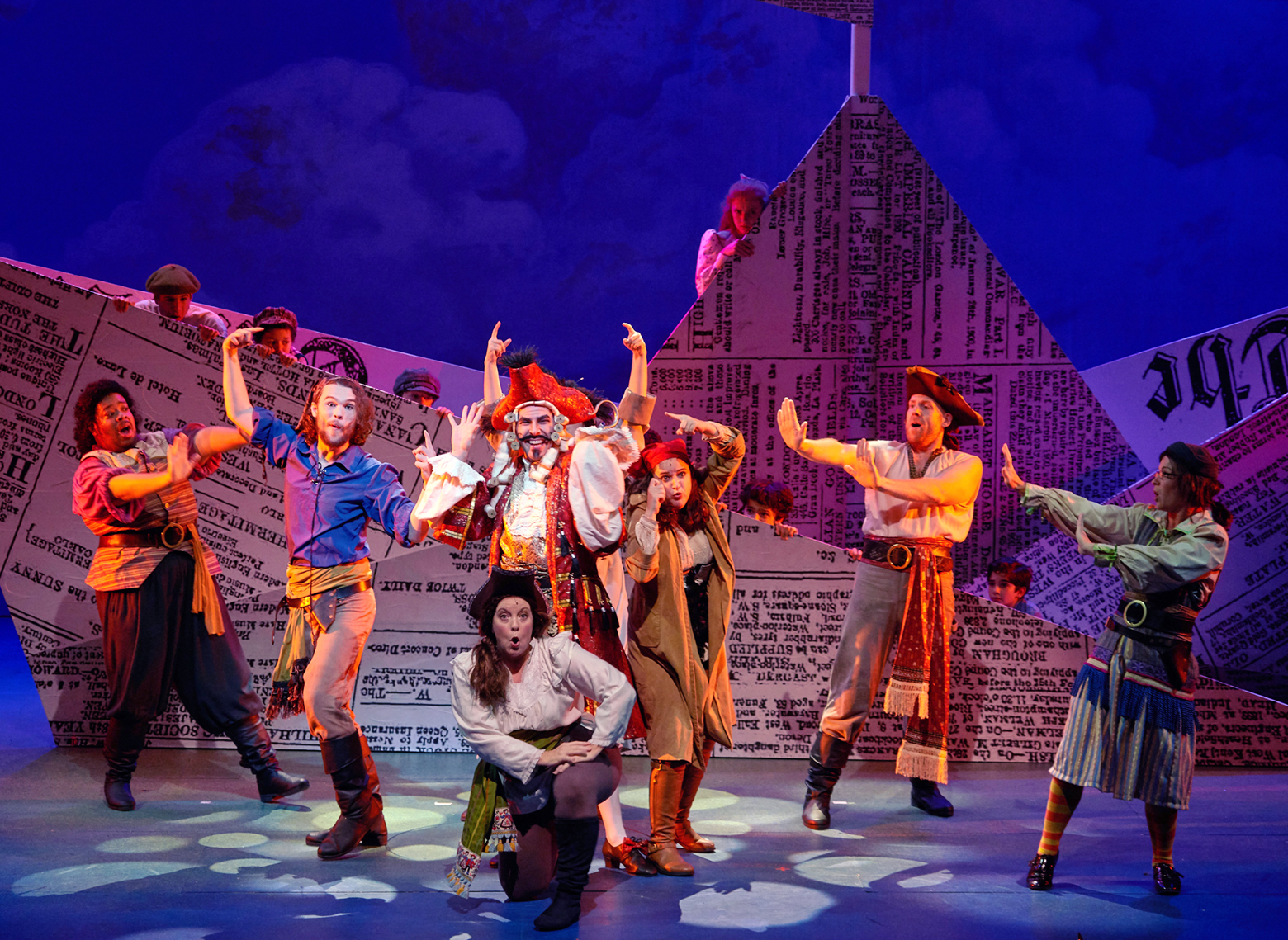
Sets by Robin Best weren’t the most eye-popping that I’ve seen at the McColl, a little humdrum in the framing London scenes but bursting with life in Neverland with a preternaturally large dragonfly painted onto the skein along with clusters of grapes larger than Hook himself. The deck of Hook’s ship was, in the same vein, a monstrously enlarged replica of the boat we first saw on John’s bed, made from a folded-up newspaper. Dreamy and odd. The idea of making Nanna, the Darlings’ dog, into a big floppy puppet was brilliant, but I’m sorry to report that Male and her design team bungled the Croc rather badly, giving us only a tail dangling over the side of that newspaper boat as the action crested. Evidently, nobody at ImaginOn has checked out the wondrous Charlotte Ballet production of Peter Pan and discovered just how hilarious a costumed Croc can be.

But it would be foolish to assert that Children’s Theatre didn’t know what they were doing in this spectacular season opener. Clocking in at 140 minutes, Peter Pan surely ranks among the longest shows ever staged at the McColl Theatre, its opening act longer than most of the shows the company produces. Maybe the cagiest – and subtly effective – thing Male does is in the careful placement of her intermission. Flouting the norm, she doesn’t bring down the curtain on a rousing climax. Instead, we adjourn at the moment when Peter and Tiger Lily shake hands after saving each other from the pirates. When the lights came up, everybody in the audience – children of all ages – knew that there was more to come and that it would be good. The flying by Peter, Wendy, her sibs, and the surprising Tink is delightful throughout, but the curtain call sends Peter out over the audience, an artful cherry on top.

Fall Works Fetes Bernstein and Robbins in Witty Style

Review: Charlotte Ballet Fall Works

By Perry Tannenbaum

Hope Muir’s second season as artistic director with Charlotte Ballet began very much like her first, with another program titled Fall Works that revived a gem from the company’s existing repertoire while introducing a pair of pieces that were new to the Queen City. It wasn’t as splashy or audacious as last year’s edition, when Muir not only gave us our first sighting of choreographer Javier de Frutos but also delivered the electricity of Tony Award winner Levi Kraus. The 2018 program was merely more polished and more consistently satisfying.

We began with Jerome Robbins’ setting for Leonard Bernstein’s Fancy Free, the 1944 prototype of On the Town, their joint debut on Broadway later that year. Muir’s company hasn’t staged this work since it was Jean-Pierre Bonnefoux’s company, NC Dance Theatre, in 2006, but it certainly returned propitiously, in the centenary year of both Robbins and Bernstein. Robbins was celebrated with a full evening of his works at Spoleto Festival USA earlier this year, a fitting tribute since Robbins founded his dance company, Ballets: USA, at the Italian Spoleto in 1968.

That March 2018 celebration in Charleston circles back to Charlotte when you remember that the program of Robbins duets at Spoleto USA replicated one that had been originally staged in Italy in 1973 – with Bonnefoux and Patricia McBride among the elite superstars who danced the pas de deux.

Longtime NYC Ballet stalwart Kipling Houston, who danced Fancy Free on Dance in America back in 1986 during his younger days, staged a very handsome revival, aided by the dreamy original set design by Oliver Smith and the spot-on World War II costumes by Kermit Love – both on loan from Richmond Ballet. What really livened this staging was the live accompaniment by the Charlotte Symphony under the direction of Christopher James Lees

Peter Mazurowski and Juwan Alston were the two sailors on shore leave in NYC who left James Kopecky in the lurch to pursue a bright yellow skirt, otherwise known as Sarah Hayes Harkins. Kopecky didn’t need to lick his wounds for long before Alessandra Ball James sauntered in, working a burgundy dress. The tone got more serious when James popped up, for the sailors engaged in horseplay even before Harkins arrived on the scene – and teased her a bit after they had vied in preening for her.

Harkins was sassier than usual before her first exit, a welcome sign that she’s hungry for this kind of role. As we saw a couple of times during this comedy, Mazurowski and Alston were in cahoots with one another at Kopecky’s expense, but they competed against each other, too, for the arithmetic is obvious when the young men and women reassemble at the bar. Three men were vying for two women’s favors. Each of the men took a turn at making his case. Landing two prodigious splits after high leaps, making me wince both times, Mazurowski definitely impressed me.

The moment of truth, when we expected the ladies to choose their men, turned chaotic and comical as the guys sought to usurp the ladies’ privilege and wound up brawling with one another – in front of and behind the bar. By the time the fisticuffs had concluded, Harkins and James had escaped, leaving all three sailors high and dry. Cue the entrance of Sarah Lapointe, really working it as she sashayed into view for a delicious cameo.

With Sasha Janes taking Bernstein’s music and replacing Robbins’ choreography with a totally new setting, Facsimile showed us more of Bernstein’s symphonic side and gave us a fuller view of the company to start the 2018-19 season. Instead of Robbins’ original love triangle, Janes presented us with a sometimes-surreal seduction, with Harkins trying to perk up the downtrodden, woebegone Kopecky. Listlessly pushing a custodian’s broom, Kopecky found Harkins beaming sympathetically at him.

Daring and precise as she has always been, Harkins seems to be taking a more lithe and spontaneous approach these days, with a new fluidity that makes her even more versatile and formidable than she has been before. As the troubled Lead Man, Kopecky was more troubled than pathetic, exactly the right mix to keep up Harkins’ efforts to puncture his despondency. You want him to be worth her time.

Janes’ Lead Woman suddenly receives backup when an upstage scrim lifts and a colorful gallery of circus characters appear, from Ringmaster and Equestrians to sideshow Fortune Teller and Strong Man, garishly costumed by Jennifer Janes, the choreographer’s mom. Among this motley crew, Drew Grant as the Ringmaster and Amanda Sturt-Dilley as the Fortune Teller were the most vivid diversions, but I couldn’t help ogling Maurice Mouzon Jr. with his barbells and Colby Foss as the Bearded Lady.

None of these fantastics could quite keep Kopecky’s mood levitated though they became a rather bacchanalian carnival when Lees stirred up the orchestral hullaballoo to max volume. They vanished almost as suddenly as they appeared, leaving Harkins one last half-hearted opportunity to accomplish what the circus could not. Here we saw perhaps the best of Kopecky’s performance as he summoned up sufficient ambivalence to justify a hopeful if not happy ending, chiming beautifully with the music.

With his mischievous against-the-grain style, Medhi Walerski and his Petite Cérémonie easily supplied the most fun of the evening. Dancers in mostly black formal attire, designed by Linda Chow, entered a bare stage – some of them processioning up the theater aisles – and formed a strict chorus line upstage, staggered by gender, repeating the same monotonous step. Then as the rapturous, prayerful strains of Bellini’s “Casta diva” played softly in the background, the men and the women moved in regimented unison, often with the men and women assigned different sequences of movement.

Or a couple might break away from the ensemble to perform a brief duet conspicuously devoid of human connection. Creepily enough, there were times when the ensemble’s regimented routines – or even the couple’s movements – were louder than the opera.

It took awhile for the audience to get Walerski’s humor. There was no turning back when Ben Ingel came out and juggled three balls under a boom mic and delivered a disquisition on the difference between male and female brains while Mozart played faintly in the background and other dancers attempted to distract him. The visibly disproven point our juggler made about men’s brains was that they couldn’t concentrate on more than one thing at the same time.

Similar disconnects between the recorded music and the live action persisted in settings of a Benny Goodman Orchestra version of Irving Berlin’s “Blue Moon” and a Mozart concerto, finally arriving at a witty obliquity when we reached an excerpt from Antonio Vivaldi’s Four Seasons. The ensemble danced in the same regimented, sometimes robotic style we had seen in previous sections of Petite Cérémonie, but now each of the 15 dancers also moved a white cube along the floor.

When you recognized the music as coming from Vivaldi’s Winter Concerto, you might imagine that the dancers were performing an ice dance, sliding those white cubes along a frozen pond. As the music churned to its conclusion, they piled all those cubes up and struck a pose. In that final tableau, you could imagine that they had built a little ice castle for their backdrop.