Review: Beyond the Surface at McBride-Bonnefoux Center
By Perry Tannenbaum
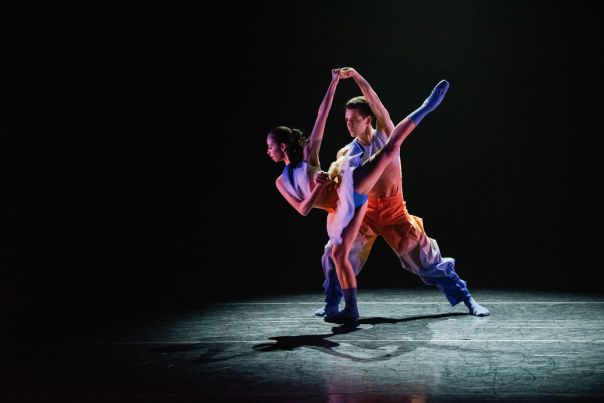
The new Charlotte Ballet season is off to a blazing beginning. Presenting Beyond the Surface at the McBride-Bonnefoux Center for Dance through October 26, the troupe looked fresher and younger than ever. But the choreography was far, far younger: two world premiere hatchlings that emerged from their shells last Thursday from Omar Román de Jesús and Mthuthuzeli November, and a third Charlotte Ballet commission by Jennifer Archibald that had its premiere less than two years ago in the same studio.
On that auspicious occasion, Archibald’s fledgling was at the top of the Innovative Works program, sparking hopes that the pieces that followed would reach the same high level. This year, HdrM is nestled in the middle of the program – and my 2023 hopes were already realized again in 2024 with the premiere of De Jesús’s Balúm.
Yes, the first dance of the night easily merited a climactic spot in any evening of premieres: beautiful, complex, mysterious, symbolic, intricate, moving, epic, and surreal. Music by OKRAA, Ola de Luz, was relentlessly propulsive, with random noises at random intervals littered around the main core, a minimalist loop with a harp-like timbre. Once that core cleared the noisy interference, like a spiraling starship navigating through a belt of asteroids, a sudden hypnotic calm and spaciousness prevailed – and the wonder of this dance multiplied, lending it an uncanny glow.
De Jesús has indicated that he is exploring our interactions with the air that engulfs us, from the moment we are born until we take our last breaths. Or maybe that emergence from the noise field near the beginning of the piece is an expulsion from the womb, our birth after a pre-natal prelude. The Puertorriqueño choreographer also has a hand in scenic design and Branimira Ivanova’s costume designs, for she has some specific prompts to execute in fashioning the dancers’ outfits and props.
The most notable of these are black: Two umbrellas that conjure up the surrealism of René Magritte and the fearfully magnificent ambiguity worn by Rees Launer. One of the umbrellas starts upstage center, held by one of the dancers seated on a bench, and it gets passed from dancer to dancer during the action, frequently cycling back to its starting position. The other is held stolidly by a woman on a side bench who resolutely faces away from the action until the stunningly gorgeous denouement – when we get to see the air!
At various moments when Launer grips our attention, we can have different conjectures about what his stern character represents. A raging fire-and-brimstone preacher? a demon? a witch? the Angel of Death? Launer will be a member of two of the three ensembles that get to present Balúm during its current 16-performance run. Another standout in the opening weekend’s seven-member ensemble, Maurice Mouzon Jr., will be in all the performances of this piece.
The liquefied movement of the dancers – along with some robotic intertwining – was juxtaposed with no-less-idiomatic lifts that were more horizontal than vertical. Like chapter markers at the end of episodes, the ensemble would gather and swirl around the stage in an evocative oval parade. Autumn leaves swirling in the wind. Often two or three subgroups performed simultaneously before an ensemble swirl would resolve the dissonance.
What amazed me most was that synchronized entrances and overlapping actions were so precise when there were seemingly no musical cues to give the dancers a toehold. If you’ve heard music by Philip Glass, you know that minimalism is not particularly danceable music. Musicians playing it and maestros conducting it must concentrate intently on the score to keep their bearings amid the repetitiveness. I’m still gobsmacked by how this Charlotte Ballet team pulled this off.

Following Balúm, a piece so untethered from every aspect of its music except for OKRAA’s tempo, Archibald’s HdrM struck me from an altered perspective. Archibald’s ability to mesh expressive movement to a soundtrack of musical compositions by Ludwig Ronquist, Heilung, and Federico Albanese stood out more boldly than ever after the more abstract and surreal De Jesús piece – though these intimate bonds in HdrM could be broken by abrupt mechanical disconnects from the score.
Two other conflicting factors came into play. Most welcome was the opportunity to see the Canadian-born choreographer’s work reprised by three of the eight dancers who performed at the 2023 premiere, Raven Barkley, Luke Csordas, and Shaina Wire. The piece looked more natural and “lived-in” twenty months later, so its internal contrasts were sharper and its sensual moments more relaxed. Barkley, in particular, stood forth dramatically, as sensual, captivating, and devastating as we’ve ever seen her. Nor can you fail to notice the ‘do.
Here, more than in any other dance of the evening, the ensemble bought into the “Unfiltered” theme of CharBallet’s 2024-25 season with their spirited, lyrical work. My only worry was off the dance floor and in the program booklet, where Archibald’s useful explanatory remarks where no longer in print. There in 2023, she was concerned with environmental psychology and posed a pointed question: “Is there a social responsibility to humanize architecture?”
Just asking that question helps us to connect with Archibald’s struggling language of movement. It also hints at the likelihood that Kerri Martinsen’s drab costumes are intended as institutional, such as clothing worn in hospitals, prisons, or mental wards. Aside from the contrast between lithe and mechanical movement, HdrM holds our gaze with a nice balance of ensemble, individual, and pair segments that flow naturally into one another.
Like many finales we’ve seen before from CharBallet, November’s Vibes and Variations is the most celebratory and carefree piece of the night. After last year’s From Africa With Love, it’s also the second consecutive November premiere to kick off a season at the McBride-Bonnefoux Center. Where Africa was surprisingly serene and monochromatic, preoccupied with mauve-colored ostriches from his South African homeland and their exquisite fragility, Vibes seems to wander westward to South America, to samba, tango, and carnivale.

Ivanova’s costumes burst with pastel cotton-candy colors and outré pleating, what my late mom in her saltiest Yiddish would call ongepochket, crassly over-decorated. The bulges on the men’s costumes give them seahorse legs and the frilly women look like spinning tops in a color scheme that matches the men’s harlequin-like rigs. The music starts off rather quietly with Gaby Moreno singing the first vocal on the program, her cover of “Cucurrucucu Paloma” over a simple acoustic guitar accompaniment, smoldering with bossa nova intimacy and sadness.
Things intensify as the 15-person ensemble digs into the Bang on a Can All-Stars’ version of David Lang’s strangely percussive – and minimalist – “cheating, lying, stealing.” But the most intense partying launches when we arrive at beatmaker Jamie xx and MC Moose performing the brash, irresistibly mindless “Gosh.” Catching my eye most compellingly were Csordas and Fuki Takahashi, each of whom will be in two of the three rotating ensembles performing November’s piece throughout its current run.
If I have to predict who will land the title role in Carmen next spring when artistic director Alejandro Cerrudo and CharBallet unveil their Vegas-showgirl update, my guesses would be Takahashi or Barkley. Since that Charlotte premiere will be running for two weekends, both temptresses could take turns at it.

 Charlotte Ballet’s reveal wasn’t as dramatic as the recent return of the renovated Old Barn on Queens Road with a full-fledged Theatre Charlotte musical. But after the COVID shutdowns, postponements and cancellations, and the abrupt departure of artistic director Hope Muir after barely five years – the last two during the pandemic – it was hard to feel that Charlotte Ballet was all the way back until last weekend. Until we had seen some choreography by the new AD, Alejandro Cerrudo. Extra frustrating for me, since I had declared his work a perfect fit for CharBallet when I had first seen it at Spoleto Festival USA in 2014, had been the absence of his imprint on the Fall Works program at Knight Theater last October.



 Art on My Sleeve