Tag Archives: Jennifer Adams

Christmas at Pemberley Gets a Gendered Makeover

Review: Miss Bennet: Christmas at Pemberley @ the Cain Center

By Perry Tannenbaum

If it weren’t for all the adaptations we hear about on TV and in movies, we could say that it required supreme audacity for Lauren Gunderson and , to tread in Jane Austen’s footsteps and pen a sequel to Pride and Prejudice, her wittiest and most beloved novel. But despite the obvious commercial bent of Miss Bennet: Christmas at Pemberley, Gunderson and Melcon have aimed to capture Austen’s essence and bring fresh life to her characters.

As you’ll find up at the Cain Center in Cornelius, no small thanks to the audacious direction of Steve Kaliski, the script sprinkles a bit of modern perspective on the Bennet sisters and their beaus – occasionally forcing us to recognize that Austen’s times are not so different from our own. Elizabeth Darcy, the heroine of the novel, still retains enough decorum not to call Fitzwilliam Darcy by his first name. Even in the privacy of their own home!

Likewise, elder sister Jane and her beloved Charles address each other as Mr. And Mrs. Bingley. “Happy Christmas” rather than “Merry Christmas” is the greeting norm, and the Christmas tree tradition has yet to take root in England in December of 1815. It’s Elizabeth’s audacity that brings this German custom to the Pemberley drawing room with its attached library.

In some ways, history has circled back. Back in college, my professor instantly drew our attention to the epistolary nature of Pride and Prejudice. The story is largely driven by letter writing. A chief turning point in the story is contained in a letter from Darcy addressed to Elizabeth, debunking her previous prejudices against him!

The prevalence of letter writing astonished us then – and felt alien. Ancient. Forty-plus years later, the sight of Mary Bennet, her sister Lydia, and Arthur de Bourgh exchanging billets-doux while under the same roof has to remind me of today’s texting, Instagramming youth, perpetually thumbing their cellphones. Buttressed by books, these youngsters can put quill to paper.

With Kitty off in London, not expected to arrive until Christmas Day with her parents, Mary is the only Miss Bennet we see and unexpectedly the leading lady. Arthur is an entirely new character, rivalling Mary in his bookishness. Resigned to spinsterhood, Mary is shocked to find that they’re hitting it off.

The forward-looking Gunderson and Melcon, proclaiming that Austen is for everyone, encourage diverse casting. But Kaliski and his Davidson Community Players go further, bringing us an all-female/non-binary cast. It’s an added semicircle backwards to Elizabethan days when only boys and men were permitted to perform onstage.

All three of these transpositions – Brooke McCarthy as Darcy, Rhianon Chandler as Bingley, and Jennifer Adams as De Bourgh – add a fresh patina of mirth and comedy. As for the playwrights, they inject plenty of wit and sparkle of their own. Speaking to Darcy before we see that Jane is seven-months pregnant, Elizabeth broadly hints she is arriving “safely and enormously.” Lizzy is more tactful when the expectant mother enters and they exchange greetings:

Lizzy: Look at you! You’re radiant.

Jane: I’m as large as a cottage.

Lizzy: And exactly as a cottage, you are warm, filled with life, and lit from within.

Although McCarthy plays him with some florid gestures, we soon see that he is richly endowed with breeding and tact. When the punctilious Mary presumes to correct Bingley, by informing him that the tree standing before them is a spruce and not a fir, Darcy pointedly intervenes. Before any dispute can begin, he proposes that he and his longtime chum exit for a brandy.

The ladies can now rebuke Mary, if they wish. They do, while gradually discovering that their younger sister has more charm and talent than previously suspected. Arthur’s admiration for her shocks them as much as it shocks Mary herself. As it turns out, Lizzy and Jane better be witty and perceptive, for Mary and Arthur are the plumiest roles. Fortunately, with the arrival of Lydia, the silly sister with the sham marriage, Lizzy and Jane can redirect their sharpest barbs.

Arthur is the heir to the nearby Rosings estate, but he is a distant nephew of the late Lady Catherine and has never lived there. There is some juicy history at that estate, left over from Pride and Prejudice,chiefly the presumption that Darcy would marry Milady’s daughter and not the comparatively lowborn Lizzy. Not to worry, Pemberley gracefully catches us up if we don’t remember Austen’s original.

What makes the role of Arthur so appealing is that he has no clue how to run an estate – and no solid experience with other men, women, or people. Adams carries a book around with her as if it were Arthur’s security blanket. Without one, Adams seems at a loss for what to do with her hands and arms, so we see Arthur almost perpetually in a scholarly or supplicating pose.

Attempting a billet-doux, Adams as Arthur reminded me of Christian in Cyrano de Bergerac, only he has nobody to help him out. When Arthur learns that his cousin Anne, after getting jilted by Darcy, now presumes she is betrothed to him, Adams’ awkwardness and shyness veer toward desperation and panic. When bliss is achieved, Adams’ glow is mesmerizing.

Crippled by a similar lack of self-esteem, Sahana Athreya as Mary is no more experienced and no less shy than Arthur – so she can range from being pedantic and irritating to heartbroken and pitiful to vivacious and adorable. Athreya can also freely gesticulate with her arms and sit down regally at the pianoforte.

The central triangle is further complicated by Destiney Wolfe as the compulsively silly Lydia. Glossing over her troubled marriage doesn’t inhibit Lydia from flirting shamelessly with Arthur, giving us extra tastes of how unaccustomed he is to such attentions. Nor does Kaliski bar Wolfe from being as irritating as Mary at her worst. On the contrary. Wolfe, when she isn’t pouncing, is often prancing.

At the center of all the overtures from Mary and Lydia – and the strict orders from Agatha Emma as the imperious Anne – Adams gets to be meaningful as well as stressed and sympathetic. For Mary and Lizzy, in the face of Arthur’s inclination to yield to Anne, are at considerable pains to remind him that he has what women don’t: a choice.

Of course, when Gunderson and Melcon wrote their merry comedy in 2016, they had no inking that “Your body, my choice” would be staging a comeback. But the playwrights are far from declaring that women were powerless. Even before her Christmas awakening, Mary is strong enough to proclaim that she would rather wed a plant than an unsuitable man.

Caring about their sisters, Lizzy and Jane sustain their relevance, Skylar Schock as Lizzy warming up to Mary and Emma Kitchin as the Jane becoming Lydia’s tactful benefactor. Christmas can even be celebrated by Emma, for it turns out that there’s kindness in Lydia beneath her silly, meddlesome surface.

Kaylen Gess’s scenic and lighting design complement each other handsomely, with Caleb Sigmon’s projections adding an extra festive luster. I’d imagine that Gunderson and Melcon would have envisioned a much larger, more intrusive tree at Pemberley. But as a Tannenbaum, I’m probably prejudiced.

The tree outside Cain Center, let me add, is big and bright enough for anyone.

Pro-Grade “POTUS” at Booth Gets New Conservatory Run in Cornelius

Feature Review: Charlotte Conservatory Theatre’s POTUS Transfers to Cain Center

By Perry Tannenbaum

POTUS_Fenixfoto_Charlotte_5R4A2102

After the morning press conference, there’s China, an international meeting on nuclear proliferation, followed by a photo op with blinded-and-maimed Iraq War vets, and a much-anticipated endorsement of a gubernatorial candidate somewhere out in the Midwest. Pretty typical day at the White House.

But in Selina Fillinger’s frenetic presidential comedy, POTUS, neither the man in the Oval Office nor the playwright’s viewpoint is typical. Fillinger made that clear in her subtitle, Behind Every Great Dumbass are Seven Women Trying to Keep Him Alive. At opening night of Charlotte Conservatory Theatre’s production of this romp, seven frantic women directed by Stephen Kaliski had their audience laughing nearly non-stop at Booth Playhouse.

It was the second consecutive Conservatory production that reminded many of us of the last resident company at the Booth, Charlotte Repertory Theatre, which expired way back in 2005. Members of Actors Equity are back in the mix, along with members of Stage Directors and Choreographers behind the scenes. Other professional groups are involved, including the local IATSE union and United Scenic Artists. Kaliski and Conservatory Theatre co-founder Marla Brown also harbor the long-term ambition of ascending to the highest rung of regional companies and becoming Charlotte’s first LORT (League of Resident Theatres) company since Rep’s demise.

Kaliski wasn’t behind the scenes for Conservatory’s debut at the Booth last August. No, he was onstage as a rather charismatic devil named Scratch in a surprisingly amorous faceoff with Elizabeth Sawyer. Jen Silverman’s Witch was the playwright’s fresh 2018 spin on The Witch of Edmonton, first staged in 1621, and Sawyer was a dramatization of a real-life woman burned for witchcraft earlier that same year. Brown wasn’t onstage in that “then-ish” setting, but her inclination toward making Conservatory a classics-flavored company definitely was.POTUS_Fenixfoto_Charlotte_5R4A2210

With POTUS, it’s Brown who is taking the stage – nearly assuming the title role late in Act 2 as she prepares to take the place of her lookalike brother, the Prez, at a posh speaking engagement. Speaking with Brown for this story, I opined that the recent POTUS she most closely resembled was The Donald. Nope, she countered, it was Obama.

You can decide who’s right. For the Conservatory Theatre production, after closing at the Booth several weeks ago, reopens at the new Cain Center in Cornelius for another three-performance run on April 26.

Until her shocking transformation into formalwear, Brown as the drug-dealing presidential sib Bernadette looked to me like a punkish Rob Roy on the skids. Here Brown and I are in much closer agreement, since she has proclaimed, “I got that role because I can rock shorts that are hideous.”POTUS_Fenixfoto_Charlotte_5R4A2137

Yet Brown’s shorts may not be the most bizarre or hideous thing we saw at the Booth in POTUS. Iris DeWitt as Chris, a beat reporter fishing for a scoop, multitasked by sporting a pair of noisy breast pumps that reminded me of football fan craziness, helmets retooled to hold beer cans emptying into drinking straws. Katy Shepherd as presidential secretary Stephanie may be the queen oddball. After unwittingly sampling an overdose of Bernadette’s merchandise, Steph goes so far off the rails that, by intermission, she’s prancing around the West Wing dreamily with a pink swimming pool floating around her waist.

The zany, comical mayhem that brings POTUS to the end of Act 1, with all seven women in action and Chris somehow stealing focus from the ever-twirling-and-spacey Stephanie, is the closest equivalent I’ve seen in many years to the explosive circus that engulfs the stage at the second intermission of George S. Kaufman’s You Can’t Take It With You. And that fizzy moment was the only time in Fillingers’ comedy that I caught anything like a whiff of classical flavor.

Conservatory’s swerve from classicism has been both intentional and fortuitous in terms of POTUS coming here and moving up the road to Cornelius.

“We want to leave our options open in these early days,” Kaliski says, “so there was a consideration early on of, okay, we’ll always do something that has some sort of anchor in a classical story. Right now, the aesthetic we’re landing on is, you know, how can we be that company? The plays in New York that are either your non-touring Broadway shows or prestige Off-Broadway shows – we want to be the group that picks a lot of those off and brings them to Charlotte. And I think Actor’s Theatre filled this role.”

Yeah, it’s clear that the closure of Actor’s Theatre rocked this town – arguably harder than the shuttering of Rep, which left CAST (Carolina Actor’s Studio Theatre) and Actor’s Theatre in its wake. Now? We’ve devolved into a bunch of small black box theatre outfits, counterbalanced by the bigger BNS Productions. They all produce consistently fine work, but none of them can be called “that company.”

Actor’s and CAST hardly messed with the classics at all. BNS, when it isn’t producing works by its founder, Rory Sheriff, mostly does the classics by August Wilson. So there’s definitely a niche for a major company in Charlotte that plans to straddle recent hits and the classics. Or any major LORT company at all, since we’re probably the largest US market without one.

Even in its beginnings, Conservatory is flipping the script written by Queen City theatre behemoths that perished in the past. Whether suddenly or gradually, Rep, CAST, and Actor’s all disgorged their founders through actions of their boards of directors, who then proceeded to dissolve their companies – without alerting the public that they were in crisis, let alone appealing for aid.

Having founded The Warehouse up in Cornelius in 2009, Brown and her board have not liquidated her brainchild. Utilizing Warehouse’s non-profit 501c3 credentials, they have rebranded as Charlotte Conservatory, upsized their mission and ambition, and – here’s a twist – amicably disbanded their board.

“I love that space very much,” Brown still says of The Warehouse. “But I also knew that after ten years, if I continued to produce there, I would regret it. Because Charlotte has seen such a de-evolution of theatre since Rep’s demise, and such a de-evolution of our talent pool. Anybody who works on a professional level or who understands the craft either has to do it for very little money or they have to teach and then do it at theaters, other LORT companies at other cities, or they work for Children’s Theatre only.”

In the wake of COVID, which gave theatre companies plenty of time to pause and reflect; and in the wake of We See You, White Theatre, a scathing BIPOC indictment of American theatre companies’ lack of inclusivity; Conservatory Theatre is intent on being more open-ended – and more open-minded – as it continues to take shape.

Neither cliques nor permanent positions have formed as Conservatory blazes its new path.

“We didn’t start with, okay, here’s our artistic director and the managing director, and here’s our director of development, etc., etc.,” Kaliski explains. “We didn’t start with a typical organizational structure. We were kind of thinking, all right, we’re a collective in this room together, and we’re going to take it project by project to start, and each project can have its own set of showrunners, if you will, kind of like a TV show. And they’ll be in charge of that, and then we’ll kind of have a different group of showrunners or a different producing pod for the next one.”

That kind of inclusivity has allowed Kaliski and Brown to reach out, in Conservatory’s formative phase, to Matt Cosper, who still cranks out XOXO productions, and playwright/actor/director Brian Daye, a former member of the Warehouse board. Nor is this core group and others limiting their horizons to the Booth Playhouse and the Cain Center, especially since Conservatory doesn’t have the kind of sweetheart rental deal the would come with official residency at either venue.

Mint Museum, the Stage Door, and the new Parr Center are all in play for future reconnoitering and producing, along with whatever the epic renovation of Uptown’s Carolina Theatre winds up offering. Meanwhile at Cain Center, whose stage does not sport a fly loft, there’s a mutual feeling-out process as both newbie organizations find their bearings.

Both Brown and Kaliski were surprised and delighted that rights to perform POTUS became available so soon after the Broadway production closed last August. Many in their circle presumed there might be a national tour in the offing. But POTUS doesn’t make the most discreet or decorous entrance for a Cornelius audience, that’s for sure.

Brown had some trepidations when she approached Cain director Justin Dionne. “Okay, Justin,” she remembers thinking, “you understand that the first word is the C word. And I know you don’t want people coming and going, ‘This is not what we built the Cain center for.’” She squeals in a high falsetto, half-relishing this possibility.POTUS_CCT_Charlotte_Group_Fenixfoto15379 - 4

Yes, before Fillinger’s action even begins, POTUS has used this word at his morning presser – in describing the First Lady, no less. In her presence. He doesn’t know she’s there, due to a couple of additional plot points – one, we’ll learn, involving anal sex – so he explains her absence by saying, “She’s having a cunty morning.”

So Valerie Thames as chief of staff Harriet opens the show by storming onstage and exclaiming the offending adjective in its root form. Instantly radiating dignity, morality, and competence – qualities that will not be attributed to POTUS – Thames authoritatively dumps this crisis of the day in Jean’s relatively cool hands. Slim and conceivably serene, Jennifer Adams as POTUS’s beleaguered press secretary wastes little time in convincing us that poor Jean likely holds the most combustible burnout position in the West Wing.

Harriet and Jean are the women most seriously invested in keeping the dumbass alive and the most adept at getting the job done. This often involves prodding Stephanie, quite intelligent beneath her scared-rabbit exterior, into action. Bernadette, ankle monitor on her leg, is also very interested in keeping her brother alive, if for no other reason than her nefarious enterprises will ultimately require a presidential pardon.

“Harriet,” Jean memorably informs Bernadette, “is the number one reason this country continues to function.” By this time, Jean has perpetrated a monumental screw-up of her own.POTUS_Fenixfoto_Charlotte_0K9A1454

Wielding a blue slushy, Sarah Molloy makes an entrance as Dusty that rivals Harriet’s, rushing across the stage to vomit into a trashcan. Not the subtlest indication you’ll ever see that somebody is pregnant. Yet the West Wing brain trust struggles to put two and together. Bernadette sees it all rather quickly, though. You need to be truly family to understand POTUS.

Iesha Nyree as The First Lady sizes up Dusty nearly as quickly as his sister-in-law. Assailed by presidential insult and infidelity, Margaret is also complicit and invested in her dumbass husband’s political machinations. Never playing a victim card, Nyree makes Margaret formidable and conflicted. But while Fillinger flips the meaning of her subtitle upside down, hinting that impulsiveness and incompetence aren’t confined to POTUS or his gender, she spreads the inner conflict around: lurking among these ladies are two lesbians who will consider rekindling the old flames that once blazed secretly on the campaign trail.

“At least three of the characters must be women of color,” Fillinger prescribed in her script. “Actors can be cis or trans. Age is flexible. Beauty is subjective. So long as they’re fast, fierce, and fucking hilarious.”

Kaliski, Brown, and Charlotte Conservatory Theatre checked all of those boxes at the Booth. True, POTUS is a bit lightweight and more than a little over-the-top. But if you missed it in Charlotte, it’s worth the trip to follow this production up to the new Cain Center. Seeing how it all goes over with the Cornelius crowd might be an extra treat.

Cosper’s Take 2 on Genet’s “The Maids” Is a Keeper

Review: XOXO Presents The Maids at The Mint Museum

By Perry Tannenbaum

IMG_2297

Why hasn’t Absurdism ever taken root in America as it has across Europe? After analyzing the plays of Samuel Beckett, Eugene Ionesco, Harold Pinter, and Jean Genet in his renowned study, The Theatre of the Absurd, Martin Esslin briefly pondered the question. What America seemed to lack, according to Esslin, was the deep disillusionment that sprouted up in the UK and France, the epicenters of Absurdism, as they languished in the lingering ashes of World War 2.

On this side of the Atlantic, we still had a strong sense of meaning and purpose, for the American Dream still flourished during the Ike Age. Watergate, Vietnam, and Edward Albee hadn’t yet dented our optimism – or our tough, leather-clad cynicism – while Absurdism percolated abroad.

Well, 75 years after the premiere of Genet’s The Maids, disillusionment and despair seem to be the most unifying features of American life. Coin of the COVID realm. So the times could hardly be riper for the gestation of new Absurdist playwrights in the Land of the Free, though inhabitants of MAGA World may have gotten a head start in their alternate universe.

Certainly, The Maids should be considered in-season at the Mint Museum, where a stylish and purposeful XOXO production is running through August 14. We’ve waited long enough: since I last reviewed The Maids in 2002, we’ve hardly heard a peep around here from Pinter, Ionesco, Beckett, or Genet.

Over the past 35 years, Charlotte’s main proponents of the notoriously criminal Genet – thief, prostitute, smuggler, deserter – have been UNC Charlotte, where I saw The Balcony and The Maids in the late ‘80s, and Matt Cosper, who directed both the 2002 edition of The Maids at the Hart-Witzen Gallery and the current effort in the Mint’s Van Every Theater. Imprisoned many times, “Saint Genet” (as Sartre called him) could have easily fit Esslin’s profile of disillusionment and despair.

Yet a look at Genet’s most notorious works (add The Blacks to those suspects I’ve already named) shows the Frenchman to be subversive, nihilistic, angry, rebellious, wickedly sarcastic, and restlessly playful. At the same time, The Maids is an especially oblique and mercurial text, tough on readers and even tougher on actors, directors, and audiences.IMG_2229

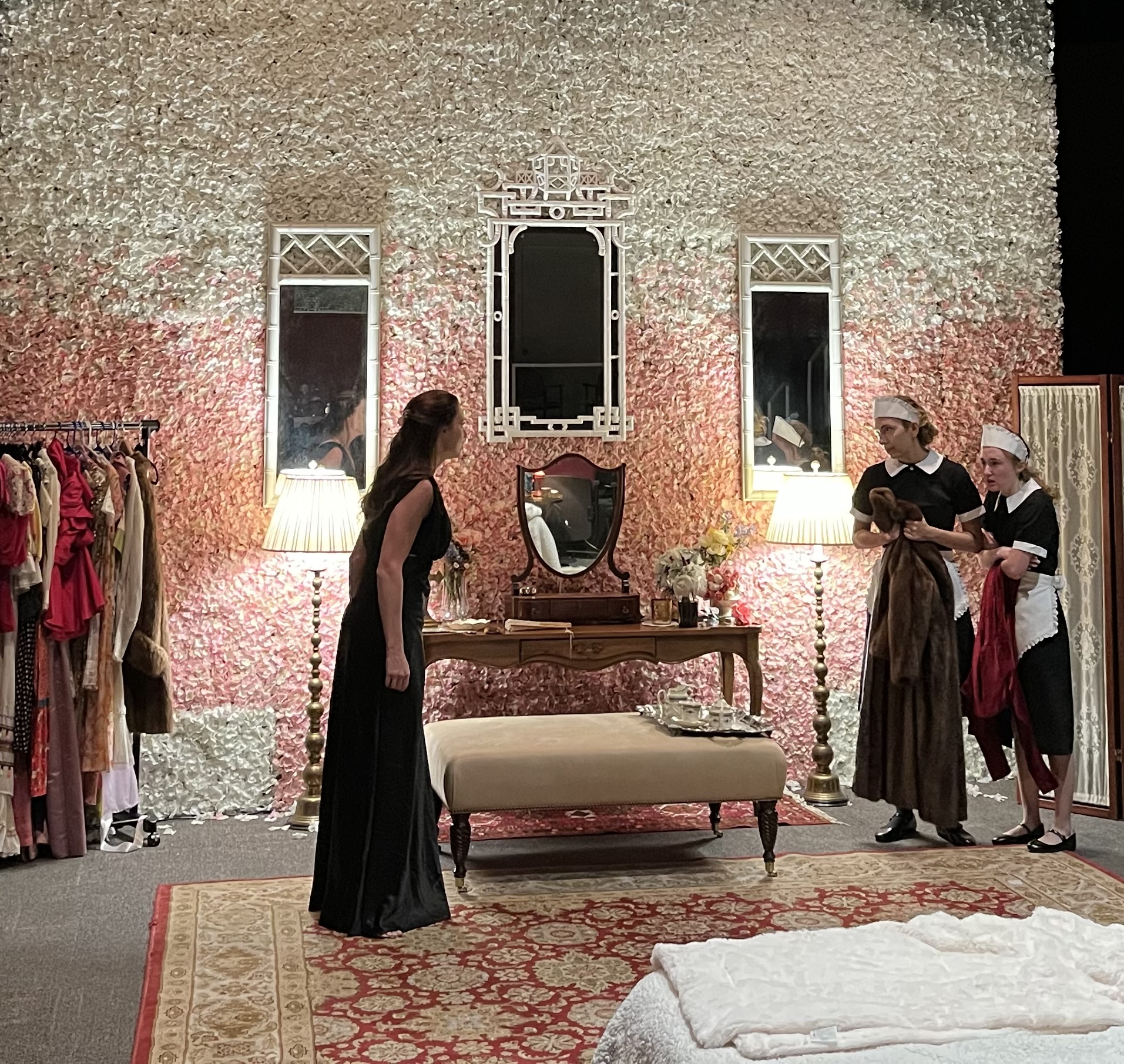
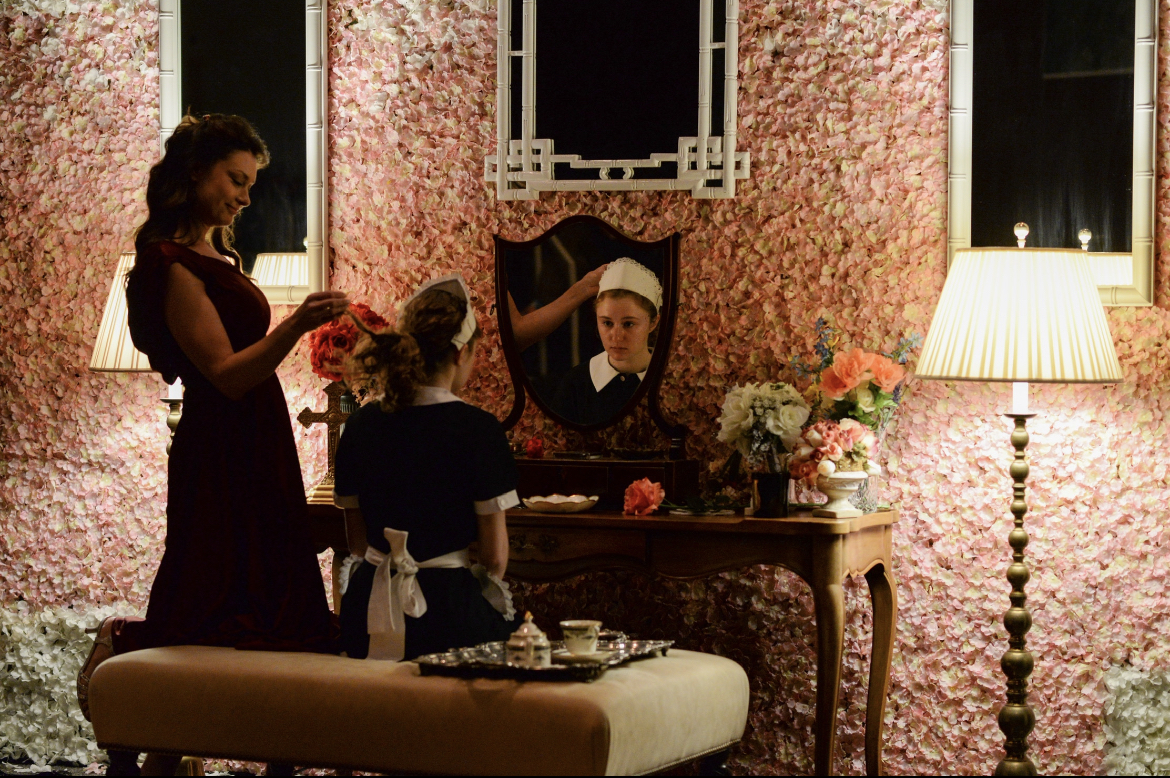
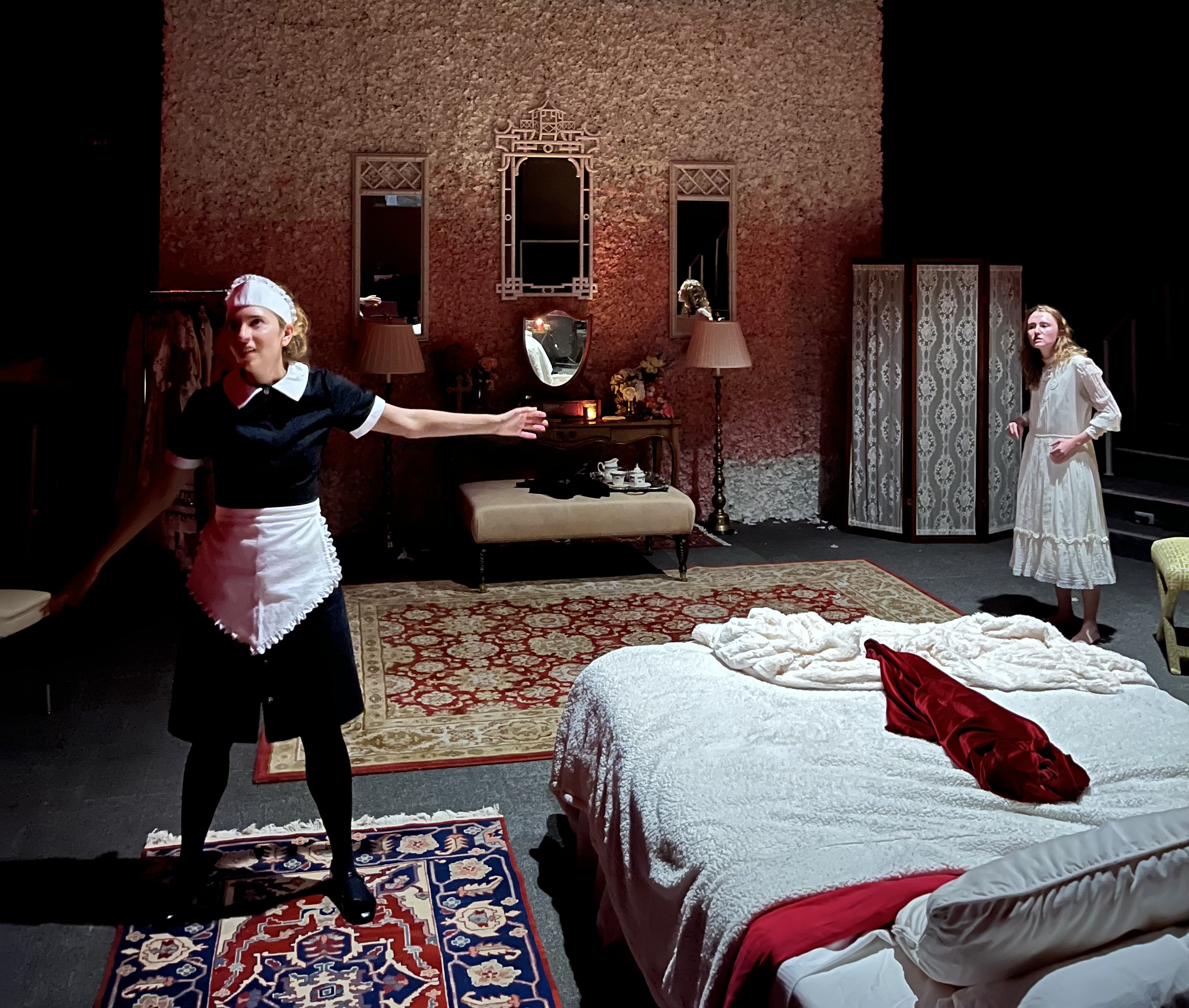
In his second shot at presenting Genet, Cosper takes the script by the scruff of the neck and bends it to his will, making the action more sensational and surreal, adding musical interludes for the sister maids, and taking charge of the denouement and the final tableau, making the experience easier for us to take in. With an outstanding set and lighting from production designer Will Rudolph, and with composer Shannon J Hager’s sound design deepening the spell, this may be the richest theatre experience we’ve had at the Van Every.IMG_2192

Rudolph captures the Louis-Quinze ambiance prescribed for Madame’s boudoir with his furnishings and eclipses the playwright’s wildest imaginings with his follow-through on Genet’s call for flowers-flowers-everywhere ornamentation. We seem to be watching Madame dressing up and admiring herself more convincingly here, waited on by her maid Claire, than we did at the Hart-Witzen 20 years ago. Yielding partway to Genet’s perverse suggestion that men play all three roles, Cosper had one man onstage as the action began.

Not this time. We can see in our playbills that this is an all-female cast, but we still might think there’s a misprint even if we recognize Kadey Ballard and Kate McCracken when they first appear. It’s not long before Cosper’s players let us know that things are more than a little out of whack.5680C148-E886-464F-88DA-28A0326C5891

Two-time Blumey Award winner McCracken is noticeably histrionic, sometimes almost operatic as Madame, preening herself and striking attitudes. Ballard, QC Nerve’s 2021 Best Singer-Songwriter, is even more bizarre, veering as Claire from Southern drawl to bossy Irish brogue and then to a French accent. Then she shifts from sweet maid to bossy dominatrix, slapping Madame hard in her expensively powdered face.

Then an alarm clock goes off, bringing the ritual to a halt, and soon afterward, the phone rings – another sudden reversal that further excites and confuses us because it discombobulates the sisters. We gradually understand that two maid sisters, Solange as Claire and Claire as Madame, have been playacting while Madame is away, fondling their mistress’s jewelry, modeling her dresses and lingerie, building toward the climax in the sisters’ fantasy when they will murder Madame.

But the alarm going off startles them, signifying that the real Madame is returning from her nocturnal partying. The telephone call brings news that Madame’s beloved Monsieur, whom they have cleverly contrived to send to prison – apparently an easy chore in Genet’s world – has been released on bail. The delicious jig-is-up panic between Ballard and McCracken, seasoned with a desperate mix of sisterly animosity and solidarity, weaves a wonderful red carpet for Jennifer Adams to make a serenely regal entrance upon as the true Madame.IMG_2353

And indeed, an exit door from the theater opens and Adams descends three straight flights of stairs to join the quaking siblings, instantly and effortlessly establishing her superiority and dominion. Adams is the diva that McCracken has pretended to be, her crises are as big as life, maybe bigger, and her dictates are to be followed.

Or at least Madame’s tragic and operatic sufferings are real until Claire stupidly blurts out that Monsieur has been released. In the blink of an eye, the air of fantasy and seething underclass resentment turns into a movie thriller predicament. Now if Claire doesn’t kill the real Madame before she gets to have a tête-à-tête with the liberated Monsieur, her mistress might get to the bottom of why her beloved was thrown into jail, and the two complicit maids could be facing some prison time of their own.

It’s urgent, for the impulsive Madame plans to rush out and rendezvous with Monsieur immediately, past midnight, at a designated place.

The 20-year interval since my last experience with The Maids was enough for me to have forgotten the outcome, even if Cosper weren’t bent on changing it. Curiously enough, the comical vibes from the three extravagant performances allowed me to feel a certain amount of detachment. After all, if the bumbling maids couldn’t manage to knock off Madame in multiple roleplaying sessions, what could we expect when it all had to become real, outside their hurriedly aborted play-within-a-play?IMG_2364

Yes, I could root for the maids because Adams had regally discarded feelings in favor of decorous posturing, her Madame never condescending to display any sort of interior. Cosper flips the chemistry between the females by making his Madame older than her servants, rather than 5-10 years younger as Genet prescribed. Somehow this Madame is less innocent in her imperiousness, more heartless than she might have been in Genet’s mind. The oppression of these maids by their mistress seems more severe.

At the same time, McCracken and Ballard point up the youthfulness and playfulness of the sibs, adding extra edge – and a bit of shock – to McCracken’s sweetly murderous Claire and Ballard’s wickedly cruel Solange. Even if you read Genet’s script tonight, you’ll be surprised tomorrow at the Van Every by how energetically and decisively this duo navigates the changes in mood, tone, and subject in their dialogues. One moment, they are in their ritual roles. Next, they’re themselves, bickering sisters, berating each other as Madame would.

For they admire the mistress they hate.

Late in the playscript, there’s a moment when only the audience should be able to see Claire. It’s a moment where Cosper would need to reconfigure his stage design to comply with Genet’s demands. Instead, he becomes wildly imaginative, with electrifying results. The ghostly, demonic ceremony of flaming despair that concludes The Maids at The Mint remains in the spirit if the lurid script, if not the letter, becoming Genet and Cosper at their best. Perhaps the rogue playwright, beholding this director’s boldness and impudence, would have been as awestruck as we were.