Review: She Kills Monsters at the Parr Center
By Perry Tannenbaum
When you think about it, not too many comic books get to be adapted into plays or musicals. Movies and TV seem to be the hallowed afterlife of superheroes and Marvel headliners – except for that regrettable Spiderman the Musical fiasco. Only video games, if memory serves, make it to the big screen. But never to a live stage. Monopoly, Chutes & Ladders, and other pop culture board games were similarly neglected until Clue proved that it could have legs onstage.
So now we have playwright-director-choreographer Qui Nguyen’s She Kills Monsters, inspired by the legendary Dungeons & Dragons board game, onstage in Charlotte for at least the third time in the last 10 years, beginning with a UNC Charlotte production in 2016. In some ways, the current Central Piedmont Theatre production is an upgrade from the 2022 version presented at the Arts Factory by Charlotte’s Off-Broadway.
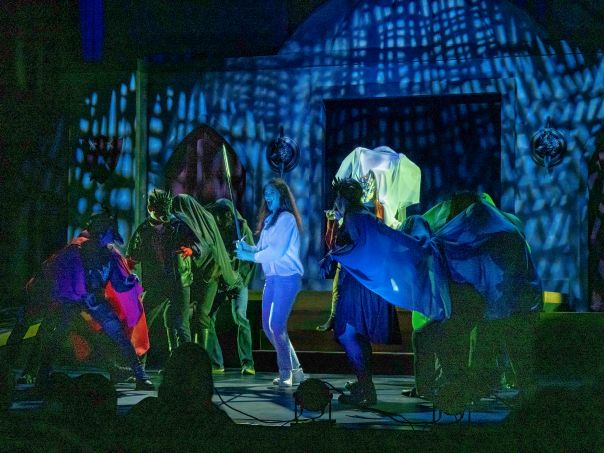
The bigger, newer Parr Center offers the spaciousness for scenic-and-projections designer James Duke to make Nguyen’s spectacle more spectacular. In cahoots with lighting designer Jeff Childs, costume designer Freddie Harward and prop designer Maxwell Martin have the equipment and budget to splash additional color across the Parr stage. Add the sound designs of Montavious Blocker and Carly McMinn and you have a sensory-rich fantasy brew.
To stage his own scripts and bring martial arts action into live theatre, Nguyen established the Vampire Cowboys Theatre Company in 2000 – and himself as the godfather of “Geek Theatre.” Presumably, he was convinced stage combat and martial arts could be a more visceral experience in live performance than it is on film, even if the resources of slow-motion photography, AI, and animation had to be tossed aside.
Much of Nguyen’s geekery can be comic book silliness and free-range Gothic imagination, delighting as much in creating outré villains as in birthing super-powered heroes – with a smattering of witchery and magic on both sides. What makes She Kills Monsters especially clever and brilliant is Nguyen’s use of Dungeons & Dragons as a game within a drama. His hero, Agnes Evans, uses D&D as a tool to recover the essence of her younger sister Tilly after her untimely death.
You will wonder how this can be possible if you don’t already know that D&D can be deeply and extensively personalized. You can create your own module for the game and envision heroes and monsters based on your own friends and enemies: a wonderful way for high school teens to vent their thwarted loves and seething hates.
Key example: Tilly, venerated as Tillius the Paladin among D&D geeks in Athens, Ohio, was jealous of her elder sister’s boyfriend, Miles. So along the path of Tilly’s scenario, Agnes will discover that Miles is a villainous force who must be vanquished, even though the evildoer has been imprisoned in a huge gelatinous cube.
That discovery will pale in comparison with the discoveries Agnes makes about Tilly’s sexuality. Geeks are merging with Greeks in Athens, as Nguyen is quite aware, so his female warriors will not be as straight as Homer’s Amazons.

Nor can Nguyen’s Athens be down in Georgia, for he has ordained that Agnes is average – the birthright of all Ohio citizens. For Agnes, it’s a journey into the underworld just to meet Chuck, who will serve as Dungeon Master for the surviving sister while entrusted with the precious posthumous work of Tillius the Paladin.
Layered onto all this teen angst (Tilly’s) and Agnes’s quest to recover her dead sister’s lost soul – both in the D&D game and in real life – is another Narrator, a high school guidance counselor, and numerous mundane classmates that Tilly has mirrored and immortalized in “The Lost Soul of Athens.” My picks for most lethal are the Athens High cheerleaders, Tina and Gabbi, turned into succubi in the D&D realm.
Carly McMinn directs the show, immersing herself and her cast in the action to a fault. I’m not sure McMinn sat herself more than three rows away from her players during rehearsals at the Parr Center. By the time Nguyen’s words reached my party in Row G, much of the Vietnamese playwright’s snappy dialogue had become unintelligible.
Get as close as you can if you wish to hear as joyfully as you’ll see.
If you don’t mind experiencing She Kills Monsters like Greek drama, knowing the plot beforehand, you can freely read and/or download the script online. Otherwise, you’re adding the Neil Simon layer afterward. If at all.
Generally speaking, the vaunts, boasts, and challenges within the game are louder than the conversations inside Agnes’s apartment, Chuck’s store, or the guidance counselor’s office – and more often competing with the soundtrack, which is not at all Dean Martin. Is it Beck’s “Loser” or LL Cool J’s “Mama Say Knock You Out” or Smashing Pumpkins as suggested by the script? Couldn’t say.
McMinn and her choreographers capture the spirit of Agnes’s odyssey beautifully, true to Nguyen’s saucy mix of fantasy and reality, silliness and profundity, fun and feeling, play and play. Fight choreographer Elizabeth Sickerman and dance battle choreographer Becky Rooney both grasp the double layer of artificiality that protects us from viewing violence, injury, blood, or death in the D&D world as any more serious than AEW on TNT.

But unlike AEW, Sickerman and Rooney can take advantage of the outright artifice for comedic purposes. How bad is it, then, if Tillius the Paladin wields her mighty sword – The Eastern Blade of the Dreamwalker, forged from the fiery nightmares of Gods and blessed by the demons of Pena – and slashes at a Bugbear, missing her target by two yards? Not at all. Especially if the Bugbear is mortally wounded anyway. Or if any other fearsome adversary writhes in agony, breathing its last for no apparent reason.
A little of this ridiculous fakery goes a long way.
To be fair, if McMinn doesn’t have her protagonists consistently declaiming at sufficient decibels, she has the wisdom to see that their character arcs are moving in opposite directions to make reconciliation – or even acquaintanceship – possible. Nguyen takes more care with the nuances of Agnes’s evolution since it’s moving in parallel directions in altering her relationships with Tilly and with Miles.
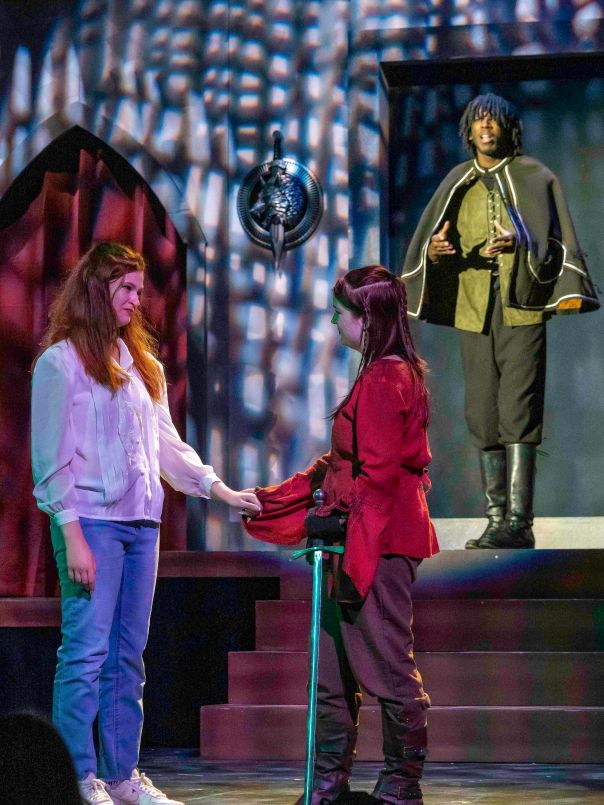
So Saskia Lewis as Agnes has a bunch of calibrating to do as she moves from average and static to insightful and savage. Lewis must be awkward for a while with her blade, shield, and helmet before Agnes the Ass-hatted can morph into Agnes the Badass. She also goes through gauche stages with Miles, with Vera the guidance counselor, and her squeamish attitude toward Chuck (some of it quite warranted).
It’s a curve that Lewis delineates well, though she never quite figures out how to give Average Agnes any spark or gusto. A little dopiness might do it. Or a little surprise when Agnes discovers she can have fun.
Whether or not McMinn saw the 2022 Monsters at the Arts Factory, she and Claire Grant demonstrate that less can be more in portraying Tilly and Tillius. Grant is never quite the legend Charlie Grass was as Tillius in 2022. There is no warpaint on Grant. You might even catch her slouching once or twice. She is mighty, yes, but we also see her as vulnerable. This Tillius is one that Agnes can envision, not the invincible Tilly she wants her to see.
Very likely, Brian DeDora was mostly enticed by the monster-in-gelatinous-cube side of Miles when he auditioned for the role, but I couldn’t help liking him even more as the wholesome boyfriend. Nguyen gives DeDora a wonderful pathway into making mundane Miles likable, for he earnestly wants to be a part of the D&D fun and fantasy once Agnes has gotten the bug.

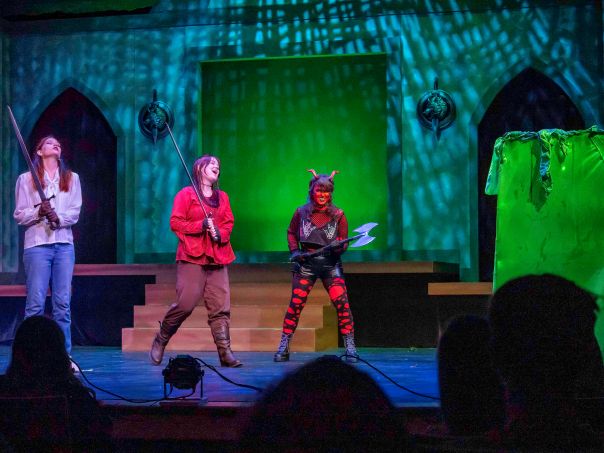
Aside from Kameal Brown as the guidance counselor, slightly tainted by adulthood, all the other women get to revel in D&D nastiness and badassery. My favorite is Ashlie Hanke as Lilith Morningstar, Tilly’s right-hand fantasy demon, followed closely by Anaiah Jones and Kristina Ishihara as the Evil cheerleader succubi.
Hanke gets the best crossover into reality as Lily, more closeted at Athens High than Tilly. To Hanke’s credit, Lily is poignantly burdened with the sad consequences of spurning real-life Tilly to keep her cover. When they aren’t tormenting Tillius & Crew as succubi, Jones and Ishihara can tag-team Tilly, cruelly teasing her over her sexuality. Even if they’re a bit stereotyped as cheerleaders, they make Athens High more real.
All three of these wicked slayers are radically red-faced in New Landia, the country where Tillius tries to recover her lost soul. Their having to un-paint and repaint is the only good excuse I can imagine to explain why everyone onstage isn’t miked. So for me, it’s a love-hate relationship with these vicious vixens.
Among the remaining men, we should first consider the storytellers, Elon Womble as our Narrator and Maximilian Novick as geek master Chuck. Nguyen doesn’t specify how our Narrator should be attired, but he broadly suggests that she or he radiate a Lord of the Rings aura. Accordingly, Novick sports a garish green medieval outfit over long black boots, an implicit invite for us to straddle the real and fantasy worlds as the story unfolds.
Novick can roam more freely between teen nerdiness and master of the dark arts, a transition marked by donning a monkish cowl and deepening his voice. There’s also a mix of gawkiness, horniness, and bravado that Novick obviously relished.

As Orcus, the retiring Demon Overlord, Truman Grant gets to wear more majestic horns than those sported by Lilith (some history between them is hinted at). For old-school aficionados of The Wizard of Oz, Orcus might pleasantly echo the roaring veneer of the Cowardly Lion. Grant’s demon doesn’t suffer from self-image hangups, and he’s more of a careless, world-weary slacker than timid, having shrewdly traded Tillius’s soul for a badass TV/VCR combo.
Evangelicals and assorted homophobes despise She Kills Monsters, especially when it defiles their precious schools. Once again, such harmless and rollicking sacrilege is happening again in the QC. It’s particularly distressing for the haters to see Tillius and Orcus uniting with Agnes on her adventure. Both of them can tell the Ass-hat a thing or two about how to die.




 Art on My Sleeve