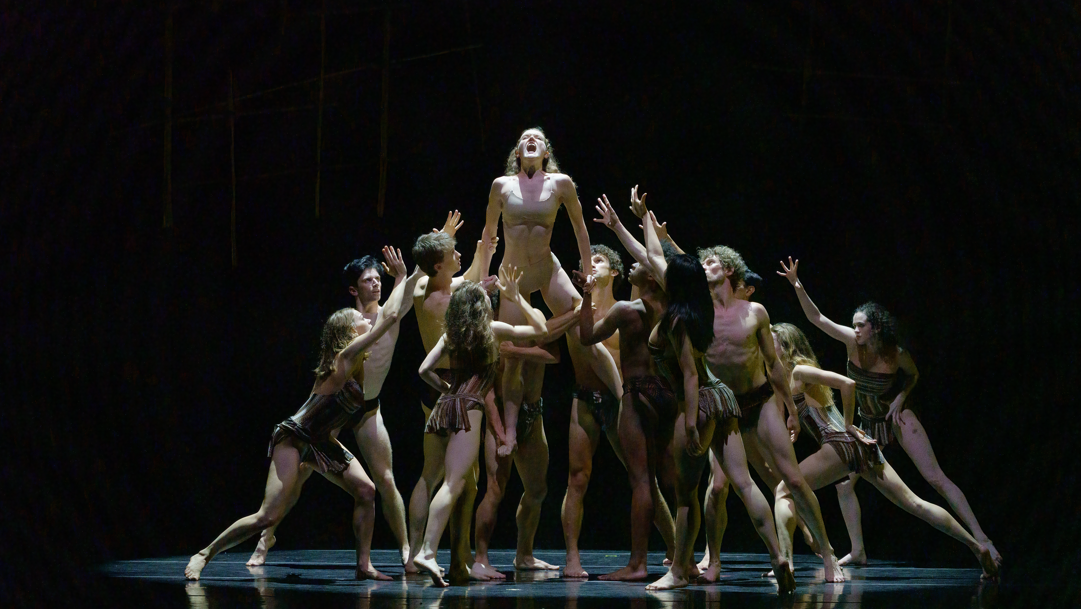
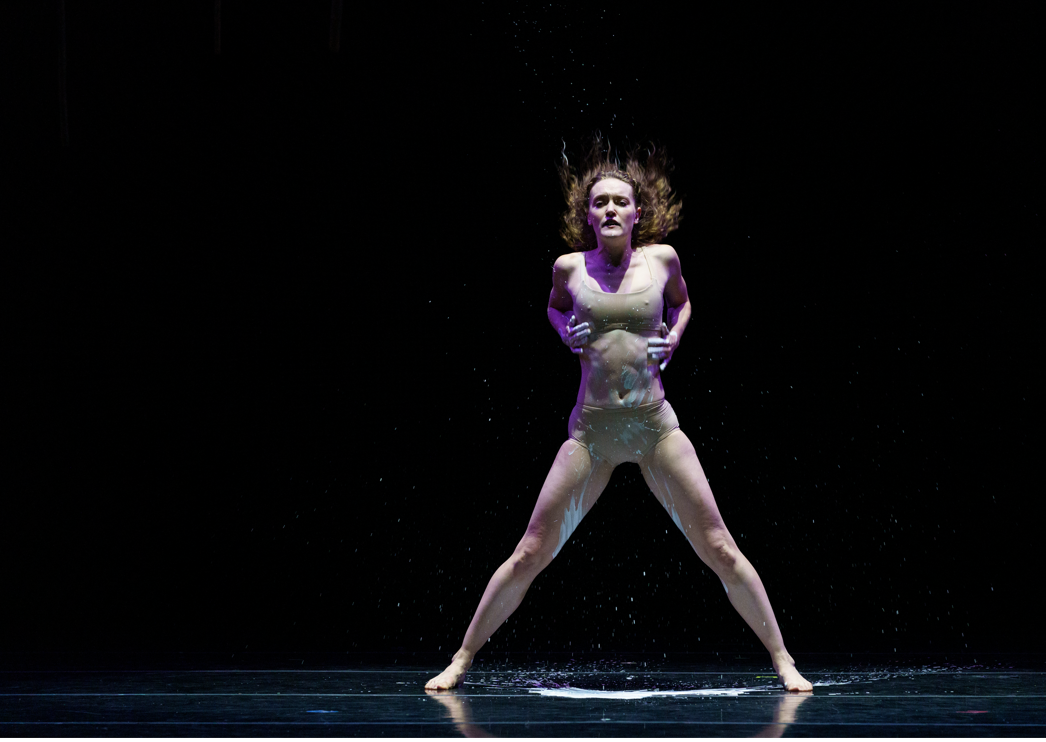
Tag Archives: James Kopecky

Breathtaking Perfection Makes Charlotte Ballet’s “Swan Lake” Premiere a Dazzler

Review: Swan Lake at Knight Theater

By Perry Tannenbaum

May 3, 2024, Charlotte, NC – For generations, budding ballerinas around the globe have aspired to be a member of the gaggle who dance to the primeval strains of Pyotr Ilyich Tchaikovsky’s Swan Lake. The best of them dare to dream of dancing the roles of Odette, Queen of the Swans, and her evil, seductive doppelganger, Odile. Yet more than 50 years elapsed in the life of Charlotte Ballet before the company brought Odile, Odette, and Swan Lake to the Queen City. To many, including millions of those budding ballerinas, Swan Lake and ballet are synonymous. So in a town that has a reputation of resisting the new and clinging blindly to proven classics, you have to wonder why this premiere – a quite glorious one at Knight Theater – has taken so long to happen.

Although scenery, costumes, and props are on loan from the ballet troupes of Cincinnati, Arizona, and Atlanta, the mélange is quite impressive. Choreography by Ib Anderson, based on the definitive 1895 overhaul by Marius Petipa and Lev Ivanov, and the work of CharBallet dancers, Charlotte Ballet II, members of the pre-professional program, and students of the Ballet Academy are more than enough to stamp this marvel as homegrown. Extra freshness and vivacity rose from the orchestra pit as the Charlotte Symphony, directed by Gavriel Heine, performed the full score for the first time – with the ardor of an orchestra that has been waiting over 90 years for a living, breathing ballet corps to partner with on this mammoth venture.

Those little-girl aspirations are freshly recalled by the glittery merch in the Knight lobby, so the anticipation in the audience before curtain-rise was akin to the excitement that greets the CharBallet-Symphony collaboration each December as Belk Theater fills up for The Nutcracker. Even after opening night, you are at a special event. While the Cincinnati scenery can be improved upon (rather easily, I’m afraid); especially in and around Prince Siegfried’s castle; the courtiers, the servers, and the ladies in waiting regally create a teeming spectacle that fulfills expectations in Act 1. Oliver Oguma, the first of three leading men who will rotate during the 12-performance run, is a soulful Prince Siegfried with a bonus of brawn. Some heavy lifting lies ahead, but before lifting Odile up high Oguma had to be able to shine solo in the opening scene, where he basically rejects every eligible maid in the kingdom. The Queen Mother is royally chagrined – a triumphant comeback for Ayisha McMillan Cravotta, more beautiful than ever.

Anderson discreetly subtracts some courtiers from the Petipa scenario, but there’s enough dazzle remaining for them not to be terribly missed. The dozen courtiers beguile us in varying configurations, and the pas de trois sequence with Bridget Fox, Humberto Ramazzina, and Samantha Riester is endearing elegance and charm. Dancing the Page’s solos, Academy student Russell Abel struck me as a prodigy, able to leap and land squarely on the beat. Yet as the act climaxed, viewers who are accustomed to seeing Prince Siegfried flanked by noble chums might feel that Oguma gradually becomes excessively forlorn in spite of all his solo exploits.

Yet it’s justified to view the sparsity of plot and companionship in the opening scene as a perfect way to magnify the éclat of Act 2, where the evil sorcerer Von Rothbart and his enchanted flock finally take the stage – a bevy of 24 Cygnets and Swans plus one sublime Queen. You might even be tempted to laugh at the triteness of the choreography that precedes Odette’s first entrance – until you realize that Ivanov and Swan Lake likely fashioned the familiar template that Hollywood, Broadway, TV, and Vegas have turned to ever after in innumerable dancing build-ups to the entrances of their stars. James Kopecky, in a spectacularly hideous bird costume of his own – with poles to extend his wingspan – is magnificently malign in his various poses and flourishes, adding magic and menace to the big moment.

Evelyn Robinson was more than equal to it. She was divine perfection: fearlessness, symmetry, balance, musicality, and supple flow were all absolute to an inhuman degree. Only the little expressive flutters of her head and face subtly reassured us that a tortured soul hovered above her pluperfect point work. Later, when Robinson invaded Prince Siegfried’s surprisingly drab ballroom as Odile, you kind of wondered whether she would dramatically vary or eclipse what has gone before. Seemingly responding to more spellbinding sorcerer gestures from Kopecky, a bit like a taunting pro wrestling baddie in his taunts, Robinson softened ever so slightly. Her seductiveness trickled naturally from her added liquidity, and her expressions became more worldly and knowing, like a Vogue supermodel shoot. Or Melania.

In sum, Robinson was all I could hope for and occasionally more. But the swans! I hadn’t even begun to imagine what they can be in live performance. Whether it was the composer’s masterstroke in the original 1877 score premiered by the Bolshoi or the brainchild of ballet specialist Riccardo Drigo, who revised the score for its successful 1895 resuscitation in St. Petersburg, the music hushes so much that the en pointe work of flock is clearly audible – not only audible but a chief element of the music’s fluttery percussion. Over the course of the 2 hour 17 minute epic, it wasn’t only principal harpist Andrea Mumm who excelled. Concertmaster Calin Ovidiu Lupanu came to the fore with some fine solo work in Act 3 and acting principal oboist Erica Cice was gold all evening long on the haunting big tune.

What floored me most, after watching Charlotte Ballet ever since it arrived here (from Winston-Salem) as North Carolina Dance Theatre in 1990, was the unprecedented synchronicity of this bevy of fluttering Swans. For decades, the individuality of each NC or Charlotte dancer was the company’s trademark. Let Miami and what’s-his-name do synchronicity! Yet here in an instant, the phenomenon of a perfectly calibrated ensemble of 24 women, dancing on point to the same heartbeat, had arrived in Charlotte, North Carolina. It was eerie and breathtaking. Historic.

Will CharBallet fully possess Swan Lake in the future with their own scenery, props, and costumes? Hope so. This is one you’ll want to see again.

The Full Cerrudo Experience Is a Hit in Come to Life

Review: Charlotte Ballet’s Come to Life at Knight Theater

By Perry Tannenbaum

March 7, 2024, Charlotte, NC – Midway through his second full season as artistic director, we can now say that Alejandro Cerrudo has stamped Charlotte Ballet as his company. The corps looks fresh, peopled with more newbies we’re getting to know than trusted heirlooms who have long since proven their mettle. The choreography on their current Come To Life program at Knight Theater – Cerrudo’s Little mortal jump, Jiří Kylián’s Petite Mort, and the world premiere of Penny Saunders’ Beat the Clock – is beguilingly adventurous. Wow factor? Check.

For those of you who remember the 1950s, yes, Beat the Clock exhumes the classic TV game show hosted by the preternaturally vacuous Bud Collyer and sponsored by Sylvania. So at first, it wasn’t at all apparent that Saunders was targeting gender roles in those ancient days. But while the jackpot money was still flying gloriously above the dancers portraying the announcer, the host, the contestants, and the amped audience, we were cinematically fade-dissolving into a different scene as the shower of bills hit the ground.

This was a panel discussion where three women discussed the provocative question of whether housewives could benefit from additional education. Though it’s a godsend for the choreography, the discussion got heated, which may frustrate a few feminists in the audience. What frustrated me, however, was that Saunders’ sound design wasn’t as clearly audible for the panelists as it was for the archival gameshow track.

As the panelists’ hubbub subsided at stage right, there were a few moments of split screen as Michael Korsch’s lighting intensified at stage left for a briefer husband-and-wife scene, where both of the marrieds ended up feeling ignored and unvalued. Is this why we won the war? Sometimes, it felt this way. This brief microcosm gave way to two concluding community scenes, the first spotlighting the women and the finale embracing the entire 14-person ensemble.

Kerri Martinsen’s costume design had something to say about conformity in the outfits sported by the gameshow contestants and audience, later giving way to assorted nondescript outfits. Similarly, Maurice Mouzon Jr. as the announcer and James Kopecky as the host wore uniform outfits – with glittery silver blazers, to hell with historical accuracy. Back then, the em in emcee stood emphatically for master of ceremonies, so I suspected that Saunders and Martinsen were double-underlining their point.

After the first intermission, the repertoire flipped from cinematic to theatrical, with costume designer Joke Visser adorning Kylián’s men with gilt-edged cavalier attire that fit tightly and, for his women, the stiffest possible dresses. Suffice it to say that you’ve probably never seen women move laterally across the stage as these ladies in black do. Nor can it be doubted that these ladies – or their dresses – are the little deaths implied by Kylián’s Petite Mort title. Scored with slow movements from Mozart’s 21st and 23rd Piano Concertos, Mort both celebrates and lovingly skewers classic elegance – with a beautiful set of pas de deuxs between the ensemble segments and a couple of breathtaking transitions that require some nifty undercover choreography of their own.

The most eye-catching pairings among the six couples, for me, were Kopecky and Samantha Riester along with Raven Barkley and Rees Launer. Your mileage may vary, especially if you’re witnessing Charlotte Ballet for the first time, and the six couples will change from performance to performance (only Reister and Kopecky are constants, and they will be swapping out dances and partners). Just try not to gag on the relentless grace and symmetry.

If Kylián’s piece was a wry and perfect gem, then Cerrudo’s Little mortal jump, premiered by Hubbard Street Dance back in 2012, impacted like a coolly calculated over-the-top extravaganza. Korsch italicized the spectacle with his lighting design, principally when he aimed his beams at the audience and when he illuminated rows of vanity bulbs on cue. Branimira Ivanova’s costumes arguably upstaged Korsch’s lighting and Cerrudo’s choreography, literally stopping the show and putting two of Charlotte Ballet’s dancers in suspended animation, pinned to the scenery. Well before that, it was apparent that Cerrudo’s scenic design – massive movable boxes about as high as a school locker – was an integral part of his choreography. The movements of these huge boxes made transitions between scenes a constant source of excitement and surprise.

Ten pieces on Cerrudo’s playlist, listed alphabetically rather than sequentially in the program booklet, add to the kaleidoscopic swirl of his scenario and the giddy, stagey energy of the dancers. So his magical moment of suspended animation stands all the more dramatically apart from the hectic electricity that bookends this utterly unique pas de deux. Cerrudo’s piece, longer than the others, fit in well with them, maybe even eclipsing them a little. More comfortable in his leading role, his welcoming remarks were confident, for his invitation to support CharBallet’s 2024-25 season would soon be buttressed with a stunning program. The buzz in the house seemed to indicate that Cerrudo is winning over fervent new fans in his audience and onstage. As one ticketholder summarized, leaving the elevator that descends into the nearby parking garage: “Holy cow.”

Charlotte Ballet’s “Peter Pan”: An Intriguing Hybrid With Provocative Possibilities

Review: Peter Pan at Knight Theater

By Perry Tannenbaum

DSC_6711

We don’t grow up with the various incarnations of James M. Barrie’s Peter Pan as much as we used to. The aged Mary Martin musical is no longer resuscitated every year, the Disney animation has been relegated to a fairy-dust sprinkling for their theme park promotions, and I honestly can’t remember the last time I saw an ad for the peanut butter. And gosh, wasn’t there once a popcorn? Not a kernel remains in all of Googledom.

Yet the young flying prince of Neverland is still a powerful presence. Whether in touring musicals, glittery ballets, the original stage version, or that bizarre Broadway offshoot, Peter and the Starcatcher, the eternally young green sprite has visited our Metrolina stages at least 15 times during the new millennium. And tomorrow, Disney’s refresh, Peter and Wendy, starts to stream in your home if you’re subscribed.

Renaissance or evolution? The amended title begins to tell the direction of the Disney+ refresh. Meanwhile at Knight Theater, Charlotte Ballet unveiled their new Peter Pan, choreographed by Christopher Stuart. Building upon the previous version choreographed by Jean-Pierre Bonnefoux in 2004 for Peter’s centenary, Stuart has retained Howard Jones’s set design and most of A. Christina Giannini’s costume designs.

The jolly pastiche of Rossini favorites that Bonnefoux leaned on for his score, with gossamer drizzles of Respighi, is replaced by a full-length ballet score by Stephen Warbeck, best known for his Billy Elliott and Shakespeare in Love film scores. In exchange for the one step backward in his scenario, restoring the traditional resurrect of Tinker Bell, Stuart took the evolution of Barrie’s story a couple of steps forward toward political correctness.

Was such evolution necessary? When Mary Martin first flew in from Neverland on the wings of Moose Charlap and Jule Styne’s music, she turned Peter into a female action hero, smoked the peace pipe with Tiger Lily and her tribe, and depended on the Darling women across the generations. Not that these were radical changes, either, since Nina Boucicault (daughter of the famed playwright Dion) originated the title role in 1904.DSC_6648

So with respect to women and Native Americans, termed Indians back in 1954, Peter Pan easily passed for progressive in my eyes. But in recent touring versions and in the Bonnefoux remake, you could see these sore points addressed. Styne’s “Ugg-a-Wugg,” with its Comden and Green lyric, remained in all the Broadway revivals through 1999, but has been discreetly reworked or dropped in recent tours. Bonnefoux turned the Indians into Incas in 2004, and when he brought his version back in 2013 with the new sets and costumes, Captain Hook’s pirate crew were equally divided between men and swashbuckling S&M women.

Stuart’s Tiger Lily, gracefully danced by Raven Barkley, is now a fighting flower. Thanks to new costumes by Kerri Martinsen, Tiger’s all-female militia are now billed as the Lillies of Neverland. While the Lost Boys haven’t changed their name (or costumes), half are now girls. The feminine swarm is augmented by a dozen female butterflies, but there are now a few more gigs for boys. Following in the wake of the funky Crocodile that Bonnefoux reconceived, a new gaggle of Little Crocodiles added microscopically to Pierce Gallagher’s menace at the premiere.Peter Pan

A quarter of this reptilian dozen are boys, so I’m guessing that the gender breakdown among the younglings parallels enrollment at the Charlotte Ballet school. The pre-recorded music, the hand-me-down costumes and sets, and especially the profusion of child labor – all of these economies make perfect sense. But did Stuart really think it would fly with a 2023 audience if Peter, Wendy, and the Darling bros didn’t fly?

Surely there were mommies and daddies out there in Knight Theater who had promised that Peter and Wendy would fly. Hell, there were adults out there counting on it. I couldn’t think of a single reason, not even a politically correct or environmentally responsible reason, why they didn’t fly. Flying by Foy is on strike, they missed their flight, or their train was derailed. Try those.DSC_6332

If nothing else, the gaps and hybrid aspects of the new Peter emphatically indicate that it is a production in flux, ready for new twists, new replacement parts, upgrades, and embellishments in years to come. To Stuart’s credit, he tinkers brilliantly with Tinker Bell, impishly danced by Isabella Franco at the premiere. The new opening scene, at the newly-discovered Darling Orphanage, shows her stealing a newborn from its cradle and whisking it off to Neverland.

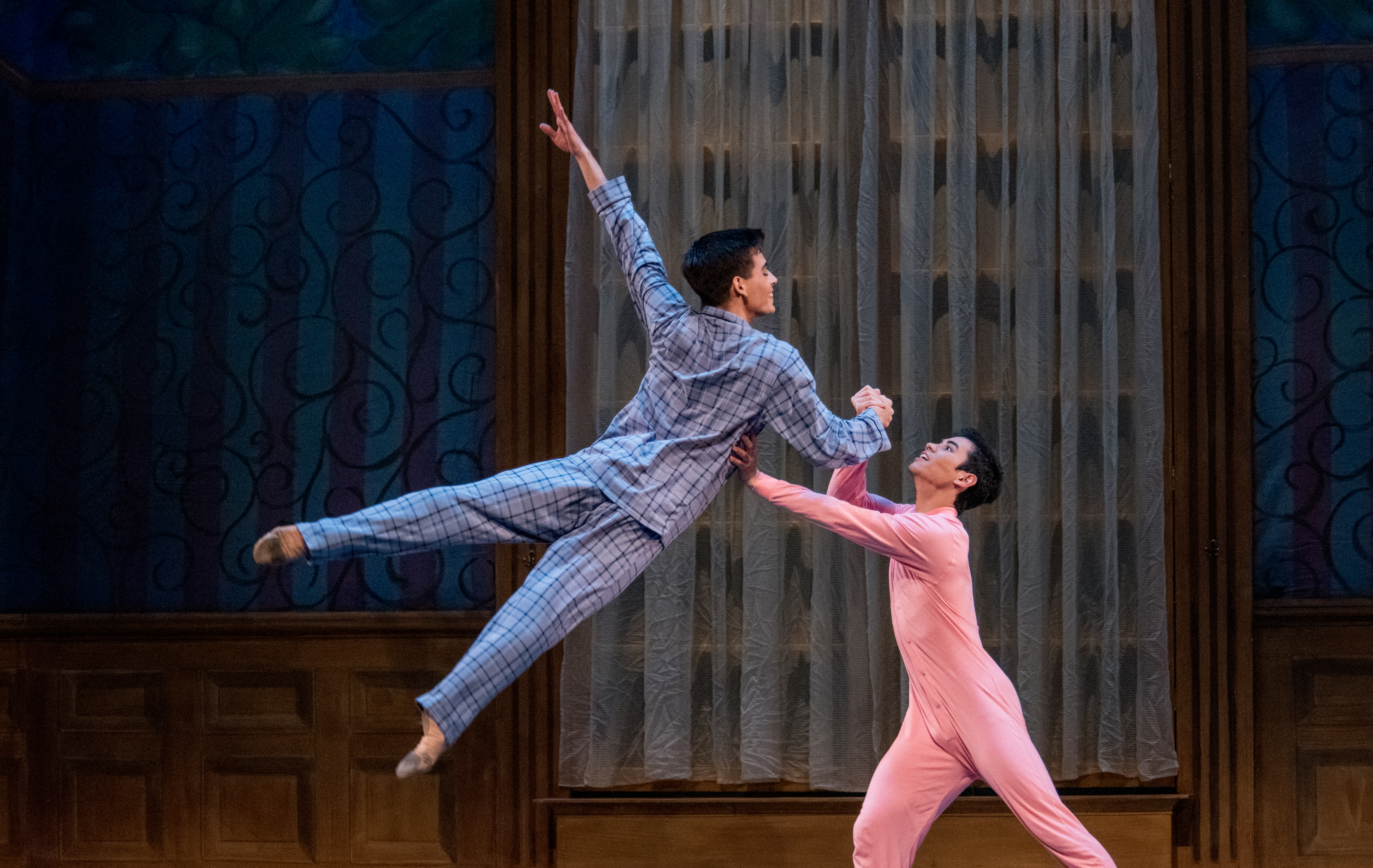
In the ensuing scene, when the curtain goes up, Tink is more jealous of Wendy than usual, a resentment and hostility that will carry over to Neverland – where Peter, the little babe she has raised, must eventually put her in time-out! A delicious moment. Michael Darling and John Darling, danced by Tyler Diggs and Lorenzo Dunton, also get more development than I usually note before Peter’s arrival. Their mom and dad, Sarah Lapointe and James Kopecky, were admirably contoured as well. Kopecky showed a little achiness after dancing with his sons, yet Lapointe regally summoned him for another spin or two on the floor.DSC_6024

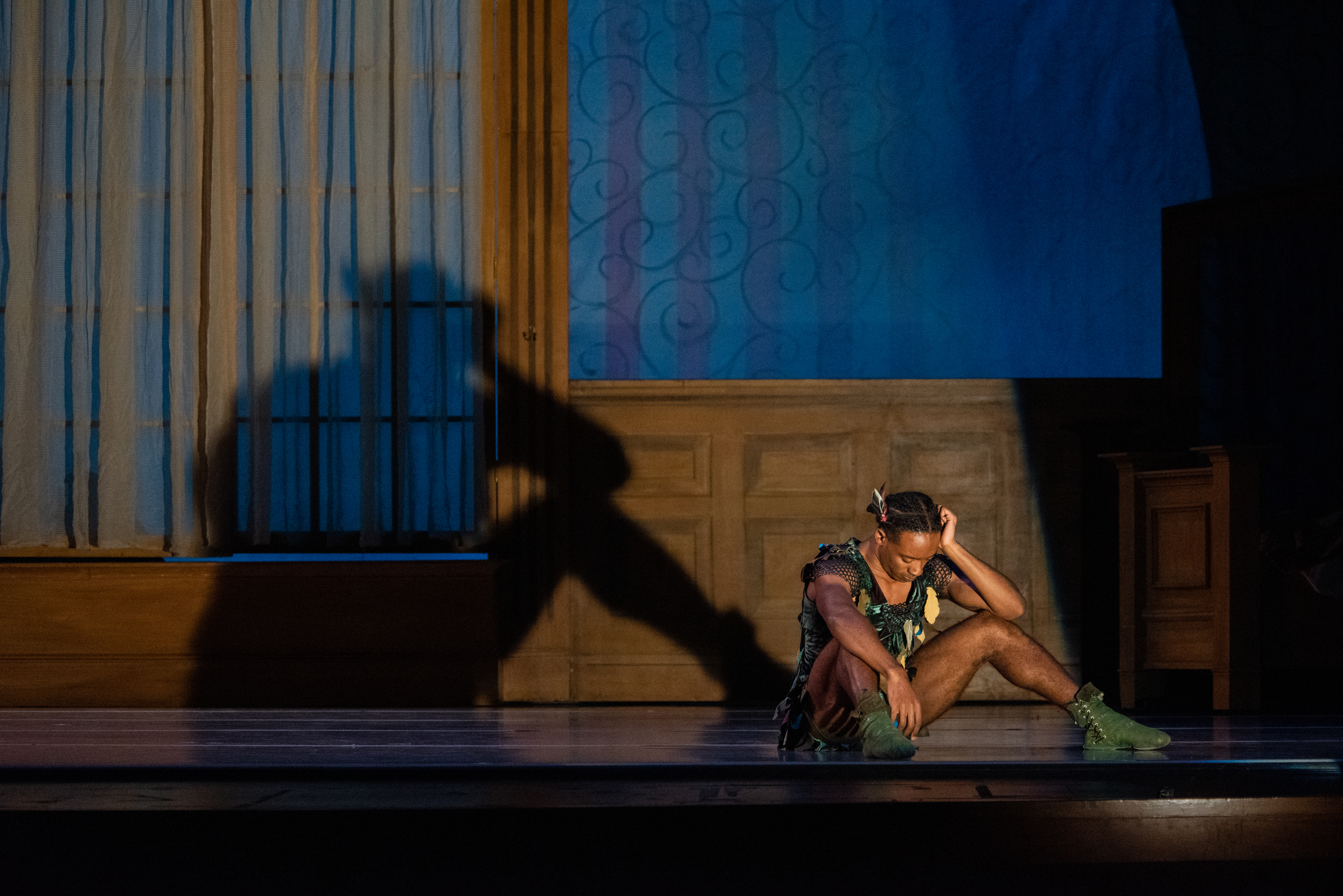
Both Sarah Hayes Harkins and Maurice Mouzon Jr. were youth and joy from the moment they met, but their start was a bit awkward in the Darlings’ bedroom compared to their outdoor adventures in Neverland. Aside from the no-fly-zone reveal we had to overcome, Stuart needs to clean up the sequence and the lighting of Peter’s lost and found shadow. He seems to have his shadow quite dramatically soon after he comes in, but then he inexplicably loses it.

There are usually two scenarios to choose from. The musical has Peter returning in search of a shadow left behind an indeterminate time ago. In other tellings, he might fly away from Wendy in a huff only to realize that his pesky shadow has stuck on the supersized window sill when he left. Stuart and lighting designer Jennifer Propst have to be on the same page with these niggling details.DSC_5944

Up in sunny Neverland, it all goes so beautifully. As always, Franco as Tink has taken the shortcut, arrives before all the others, and instigates the shooting down of our airborne Wendy by one of the Lost Boys. With a slingshot, not a bow and arrow.

For a flower, Barkley does seem to have a lot of fight in her, so her kidnapping by Ben Ingel as Captain Hook remains a satisfying battle. In his rescue of Tiger Lilly, Peter is wounded by Hook, proving that the pirate is a worthy foe. But don’t expect Ingel to be as fearsome as Jude Law will be on Disney+. He retains some of the comical blood that Bonnefoux infused into previous Hooks, lurking and skulking across the stage when he isn’t prancing merrily or fleeing in terror from the cheerfully chomping Croc.

There’s plenty of lovely, charming, and colorful mayhem as the nearly poisoned Peter rescues Wendy, the Darling bros, and the Lost Boys. Joy is abundant in the homecoming, and Stuart tacks on the cherishable postscript when Peter returns a generation later for Wendy. Four little girls will get to play the touching part of Jane during the 12-show run, one more than any other role.

Now aside from a phone call to Foy, Stuart and company might consider returning to that Darling Orphanage they’ve left dangling for future editions. In Barrie’s novelization, one of the Lost Boys, adopted by the Darlings, becomes a titled lord and another becomes a judge. The least Stuart and CharBallet could do is bring them home.

Charlotte Ballet Roars into a New Era With FALL WORKS

Review: Fall Works by Charlotte Ballet

By Perry Tannenbaum

Under the Lights_Taylor Jones

Knight Theater should have been abuzz last Friday night. Yet somehow, a year after Charlotte Ballet’s 50th-anniversary celebration – celebrated a year after the company’s actual 50th anniversary – my excitement wasn’t reflected by the community at large. A night after Opera Carolina had opened its 2022-23 season at Belk Theater to an empty upper balcony and a disappointing crowd, the curtain went up on Ballet’s new era with a similarly sparse turnout.

Our takeaways from this phenomenon need not be terribly dire, for it may be up to OpCar and CharBallet to learn a simple lesson: don’t open your seasons on the same night! Or on the night that a megahit like Hamilton – or the NBA season – is opening down the block. Your two companies collaborate every December on The Nutcracker, so you ought to be able to ace October.

It can be disheartening for performers to see the curtain rise on a hall pocked with vacant seats, but the effect seemed more noticeable on the soloists singing Tosca than on the dancers bringing us FALL WORKS. Understandable. Charlotte Ballet is a more resident company, devoid of prima donnas who swoop into town for one rehearsal and one weekend, they’ve worked hard perfecting their moves at their own studio, and nearly 40% of them have been in the company for less than two years.

They can be as excited to be working with new comrades and new partners as we are to see the diverse new faces. Implacable prerecorded music – synced to crucial interactions with other corps members – keeps them in step, and they don’t need to worry whether their voices will betray their nerves. Or hold up through Act III.

We can question the wisdom of reprising two works that premiered here within the past three years. Both Helen Pickett’s IN Cognito and Crystal Pite’s A Picture of You are fascinating, edgy pieces, neither one saddled with music we might readily recall months or years afterward. Although the choreographies jogged my memory, the freshness of the experiences was enhanced by watching different dancers perform them, especially after missing opening night to attend the opera.

OK, so I must admit a little frustration that, more than six months after he was named CharBallet’s new artistic director, we still haven’t seen any of Alejandro Cerrudo’s choreography here in Charlotte. After all, it’s over eight years since I lobbied specifically for our most prestigious performing arts company to take up Cerrudo’s work when I first saw it at Spoleto Festival USA, tabbing it a “winner” after witnessing Hubbard Street Chicago’s staging. Nor have I yet seen Cerrudo onstage to address his company’s loyal audience.Anna Mains_Ben Ingel_UTL_by Taylor Jones

Instead, we could take consolation in getting the local premiere of Under the Lights by Christopher Stuart, the new director of Charlotte Ballet II. After the heaviness and intensity before intermission, Stuart’s medley, set to nine tunes by Johnny Cash and June Carter Cash, was a light and lively chaser. A couple of dancers from Ballet II occasionally infiltrated the frontliners in this entertaining suite, adding their youth to the bustle and effervescence onstage.

Similar incursions occurred over the course of Pickett’s IN Cognito, which proved to be the most free-flowing work of the evening, hardest to follow, and by far the easiest to forget. As a result, the impact for me was almost as fresh as Stuart’s piece, a good thing, and I didn’t find myself comparing the dancers of 2022 with those who gave the world premiere performance in 2019. Only one of the nine I saw on Friday had danced it two years ago. I hardly ever knew what was coming next, but when it came, it usually struck me as familiar – and the flow of the piece seemed far more organic this time.

So much was going on with the dancers, in multitudinous permutations moving hither and thither, that I often lost track of the props and furnishings whisked onto the stage and then off to the wings. One of the two table lamps would suddenly be missing, lounge chairs might multiply while the sofa exited, or a quartet of mismatched chandeliers might arrive randomly from the fly loft without reason. The dancer hiding behind the shrub – incognito? – would exit elaborately, crossing the entire upstage to the opposite wing, making herself absurd.

Sarah Lapointe_Ben Ingel_UTL_by Taylor JonesDancers communicated and coordinated. They partnered, interacted, and created beauty together. Yet they never connected, perhaps incognito to each other and to everyone else. Busy and beautifully baffling, very much like the modern world.
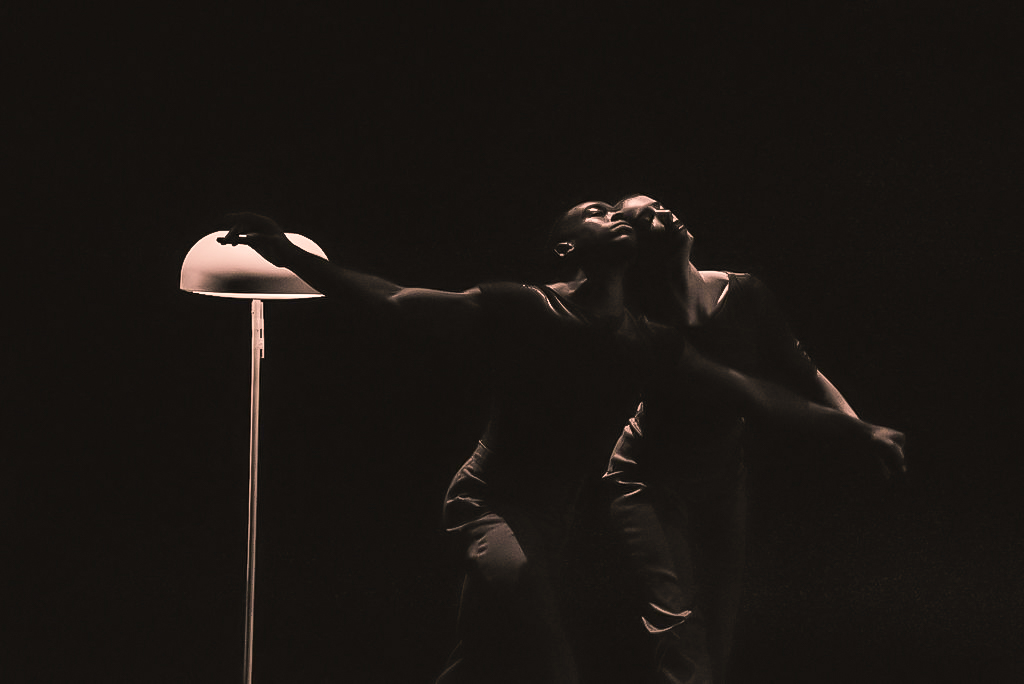
A Picture of You Falling, with choreographer Pite also supplying the biting prerecorded text, was edgier, more satirically impersonal. At times catatonically repetitive, this strange pas de deux imprints itself readily and deeply – an almost sinful delight, since it lays bare the careless ways we talk about love and romance. Sarah Lapointe and Ben Ingel first connect by accidentally bumping into one another. We’re speaking literally here, as they walk in opposite directions across a geometrical space outlined at regular intervals by strobe lights.

When Ingel falls, he literally falls, and his heart literally hits the floor when he is smitten and when the makeshift couple breaks apart. Unlike the score that Pickett cobbled together to move and regulate her dancers, the original music by Owen Belton never seems to register as a pulse or an emotional coloring, particularly when Pite tells us “This is the place” and “This is how it happens” – over and over.

What lighting designer Robert Sondergaard creates with his symmetrical formation of strobes is emphatically not a space. Nor can we be sure whether Pite is telling us again and again and again that this is how this ephemeral intimacy happens or whether – in some kind of condensed or looping timeframe – it’s actually happening again and again. Focus does shift for a while from Ingel to Lapointe in the moments of intimacy leading to the breakup, but this is ultimately the man’s story. Or a picture of what men have made out of love.Maurice Mouzon Jr_Shaina Wire_IN Cognito_by Taylor Jones

We confronted a couple of filters between ourselves and the music of the Cashes in Under the Lights. The least discordant of these was Stuart’s choreography, which briefly stumbled with his blithe setting for “Folsom Prison Blues,” when his five men carried on merrily during the vocalist’s confession that he “shot a man in Reno just to watch him die,” a jarring disconnect. More problematic were the recordings of The Man in Black’s signature songs by Sugar + the Hi-Lows, most egregiously lightweight when they missed the gravitas and drama of “Hurt,” leaving Nadine Barton little to work with, though she worked it well.

James Kopecky got us off to a charismatic start with “I Walk the Line” as it dawned on us what we would have to cope with from the Bi-Los. Anyone who had heard a definitive rendition of “Ring of Fire” or “Jackson” could empathize with the struggles Stuart faced, but Sarah Hayes Harkins didn’t flinch at all as she joined Kopecky for the coolish “Fire,” and a couple of winsome couples, Isabella Bertolotti with Humberto Ramazzina and Meredith Hwang with Oliver Oguma, redeemed the Mississippi superficiality.

Sugar plus or minus the Hi-Lows was hard for me to swallow, which may account for my liking Stuart’s settings best for songs I was least familiar with. “Two Day High” offered us three dynamic duos, Isabella Franco with Maurice Mouzon Jr., Shaina Wire with Luke Csordas, and Olivia Parsons with Juan Castellanos. With “I’ve Got You Covered,” we got a glimpse of Amelia Sturt-Dilly partnered with Kopecky, just one night after she danced A Picture of You, the CharBallet commission she premiered a year ago. Stuart’s best pas de deux by far.

“Tennessee Quick” was the most attractive track I heard from Sugar +, complemented by some really rousing ensemble work from Stuart and a swarm of 14 dancers. Couldn’t imagine Johnny singing that one. That harmonious taste of “Tennessee” was a perfect setup for Stuart’s stomping ensemble finale, “God’s Gonna Cut You Down,” fronted by Kopecky, the hardest-working man in Charlotte that night. Johnny didn’t get to that golden nugget until late in his career, so it wasn’t among his best recordings, but to hear the Hi-Lows attacking that traditional come-to-Jesus song with an electric guitar was almost as much of a kick as Kopecky and his backups.

Choreographic Lab Distills Inventiveness and Energy

Review: Charlotte Ballet’s Choreographic Lab

By Perry Tannenbaum

web_1525-8639

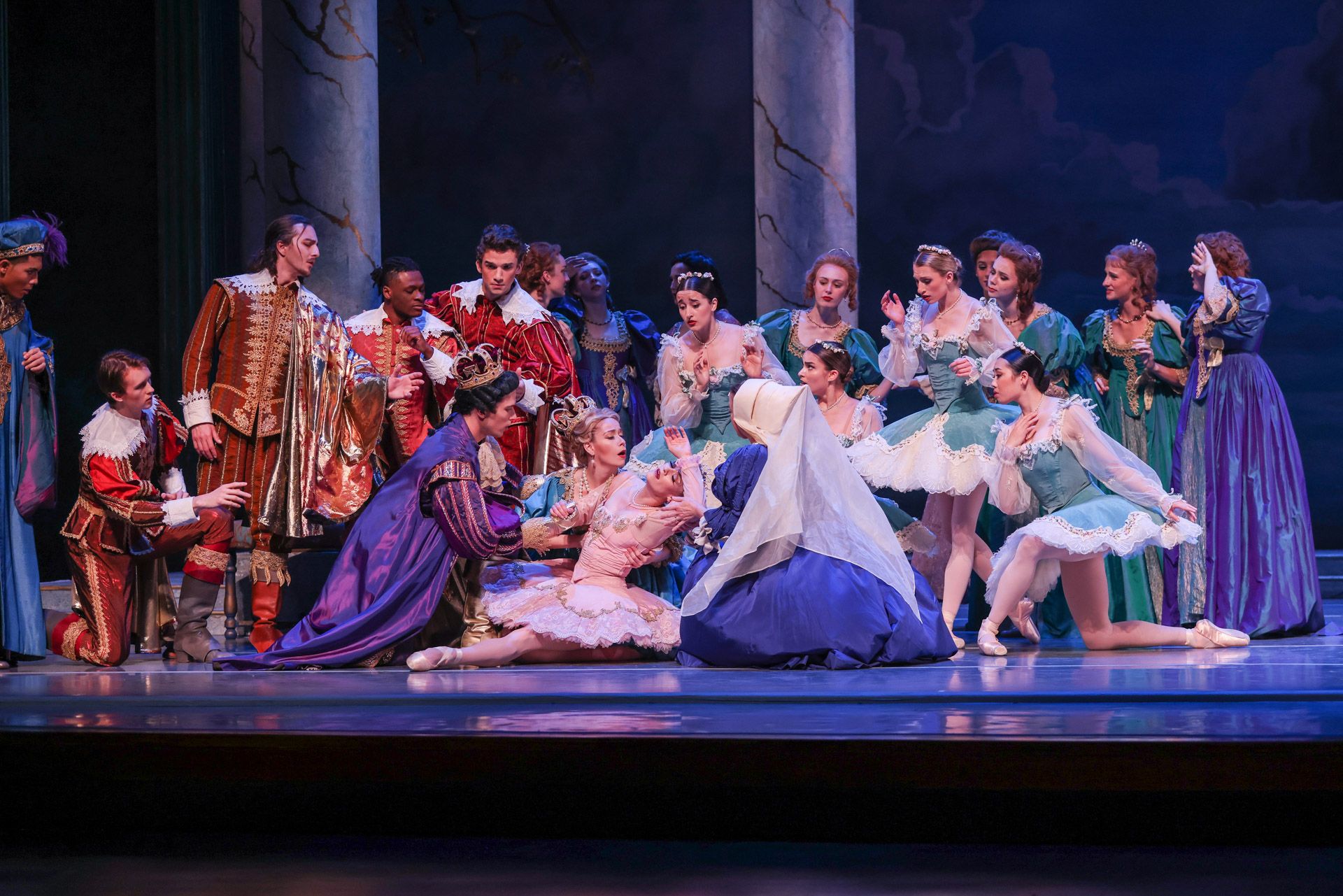
May 13, 2022, Charlotte, NC – We’ve been seeing plenty from Charlotte Ballet in the past month. Ending April and plunging into May, the company unveiled the world premiere of Sleeping Beauty: A Fairy Tailored Classic, with choreography by Matthew Hart – a ballet about a sleeping princess that had slumbered for two years prior to its pandemic-postponed awakening. That new piece ran for 11 performances over two weeks at Knight Theater to a trimmed Tchaikovsky score, with no fewer than four Charlotte Ballet dancers playing each of the lead roles, Princess Aurora, Prince Florimund, and the Lilac Fairy. Five days after that run – with plenty of rehearsal during the run, we can presume – another swarm of Charlotte Ballet and Charlotte Ballet II dancers darted to and fro across the studio at the Patricia McBride/Jean-Pierre Bonnefoux Center for Dance for the third edition of Choreographic Lab, also postponed for two years.

Naturally, all seven dances on this fresh program were created and developed in-house, with members of the two Charlotte Ballet troupes trying their hands at choreography, all working with their colleagues at the McBride/Bonnefoux “lab” to bring the new dances to fruition. In more than a couple of instances, new music was created especially for the new works. Giving extra polish to the production, each new dance was preceded by a video in which the choreographer discussed his or her aims and process. Somehow, the idea that Charlotte Ballet was alive and kicking became even more intense than with even the long-dormant Tchaikovsky ballet, for now the sounds and the styles were more contemporary.

The trio of new pieces before intermission was especially impressive, two of them featuring new music, one performed live by the composer. “Movement in 3” was accurately described by choreographer Maurice Mouzon Jr. as a “neoclassical work with a groove,” for the eight dancers, evenly divided by gender, all wore ballet shoes and costumes, with the women particularly prevailed upon to work en pointe in the opening section to music by Jonny Greenwood that sounded like a Bach partita. After insinuating themselves among the women, the men came to the fore in “Yumeji’s Theme,” music by Shigeru Umebayashi that had an unmistakable waltz-tempo lilt. Most of us were likely wondering where the groove was until we heard Olle Nyman singing “Heart & Soul” as all eight dancers joined in. Then it was unmistakable – and irresistible.

“Mile Marker 123” by Colby Foss would remain my favorite new piece of the evening, largely because it was so completely produced, with lighting, staging, music, and dance unifying so effectively. During most of the dance, Foss had his partner, composer and cellist Ian Cooke, seated center stage, playing and singing his original song, “Sterling.” Surrounding him were nine dancers in symmetrical formations, variously evoking a royal court, a worshipful adoration, or a campfire.

Two couples were deployed on each side of Cooke, and the ninth dancer, a female, stood vigilantly behind him, there to take hold of his cello when the singer stood up and was incorporated into the dance. At this point Cooke himself didn’t dance. The other dancers lifted him up, turned him upside-down, revolved him like the hand on a clock, and then carried him solemnly like a corpse at a funeral before restoring him upstage center to his throne. Very evocative in moody, amber light. The epigraph embedded by Foss in the playbill enjoins us to pay heed to Mother Nature: “Her power brings life and beauty but can just as easily wield chaos and death.”web_1525-9401

Sarah Ingel, who choreographed “Nebulous Reverence,” actually works behind the scenes at Charlotte Ballet as a production assistant – and with femme and queer performance makers across the Southeast. “I practice myth making from a queer and feminist perspective,” she says at her website, but there was no reason to feel threatened by her new work, which has comical and satirical overtones despite the black unisex costuming and Ingel’s explicit intent to project chaos. The three dancers deployed to intensely watch the other three, in the most memorable episode, share a bowl of popcorn as they behold the chaos, before spilling the remainder of the popcorn in their excitement. While you or I wouldn’t describe such reverence as nebulous, it was hard to argue with Ingel’s idea.web_1525-9754

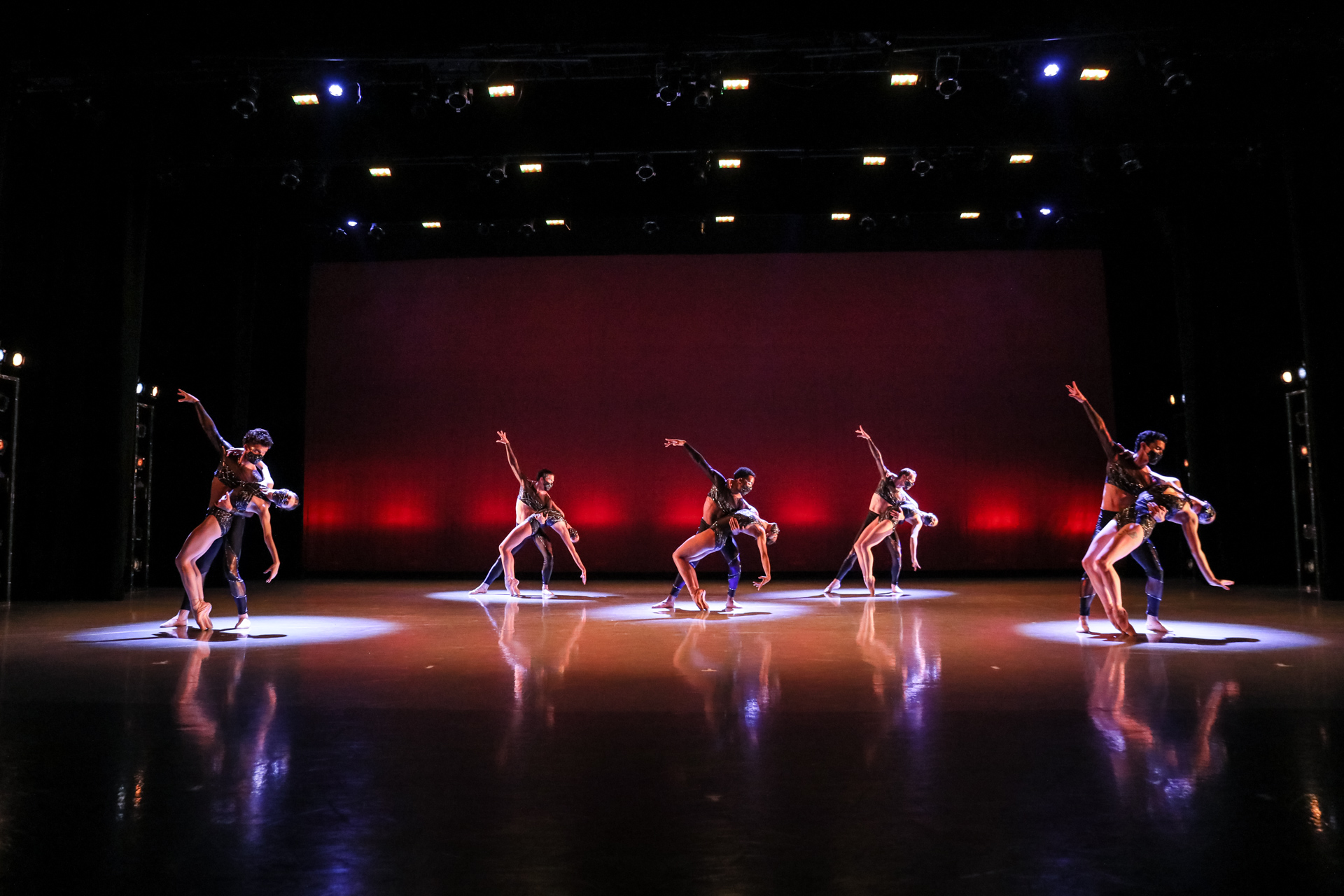
Among the four pieces after intermission, the first and third, Josh Hall’s “Remnants” and Nadine Barton’s “Woebegone,” left the deepest impression. Could be that I’m a sucker for spotlit circles gleaming on a dance floor, for that’s what these works had in common. In Hall’s piece, contiguous circles lit up in a sequence corresponding to the shifts in music, two spare piano recordings by Luke Howard surrounding M Haase’s “Plaything.” Amelia Sturt-Dilley and Meredith Hwang were the first to dance Hall’s intimate choreography, joined by Anna Mains, who shed a frumpy pullover blouse to chime with the summery pink outfits worn by the others. Mains didn’t stop there, shedding her pink skirt with the arrival of Humberto Ramazzina for the final segment. Interaction between the sexes was relatively chaste and innocent, though Ramazzina’s tenderness was unmistakable. His windup probably confounded most expectations as he handed back the clothes that Mains had shed, and she put them back on.

“Woebegone” had a solo dancer, Ben Ingel as Scooter, navigating the spotlit circles, choreographed by Barton to “How Can I Find True Love,” the B-side of the Del-Vikings “Come Go With Me” in 1956. Overdramatizing his woes, decked out in a clown suit, Scooter’s misery was substantially less than Pagliacci’s, particularly when Ingel broke the fourth wall and milked the audience for applause. Barton dressed purposefully for the occasion, coming onstage after the premiere to take her bow in a dominantly black polka dot outfit that echoed Ingel’s clown suit, topped by a vaudevillian black bowler hat and accented by flaming red gloves. Such preening was actually encouraged, it would seem, for Foss took his bow earlier contrasting radically with his partner, sporting a silver dinner jacket as he stood beside Cooke, who remained in his ramblin’ man casuals.

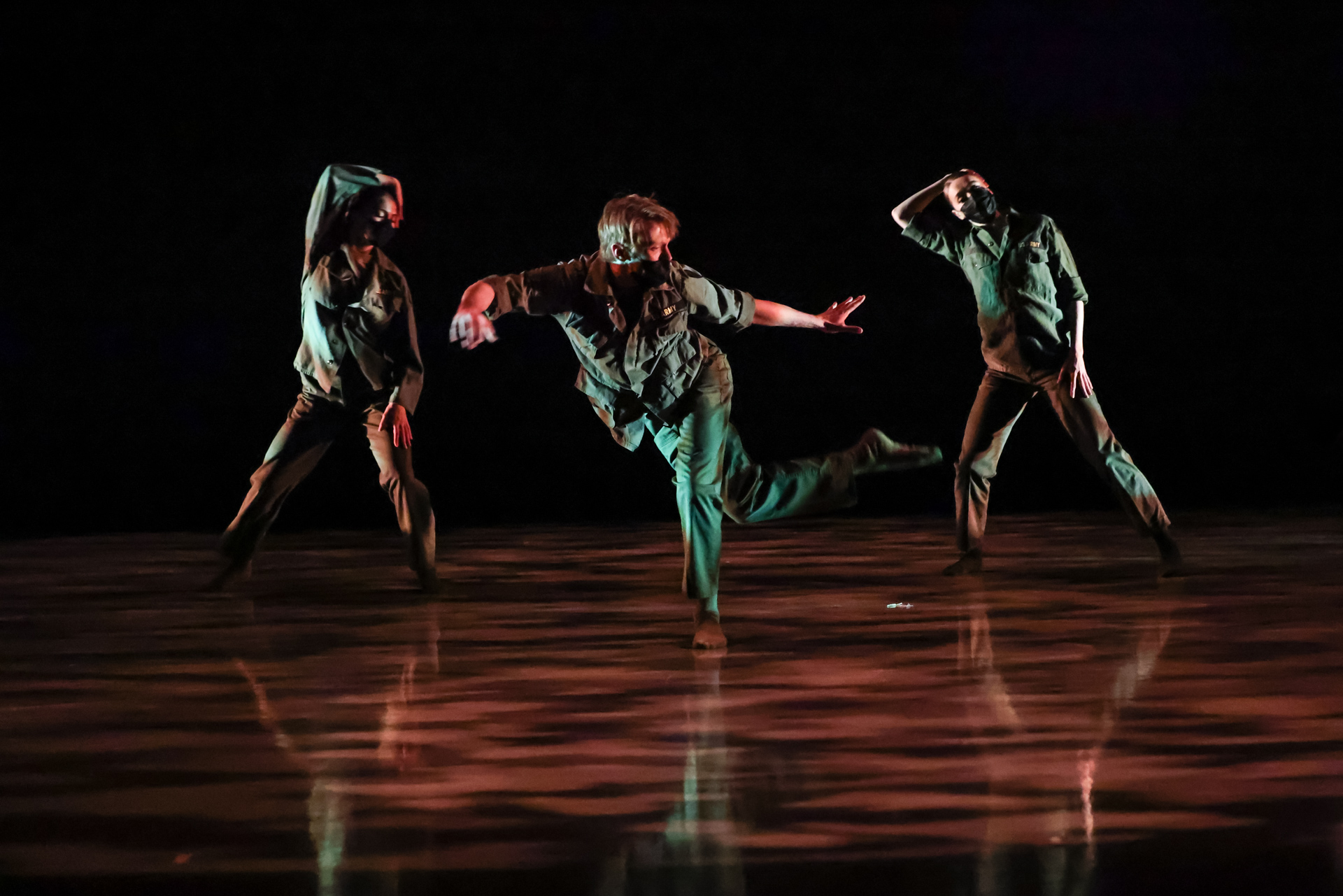
The other two pieces were certainly modern and energetic, reflecting the violence and pandemonium of our times. “Fulfilled Conviction” by James Kopecky fulfilled the choreographer’s desire to stage a jailbreak, featuring a scintillating and charismatic performance from Sarah Lapointe as the fevered action swirled around her – and in pursuit. “Listen to Me (Us)” by Eric Stith III of Charlotte Ballet II, had a surprisingly militant core: “We all want to be heard and seen. Sometimes you have to do that with violence.” Music by Les Tombours du Bronx, “Pneumothorax,” gave the violence a machine-gun battlefield atmosphere rather than the hues of terrorism or protest, and the bright red costumes worn by the dancers were closer to pajamas than blood.

Originally published on 5/15 at CVNC.org

Heretical Fairy-Tailored Format Is a Winner at the Knight

Review: Charlotte Ballet Premieres Sleeping Beauty: A Fairy Tailored Classic

By Perry Tannenbaum

Final Dance by Jeff Cravotta

Whether paired with Vampire Lesbians of Sodom onstage, orchestrated by Tchaikovsky for ballet, or adapted by talents as diverse as Walt Disney and Matthew Bourne, Sleeping Beauty isn’t a title that sleeps for long. Between here and Greensboro, the title appeared more than a dozen times on our cultural calendars between 2005 and 2020. So it’s a bit of a shock to find that the Charlotte Ballet’s world premiere of Sleeping Beauty: A Fairy Tailored Classic, one of the first cultural events in Charlotte to be cancelled with the onset of COVID in March 2020, has slumbered more than two years before finally coming to life.

Actually, it had been more than three years since Charlotte Symphony last played the Tchaikovsky score live at Knight Theater. But not the whole score. Mikhail Pletnev’s benchmark recording with the Russian National Orchestra clocks in at two hours and 45 minutes, about 75 minutes longer than the typical Nutcracker performance. So if by “tailored” you were hoping that Charlotte Ballet and choreographer Matthew Hart mean trimmed – substantially trimmed – then you can breathe a sigh of relief.

More exciting, the fairy-tailored concept embraces a format that some balletomanes might find heretical, integrating a spoken narrative with the dance. Obviously, spoken narration invites a more intimate interaction between the performers and the audience, especially the anklebiters that adults may have dragged into Knight Theater with them. But really, what might seem outré to ballet fans is perfectly de rigueur for parents and kiddies attending Symphony’s Saturday morning concerts, drawn to Belk Theater by the lure of Francis Poulenc’s Babar, Serge Prokofiev’s Peter and the Wolf, or similar fare.Nurse Fairies by Jeff Cravotta

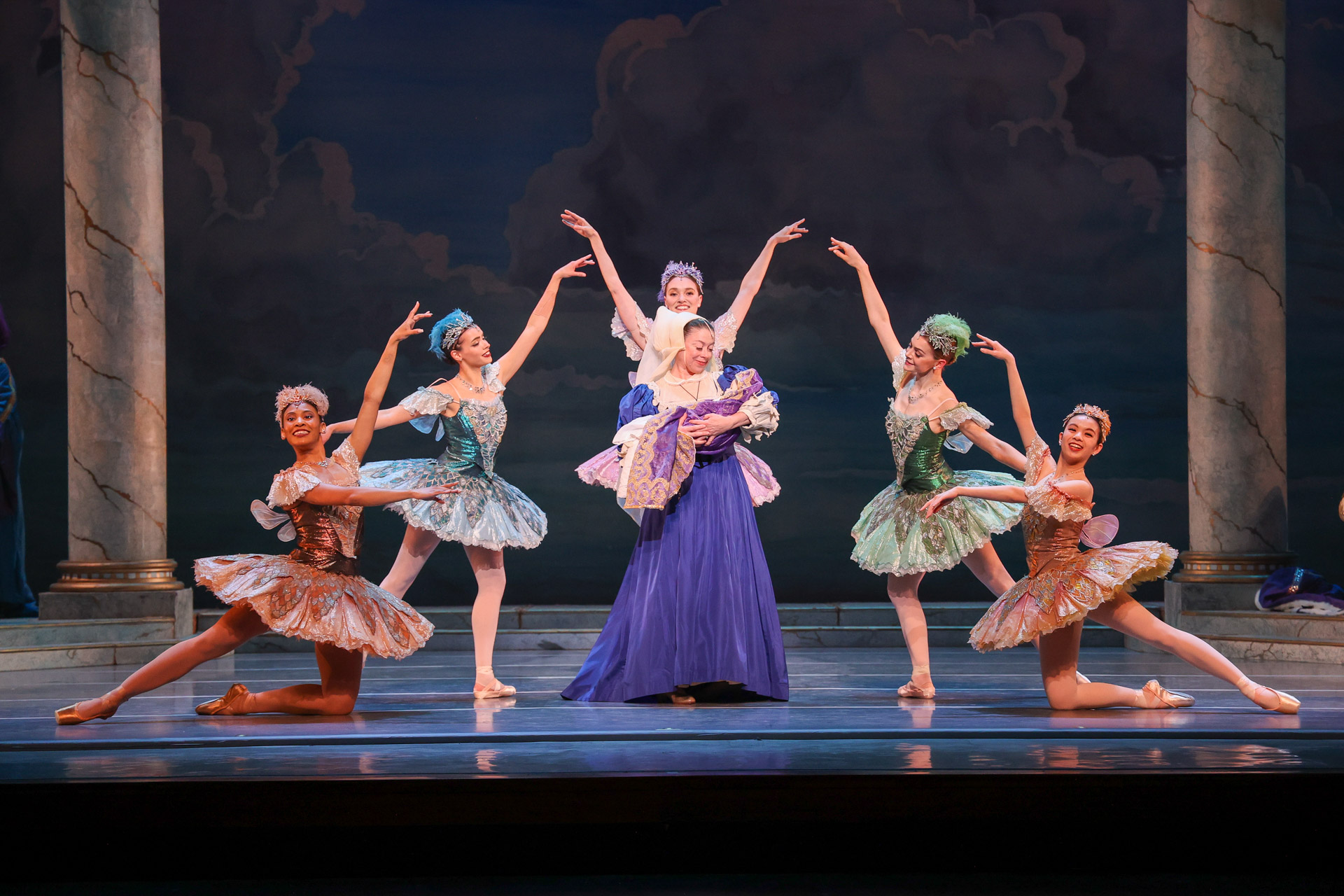
Traci Gilchrest-Kubie, portraying little Princess Aurora’s doting Nurse, is our graceful trailblazing narrator. Once upon a time, you may recall, Gilchrest-Kubie was a perennial lead dancer when the company was known as NC Dance Theatre, but she has transitioned within the organization over the past 10 years and now serves as Repetiteur – rehearsal director, if you don’t speak ballet – for both CharBallet and CharBallet II. She has also worked behind the scenes, staging several company productions, as she also does here alongside Charlotte Ballet II director Christopher Stuart.

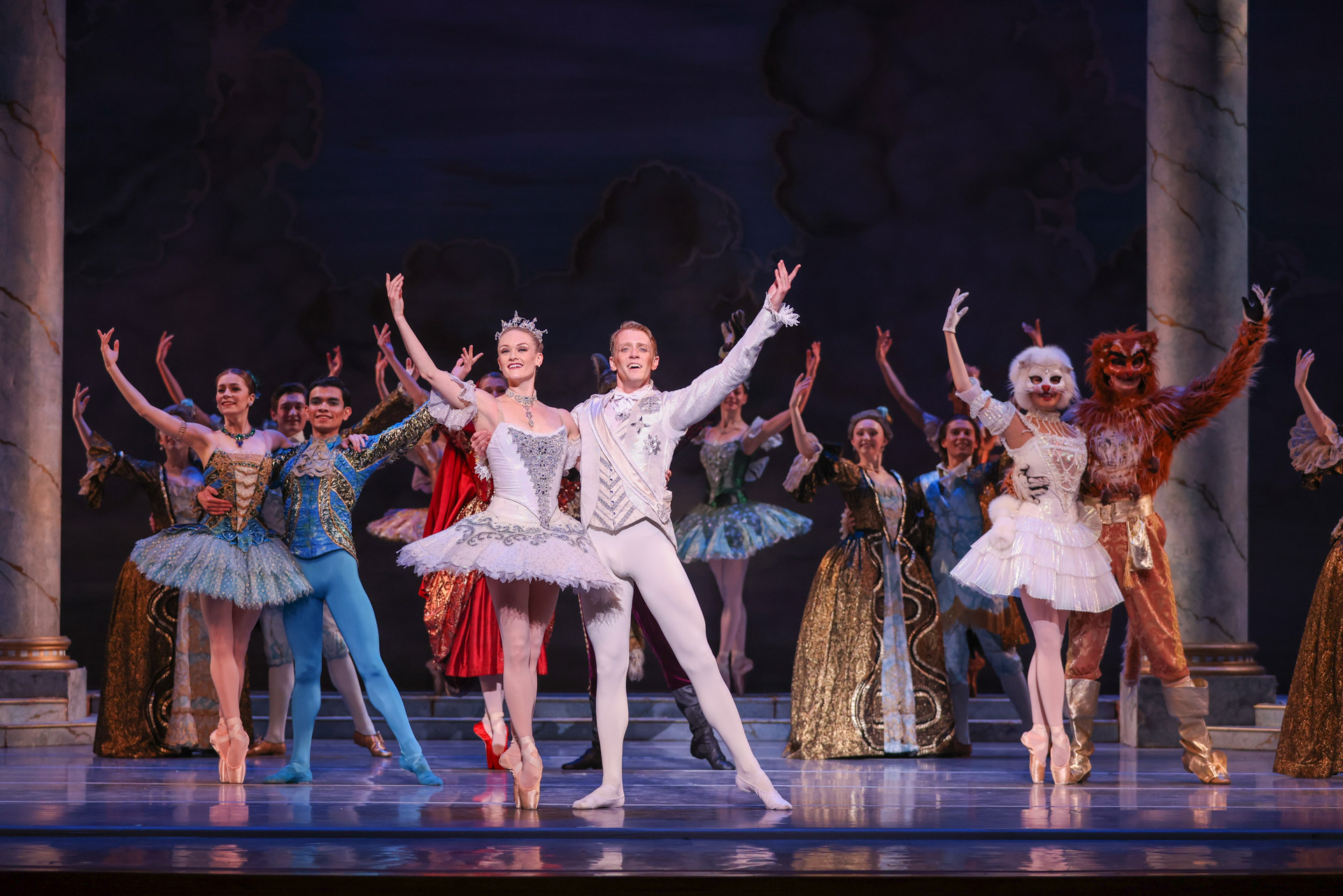
While the playbill didn’t specify who was responsible for the narrative script, it was worthy of credit, pleasingly spare like Prokofiev’s beloved Peter. Turns out that the nifty narration was co-written by Hart and acting coach Jane Wymark. Ostensibly modeled after Marius Petipa’s original 1890 choreography, Hart allows himself and his dancers some strikingly whimsical moments. Perhaps the most pointed of these came when Rees Launer as Puss in Boots and Meredith Hwang as the White Cat danced their featured pas de deux at Princess Aurora and Prince Florimund’s gala wedding celebration.Aurora Group by Jeff Cravotta

If the tentative meowing music, abruptly segueing into hissing and clawing, sounds oddly familiar, it’s because Disney sacrilegiously applied it to the climactic moment when Sleeping Beauty finds a spindle high up in an abandoned turret of her castle and pricks her finger on it, fulfilling the Evil Fairy Maleficent’s curse. Not to be outdone by Disney’s irreverence, Hart had Puss twerking to that same macabre music.

The magical role of Princess Aurora will be timeshared by no fewer than four dancers between now and the closing May 8 matinee, but that hardly implies that the ballerinas’ burdens have been lightened. Sarah Hayes Harkins, who played Aurora on opening night, was fated to play the title role twice more, but she was also slated to take on Gilchrest-Kubie’s narrative role at three other performances, so she had lines and steps to rehearse. Meanwhile, Harkins’ opening night partner, James Kopecky as Prince Florimund, had two more turns scheduled as Aurora’s destined beau, five as her father the King, and three more as Prince West, one of the marriage prospects presented at the princess’s inauspicious 16th birthday ball.

One of the most rewarding qualities of CharBallet’s extravaganzas, for audiences and dancers alike, continues to be the freedom that the company allows to their principal dancers – encouraging them to bring their own style and personality to each role they play, rather than enforcing a bland and boring sameness. So you’ll find a gratifying individuality to Harkins’ Aurora as she pours regal elegance into her, along with touches of youthful delight, mischief, and a wisp of loneliness. Other Auroras sharing the role (Emerson Dayton, Amelia Sturt-Dilley, and Isabella Franco) might strike you as more nubile, childish, coquettish, or amorous.

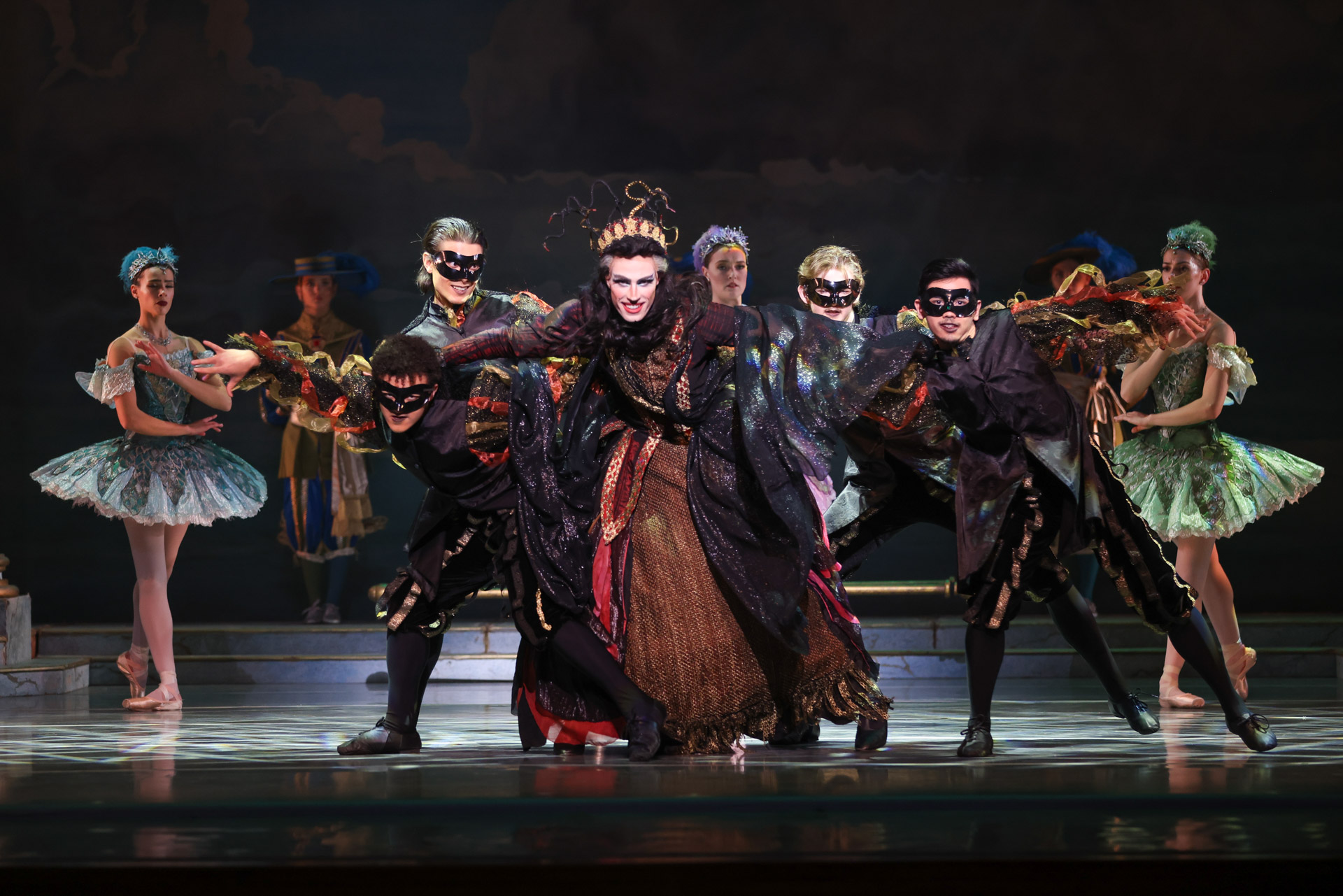
As Florimund, Kopecky is almost pathologically sensitive and sincere, an absolute dreamboat for the naïve young fry in the audience, but I expect that Josh Hall, consigned to the role of King on opening night, will stir older libidos when he takes over as the destined Prince, paired with Dayton in her maiden season with CharBallet. Kopecky’s sublimity, on the other hand, chimed well with Harkins’ ethereality – and contrasted deliciously with Colby Foss’s flamboyant rendering of Carabosse, Tchaikovsky’s Evil Fairy.Carabosse 2 by Jeff Cravotta

Of course, the Sleeping Beauty that former CharBallet artistic director Jean-Pierre Bonnefoux premiered here in 2012 is still deeply embedded in the company’s DNA, so a crossdressing Carabosse won’t be a total shock to loyal subscribers. But Disney’s Maleficent can also be cited as part of the evolution of Hart’s Carabosse. When Tchaikovsky stretched the rather thin storyline to epic length, he largely relied upon celebrations, a Sweet 16 and a wedding piled upon the original christening.

Disney wanted drama, so he didn’t discard Carabosse after the opening scene, or even after the birthday party, where Tchaikovsky began the tradition of having her disguised and smuggling a contraband spindle into the kingdom. No, she is still around a century later, in Disney’s scenario and in Hart’s, barring Prince Florimund from waking his ladylove and providing some sorely needed pushback against the predestined outcome.

Foss’s bravura requires a counterweight that’s stronger than the magically-challenged Florimund, so the Lilac Fairy, “wisest of the Fairies” according to the Nurse, is elevated as much as Carabosse in Hart’s scenario. In fact, with Sarah Lapointe’s sparkle, power, and serenity, you can make the case that Carabosse and the Lilac Fairy are the plum roles in this Fairy Tailored Classic rather than Aurora and Florimund, though Harkins and Kopecky do conquer the most challenging choreography.Court by Jeff Cravotta

Sharing the Lilac gig with three other dancers, Lapointe will actually spend most of this CharBallet run as Aurora’s mom, the Queen. When Foss isn’t making a meal of Carabosse’s malignity, he will trade places with Andrés Trezevant, looking very cavalier on opening night as Catalabutte, the officious and slightly pompous page who presides over every ceremony. While the costumes designed for him by Peter Docherty aren’t nearly as wicked, gnarly and spectacular as Carabosse’s outfits, Trezevant was accorded a wardrobe change after the 100-year intermission, wielding his scepter in a purple-and-blue livery for Aurora’s birthdays before rocking a copper-and-blue ensemble for the wedding.

While Docherty’s scenery is not quite as eye-popping as his costumes, Jennifer Propst’s lighting design dramatically contrasts the daylight of the public celebrations with the moody gloom of the sleeping kingdom and castle. Aside from the dimly lit apparition of the Sleeping Beauty behind a misty scrim, Docherty and Propst combine on a nice effect as the Lilac Fairy’s spell first takes hold. Vines descend dramatically from the fly loft, covering most of the courtyard as we move toward the intermission blackout.

Thanks to the Nurse’s ongoing narrative, there is extra charm to the intermission. Before nodding off in front of the proscenium and slipping away to the wings, Gilchrest-Kubie announced the 20-minute interval and drew our attention to the slowly moving clock projected high over centerstage. Just a single minute hand sweeps clockwise around the clock after the lights come up. Only the clockface has been reconfigured so we’re gradually counting up to 100 like a speedometer, instead of the usual 12 or 60, as Sleeping Beauty’s sleep flies by.

Compared to Aurora’s century-long coma, the two years we’ve had to wait for this Fairy Tailored Classic are nothing to complain about. On the contrary, we have a ballet wakening of our own to celebrate.

Charlotte Ballet Takes Us Back to the Future in Rousing and Meaningful “Innovative 1970”

Review: Innovative 1970 at Center for Dance

By Perry Tannenbaum

Innov1970 gypsy moths photo by Jeff Cravotta

February 4, 2022, Charlotte, NC – Distorted by delay, the title of Charlotte Ballet’s latest program sounds more like an oxymoron than ever. Innovative 1970 was originally designed to celebrate the company’s 50th anniversary, but COVID intervened in all our lives so that the official celebration couldn’t be staged until October 2021, already 51 years after the original troupe was formed in Winston-Salem as the North Carolina Dance Theatre. That commemoration included an electrifying revival of The Rite of Spring by Salvatore Aiello, who brought NCDT to Charlotte in 1990. Following that program, the company more predictably reprised The Nutcracker for the holidays, choreographed by Jean-Pierre Bonnefoux, who succeeded Aiello as NCDT’s artistic director in 1996 and rebranded the troupe in 2014.

The durably titled Innovative 1970 is thus the first program of all-new pieces since Charlotte Ballet returned to live performances this season and the first to return dancers and subscribers to the Patricia McBride and Jean-Pierre Bonnefoux Center for Dance, doubly appropriate because 1970 was adopted as the creative trigger for all three newly commissioned pieces on the program, choreographed by Andrés Trezevant, Rena Butler, and Ja’ Malik.

Innov1970 What was it for Photo by Jeff CravottaAppropriate to its Vietnam War theming, Trezevant’s “What Was It For?” arrived for its premiere as a partial amputee, for the beginning of the scenario in the printed program, where war protesters make houses out of draft cards, is MIA – along with the conspicuous absence of Elton John’s “Bennie and the Jets (1974).” What remained thrust us into middle of warfare, Julie Ballard’s lighting design turning the floor of the Center for Dance’s black box into camo splotches of green and gray, while a house of cards lingered downstage, now a cryptic relic of the original concept. A quaint portable radio was spotlit near the opposite wing, likely another leftover, but it remained functional, emitting only white noise as five male dancers, dressed as soldiers, populated the stage, simulating scenes of combat, capture, escape, and rescue.

We were clearly – and perhaps angrily – back home, when Maurice Mouzon Jr. subsequently performed a dashing solo to Nina Simone’s “Backlash Blues (1967).” The two women in this piece, Sarah Lapointe and Anna Mains, arrived onstage as healers while the scene brightened somewhat. Now the returning soldiers – Colby Foss, Ben Ingel, James Kopecky, and Rees Launer – were presumably in hospitals and rehab, dealing with mental and physical trauma in the grim aftermath of a futile war. I suspect that the house of draft cards was intended to fall at the end, but it remained standing.

Innov1970 Subliminal Tsunami photo by Jeff Cravotta

Subliminal Tsunami by Rena Butler, with original music by Daniel J. Hoffman, was a more acerbic and satirical piece that took 1970 as a checkpoint on the state of women’s rights and horizons, compared with where they are today. Recorded voices of Gloria Steinem, Nikki Giovanni, and ABC News anchor Marlene Sanders were in the colloquium, intermingled with recorded voices of seven Charlotte Ballet dancers delivering their own personal accounts. Sharply contrasting with this dignified discussion was what we saw onstage, five women dancers coldly confined by Ballard’s lighting into five squares. The stiffness of Lapointe, Raven Barkley, Isabella Franco, Sarah Hayes Harkins, and Amelia Sturt-Dilley, dressed in matching costumes by Kerri Martinsen, clearly identified them as a collection of Barbie dolls, handled dutifully by four men – Foss, Ingel, Launer, and David Preciado.

Only occasionally did the voices compete with the dancers for attention as the piece proceeded, giving the dancers more latitude for movement. No doubting that the black box’s sound system sorely needs an overhaul, OK for rehearsals but not suitable for prime time. It was still a bit stinging to listen to the cautions against following your impulses issued to young girls contemplating a future of homemaking. Lamentably, the pace of progress for women has been mostly subliminal, not at all a tsunami, though cumulatively we have evolved substantially since 1970, and more progress can be perceived if we look back to when women gained the right to vote 50 years earlier. While I was bothered to see the dancers still masked in 2022, Butler had an ingenious way of coping with the situation: Big smiley, lipsticked mouths on Martinsen’s matching flesh-colored masks were clearly and effectively part of the women’s design.Innov1970 gypsy moths 2 photo by Jeff Cravotta

After the traumas of war and the indignities of gender inequality, it was refreshing to return after a second intermission to gypsy moths, Ja’ Malik’s joyous celebration of funk rockers LaBelle and their frequent collaborator Laura Nyro. A teeming cast of five men and five women, all in spangled masks, converged on the floor for “Met Him on a Sunday,” Nyro’s 1971 cover of a song introduced by The Shirelles thirteen years earlier, and “Come Into My Life,” introduced on LaBelle’s Chameleon album in 1976. “Gypsy Moths,” introduced on the same LaBelle album, paired the company into five couples Emily Porter with Kopecky, Harkins with Humberto Ramazinna, Shaina Wire with Josh Hall, Emerson Dayton with Preciado, and Barkley with Mouzon.

It wasn’t until the ensuing three songs that it became clear that Barkley and Mouzon were the alpha couple of Malik’s piece, for Barkley was obviously the lead in “The Wind” and Mouzon was unquestionably the alpha male in “Going on a Holiday,” both backed by the full cast. Neither of these ensemble segments was as special or memorable as Malik’s seething setting of “Been on a Train,” the whole stage cleared for a slithering Barkley-Mouzon pas de deux. “Desiree,” taken from Nyro’s 1971 Gonna Take a Miracle album was only slightly anticlimactic, a glittery showcase for the other four women, and “What Can I Do for You” was a stirring finale for the entire cast, so infectious that it roused rounds of rhythmic clapping from the audience. The ovation when the spectacularly dressed Malik joined the dancers onstage was even more raucous.

Originally published on 2/5 at CVNC.org

Charlotte Ballet’s 50th Is Luxuriously Long and Varied, Culminating in a Sizzling “Rite of Spring”

Review: Charlotte Ballet’s 50th Anniversary Celebration

By Perry Tannenbaum

ROS Rehearsal Photo

Sitting next to an audience member I’d never met before and conversing with her, thanks to the COVID vaccines and to our vaccination cards that had been scrupulously checked in the Belk Theater lobby, I could share her excitement in being back to see the Charlotte Ballet, out in public without pods or social distancing, and enjoying live performance in a real audience for the first time in nearly 19 months. Even though we were all masked – discarding social distancing seems to increase our tendency to take this precaution seriously – my wife Sue and I felt a distinct residue of wariness.

Yet my trepidations must be an infinitesimal fraction of the wariness anti-vaxxers maintain toward getting vaccinated and an infinitesimal fraction of the daily risks they’re willing to take. Trusting that the people sitting next to you and the people checking them are trustworthy was a calculated leap of faith, my first occasion of sitting next to a stranger since March 2020, so I could understand why the upper tiers at Belk Theater were empty for Charlotte Ballet’s 50th Anniversary Celebration, and why the orchestra and Grand Tiers weren’t teeming to capacity.

Gathering us together for their big celebration after two postponements, Ballet didn’t shrink from keeping us together, offering us a longer and more varied program than we’ve seen in many a season. More than that, they welcomed Christopher Warren-Green and the Charlotte Symphony to the pit (have we ever seen him down there before?) to perform a Philip Glass piece and brought four masked Symphony principals onstage to fuel a performance of Antonin Dvořák’s Piano Quintet. With the exception of Salvatore Aiello’s electrifying setting for Igor Stravinsky’s The Rite of Spring, the program didn’t find Charlotte Ballet in a retrospective mood.

Christopher Stuart, the new Charlotte Ballet II program director, jumped into the fray first with a new piece, “Then, Now, Forever,” set to the live Glass. Canadian choreographer Crystal Pite, whose work has been featured at Spoleto Festival USA on a couple of occasions dating back to 2009, made an edgier Charlotte debut with “A Picture of You Falling,” paired with the Stuart piece before the first of two intermissions. Framed by the two intervals, Val Caniparoli appeared in Charlotte for the first time with Ibsen’s House, interestingly set to the Dvořák. All of these choreographers were present for the celebration – except for Aiello, the former North Carolina Dance Theatre artistic director who died in 1995 at the age of 51.

TROS Young Warrior

The company itself, launching season 51, looked no less fresh and new, especially with etoile Sarah Hayes Harkins happily sidelined on maternity leave. No less than five dancers were taking their first steps as new members of Charlotte Ballet and Charlotte Ballet II, including two Isabellas, Franco and Bertellotti, who are time-sharing a role in the three performances of Ibsen’s House through Saturday. Meanwhile, a trio of seven-year veterans of the troupe; Sarah Lapointe, Raven Barkley, and Amelia Sturt-Dilley; are striding more to the forefront. Lapointe and Barkley struck me as the most arresting presences in Section 1 of the “Then, Now, Forever” suite. Tempo quickened noticeably for Section 2, with newcomers Franco and Emerson Dayton paired with Ben Ingel and Davis Preciado. Easing back to a languid midtempo Section 3, Lapointe poured out her newfound imperious confidence opposite Rees Launer, which made the fast pace of Section 4 that much celebratory, teeming with 10 dancers. Stuart’s choreographic style didn’t startlingly depart from classical models, so his costume design collaboration with Katherine Zywczyk, as well as the dancers, somewhat upstaged him. Backlighting and dramatically silhouetting the famously inert Belk Theater organ pipes, lighting designer Jeff Emory made them useful for the first time in their ignominious history.

Standing spotlights were the scenery for Pite’s “A Picture of You Falling,” surrounding Sturt-Dilley and Andrés Trezevant in a semi-circular formation as the tenuously connected couple performed to Owen Belton’s original 2008 music and Pite’s cold, emotion-free text. We are perhaps invited, without any cordiality, to identify with this brief deconstructed romance, first from Trezevant’s point of view as he faced himself and the repetitive emptiness of his life. Eventually, we escape from this spiral as Pite takes us to the moment where he literally bumps into Sturt-Dilley.

Flirtation and courtship do not figure on this island of light in Pite’s pitch-black universe, so when Trezevant is shown falling, the effect is from gravity rather than love – “This is you falling,” “This is you collapsing” – and his heart literally hits the floor rather than filling with passion. Sturt-Dilley seemed to take over the lead, drawing our empathy for a while, as the little chronicle climaxed at “The Place,” with a light hint that what’s happening, as the two are engaged in their pas de deux, isn’t happening to him. “This is how it happens” transitioned swiftly, without the luxury of regret, “to this is how it ends” after repeated, obsessive descriptions of the room, something like a Last Year in Marienbad video loop or some classically gloomy Ingmar Bergman. Repeated collapses followed, and the falling featured some slo-mo and freeze-frame touches reminiscent of The Matrix.

We haven’t seen any Ibsen from our local theatre companies in Charlotte since a lackluster production of A Doll’s House in 1999, so Caniparoli’s Ibsen’s House figured to be a bad mismatch with the Queen City’s theatre tastes, theatre history, and local theatre professionals outside UNC Charlotte, where they presumably remember that the Norwegian is revered as the father of modern drama. Caniparoli showcased five oppressed Victorian women, including the heroines from Ghosts, Lady from the Sea, Rosmersholm, and the title character of Hedda Gabler. Yet it would be irresponsible for me to recommend catching up with these scripts, for there was little from Dayton and Ingel that reminded me of feminist icon Nora Helmer, insensitive ingrate husband Torvald, and A Doll’s House – or anything at all from Lapointe as Hedda, Josh Hall as George Tesman, Sturt-Dilley as Mrs Alving, and Peter Mazuroski as her son Oswald that awakened memories of Gabler or Ghosts, the other Ibsen staples in Caniparoli’s gallery that I’ve seen. Dayton captured Nora’s early timidity beautifully and Lapointe had a steely resoluteness that was almost intimidating, yet we never found ourselves in the vicinity of the notorious endings of their dramas. Scenic and costume designer Sandra Woodall is best in evoking this strait-laced and corseted era, and Caniparoli excels brilliantly in choreographing the Dvořák, whose 1887 quintet was completed between the times that Ghosts and Hedda Gabler premiered.

Sarah Lapointe in TROS

Having already previewed The Rite of Spring, we need not dwell on the fire and fury of Lapointe as The Chosen One – other than to say that Lapointe didn’t disappoint and completely owned the sacrificial maiden’s every move (Sturt-Dilley dances the role on Friday and Lapointe returns Saturday). Lapointe upstaged and literally towered over everyone else in sight, but the clash between Ingel as the Old Chieftain and James Kopecky as the Young Warrior was primal, intensely physical, and thrilling. Presiding over everything with a shamanistic presence as the curtain went up was Nadine Barton as the Earth Figure, a grand coming out for her in her third year. About the only clear reminder we had all evening of concessions we’re still making to COVID was the absence of live winds, brass, and percussion blaring forth and flailing away at Stravinsky’s score in the orchestra pit. Representing the Salvatore Aiello Trust, curator Jerri Kumery brought the spirit of the choreographer into the hall, and the 17 dancers onstage kept the temperature of his work white-hot.

King of Pop Invades Popo in “Leonce and Lena”

Review: US premiere of Leonce and Lena

By Perry Tannenbaum

DSC_0010[4]

As the action in the US premiere of Christian Spuck’s Leonce and Lena reached its climax, King Peter of Popo stepped forward on the Knight Theater stage to make an important announcement – to the audience, presumably, for the rest of the Charlotte Ballet cast stood respectfully and expectantly behind him. King Peter struggled mightily to express himself, never quite succeeding in uttering a syllable, though I’m sure I heard a consonant.

Summoning up more power and determination, the doddering King of Popo snapped his fingers. Behold, the house lights came on. But still, when he faced us squarely, no words came out. Well-heeled ballet mavens would have scanned their programs by now and read the synopsis, knowing before Peter’s abortive attempts at speech that he was probably announcing the upcoming wedding of his son, Prince Leonce, to Princess Lena of Pipi.

Or, since Leonce and Lena had fled their respective kingdoms back in Act 1, perhaps Peter was announcing a kingdom-wide search for the absent bride and groom-to-be. A reward for whoever found and returned them? That would certainly be in keeping with fairytale decorum.

That the ineffectual king snapped his fingers and brought the house lights back down was no longer a big surprise. But Spuck had plenty more shtick in reserve for James Kopecky, the dancer in Peter’s royal regalia who had pitifully shrunk away from us in defeat. Shedding his doddering persona, Peter busted a whole bevy of pop dance moves, including a stylish anthology of moves associated with the concerts and videos of Michael Jackson.

“You are the king!” I was tempted to shout.

There probably were shouts amid the hubbub of laughter and surprise that greeted this dramatic break from Peter’s previous character. You couldn’t doubt that Spuck’s intentions were largely comical, but if you found an edge of satire lurking beneath the laughs, you might also find it challenging to decide who or what the targets could be.

A powdered periwig that detonates in the opening scene reliably tells us that ceremonial pretensions were definitely in Spuck’s crosshairs. The fawning and fussing of Peter’s underlings are also mercilessly exposed in the costume designs of Emma Ryott and Spuck’s choreography. Repeatedly in Popo, the presumed grandeur of fairytale kingdoms – or European kingdoms so obscure they might as well be fairytales – is repeatedly punctured. Peter’s first wedding announcement is scrawled on a humble blackboard, with interlocking rings hastily drawn with chalk, while Leonce listens to his music on his friend Valerio’s wee boombox instead of adjourning to an dignified spinet.

What Charlotte Ballet subscribers are most likely to overlook, until Kopecky’s King of Pop antics conk them over the head with it, is that Spuck’s prime satirical target is ballet itself. Robotic choreography, such as we see in Leonce and Lena among Peter’s sycophants and later among the Italian townspeople, has been part of the balletic arsenal since the days of Copéllia and Nutcracker in the 19th century. That isn’t where I was finding Spuck’s fresh assault on ballet conventions. No, it’s the royal lovebirds who are most hilariously antithetical to ballet.

Instead of the customary piety, elegance, or bookishness that might mark Leonce and Lena as kindred spirits, Spuck points up their pure boredom. Nor is this mere low-key eyeroll boredom. This is enervated, prone, cradling-your-chin-in-the-palm-of-your-hand boredom. While Leonce is moping on the floor, he does something even more unbefitting the heir to the Popo throne: he propels himself along the ground like an inchworm. Backwards.

The alienation that Lena and Leonce feel toward their parents is demonstrated, in a charmingly antiquated way, by the music they listen to. At court, we’re likely to hear the waltzes of Johan Strauss Jr., including the majestic Emperor Waltz. Lena and her loyal Governess prefer to unwind with a coy version of Cole Porter’s sexually suggestive “Let’s Do It,” while the less fiercely rebellious Leonce and Valerio crank up Burl Ives’ greatest hit, “A Little Bitty Tear” on the boombox.

DSC_0230[11]

Less downcast than their besties, Peter Mazurowski as Valerio and Alessandra Ball James as the Governess get to sparkle more at their respective castles before the young royals hit the road – and wear the less humdrum costumes. They also spark more readily with each other when the quartet meets up in Italy. Love at first sight between Leonce and Lena is more of a slow burn and more passionate, allowing Colby Foss as the Prince and Sarah Hayes Harkins to fire up a singularly quirky pas de deux that will linger in your memory. Notice that Stuck sticks them side-by-side in this whirlwind courtship, not forgetting how he established their characters.

Meanwhile, Mazurowski and James’ settle into a comedy groove that has belonged to second-banana couples on stage and on screen since before the days of Guys and Dolls. Then the zany Finale, when they return to Popo to crash the wedding – and stop the show almost as hysterically as Kopecky.

Plotwise, where ballet and its mute characters always have difficulties in storytelling, Spuck gets a little haphazard when Leonce and Lena part from each other in Italy. There’s a bit of Cinderella-at-midnight confusion to how Lena abruptly leaves Leonce. So it’s quite possible on your way home, after the full happily-ever-after tale has been told, that you’ll be asking yourself: when love first exploded between them, did Leonce and Lena even tell each other who they were?

During the final scene; filled with masquers, eccentrics, a wedding bower, and the king’s antics; you’ll likely be too entertained to worry about tying up such stray details. You might, on the other hand, miss Chelsea Dumas’ pouting as Rosetta and her unsuccessful flirtations. Pursuing Leonce in the opening act, Dumas neatly livened the action and underscored the Prince’s ennui. Maybe Spuck could bring Rosetta back to ply her charms on queenless King Peter! Such monkeyshines would be quite apropos in Popo.

Divinity, Orgy, and Terror Are Excitingly Mixed into Charlotte Ballet’s “Spring Works”

Review:  2018 Charlotte Ballet’s “Spring Works”

By Perry Tannenbaum

Spring is always considered a season of growth and renewal, and at Charlotte Ballet, where Hope Muir is completing her first year as artistic director, that old maxim was explosively confirmed on opening night of Ballet’s Spring Works at Knight Theater. Indications were strong that Muir and the company had turned a corner with the triumphant American premiere – after a one-night postponement – of Javier de Frutos’s The Most Incredible Thing in early March, reaffirming that CharBallet could take on bigger challenges and fill anybody’s shoes. The current sequel has brought in Bryan Arias, Helen Pickett, and Filipe Portugal, three choreographers the company had never presented before, and a rousing reprise of Ohad Naharin’s masterful Minus 16 suite.

The evening began with the splendid partnering of Alessandra Ball James and Josh Hall in Pickett’s “Tsukiyo,” premiered by Boston Ballet in 2009. Having watched The Shape of Water on a flight from Rome the previous morning, I saw a common thread between the Oscar-winning film and Pickett’s pas de deux, which is set to Arvo Pärt’s Speigel im Speigel. Both have the look of an amorous encounter between the human and the divine. James emerged from a mist like Botticelli’s Venus, supremely elegant and graceful, radiating a regal and divine assurance.

Hall approached her with worshipful awe, initially repulsed by the goddess, but he didn’t flee, continuing to circle her with awestruck wonder. Somehow Hall, who is the title character of the piece (and a god) as far as I could determine, wasn’t upstaged by James’s perfection. After starring as Leo the Creator in The Most Incredible Thing, Hall may have given an even richer characterization here, often curving his body to a picture of humility, yet strong and worthy of the goddess in those few moments when she yielded to him. The chemistry was profound, meshing beautifully with the music. Costumes by Charles Heightchew and lighting by John Cuff enhanced the magic.

In the wake of this powerful intensity, the next two pieces, both in their world premiere presentations, were comparatively abstract. Set to generous selections from the “Tirol Concerto” by Philip Glass, Portugal’s “Stepping Over” shuttled from fast to slow and back to fast in classic style. Action, divided among eight couples, was lively in the fast sections, most effectively in the final movement, where the music has a ragtime flavor. But I most enjoyed the slower middle movement with its style and grace.

Costume design by Christopher J. Parker detracted from the overall impression, barely transcending workout togs, matching blue outfits for the three lead couples and teal for the others. Hall and James made fairly quick costume changes into blue, each taking on a new partner, Chelsea Dumas and Drew Grant respectively, but it was hard for me to take my eyes off Sarah Hayes Harkins. Eclipsed and maybe a little enervated for much of the 2017-18 season, Harkins regained all her old sparkle and precision paired with James Kopecky, dancing with a new joy and rejuvenated spirit. An impressive North American debut for Portugal.

The only true intermission came after “Stepping Over,” though the program booklet deceptively places another one after the world premiere of “When Breath Becomes Air” by Arias. With more time devoted to ensemble movement, dancers were more detached and impersonal in the Arias piece than in the Pickett. Yet there was something more conceptual going on, since Arias has set his dance to Six Breaths by Ezio Bosso. As his title hints, part of Arias’s intent was the give physical shape to the invisible. All-white costumes by Márian Tatán heightened the molecular quality of the ensemble’s motion. Arias seemed to break away from that mold in the midsections of the piece, breaking down his ensemble into four different couples. Perhaps because these couples came on an evening that was already highlighted by the exploits of James and Hall, I was more enchanted by the trio of Colby Foss, Lexi Johnston, and Harkins.

Lights come up at Knight Theater after the Arias piece and the curtain comes down, but you shouldn’t leave the hall. Naharin’s piece explores the sometimes-ambiguous borderlines between playfulness and madness in a society under constant threat of terrorism. The most famous part of the Israeli choreographer’s Minus 16 is where he sets the Tractor’s Revenge modernization of a Passover song for a tightly regimented group of dancers who curve from one side of the stage to the other, mostly sitting and moving on chairs as “Echad Mi Yode’a” cycles from one to 13 in much the same fashion as “The 12 Days of Christmas.” Naharin brought this part of the piece to the Carolinas when his Batseva Dance Company made its Spoleto Festival USA debut in 2007. But the first complete performances of the suite in the Carolinas came at Knight Theater in 2012 when the Alvin Ailey American Dance Theatre brought it to town in 2012 – on their way to presenting it at Spoleto. Charlotte Ballet latched onto the piece in 2016 with smashing success.

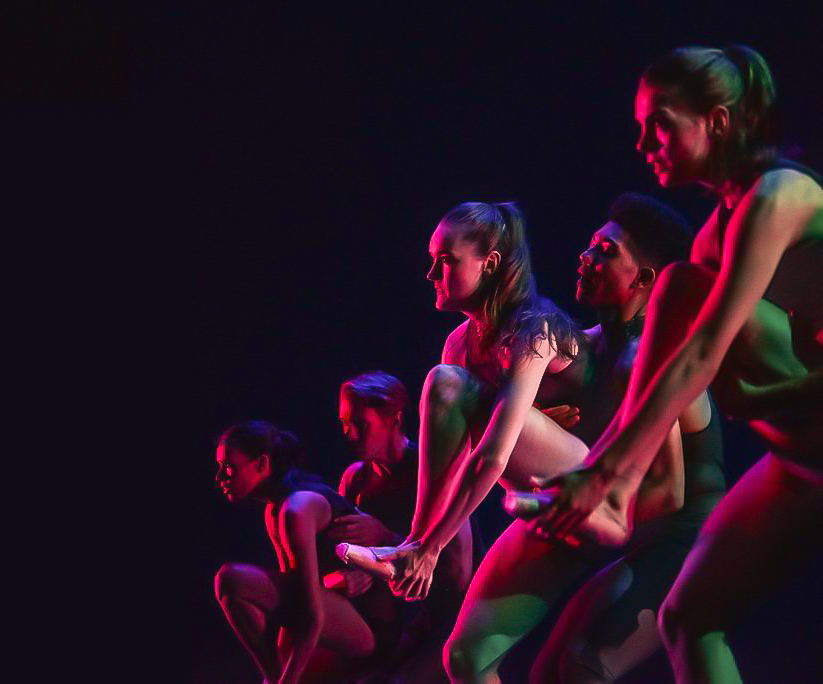
The encore presentation seemed even better. While the lights were up for “Intermission,” Kopecky came out for his solo, a potpourri of spasmodic, graceful, and acrobatic movement – mixed with stony motionlessness and paranoid scrutiny of the audience. Of course, the sensation of all this wackiness increased as audience members returned from the lobby to discover it. (Maurice Mouzon Jr., who originated this role in 2016 while still a member of Charlotte Ballet II, will do this solo on the evening of April 27 and at an April 28 “family matinee” which will omit “When Breath Becomes Air.”)The curtain rose and fell many times during Minus 16, most shockingly when we suddenly see the “Echad Mi Yode’a” tableau, where costumes resemble those worn by ultra-orthodox Haredi Jews.

Primed by Kopecki’s antics, the audience was inclined to laugh at the end of each refrain, where a wave of prayerful motion sweeps from left to right, to Hebrew words that translate as “One is our God,” capped by one solitary man who explodes from his chair and falls face down onto the stage. It’s only when the ensemble’s collective actions grew crazier, all of them shedding an article of clothing in each refrain, that the laughter subsided – perhaps with the realization that the fallen man was a victim of a terrorist bomb. Maybe the sight of ultra-orthodox Jews tossing off their hats was their cue.

Amazingly, the chaos of clothing strewn across the stage gave way to frantic joy as the borderline was crossed once more to energetic, orgiastic celebration. All of the dancers eventually came out into the audience, as “Over the Rainbow” poured from the loudspeakers, and picked out members of the crowd who came back with them onstage. It really got crazy when the stage filled up again, as a block party broke out to the strains of “Hooray for Hollywood” and Dean Martin’s iconic “Sway.” Joy, laughter, and escape were fully consummated.