Tag Archives: Garrett Murphy

Charlotte Bach Festival Travels Back to the Future With “Bach, the Next Chapter”

by Perry Tannenbaum

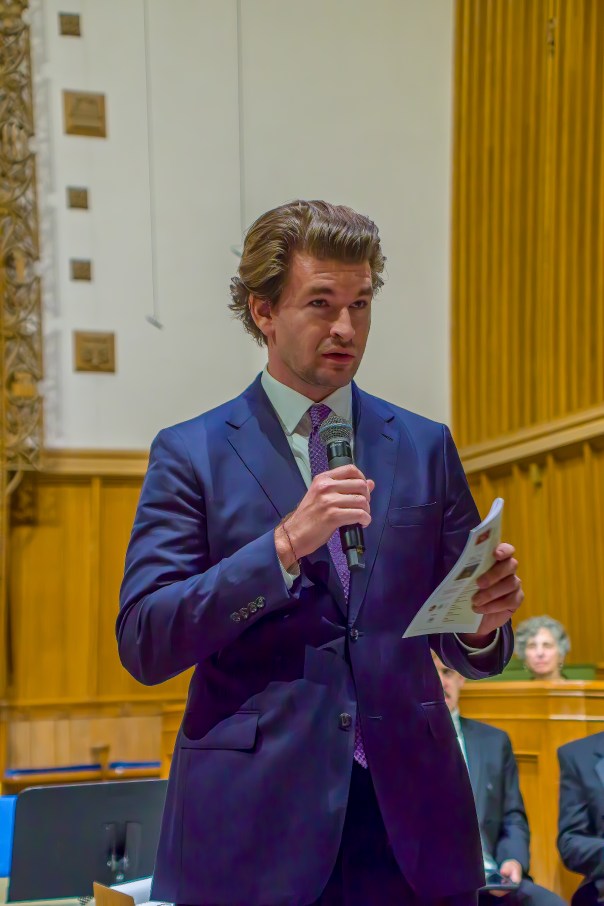
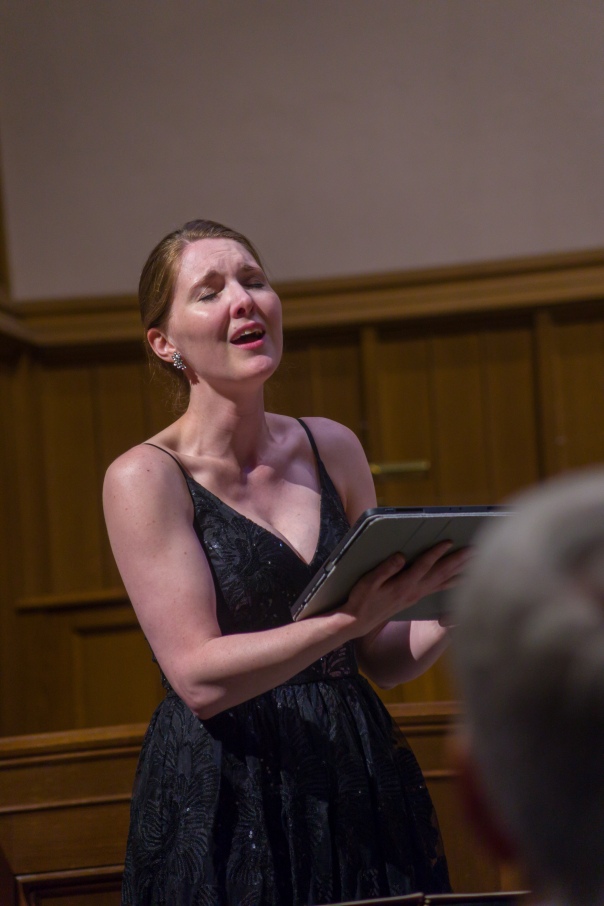
CHARLOTTE, NC – With the departure of the two people most instrumental in establishing Bach Akademie Charlotte and the Charlotte Bach Festival, artistic director Scott Allen Jarrett and chief exec Mike Trammell, we couldn’t help wondering how radical changes might be at the 2024 festival. The new artistic leaders filling in for Jarrett have actually been with the Bach Festival since the first Charlotte celebration in 2018. All three – concertmaster Aisslinn Nosky, cellist Guy Fishman, and keyboardist Nicolas Haigh – have made significant contributions in performance season after season. The new executive director, Garrett Murphy, began his hosting chores last spring at the Venetian Vespers concert, prior to the last year’s Bach Fest that featured marathon offerings of Johann Sebastian’s Christmas Oratorio.

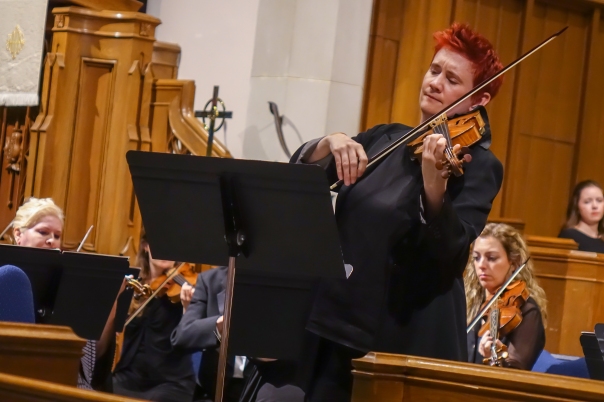
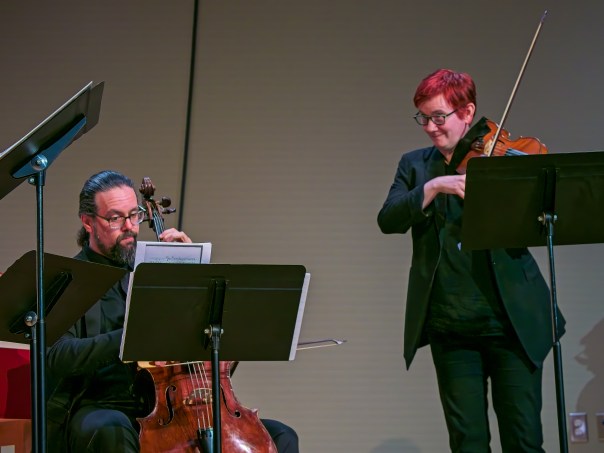
The changes for 2024 were somewhat telegraphed by the first glimpses we had of Claudio Monteverdi’s Vespers of 1610 in that spring concert last year. For the first time, the headline works for the opening and closing concerts at Charlotte Bach are not by Bach. The laurel for the big opening at Sandra Levine Theatre was Antonio Vivaldi’s The Four Seasons, with Nosky fronting a string reduction of the iconic score that reprised her triumph as guest soloist with the Charlotte Symphony a few months before the inaugural festival. Stamping and mugging, red-headed Nosky brought the Red Priest’s electricity back. But with two afternoon sessions devoted to demonstration concerts of the Vespers, the closing concert with Monteverdi’s gem has been clearly designated as this year’s top highlight.

Not that Johann has been totally neglected. He had some play when Peter Blanchette, inventor of the 11-string archguitar, unofficially opened the festival with a “Bach at the Brauhaus” event at the temporary Pianodrome constructed at the Brooklyn Collective. And in the wake of The Four Seasons, where Bach’s “Tilge, Höchster, meine Sünden” served as a handsome preamble, Jonathan William Moyer‘s Organ Recital was all-Bach, an earth-shaking German Organ Mass that may be the best organ concert in the festival’s history.

In this year of transition, the “Bach, the Next Chapter” concert instantly stood out for me as the most telling event in this year’s lineup. Not only was the festival looking at Bach’s predecessors and contemporaries to explore their influence, it was now guiding us forward to examine his legacy – beginning in his own family with his most illustrious son, Carl Philipp Emanuel Bach. That extra stretch of the envelope – at a new venue, the Kathryn Greenhoot Recital Hall, never before called into service at Charlotte Bach – made “Next Chapter” a little more fetching than the half dozen other festival events scheduled at sites making their CBF debuts.

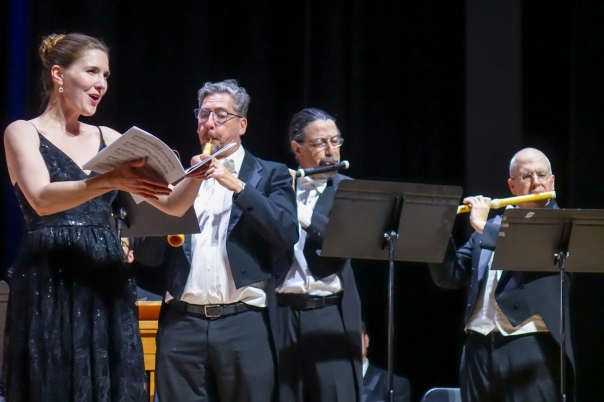
“Next Chapter” began with Johann Sebastian’s Magnificat, but only a small taste of its Canon Perpetuus – played by Nosky, Fishman, and oboist Kristin Olson – enough to establish the Leipzig master’s achievement as a jumping off point. Then before playing CPE’s Sonata for Oboe in G minor, Olson discussed how the younger Bach was intent on diverging with his illustrious father. Without the modern oboe’s metal keys, the baroque oboe would prove to be a fussier instrument, requiring more frequent swabbing, and its tone was noticeably thinner in the opening Adagio movement, with a litheness that seemed even better suited to the middle Allegro. The wide leaps of the closing Vivace were effortlessly navigated, and Olson’s tone grew slightly richer.

Johann Gottleib Graun’s Trio Sonata in B-flat for Violin and Viola actually brought four musicians to the fore. Harpsichordist Jennifer Streeter teamed with Fishman on the continuo while violist Maureen Murchie shared the title roles with Nosky. Introducing the piece, Nosky emphasized the new tendency of composers to give the spotlight to multiple soloists. Yet the promised parity between violin was only confirmed in the opening Adagio before it was discarded in the middle Allegretto, where Nosky was clearly the superior among equals in drawing technical challenges. Murchie had more of a chance to shine in the closing Vivace, where she had the first run at the theme.

All five hands came on deck for Johann Adolph Hasse’s Sonata for Oboe, Violin and Viola, though we were cautioned that Hasse was likely not the true composer of this charming piece. Olson drew most of the spotlight, with Nosky her chief responder, but Murchie had more challenges here than in the preceding piece. Nosky and Murchie withdrew for the next work by Princess Anna Amalia of Prussia, and Olson had the joy of announcing the discovery of a woman composer in the generation that followed Bach. Nosky’s excellent program notes offered only a slight clarification, reminding us that Anna Amalia studied with a student of Johann’s, distancing her musically from Bach by an additional generation.

Olson also confided that the piece was originally written for flute before possessing it in scintillating fashion with her oboe. The beauties of the opening Adagio drew even richer sounds from the oboist, yet Olson had to pause before the ensuing Allegretto “so all the notes will come out,” explaining the troubled relationship between her instrument and moisture as she swabbed. Fishman sat by patiently before upstaging his colleague, helpfully quipping that it was the same with his cello. Not to worry, Olson more than answered back with dazzling work on both the Allegretto and the concluding Allegro ma non troppo.

Nosky and Murchie returned for the evening’s finale, Johann Gottlieb Janitsch’s Quadro in G for Oboe, Violin and Viola, but once again Olson more than justified her top billing – in a four-movement crowdpleaser that was the most radical break with the Baroque Era that we heard. Once again, we had a swabbing pause between movements as Olson primed her instrument for the final fireworks of the Vivace non troppo. If you think of the baroque music canon as a cavalcade of perpetual motion machines, this last salvo was a shocker. Olson excelled yet again, laying down the gauntlet on multiple occasions and, rather than merely repeating, Nosky and Murchie fired back their flaming responses – after dramatic silences that crackled with tension.

Photos by Perry Tannenbaum

Charlotte Bach Is Breaking Out All Over

Preview: Charlotte Bach Festival 2024

By Perry Tannenbaum

Since 2018 – with a pandemic hiatus – singers, musicians, and ancient instruments have been gathering to greet the summer at the Charlotte Bach Festival, a nine-day celebration of the Baroque Era’s best. Well, once again, the assembly has gathered, but they’re branching out. Embracing new locations, new composers, and venturing beyond the baroque.

Neither of the headline pieces at the festival’s big Saturday night concerts is by the great Bach patriarch, Johann Sebastian. The big kickoff features violinist Aisslinn Nosky, who first dazzled the Queen City in 2018 playing Antonio Vivaldi’s The Four Seasons at Belk Theater with the Charlotte Symphony. Now the redhead is offering a Red Priest encore with authentic baroque instruments at the Sandra Levine Theatre at Queens University.

Of course, Vivaldi was a contemporary of Bach’s, and Johann will share the bill with Antonio, launching the Opening Concert in Tilge, Höchster, meine Sünden, a church cantata based on Giovanni Pergolesi’s famed Stabat mater – only with a new text based on Psalm 51. On the other hand, Claudio Monteverdi’s Vespro della Beata Vergine, more commonly known as the Vespers of 1610, was premiered 40 years before Bach’s birth. Or maybe 414 years before its Charlotte premiere at Charlotte Bach’s Closing Concert on June 22, also at the Levine.

Bach Akademie Charlotte, the festival presenters, performed a teaser of the complete Vespers last March at an all-Venetian concert.

“That was the one we did at Myers Park Presbyterian,” recalls Akademie president Garrett Murphy. “We had quite a good audience for that, and a preview movement of the Monteverdi Vespers. We knew at that moment we were going to do that whole piece, so the artistic leadership team designed a whole festival around that theme of what was happening in Italy.”

Vespers also gets the biggest build-up with a sequence two noonday demonstration lectures, “The Monteverdi Experience” I & II, at St. Peter’s Episcopal Church on Thursday and Friday – both free with the purchase of Vespers tickets. Clearly the festival climax.

Plus the entire piece hasn’t been played here in ages, if at all.

“Our musicians are most excited about that,” Murphy confides. “For them, that’s the festival, and they are coming together with great excitement to perform the Monteverdi Vespers and are really hoping that folks will come out.”

Leadership of the festival is also branching out in the wake of artistic director Scott Allen Jarrett’s departure. A triumvirate now reigns as artistic leaders, including Nosky, cellist Guy Fishman, and keyboardist Nicolas Haigh. While they craft the festival’s programming – and a burgeoning season of Akademie concerts between festivals – Haigh’s spouse, soprano Margaret Carpenter Haigh, corrals the talent.

Each of the four will also headline a festival concert. After Nosky’s Vivaldi on Saturday, Margaret Haigh teams up with theorbo master William Simms for Lagrime mie: Songs of Lamentation, Disdain, and Renewal next Monday at the McColl Center on N. Tryon Street. She’ll naturally be singing songs by Italians, including Giovanni Kapsberger, Luigi Rossi, Monteverdi, and of course Barbara Strozzi’s “Lagrime mie,” for she has privately labeled the entire 2024 festival “Bach Akademie Goes Italy.”

But not before she and Simms begin in the Renaissance and Elizabethan England with a sheaf of songs by renowned lutenist composer John Dowland.

Nicolas, a fixture on harpsichord and organ at past festivals, steps into the spotlight as he leads the Bach Akademie Charlotte Choir and the festival’s four vocal fellows in “The Renaissance Motet” with compositions by Giovanni da Palestrina, Giaches de Wert, Nicolas Gombert, and the marvelously innovative Englishman, William Byrd. This Wednesday night concert and the Tuesday night “Vocal Fellows Recital” preceding it bring a new site into play, both for the festival and the QC.

Apparently, the Holy Comforter Episcopal Church on Park Road is ready for its closeup.

Fishman opens another new frontier for the festival at Trinity Presbyterian on Providence Road in what promises to be one of the season’s most revelatory programs “The Cello, Ascending.” Leading an assortment of Akademie Choir and Orchestra members, Fishman will illustrate what he subtitles “The Rising Virtuosity of the Baroque Cello” as the instrument shed its subsidiary timekeeping role of providing an ensemble’s bass line and emerged as a major solo voice. The mix of composers will include Vivaldi, Handel, and Gabrielli along with less familiar names.

Arguably the most trailblazing of all the Bach Festival concerts is the Tuesday event, “Bach, the Next Chapter,” staged at a previously undiscovered underground treasure: the Kathryn Greenhoot Recital Hall, below the Levine at the Sarah Belk Gambrell Center.

Nosky leads a tight-knit group in guiding us into the influence JS had on the generation after him, including Princess Amalia of Prussia and his own most famous son, Carl Philipp Emanuel Bach. Spoiler: Johann was a very popular name in the Bachs’ day.

“Since the first time I toured Queens,” Murphy remembers, “I’ve been excited about using that Katherine Greenhoot Recital Hall downstairs, which I think is a perfect size venue for something like this. It’s beautiful, about 150 seats, I think. And very modern and a nice little space. But this is something we’re excited to share with Charlotte and are hopeful that we can continue to grow a following for C.P.E. Bach as well.”

ImaginOn almost gets its Charlotte Bach concert debut as it hosts “Lunch and Learn” at noon on Tuesday. Carolina Pro Musica’s multi-instrumentalist mainstay Holly Maurer and Weber State University professor Esther Jeehae Ahn will go over some Baroque basics and explore the influence Italian composers, from Monteverdi to Vivaldi, had on J.S. Bach in a casual bring-your-own-lunch setting. Sorry, kids, this freebie is “sold” out.

Which brings us to Charlotte Bach’s guest celebs and another free event. Peter Blanchette, the virtuoso inventor of the 11-string archguitar takes the festival’s popular Bach@The Brauhaus series to The Pianodrome on S. Brevard Street in The Historic Grace at the Brooklyn Collective. Blanchette has arranged hundreds of Bach compositions for his invention, but his repertoire ranges from medieval and Renaissance to contemporary and world music. Already this Friday’s revels are sold out.

But perhaps in honor of Simms and his many-stringed theorbo, you’ll also find a cash bar Monday night at the McColl for the Lagrime mie concert.

St. Peter’s mighty organ gets a workout as virtuoso Jonathan William Moyer plays J.S. Bach’s complete German Organ Mass – with an intermission – on Sunday evening. Then on Monday afternoon, Moyer offers an Organ Masterclass at Providence United Methodist, listening to and critiquing local organists, then showing how it’s done. This freebie, open to the public, starts at 2:00 PM.

“He is now the professor at Oberlin, and a consummate artist, doing recitals all over the world,” Murphy says about Moyer. “He’s doing the complete, as they call it, Organ Book Three, but it has a lot of familiar tunes, and it’s a pretty epic thing to hear all at once. He is just delighted to be coming and playing that organ at St. Peter’s, one of the few, I’m told, in the country that can really do that piece justice.”

Planning by the new Nosky-Fishman-Haigh troika has already begun for the 2026 Bach Festival and beyond. Meanwhile, they will be tag-teaming Bach Akademie’s upcoming regular season, just announced this week. Lift-off is set for September 7 when Fishman will play all six Bach Cello Suites, split into afternoon and evening concerts with three suites each.

A new and different kind of split happens when Nicolas Haigh leads the Bach Akademie Choir in October. They’re breaking out of town! On successive nights, October 25-27, Akademie’s choral concert will be performed in Asheville, Charlotte, and Lancaster. Fishman returns for a single concert, leading the Akademie Ensemble in Charlotte on January 25.

Then before the 6th Charlotte Bach Festival returns in 2025 on June 14-21, the regular season climaxes with another three-day marathon. Nosky and Margaret Carpenter Haigh will co-lead the Akademie Charlotte Choir & Orchestra on another Asheville-Charlotte-Lancaster tour, May 9-11.

Bach Akademie is definitely spreading the music around, even into the Palmetto State. Spread the word!

Monteverdi Validated at Myers Park With Venetian Vespers

Review: Venetian Vespers with Bach Akademie Charlotte

 By Perry Tannenbaum

2023~Venetian Vespers-03

March 4, 2023, Charlotte, NC – You might gasp audibly upon learning that The Oxford Dictionary of Music proclaims that Claudio “Monteverdi’s place in the history of Renaissance music can justly be compared to Shakespeare’s in literature.” That high regard was echoed stateside by Ted Libbey in The NPR Listener’s Encyclopedia of Classical Music: “To paraphrase his contemporary Shakespeare, he bestrode the musical world like a colossus.” Yet many at the Myers Park Presbyterian Church; where Bach Akademie Charlotte presented their latest concert, Venetian Vespers conducted by Scott Allen Jarrett; were probably witnessing a live performance of Monteverdi’s music for the first time. Others had likely never heard Monteverdi anywhere but in church and/or on recordings in their entire lives.

As far as I can tell, the Renaissance colossus has never had a hearing at Belk Theater or Knight Theater in Charlotte. I’m fairly certain that my first live encounter with Monteverdi was at Spoleto Festival USA in 1991, when L’Incoronazione di Poppea was presented at Dock Street Theatre. Before then, my revelations had happened at local libraries in Columbia and Charlotte, where I could borrow and fall in love with vinyl recordings of Monteverdi’s Madrigals (there are nine books of them) followed by my discovery of L’Orfeo, the first masterpiece in opera history.

In keeping with the tone of the venues where Bach Akademie usually performs – and the liturgical spirit of their marquee composer – Jarrett, with a small chorus of six voices and an instrumental quintet, focused on two major sacred works that bookended Monteverdi’s career, his Vespro della Beata Vergine (1610) and his Selva morale e spiritual (1641). Sensing a general unfamiliarity with Monteverdi’s music and his importance, Jarrett spoke at length on both, stressing the cultural eminence of Venice at the peak of the Renaissance and Monteverdi’s towering influence over how composers would write for voice after he upended traditional practice by prioritizing text over music.

The texts that Bach Akademie performed were mostly scriptural and liturgical Latin, but Jarrett and his musicians also dipped into the “moral madrigals” found in the Selva collection, with Italian texts written by Francesco Petrarch and Angelo Grillo. In fact, Jarrett’s selections were admirably proportional to the original collections: we had twice as many excerpts from the Selva as we heard from the Vespro, and the Italian songs gave us a balanced representation of the larger collection, which on complete recordings is just over twice the size of the 1610 Vespers.

2023~Venetian Vespers-17

We began and ended the concert with full ensemble pieces from the Selva, starting with “Laudate Dominum” (second version). Sopranos Margaret Carpenter Haigh and Arwen Myers blithely chimed the opening exhortation – “let us praise” – over and over, interspersed with full choral and instrumental passages, along with a couple of merry exchanges between tenors Nick Karageorgiou and i. Four of the six Selva selections were originally for accompaniment by two violins, slots ably filled by two mainstays of Boston’s exemplary Handel and Haydn Society, concertmaster Aisslinn Nosky and Fiona Hughes.

2023~Venetian Vespers-32

Replacing the four trombones in the score as well as playing their own parts, Nosky and Hughes figured more prominently in the “Gloria” that followed Jarrett’s impressive disquisition. This larger-scaled composition also offered more opportunity for the vocalists to shine, the tenors declaiming the title word most often before the sopranos dominated with their filigree on the recurring “Domine.” Thanks to Jarrett’s intro, we were also on the lookout for the heavenly harmony lavished on the stately “peace on earth” passage, enriched by Edmund Milly’s bass-baritone, cellist Guy Fishman, and organist Nicolas Haigh.

2023~Venetian Vespers-13

Accompanied solely by Deborah Fox on theorbo, Myers and Margaret Haigh gave us a marvelous first sampling of the Vespro, “Pulchra es,” set to two amorous verses from the Song of Solomon, delicately straddling the borderline between chastity and seduction as they sang from opposite sides of the chancel. Both sopranos rejoined the male vocalists as we returned to the Selva with “Laudate pueri” (first version). The men harmonized sweetly to launch this setting of Psalm 113 before the sopranos quickened the tempo and lifted the music to joy and jubilation.

I wondered how Jarrett and Bach Akademie planned to handle “Duo Seraphim,” the next Vespro selection, since it was written for three tenors, according to the program booklet, and the conductor deployed Karageorgiou and Wilson to opposite ends of the stage. Akademie’s artistic director must have also anticipated some suspense in the room, for it wasn’t until halfway through the piece that the third tenor walked to his place upstage, behind organist Nicolas Haigh – Milly, the bass! While Milly’s tessitura didn’t need to reach quite as high as the two other tenors’, he did quite well, actually sounding louder than his comrades on a few notes. Of course, there’s another way of construing the drama of Jarrett’s staging. At the exact point where the text departed momentarily from its familiar Isaiah 6 refrain, and the heavenly witnesses to the seraphs’ “Holy, holy, holy” call were cataloged as “the Father, the Word, and the Holy Spirit,” Milly took his spot upstage before the three were said to be one.

Composed while Monteverdi was still in service to the Duke of Mantua, the “Dixit Dominus” for six voices and instruments seemed to be specially crafted for the acoustics of the Venetian Basilica of San Marco where he would later serve as the chapel maestro. John Eliot Gardner’s recording of the complete Vespro at San Marco with the English Baroque Soloists in 1986 implicitly made that point, and Jarrett, both in his introductory remarks and with the ensemble’s performance, made that point explicitly at Myers Park Presbyterian.

2023~Venetian Vespers-31

Although she didn’t get much of the vocal spotlight, alto Laura Atkinson picked up a microphone to preface the remaining three Selva selections. Both of the poems that followed, written by Monteverdi for the other five voices, proved worthy of the pulpit, as their translated titles indicated: Petrarch’s “O blind ones! What use is all your toiling?” and Grillo’s “This life is a flash of lightning.” Reminding us that this was Bach Akademie and that the Charlotte Bach Festival is slated for its return on June 10-17 (if interim managing director Garrett Murphy’s fundraising goal is met), Jarrett and company gave us a small-scale preview of the plenty to come with Johann’s “Sanctus in D.” Not the swiftest version you’ll ever hear, but light, lively, and irresistible.

“Beatus vir” (first version), set to Psalm 112, was an apt finale to this Venetian Vespers concert, carrying forward the festive mood of the penultimate Bach with invigorating vocal counterpoint – Monteverdi writing here for six exactly voices at last – and providing Nosky and Hughes, as the two violinists also prescribed by the score, with their best opportunities to shine. But it wasn’t until the music slowed down, where the Psalmist spoke on the steadfastness of a god-fearing man in the face of evil tidings, that the finale became truly grand. The sheer massiveness of the sound summoned up the church to mix its harmonies, reminding us that we were in a house of worship.