Tag Archives: Dennis Delamar

Old Barn’s “Orient Express” Is a Clue-ful Poirot Treat

Review: Murder on the Orient Express at Theatre Charlotte

By Perry Tannenbaum

We can thank the Brits for the notion that passenger trains should run with absolute timeliness and precision. Now that Ken Ludwig’s meticulous adaptation has opened at the Queens Road Barn, we can also thank Agatha Christie, Britain’s most avidly read mystery writer, for her Murder on the Orient Express. Layer on Jill Bloede’s bubbly direction – and dialect coaching – and the treacherous trip rattles along with a savory continental flavor.

That soupçon of glitter and effervescence is greatly enhanced by Theatre Charlotte artistic director Chris Timmons’ fleet and fluid set design, an art deco wonder that transitions delightfully from an Istanbul hotel to a smoky train depot to the luxe interiors of the Orient Express. Since the landscape and snowscape outside the legendary train are also moodily conveyed by projections, it’s difficult to draw a precise borderline between Timmons’ scenic exploits and his lighting design.

While the paucity of professional theatre companies in the QC continues to account for the plethora of professional-grade acting talent we behold at the Barn, so does the opportunity to appear in opulent costumes such as those designed by Sophie Carlick – for hotel waiters, train conductors, and various glitterati who can afford a first-class sleeping compartment on a luxury transcontinental train.

Speed is beneficial in a murder mystery, especially as it plods along, contrary to real life, when we’re introduced to a multitude of suspects who have sufficient motive to commit the cold-blooded crime. Anyone who grew up watching the Perry Mason series on TV (or has binged on it more recently) knows the classic drill: the murder victim antagonizes a slew of enemies. So many enemies that we’re unsure who might have done the deed and more than mildly uncaring about the victim, no matter how brutally they were killed.

Ludwig admirably singles out our obnoxious victim-to-be and all the antagonisms he can spark while introducing us to Christie’s heroic protagonists, Constantine Bouc, owner of the Orient Express line, and peerless detective Hercule Poirot. There will be debate about Bloede’s decision to shitcan Poirot’s mustache wax and twirls in favor of a more conventional groom, but Brandon Samples’ initial entrance as the Belgian is star quality.

There’s a bit of aristocracy to Samples’ bearing that allows Poirot to fit in with his fellow passengers, including a princess, a countess, and a colonel. While Timothy Hager zestfully cements his repulsiveness as Samuel Ratchett, it’s also important for us to see that Poirot has sufficient dignity, discernment, and assets to reject Ratchett’s crass job offer.

Poirot also offers Samples a few brief episodes of befuddlement, for the culprit he is hunting leaves a blizzard of clues.

Unlike all of those complacent Perry Mason victims destined for the morgue and a court-ordered autopsy, Ratchett is keenly aware that he is being hunted. He’s willing to retain Poirot for a fabulous amount of money to protect him. Perry, you’ll remember, doesn’t arrive on the scene until after the wrong suspect is accused and arraigned. Here, Poirot is directly involved while the victim is alive. So when Samples shows no guilt or remorse for not accepting Ratchett’s offer after he is murdered, we’ll need further reasons for despising the playboy.

Christie piles them on and, in doing so, makes the bizarre solution to her mystery more plausible, for Ratchett is far more monstrous than he first seems to be.

Yet the elegance, hauteur, and glamor of the leading ladies would seem to instantly eliminate them from suspicion – or any close acquaintance with the vulgar victim. To think that Paula Baldwin as the Russian Princess Dragomiroff would deign to inflict eight stab wounds on the repellent Ratchett seems like sacrilege.

Likewise, Julia Howard as the serene and mysterious Countess Helena Andrenyi from Hungary seems worlds away from the slain playboy. The ethereal Gretchen McGinty as English governess Mary Debenham, also a smashing beauty, seems to live in an entirely different sphere, more involved with Scottish Colonel Arbuthnot (Ben Allen with a brash brogue) than the slain American.

As for Kathryn Stamas, as an esteemed actress traveling under the assumed name of Helen Hubbard, she is sufficiently brash, loudmouthed, and inconsiderate for us to worry whether Ratchett, trying to get some sleep next door and stewing with rage, will burst into her room and murder her. Murdering him would ruin her delight in riling him with her late-night singing.

However laudable it might be to murder Ratchett, three acts of God will prevent the ghoulish plan from eluding discovery: the unexpected arrival on board of legendary unraveller Hercule Poirot, the serendipitous intervention of Orient Express owner Constantine Bouc in securing a first-class compartment for Poirot, adjacent to the victim’s room. After these pieces are in place, with Bouc ready to serve as Poirot’s loyal sidekick, comes the fortuitous storm that halts the regal train in a snowbank out in the wilderness, giving Poirot sufficient time to investigate.

Bouc is obviously a key prong in Christie’s plotcraft, allowing Poirot to board the Orient Express and vesting him with the authority to investigate. Otherwise, our mustachioed sleuth wouldn’t be able to scan all our suspects’ passports or rummage through their luggage. Dramatically, he enables Poirot to interview all the suspects, another ritual of the mystery genre, corresponding to Perry Mason cross-examinations, that cries out for swift pacing.

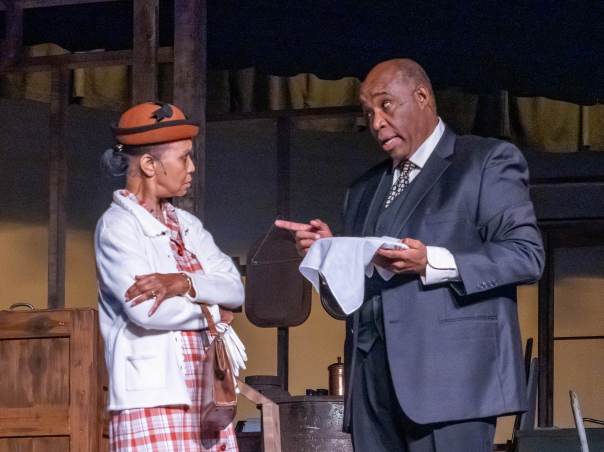
The venerable Dennis Delamar would seem ideal for bestowing the requisite bonhomie on our gracious host and eager sidekick, except… for all his wholesome triumphs as Henry Higgins, Grandpa Vanderhoff, Kris Kringle, John Adams, Hucklebee, Jacob the Patriarch, and many more, has he ever done a French accent before? Maybe that was the question Delamar was asking himself on opening night when he uncharacteristically stumbled over a few of his opening lines.

Even for a semi-pro like me, those are lines you should be able to say in your sleep. Of course, Double D never broke character during his difficulties, so to neophytes in the audience, it may have seemed like the garrulous pensioner was stumbling over his English. Delamar’s imperturbability in this brief crisis only made Bouc more charming when he righted himself – and real panic was safely in reserve when the unsolved murder, right under his nose, threatened the image and prestige of his company.

Bouc also serves as a buffer between Poirot and the petty annoyances presented by our suspects, allowing Delamar to display his comedic chops. Samples, on the other hand, gets to revel in flipping over innocent façade after innocent façade in revealing the secret underbellies of his artful gallery of suspects. The parade of skeletons emerging from closets can’t help but add to our merriment.

So most of the actors on stage need to be adept not only in erecting their respective façades, but also in carrying off those deliciously satisfying moments when they are so disconcertingly exposed. Joshua Brand as Ratchett’s querulous secretary seems particularly innocent and above suspicion, while Emma Brand as the Princess’s trembling missionary ward is even further above. So pleasant when they fall.

Climb aboard this fatal train, and you’re likely to find the ride more fun than you expect.

“One Year to Die” Is a Premiere to Be Proud of in Matthews

Review: One Year to Die at Matthews Playhouse

By Perry Tannenbaum

September 11 has been part of LaBorde family lore much longer than for nearly all other American families. On that date in 1943, the USS Rowan was sunk in Mediterranean waters by German torpedoes after delivering an arms shipment to Italy to combat the Nazis. Local actor/director/playwright/school principal Charles Laborde’s Uncle Joe was among those aboard the Navy destroyer lost on that day, along with 201 other officers and crew. Only 71 survived the attack, rescued by the USS Bristol.

Curiously enough, the official date of Uncle Joe’s death is listed as September 12, 1944 – still a full five years before Charles was born – because none of those 202 bodies was recovered. As the Naval Officer informs Charles’s grandma Edwina with full-dress formality in LaBorde’s new play, One Year to Die, Joe was officially “missing” after the Rowan was torpedoed until one year and one day had elapsed. Then the Naval Death Certificate would be issued.

The world premiere of LaBorde’s play opened last week at Matthews Playhouse and runs through September 29 at the Fullwood Theater.

While it’s intriguing to wonder how Charles’s grandparents, Oscar and Edwina, coped with this limbo year of unofficial death – maybe holding out hopes of a miracle for a few weeks or months – it’s hardly the stuff of sustained suspense and drama. To achieve these enhancements, LaBorde applies some research, imagination, and basic math.

Time-travelling back to his grandparents’ farm in Hessmer, Louisiana, which wasn’t big enough to be incorporated until 1955, LaBorde modestly multiplies the number of local families impacted by the Rowan’s sinking. Now two moms down in Cajun country are grieving over their lost sons, Edwina and Ella Broussard, an ailing black washerwoman who takes in laundry from the richer families in the region.

Everybody seems to know everyone else around town, so when the Naval Officer shows up on Edwina’s front porch to deliver his sad news, she can point him in the right direction toward the part of town where Ella presumably lives. The fact that LaBorde has invented her makes no difference. But it’s going to take far more resourcefulness from the playwright for him to even begin exploring the racial divisions and tensions that prevailed in the little town of Hessmer when the dark days of Jim Crow hadn’t been dispelled, even after African Americans were welcomed by our military.

No, for that to happen, LaBorde had to find a compelling reason for Ella to appear at Edwina’s doorstep. Indeed, to fully engage us and win our admiration for Ella, the mission driving her to Edwina’s farmhouse had to be compelling enough for her to knock on the LaBordes’ front door. Now you have an action sufficiently outré to set a little Jim Crow town in turmoil.

What on earth could be so important for Ella to commit such an effrontery?

She has enough imagination and ambition to match her chutzpah, for she plans to pay tribute to both her son Lonnie and Edwina’s Joe – along with all the other 200 soldiers aboard the USS Rowan who perished fighting the Nazis. The tribute will be a quilt of 202 gold stars on a field of blue, with the two stars representing Lonnie and Joe conspicuously larger than the 200 others.

The project is worthy, and quilting 202 squares with 202 perfectly centered stars, along with a suitable border to frame it all, seems to be a sufficiently monumental task to occupy two women for the better part of a year – once the ladies have solved the math problem of how to symmetrically configure those 202 stars. Director Dennis Delamar certainly isn’t going to gloss over the problem of getting the math exactly right.

But that front door thing is key (even though Edwina is proud to say it’s unlocked) and obliges LaBorde’s family to be tested onstage in a manner they probably never faced in real life. To the playwright’s credit, neither of his kinfolk is perfect in receiving their surprise guest – who should, as everybody in Hessmer knows, be knocking at the back door.

That is the attitude here from both Edwina and Oscar when they first encounter this unfathomable cheek. Just to double-underline the point that the LaBordes are not perfection, Edwina rebuffs Ella twice. Yet we soon see that they are willing to evolve, uniting with Ella’s cause once they’ve heard her out. Granting her the unique privilege of entering by the front door. But what about the rest of the town? Here is where LaBorde can inject suspense, drama, and a sprinkling of terror.

Joshua Webb’s set design, with its wood-burning stove and perpetual coffee pot centerstage, has a rusticity that allows for a wisp of primal danger and violence lurking beneath its humble domesticity. Both kitchens are lovingly dressed, but sightlines are a rather dreadful problem: unless you’re seated in the center or toward the right side of the Fullwood Theater audience, you might go home never knowing that Oscar had been visible building his stone wall – hidden by the Broussard kitchen to those of us sitting on left – in defiance of stone-throwing yahoos (or KKK) repeatedly breaking the LaBordes’ windows.

Complemented by Sean Ordway’s moody lighting design, which casts a spell even before the action begins, Yvette Moten’s costume designs have the timelessness of Norman Rockwell paintings on the covers of old-timey Saturday Evening Post magazines. It’s hard to resist the visual charm of this production as Delamar frames one memorable tableau after another. From the time we first see the spirits of Young Lonnie and Joe (Aaron Scott Brown and Bennett Thurgood in rather touching non-speaking roles) to the great starry quilt reveal, Delamar lavishes a series of freeze-frames that are a memorable slideshow within the show.

Some discreet subtraction is applied to LaBorde family history that results in somewhat awkward casting for the leading ladies, Paula Baldwin and Corlis Hayes. Nowadays, we’d expect moms of strapping young military enlistees to be in their forties or fifties, not 60+ – but the real Edwina had way more offspring than two sons, so she actually was aged 60 at the time of Joe’s death.

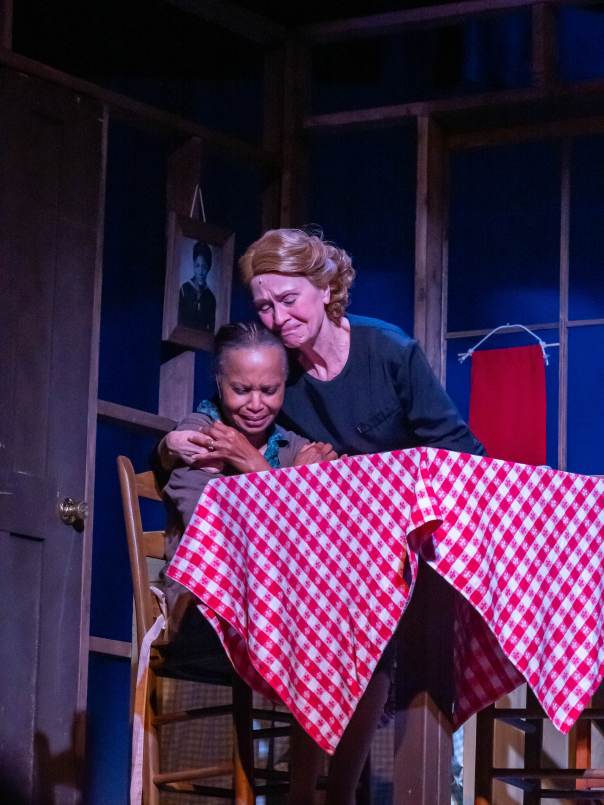
So sitting at her kitchen table, sustaining her renown as the county’s quilting queen, and looking rather matronly, Baldwin is exactly what LaBorde envisioned as Edwina. Life on the bayou does take its toll here, so Joe will merely be the beginning of Edwina’s ennobling griefs. Baldwin endures these crucibles like so many we’ve seen from her over her distinguished QC stage career, with signature stoicism. Neither Delamar nor LaBorde had any hesitation in casting her.

As for Hayes, I first encountered her at Johnson C. Smith in 1988 when she directed for colored girls at the tender age of “24” – just guesstimating here – so she’s also perfectly cast as Ella. Maybe the most heartwarming aspect of this production is the gift LaBorde has given her with a world premiere credit in this role. Confronted by both black and white folk, Ella is a far more nuanced and varied character than we normally see Hayes portray.

We instantly see the strong spine that brings her to Edwina’s door – twice – and we see her pragmatism in backing off the first time. She seethes back home and resolves to repeat her effrontery, still knocking at the front door. Then there’s the beautiful passive aggression when Edwina belatedly agrees to allow Ella over her front threshold. Hayes pointedly hesitates, referencing the insults she has previously absorbed and the dignity she maintains.

LaBorde has obviously labored over Ella, for she has her maintaining this steely dignity when confronted by her minister, Reverend Johnson, and even when she is complimented by white churchlady Nodie Ardoin, Edwina’s nemesis. Yet there’s one more telling Easter egg to be found in LaBorde’s script, that Hayes and Delamar brilliantly emphasize. As soon as Ella gets the first clear sign from Oscar that she might not be welcome in his kitchen, we see Hayes instantly cowering, clutching her pocketbook, and readying for a quick exit.

That’s the kind of good sense Ella has, for all of her sturdy spine. We can be thankful that this rich role has finally found Hayes.

If it weren’t obvious before, One Year to Die signals that Matthews Playhouse has joined the ranks of Metrolina community theatres that consistently present pro-grade work. The standard set by Hayes and Baldwin is met by the men who portray the Hessmer clergy, Steve Price as the soulful Father Morton only slightly upstaged by the charismatic Keith Logan as Rev Johnson. LaBorde would have done better by both of these religious leaders if he had refrained from broadly hinting that Catholic and Baptist ministers follow the exact same script when upbraiding wayward lady congregants.

Aside from Oscar, the other guys we see onstage are military, so we never sample the boorishness or the toxic philosophies of the town’s window breakers. The military cameos, however, are beautifully handled by Vic Sayegh as the Naval Officer who rocks the LaBordes’ world and Brian DeDora, who appears as The Sailor after the Normandy invasion.

Possibly, LaBorde dropped the idea of including the rock-slingers onstage, for Nodie bears the same last name as one of them. Robin Conchola as Nodie is actually the more benign of the “watchin’ committee” that darkens Edwina’s doorstep to register their condemnation, a lot more conflicted than Barbara Dial Mager as Sarah Jeansonne. It’s Conchola as Nodie who has the chance to be rebuffed by Hayes. Sarah is slower to evolve, so we can despise Mager longer, if only for her horrid wig.

As Oscar, also aged 60 when Joe perished at sea, Henk Bouhuys is delightfully homespun, although there’s still enough Jim Crow ingrained in him to be shocked by the ladies’ audacity. Bouhuys continues to project ambivalence long after Oscar decides the memorial project is worth doing no matter how the rest of Hessmer may think. Once he gives Edwina his assent, his loyalty is as steadfast as his love.

Whether it was absent-mindedness or a directive from Delamar, Bouhuys only intermittently sounded Cajun on opening night – while the rest of the players hardly bothered with an accent. So it was startling when Oscar became full-out Cajun just before intermission after a cowardly attack on the LaBorde farmhouse. Out of nowhere, the accent was stunningly convincing, adding some sharp ethnic spice to the most fiery monologue of the night.

Photos by Perry Tannenbaum

Kennedy’s Bridge Circle Meets Its Quota of Quips – and More

Review: The Thursday Bight Bridge Circle at Theatre Charlotte

By Perry Tannenbaum

Since 1987, the last time I watched a live performance at St. John’s Baptist Church, I haven’t cut a deck, played a hand, won a rubber, or even bid a single No Trump – I’ve even lost track of my copy of Charles H. Goren’s Point Count Bidding. But since that night when PlayWorks staged The Octette Bridge Club at St. John’s, I haven’t needed much knowledge about the game of bridge or its culture. My last brushes with the game were in Sunday columns I would read in the arts section when The Charlotte Observer was a traditional newspaper.

So it was a little concerning, when I sat down at Theatre Charlotte for the premiere of Ray Kennedy’s The Thursday Night Bridge Circle, that I found no less than four bridge teachers were credited in the playbill for their contributions. My concerns were thankfully unfounded. Visitors to the Queens Road barn will not be assailed with bridge terminology, the intricacies of bidding, or even extensive card play.

Louise Kennedy’s circle is a looser agglomerate than P.J. Barry’s octet, which was an unwavering group of eight sisters. And it’s only Louise’s circle tonight because hostess chores hopscotch from member to member on successive Thursdays. Nor are participants constant, we learn, as Louise welcomes us to her cheery, symmetrical, split-level living room – two tables flanked by two sofas – a luxe scenic design by Tim Parati that gives us peeps at the garden and the foyer.

Tonight, for example, Louise’s college co-ed daughter, Mary Carter Kennedy, is in town to play one of the hands, to be partnered with Louise’s mother-in-law, Mrs. Kennedy, who has earned a risqué reputation in LaGrange, North Carolina, as a liberal. Since one of the regulars can’t make it this week, dear Louise is bracing herself for the arrival of Miss Virginia, who will likely be roaring drunk as soon as she can guzzle sufficient booze. Excitement is ratcheted up further by a new player that only our host knows, Carmella, feared to be a judgmental Yankee – and to have a profession!

Imagine that!

The two tables are filled out by Bootsie and Cluster, gals from Louise’s generation, and two more elders, Miss Caroline and the eternally disapproving Mrs. Coltrane, Louise’s mom. You can bet there will be plenty to rouse Mom’s umbrage, beginning with the fact that housemaid Margaret and her daughter Bernice will be mixing drinks, pouring beverages, and preparing the hors d’oeuvres. Mary Carter also has a truckload of disclosures that will disconcert her granny.

Hosting such an exhilarating event is so intricate, complex, and daunting that Louise – or anyone who hosts the circle – cannot be expected to participate in the cardplaying. The standard of perfection is too high for a hostess to divide her attention. Tables must be carefully set, partners thoughtfully chosen, and place cards placed exactly so at every chair.

Sadly, Carmella hasn’t chosen the best night for her first sampling of Southern hospitality – or the best year. It’s 1970, LBJ is midway through his second term and the backwater of LaGrange still has separate black and white schools, bathrooms, and post offices. “It’s always been that way,” Miss Caroline complacently declares, and none of the LaGrange ladies except the liberal Mrs. Kennedy seems to suspect that Margaret or Bernice might be discontented with the racist status quo.

Needless to say, Kennedy has concocted a comical time bomb that is primed to explode before our eyes. Desegregation has arrived and Louise’s mom and husband have decided to send their imperiled offspring to military school – a betrayal of Louise’s bestie, Bootsie, who was counting on her public-school solidarity. Nor will Mary Carter, an activist at school, take this well, while Carmella and Mrs. Kennedy will be reliably alarmed. Toss in a stray N-word from Virginia when she’s sufficiently lubricated and you may conclude that a polite evening of bridge has been scuttled.

Before his fictional kindred took the stage on opening night, the playwright Kennedy spoke to us about his autobiographical work and introduced us to the real-life Mary Carter, proudly sitting in the third row. So when Tonya Bludsworth entered as Louise, it was a bit like a continuation of the playwright’s monologue, except that the hostess was giddier with excitement and nervousness because she didn’t know how the evening would go.

Sketching each lady who would sit in each bridge chair, the intro was a bit draggy despite Bludsworth’s fretful charm, particularly since the playwright doubles down on his intros by granting Louise mystical foresight into who is arriving at her front door – tripling down when she greets them by name. Most people will be delighted with Kennedy’s style, which endows most of his characters with the ability to come up with a Southern-fried quip or a salty simile in nearly every sentence.

Almost by magic, Kennedy is able to differentiate between his ladies anyway, thanks to the big family squabble and the political, class, and age divides. Dennis Delamar’s stage direction is as handsome as Parati’s set, elegantly accessorized by “props team” Lea Harkins and Lois Marek. No doubt Delamar’s successes are facilitated by the presence of at least three more actor-directors in his cast, Corlis Hayes as Margaret, Paula Baldwin as Mrs. Kennedy, and Bludsworth as the fourth ace. Assistant director Dee Abdullah is no slouch, either, as a dramaturge.

Kennedy’s lapses into logorrhea may be the result of his not realizing the full power of his script, which bursts forth with terrific force on Queens Road, first when Hayes reacts to the bombshell dropped by Kathryn Stamas late in Act 1 as the soused Virginia (which Grace Ratledge as Mary Carter and Ashley Benjamin as Bernice refuse to let go) and then a stunner by Ann Dodd as Mrs. Coltrane when she is unexpectedly confronted deep in Act 2.

Costume designer Angeli Novio accepts the challenge of making the hotsy-totsy New York lawyer, Stephanie DiPaolo as Carmella, stand out among the local LaGrange fashionistas in her haute couture. DiPaolo does her Long Island accent lightly enough to maintain her stature as an evolved Yankee outsider, but instead of leaning more into her legal expertise and feminist superiority, the playwright lets her devolve into an excuse to more thoroughly introduce us to the natives.

No matter how charmingly Jenn Grabenstetter as Bootsie and Amy Pearre Dunn as Cluster expound on the origin of their Dixie nicknames, I just don’t care, even if it did incentivize them to audition. Let’s get to the juicy stuff quicker! And when we do get there, let Baldwin have more space to bemoan and bewail how her son could conspire with Mrs. Coltrane to send her dear grandson off to a boarding school. It’s a glaring plot point that needs to be addressed – and weren’t we in the middle of a war in 1970?

Regardless of how much more meat Kennedy could pile onto our plates (and how much candy he could discreetly remove), Hayes makes an enduring impression in her climactic monologue, deftly calibrated by the playwright not to become a tirade. Ginger Heath, anointed my first Best Actress many years ago, get surprisingly little to sink her teeth into here despite her imposing wig, but that only spotlights the exploits of the newbies all the more.

Benjamin absolutely commands the stage when she unexpectedly returns in Act 2 as Bernice, a bit of a surprise after her badly miked debut as Tinman last September. That leads to a rather memorable sequence of assertiveness, contrition, and reconciliation begun by Dodd in her QC debut as the formidable Mrs. Coltrane. I didn’t expect to weep after intermission, but I did, even while the quips kept landing.

Shakespeare Is a Thieving Magpie in Theatre Charlotte’s “Something Rotten!”

Renovated Queens Road Barn is ready for its closeup

By Perry Tannenbaum

Something Rotten

 We are all stupid and silly – and we all love smart-ass musicals that tell us so. That’s the deep message of Something Rotten! Theatre Charlotte’s brash, big-ass extravaganza that’s raising the curtain for the grand reopening of the iconic Queens Road barn.

Yeah, it’s been awhile since a musical opened at our venerable community theatre’s home. That was early September 2019, when Oliver! launched what would have been the 2019-20 season. But COVID-19 shut everything down in early March, before auditions or rehearsals could even begin for Dreamgirls, scheduled to open in late spring. Then a latenight fire in the waning hours of 2020 gouged a huge hole in the theater floor, smoked the ceilings, and fried all the precious electronics – lights, audio, AC, computers – and kicked the company out of their house.

For over two years, while more than $1 mil in repairs, renovations, and new equipment requisitions could be authorized and completed, artistic planning continued while navigating insurance adjustments and jumping municipal hurdles. While the new 501 Queens Road gestated and marinated for more than two years, the company hit the road, resuming production in September 2021 and hopscotching the city to keep Theatre Charlotte alive in Charlotte. The Palmer Building, Halton Theater at CP, and the Great Aunt Stella Center were the first three stops on the season-long 2021-22 road trip.

Now there have been five or six shows at the old barn, in play or concert format, since Oliver! closed back in 2019, including two iterations of A Christmas Carol, a Theatre Charlotte gotta-do-it tradition. But nothing short of a musical, one with an authentic exclamation point yelling out its title, can truly show off a theater’s brand-new bells and whistles – or put them to their ultimate test.

Of course, there had to be some extra drama, an extended drumroll, before Something Rotten! could give the renovated Queens Road barn its much-anticipated relaunch. Scheduled for its closeup last October, the revamped site wasn’t going to be ready for opening night. The 2022-23 season had to be reshuffled, and the wondrous Shakespearean mashup of a musical was postponed.

A construction project. In Charlotte! Can you believe it wasn’t finished on time??

Billy Ensley, after directing the first little musical away from TC’s home, The Fantasticks, now pilots the first leviathan since the company’s return. Three of his mates from that Palmer Building gem back in 2021 are on board with Ensley for this new voyage, all of them playing major roles and all of them delivering.

I was fairly bowled over by the brash irreverence of Something Rotten! when I first encountered this Karey and Wayne Kirkpatrick concoction on Broadway in 2016. You might wonder if the Kirkpatricks had the zany antics of The Compleate Wks of Wllm Shkspr (Abridged) on their minds when they decided to take aim at the Bard of Avon and musicals.

Certainly the methods of their madness can be traced to the Reduced Shakespeare Company – with genetic material from Forbidden Broadway and The Producers also in the DNA. The Kirkpatricks discard the merely dubious ideas that Shakespeare’s works were written by someone else, or that his awesome greatness was only fully appreciated after he died. They ignore the reality that there’s only faint, sketchy traces of the man over the course the grand Elizabethan Era.

No, all those tropes are toast. The Kirkpatricks, with John O’Farrell collaborating on the book went full-bore misinformation and alternate reality. Months before The Donald descended the Trump Tower escalator.IMG_2969-2

Shakespeare is no longer a dim peripheral figure on the Elizabethan cultural scene. He’s a full-blown superstar, recognized and wildly adored wherever he goes. Mobbed by his rabid fans, he gives outdoor spoken-word concerts to sustain the mass hysteria.

The secret of the Bard’s genius is revealed. Like the Reduced Shakespeares, Forbidden Broadway, and the Kirkpatricks after him – not to mention The Donald – the real Shakespeare was a thieving magpie. Not only did he steal from ancients like Plutarch and Ovid, predecessors like Chaucer and Boccaccio, and contemporaries like Christopher Marlowe, he cribbed from unknown wannabes and the man or woman on the street.

Case in point: after defecting from Nick Bottom’s struggling theatre company, Will takes his former boss’s name with him and dumps it into A Midsummer Night’s Dream. Another case in point: Sniffing out the possibility that Nick is working on something revolutionary for the stage, Shakespeare embeds himself in his former company, where he swipes the complete manuscript of Hamlet from its true author, Nigel Bottom. Because big brother Nick has astutely told him that “to be or not to be” is trash. Not to be.IMG_2417

A hapless mediocrity, Nick is our hero. In his crazed search for the next new thing in theatre, Nick seeks out a soothsayer to look into the future, a rather Shakespearean ploy. The eccentric soothsayer that Nick picks, Nostradamus, turns out to be a genuine visionary, but his inner crystal ball seems to be afflicted with astigmatism. Skipping over the breakthrough artform of opera on the near horizon, soon to be birthed in Italy, Nostradamus is himself amazed to see… a musical!

So powerful is this concept that Nostradamus cannot even say the word without a vatic, conjuring sweep of his right arm. He wants Nick – and us – to see it clearly, too. Nick, poor thing, doesn’t have as juicy a role as the raving Nostradamus, who must convince his skeptical client that such an impossibility can be created, believed, and become universally popular. He’ll be able to bring my play to a complete stop and have my speaking characters suddenly start singing? And he’ll be able to interrupt this blatant interruption with a whole crowd of people dancing? Tap dancing?IMG_2703

Yes, yes, and yes, Nostradamus prophesies, and audiences will lap it up. We do see, for we were living proof of this seeming insanity at the Queens Road barn, just like I was at the St. James Theatre in 2015.

Over and over, the Kirkpatricks reinforce the idea that the road from brilliant concept to acclaimed masterwork is strewn with pitfalls. Nick begins with a colossal misstep, an upbeat number called “The Black Death,” which strives to match Mel Brooks’ “Springtime for Hitler” in utter tastelessness.

So Nick hurries back to his soothsayer. What will Shakespeare’s greatest triumph be, he asks, determined to beat the Bard to the punch. Pushing away invisible cobwebs between him and the future, Nostradamus proclaims, Omelet, the Musical is the future, confident he’s setting Nick on the right track.

With creditors and prudish censors dogging his way, Nick has ample complications to overcome. The backbreaker is Nigel’s resistance. Instead of sticking to the yolks and the big egg picture, Nigel is spouting useless lines like “To thine own self be true.”

Another Shakespearean device comes into play with little brother, the double plotline. While tasked with writing the world’s first libretto, Nigel is smitten by Portia, the lovely daughter of Brother Jeremiah, the most sanctimonious and censorious Puritan in London. Avid admirers of Shakespeare, both Portia and Nigel can see the parallel between their star-crossed plight and the tragedy of Romeo and Juliet, their idol’s newest hit.IMG_3812

Ensley’s eager, able, well-drilled cast of 25 can seem like a teeming city in the confines of a barn, heartily welcoming us to two Renaissances, really, with Nehemiah Lawson as the Minstrel leading the ensemble’s bustling greeting – to the refurbished theater and olden days – when the curtain rises. They can form a credible mob around Will when he struts upon his stage.

Along with such teeming scenes, Ensley and choreographer Lisa Blanton and headshot sketch artist Dennis Delamar can pour in numerous references to familiar, beloved musicals we all know. Explicit references to Phantom, Les Miz, Cats, Sound of Music, and Chess are in the Kirkpatrick-O’Farrell script, but what about the sly nods to Annie, A Chorus Line, The Producers, and West Side Story?

There are more Broadway allusions than I’ve mentioned and still more that I may have missed. Ensley keeps the pace brisk.

Twice cast as Jesus at Theatre Charlotte in past seasons; along with leads in Rent, Memphis, and Arsenic and Old Lace; Joe McCourt steers us through Nick’s sea of troubles. Folks out in Matthews would remember McCourt’s exploits in Bonnie and Clyde more vividly, his first team-up with Ensley. The Arsenic and Old Lace agitation as Mortimer, when McCourt strayed from musicals into comedy, served as a nice precedent for his work here. When he leans away from straight-man chores opposite Will and Nostradamus, and into Nick’s showpieces, McCourt flashes his confident charisma – with comical seasoning – when he fumes “God, I Hate Shakespeare.”

McCourt is no less in command when he brings down the curtain for intermission with “Bottom’s Gonna Be on Top,” though his best soufflé may rise when he greets his troupe for the first Omelet rehearsal, absurdly exclaiming “It’s Eggs!” Yet this wannabe turn is decisively upstaged by the conceited rockstar and the wild-eyed prophet.

Perfectly cast at the Palmer in The Fantasticks, Mitchell Dudas and Kevin Roberge are even more smashing now. Dudas was a wonderfully swashbuckling El Gallo, the beguiling Fantasticks narrator, but he’s far slicker and more self-absorbed here, shining in his wicked showpieces, “Will Power” and “Hard to Be the Bard.” And the sheer arrogance of him when Dudas flashes his Shakespearean smile! You expect little LEDs to twinkle at the edges of his teeth.

Since “The Black Death” is an ensemble slaying, it’s Roberge who gets the killer solo of the night, “A Musical,” indoctrinating McCourt so thoroughly that the conjuring sweeps of Nick’s arm become nearly as prophetic. After his portrait of the more blustery Fantasticks dad, Roberge turns up his leonine energy more than a few notches. And the hair! Far more eccentric than the Einstein in Verizon ads. Think Charlton Heston on top of Sinai in The Ten Commandments.

Matt Howie, the naïf swain from Ensley’s Fantasticks, and Cornelia Barnwell mesh beautifully as the confidence-challenged Nigel and the overprotected Portia. But they’re overshadowed by a slew of quirkier characters who don’t sing nearly as much. Who comes first? Maybe Lindsey Schroeder as Bea, Nick’s proto-feminist wife, who fills out the contours of Shakespeare’s Portia in a memorable courtroom scene.

Certainly Hank West vies for the honor of favorite minor character as the shifty and resourceful Shylock, who remains a moneylender in Shakespeare’s world but transforms into the first theatre producer in Nick’s troupe and the New World. Delamar, our sketch artist and longtime Theatre Charlotte idol, gets props here for portraying a pair of pomposities: Lord Clapham, Nick’s skittish financial backer, and the Judge who must sentence Nick for his trumped-up crimes.

If there’s space for a feminist, a theatre producer, and a rockstar in this Renaissance makeover, there’s also room for a gay preacher and an outré transvestite. J. Michael Beech’s homosexuality as Brother Jeremiah is hardly latent at all as he strives to keep himself closeted with indifferent success, and we can presume that Paul Reeves Leopard as Robin gets the pick of the women’s roles in the Bottoms’ troupe, perennially dressed and simpering for the part.

Brave New World!

If the players I’ve named thus far decided to form a professional theatre company, I’d only be mildly surprised by their audacity. The new Old Barn made them all look good, first with the opulence of Chelsea Retalic’s period costumes – and the stark anachronism of Shakespeare’s glitter. Chris Timmons’ set designs didn’t look like he was working on a shoestring budget, either, indoors or out.

Better yet, the renovated 501 Queens Road facility has remained true to itself, in its lobby and its theater space. In the lobby, there are new, more modern-looking ceiling fans, which sit admirably flush to the upgraded ceiling. There were still extensive lines to the restrooms, so my inspections of the toilet – and the new backstage – must await visits to come.

In the theatre hall, the skeleton of the new scaffolding isn’t fleshed out at all with sheetrock, so the roofbeams are visible all the way to the bricks that meet it at the proscenium wall. More like a beloved old barn than ever! Artistic director Timmons, wearing his second hat as acting executive director, told me that the renovations made it possible to raise the stage proscenium. Yet there was a shower of confetti to climax the finale, where the “Welcome to the Renaissance” melody completes its last rebirth as “Welcome to America.”

Can’t remember the last time, if ever, that I had seen evidence of a functional fly loft at the Queen Road barn.

Best of all, there was a profusion of theatre lights shining in many colors, along with strategically spaced audio speakers. All are discreetly black, of course, so I couldn’t resist taking flash photos to confirm that all this equipment is spanking new. Everything worked flawlessly, including Theatre Charlotte’s soundboard. Nor did I notice any coughing or humming from the heating system. All was bliss, best feet forward, with nothing rotten except the show’s title.

Don’t be shocked to find that Something Rotten! is sold out for the rest of its current run. The show, the production, and the newborn theater are all that good. Timmons & Co. may need to add performances to meet the well-deserved demand.

Spacious Setting at Halton Theater Creates Fresh Perspective for “You Can’t Take It With You”

Review: You Can’t Take It With You

By Perry Tannenbaum

THEA2021-DLV-0923-4498

Picking up our tickets for You Can’t Take It With You in the Overcash lobby outside Halton Theater, I was asked how many times I had seen this comedy by George S. Kaufman and Moss Hart before. Reflexively, I answered four or five times – discovering, to my surprise, that I was replying without a groan. My later researches proved my estimate to be correct, for I have now seen local productions on at least five occasions dating back to 1990, including presentations by Charlotte Shakespeare, Old Courthouse Theatre (1991), and two at Theatre Charlotte (2001 and 2016), along with the current Central Piedmont Theatre effort. Over the years, I’ve gradually warmed to the script, perhaps because it’s better-respected now than when the 1937 Pulitzer Prize winner was turned into a star-studded screwball extravaganza in the 1938 Oscar-winning film.

Each time I’ve beaten back my resistance to reviewing You Can’t Take It on recent occasions, I’ve found myself taking away something new. The last time I saw the comedy, just days after the 2016 election, I found myself imagining how in tune with public sentiment the Kaufman-Hart concoction must have seemed when it first premiered – after the 1936 election. Hardly shocked or even surprised anymore by the cavalcade of eccentricity in the Sycamore family and their outré circle, I found myself newly fascinated by patriarch Martin Vanderhof’s anti-government stance and the playwrights’ decidedly anti-Wall Street sentiments. Of course, I had no idea at that time how much I could come to loathe a President who boasted about not paying his income taxes.

Nearly five years later, the similarities – and dissimilarities – between Martin and The Donald have popped into sharper focus, creating a provocative tension. What struck me most forcefully this time around was how much You Can’t Take It With You is about the classic clash of New York values, the free-thinking Bohemian chaos at the Vanderhof home, around the corner from Columbia University, and the stuffy, moneyed callousness of Wall Street, the planet’s financial capital, still wobbling after the crash. Maybe the other thing that struck me with new force was also a result of the Trump Effect. This play is absolutely crawling with Russian influences: emigres, ballet, socialism, Stalinism, Trotskyism, and blintzes. No wonder at all why the place gets raided by G-Men.

Kaufman and Hart would have no doubt delighted in Jennifer O’Kelly’s vast set design, for they described this expanse as an “every-man-for-himself room,” where every member of the household has the freedom – and space – to do whatever he or she pleases. “For here,” they added, “meals are eaten, plays are written, snakes collected, ballet steps practiced, xylophones played, printing presses operated – if there were room enough there would probably be ice skating.” With admirable restraint, there is no Zamboni in sight under Paula Baldwin’s deft direction, and the wide vista of the O’Kelly’s set encourages players to move quickly to answer the front door at stage left, to step lively in reaching centerstage, and to speak loudly so that all might hear. Baldwin was also spied at the back of Halton Theater on a couple of occasions, perhaps after hovering near the soundboard, for the sound from body mics onstage was exceptionally problem-free. Sound design by Ismail Out, including cuts of Johnny Mercer’s “Goody Goody” from 1936, was also on-target.

THEA2021-DLV-0923-4527

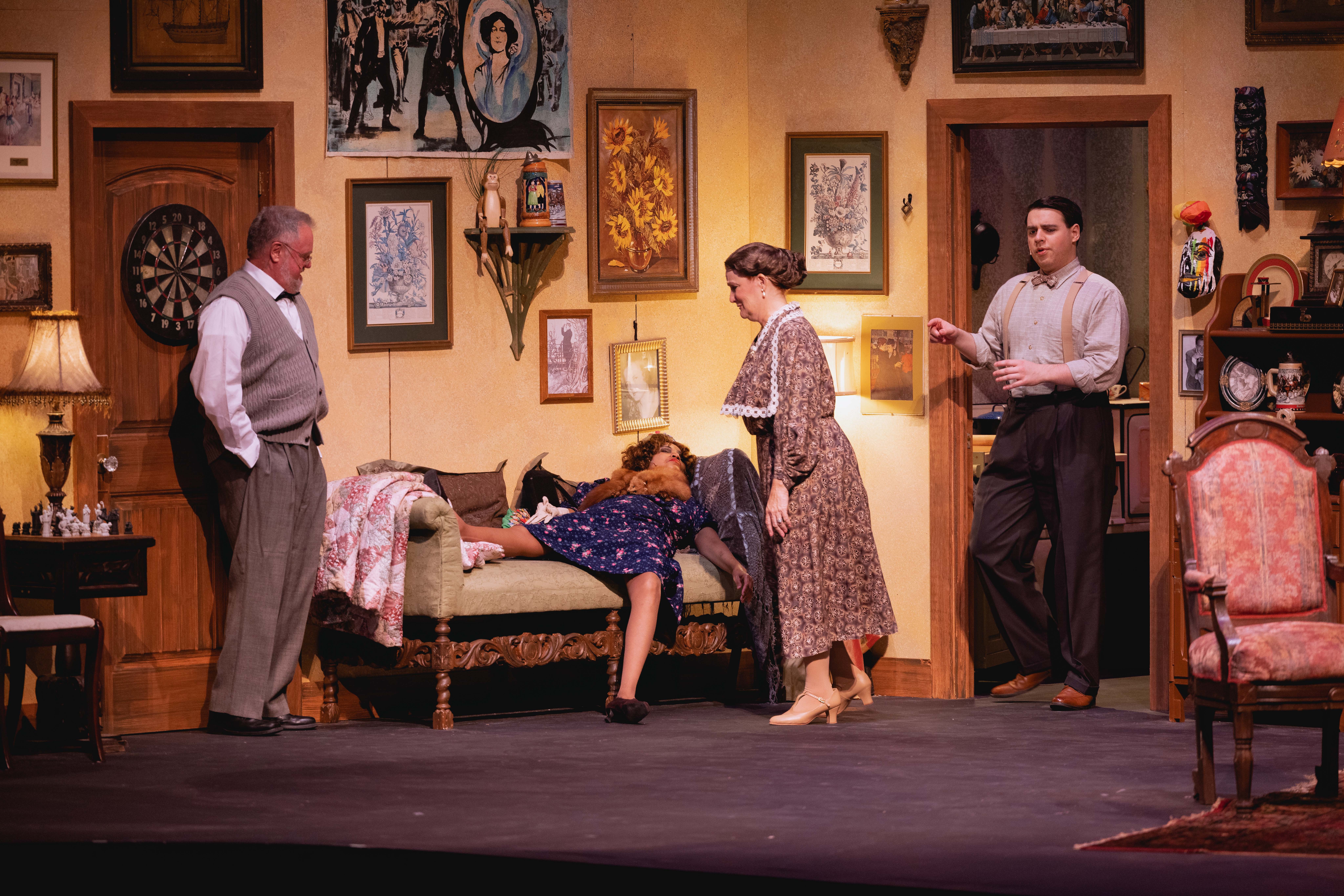
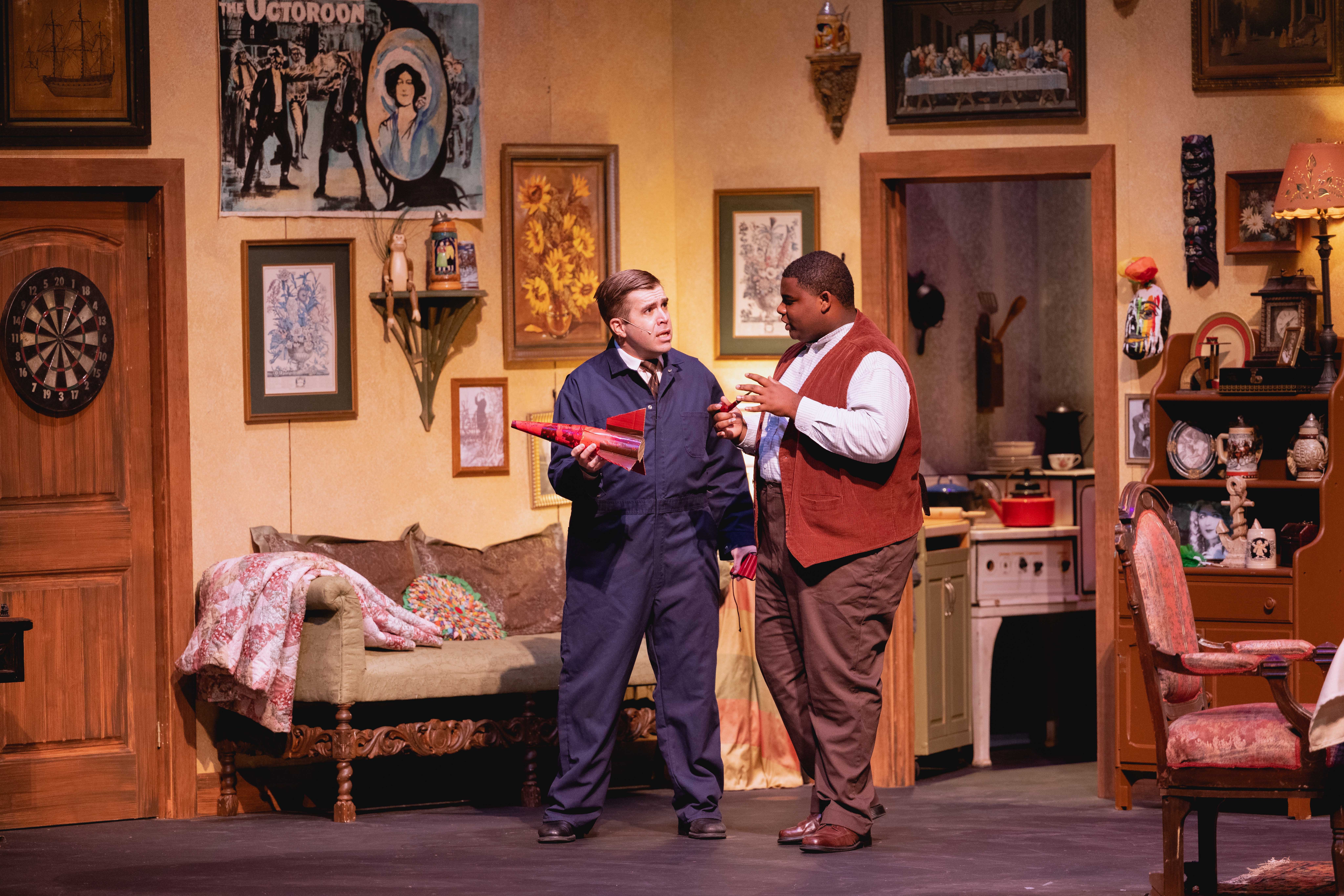
The plot revolves around the possible nuptials between Alice Sycamore, Martin’s granddaughter, and her Wall Street boss, Tony Kirby. As Alice sees it, the multitudinous eccentricities of the Vanderhof household are an insuperable barrier between her and the ultra-respectable Kirbys. Obviously, Alice is conflicted about her family, loving them all while seeing them with the clarity of the only household member in daily contact with the outside world. Tony, as it turns out, is no less attuned to the shortcomings of his own family, so he pushes for a meeting with Alice’s family and then for the inevitably explosive rendezvous between his folks and hers. Did we mention that Alice’s dad, Paul, fashions fireworks with his faithful assistant, Mr. De Pinna? No, because all of those chemical reactions happen down in the cellar, out of view.

THEA2021-DLV-0923-4629

Having to move so quickly across O’Kelly’s arena seems to endow all the residents of the Vanderhof home with an enthusiastic complacency, so engrossed are they all in their eccentricities. Pam Coble Newcomer is the restless artist of the family as Martin’s daughter, Penny Sycamore, working on a couple of her 11 unfinished playscripts as we watch, until she decides it’s time to resume work on painting a portrait of Mr. De Pinna posing in a Grecian tunic that she abandoned years ago. Abigail Adams is Penny’s eldest daughter, Essie, the perennial ballet student who also makes candies, and Braden Asbury is her husband, who mostly splits his time between the xylophone and the printing press in his nook. He also likes to make masks and serves as Essie’s candy seller and the family pamphleteer. Busy fella. So you’ll notice that Kaufman and Hart enjoy piling multiple enthusiasms on their characters.

THEA2021-DLV-0923-4561.jpg

Contrasts can be extreme, sometimes with a zany logic. As Boris Kolenkhov, Essie’s ballet teacher, John Sexton can beat a taskmaster’s cane on the floor in perpetual frustration, since Essie shows no promise whatsoever, and then, at the most inopportune moment, reveal his zest for wrestling. It’s a lot for the Kirbys to digest all at once, but other weirdos like Mr. De Pinna are likely to show up on the Vanderhof doorstep and never leave. Weirdest of these may be Corlis Hayes as Gay Wellington, a flamboyant actress who would steal every scene if she weren’t spending so much time passed out on the settee from excess drink. Of course, cameos from those government raiders and an overnight stay in jail didn’t improve the Kirbys’ first impressions of Alice’s family. Nor do the fireworks down in the cellar remain inert. As the elder Kirbys, Rick Taylor and Pamela Thorson were as starchy as can be, but Thorson was especially regal in taking affront.

THEA2021-DLV-0923-4325In the face of such humiliating catastrophe, Alice wished to exile herself to the Adirondacks, but Charlie Grass managed even here not to be overly annoying in her shame and mortification as the one “normal” member of her family. Love and practicality are nicely mixed in this Alice. Serene and optimistic as ever, Martin, Penny, and Paul are able to laugh off the misadventures of the previous night. Newcomer as Penny, Jeremy Cartee as Paul, and Dennis Delamar as Martin became especially endearing from this moment forward, maintaining their equanimity after this buffeting of adversity. Galumphing and awkward in the early going, in and out of his mad scientist coveralls, Cartee showed some touching solicitude toward the wife and daughter when crisis struck. Delamar, in his second go-round as Martin, has thoroughly mastered his dignity and glow, aided by Emily McCurdy’s costume design and James Duke’s lighting.


Whether or not Baldwin was looking for a James Stewart type in replicating the onscreen chemistry between Alice and Tony (judge for yourself when you see Grass’s hair), Timothy Hager brings some of the same height and charming gawkiness to the role. Although O’Kelly does her best to clutter up her set, there is never the sense that Tony is slumming because the space is so expansive. That spaciousness also tends to dilute whatever humble, homespun quality you might have associated with Vanderhof and his clan in past viewings.

THEA2021-DLV-0923-4455

With Baldwin’s staging, you’ll likely find that the wide-open space enhances Delamar’s eloquence when he delivers Martin’s signature monologue in the final act. If you can tear your eyes away from Delamar, you’ll notice that Newcomer has been deployed far to stage right, leaning forward on the sofa in rapt attention, beaming and proud of her daddy. Most other family members have been spread out around a stage that has more than a couple of times been teeming with tumult. All eyes are Grandpa, all the family are respectfully still, radiating pride and content. It gives a special moment an extra aura.

Cernyak-Spatz’s Memoir Gets Better, More Urgent, With Age – and Video

Review: Protective Custody: PRISONER 34042

By Perry Tannenbaum

2021~Prisoner 34042-54

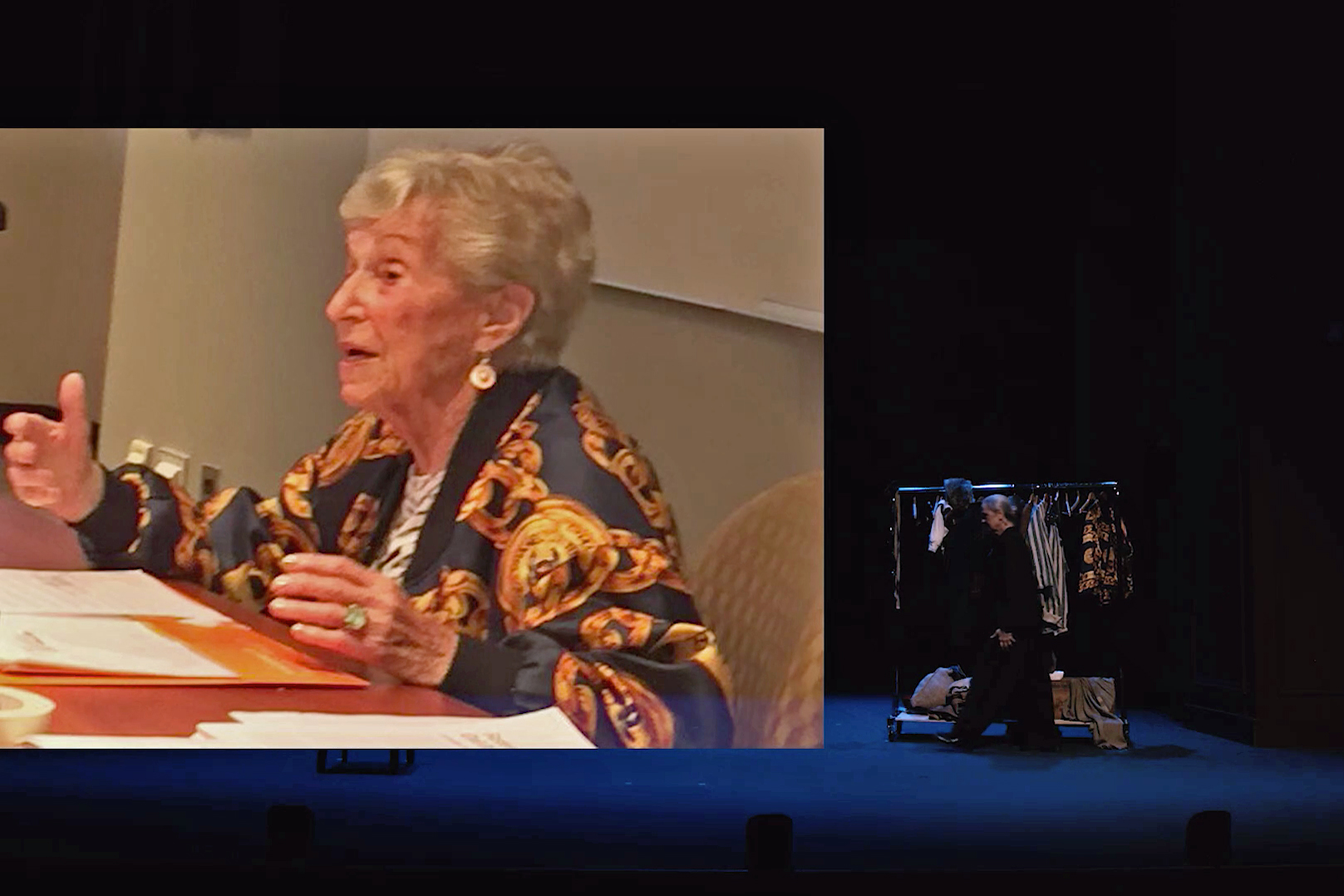
If you missed the 2018 staged reading of Protective Custody: PRISONER 34042, Charles LaBorde’s adaptation of Holocaust survivor Susan Cernyak-Spatz’s memoir – or Three Bone Theatre’s world premiere production in 2019 – fate has been kind to you in 2021 with another reprise. Cernyak-Spatz, freed from the Birkenau and Auschwitz concentration camps at the age of 22 in 1945, lived long enough to see her story dramatized onstage. Already ailing, she lived only two weeks after attending the performance at Spirit Square on the opening weekend of the run.

Half whimsically and half seriously, she told the stage director Dennis Delamar to take the show on the road before she died at age 97. Founder of the UNC-Charlotte’s Holocaust Studies program and a professor of German language and literature, Dr. Cernyak-Spatz had seen plenty in her long life, but she couldn’t foresee the COVID-19 pandemic and its impact on theatre and the arts around the globe, particularly how streaming would become de rigueur. Instead of on the road, Protective Custody is now online, free for the asking on your computer monitor or on your television screen.2021~Prisoner 34042-15

Of course, Cernyak-Spatz’s deathbed wishes weren’t about vanity, for the UNCC professor had lectured widely on the Holocaust and her personal survival, holding a passionate belief that we forget this horrific history at our own peril. What you may find disarming about Susan’s staged account, once again performed by Leslie Giles with the aid of Paula Baldwin as her dresser-mother-dancing beau-Nazi guard-fellow prisoner-rapist-Nazi accordionist-American rescuer, is how dispassionate her tone often is, punctuated by eruptions of bitter irony, cynicism, and rage. She tells us she lost her modesty long ago in the concentration camps, how animalistic she needed to become to survive them, implicitly conceding that the Nazis were at least partially victorious in dehumanizing her.

They surely hardened her, maybe the greatest irony of all. “I was strangely detached from the incredibility of what I heard,” she tells us after a Nazi guard has welcomed her to Birkenau by explaining – and describing – the extermination that is happening to newcomers who aren’t as lucky as she. Those younger than 16 and older than 35 rode immediately to “the gas.” We have all heard about the fiendish efficiency of the Nazis’ extermination systems and apparatus, but Susan repeatedly calls our attention to how the Nazis systematically humiliated and dehumanized their prisoners, squeezing as much work out of them as possible with the smallest expenditure. Cruelty is constant, even as the Third Reich faces defeat. Ordering the death march out of the camps as the avenging Russian Red Army approaches, the guard barks, “A bullet in the head for those who cannot walk!”

2021~Prisoner 34042-10Detachment and inhumanity are inevitable results of the plum jobs Susan is able to land at Auschwitz. The cushiest requires nothing more of her than drawing a line through the names of fellow prisoners, thousands of them, who have passed through “the gas” and the crematoriums. Another requires her to sort through the clothes and possessions of those who haven’t been as lucky as she has been – she can even scavenge some choice articles of clothing. No doubt this aspect of the story fascinated LaBorde as he adapted Cernyak-Spatz’s sprawling memoir for the stage. Thinking of changes in wardrobe as the organizing principle of Susan’s narrative is his idea, not hers. Magda Guichard’s wide range of costume designs help LaBorde depict Susan’s precipitous fall from her upper middle-class status in Vienna to her total degradation at the Birkenau death camp. Delamar spares Giles from the fullest indignities that the script allows, letting his star wear a flesh-colored leotard when Susan is ordered to strip for a delousing shower and allowing her to retain her own disheveled hair when she is shaven bald. A sleekly coiffed wig is removed to suggest the transition.

2021~Prisoner 34042-52

PRISONER 34042 remains a potent brew in spite of these discreet alterations, with language, lurid descriptions, and a vaguely simulated rape scene that might give today’s helicopter parents some pause. Perhaps the sponsorship of this filming by Culture Blocks, which partners with the Charlotte Mecklenburg Library system, was the inspiration for addressing such qualms with a more benign Student Edition of the film. (Unabridged, as far as I could determine.) Filmed at McGlohon Theatre by SimplisticPhobia Productions, the three-person camera crew helmed by Will Jenkins helps to dramatize the action with angled close-ups, from stage right or stage left, that nearly fill our screens with the two players. These give way to centered long shots that remind us that we’re in a theatre, especially when Giles perches over the lip of the McGlohon stage and, after the Nazi accordionist plays the verse, sings the first eight bars of “Stardust.”

2021~Prisoner 34042-29.jpg

Somehow all of the spot-on lighting changes by production designer Ryan Maloney stand out in better relief now than they did at Duke Energy Theatre 17 months ago, and photographs of Susan and her parents are far better showcased when shown in split-screen. Maloney also shines in sound design, whether bringing us that charming accordion, the sound of the cattle cars rumbling to the deathcamps with their human cargo, or the air-raid sirens when liberation is near. Decking his actors out in body mics that offer very crisp reproduction on the video, Maloney also provided pragmatic reasons for Giles to keep her hair and don a leotard.

Calmly helping Giles through all her costume changes and repeatedly partnering with her at key moments, Baldwin’s surrogate work seemed far more awesome as I re-watched her alternately stony and empathetic portrayals. Fearsome and melting like an iceberg, how much scurrying was Baldwin doing behind the scene, transforming from Mom to debonair boyfriend or from prisoner to Nazi oppressor, and how much of stage manager Callie Richards’ work was devoted to making Baldwin’s metamorphoses look effortless? She will likely be undervalued by many who see her because she has so few lines, but Delamar and LaBorde have given Baldwin a new epilogue to deliver after Giles is gone, and her perfection continues. A final elegant touch happened when she hung up one last article of clothing, surely the only costume Guichard didn’t design, for we see it on film immediately afterwards – with the real Dr. Cernyak-Spatz wearing it.

2021~Prisoner 34042-41

Giles’ performance would be cleaner and bobble-free if cuts had been decreed during the filming rather than entirely in post-production. Yet after all the immaculate multi-take perfection that I’ve seen for months in screening films and TV series at home, it was wonderful to experience the arc and energy and stamina of a true live performance, warts and nerves – with lapses in Austrian accent – and all. Giles’true professionalism emerges in adversity, and like the performance at Spirit Square that I attended in 2019, accent and performance grew stronger as her story progressed, as we witnessed Susan’s perils and desperate hopes gripping her more and more.

2021~Prisoner 34042-69

The little coda that LaBorde added to Cernyak-Spatz’s 2005 memoir, taking aim at emboldened White Supremacists and Anti-Semites as well as hate-spewing demagogues in the halls of Congress and the White House, sounded more potent and relevant on Easter Sunday than they did in late 2019 when Donald Trump was still our President. Maybe Delamar and Giles were simply more insistent on emphasizing LaBorde’s message. Or maybe the impact was greater for me now because, as these Holocaust echoes recede into the past, it’s more important than ever to remember them, remember how they recently grew more virulent and threatened our republic – and to call them out where they are still lurking.

Paige Johnston Thomas (1968-2020)

Paige Johnston Thomas – Dynamic actor, director, casting agent, board member, and fundraiser

By Perry Tannenbaum

Paige[3]

When Paige Johnston made her Charlotte Rep debut in 1995, she was 26 years old, exactly the same age as the character she portrayed in Edward Albee’s Three Tall Women. Can you imagine the thrill? The other two tall ladies were Lucille Patton, reprising the role I’d seen her play on Broadway the previous November, and Mary Lucy Bivins, at the start of her two-year reign as Creative Loafing Actress of the Year.

Paige held her own – and went on to carve a special place in Charlotte’s theatre scene as an actor, director, casting agent, and as a board member. CAST’s most successful fundraiser, from what I heard. After marrying ace videographer Jay Thomas 13 years ago, Paige Johnston Thomas almost made it to the same age Bivins was supposed to be, dying early last week of a rare form of cancer, compounded by liver disease, at the age 0f 51.

It wasn’t a one-sided battle. Less than a year ago, Thomas was being hailed for conquering cancer as she directed the local premiere of J.T. Rogers’ Oslo, winner of the 2017 Tony Award for Best New Play. Deploying a large cast on a key episode in the endless conflicts in the Middle East – when peace blazed as a real possibility – in Norway, of all places! – the poignancy and hope of Oslo certainly wasn’t a low-energy project. Directing it wasn’t for beginners.IMG_7076

The career highlights on the road to Oslo with Three Bone Theatre included her devastating turn as Elvira in Noël Coward’s Blithe Spirit (2003) at Theatre Charlotte. As a director at CAST, Thomas is most fondly remembered for dark play (2008) and No Exit (2009). Steel Magnolias (2010), the female Odd Couple (2012), and The Miracle Worker (2016) were probably her most resounding Theatre Charlotte hits. The local premiere of Three Days of Rain (2017) with Charlotte’s Off-Broadway was a handsome calling card prior to Thomas’s Oslo gig.

Yeah, the sun was shining a year ago – seemingly on an unclouded future – as Johnston was in rehearsals for Oslo. Here is the interview we did, along with excerpts from Q&A’s that I did with a few cast members.

96127954_565686381024653_1904675626200072192_n

🎭       🎭       🎭       🎭       🎭

Queen City Nerve: How did you become involved in directing Oslo for Three Bone Theatre? Were you familiar with the script before you were asked to come aboard?

Paige Johnston Thomas: About a year and a half ago, I received a call from Robin [Tynes-Miller] about helming this project. I had been very aware of Three Bone and the success that Robin and Becky [Schultz] had been enjoying. I also loved that they teamed up with a community partner for each show, which I found made their company really unique in the world of theatre. Also, the fact that their tag line was “To succeed in life you need three things – a wishbone, a backbone, and a funny bone” – always cracked me up, yet resonated strongly with me! I was familiar with Oslo and its successful run on Broadway, but I had not read the script or seen the play when they reached out to me.

Not ignoring the logistical problems of coordinating rehearsals for a cast of 15, what are the special challenges of directing Oslo?

Thomas: Yes, the rehearsal schedule for 15 cast members was quite the challenge. But so was planning rehearsals for 15 people for 65 scenes! As they say in the theatre, “I was told there’d be no math!” Many of the scenes are short, moving the story along briskly, but working on the rehearsal schedule was intense. Even before undertaking the schedule, one of my first challenges was the subject matter of the Israeli-Palestinian conflict. It seemed such an onerous undertaking, and I had two main concerns: I worried if my knowledge and comprehension of the conflict were up to the task, and was this process going to be arduous and depressing because of the subject matter.

DSCF3967

But both those concerns quickly dissipated once I delved in to the script. Yes, as a director I was going to need to know the details of the conflict, and by starting my research early, I felt confident I could arrive to rehearsals prepared. But the beauty of the script is that it naturally reveals the necessary history and details needed to follow the story. One doesn’t need to know much, if anything, about the dissension between the two parties. And my concern about it being arduous and depressing were quelled once I realized that this is a story of hope, a story of success, and a story of the human spirit persevering through adversity. And thankfully, playwright J.T. Rogers has weaved in humor and witty badinage to keep the audience entertained and connected.

Are you thinking that the tortuous path to conflict resolution that happened in Oslo is in any way analogous/applicable to the polarization in American politics today – can we carry away any optimism after watching Oslo, or will seeing it deepen our sense of urgency and despair?

Thomas: Oslo is ultimately an optimistic play. It is filled with moments of solidarity, connection, and understanding; all the while underscored with the backdrop of hatred and distrust. Even more than when it opened on Broadway, I feel this play is extremely relevant and crucial in today’s political climate. How did two warring factions come together to forge an understanding? The play deals specifically with the Israeli/Palestinian conflict, which is still rearing its ugly head daily, but it is also dealing with the idea of peace, with the possibility of peace, and the hope for peace. Those themes are broader and relate to our American political parties, our foreign policies, and even to our smaller, but not less important, personal interactions. I hope our audience members leave the theatre with a sense of action and insight and see, like the characters in the play, that there is the possibility of peace and understanding even in the face of formidable obstacles.

IMG_3793

🎭       🎭       🎭       🎭       🎭

QC Nerve: How do you see Mona as a person? She seems both exciting and enigmatic on the page to me, frustratingly cautious one minute, brilliantly resourceful the next, with no obvious partialities either way in the Middle East conflict. Did you need to research her to see what made her tick, or did you simply rely on the script and/or Kat Martin’s dramaturgy instead?

Tonya Bludsworth (Mona Juul in Oslo): Mona is certainly all those things and she has been so much fun to figure out as a character. I did some research about her on my own, but Kat Martin was definitely an invaluable resource. Kat is a rock star in my book. Her dramaturgy packet was so detailed and chock full of information on the history of the conflict and the people involved. That information gave all of us a solid foundation on which to build our characters and the show. That said, I also wanted to make sure I wasn’t just imitating Mona and our director, Paige Thomas, has been so great to work with in that regard. We wanted to make sure that Mona was not just a narrator or stern politician. She carries a lot of emotional weight and even though she is adamant about neutrality she also feels the importance of the situation and the opportunity, and she genuinely hopes that this “process” will make a difference for all sides.

DSCF3936

🎭       🎭       🎭       🎭       🎭

QC Nerve: What impacts have the J.T. Rogers script, Paige Johnston Thomas’ directing, and Kat Martin’s dramaturgy had in developing your performance?

Victor Sayegh (Ahmed Qurie in Oslo): Rogers’ script is a beautiful tapestry of conflict, personal relationships, mistrust and humor. It is important to remember that, although the people portrayed in this play are real people, the words they speak are entirely the playwright’s. And he has done a beautiful job of portraying their roles in the story and their humanity without watering down their resolve. Qurie in particular is almost poetic in his language and there are lines he/I speak that touch my heart as the words leave my lips. Working under Paige’s direction also played into my interest in this project, and it has been a wonderful experience. She provides the perfect balance of direction and the freedom to make our own choices for our characters. Like the peace process itself, it has been an intense collaboration. Kat’s dramaturgy has allowed all of us to be immersed in the history of this conflict. She consistently reminds us all of the historical background that shaped each of our characters.

Going through the rehearsal process and Ahmed’s character arc night after night, does it get increasingly difficult each night to start out with the same degree of hatred and distrust every night towards characters/actors you’ve become accustomed to? What’s the secret to keeping your edge fresh?

Sayegh: This has been a challenge for me. Not only because of the many emotional ups and downs of the script, but also because Qurie often has an ulterior motive behind his words. He is very calculated. Like a poker player, he never lets his face give away his hand. Paige’s rehearsal process is very specific and organized. She has broken down the entire play into 67 scenes. Each night we know what scene or scenes we will be rehearsing. Therefore, I prepare myself each night by reliving what happened prior to that scene (the cards in my hand) as well as what I want to portray (my poker face).

DSCF3944

🎭       🎭       🎭       🎭       🎭

QC Nerve: Are you tackling the singular Israeli accent in your portrayals, or is the cast steering clear of such minefields?

Dennis Delamar (Shimon Peres and Yair Hirschfield in Oslo): I enjoy trying to fine-tune an accent, and I was up for the Peres/Hirschfeld challenge, but Paige made the directorial decision for us not to use accents, to “steer clear of such minefields,” which I understand and respect. There are a few times accents are used because they are necessary for the humor in a scene (usually Norwegian), but for the most part, we are all using straightforward standard English dialect. However, there are places in the script where the playwright has us actually speaking a line or two in Arabic, Hebrew or Norwegian for a desired effect, which I find enjoyable. I am very proud of my one line of Hebrew I hopefully mastered, which I speak to Anne Lambert as Toril, the Norwegian chef who serves all us men her specialty, waffles from her mother’s recipe. Paige was able to get dialectician Fiona Jones to provide us with translations and pronunciations of names and cities, quite a help.

In a diverse cast working on a taut, dramatic script, were there any outbreaks of arguments or hostilities between members of the cast during the heat of rehearsals – or were these subsumed by politeness and professionalism?

Delamar: I have not observed any outbreaks of hostility between members of the cast during rehearsals. Professional, polite, committed to finding the truth in the scene and the point of view of the character we were each playing have seemed to be our standards and primary goals. I’ve really appreciated the way Paige approached each scene from the outset with reinforcement from Kat the dramaturg at the table with the facts and the reminder to us, only speak for yourself, not anyone else’s character. We were encouraged to respect and try to understand other characters’ differences, as we analyzed how our characters were feeling and why. The honesty we have developed in our dramatic scenes have been informed intelligently by dialogue at the table before we have put each scene on its feet. There was a delicate and respectful dance preceding the often-explosive interchanges, helping with the ease and success of these scenes.

DSCF3952

How much work was it to see how incredible the Oslo process was from an Israeli point of view? How did the J.T. Rogers script, Paige’s direction, and Kat Martin’s dramaturgy contribute to properly shaping your mindset?

Delamar: I knew I was in for something special when this large cast of talent, many new faces to the Charlotte scene, showed up for the first read-through. My task, to find and appreciate the Israeli point of view was helped considerably by Paige’s guidance and the in-depth research provided by Kat Martin, our dramaturg. First, she provided articles and history on each of our characters, also the history of this part of the world, the Palestinians, the Israelis and the sequence of events before and after the Peace Accord. All helpful in understanding the Israeli point of view.

Links to documentaries and footage of interviews were also beneficial, although I got to a point I couldn’t watch them all. As I mentioned earlier, the playwright’s text also took me to that “point of view” awareness with some thoughtful analysis and good table discussion with the team. I found myself reading everything I could on Hirschfeld and Peres, of course, the two Israeli officials I am entrusted with playing. Such respect developed for their lifetime commitment to their cause and the State of Israel. When you play real human beings, there is a responsibility to bring life to their portrayals. Not a “spot on” impersonation, but achieving some sort of essence and dignity in their words and actions have been my goals.

Photos by Jay Thomas and courtesy of Theatre Charlotte


Grit and Endurance at Birkenau – and Urgency Today

Review: Protective Custody: Prisoner 34042

By Perry Tannenbaum

ProtectiveCustody5

For those of us who didn’t endure or survive it, talking about the Holocaust can be awkward, uncomfortable, and disturbing. I should know: Invited to a 1991 production of I Never Saw Another Butterfly by Children’s Theatre, my own uncle – brought to Charlotte as a pre-eminent authority on gifted children – turned down the opportunity to see a fine Teen Ensemble in action. Very likely, the I in the title was the biggest red flag for Uncle Abe – the threat of hearing a first-hand account of the horrors, the inhumanity, and the suffering. Even from teens.

Ah, but what if you weren’t the child of Jewish American immigrants, safe from the Nazi killing machine and the misfortunes of growing up Jewish inside the Third Reich? If you had grown up Jewish in Berlin and Vienna, if you had seen the belly of the beast as a concentration camp prisoner at Auschwitz and Birkenau, smelled the smoke of the crematorium from the moment you arrived, dreaded every morning roll call, and reverted to your animal instincts just to survive – even then, after surviving this unfathomable ordeal, you’re unlikely to feel comfortable talking about it.

Come to Duke Energy Theater and you’ll see why.

The screening of Surviving Birkenau at the Charlotte Jewish Film Festival late last month was a preliminary reminder. Like Three Bone Theatre’s world premiere of Protective Custody: Prisoner 34042, now at Spirit Square through Sunday, Ron Small’s documentary was all about the early life of Dr. Susan Cerynak-Spatz and how she managed to outlast her brutal captors – ultimately escaping Adolph Hitler’s infamous “final solution.”

ProtectiveCustody2

After the film, there was a panel discussion and time set aside for audience questions. Among those on the panel were Three Bone Theatre artistic director Robin Tynes-Miller, Charles LaBorde, the actor-playwright-educator who adapted Cernyak-Spatz’s memoir, and Dennis Delamar, who is directing it. Joining the panel was Jackie Fishman, Cernyak-Spatz’s daughter, who had appeared briefly during the film and was instrumental in greenlighting the new play.

It was Fishman who inadvertently delineated the key difference between the Cernyak-Spatz we had just seen onscreen at the Levine Jewish Community Center and the one who I would see portrayed at Duke Energy the following week. Asked about how her mom had discussed the Holocaust in their home while she was growing up, Fishman recalled that the subject was rarely mentioned. Avoided.

We had just watched a woman who, already well into her 90’s when Surviving Birkenau was filmed, had spoken – and as a UNC Charlotte professor, lectured – all over the US and around the world for decades about her Holocaust experiences and studies. She hadn’t been at all uncomfortable about doing so once again for the cameras. The woman that LaBorde would have us meet, Leslie Giles playing the role, is 40-something according to the script, about the same age Cernyak-Spatz was when she and Fishman attended the same Midwest college together.

[Getting an actress who could replicate the 97-year-old today is borderline impossible. Recently felled by a stroke, Cernyak-Spatz willed herself out of her sickbed and attended last Sunday evening’s performance. Brava, Susan!]

What LaBorde has done, taking the author who published her memoir in 2005 and making her some 40 years younger, isn’t exactly unusual for adaptations we see onstage, in movies, or in opera. But when you’re dealing with Holocaust material, the discomfort factor needs to be part of your calculus.

For LaBorde, audience discomfort is definitely a consideration. You can see it and hear it as the play begins. But what LaBorde, Giles, and Delamar didn’t calibrate – or consider – was Susan’s discomfort four decades earlier.

ProtectiveCustody4

Instead of immediately plunging us into the Kristallnacht pogrom of 1938 and all that she and millions of other Jews experienced after that, in a gradual crescendo of horrific inhumanity, Susan introduces us to a rack of clothes that – with a Dresser, portrayed by Paula Baldwin – will help her to guide us through all the major transformations that befell her from the days of her relatively idyllic childhood in Vienna onwards. It was during the lighter pleasantries opening the show that Giles faced what nobody had anticipated.

Whether it was because so many theatrefolk were in the audience on opening night or because of the grim subject, this wasn’t the kind of crowd that shouted back a greeting if you started off with a “Good evening!” or a hearty hello, Nothing came out of us in response to Susan’s welcome. Not even enough for Giles to come back with the obligatory, “Aw, you can do better than that!”

It was an awkward moment – but also a momentary glimpse of what we would see if we were being addressed by a Susan who had real trepidations about broaching a story that might be uncomfortable or disturbing for us to hear. Or for her to relive. Giles proceeded to tell Susan’s story with all the confidence that’s on the pages of the original Protective Custody memoir, in a voice that, benefiting from fruitful time spent with Cernyak-Spatz’s audiobook, occasionally replicated Susan’s with chilling accuracy.

And what a story it was, a powerful no-bull account of what life was like in the showcase Theresienstadt camp and the more harrowing living conditions at Auschwitz and Birkenau. Nor was there any sugarcoating of what it took from Susan to survive. Actually, the show is pretty amazing when you consider that Three Bone Theatre skipped the preliminary processes of a full staged reading or an intermediate workshop version. The entire production team was learning for the first time how an audience would react to the full script.

All that I saw on opening night was at a surprisingly advanced state of development. LaBorde, Giles, and Delamar have delivered far more than a mere chronology of a descent into hell. There are a couple of times when the highly detailed narrative is paused. One happens when Susan ponders how a bad decision by her mom changed the course of both their lives – and poisoned Susan’s attitude towards her to this day. Another recounts how Susan lost her faith in God.

Giles makes these into moments that challenge us – and LaBorde gives her another at the end of the evening when Susan turns her unflinching gaze on today’s world and the question of whether we have learned anything from the history she has devoted her life to preserving. She frames the Never again question in a way calculated to make us uncomfortable one last time.

ProtectiveCustody1

More moments such as these, with Susan speaking her heart, voicing her sense of urgency, or simply engaging us directly would help in fleshing out Prisoner 34042, which now has a somewhat boney 80-minute runtime. I’ll be surer of whether LaBorde has mined all the details from the memoir to give his drama maximum power when I finish the ebook, but what I’ve already read convinces me that the task of distilling the book was as daunting as he has said.

Paying more attention to the drama inherent in becoming comfortable with the Holocaust conversation – or at least usefully informed by it – might also turn up the temperature, but there were also times that I felt more dialogue between the two women onstage could spark more tension, light and warmth. Even though she rarely spoke, Baldwin brought me some of the most touching drama of the evening. Curiously enough, her most affecting moments came at the end, when she ditched her Euro accents and became a couple of Americans who welcomed Susan to freedom. Choked me up.

Of course, we can credit much of Baldwin’s liberating impact to the vivid narrative Cernyak-Spatz had written, LaBorde had adapted, and Giles had so deeply immersed herself in, taking her audience along with her on her journey. Already portraying Susan’s mom and various Nazi jackboots, Baldwin could be helping to make Giles’ journey even more intense along the way. But I won’t disagree with anyone who emerges from Spirit Square feeling that Protective Custody: Prisoner 34042 is informative, intense, and impactful enough as it stands.

Disturbing? I hope so.

Charlotte’s Witness to Genocide

Preview: Protective Custody: Prisoner 34042, a Three Bone Theatre Production

By Perry Tannenbaum

ProtectiveCustody1 

At age 97, Dr. Susan Cernyak-Spatz can look back on a life well-lived – and a life well-told. Neither outcome seemed possible on May 7, 1942, when Cernyak-Spatz and her mom responded to an invitation from the Nazi invaders who had occupied Czechoslovakia. It was an invitation that Jews could not refuse. They assembled at a large public square, where they were marched across the city of Prague in broad daylight, herded to a freight station, loaded onto trains, and transported to the Theresienstadt concentration camps.

Survival was already against the odds. Those odds grew slimmer on January 31, 1943, when Cernyak-Spatz was transported from Theresienstadt, the “showplace” camp built to deceive International Red Cross inspectors, to Birkenau, the belly of the beast in Adolph Hitler’s genocide machine.

Yet Cernyak-Spatz did survive. She survived a transfer deeper into the belly, to Auschwitz, and an attack of typhus fever brought on by the toxic living conditions there. Even after the Russians began “liberating” Eastern Europe, Cernyak-Spatz survived a grueling death march in the custody of her captors.

And oh baby, since arriving in the US nearly three-quarters of a century ago, Cernyak-Spatz has told her story – well and often. New generations have heard it at Jewish Sunday schools and at UNC Charlotte, where she is still a professor emerita in German literature. In classrooms, in lecture halls, and in synagogues across America and Europe – including Germany – she has opened fresh eyes to Nazi atrocities. In books she has authored about her life, the Holocaust, and Theresienstadt, Cernyak-Spatz has chronicled the unthinkable horrors she survived – horrors that millions of other Jews did not survive.

ProtectiveCustody2

The story keeps getting told. At the upcoming Charlotte Jewish Film Festival, filmmaker Ron Small’s documentary biopic, Surviving Birkenau, will be screened on October 26. And next week at Spirit Square, a project initiated by Cernyak-Spatz’s daughter, Jackie Fishman, and notables of the QC’s theatre community comes to fruition. Charles LaBorde’s adaptation of Cernyak-Spatz’s memoirs, Protective Custody: Prisoner 34042, opens on November 1 in a Three Bone Theatre production directed by Dennis Delamar.

The idea for presenting a one-woman show focused on his longtime friend Susan’s life had been moldering in Delamar’s mind since 2005 when he directed the Charlotte premiere of Doug Wright’s Pulitzer Prize-winning I Am My Own Wife, an adaptation of transvestite Charlotte von Mahlsdorf’s autobiography.

“That survivor’s story carried us through the Holocaust and also the fall of the Berlin Wall and made me start visualizing something similarly possible about another person’s unique Holocaust story. Someone I actually knew and cared for very much – Susan! Since then, I thought the idea was a really good one, but it stayed in the back of mind, dormant. Cut to eleven years later.”

Pieces began falling into place when Fishman, education coordinator at the Stan Greenspon Center for Peace and Social Justice, brought Delamar and LaBorde to Queens University for a reading of Address Unknown in April 2017, reviving one of multiple Holocaust plays LaBorde had already written. Almost inevitably, Delamar broached his long-gestating idea with Fishman during rehearsals.

“Jackie was immediately ecstatic over the idea,” he recalls, “as if I had said some magic words. ‘Let’s do it! Mom has already written her story down, the book she published in 2005. Have you read it? I’ll get you a copy.’ At that moment, Jackie became a key driving force behind this play getting done, a mission she has continued to energize as a daughter’s gift to her mother.”

Though Fishman had been one of his most valued teachers back when LaBorde was principal of Northwest School of the Arts, he didn’t see a natural transition of Protective Custody from page to stage: “too many people, too complex a story to pare down enough for an audience to follow.” LaBorde was prepared to walk away – until he came face-to-face with Fishman’s enthusiasm for the project. So he gave the book a second look.

With Three Bone Theatre aboard – and Cernyak-Spatz greenlighting the project – Delamar and LaBorde returned to Queens University, where the Greenspon Center hosted an even more exciting event last December than they had the year before. For Cernyak-Spatz was seated in the front row of a packed house at a reading-stage performance of a new LaBorde play, doubly honored at the occasion.

Nor did Cernyak-Spatz sit idly by as the latest incarnation of her life story took shape. She and her daughters, Jackie and Wendy Fishman, have been intensively involved in the process, checking facts, suggesting enhancements, correcting pronunciations, and fine-tuning the voice of the Susan we will see onstage.

“My favorite bit of research,” LaBorde reveals, “was to ask Wendy and Jackie if their mother would say the line I had written early in the play, ‘Somebody fucked up.’ Their reaction was to look at each other and then say simultaneously, ‘Oh, yeah.’”

My own research for this momentous Three Bone premiere took me to Prague last month – and from there to the fortress site of the Theresienstadt camps, the town of Terezín, and the Museum of the Ghetto. In Prague, my wife Sue and I stood in one of the squares where Cernyak-Spatz may have been marched to the transport awaiting her at the freight yards. Our guide told us that we were standing on pavement made from the shattered gravestones from a demolished Jewish cemetery.

At Theresienstadt we saw the barracks where Jews were warehoused in hall-length beds three and four levels high, no toilets provided. We saw a washroom built to hoodwink the Red Cross, lined with sinks where no water has ever flowed. We saw cemeteries near Theresienstadt and Terzín larger than football fields – with marked graves, unmarked graves, and mass graves. We were guided to the Secret Synagogue where I read the most heartbreaking plea to God that I’ve ever seen in a house of worship, written in Hebrew:

“PLEASE RETURN FROM YOUR WRATH.”

And outside Terezín, adjoining one of the burial grounds, we saw the crematoriums, restored by the Luski Family, a name familiar throughout Charlotte’s Jewish community. Maybe the most chilling and revelatory things I saw were the records displayed at the Ghetto Museum of the transports, punctiliously kept by the Nazis: dates, points of origin, and numbers of Protective Custody prisoners brought into Theresienstadt via the transports. Of the hundreds, sometimes thousands who were loaded into the cattle cars, I never saw that even 100 survived any of these horrific transports. More than once, the number was zero.

Clearly, Cernyak-Spatz bucked prodigious odds to arrive at Theresienstadt, to survive her journey to Birkenau, and finally reach Ravensbrueck, the destination of her January 1945 death march. Susan does use the word “miracle” in LaBorde’s script to account for her eluding “the gas.” Once.

ProtectiveCustody4

Benefiting from the guidance of the Fishmans – and the sound of the real Cernyak-Spatz’s voice (yes, there’s a Prisoner 34042 audiobook!) – Leslie Giles takes on the daunting challenge of being Susan at Duke Energy Theater, assisted by Paula Baldwin as The Dresser.

“Oh my gosh, daunting doesn’t even begin to describe how it feels to take on this very special project about this incredible person,” says Giles. “The amount of lines would be enough to scare some actors away, and then to top it off with the very real and gritty details makes it overwhelming at times. That said, it is absolutely worth it, probably the most important piece of work I’ve ever performed in my entire career. It is one thing to read about these events in a book. It is another thing to watch the story coming alive in front of you.”

Reflecting on the wonder of her survival, Cernyak-Spatz scoffs at the notion that she had any special wisdom. “Our entire day was taken up with thinking of survival,” she declares. “We had to be alert like wild animals. Wild animals don’t do much thinking. They survive. We ate anything that wouldn’t eat us. There was no time to dwell on faith or God; you had to give up your expectations of a normal universe. Perhaps my naivete allowed me to take great risks that paid off.”

If it weren’t for the war, Cernyak-Spatz says she would have likely become a dancer or an actress. Indeed, she has occasionally performed onstage here in the QC, most recently when I called her one the “islands in a stream of ineptitude” in my review of Theatre Charlotte’s production of A Little Night Music in 2006. No wonder she treasures the gift of a new drama dedicated to her in her twilight years.

There’s also a twinkle of artistry in the title of her memoirs. The Nazis didn’t simply record your prisoner number in a ledger or stitch it into your prison clothes – it was tattooed into your forearm. They fancied themselves the master race, so they could house Jews and brand Jews and liquidate Jews like cattle. The 34042 that endures in Cernyak-Spatz’s title does not signify their triumph.

“The title serves my purpose of explaining the steps and the de-humanization of a group of human beings. When one is ultimately reduced to no more than a number, the extrapolation is that there’s no worth to this life and it can be easily disposed of. I have outlived the Third Reich, triumphed over them, with a successful and productive life – raised a Jewish family and have told my story all over the world. Anyone who sees the tattooed number on my arm becomes a witness to this history.”

nuVOICES NEW PLAY FESTIVAL Bucks the Patriarchy

Review: Actor’s Theatre of Charlotte staged their nuVOICES NEW PLAY FESTIVAL

By Perry Tannenbaum


BWW Review: nuVOICES NEW PLAY FESTIVAL Bucks the Patriarchy


It’s been over three years since Actor’s Theatre of Charlotte actually staged their previous nuVOICES NEW PLAY FESTIVAL, but it may not seem like that long to fans of the company and fans of the festival. For one thing ATC commits to presenting the winner of the festival – as selected by audiences and/or a panel of judges who attend staged readings of the plays – in a full-length production the following season. ATC was unusually generous toward the four playwrights whose plays were read in 2016, for two of their works were presented two years later at Queens University in 2018, Meridith Friedman’s The Luckiest People in January and David Valdes Greenwood’s The Mermaid Hour last May.

Although nuVOICES languished for the next two seasons, ATC remained productive, managing to stage four shows during the 2016-17 season while landlords, landowners, and city inspectors screwed over them. Queens University opened their arms to the wanderers in the spring of 2017 as they searched for a new home, and by the start of 2017-18, the 30-year-old ATC became the university’s resident theatre company. Stability! For ATC’s fans, seeing the resumption of nuVOICES has taken a backseat to the satisfaction of their survival.

Well, in one respect, nuVOICES was not only back but better than ever, for the fifth edition of the festival won a sizable grant from the National Endowment for the Arts. The influx of NEA support seemed to raise the technical polish of the staged readings somewhat, for the handiwork of sound designer Kathryn Harding and lighting designer Evan Kinsley occasionally came into play.

Although seven of the 13 festival script readers were men, all four of the chosen scripts at nuVOICES 5 were by women. Yet there was plentiful ethnic diversity among the characters the playwrights presented onstage – and among the playwrights themselves.

First up was Nora Leahy’s Girl with Gun, a one-woman show starring Caroline Renfro as Lynette “Squeaky” Fromme. We caught up with Squeaky on Christmas Eve 1987 shortly after her escape from a prison in West Virginia. When apprehended, she had been on her way to rendezvous with Charles Manson, imprisoned (and seriously ailing) across the country in the California State Pen. Now as she speaks, occasionally to an unseen guard but usually to nobody in particular, she’s being detained at a ranger station, awaiting transport to Fort Worth.

We learned a few things about Squeaky that I hadn’t known, including her appearance as a kid on the Lawrence Welk Show, how she got her weird nickname, and that her bad behavior in prison also included bludgeoning a fellow inmate with a hammer. In the talkback after the show, conducted as a video call with a big-screen monitor, the playwright revealed that her play had been commissioned as a historical portrait and that she is thinking about adding 20 minutes to its current 55-minute length.

In their staged reading of Themba by Amy da Luz with Kamilah Bush, nuVoices broke with precedent by not having any talkback at all. Both the playwright and dramaturg were in town, making themselves available for a pre-show interchange with festival director Martin Kettling. A bad idea for numerous reasons. People who hadn’t already seen Girl with Gun at 6pm would not have gotten word that the customary playwright powwow was happening before the 9pm performance of Themba and not after. This likely deprived them of actually seeing the pre-show before Themba and definitely robbed them of their chance to have their questions answered afterwards. Or simply voicing their reactions.

Of course, the Bush-da Luz team also missed out on getting feedback from this Thursday night performance, though they would get a second opportunity at the twilight performance on Saturday. Really, the process should be uniform for everyone involved – audience, performers, and playwrights. If you’ve written a play that gets a nuVOICES reading, you should be able to commit to appearing in person at talkbacks.

Da Luz changed the title of her play after ATC announced their final four, so her team clearly viewed their time in Charlotte as part of a developmental process. Like Leahy’s study, Themba was a docudrama, oozing with personal stories and intensive research. At the unseen vortex of the story was Lola, a young African girl who is the beneficiary – and/or victim – of a missionary adoption in war-torn Uganda, which may not have been legal. That question comes up in a roundabout way after the adoptive father has died and his two sisters, evangelical Mary and theatre director Sarah, wrangle over who should get custody.

Ah, but the story doesn’t remain centered solely on the white adoptive family. To fortify her claim, Sarah brings her partner Fran, a Black playwright, into the fray. Fran sees that she’s being used, wonders how the father was approved, and begins to probe into the process, asking the Black adoption official Jelani some pointed questions. The probe widens, becomes a formal government investigation, and the four young women who have been lurking in the wings – until now detached from the main action but intermittently interrupting it to tell their stories – suddenly become factors in the main plot.

The four are certainly not a homogeneous group. Recognizing that they were likely rescued from poverty, slaughter, or disease, they are not universally comfortable with Christianity or the USA. Some of them are as antagonistic towards Jelani as Fran was – and the young women vented considerable animus toward each other. We had a lot to think about after Themba. In the nine-person cast directed by Heidi Breeden, Stephanie Gardner as Sarah, Lisa Hatt as Mary, Valerie Thames as Fran, and Angela Shannon as Jelani drew the juiciest roles. Nonye Obichere as an adoptee and Dennis Delamar as the sibs’ preacher dad delivered the tastiest cameos.

Friday night’s schedule went off without any further rule-breaking, beginning with Mingus, a two-hander by Tyler English-Beckwith. The basic structure reminded me fairly quickly of David Mamet’s Oleanna, with newcomer Amberlin McCormick portraying B Coleman, a college student who comes to the office of Harrison Jones, a distinguished professor of black studies portrayed by Ron McClelland. B hopes to get a letter of recommendation from Harrison and an assessment of an essay she’s planning to submit for a prestigious award.

Harrison’s acceptance is conditional. He’ll write the letter if, with his help, she sufficiently improves her essay. Thanks to Rory Sheriff’s crafty direction, we had to go very deep into this play trying to figure out who was exploiting whom, maybe misreading signals about who’s in love with whom and how that will ultimately affect their relationship. In Mingus, Harrison’s past is referenced in the title, for he aspired to play the bass like his jazz idol, Charlie Mingus, before joining the Black Panthers and being forced to alter his dreams. It may also serve as a marker for the spot where he allows his professional relationship to become personal. As in Oleanna, the student takes formal action against her mentor, but for most of us, I suspect the reason was a surprise. Final score: #MeToo 1, Patriarchy 0.

Last up was the most bizarre and comical of the nuVOICES 5 plays, Diana Burbano’s Ghosts of Bogota. Reunion plays are certainly not a rarity, and the friction between the two sisters, Lola and Sandy, was very much in the cosmopolitan-vs.-judgmental vein we had seen the night before from Sarah and Mary – with a generous sprinkling of Latinx spice. Only here the reunion is transcontinental, the Spanish-speaking sisters returning to their parents’ hometown in Colombia with their younger nightlife-loving, sleep-averse brother, who knows very little Spanish at all.

Ancient history bubbles up in Bogota as they prepare for the funeral of their grandfather. The old man, Lucho, was not beloved by any of the siblings, and he repeatedly abused Sandy. She needs to see the predator buried physically and spiritually, facing off with his ghost. Meanwhile Lola is upset because she feels she should have known what was going on and should have protected her younger sister. The ghost she needs to exorcise is her grandmother Teresa, the knowing enabler. Lucho may not be a nuanced pervert, mostly snarling when he appears, but Teresa, a product of her upbringing, is a different story.

Aside from the petty squabbles between drama queen Lola and prissy resentful Sandy, what tips this drama toward comedy is the living-the-dream insouciance of Bruno, who registers such hardships as Internet deprivation, and the scene-stealing exploits of a very lifelike head in a jar. Nothing can go terribly wrong with Creepy Jesus on the case. Kudos to Adyana De La Torre-Brucker as Lola, Glynnis O’Donoghue as Sandy, and newcomers Neifert Enrique as Bruno and Grant Cunningham as Jesus. Director Adrian Calabrese also made an auspicious debut.

nuVOICES 5 was presented at Queens University as a pay-what-you-can event, and by Friday Evening, Hadley Theatre was teeming with festival enthusiasts. An outdoor Midsummer Night’s Dream will run on the campus quad beginning on August 12, and ATC’s 31st season will begin with Silence! The Musical on August 15. The talent onstage at Hadley last week and the technical artistry behind the readings served as compelling inducements to check out those upcoming productions.