Review: The Flick at Theatre Charlotte and Independent Picture House
By Perry Tannenbaum
From time to time, it’s nice to see Theatre Charlotte showing greater confidence in its audience and extra audacity in its programming. Recent seasons have seen increased excursions beyond bankable fare, such as A Christmas Carol, Misery, Murder on the Orient Express, and Rumors, to more daring and provocative frontiers such as Violet, Every Brilliant Thing, I and You, and Detroit ’67.
God of Carnage is on deck for next month.
Now we’re in the midst of a run that’s even more daring and experimental than their 2016 concert version of Caroline, or Change, which was staged out in the lobby of the Queens Road barn. The current production of Annie Baker’s THE FLICK, directed by Kyle J. Britt, goes even further out on a limb.
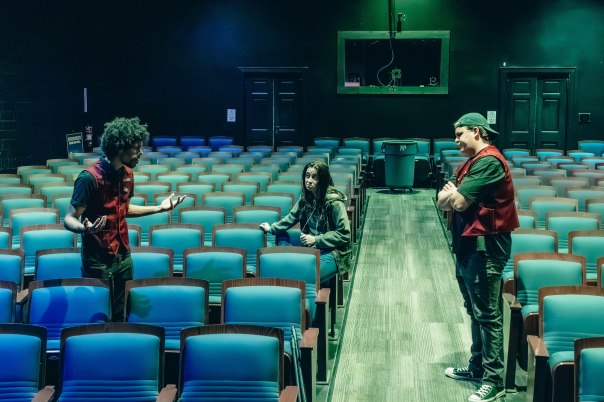
It’s very high-concept, for now we go past the theater doors leading to the front and rear of the orchestra, entering instead through the stage door. Instead of heading backstage, we hang a right – and take our seats onstage, looking out into the orchestra where we usually sit and the light booth beyond.
Tonight, that orchestra is the stage and the light booth is a projection room aiming blinding light at us, for Baker’s notorious Pulitzer Prize winner takes place in a movie theater, one of the last in America that still shows movies made on 35mm celluloid. Famed for its epic length, sustained pauses, and glacial pace, The Flick had premiered Off-Broadway in 2013 at Playwrights Horizons and revived, with the original cast, at the Barrow Street Theatre, where I reviewed it in 2015. Avenging myself on that production at my computer turned torture into a bit of a picnic.
Without that mischievous consolation, I presumed that my wife Sue was sufficiently traumatized not to wish to see this faithful sketch of the quotidian a second time. Wrong. Until midway into the second act, she had totally forgotten The Flick.
Nightmare City. Properly braced for the epic slog, I found myself charmed by the Theatre Charlotte version, for Britt goes the extra mile – recalling the greatest Carolina Actors Studio Theatre forays into experiential theatre – in making The Flick a moviegoing adventure. An elegant ramp bordered by chrome railing is slung over the couple of humble steps that normally lead you backstage at the Old Barn.

The new entranceway is draped in black curtains and discreetly spotlit, duplicating the ambiance at a multiplex when you leave its indoor boulevard and plunge into the darkness of one of the theaters. If you’ve seen the movie posters promoting this special Theatre Charlotte presentation, you’ll already be impressed by Britt’s ability to capture the deathless noir flavor of the Pulp Fiction movie poster.
Seeing this sly Tarantino homage, perfectly sized and displayed in that spotlit alleyway, adds a wonderful frisson to the evening. For those who weren’t as thoroughly braced as I was for the inaction and inertia to come – or less advantageously seated than we were – that evening grew very long. In the heart of Greenwich Village in the summer of 2015, I troubled to time the show: playing time clocked in at 2:54 plus a 19-minute intermission.
We can further admire Britt for speeding up the action to narrowly beat those Off-Broadway timings. He’s actually bucking the odds.
Brilliant concepts can start to crumble when they collide with reality. When David Zinn designed the set for the legendary Barrow Street, he could take liberties. His theater could be four rows and achieve reasonable verisimilitude, but Britt must play the hands he is dealt. That’s 13 rows of seats at the Queens Road barn, and if you want your actors within reasonable proximity of the stage, you’ll need them to traverse seven or eight rows to replicate the same intimacy we had at Barrow Street.
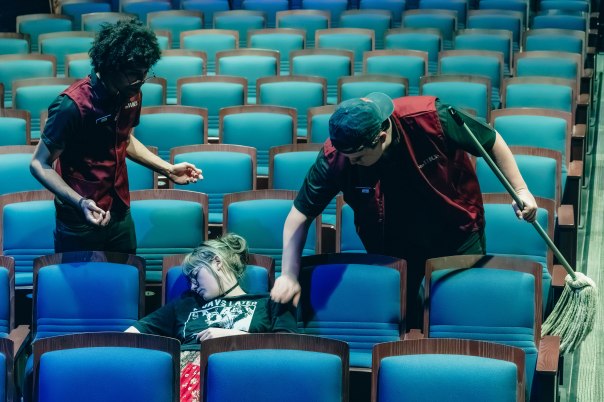
Each exit between Baker’s many scenes must traverse that extra distance, threatening to further lengthen our playing time. When we first see Aedan Coughlin, as Sam, schooling John Felipe, as Avery, in the finer points of cleaning up theater trash between ushering stints, Britt wisely spaces them at opposite sides of the aisle. So it’s plausible that both men must raise their voices to be heard.
Even so, Coughlan, as the disgruntled senior usher, is the more consistently audible, showing the newbie the ropes and schmoozing with Felipe. That gap didn’t narrow significantly as Sam continued his chattering and coaching toward the front seats. Avery does seem to emphasize the names of Hollywood stars, compared to the relatively garbled names of the films they were linked to when showing off his cinema geekiness.
Otherwise a bit shy and withdrawn, Avery boasts that he can connect any two Hollywood stars you name in six-degrees-of-Kevin-Bacon style. For all of Sam’s repeated efforts, Avery always makes good on his boasts. While it is likely that Sam begrudges Avery his more substantial education and his more promising future, that’s not where the friction between them peaks.
Enter Destiney Wolfe as Rose: younger, savvier, and sexier than any of her co-workers. So sexy that Sam tells Avery that she’s a lesbian – to clear his lane to Rose. If he ever summons up sufficient courage to make a move. Wolfe isn’t full of herself as Rose, but she’s coolly self-assured. After getting passed over while Rose snagged the promotion to projectionist, Sam may rightly believe that this talented young lady is out of his league.
To look at Coughlin, you would not instantly agree. While not as erudite as Avery – or as snobbish – Sam can propose numerous worthy candidates when the college guy boldly declares that Pulp Fiction (1994) was the last great American film.
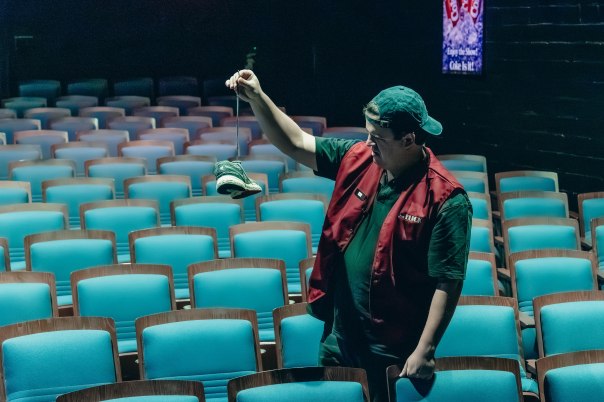
Among those candidates, Avatar (2009) draws the most scorn from Avery and is one of Felipe’s best moments before intermission. Thematically, the comparison between classic noir celluloid and digital fantasy gets us to the heart of Baker’s yarn. The Flick, doubling as the name of Baker’s movie house, is an endangered species, treasured by Avery as an analog monument, one of the last-standing rear guards against the onrush of digitality that isn’t film at all.
Surrendering, we shall see, without a fight.
The location of this landmark is in Worcester County, Mass., allowing Coughlan to add on another layer of excellence, intermittently capturing the Southie brand of a Boston accent. As the scholar in the group, Felipe is hardly obligated to attempt the working-class accent, but Wolfe doesn’t even try.
At least, I don’t think she does. Hearing anything she says without her calling across the theater was a pretty rare experience. What really crash-burned Britt’s concept, beyond the usual acoustic difficulties we’re familiar with at the Old Barn, were the problematic sightlines of the temp seating onstage. Further back than a couple of rows, there was no way to hear or see all the action. The lip of the Theatre Charlotte stage got in the way when the actors moved all the way up front because of the problematic sightlines.
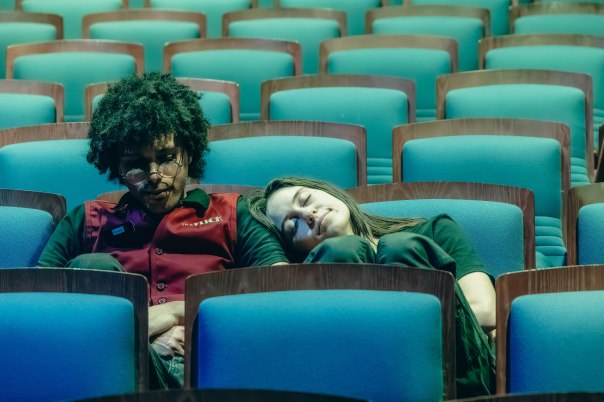
Since so much was so hard to take in before the lights came up for intermission, I felt obligated to issue a spoiler to my companions, telling them there was drama on the near horizon. Shit will begin to hit the fan – not at a blinding velocity – when Sam returns from attending his brother’s wedding and discovers that Rose has taught Avery how to work the projector, a favor (not the only one) that Sam has been denied.
Other members of the opening night audience simply defected.
Now the show, fully chastened, continues its run at the Independent Picture House this weekend. Prospects are better at Raleigh Street for fuller enjoyment. None of the movie theaters there has more than 12 rows, almost all are considerably narrower, and none are saddled by an overhanging stage compromising an audience’s sightlines.
One of these houses even allows actors to slickly enter the space behind the fourth row of seats. The express route!




 Art on My Sleeve