Tag Archives: Dan Grogan

“Wink” Dares Us to Jump out of Our Skins

Review: Wink at Booth Playhouse and Warehouse PAC

By Perry Tannenbaum
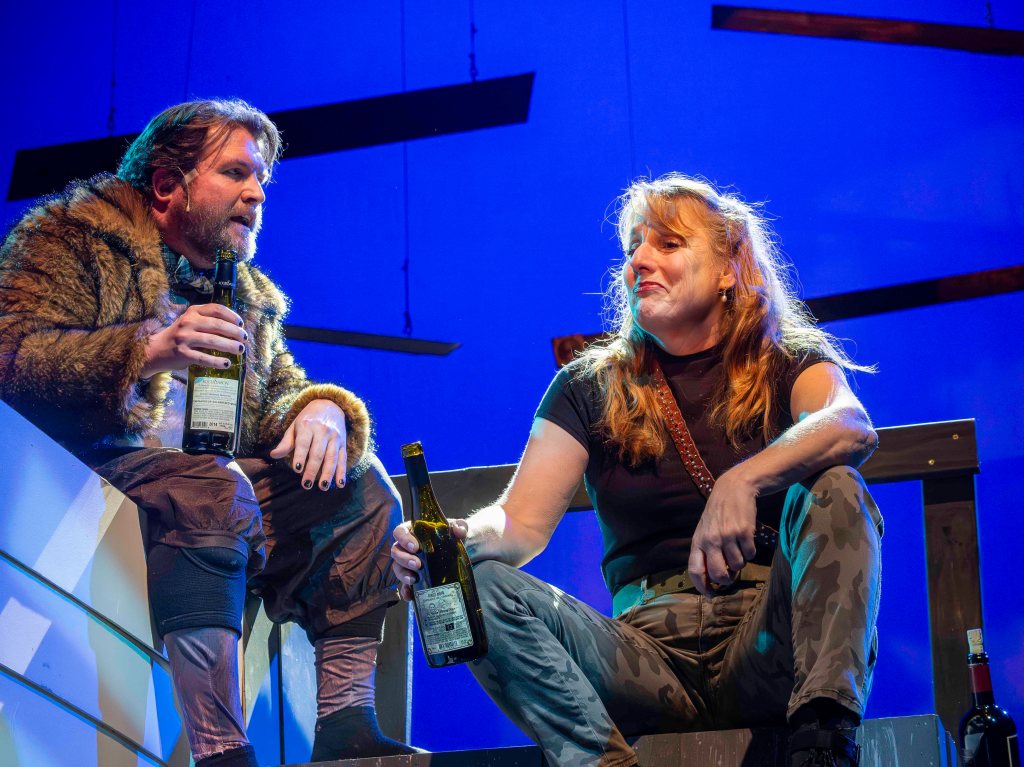
If you love cats, you already know the open secret of their appeal: they are all wild thangs. Yes, we can declaw them or inflict various mutilations on their genitalia to superficially tame them. But they will still swat at things floating in the air, still hiss when cornered, still religiously stalk, crouch, bide their time, creep stealthily closer to their prey, and pounce.

And they purr.
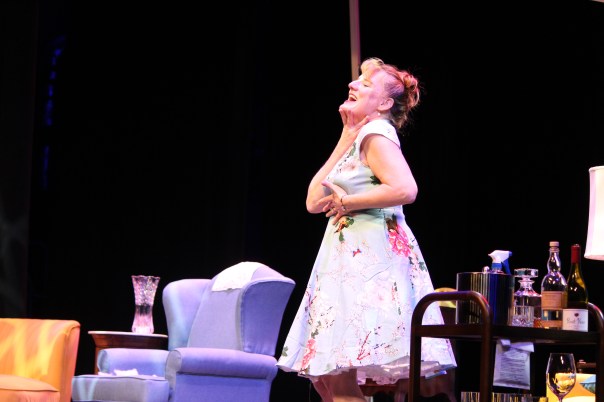
In Jen Silverman’s Wink, there is no purring. Now in transit from its opening weekend at Booth Playhouse to the comparably compact Warehouse PAC in Cornelius, Wink may be tough to catch in the wake of its positive word-of-mouth. Reactions at the Booth to the sight gags rank with the loudest, most vociferous, and gob-smacked I’ve heard in the QC.

Spearheading this flawless Charlotte Conservatory Theatre production – at an admirably brisk pace – director Marla Brown has cast real-life husband and wife Steven Levine and Shawnna Pledger as Sofie and Gregor, the caretakers of the title feline. The couple has radically opposing views on Wink. Sofie adores her AWOL pet, while Gregor strives to veil his murderous antagonism.

The unscientific ploy that Sofie uses to partially pierce Gregor’s defenses in this staid opening scene is unmistakably feminine and devastatingly clever. Such fancifulness, heterodoxy, and cleverness suffuse this 75-minute gem.

It’s not glaringly obvious in the sedate, passive-aggressive early moments, but Gregor and Sofie could likely benefit from some top-notch marriage counseling. It’s already too late. Separately, with complete confidentiality, they are seeing the same psychologist, the profoundly lonely and disciplined Dr. Frans, beautifully calibrated by Dan Grogan.

He’s a perfect fit for both Sofie and George. Perhaps too perfect, since the remedy he insists upon for both their ills is the same: tamp down and conquer your outré impulses. Oh, and go on vacation with your spouse as a healthier release of your tensions. It’s a prescription for George and Sofie to go on doing what they’ve done for their entire adult lives.
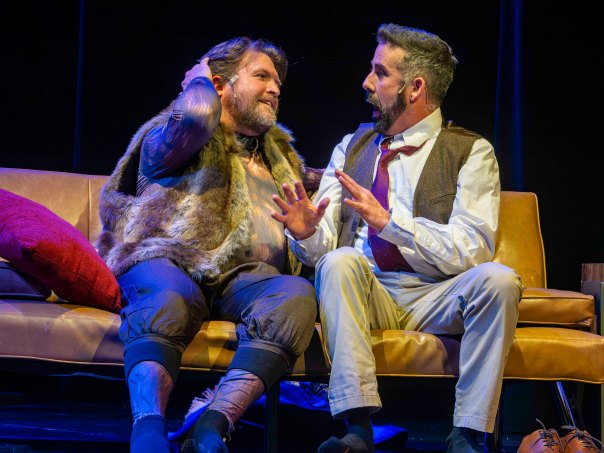
Played with an edgy insouciance by Nathaniel Gillespie, Wink also goes to see Doc Frans, but not as a patient. Every word from Wink, and every move, indicates that he is – or was – purr-fectly comfortable in his own skin. Out of his skin, Wink remains a hunter, but now, like a snake, he’s a coil of vengeance, poised to lash out.

But what is Wink at this point? Answers at this point will vary among audience members, who may see him as a projection of Gregor’s guilt, a Doc Frans nightmare, a monstrous cat succubus, or a surreal Saturday morning cartoon. Maybe a Saturday night cartoon, since Silverman is delivering a dark comedy and Gillespie can never be mistaken for a comedian.

If I haven’t pussyfooted sufficiently around Silverman’s plot, my apologies for the spoilers. At about this point, I looked at reviews of previous productions and discovered they disclose less, zeroing in on each of the humans’ problems, and not always troubling to include Wink as a character or how he’s portrayed. That’s pretty much how Charlotte Conservatory’s press release handled it, so I was expecting a breezy little comedy, maybe a Sylvia Redux with breeds and genders switched on the title pets.

It would be interesting to hear Silverman’s advice on how much to divulge. In her playscript, she lets the cat out of the bag in her character descriptions, before the action even begins. There’s plenty more electricity to come.

The script is not bossy, very spare in its stage directions, so the shtick we encounter in the opening scene is Brown’s. One thing you’d only detect in the script is its layout, occasionally abandoning its prosaic paragraphs and laying out like poetry – but only after Wink makes his first sinewy and sensational entrance.

How much of the Booth Playhouse audience expected to see Wink? If you caught Gillespie’s photo on Facebook, on a lobby poster, or downloaded the playbill from the posted QR code soon enough, you would know. For those savvy few, the costume design by Allison Collins (and “Group Effort”) provides the needed extra jolt when the spotlight hits him.

The hits keep coming as Sofia and Gregor transform in sudden lurches, arriving at a kind of Peanuts absurdity. With wine. Set design by Chris Tyer, with the unblissful couple’s house at stage left and the doc’s office at stage right, should compress neatly enough at the renovated Warehouse PAC, but somebody will need to confirm for me whether the gratuitous use of the Booth flyloft will be replicated up in Lake Norman. Modifications could also dawn on David M Fillmore, Jr.’s shrewd lighting design.
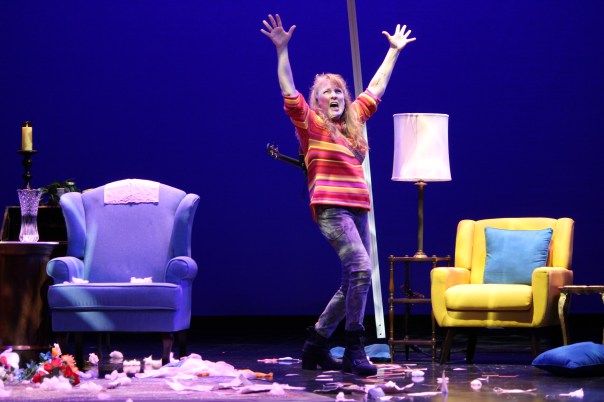
At its essence, Wink explores what can happen when we rashly, spontaneously, and completely yield to our impulses. It wouldn’t be so frightening – or so much hilarious fun – if we didn’t have a conscience about it all, if we didn’t recoil from our own audacity. On balance, Gregor’s and Sofie’s cover-ups are funnier than their crimes, and both Levine and Pledger play it that way. Silverman layers on additional new obsessions for Gregor and new deceits for Sofia that ironically show us how similar they are as they drift apart.

Are they losing their minds or becoming more self-aware? Silverman has provided a double edge here.
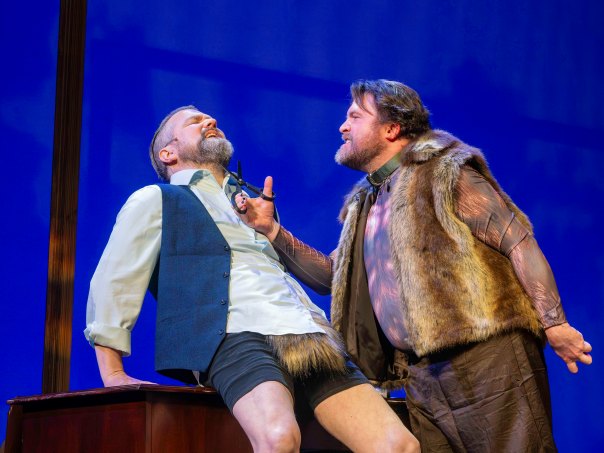
The evolution between Wink and Doc Frans is vastly quieter and quirkier, though there are playful moments. Gillespie and Grogan can play at teaching and learning from each other. Since there’s always a couch to our right, Brown yields briefly, unbidden by the script, to the temptation of redefining their doctor-patient relationship – with Frans reclining on the sofa.

With all the hairpin twists, sudden surprises, and belly laughs, you can reach the end of this whirlwind evening asking yourself, “What did I just see?”: a rare and thrilling experience at the theater. There’s so much wrong with Doc Frans’ preachings of discipline and such excesses in Sofia’s and Gregor’s escalating impulses that we can easily imagine that Silverman wants us to be dizzily ambivalent.

She probably does. It’s the kind of “You just gotta see this” reaction a playwright lives for.

Take a few extra moments, then, to consider Wink as a role model. His hunting routine, repeated more than once, is a blend of discipline and savagery, keen calculation and patience before taking your shot.

Expect that of a dog? Their lack of self-control and stealth is why they hunt in packs. You can train a dog to stop on a dime when it gets a first sniff of its prey, but then it just dopily points its nose in the air towards your quarry. Still imprecisely.

There may be nothing happier than a contented dog; that’s true. Give the enlightened Wink a bottle of wine, and he’s still cool. Cheers!

Photo by Perry Tannenbaum

“Appropriate” Sports Multiple Meanings and Graveyards

Review:  Three Bone Theatre’s Appropriate

By Perry Tannnenbaum

Two graveyards flank the Lafayette home in southeast Arkansas, dating back to its antebellum plantation days. One of these cemeteries preserves the remains of the former owners’ family and the other, receiving less upkeep perhaps, the bones of their slaves. Yet it seems, as we become more and more familiar with the Lafayette siblings in Branden Jacob-Jenkins’ Appropriate, that there are also – figuratively, anyway – at least two more graveyards inside the home. And a malevolent ghost.

As the sibs gather at the old homestead, poring over their dad’s possessions a few months after the funeral, prepping the place for a scheduled auction and liquidation, it’s obvious that the home is a graveyard for blurred childhood memories that don’t align with each other. Old grudges and animosities rise freshly out of their tombs. Just as dramatically, there are damning objects buried among Dad’s salable possessions.

He could have been a virulent segregationist, a KKK member, or even part of organized lynch mobs. Or he could have merely been a collector of such grisly artifacts. Or they may have simply come down unnoticed from the original plantation owners.

Ambiguities abound, and in the Three Bone Theatre production now at Spirit Square, they aren’t shying away from the confusion. If anything, these tantalizing uncertainties are sharpened by director Sarah Provencal and her cast. On the title page of the playbill, definitions for “ap•pro•pri•ate” are offered for both the adjective and the verb, inviting us to be unsure about even how to pronounce the name of what we’re watching.

Thanks largely to Rachael, “Bo” Lafayette’s annoying and judgmental Yankee wife, and Franz his black sheep younger brother, we’re scrutinizing the inheriting generation as much as the deceased. Is the elder sister, Toni, showing her racist colors when she denies knowing of any evidence of Daddy’s bigotry? Or how about when she presumes that River, Franz’s fiancée, is Native American on the basis of her braided hair? Does it count as denial that Bo has been oblivious to the second cemetery outside?

Thanks again to Rachael’s stridency, we also occasionally wonder, as we sit watching this venal spectacle, whether we ourselves are too quick to judge, victims of our own prejudices. Certainly that is a strong component of Jacob-Jenkins’ intent. After we reach preliminary conclusions, we may have to recalibrate when we discover that more than a couple of these people are capable of keen reflection and insight.

What fascinated me even more was what none of the lively folks onstage perceived, for amid the squabbles, the stressing, the venting, the scheming, and the violence, Jacob-Jenkins is exploring what makes families tick or malfunction. The easiest part of all this to convey is the diverging narratives we build from different perspectives – as basic as I-was-there-and-you-weren’t in some cases – and from simple misperceptions, sometimes as simple as taking our eyes off the ball. Or a photo album.

These differences can explode. But more subtly, we can fail to communicate – or screw up when we try.

That’s why it’s tough for me to choose among the three most stellar – and introspective – performances currently on view at Duke Energy Playhouse. For sheer octane and horsepower, nobody surpasses Becca Worthington as Toni for keeping hostilities blazing hot. Toni hates everybody for leaving all the caretaking and dirty work to her (a staple gripe in family sagas like these), but despite all the venom she spews at everyone in sight, she’d like somebody to love her. Quite funny if you think about it, because Toni doesn’t come off as anybody’s doormat.

On the other hand, Leslie Giles actually seems to believe she’s in a comedy as Rachael, jarringly shrill in her perpetual alarm, taking offense so readily that she eventually earns it, and parenting as if every moment were a dire emergency. Things don’t go well between the chronically caustic Toni and the high-strung Rachael. You’ll strain to determine who’s more in the wrong – or more sincere in her self-loathing.

Of the two brothers, I find Franz far more significant, textured, and engaging than Bo. Yet you’ll see that Dan Grogan has plenty to chew on as Bo, trying to fix his siblings’ messes and get the maximum return on the family estate while maintaining peace with his virago wife. He treads fine lines with his steamrolling missus, who feels she has been targeted for anti-Semitic bias by Toni’s precious dad. Bo strives to prevent the inevitable explosions when Rachael pushes her sister-in-law’s limited patience too far. We probably dislike Grogan most for seeming so pragmatic, grounded, and occasionally spineless.

Home after many years of being on the road and out of touch, showing up months after Dad’s funeral just in time for the auction – with a youthful New Age fiancée on his arm who adores him – Franz is the object of suspicion, resentment, and envy. So why did I find myself liking him in spite of his past as a sexual predator? I guess I was as captivated as River was by his mellow, slightly dopey earnestness.

What drills down to the essence of Jacob-Jenkins’ dissection of family life are Franz’s repeated efforts at meaningful communication. Ignoring his sibs’ suspicions, Franz tells the family that he has come home to apologize to them, not completely sure he believes it himself. But he makes a big deal out it, clumsily reading a handwritten apology that is more than a cursory couple of sentences. Tim Hager gets the awkwardness of this man down to the bone, trying to believe he has finally turned the corner to personal redemption. Even more pathetic are Franz’s incoherent efforts to mentor his nephew Rhys – at a vulnerable moment when it might be more prudent to just leave the embarrassed teen alone.

Maybe well-meaning inarticulateness is Franz’s true inheritance from his father and the true reason why his life has so frequently jumped the rails. Very American, this Franz. We’ve had a couple of inarticulate presidents during this blundering century, one of them fairly likable. Hasn’t worked out so well.

The younger Appropriate generation does seem to include River, and all four of them seem to offer us rays of hope. Despite her hippy-dippy spiritualism, Joy White doesn’t gloss over River’s inclination to look after Franz’s financial interests, becoming a rounder, savvier adventuress than we first surmise. There’s a modicum of chemistry between Sean Riehm as Rhys and Siri Patterson as his cousin Cassie, Rachael’s daughter. Clearly, the teens’ parents worry about them more than is necessary. Jamey Helm completes the cast as Cassie’s younger brother, not so much bratty as speedy. His darting sprints from one end of the stage to the other heighten the overall sense of turmoil, clutter, and chaos.

You may be troubled by this Three Bone production, but you won’t be bored. Special perk: Jacob-Jenkins devises a stunning way to end a family brawl.

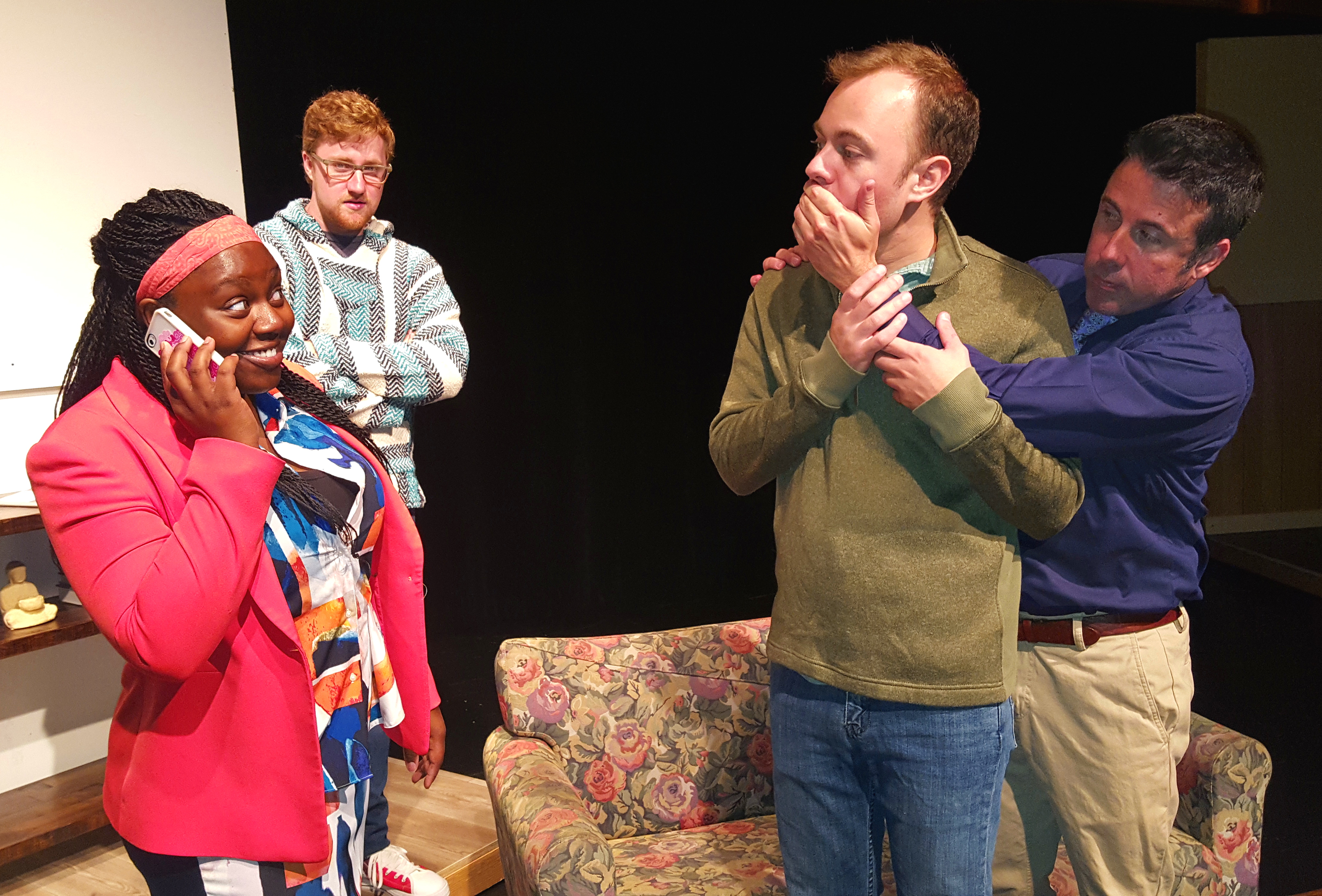
Playwright Imposter Goes Off-Script in “The Submission”

Group1_HiRes

Review: The Submission

By Perry Tannenbaum

A gay white playwright and a black actress walk into a bar… Not a promising lead-in to a joke, because nothing funny or violent should happen. Writers who pen scripts about racists or homophobes for theatre, film, and TV usually draw a free pass when we ask ourselves if they might be harboring prejudices of their own. Same with the actors who appear in such productions. Surely they are as progressive and tolerant as the authors who create their roles.

Maybe more progressive and tolerant than we are.

In Jeff Talbott’s The Submission, currently at Spirit Square in a Three Bone Theatre presentation, we can trash those presumptions – under circumstances that would ordinarily strengthen them. Talbott’s protagonist, white gay playwright Danny Larsen, has written a drama about a black alcoholic mom, her cardsharping son, and their struggles to escape the projects. Takes some empathy to do that, right?

Danny has never had a play of his produced before, but he thinks this one might be special. His best friend Trevor agrees, so Danny submits his street saga to the prestigious Humana Festival, hoping that he will be among the elite few whose work will be premiered at the annual New Play Festival in Louisville. But to make sure his whiteness doesn’t become an obstacle in recognizing the merits of a play with black leads, he invents the African name of Shaleeha G’ntamobi to become its author.

When Humana phones to tell Danny that his script has been selected for the New Play Festival, he could own up to his subterfuge right then. But – reasonably or not – Danny is afraid that the prize will be withdrawn of he comes clean. So he temporizes, saying the playwright isn’t at home, and hurries out to hire an actress to impersonate Shaleeha.

It takes a few moments before the chosen actress, Emilie, can grasp Danny’s intentions – and for Danny to convince her that there’s no kinkiness involved. Wile Danny has demonstrated considerable empathy toward black people, Emilie is honestly impressed with the play, despite the playwright’s fears that he has trespassed onto forbidden territory. Plenty of goodwill on both sides.

Yet things go badly after the first meeting. Danny has a number of personal insecurities, more than a little buyer’s remorse, but worst of all, casual prejudices against black artists that he hasn’t faced up to. They begin to pour out during a second meeting – at a coffee shop, not a bar – when Danny refers to black actors as “blactors” and the awards they win as “blawards.” The unsavoriness of that viewpoint is compounded for me by the signals I get from Danny that feels entitled to speak his mind so brusquely because he’s Emilie’s employer.

Emilie doesn’t listen to these slurs passively – unless you construe a response like “You’re so full of shit your eyes are brown” as deferential. What began as a mutually beneficial relationship has already degraded into an uneasy détente. As the pre-production process unfolds in Louisville, with Danny missing out on all the little perks of close contact and communication with the big-name artists converging on the festival, Danny’s resentments and jealousies heat up and his attitude toward Emilie becomes more toxic. Dropping the director’s nickname can set him off.

No doubt about it, the balance of my sympathies went out to Emilie as she kept drawing Danny’s scorn for merely doing what he hired her for. Even when some of Emilie’s anti-gay attitudes surfaced, things didn’t even out for me, because some rational thought verifiable observation was actually mixed in with her resentment – and because Danny goes nuclear in their final verbal faceoff.

If you can see this explosion coming, the venomous crossfire may feel a wee bit overlong, and I was not very convinced by the way Talbott has Danny handling the aftermath of his festival acclaim. But director Sidney Horton keeps the action as taut as possible, and Scott A. Miller keeps us fascinated with each new slimy twist of Danny’s personality. We can believe that the same insecurities inside Danny that produce such aberrant attitudes might also produce great art.

On the other hand, Talbott has incorporated some entertaining – and dramatic – complexities into Emilie. In her Charlotte debut, Lechetze D. Lewis captures all that’s engaging and spontaneous about Emilie and all that’s strong. Not only does she deliver a groupie’s euphoria while she’s mingling with theatre royalty, she adds an extra dollop of giddiness as romance blossoms between her and Trevor. You don’t really marvel that a free spirit like this would go off-script when she’s supposed to read Danny’s acceptance speech.

But is she more cunning and All-About-Eve than she first appears? That’s a big question Talbott keeps nicely float, helped by Lewis’s pugnacity.

Trevor is caught in the middle of the crossfire as he becomes more seriously involved with Emilie. He’s somebody who readily grasps Danny’s blind spots, and Daniel Henry perfectly calibrates his weakness as a right-minded peacemaker – so I completely bought his allowing himself to be told to shut up while the main battle raged.

I’m not sure that Talbott didn’t intend Pete, Danny’s CPA-like partner, to be more of a clueless hunk. Yet Horton’s somewhat outré casting choice, Dan Grogan, keeps things very real during the marital infighting. Though Pete remains a needless appendage in the plot, he’s a stuffy outsider who makes our badly behaving protagonists seem more palatable. There’s an intentional poetic justice when Grogan’s best moment happens while he’s offstage. He’s that untheatrical.

Talbott is appealing with his self-regarding cleverness, particularly when Danny’s play mirrors his own. But more often, he seems intent on wearing the David Mamet mantle for faithfully transcribing Generation X. Sentences from these 28-year-olds repeatedly proceed after multiple false starts and loose fragments, often getting tangled in multiple detours before reaching a period – particularly when Miller deftly navigates as Danny. Every person onstage, especially the artists, seems compelled to drop at least two f-bombs with every breath.

Peppered with fucks and the occasional shit, the dialogue at Duke Energy Theatre doesn’t shock me so much as irritate me as The Submission barrels along. If this tedium and annoying effect are the crux of Talbott’s point, he’s making it too obliquely. And if he’s trying to assert that effing Gen-Xers really effing talk this way, I do not effing agree.

But selfies of a hot actress’s boobs messaged to her boyfriend? In the age of Anthony Weiner (and Snapchat), I wouldn’t be shocked to learn it’s happening right now.