Review: Rudolph the Red-Nosed Reindeer at ImaginOn
By Perry Tannenbaum

November 22, 2025, Charlotte, NC – Okay, so Christmas erudition isn’t my thing. Thanks to the Gospels of Matthew and Luke, my familiarity with the biography of Jesus, from the Anunciation to the Resurrection, is sufficiently sketched out, though not nearly as complete as my knowledge of Moses and Joseph. My familiarity with Christmas and the Nativity comes mostly from network TV, the annual inundation of all media, neighborhoods, and supermarkets with the holiday spirit when the season comes around, various musical and movie masterworks such as Messiah and The Christmas Carol, and very infrequent visits to Christians’ homes when their trees were decorated.
All of this is to say that, until a couple of days ago, my ignorance of Rudolph the Red-Nosed Reindeer was quite profound. Silly me, I thought “Rudolph the Red-Nosed Reindeer” was simply a hit song recorded by singing cowboy Gene Autry that has haunted the airwaves and shopping malls since 1949. It wasn’t until Children’s Theatre of Charlotte premiered this past weekend at McColl Family Theatre in ImaginOn that I found out that Rudolph the Red-Nosed Reindeer was also a well-known story – and has been since the original song by Johnny Marks and story by Robert L. May was adapted for an animated TV special by Marks and scriptwriter Robert Penola in 1964.
Sam the Snowman, Hermey the elf, Mrs. Donner, Clarice the doe, Yukon Cornelius, snow monster Bumble, Boss Elf, Coach Comet, and the Misfit Toys were all new to me as the Children’s Theatre Rudolph unfolded. Only later was I informed that my own stepchildren had grown up on all of them. Maybe my daughter, too! Sadly, all this nostalgic family info arrived too late to sway my affections toward what I had just seen onstage. As much as I’ve always adored the Rudolph song – or perhaps because of that longtime adoration – I found that I disliked this precious and sugary musical.
Let’s begin with the costume designs by Kahei Shum McRae, so lovingly faithful to the original TV art. That’s a huge problem for me. Since cartoons and animation were defined for me in my childhood by what they delivered, ranging from Snow White and Batman to Bugs Bunny, Bullwinkle, and Hanna-Barbera, the advent of Claymation, Animagic, and stop-motion – whatever you call it – seemed like a clumsy step backward to me. Sure, the small-scale props and dolls cast 3D-like shadows, but they were as immobile and expressionless as dolls or puppets, plopping you awkwardly back into the real world.

Though McRae successfully recreates the feel of the old TV evergreen, he is hamstrung by that objective and all its cuddly clunkiness. Sam the Snowman seems to truly roll across the McColl stage inside his snowy skirt and plaid vest, and the puppeteers who team up to form Bumble are barely more terrifying than a jellyfish of similar size. To the rescue come youth and adult actors who can visibly inhabit McCrae’s costumes and give them energy and spontaneity.
Woke objections that have been raised against the tale didn’t faze me, though they likely dulled the edginess that director Christopher Parks could have brought to this production if he had defied them. Au contraire: Amp up Santa’s rejection of Rudolph’s shiny nose, the other reindeer’s bullying, Donner’s male chauvinism, and the fearsomeness of Bumble (a name change might also help) so that our hero’s sufferings are more in line with those we find in our favorite fairy tales.

Politically correct or not, triumphs over mighty evils are more satisfying than triumphs over muted evils that fade away as soon as they’re opposed. Forbidden to associate with his sweetheart Clarice and banished from his reindeer team and their games, Rudolph runs away instead with Hermey, the misfit elf who would rather become a dentist than build toys. Vance Riley has the perfect elfin look as Hermey, with a resemblance to Will Ferrell that plays well into the misfit’s wackiness.
But it’s Tilly McDaniel as Rudolph who best models why this live theatre Red-Nosed Reindeer, vapid as it may be,is so much finer to me than the TV travesty. Under her adorable reindeer jumpsuit, McDaniel is recognizably human – or venison – rather than clay. When the lovely Julia Straley, as Clarice, comes on to him with praises galore, Rudolph’s reaction is a cosmic blush: Rudolph’s nose suddenly glows, and McDaniel flies up into the air. There’s genuine emotion here, notwithstanding the slaughterhouse hoist..
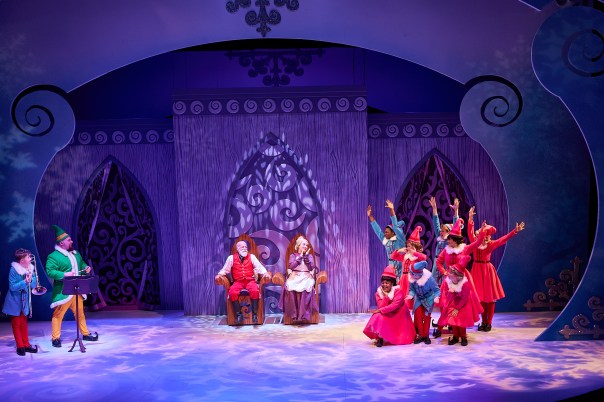
On the other hand, I subjected myself to all of the Animagic version I could find on this side of the $8.99 paywall. Everything I saw struck me as painfully primeval and lifeless – you’d have to pay me far more than nine bucks to watch it all. Only a few snippets of Santa can be found in the clips and trailer I sampled, enough to firm my conviction that John DeMicco as Santa and Allison Snow Rhinehardt as Mrs. Claus are far more rewarding than their Claymation counterparts. Rhinehardt even adds some grace notes that give the impression that Mrs. C is pushing back against Santa’s grumpiness and prejudice.
Likewise, Carlos Nieto and Ericka Ross convince us that Rudolph’s parents, Mr. and Mrs. Donner, have real souls instead of clay molds. You can feel that they’re genuinely worried about their cute little oddball offspring. Our host and narrator, Brandon J. Johns as Sam the Snowman, was geniality itself, establishing a fine rapport with the matinee audience and delivering “A Holly Jolly Christmas” with nearly as much avuncular jollity as its originator, Burl Ives.

Moonlighting from multiple puppeteer exploits, including the bodacious Bumble, Alex Manley gets his face time as the Boss Elf, so sunny that you never believe he really opposes Hermey’s dentist dreams in his heart of hearts. Richard Edward III drew two chauvinist bucks to portray: Coach Comet, Clarice’s intimidating dad, and Yukon, the flamboyantly superfluous gold-digger that Rudolph and Hermey meet in their travels. Kids of all ages seemed to delight every time Edward wielded his prospector’s pick-axe, particularly when we learned – or at least I did – that he wasn’t hunting for gold.


 Art on My Sleeve