Tag Archives: Calin Lupanu

Bach and Mozart Strive With Stravinsky at Knight Theater

Review: Orion Weiss with Charlotte Symphony

By Perry Tannenbaum

January 11, 2025, Charlotte, NC – Although we still get steady rations of Mozart from Charlotte Symphony since the days when Christof Perick passed the baton to Christopher Warren-Green, we havn’t heard much Bach from the orchestra since the autumnal Bachtoberfest faded from Symphony’s portfolio nearly a decade ago. This is understandable, if lamentable: after bringing us a double dose of the Baroque titan in 2018 – plus a shot of Vivaldi’s Four Seasons – violinist/conductor Aisslinn Nosky became a mainstay at Bach Akademie Charlotte (and one of the annual Charlotte Bach Festival’s primary claims to national prominence). A return to the Classics Series, set for 2020 via the Leipzig master’s Brandenburg Concerto #2, was quashed by the onset of COVID.

You could say that the suspense has been building. For a while, it seemed like CSO was tacitly conceding the high ground to the Akademie and its festival, presented by musicians from across the country who perform on authentic Baroque instruments. Playing the music of Bach on modern instruments, you could argue, has become paradoxically retro.

Yet the more deeply you explore musical history and authenticity, the more obvious it becomes that ancient (looking at you, Vivaldi-Schubert-Tchaikovsky) composers eagerly embraced new instruments, recycled their compositions for different instruments and different-sized ensembles, and encouraged musicians to copy, interpret, modify, and spread their music as they pleased. Reverence for absolute fidelity to original compositions is as absurd as assuming that top recording artists, whether it were Bob Dylan or Taylor Swift, would never allow covers of their greatest hits. If it sounds good – and magahits often do – go for it!

So it was heartening to find that CSO was intrepid enough to present a Bach Orchestral Suite in a modern-instrument performance and, perhaps to underscore the point, Johann Sebastian’s Keyboard Concerto No. 6, adapted by the composer himself from the Brandenburg No. 4. A certain amount of ambiguity pervaded Knight Theater as guest conductor Jeri Lynne Johnson made her debut. The house that greeted her was packed to the topmost row of the balcony. Yet the cause for the crush may have been the cancellation of the previous evening’s performance due to a “snowstorm” that had generated more bloated hype than solid news.

The only sparsity was on the Knight Theater stage. Johnson and the CSO would not be discarding all of the orthodoxies of the authenticists: the size of the orchestra had been scaled back to those employed in Bach’s days and those that would have played Mozart’s Symphony No. 25. The interloper on the program, Stravinsky’s Concerto for Piano & Wind Instruments, was also conspicuously downsized.

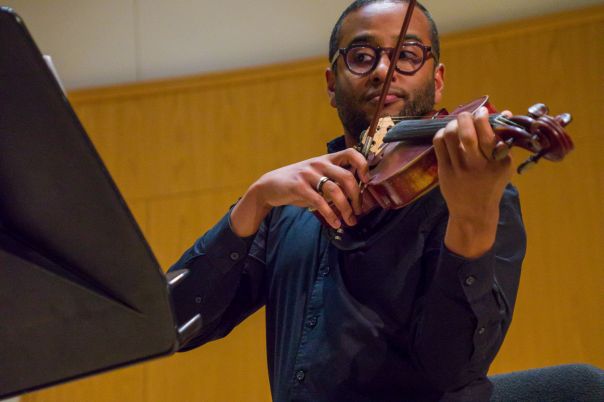
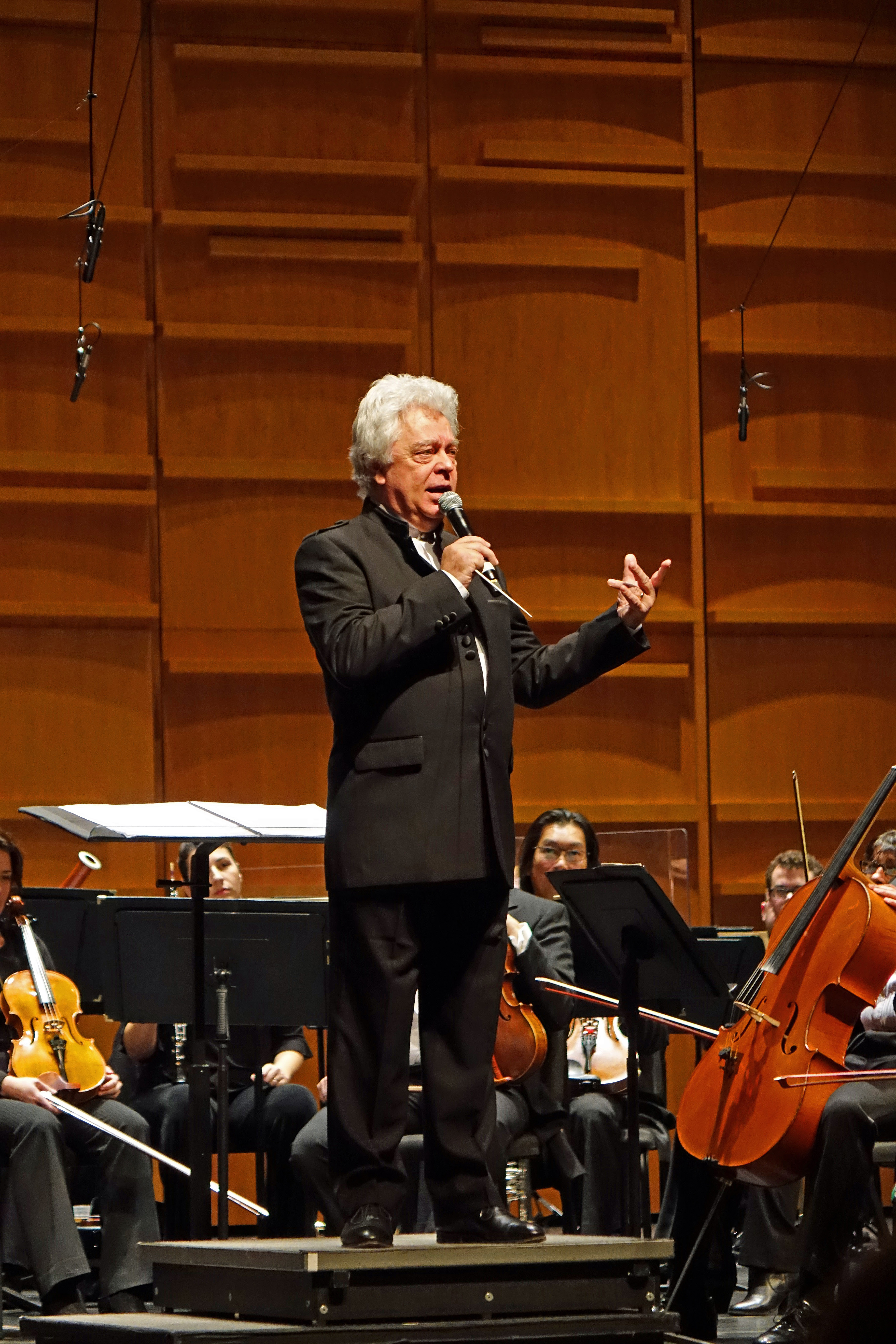
Viewed in profile, Johnson’s black suit – and her decisiveness – enhanced her resemblance to Kamala Harris. Symphony responded energetically to her baton all evening long, yet there was no lack of lyricism or finesse when Bach’s Orchestral Suite No. 3 transitioned from its brassy opening Overture to the famed Air (on a G string). Concertmaster Calin Lupanu, accorded considerable space in the opening movement, spearheaded the ethereal violin section to the requisite sublimity as the big tune gracefully swelled. Their intimacy quickly pointed up the advantage of a trimmed ensemble.

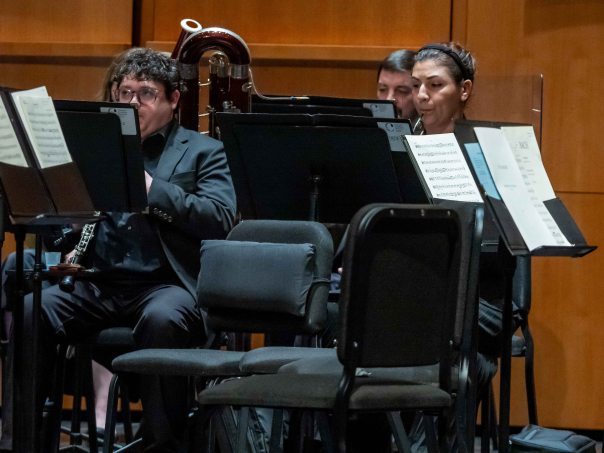
Subscribers who hadn’t scrutinized their program leaflets, let alone scanned its QR code for the full booklet, were likely shocked by the mass departure of the string sections, the arrival of the Steinway, and the empty chairs that remained as pianist Orion Weiss made his genial entrance. Deceptive! After a rather solemn Largo opening from the winds, with a somewhat promising crescendo at its center, Weiss’s first notes from the keyboard in the Allegro section were savage knuckle-busting clusters, met by a lusty clamor from the previously wan winds, crowned by a thumping of timpani.

Amid the cascade of chords that Weiss inflicted on the keyboard, a jazzy percussive rhythm infectiously emerged – even if it was impossible to determine whether the blizzard of notes Weiss was playing were the right notes. Suddenly, Weiss had taken on the appearance of a febrile Russian madman! The ensuing Largo provided lyrical reassurance, with some primeval passages set aside for oboists Erica Cice and principal Timothy Swanson. The pacing of the closing Allegro was almost as frenetic as the opening: if there were wrong notes here, Stravinsky had put them there with wicked glee.
This image has an empty alt attribute; its file name is 2025bach-mozart-7.jpg

Unless you were expecting an enormous horde of string players to flood the stage for the Mozart symphony, the biggest surprise after intermission was at the beginning, when Weiss returned for the Bach Keyboard Concerto. When Johnson stood by, she applauded not only Weiss but also flutists Amy Orsinger Whitehead and principal Victor Wang. Jackson’s outfit hadn’t been the only one I’d noticed until then. As she took her place with the winds for the Orchestral Suite, Whitehead’s black attire seemed to be strikingly ornate and elegant. So this featured slot explained the seeming breach of decorum.

Nor do you need to go more than a couple of bars into the Brandenburg Concerto No. 4 or its Keyboard Concerto offspring to savor the impact of its paired flutes delivering the catchy theme of its opening Allegro. Baroque aficionados, on the other hand, might have needed a minute or so to acclimate themselves to hearing the more rounded and gilded timbres of modern metal flutes. Their record shelves are likely clogged with trendier authentic recordings, marked by the presence of ancient wooden flutes and their hollower sound. Frankly, it was refreshing – and fun – for me, and Weiss bore a distinctly merrier look as well, though his cadenzas remained challenging.

Let’s not waste any more time in declaring that Charlotte Symphony retains its zest for Mozart. With this trim ensemble and Jackson’s accenting, what we heard at the Knight ranked among the most exemplary performances CSO has lavished on a Mozart symphony, even if the youthful No. 25 doesn’t rank among his very best. The opening 25-note sequence from the legendary 17-year-old prodigy, a 16-note vamp followed by a nine-note melody, hasn’t worn out its winsomeness in over 250 years.

Standing out almost as much as the crispness of the orchestra were the lovely solo spots from Swanson, capping what was perhaps his finest evening since assuming the first oboe chair this season. Jackson was gratifyingly bold in differentiating Mozart’s dynamics, finishing out the penultimate Menuetto with a satisfying crescendo. The closing Allegro featured more assertive playing from the winds pitted against the ferocity of the strings. Every now and then, we could discern Swanson’s oboe hovering above the fray.

Falletta and Wilborn Dazzle at the Knight

Review: Charlotte Symphony Plays Wagner + Strauss

By Perry Tannenbaum

March 22, 2024, Charlotte, NC – Charlotte Symphony’s latest concert pairing, Wagner + Strauss, is logical and cohesive enough, but with the two Germans represented by the “Liebestod” (love-death) from Tristan and Isolde followed by the great Death and Transfiguration tone poem, abundant jollity seemed unlikely at Knight Theater. Wedged between these famed titans of 19th and 20th century music, however, were two lesser-knowns, Richard Strauss’s contemporary Oskar Böhme (1870-1938) and American composer Julia Perry (1924-1979). Thankfully, these composers, especially Oskar, lightened things up. Originally scheduled to perform with Symphony in August 2020, renowned conductor JoAnn Falletta returned for her first guest appearance with the orchestra since 2002, and principal trumpeter Alex Wilborn, similarly postponed by the pandemic, made his solo debut in Böhme’s Trumpet Concerto.

When former Symphony music director Christof Perick last performed the “Liebestod” at Belk Theater – almost precisely 15 years ago – he also paired the piece with a revered Strauss tone poem, Also Sprach Zarathustra. Strauss was one of Perick’s prime passions, and the Friday evening performance reaffirmed that the ardent Prelude and Liebestod remains deeply embedded in the ensemble’s DNA. Falletta’s reading, gradually peaking to a lovers’ climax, with delicious peeps at the hypnotic love theme that blossomed with promise, made me feel afterwards like asking if anybody else in the audience craved a cigarette.

Musically, it seems like a trumpet is a better post-coital sequel for Symphony than a cigarette when they finish the Liebestod, for who can contemplate Strauss’s Zarathustra without recalling its trumpet heraldry? Now that Wilborn is in the principal chair, he could bring us a virtuosic account of Böhme’s Trumpet Concerto with a surprise bonbon afterwards. The opening Allegro moderato brought forth a beautifully burnished tone from Wilborn’s horn and delectably supple phrasing, hardly seeming to challenge his technique, while Falletta emphasized the massiveness and lyricism of the orchestral accompaniment. That foundation segued nicely into the middle Adagio religioso movement, which began with stately dignity from the strings and brass and peaked with soaring aspiration from the soloist, no less pleasing than the melodic opening movement. It was only in the closing Rondo that we could savor anything close to Wilborn’s full virtuosity. Some real jollity here.

Perhaps both Wilborn and Falletta felt that the fireworks were all too brief in Böhme’s finale, for after the audience ovation, the trumpet virtuoso returned with perhaps the lengthiest encore ever heard at Knight Theater. Jean-Baptiste Arban’s “Variations on The Carnival of Venice” had all the virtuosic challenges and exploits you could ask for, with merciful orchestral interludes between the clusters of variations so that Wilborn could catch his breath. It wasn’t just speed that was demanded: in the most intense variations, we needed to make out the main melody amid a blizzard of relatively quiet filigree. The effect was sensational, exhilarating, and exhausting. Falletta showed us how much fun she was having long before she could rest her weary arms and face us again, and Wilborn, in a gesture that promised both him and his audience some respite, jokingly signaled to us when there were only three variations remaining.

Sadly, it would be an understatement to say that African American composer Julia Perry’s work has been neglected in her homeland. Only a handful of recordings – and no full-length CDs – exist from her voluminous output, which included 12 symphonies and four operas. The work unveiled in Charlotte, A Short Piece for Orchestra (1952), has only been recorded once, 14 years ago by the Imperial Philharmonic of Tokyo.

Falletta’s helter-skelter reading of the work made it feel far more modern and audacious than the more lyrical and legato Tokyo take under William Strickland’s baton. A live performance certainly brought out more textures after the raucous opening, including some dreamy reeds from principal clarinetist Taylor Marino and acting principal oboist Erica Cice. From the rear of the ensemble, a snare drum’s tattoo and some noodling from a celesta crept in. Really lovely stuff. My first exposure to Perry came just three days before her centennial birthday might be celebrated (apparently, there’s a half-billion-dollar bond deadline that’s considered to be a bigger deal).

The crisp dynamics that distinguished A Short Piece made a difference once again as Falletta turned to Tod und Verklärung. There was thunder like Perick brought to the work plus a little more electric crackle. In the more sweeping passages, the orchestral blend was as exquisite as ever, yet there were also ample opportunities for Cice, Marino, principal flutist Victor Wang, and concertmaster Calin Lupanu to shine in the hushed moments. Perick’s interpretation had more narrative cohesiveness and continental flavor, while Falletta’s took the piece in a more American direction, almost exiting the realm of a tone poem and crossing over into a concerto for orchestra. Opening up the dynamic range was certainly an intriguing and exciting approach. After waiting an extra four years, Falletta clearly triumphed in her return.

CP’s Connor Series Signs Off With Two Powerhouse Piano Quintets

By Perry Tannenbaum

September 17, 2023, Charlotte, NC – Even before the Connor Chamber Music series began six years ago at Tate Hall, Catherine and Wilton Connor were among the strongest advocates of chamber music in the Metrolina area. They had previously helped to give the St. Peter’s Chamber Music series extra reach beyond Uptown church by hosting Living Room Concerts in their Myers Park home. Furthermore, they had opened their doors to violinist Rosemary Furniss and her chamber trio when her husband, Christopher Warren-Green, was the Charlotte Symphony’s music director.

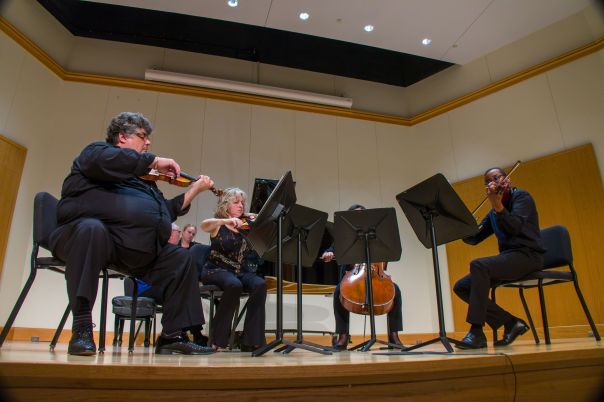
So it was bittersweet to hear Mr. Connor announce that the latest concert on the Central Piedmont Community College campus, showcasing piano quintets by Béla Bartók and Antonín Dvořák, would be their last. Connor hastened to console us, hyping the recent and future concerts of Chamber Music for All, led by Charlotte Symphony concertmaster Calin Lupanu. And in fact, the program we were soon to hear had already been performed a week earlier at the Lancaster Cultural Arts Center, the climactic event of the inaugural Historic Lancaster Music Festival. Future CM4A concerts are already scheduled there, at Sedgefield United Methodist Church, and at the Steinway Piano Gallery.

Not nearly as renowned, recorded, or as frequently performed as his six string quartets, Bartók’s Piano Quintet in C Major is one of the composer’s earliest works, written in 1903-4, a mere 17 years after Dvořák’s quintet was premiered and 35 years before his own final string quartet. Often in its outer movements, the opening Andante and the concluding Poco Vivace, the music has an anthemic openness that you might expect from a 19th-century piece written in the shadows of Liszt, Strauss, and Brahms, before Bartók leaned more toward folk music and modernistic experimentation.

At the keyboard, Phillip Bush resisted the temptation of steering the joyousness of the piano part into stentorian jubilation, resulting in more ensemble cohesiveness and more contemplative edge. Lupanu could stay more within himself to match Bush’s fire without ever flattening the peaks and valleys of the volatile music where Bartók abruptly changed tempos and dynamics. Marcus Pyle, who had inched onto our radar earlier this year as a preview speaker for Opera Carolina’s production of Porgy and Bess, impressed almost instantly on viola with his lush tone and sleek double-bowing.

The inner movements, a Vivace-Scherzando followed by an Adagio, are more forward-looking. The Scherzando did not lack for quirkiness, but Bush could have been more provocative and eccentric in the second movement. With cellist Marlene Ballena and second violinist Monica Boboc making valuable contributions, the quartet sounds were dominant in the Adagio, though the 2019 Alpha Classics recording, captured live at the Lockenhaus Chamber Festival, dares to be more raucous and astringent. When Lupanu’s quintet surrendered more fully to the closing Vivace, they delivered more of its fire and madness.

Competition among recordings of the Dvořák Piano Quintet No. 2 in A Major not only increases exponentially compared with the sparse field of Bartók recordings, so does the name recognition of the pianists, violinists, and string quartets who have entered the fray. On the other hand, the musicians onstage at Tate Hall must have had so many more opportunities to glean master classes from this immense discography – and likely more opportunities to rehearse and perform this perennial favorite before bringing it to CPCC. The electricity and sound quality of live performance, the familiarity of the audience with the piece – particularly when it settled into the dreamy Dumka movement after the rousing Allegro opener – brought the Connor concert experience into gratifyingly close alignment with the best CDs available.

Bush played with confident élan, pliant and at ease navigating the tempo shifts of the opening movement, charming and lyrical in the gorgeously pianistic Andante passages that make the Dumka so memorable, and unbridled with the onset of the folksy interludes. Lupanu also played with loose and spontaneous abandon, slashing boldly with his bow at the quick tempos and delicately caressing the strings in the lovely soft passages. Ballena shone most with her cello as she introduced the first theme of the Allegro, and Pyle was equally convincing introducing the second. Everybody seemed to be having a jolly time as the sober ending of the Dumka gave way to the penultimate Scherzo. Lupanu and Bush mischievously frolicked on the left side of the Tate stage, answered to humorous effect by Ballena and Pyle with their suave mellowness.

Boboc had her most memorable spot in the Allegro Finale when we jumped away from the spirited interplay between Bush and Lupanu into a fugal section where Ballena and Pyle also got a taste. There were also harmonious sections that reminded me of the uniqueness of Dvořák’s string quartets. Yet it was Bush who was most dominant at the concert’s climax, trilling and ding-a-linging merrily before he ramped up the speed and intensity toward the very end. Obviously relishing the encounter, Lupanu matched him note for note as they raced to the precipice.

Parameswaran Delights With Eclectic Mix of Moderns

Review: Sibelius No. 5 with the Charlotte Symphony

 By Perry Tannenbaum

2023~Sibelius 5-14

Maybe subscribers to Charlotte Symphony’s Classical Series aren’t as invested in choosing a successor to music director Christopher Warren-Green as I had presumed, or maybe the weather was too darn wintry for the wusses. Whatever the cause, the audience that came to see guest conductor Vinay Parameswaran perform a program that included music by Gabriella Smith, Benjamin Britten, and Jean Sibelius – while launching CSO’s celebration with a fine example of William Grant Still’s artistry – didn’t come close to filling Knight Theater to capacity.

Nor could anyone who looked over the stalwarts who braved the Arctic cold have called us diverse.

Could be that we’re complacent, self-satisfied, and spoiled. After hosting a musician as renowned and prestigious as Warren-Green, we may have forgotten that the candidates parading before us, seeking to impress in order to land a job offer, might just need to be sufficiently impressed by us to accept.

So it was interesting to watch how Parameswaran reacted when he looked out at the crowd, pocked with empty seats, and met us for the first time in his Charlotte debut. A rather sober look on his face abruptly turned to shock, surprise, and gladness as he heard our outsized enthusiasm.2023~Sibelius 5-02

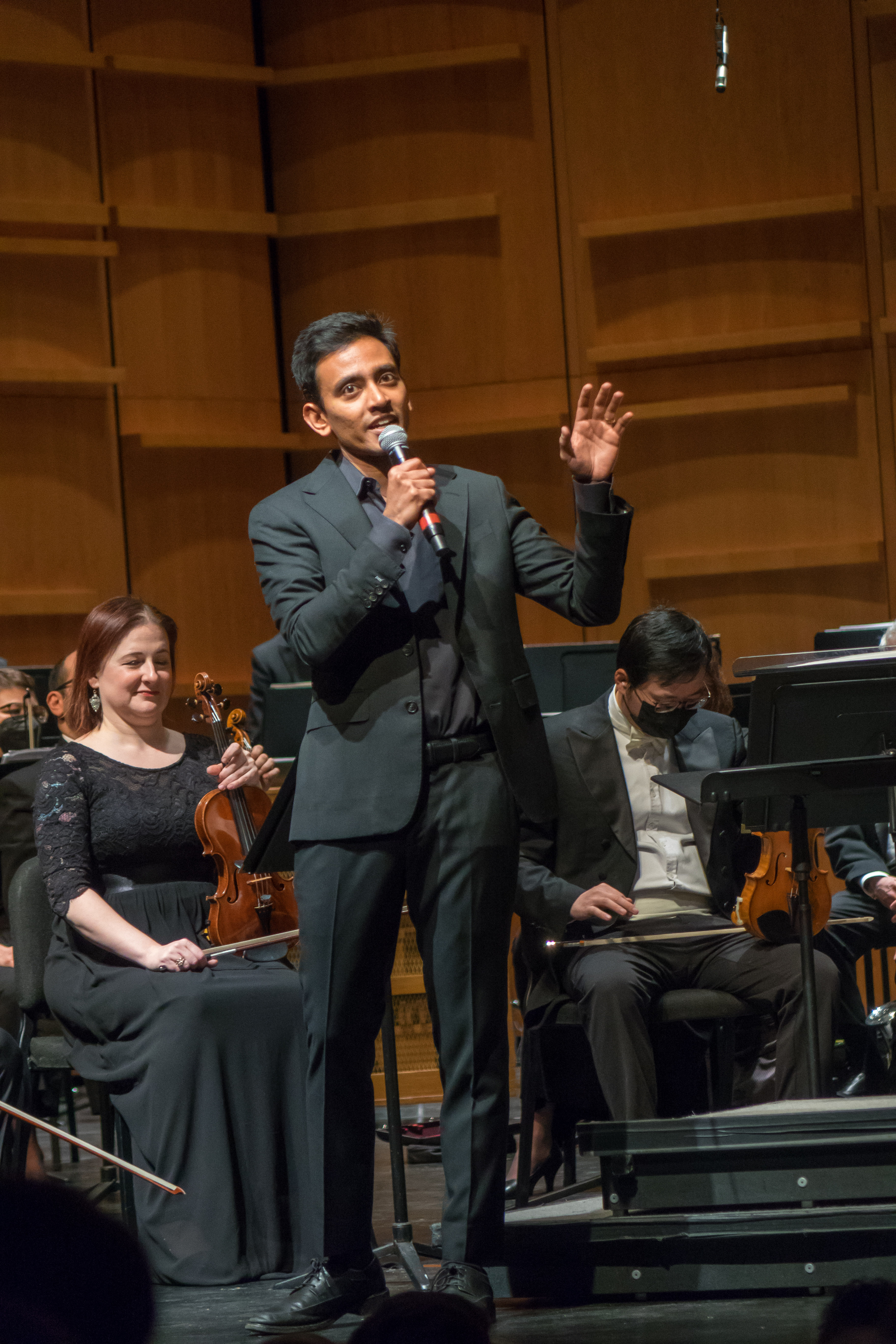
He was rather charming, then, when he picked up the mic at the podium and described Smith’s piece, Field Guide, along with the works that followed. Any misgivings that concertgoers who stayed away could have harbored about his foreign-sounding name would have been instantly dispelled by the ease with which he spoke and the ease with which we understood – even if it was outré for him to describe Arthur Rimbaud’s Les Illuminations, the text for Britten’s song cycle, as “nonsensical.” I could hardly believe my ears.

Fortunately, the boldness of the San Francisco Bay Area native didn’t end there. He and the orchestra dug into Field Guide with gusto. Or tapped in, for the lower string players tattooed a sustained ostinato at the beginning of this pictorial voyage, delivering the sounds of insects, birds, animals, and swirling waters that Smith had recorded in the field and given new orchestral color. Cacophony was also mixed with the woodland stealth, and a look at the digital program booklet confirmed, in stray passages reminiscent of Debussy’s La Mer, that Smith had also taken her recording equipment to the ocean and under the sea.2023~Sibelius 5-24

Surreal, visionary, and hallucinatory though they might be, Rimbaud’s landmark prose poems are neither indecipherable nor dated. Canadian soprano Alexandra Smither, also making her Queen City debut, was evidently eager to share the wonder and variety of Britten’s settings, though she seemed as taken aback and gratified by our lusty greeting as Parameswaran had been. To fully savor the rightness of the music and the subtly crafted lucidity of Britten’s discreetly edited text, you’ll want to download the digital program booklet (via QR code) and follow along on your smartphone.

They do ask that you turn down the brightness of your screen as you’re reading the English translations of the French. Savor the irony as you reduce the illumination for Illuminations.

Our CSO thinned out during the transition from Smith to Britten, for the song cycle was written for strings and voice – with its intimacy compounded when concertmaster Calin Lupanu and principal cellist Jonathan Lewis play solos. Taking for a refrain a line of Rimbaud’s “Parade,” which concludes with “I alone have the key to this savage parade,” Britten turns his entire cycle into a savage parade – or as Duke University professor Wallace Fowlie translated it, “this wild circus.”

“Parade” doesn’t actually occur until the penultimate song in the 10-part suite, and both Smither and Parameswaran fully savored its climactic orchestral exuberance, appropriately rendered in marching tempo. Unlike Rimbaud’s masterpiece, which ends by scaling to a blasphemous pinnacle in “Genie,” Britten goes from “Parade” to a devastatingly subdued “Départ” (Departure), perhaps expressing empathy for the tragic gay poet. The effect was more powerful because Smither and the CSO had partnered in mostly uptempo songs until then. Excitement had been fairly intense from the beginning, when tremolos from the lower strings flowed into the first vocal scoring of Britten’s surreal refrain in “Fanfare,” taken by Smither at an infectious poco presto tempo with all her characterful ebullience.

Okay, so I’ll confess that I had slept as soundly as anybody on William Grant Still until Parameswaran brought him brashly to us. We’re catching up with him comfortably ahead of the centennial of Still’s ascension to the title of “Dean of African American Composers,” when he was the first black composer to have his work performed by the New York Philharmonic in 1930. The Naxos label and Apple Music are fairly woke to Still, woker than my first Spotify searches could confirm, though I found the same recording of Poem for Orchestra – by the renowned Fort Smith Symphony – at both streaming services.

With a helter-skelter cacophonous opening, Symphony and Parameswaran were far bolder and more modern than their Fort Smith counterparts as the full ensemble returned after intermission. Even when the CSO settled down and we could see the Brahms-and-Gershwin bloodlines of Still’s composition, with occasional soured passages paralleling Shostakovich’s wartime works, the music sounded more vibrant and contemporary. After that startling first onslaught, I very much liked what I heard.

There’s also plenty more for us to experience live after dipping into the streaming goodies we can sample. Still wrote at least four more symphonies after the NY Phil breakthrough, a fairly copious amount of piano and chamber music, and numerous memorable elegies, including one for “The Colored Soldiers Who Died for Democracy” and a “Threnody for Jean Sibelius.”

Following the Poem for Orchestra with Sibelius’ most admired and recorded symphony didn’t sound random, either. Last played at Belk Theater by the CSO and Warren-Green in the spring of 2015, the brassy Tempo molto moderato opening movement made itself immediately welcome, cresting with a grandeur that almost brought me to tears. The delicacy of the Andante middle movement, beginning with waves of pizzicatos and morphing convincingly into an Allegretto scherzo, was also brilliantly calibrated.

Perhaps because those pizzicatos sound so much more vivid in live performance than on recording, the deficiencies of the closing Allegro molto – Misterioso were more apparent compared to the CDs in my library, including the definitive 1997 interpretation by Osmo Vänskä. Parameswaran didn’t push the pace as thrillingly to start the movement, so the big tune from the brass didn’t arrive as majestically in repose. But the orchestra delivered amply on the restless, mysterious aftermath, and the six hammering whomps at the end, half of them spiked with timpani, satisfied everyone.

–Photos by Perry Tannenbaum

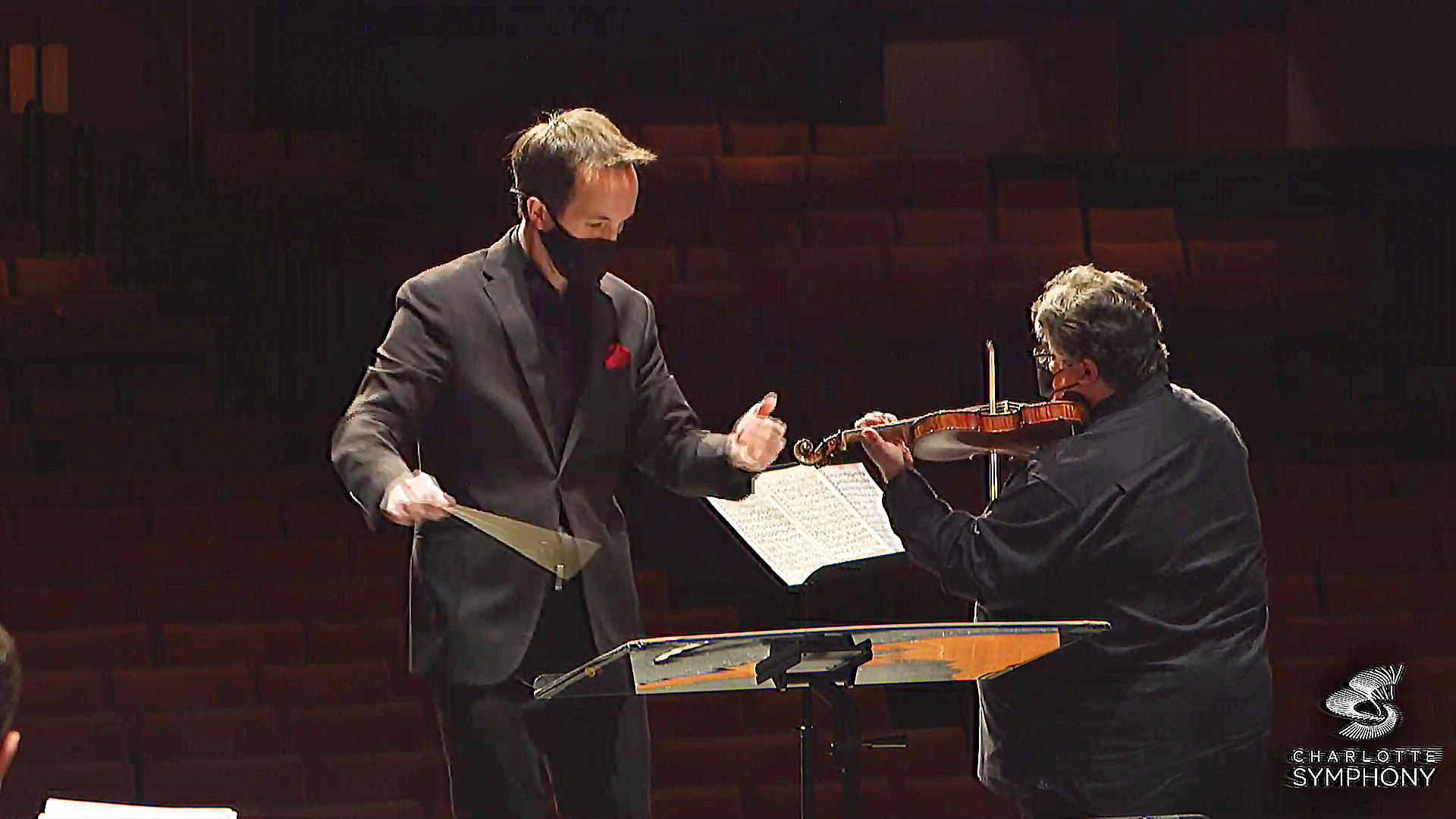
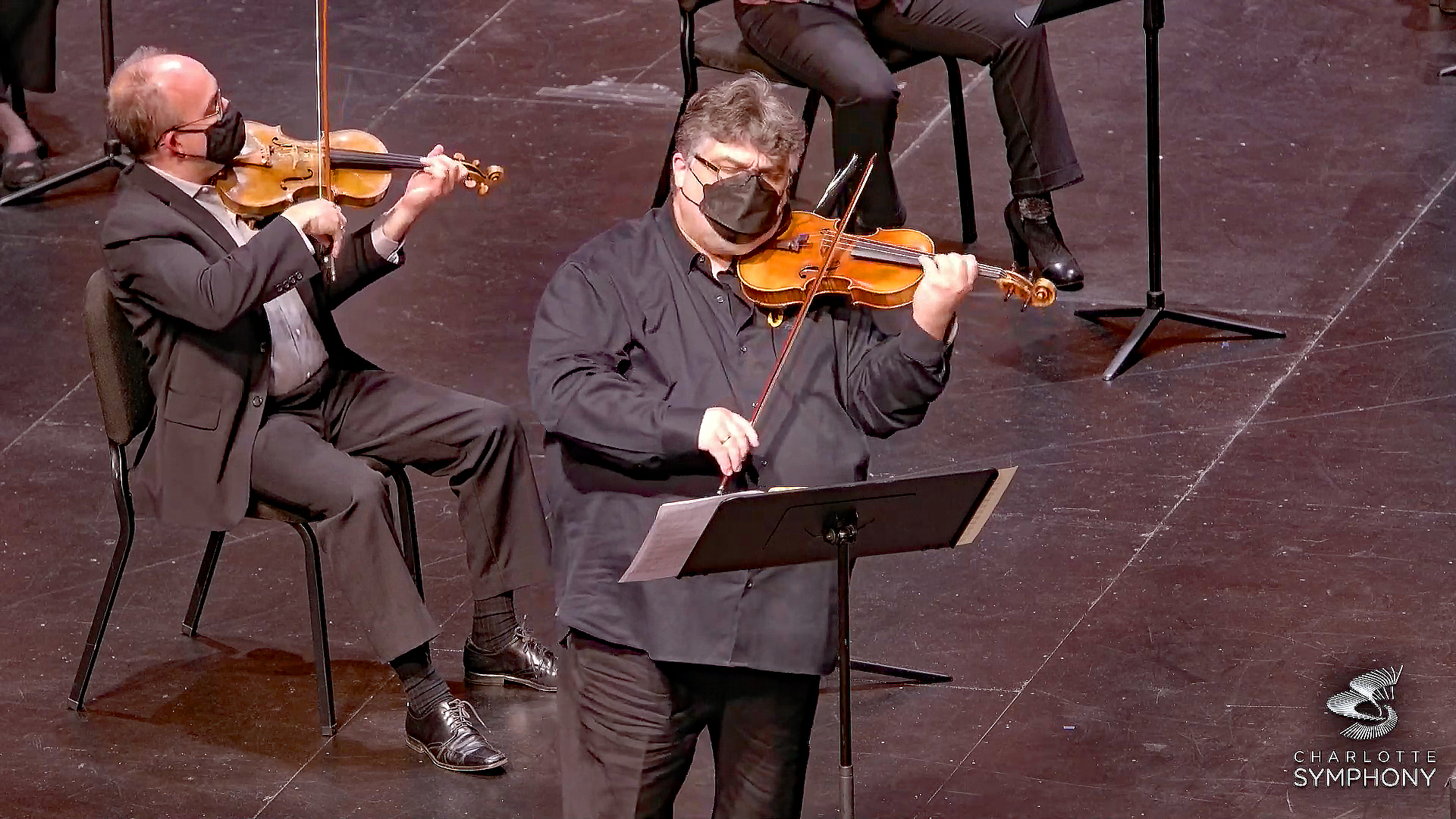
Lupanu and Friends Feed off Audience Energy in Return to Live Performance

Review: Connor Chamber Series at Tate Hall

 By Perry Tannenbaum

2021~Connor Chamber Concert-5

While orchestral performances have sadly languished during the COVID pandemic, recently reviving in Charlotte and elsewhere in prudent baby steps, chamber music has flourished in online productions. Back on Memorial Day weekend, while the youth choir and orchestra remained sidelined for a second consecutive season at Spoleto Festival USA, chamber music restarted at Dock Street Theatre in Charleston, running a full slate of programming and replaying edited versions on YouTube. Not surprisingly, it has been principals of the Charlotte Symphony Orchestra, cellist Alan Black and concertmaster Calin Lupanu, who have most dramatically stepped forward to fill the void, each of them spearheading a series of chamber music concerts while the larger ensemble remained mute or muted. More encouraging, then, for those of us who love the intimacy and verve of chamber music, is that neither of these initiatives is in retreat now that audiences are vaccinated.

Thanks to the Connor Chamber Series, Lupanu could be seen at Tate Hall on the Central Piedmont Community campus while Symphony is returning to full strength, its mainstage classics series slated to launch at Knight Theater on October 15. Lupanu hosted the concert of works by Brahms and Anton Arensky, starting off together with Phillip Bush at the piano playing the Brahms Scherzo movement from the F-A-E Sonata, which was originally premiered by pianist Clara Schumann and violinist Joseph Joachim, for whom the piece was written in 1853. After this lively opening, Lupanu yielded the violin part for the Arensky Piano Trio No. 1, replaced by fellow Symphony musicians Monica Boboc and cellist Marlene Ballena. Lupanu returned after intermission – inserted to give Bush a rest, he jested – for the finale, the Brahms Piano Trio No. 1, written just a year after his Scherzo.

2021~Connor Chamber Concert-1

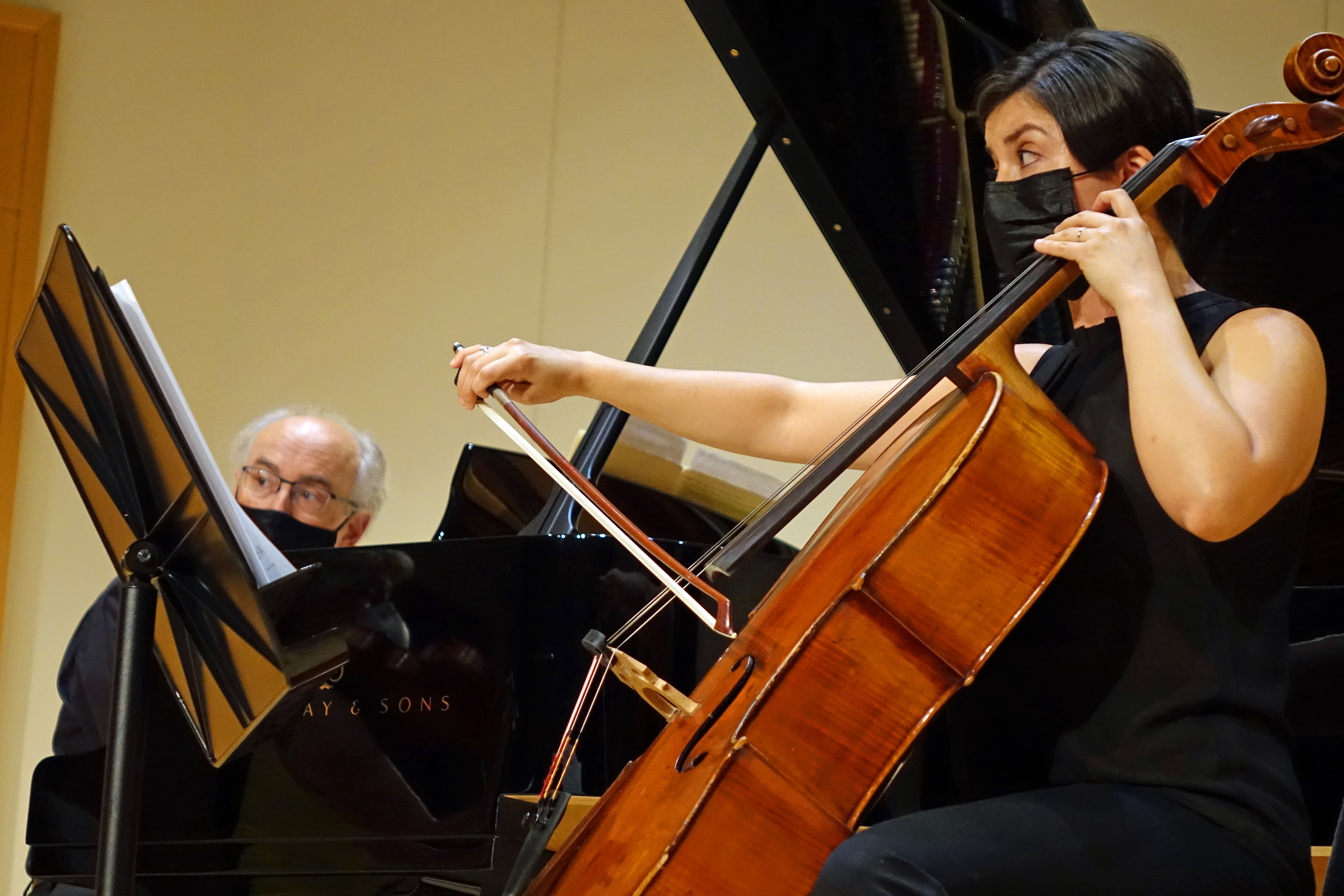
The Tate immediately proved hospitable to Lupanu’s violin in the Brahms Scherzo, which also drew movements by Robert Schumann and his pupil, Albert Dietrich. On the other hand, the treble breathed more freely from the Steinway than the bass end of its keyboard, perhaps because of its nearness to the upstage wall. The music, Lupanu’s placement downstage, and the excitement of playing chamber music for a live audience after 18 months of performing for mics and cameras (if at all) were all good reasons for the violinist to excel more than usual. Coming out and masking up, seeing the masked musicians onstage taking up their share of the pandemic risk and responsibility, the audience was also primed to be exceptionally receptive. Lupanu may have seen the enthusiasm in the audience’s eyes as he looked out on us, but he couldn’t help feeling the free, propulsive spirit of Bush behind him, very much inside the music, spurring him on to be better and better.

Arensky’s trio has been on my radar ever since pianist Yefim Bronfman headlined a Sony recording of the piece over 25 years ago (paired with an even more electrifying Tchaikovsky trio), so it was not surprising to see Bush assert more leadership. Yet both of the string players acquitted themselves admirably in each of the D minor’s four movements. A beautiful violin melody from Boboc at the top of the opening Allegro moderato was echoed in more abbreviated form by Ballena’s cello, yet it was likely that hearing Ballena’s cello so much more clearly in live performance put me in mind of Dvorak’s chamber pieces. Boboc captured the lightness of the ensuing Scherzo, but it was Ballena who became the prime advocate when that movement slowed to its more luxuriant Meno mosso tempo.


2021~Connor Chamber Concert-3

Bush’s sound, at times downright impressionistic, was the most distinctive element in the elegiac Adagio. Yet Boboc was also disarming, playing low enough on her violin to be mistaken for a cello if you weren’t watching. Not to be outdone, Ballena played even lower when we arrived at her spot. It was in the Allegro finale that Arensky finally matched the turbulence we had heard from Brahms. Bush assaulted the Steinway with a barrage of three-chord phrases while the strings stirred up the heat. Then he turned down the volume and the tempo in a poignant passage of four-note phases. Now it was the strings’ turn to dominate, Boboc and Ballena vying in eloquence as they demonstrated how lyrical and affecting those same phrases could be that Bush had played so feverishly.

Looking at the attentiveness of Bush and Ballena throughout the Brahms B Major trio, we could assume that Lupanu held the reins, yet there was admirable parity between the parts. Ballena’s cello sang out introducing the theme of the opening Allegro brio, and she had a transporting spot in the penultimate Adagio. Bush was pre-eminent in setting the tone, restless amid the shifting tempos of the opening movement, dreamy in his intro to the Adagio before the strings interceded with their sacramental harmonies, but most mischievous in the even-numbered movements. The second-movement Scherzo suddenly pivoted from a beguiling waltz tempo to a manic chromatic outburst that presaged Shostakovich, up in the treble where the Steinway fared best, and the grandeur he imparted to the Allegro con brio finale was star-spangled American. For Lupanu to dominate amid these exploits from his partners, projecting the joy of the Scherzo and the triumph of the Finale, was quite impressive.

On Your Toes for a Lively Mix of Mozart, Meyer, and Wirén

Review: Burgeoning optimism could be found in Symphony’s most recent Mozart + Wirén concert

By Perry Tannenbaum

2021~Mozart + Wirén-01

Unless a fourth wave of COVID-19 takes us by surprise and the 2020-21 season has to be “reimagined” yet again, Charlotte Symphony seems to be moving slowly, cautiously back towards full-sized concerts with their entire orchestra. Later this month, principal harpist Andrea Mumm will be reunited with the string players, taking a lead role in Debussy’s Danses sacrée et profane, and next month, we can look forward to Mozart’s beloved Symphony No. 40, presumably with a full complement of woodwinds. As I sit down to write, Haydn’s Symphony No. 64 has been announced for May, bringing us oboes and horns. Meanwhile a fresh series of five outdoor concerts has been scheduled this spring at the NoDa Brewing Company, all on Tuesdays, with a discreet 7:00pm starting time, improving our chances of keeping warm.

2021~Mozart + Wirén-14 copy

Another harbinger of spring and burgeoning optimism could be found in Symphony’s most recent Mozart + Wirén concert. Back in February at the Holst + Elgar concert, only Holst’s St. Paul Suite was lively and sunny enough to get musical director Christopher Warren-Green jumping up and down on the podium. Check out the webcast of the Mozart + Wirén program, still replaying online, and you’ll find that both of these composers had the same effect, Mozart with his Divertimento for Strings in D major and Swedish composer Dag Wirén with his Serenade for Strings. In between these two, Warren-Green offered the Charlotte premiere of Jessica Meyer’s Slow Burn, a piece originally devised two years ago to accompany a burlesque dancer in Saratoga. Jumping was probably not the proper response.

Mozart wrote no fewer than five Divertmenti in D Major, so it’s necessary to add that this was the earliest, K. 136, written at the age of 16 – or that it’s the one Divertimento that Yehudi Menuhin recorded in his Mozart collection for Virgin Classics, leading the Orchestre de Chambre de Lausanne. The youthful energy of the piece burst immediately upon us in the opening Allegro, with churning propulsion from the lower strings and lithe buoyancy from the violins and violas. Dynamics undulated with the floating grace of a glider as the steady churning continued below in rhythmic waves. The sound of the Knight Theater space added the faintest echo, and the airiness of the sound recording was close to the standard set for this piece by the Seiji Ozawa recording of 1994.

2021~Mozart + Wirén-15

Coming after this sunny effervescence, the middle Andante was so sweet and nostalgic, reminding me of one of the first Mozart pieces I was able to master on the piano more than 60 years ago. Lovely as it is, it was the only one of the three movements that could be imagined as royal background music, which is how a divertimento is normally regarded – and what resident conductor Christopher James Lees warned us against expecting in his introductory remarks. Attcked by the strings with at least as much zest as the Allegro, the closing Presto commanded attention, six staccato notes followed by the kind of explosive ignition we associate with Mozart’s Eine Kleine Nachtmusik, which Symphony performed just a month ago. Along with the exciting flux of dynamics, there were also zigs and zags of tempo navigated by Warren-Green, layers of repetition from the three main string sections overlapping one another. The ensemble surpassed themselves with their legerity and clarity in long, swift sweeps of melody.

2021~Mozart + Wirén-05

Slow or not, Meyer’s dancer evidently preferred to ply her trade in a steady 4/4 time as the piece began, with suggestive gestures from principal violist Benjamin Geller, principal second violin Oliver Kot, and concertmaster Calin Lupanu. Action halted before these solo voices – and after slaps on the double basses that sounded like whip cracks. Resuming the Burn, the music slid into swooning glissandos that allowed the dancer to surrender as much as her audience. Urgency and fury crept in as the tempo accelerated with frequent slaps on the basses, alternating with jazzy pizzicatos. The next halt gave way to a longer statement from Geller on viola that triggered a more frantic acceleration from the orchestra than before, this final gallop prodded by a constant cracking on the necks and sides of the two basses. What a dancer would do at this climax was enticing to imagine. Certainly it would be more like a flamenco flowering than a bump and grind.

Wirén had never crossed my radar before this Charlotte Symphony debut. He merits only a brief paragraph in my two music cyclopedias and only three entries in my last copy of the Penguin Guide, which did declare Wirén’s Serenade of 1937 to have been his greatest international hit. Apple Music is a better place than Spotify to hunt for it, but Symphony’s account was as exemplary as its previous two performances. Lees peeped in for another intro, describing the piece as a blend Mozart lightness and 1930s Paris, where Wirén studied composition. With long sweeping melodic phrases from the violins conveying Mozartian lightness, the opening Preludium had the urban bustle of Gershwin’s Paris – or the Londons evoked by Eric Coates and Noël Coward – and Symphony was not at all tentative about zooming into the cityscape. The cellos and double basses actually injected a heavy, foreboding undertow at times, as if a spot of rain were on the way or the specter of a traffic jam.

The rustic quality presaged by Lees in his intro was further delayed by the Andante espressivo, which began softly with pizzicatos spanning the Knight stage followed by an outbreak of melancholy from the second violins. First violins only intensified the poignancy when they layered on with their bowing, taking us further into solemnity and coloring it faintly with regret. A second round of pizzicatos from the lower strings led into deeper keening from the violas, intensified by another onset of the violins. Cellos blended with violins before a concluding pizzicato hush. The ensuing Scherzo was where Wirén finally fulfilled Lees’ rustic description, though I’d have to guess that the composer had Beethoven’s Pastoral Symphony closer to heart than anything Mozart wrote, and a few notes struck up by the second violins had a kinship with “Willow Weep for Me,” written five years earlier by Ann Ronell and dedicated to Gershwin. Amid the hairpin turns of this impetuous movement, interspersed with the laughter of the violins, the cellos took over briefly with their sobriety.

2021~Mozart + Wirén-12

With violas, cellos, and basses beating their bows on their strings, the beat of the final grand march began, reminding me most vividly of Coates’s British pomp. But here we swerved dramatically, slowing down for our first genuine B section of the evening before circling back to the forceful main theme. This Marcía is the movement that is most excerpted from this most popular Wirén work, and there’s nothing subtle about its appeal. Little strums from the basses thicken its pulse and there are moments when the beat is so strong that you could suspect a drum or two lurking somewhere offstage. Its giddy spirit had Warren-Green on his toes, waving his arms with the sweep of it all, and ultimately jumping. For joy, no doubt.

All-English Symphony Program Moves from Wintry Dreariness to Triumphant Jollity

Review: Charlotte Symphony Plays Holst + Elgar

By Perry Tannenbaum

2021~Holst+Elgar-04

Assailed by the ongoing pandemic, the postponement of vaccinations, and a midwinter cold snap, we must be contented when we receive short rations of Edward Elgar without pomp or percussion and William Walton’s Henry V without winds or brass. In fact, since Charlotte Symphony music director Christopher Warren-Green often shuttles back and forth across the Atlantic to lead our Queen City orchestra and the London Chamber Orchestra, we’re rather fortunate just to have him on the podium at Knight Theater conducting an all-English program. Traveling by air between the UK and the US has become uncertain in recent months, due to the mutating coronavirus, and restrictions pushed Symphony’s Holst + Elgar offering from January 23 into February. Electricity can also be capricious when the Arctic is riled: Texas is merely the most notorious state plagued by power outages this month, not the only one.

We’ve heard more than a couple of Serenades since Symphony returned, string players only, reconfiguring its 2020-21 season and fine tuning on-the-fly. Elgar’s Serenade for Strings in E minor was certainly not the peppiest or the most sweeping of the breed, but Warren-Green, stressing the harmonic blend of the piece instead of its rhythmic flow, gave us a drearier reading than I would have hoped for, particularly in the first two movements, a tranquil and dreamy Allegro piacevole followed by a sleepier Larghetto. Only in the concluding Allegretto did Warren-Green abandon extreme delicacy and pick up his baton. Only now did the orchestra’s energy compare with the more light-hearted Sir Roger Norrington recording of the piece. Here there was more melodic dialogue between the upper and lower strings, more satisfying swells in the sway of the dynamics.

2021~Holst+Elgar-09

Although Walton’s Two Pieces for Strings from Henry V have been paired on commercial recordings, they are hardly a representative foretaste of the full musical score written for the 1945 film starring – and directed by – Laurence Olivier. Elsewhere in the score, in places such as the “Charge and Battle” and the “Agincourt Song” collected in more extensive suites, Warren-Green could parade Symphony’s winds, brass, and percussion. Mightily. “Death of Falstaff” and “Touch Her Soft Lips and Part” are soft, brief, and fragile flowers compared to those sturdy oaks, yet they were more affecting than the Elgar pieces. The Passacaglia for Sir John was quiet and grave, almost but not quite a dirge, and the “Soft Lips” was tenderly suffused with pure and chaste ardor, tinged with the sorrow of soldiers’ farewells. Count me as enthusiastically supportive if Warren-Green opts to program a fuller representation of this Henry V score when he can bring the full Symphony to the task.

If we longed for music that quietly reflected our mood during these cold, gray, homebound winter days and nights, then these Elgar and Walton works more than fulfilled their mission, but if it was uplift that we sought, then Gustav Holst’s St Paul’s Suite in C Major was a perfect tonic. Warren-Green’s anecdote about meeting Olivier and Walton after a performance of the Henry pieces was by far the most appealing of his intros. Warren-Green had been onstage as the concertmaster that night, and the actor and the composer had vied ridiculously with each other at the post-performance reception to be more modest about his contribution to that celebrated film. Yet the insight into Holst, when Warren-Green visited the St. Paul’s Girls School in London, was also fascinating. Holst taught at the school, eventually becoming its music director, and a soundproof room was built specially for him at the school where he composed his most famous work, The Planets, as well as this more modest suite.

2021~Holst+Elgar-16

To be honest, St. Paul’s sounds more like it was written in the middle of the girls’ playground on a bright sunny spring morning with the children running and squealing in all directions around the composer, especially in the effervescent outer movements. Amid the lively opening Vivace, ebulliently labeled as a Jig, it was inspiring to see Warren-Green jumping up and down on the podium again, excitedly gesticulating after maintaining his British dignity for these many months. The liveliness spread across the Knight stage, and I strongly suspect that the masked faces of the Symphony musicians were smiling. Even the middle movements had a youthful élan. The second movement was a quiet Ostinato at a Presto pace, with concertmaster Calin Lupanu floating a melody over the subdued churning of the upper strings and pizzicatos from the cellos. Lupanu’s soloing resumed in the Intermezzo, where we slowed to Andante con moto and principal violist Benjamin Geller took a couple of turns in the solo spotlight. Here again, a Vivace interlude abruptly shed its orchestral sunlight before we reverted to a slower tempo, ending with a sedate string quartet led by Lupanu.

Jollity reigned when we arrived at Holst’s Finale, an Allegro that riffs on an English folk tune, “The Dargason,” sounding even merrier than the opening Jig, and certainly more familiar. Holst further enhanced the merriment and complexity of his composition by giving the cellos the undercover assignment of introducing the ancient melody of “Greensleeves” under the main theme. No problem if you missed “Greensleeves” while it was part of the cellos’ stealth operation, because it became gloriously dominant when it was reprised. The infectious “Dargason” was not to be suppressed for long, interweaving so well with “Greensleeves,” and Lupanu had one more tasty little cadenza before the full string orchestra pounced on the final fortissimo chords.

CSO and Lupanu Debut a Harlem Nachtmusik, a Starburst, and Youthful Mendelssohn

Review: Mozart’s Night Music

2021~Mozart Night Music-08

By Perry Tannenbaum

One of Mozart’s most beloved compositions and the inspiration for the title of a Stephen Sondheim musical, Eine Kleine Nachtmusik is perennially popular on streaming sites, CD players, and classical radio stations. WQXR’s annual countdown of audience favorites listed Eine Kleine Nachtmusik at Number 38 in its Top 100 for 2020 – ahead of Mozart’s own Clarinet Concerto, his Symphonies 40 and 41, and two of his most familiar operas, Don Giovanni and The Magic Flute. Yet if Charlotte Symphony is an accurate barometer, this Mozart masterwork is rarely heard in public. Until last Saturday night, the piece hadn’t been played in Charlotte on CSO’s classics series during the current millennium. The performances led by Christof Perick in September 2004 were played out of town at the Matthews United Methodist Church, Winthrop University in Rock Hill, and Davidson College.

Of course, the COVID-19 pandemic has refocused our thinking about what music can be performed safely by symphony orchestras, while the BLM movement has been shuffling our thinking on what music should be offered. So it’s natural to conclude that Symphony’s dusting off of this old chestnut was purely in response to pandemic conditions, for the Nachtmusik is actually the 13th – and last – of Mozart’s string serenades, written in 1787 for string orchestra (or quintet).

Opting for safety first and omitting wind players from their recent performances at Knight Theater, Symphony must have found Mozart’s G Major to be an inevitable choice, especially since they’ve already dusted off Barber’s Adagio, the only piece for string orchestra that currently polls better than Nachtmusik. Notwithstanding this logic – and Symphony’s history – it must be remembered that Nachtmusik was already scheduled for a rendezvous at the Knight last April, under the baton of guest conductor Jeannette Sorrell, when the pandemic struck. So there may be an additional logic at work: very likely, Eine Kleine Nachtmusik rehearsals had already commenced. Certainly the musical scores were already in the string players’ hands.

2021~Mozart Night Music-09

The real responses to 2020 and the “New Normal” actually lay elsewhere in the program, most notably in the resourceful pairing of Mozart’s famed Serenade with Leonardo Balada’s A Little Night Music in Harlem, premiered in 2007. The preamble to this Nachtmusik pairing on the program, Jessie Montgomery’s Starburst, was also noteworthy. Starburst was commissioned by The Sphinx Organization, a non-profit dedicated to the development of young Black and Latino classical musicians, and The Sphinx Virtuosi, who performed its 2012 premiere. Capping the live-streamed concert from Knight Theater, concertmaster Calin Lupanu spearheaded the Charlotte premiere of Mendelssohn’s Violin Concerto in D, a work discovered and premiered in 1952 by violinist Yehudi Menuhin, 130 years after it was composed. Like the Balada and the Montgomery, this excavated Mendelssohn was the antithesis of the utterly predictable Mozart revival.

Clocking in at 3:31 on Montgomery’s own Strum CD in 2015, “Starburst” was a perfect prelude to the lengthier nocturnal works that followed, cued by resident conductor Christopher James Lees with an effervescent vitality that augured well for the rest of the concert. The minimalistic repetitions didn’t last long enough to become stale monotony, churned our way with infectious enthusiasm. Strands of melody were sprinkled with pizzicatos, and the bracing celestial explosions came in collective four-note clusters at the tail end of cheery sawing from the violins.

After explaining the interconnection between the Mozart and Balada pieces, Lees drove the orchestra into the opening Allegro of the Eine Kleine Nachtmusik with the same zest he lavished on the Montgomery aperitif. There was a dramatic contrast between the delicate passages in the treble and the onset of the full orchestra’s robust responses, which always came back louder, accelerated, and edgy. While you might prefer the way Sir Neville Marriner interpreted the music with his Academy of St. Martin’s in the Fields on their Philips CD, allowing the music to speak for itself, the CSO reading was more exciting. Lees not only hears the sturdiness of the melodies we so readily remember in movements 1, 2, and 4 (not performed) of the Nachtmusik – and their amazing simplicity, anticipating the miraculous opening of Symphony No. 40 – he hears the dialectic in Mozart’s idiom. Even in the ensuing Romance: Andante, where repose might be more readily excused, Lees had Symphony playing crisply, so this wasn’t a lullaby. The brief second theme had some zip to it, subsiding graciously into the more familiar strain.

2021~Mozart Night Music-10

Born in Barcelona, Balada studied composition at Juilliard with Aaron Copland, began teaching at Carnegie Mellon University in 1970, and became a naturalized citizen in 1981 at the age of 48. The two Naxos albums of Balada’s music on my shelves; featuring concertos for Violin, for Cello, and for Four Guitars; both left me hungry for more. Both were recorded by the Barcelona Symphony, so it would have been easy to overlook Balada’s American ties if it weren’t for the Cello Concerto’s alias, “New Orleans.” A Little Night Music in Harlem, one blushes to say, was commissioned by the Hungarian Chamber Orchestra and recorded on Naxos by the Iberian Chamber Orchestra, underscoring the simple fact that Balada is underappreciated and neglected in his adopted homeland.

Music in Harlem is merely a peephole into Balada’s capabilities, but many of us who watched this Symphony webcast will not only accept Lees’ invitation to replay this performance online but also to seek out more of the composer’s output. A recurrent baseline through this composition, bowed or in plucked pizzicatos, could be construed as locals walking up and down Lenox Avenue or back and forth along 125th Street, also known as Martin Luther King Jr. Boulevard. Or it could just as easily be heard as the spirit of jazz clubs along that street, the pulsebeat of Harlem. Like Mozart’s Nachtmusik, perhaps even more so, Balada’s piece displays its layers, denser and more pictorial than the Serenade. Aside from Balada’s echoes of the second and fourth movements of Nachtmusik, the new piece evokes vehicular traffic with its occasional glisses and takes us underground for the rumble of the subway. Lees told us that he hears the extended whistling sounds toward the end of the piece as commuters emerging from a subway station whistling together. It was certainly an eerie, sad, and ethereal contrast with much of the big city bustle and cacophony we had heard before.

2021~Mozart Night Music-07

Listening to Mendelssohn’s Violin Concerto in D minor for the first time, I couldn’t help thinking that the reason it’s so rarely heard can be traced, like the absence of Mozart’s Nachtmusik from our concert halls, to its having been written for string orchestra. The biggest names to have recorded the work since the piece was discovered 69 years ago are Menuhin and Kyoko Takezawa. On the strength of their performance on Saturday, the CSO’s Lupanu, Lees, and the 22 string players onstage at the Knight can thus be counted among this concerto’s leading exponents. The sound from the orchestra was full-bodied and satisfying from the outset of the opening Allegro. After playing along with the others through most of the prologue, Lupanu showed that he was fully warmed-up, attacking the opening bars of his solo fiercely, bowing with bold panache, sharply punctuating the swiftest passages and then singing the lyrical sections with ardor, all the while producing the fullest, loveliest tone I’ve ever heard from him.

As the middle Andante movement began, I had momentary fears that Mendelssohn’s immaturity – he composed this concerto at the age of 13, after all – might have been too much of an impediment to achieving true excellence in a slow movement. However, soon as Lupanu ascended into the treble in his first solo, all doubts were dispelled, for there were no pedestrian moments afterwards. On the contrary, Lupanu’s soulfulness increased with his silvery pianissimos. The catchiest theme in Mendelssohn’s youthful concerto came in the final Allegro, enabling Lupanu to play with greater verve and virtuosity than ever. Lees and the CSO seemed to be lifted by Lupanu’s brio, maintaining the torrid pace set by the concertmaster while he rested briefly before his crowning cadenza. Some fancy bowing gave way to a final burst of ethereal lyricism as Lupanu circled back to the sunny main theme. The soloist and the orchestra tossed it back and forth with engaging spirit, triumphantly finishing in just under an hour.

Charlotte Symphony Returns, Stoutly Resisting Escapism

Review:  CSO Livestreams Grieg and Tchaikovsky

By Perry Tannenbaum


2020~CSO Grieg-Tchaikovsky-07

Over the past seven months of an unabated pandemic, I’ve become more and more immersed in reporting on and then reviewing performing arts companies and their responses to COVID-19 as it continues to swallow up the norms of our cultural life. Lately, I’ve become fascinated by what artists think we wish to see and what they wish to say. The balance seems to have tilted toward diverting and amusing us while easing the burden on our fragile attention spans. All of us wish to escape this moment, I’m sure, but ceding the drama in our lives to COVID news bulletins and political campaign rhetoric has seemed like a wan, impoverished response.

Sadly, the toolkits of artists who wish to address the moment – not to mention their monetary resources – have been drained by the necessities of social distancing and shrunken live audience limits. Larger organizations like Charlotte Symphony have had to pivot multiple times as the course of events spun out of control. Indoor concerts had to be cancelled late in the spring, and then outdoor summer events, both previously planned and hastily improvised, also fell by the wayside.

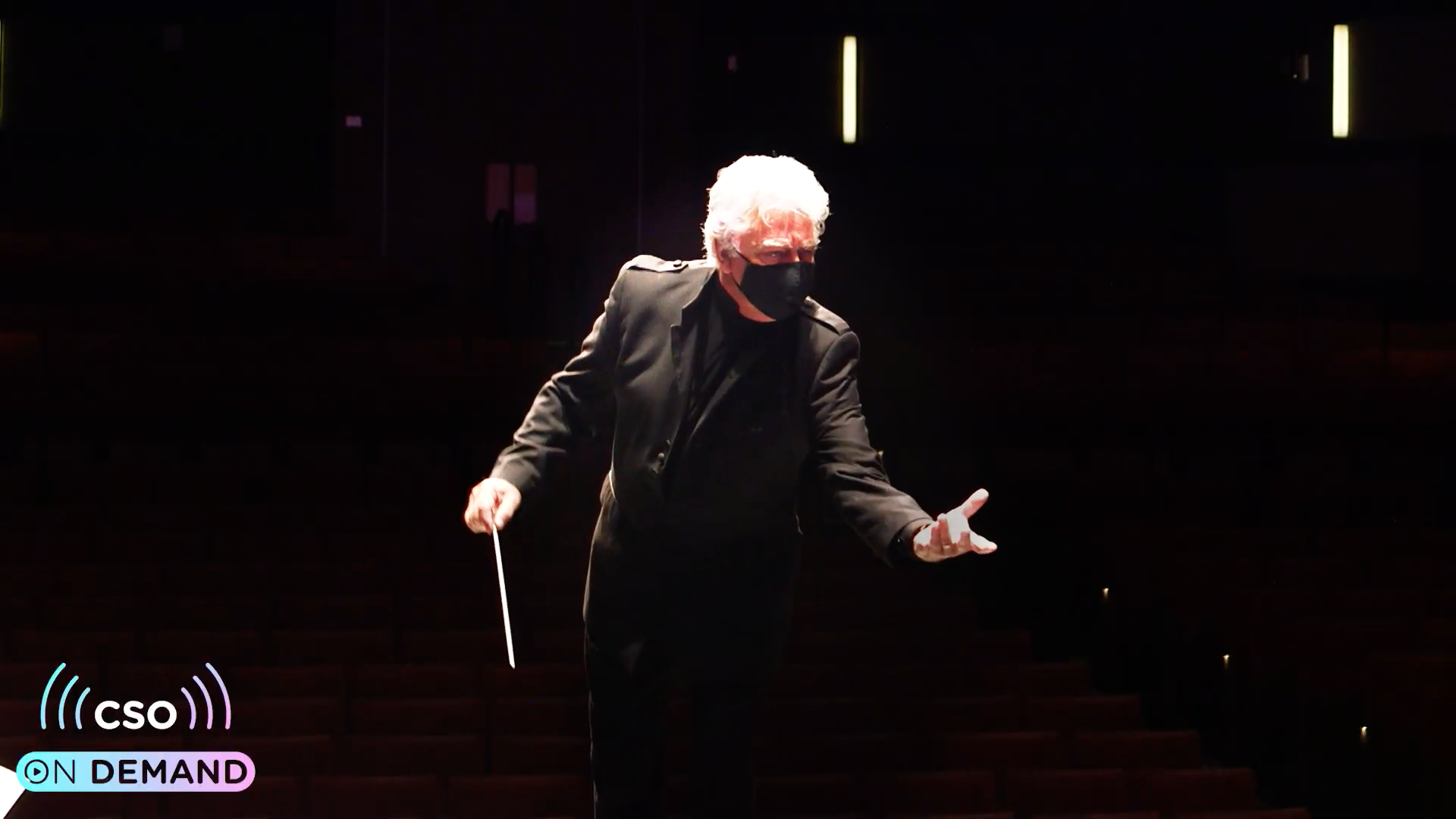
Hence a pivot to virtuality with a new CSO On Demand livestreaming series. It was doubly satisfying to see Christopher Warren-Green and a sizable contingent of his musicians onstage again at the Knight Theater, even if I was watching on a smart TV, for they hadn’t returned merely to serve up some musical pabulum. Edvard Grieg’s From Holberg’s Time and Tchaikovsky’s Serenade for Strings both have extended contemplative and elegiac episodes, echoing and commiserating with how we often feel in these mournful times instead of prodding us into forgetting.

2020~CSO Grieg-Tchaikovsky-12

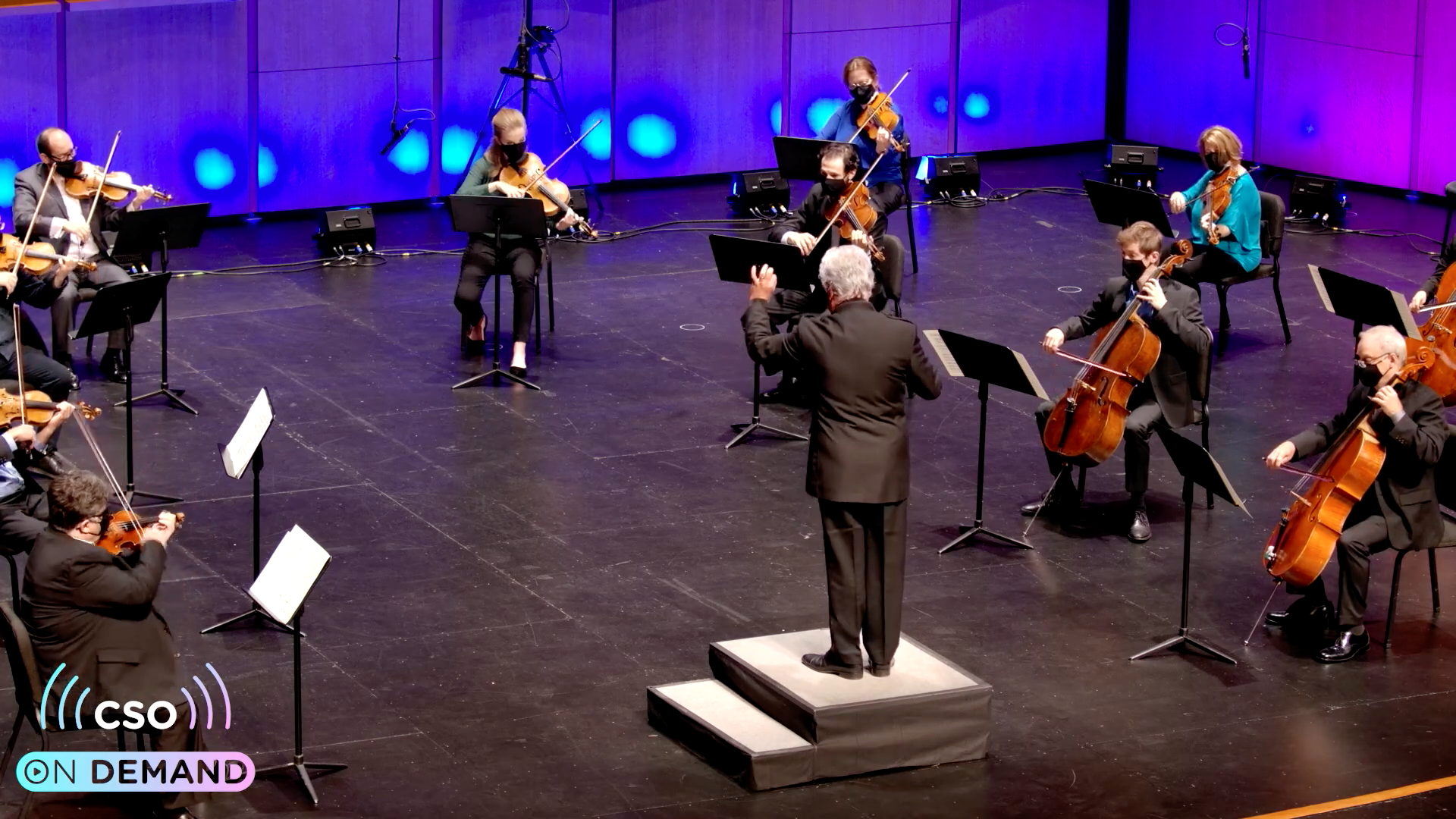
Even before they played, you couldn’t think Symphony was back to normal if you were watching. Winds, brass, and percussion were missing in action, so the stage wasn’t teeming with musicians and instruments. Nearly 40 percent of CSO’s string players were absent from this skeleton crew, spread out and socially-distanced on the Knight stage. Yes, I had expected Warren-Green and his orchestra to be masked, but the sight of them still took me aback, and I didn’t anticipate how different the ensemble would look when no two players shared the same music stand.

Whether it was hygiene, democratic deliberations, or aesthetics, the normal formalities of concert dress codes were relaxed, further emphasizing – or memorializing – that we were not back to normal. All were masked. Women were liberated to wear colored blouses or sweaters. Men wore jackets, but white shirts were not mandatory, and none wore neckties. Even with the purple-and-blue background lighting, the overall look didn’t suggest a triumphant celebration. All of these alterations seemed to color the music, making the opening Praeludium of the Holberg Suite sound braver and less festive. Similarly, I found the ensuing Sarabande more affecting, solemn, and poignant than I will if I revisit this concert at Symphony’s website in 2022.

The scent of springtime was unmistakable from the start of the middle movement Gavotte with hints of jollity in its brisk Allegretto. Nothing short of piercing heartbreak came across in the longest movement of the suite, the Air marked Andante religioso, all the more keenly felt when the music faded to a whisper before the last swell of feeling. Thankfully, concertmaster Calin Lupanu brought us back from this precipice with some truly zestful fiddling in the folksy Rigaudon finale, all of the other strings sustaining the merry Allegro con brio tempo behind him with pizzicatos, until his solo reached its jazzy release.

I don’t have any record of hearing Charlotte Symphony playing the Holberg before, but I own two recordings of the suite, one of which I reviewed in 2009, with Yuri Bashmet leading the Moscow Soloists. One of the things I particularly enjoyed on that CD was how the sound of the 17-member ensemble shuttled between the textured graininess of chamber music and the homogenized sheen of orchestral performance. That same delicious variety was audible in the Knight Theater webcast, particularly when I listened via Bluetooth on my Boston Acoustic loudspeakers via my Yamaha Receiver. Some of that texture Symphony’s 22 players was blurred when I listened through the same audio system via Chromecast, which also produced less delightful definition in the pizzicatos.

That same enhancement via Bluetooth was evident when I replayed the Tchaikovsky Serenade, which also appears on the previously mentioned Bashmet recording. So does Mozart’s famous Serenade No. 13, “Eine kleine Nachtmusik” – and with good reason. Tchaikovsky’s piece was written as an homage to Mozart’s Serenades, quickly finished while he was at work on the 1812 Overture and esteemed by the composer as having more heart and artistic merit than his flashier warhorse. Warren-Green didn’t seem to be aiming for Mozart as his trim orchestra launched into the initial Pezzo in forma di sonatina, which moves from an Andante non troppo tempo to Allegro moderato and back again. The massive sound Warren-Green elicited from his ensemble at the slower tempo evoked Bach more vividly than Mozart, and at the quicker Allegro juncture, the music was like the involuted canons Bach or Beethoven might whip up – or a dizzying 3/4 dance that might adorn one of Tchaikovsky’s own ballets.

2020~CSO Grieg-Tchaikovsky-06

With more of a ballroom ambiance as Warren-Green slowed and accelerated his tempos, the dancing flavor carried over to the Valse, where the cellos heightened the sense of intimacy with their warmth and tenderness. Beginning with a weepy whisper, the penultimate Élégie was the most tragic music of the evening, filled to bursting with bittersweet nostalgia. With pizzicatos handed off from section to section – four violas, four cellos, and two double basses to Warren-Green’s right, and 12 violins to his left – optimum audio reproduction paid especially huge dividends here. The orchestra has notably mastered playing softly under Warren-Green’s tenure, and the ending of the Larghetto was absolutely sublime.

The Tema russo conclusion began at a hushed Andante, hardly distinguishable from the Élégie that had preceded. With the onset of the Allegro con spirito section, we felt the joy and exuberance we had been craving during the middle movement of this Serenade – and realized how much we craved them. Before an even more rousing reprise of this celebration, the cellos ignited a romantic theme – and turbulent episode that built to a climax. A stately melody seemingly materialized out of nowhere, encapsulating all bravery, anguish, and grief that had weighed upon us through the evening before a final celebratory romp. Grimly, we were reminded how much more genuine joy feels after we’ve endured suffering and catharsis. Welcome back, Symphony, I’ve missed such authenticity.


Barefoot in Carnegie Hall, Conqueror at the Knight

2020~Beethoven's Emperor-11

Review: Charlotte Symphony and Conrad Tao Perform Beethoven’s “Emperor” Concerto

By Perry Tannenbaum

Celebrations of Ludwig van Beethoven don’t really need to lean on a convenient excuse. Just before celebrations broke out worldwide on January 1, 2020, commemorating the great composer’s 250th birthday, New York City’s WQXR played out 2019 with their traditional New Year’s Eve countdown of their audience’s top 100 favorites, culminating in a marathon tribute to Beethoven. Not only did Beethoven’s “Choral” Symphony No. 9 take the top spot yet again at the flagship classical FM station, six works by Beethoven were in WQXR’s top 10, including the top three. Charlotte Symphony certainly wasn’t standing in back of the line of orchestras poised for celebration as the new decade began.

Returning to Knight Theater from a tour of Southeast Asia with the London Chamber Orchestra, maestro Christopher Warren-Green capped the first full week of 2020 with a double-dose of the birthday boy’s compositions, the “Leonore Overture No. 3” and the “Emperor” Concerto No. 5, which finished No. 10 in the latest WQXR popularity poll. In between, we heard the Symphony No. 7 in C by Jean Sibelius, perhaps the first time that the Finnish composer’s final symphony has been performed in Charlotte. Pianist and composer Conrad Tao made his Charlotte debut with the orchestra.

We don’t have too many instances of rewrites among Beethoven’s published works, but his lone opera, Fidelio, and its overture are prominent exceptions. The three Leonore overtures (plus a “Fidelio Overture”!) testify that Beethoven not only fussed over the music for his opera, he also fussed over the title. Leonore, Creatures of Prometheus, and Coriolan are the overtures most favored as fillers on CD collections of the symphonies, and Warren-Green programmed Coriolan in an all-Beethoven concert in 2012. As far back as I can trace, this is the first time Symphony has separated the “Leonore Overture” from Fidelio, but our musicians likely recalled rehearsing it for an opera-in-concert version conducted by Christof Perick in 2004 and when Opera Carolina offered us a fully-staged Fidelio in 2015.

2020~Beethoven's Emperor-14

Musicians were perhaps too amped-up for the celebration as the Overture kicked off the concert. The opening sforzando over a timpani beat and the mysterious fadeaway that follows that burst were beautifully played. Woodwinds blended effectively and the flutes had a wonderful rapport before forebodings of the big tune rippled through the lower strings. But the crisp delivery and sleekly calibrated dynamics we have come to expect from this orchestra were missing on the first pass through the main theme, and there was no room left to dramatically turn up the volume later when the big tune repeated twice more. Thankfully, the ensemble steadied immediately afterwards – for the entire evening – sharpening their focus. Winds and horns remained tightly knit, principal flutist Victor Wang continued to charm, and principal trumpeter Alex Wilborn, deployed deep in the balcony, brought us forlorn pathos before concertmaster Calin Lupanu, playing fervidly, triggered the final galloping reprise and climax.

2020~Beethoven's Emperor-04

Other than interpolating how exhausted he still was after conducting the Leonore, Warren-Green was all about Sibelius when he picked up his mic for the first time in 2020, pointing out that the Finn was battling two illnesses as he wrote the piece over a 10-year stretch: depression and alcoholism. He also drew our attention to the trombone solos with insights gleaned from the original 1924 manuscript. The winds and strings, particularly the violins, drew a sweetness from the music that I hadn’t found on either of the CDs in my collection, and there were definite hints in the darkest passages, where the violins played low in their range, of the illnesses that afflicted the composer – and possible promptings for the way Shostakovich would register WW2 in his symphonies. Only the flow and the full grandeur of my Ashkenazy recording with the London Philharmonia were missing in Warren-Green’s reading. As for principal trombonist John Bartlett, the orchestral wreath surrounding his contributions – along with the embroidery Sibelius weaves with the winds – might cause you to overlook his unquestionable excellence.

No such danger threatened Tao as he emerged in his colorful attire. Only later admitting that he had begun the new year by packing negligently and forgetting his formal attire, Tao attacked his opening cadenzas with swashbuckling panache, and his phrasing proved to be no less audacious and individual than his attire and attack. Clearly, Tao has heard this soaring masterwork in his own way – but without perversely differing with traditional interpretations or seeking to draw undue attention away from the composer. Warren-Green and the orchestra responded vigorously to the young soloist, as much in the forefront of the epic opening Allegro movement as the piano. Of course, Tao impressed us more in the softer passages than the accompaniment here, but Symphony was certainly an equal partner in the magical Adagio that followed. The upper strings, delicately supported by pizzicatos from the lower strings, solemnly and lyrically cleared the way for Tao’s ethereal entrance – with a clarity that I’ve never heard on a recording. A bit of subtlety and nuance eluded Tao here and there in his phrasing, but Warren-Green and his ensemble remained marvelously simpatico in sustaining the sublimity.

For those of us who love this piece, Tao’s way with the ingenious transition between the Adagio and the Rondo finale likely sparked the most controversy and admiration. He certainly took his time, not playing the ending quite as softly as the usual pianissimos I’ve heard, but the sforzando burst to launch the concluding movement still had a satisfying snap and éclat. Symphony was as zestful as ever in its response, and Tao parleyed a playfulness and a muscular power we had not seen from him earlier, conclusively proving he could punish a keyboard.

Two more Beethoven masterworks, his Missa Solemnis and “Pastoral” Symphony, highlight the remainder of the 2019-20 mainstage classics series, the latter to be led by JoAnn Falletta. Symphony certainly had the appeal of their Tao program nicely gauged, scheduling an extra Sunday matinee after the usual pair of performances. Of course, Tao may have been kidding us when he spoke of forgetting his formalwear. In his enthusiastic New York Times review of Tao’s Carnegie Hall debut back in November, critic Anthony Tommasini couldn’t help noting that the pianist was clad in black slacks, a black jacket, a black T-shirt… and barefoot!