Tag Archives: Billy Ensley

Strong CP Cast Unleashes Newfound Power of “Ragtime”

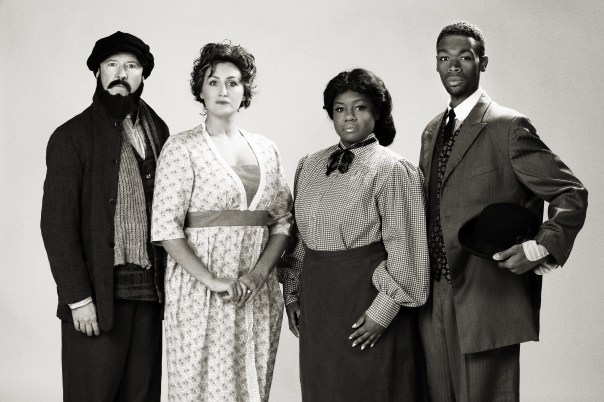
Ragtime Promo Photos

Review: Ragtime The Musical

By Perry Tannenbaum

Like Fiddler on the Roof, another musical with wide vistas, Ragtime The Musical begins its voyage back to 1906 by introducing us to groups of people. The stage begins to fill with comfortable, well-mannered white folk. Oppressed black folk, struggling for dignity and survival, form a crowd at the opposite side of the stage. Immigrants, disoriented and bewildered in the Promised Land, fill in the divide. Social activists Booker T. Washington and Emma Goldman flank the groups, along with the celebrities who tower above them all, including Harry Houdini, Henry Ford, J.P. Morgan, and Evelyn Nesbit.

But while shtetl life in Czarist Russia remains quaint, picturesque, and old-fashioned with each new revival of Fiddler, the issues revisited in Ragtime – racial prejudice, women’s second-class citizenship, and intolerance toward immigrants – have bounced back in our faces with frightful new life. The superiority we could feel toward the injustice suffered by Coalhouse Walker Jr. has evaporated since the days when Ragtime was published by novelist E.L. Doctorow in 1975 and adapted by Terrence McNally for the 1998 musical. Trayvon Martin, Ferguson… the list goes on.

Women’s rights and the welcoming attitude symbolized by Lady Liberty are also threatened by the reactionary sentiments unleashed by the 2016 election, the odious barrage of anti-Muslim rhetoric, and the post-inauguration travel ban. So the current CPCC Theatre production of Ragtime is not only timely, but thanks to one of the best casts ever assembled on the Halton Theater stage, it’s also newly powerful.

Tyler Smith delivers the most scorching performance as Coalhouse, particularly in the ragtime pianist’s valedictory solo, “Make Them Hear You,” when he’s on the brink of martyrdom. It’s as devastating a Coalhouse as I’ve ever seen, including the original Broadway production and the first national tour. But the taunting and race-baiting that come at Coalhouse from Josh Logsdon as New Rochelle fire chief Will Conklin no longer seem to be clichéd. Where Brian Stokes Mitchell on Broadway might have asked himself “how would I have felt 90 years ago?” Smith is merely tapping into how he feels – and it’s very fierce and raw.

The voice and delivery are Broadway-worthy, so it’s not at all a slight when I say that Smith’s partner, Brittany Harrington, nearly reaches the same lofty level as Sarah. When they reconcile and introduce “Wheels of a Dream,” seated in front of their Model T roadster, Harrington reminds us that this dream belongs to them both. It’s a tribute to their combined power that director Tom Hollis nearly empties the stage of the entire ensemble when the song is reprised at the end as an anthem. Together, as the happy-ending segment of the cast strolls into the horizon, Smith and Harrington sing them off.

What struck me by surprise was how much more forcefully the peaceful Mother’s story resonates. It’s quite natural to think of Mother as one of the handy junctions in this artfully interlaced tale. She welcomes Sarah and her newborn baby into her New Rochelle home, drawing the abandoned Coalhouse in pursuit – before he even realizes that he is the father of her child. Younger Brother, a member of the same well-to-do household, has a string of idols, including Nesbit and Goldman, before joining Coalhouse after the bold seeker of justice has taken over J.P. Morgan’s Manhattan library.
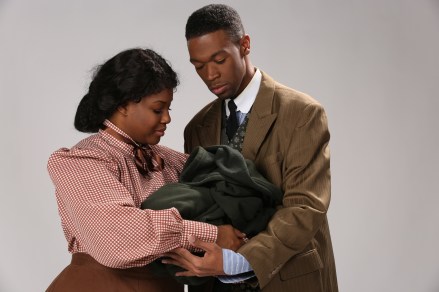
Ragtime Promo PhotosWhile all this spectacle rages around her, Mother has begun to evolve, almost from the moment that Father sails off with Admiral Peary on his expedition to the North Pole. After welcoming Sarah and the newborn into the household, her empathy widens to Coalhouse. Smith exudes a Nat “King” Cole kind of savoir-faire at the keyboard, so we’re not surprised. Yet Grandfather (Brian Holloway) is horrified and, after he returns from his explorations, so is Father.

But in the intervening year after her audacious decision to open her doors to Sarah, Mother has discovered that she has a voice. Not a small revelation when it comes more than three presidential elections before she will get the vote.

So while Andy Faulkenberry has a fine revolutionary zeal as Younger Brother, while Megan Postle breathes Mosaic fire as Emma Goldman, and Patrick Ratchford is extraordinarily patrician and privileged as Father – one of his best-ever outings – it was Lucia Stetson as Mother who truly bowled me over. The arc of Stetson’s journey, from “What Kind of Woman” when she first meets Sarah to “Back to Before” when she realizes she cannot continue under Father’s restrictions, is stunning and inspiring. This is how much a person can evolve. To his credit, Ratchford lets us know that Father has also budged slightly from his bigotry when his brave stint as a hostage is done.

In a way, Billy Ensley personifies all immigrants as Tateh, who arrives at Ellis Island at precisely the moment when Father is embarking on his polar adventure. J.P. Morgan, Goldman, and Houdini are all wrapped into Tatah’s dreams of “Success” and disillusionment, but neither Doctorow nor McNally soft-pedal his Jewish heritage. Right before his wide-ranging fantasia, Ensley sings “A Shtetl Iz Amereke” in his first song, faring better with the Yiddish than the chorus of immigrants behind him.

Houdini, a circus-like attraction in Tim Eldred’s portrayal, likens achieving success to escaping from a cage, but it’s Goldman, a fellow Jew, who speaks home truths. When Tateh wraps his daughter (Annabel Lamm) in a prayer shawl to combat the cruel cold, Emma says his rabbi would approve. Tateh is indeed a role of Houdini tricksiness as he begins by cutting out silhouettes of celebrities, later toils and goes on strike at a Massachusetts textile mill, and finally becomes the quintessential American success story when he reinvents himself as an Atlantic City filmmaker, Baron Ashkenazy.

Against the sunniness that Ensley brings to this epic musical, Keith Logan as Booker T. Washington and John DeMicco as J.P. Morgan help to shape the dark tragedy at the Morgan Library. It seems so much more inevitable to me now than it did when I first saw the denouement in 1998. If we can’t trust policemen to hold fire in 2017 when a black man surrenders with his hands up, how could we expect that they’d behave otherwise before World War I?

“We are all Coalhouse,” the ensemble sings in the somber aftermath – with a fresh sting. These words now ring as true as yesterday’s headlines. Much more in this CP revival of Ragtime may strike you that way.


American Reset Brings New Relevance to “Ragtime”

Ragtime Promo Photos

Preview: Ragtime

By Perry Tannenbaum

Things were so different in 1906, when E.L. Doctorow’s Ragtime begins. Theodore Roosevelt, a conservationist Republican, was in his second term at the White House. The wave of immigrant Jewish refugees, fleeing pogroms in Russia, was at its peak.

American women would have to wait three more presidential elections before they could vote, but the charismatic Emma Goldman was one of the strong voices agitating on the streets. Jazz had yet to be born in New Orleans, and the African-American superstars who sparked its popularity were still children, but Scott Joplin had already codified the architecture of ragtime.

When Terrence McNally adapted Doctorow’s 1975 novel for the musical that opened on Broadway in 1998, costumes worn by Goldman, by Tateh the Jewish immigrant, and by ragtime piano player Coalhouse Walker added to my impression that Ragtime was so yesterday. Women had already ascended to high elective offices and had figured prominently in presidential politics. Jewish immigrants and their descendants had crafted the very framework of Hollywood’s studios and Broadway’s musical theatre. Satchmo and the Duke were far in the rearview mirror of American cultural history, and Michael Jackson was deep into his reign as the King of Pop.

Surely we had matured as a nation since those primitive days Doctorow and McNally chronicled. Each time I saw Ragtime again, in 2001, 2005, and especially in 2011 – when Barack Obama was President, and Hillary Clinton, his most formidable opponent in the 2008 election, was Secretary of State – my sense of our superiority and progress as a nation continued to grow.

Then came 2016. The shocking election result. The inauguration. The women’s demonstrations across America and across the ocean. The opening assault on immigration.

Or how about Trayvon Martin, Ferguson, and the cavalcade of atrocities posted to social media since early 2012? When Ragtime arrives this weekend at Halton Theater in a new production by CPCC Theatre, it won’t seem as quaint and primitive as it did five years ago. In so many ways, we’ve punched the reset button.

When I saw Brian Stokes Mitchell as Coalhouse, the rousing song he introduced, “Wheels of a Dream,” seemed to be dreaming of today – or 1999, when I saw Mitchell at the Ford Theatre on 42nd Street, and the whole ensemble transformed “Wheels of a Dream” into an anthem at the end of the show. This week, when Charlotte powerhouse Tyler Smith takes on Coalhouse, I’ll have to humbly concede that his anthem is still envisioning a better tomorrow that hasn’t come.

Ragtime Promo Photos

Smith was never under any illusions. “This country was founded on principles that were never all-inclusive,” he says. “Our recent presidential results showed the world how much racial hatred still looms here.”

After a couple of lightweight roles at CP in last winter’s Irving Berlin revue and last summer’s Sister Act, Megan Postle is eager to show some range – and depth – as Goldman. “I have a personal attachment to Ragtime,” Postle reveals. “It was my first Broadway show. My aunt took me to see the original cast.”

One of the fascinating things about Ragtime is its mix of historical and fictional characters. Doctorow also gives cameos of varying lengths to J.P. Morgan, Booker T. Washington, Harry Houdini, Henry Ford, Admiral Peary, and Evelyn Nesbit.

But none of the historical characters is altered more in trafficking with Doctorow’s fictional characters than Emma, who sheds her anarchist and assassin tendencies. “Goldman is the Greek chorus for Ragtime,” says Postle. “She speaks for all members of the human race who feel there is inequality.”

Emma also helps to stitch the various strands of the plot together. Coalhouse and Tateh head two of the three families that anchor this story. They are the outsiders while the third family, prosperous inhabitants of New Rochelle, complete the New York triangle of the story. Sailing off to join Admiral Peary’s polar expedition as we begin, the Father waves to Tateh, who is on a raggedy ship that has nearly completed its voyage across the Atlantic to Ellis Island.

From that point, the story forms an epic arc that resolves gracefully as the full company delivers its epilogue. Along the way, we glide past a labor strike by exploited millworkers in Massachusetts, Goldman’s galvanizing oratory, horrid police brutality, and audacious, explosive, vengeful responses from Coalhouse.

Smith admits that racial issues have heated up since the most recent 2009 revival of Ragtime on Broadway and the end of the Obama presidency.

“Today’s Coalhouse is every father, husband, brother and son killed without proper justice being served,” he said. “Every wife, sister, mother and daughter who have to feel the grief and bear the weight of losing a lost one while nobody seems to care. People like Eric Gardner, Trayvon Martin, Keith Lamont Scott, the mothers of all those murdered in Chicago. There is a line sung in the show saying ‘we’re all Coalhouse.’ It hits home because it is true.”

Tom Hollis, CP’s drama chair, chose Ragtime for the 2016-17 season back in the spring of 2015, around the time when the announcement of Donald Trump’s candidacy was greeted with more laughter than alarm. Hollis considered it then in the vein of 1776, the musical that was already set to run last September, just before the first presidential debate.

He still does. “When we were doing 1776 in the fall of 2016, we were constantly being struck by the parallels to life today,” Hollis says. “Each generation of Americans has had to face coming up with an answer to these issues because they are woven into the fabric of our country. That we haven’t been able to find a permanent solution is the sad irony of our history.”

A hard, tragic compromise on slavery clouded the happy ending of 1776, and what happens to Coalhouse clouds the ending of Ragtime. A member of the New Rochelle family who was inspired by Goldman ultimately vows to keep Coalhouse’s story alive, while Tateh achieves the American dream.

Billy Ensley, a mainstay of the CPCC Theatre for decades, will play Tateh at the Halton. It’s just the latest in a series of Jewish roles that he has played over the course of his acting career, including Eugene in Neil Simon’s Broadway Bound and two ill-fated historical figures, San Francisco activist Harvey Milk and Atlanta’s Leo Frank. Wrongly convicted of the 1913 murder of Mary Phagan in Atlanta – and subsequently lynched – Frank was the tragic hero of Alfred Uhry’s Parade, presented at the Halton in 2006.

So for Ensley, it’s a journey back to the same period with a similar rueful takeaway, even if Tateh does end happily.

“Current events regarding immigration have only strengthened the way I have always felt about those that are marginalized, forgotten, discriminated against,” Ensley says. “We all deserve a chance to live fulfilling, safe and happy lives, and those of us that have that already should do what we can to see to it that others less fortunate can as well. Our country was built by immigrants.”

Ensley offers advice for immigration opponents: “For those today in favor of a closed-off America, I suggest a trip to Ellis Island and a little research on where the people came from that made this country the wonderful and rich country that it is.”

Travel advisory: Ellis Island is just a short boat ride away from the Statue of Liberty, depicted on the cover of numerous editions and translations of Ragtime.