Tag Archives: Benjamin Beilman

Down at Spoleto USA, the Vibe Is Shifting

Review: Spoleto Festival USA in Charleston

By Perry Tannenbaum

‘Song of Rome’ at Spoleto Festival USA in Charleston. (Photo by William Struhs)

Looking down benignly at his Dock Street Theater audience, the newly anointed host of Spoleto Festival USA’s chamber music series, Paul Wiancko, gave us a slight ceremonial nod. “You have chosen wisely,” he said sagely.

But he wasn’t exactly speaking to me, since this was already the fifth program in the noonday series – the backbone of Spoleto – that I was attending this year. Nor was he speaking to the “eleven-ers” in the audience who were signed up for the complete set of programs down in Charleston through June 9.

He was speaking directly to those in the audience who would only attend one of the concerts. Today. And he would go on to ask us all to participate in making the experience special and unforgettable.

It would be very special – beginning with a Beethoven piano trio that showcased Amy Wang at the keyboard, Benjamin Beilman on violin, and Raman Ramakrishnan on cello. How’s that for diversity? My love affair with Wang’s artistry and demeanor had begun just two hours earlier when she played the Schumann Violin Sonata, teamed up with the Slavically expressive Alexi Kenney.

Enough to mightily crown most concerts, the Beethoven was merely a satisfying appetizer. For Wiancko had cooked up a powerful combo, calling upon two living composers that I was barely familiar with, Jonathan Dove (b. 1959) and Valentin Silvestrov (b. 1937).

Our contribution to the magic would be to withhold our applause between the two pieces. It was easy enough to maintain stunned silence after In Damascus, Dove’s heartfelt setting of Syrian poet Ali Safar’s grieving – and aggrieved – reaction to a senseless car-bombing in his nation’s war-torn capital.

The prose poems were achingly and angrily sung by tenor Karim Sulayman, perhaps most indelibly after an extended instrumental interlude, turbulently delivered by a string quartet that included Kenney, Beilman, Wiancko (on cello), and violist Masumi Per Rostad.

“We will be free,” Sulayman sang in Anne-Marie McManus’s ardent translation, “of our faces and our souls – or our faces and our souls will be free of us. And the happy world won’t have to listen to our clamor anymore, we who have ruined the peace of this little patch of Earth and angered a sea of joy.”

Sulayman was visibly in tears as the lights went down on In Damascus and pianist Pedja Mužijević entered with his iPad and sat down at the Steinway. In the dimness, Mužijević played Silvestrov’s Lullaby, an appropriate coda to a song sequence that began with the children of the Zuhur neighborhood in Damascus who would never wake from their sleep – or survive a bogus “holiday truce” – and ended with the evocation of mothers and loved ones who would always await their return.

Amazingly enough, this isn’t the only instance where Sulayman is singing about children caught in the web of brutal war and barbaric terror, for his wondrous voice also figures at Spoleto in the world premiere of Ruinous Gods, a new opera with exotic music by Layale Chaker and libretto by Lisa Schlesinger.

Co-commissioned by Spoleto, Nederlandse Reisopera, and Opera Wuppertal, Ruinous Gods is a fantastical deep dive into the mindworld of Uppgivenhetssyndrome, a rare traumatic response to living in the limbo of displacement. It was first observed in children detained in Sweden, but the syndrome has now been observed in refugee camps around the world. Hopeless children simply go to sleep in reaction to their endlessly unresolved status. Some die, others lapse into coma – sustained only by a feeding tube.

Encased in a surreal bubble over a grassy bed from scenic designer Joelle Aoun, that is how we find our sleeping-beauty protagonist, Teryn Kuzma as H’ala, when the opera begins. Mezzo-soprano Taylor-Alexis DuPont as her mom, Hannah, is stressing and blaming herself while two doctors, Overcast and Undertow, hover over their patient, unsympathetic researchers hoping to analyze and classify the disease.

Meanwhile, Sulayman is decked out in a feathery all-black outfit as Crow, the mentor who, like Dante’s Virgil, guides all these comatose children from around the globe into a common underworld dreamscape where all are free. Is that a spaghetti rainbow dropping down across the Sottile Theatre stage from the fly loft as the imprisoning globule lifts off H’ala, or is there an unfathomably large jellyfish floating above?

Sinuous, jazzy, and sensuously obsessive, Chaker’s music resurfaced in the jazz sector of Spoleto 2024 – at Charleston Music Hall, a venue never used by the festival before. Bigger than Spoleto’s customary hall for chamber jazz (and eccentric modern music), the Emmett Robinson at the College of Charleston, the Music Hall was an acoustic revelation and a welcome escape from the Robinson’s clean-room sterility. Bonus points for the stars that lit up on the black backdrop.

Attendance was astonishing, more than could ever be seated at the Robinson, as Chaker, leading her Sarafand quintet on violin – with an occasional vocal – delved into her two most recent albums, Radio Afloat (2024) and Inner Rhyme (2019). Having worked with Daniel Barenboim and his West-Eastern Divan Orchestra, Chaker has created a jazz equivalent in Sarafand with Phillip Golub on keyboards, Jake Charkey on cello, John Hadfield on drums, and Sam Minaie behind the bass.

Compared to her opera, Chaker’s jazz and her Sarafand personnel made subtler political points. But this wasn’t the only jazz gig that came loaded with extra cargo. Terri Lyne Carrington returned to Cistern Yard for a pointedly themed concert under the moon and the live oaks – with political firebrand diva (and NEA Jazz Master) Dianne Reeves as her special guest.

Carrington’s cargo was collected into her Grammy-winning album of 2022, New Standards, Vol. 1, the first studio sprouting of her pathfinding songbook collection, New Standards: 101 Lead Sheets by Women Composers. So without much preaching, her set was a celebration of Geri Allen, Gretchen Parlato, Eliane Elias, and – at a high summit where Reeves duetted for the first time with Christie Dashiell – the great Abbey Lincoln and her mesmerizing “Throw It Away.”

All these greats joined together again on Allen’s “Unconditional Love,” with Kris Davis on piano, Matthew Stevens on guitar, and trumpeter Etienne Charles all getting in their licks, plus spoken and dance stints from Christiana Hunte. Wow.

Theatre at Spoleto this season is densely messaged. Or not. The Song of Rome was deeply immersed in issues of immigration and sexism, with an overarching interest in the fate of republics, in ancient day Rome and 21st century USA. Cassette Roulette, on the other hand, was pure frivolity, barely deeper than its title and whole lot bawdier.

After starring in An Iliad last season, Denis O’Hare could be logically expected to follow up that one-man conquest with An Odyssey. Well, he has, sort of. O’Hare co-wrote A Song of Rome with Lisa Peterson, his Iliad writing partner, but this time he doesn’t appear onstage, handing over the acting chores to Rachel Christopher and Hadi Tabbal.

Christopher is Sheree in modern times, a grad student striving to learn Latin, and Octavia, Emperor Augustus’s sister at the dawn of the Roman Empire. Tabbal is Azem in present day, Sheree’s immigrant Latin tutor – and our overall storyteller – and the poet Virgil during the reign of Augustus.

So O’Hare is skipping over the rest of Homer to engage with Rome’s great epic, The Aeneid, knowing full well that Virgil based the first six books of his masterwork on The Odyssey and the last six on The Iliad. As a thematic bonus, O’Hare and Peterson discovered during their research for this world premiere that Virgil himself was a refugee, forced out of his ancestral home in Northern Italy by Roman avengers of Julius Caesar who got Dad’s estate for their prize.

Although Virgil’s epic was likely commissioned by Emperor Augustus, aka Octavian, doubt remains whether The Aeneid is a work of propaganda justifying the Roman Empire as divinely ordained – tracing Octavian’s ancestry back to Aeneas and Venus as meticulously as the New Testament traces Jesus back to King David, son of Jesse – or a subversive work by an immigrant genius settling a score. While getting handsomely paid to do it.

Octavia and Virgil go back and forth on this point because the Emperor’s sister is both an admirer and a keen reader, but both are critical of Octavian, who is hell-bent on buttressing the legitimacy of Rome while closing off its path back to a glorious Republic.

“The Republic is over,” they agree. And how about ours?

While Sheree is learning about the Roman issue that comes up as Virgil delivers more and more manuscript pages to Octavia over the years, Sheree must face the issue in American terms when Azem receives a deportation notice. Does she instantly jump to his defense and rescue, or does she immediately suspect him of criminal activity?

Meanwhile, Sheree is reading The Aeneid differently from Azem and Octavia. Why is Octavia left out of literary history if she played such a key role? Why are Virgil’s women, particularly Dido and Lavinia, so passive and pathetic while the strong woman, Camilla, is a she-devil?

Finding this insidious neglect and defamation rampant in literary history and beyond, Sheree comes up with a radical, shocking solution that she announces on her podcast. She will pour fuel over every single book piled on the Dock Street stage and burn them all.

When will all this vicious animosity end? Citing the end of Virgil’s epic, where Aeneas, the immigrant from far-off Troy, killed the vanquished Turnus instead of offering peace, conciliation, and mercy, Sheree answers us curtly lighting the flame: it won’t. Opting for chaos, she almost says it aloud – to hell with the immigrants. (Or give it to the immigrants, if you’ve heard of the Goths.)

Moments like that land hard at Spoleto. Deep in Trump Country, at the Sunday matinee of Ruinous Gods, there was a loud boo among all the lusty cheering as the singers took their bows. Good. The nurturing point of the opera, gushing with empathy toward immigrants worldwide, had hit home, no matter how you feel about it.

Depending on whether you were attuned to John Cameron Mitchell’s Hedwig and the Angry Inch cache, or whether you resonated with Amber Martin’s worship of Reba McIntyre, Bette Midler, and Stevie Nicks, Cassette Roulette was hit-and-miss, redeemed or further cheapened by Martin’s bawdiness. Nicks’ “Rhiannon” was the crowd fave and mine on the night I attended, getting a far more epic performance that you’ll hear on AM radio or an elevator. But neither David Bowie nor Midler got much of a rise. The diet of ‘70s and ‘80s hits didn’t draw much of a youth crowd to Festival Hall, which was made over to a quasi-cabaret setup.

Trombone Shorty slayed far more decisively at TD Arena, where his outdoor revels with Orleans Avenue were abruptly moved when rain threatened. At the height of the indoor bacchanale, Shorty paraded through the audience at the home of College of Charleston basketball with key members of the band (none of whom were named in Spoleto’s fabled program book). They slashed up the rear aisle of the stadium, swung around to the side of the gym and came down along the side.

Snaking through the stadium, Shorty & Orleans reigned over the reigning pandemonium. The prohibition against photography was washed out to sea in a riptide of glowing cellphones.

Shoot, the band was taking selfies! And through it all, the sound remained perfect, Shorty and his brass perfectly aligned with the rhythm section on the TD stage, absolutely distortion-free. Sure, a few dissenters and defectors also trickled through the aisles, accompanied by true believers seeking and returning with beverage.

The most pathetic sufferer sat right across the aisle from my wife Sue and me, hunched over, elbows on kness, with his hands tightly cupped over his ears. Probably needed a ride to escape. Maybe he would have fared better in the open air, where at least some of the sound could have escaped skyward through the live oaks of Cistern Yard.

Final week highlights: Bank on it, the Bank of America Chamber Music series has four more different programs to offer – and a dozen performances – before Spoleto wraps up on Sunday. The Wells Fargo Jazz lineup continues strong, with an all-star Latin twist. Puerto Rican saxophonist Miguel Zenón and Venezuelan pianist Luis Perdomo bring their Grammy-nominated El Arte Del Bolero albums to life at the Dock Street Theatre in a three-day, five-performance engagement (June 6-8) while Cuban percussionist extraordinaire Pedrito Martinez lights up Cistern Yard with an Afro-Cuban stewpot of infectious rhythm, Echoes of Africa (June 7).

After distinguishing themselves in Mahler’s Fifth, the Spoleto Festival USA Orchestra returns to Gaillard Center with Beethoven’s Third (June 5), plus a Rachmaninoff concerto for piano + trumpet and composer-in-residence Reena Esmail’s “Testament” for tabla and orchestra. Upstaged by a visitation from the Charles Lloyd Sky Quartet this past weekend, the Spoleto Festival USA Chorus rebounds with a two-performance run of The Heart Starts Singing (June 6-7), sporting another Esmail piece that will feature Wiancko’s cello – and an eclectic mix of works by Tomás Luis de Victoria, Rachmaninoff, Irving Berlin, and more.

The Festival Finale of yore is gone this year, but there’s more folk, funk, Americana, and alt-country in this year’s Spoleto lineup. Still to come are Andrew Marlin and Emily Frantz’s latest partnering, Watchhouse (June 5), with their own band-backed experiments in folk-rock playing at Cistern Yard; Grammy Award winner Aiofe O’Donovan (June 7) returns with the SFUSA Orchestra to Sottile Theatre; and Jason Isbell (June 8-9) headlines the final weekend with a two-night stint at the Cistern.

Theatre continued during Spoleto’s second weekend with sharply contrasting shows, the wholesome Ugly Duckling from Lightwire Theater and the savagely satirical send-up of the American West, Dark Noon, from the Danish fit + foxy company in its US Premiere. A similar dichotomy prevails this week as Australian company Casus Creations takes over Festival Hall with Apricity (June 6-9), a family-friendly mix of aerial and acrobatic astonishment, with sprinklings of comic shtick and moody music.

On the edgy side, RuPaul’s Drag Race fans can rejoice greatly as Season 9 champion Sasha Velour deigns to bring her presence to Gaillard Center with The Big Reveal Live Show! (June 6). Is Charleston’s big house big enough for drag’s Queen of Queens? The Holy City and Spoleto haven’t been so sensationally desecrated since Taylor Mac ruled the festival.

Wiancko Takes the Baton at Spoleto’s Fabled Chamber Music Series

Review: Spoleto Festival USA Chamber Music at Dock Street Theatre

By Perry Tannenbaum

When Geoff Nuttall died of pancreatic cancer in October 2022, Spoleto Festival USA lost its most distinctive personality, the “Jon Stewart of chamber music,” before any of us had noticed a single gray hair on his glorious mane. Replacing him as director of the festival’s noonday chamber music series, the backbone of Spoleto, seemed like sacrilege last season to those close to the ebullient violinist. However, Nuttall’s stylish hosting chores still needed to be done.

Fittingly, a cavalcade of other chamber music players stepped into the role, for hosting at Dock Street Theatre had always been handled by musicians who contributed to the playing. Esteemed harpsichordist Charles Wadsworth had passed the baton over to Nuttall after many years as Spoleto’s most recognizable personality and the series’ jovial noonday host. Nobody would say whether the parading pinch-hitters were auditioning for the role of Nuttall’s successor. Still, it felt that way, especially since the festival’s general director, Mena Mark Hanna, had declared that the musician-host tradition would go on in Charleston.

And Charleston is a very traditional city.

So for cellist/composer Paul Wiancko, 2023 was an auspicious year. In late winter, before his fourth appearance at Spoleto, Wiancko became the new cellist with the pioneering Kronos Quartet, and in early fall, he was named SFUSA’s third chamber music director. Changes to the series have been noticeable: nine of the 22 performers in the 2024 festival are making their Spoleto debuts, and there are 50 percent more pieces by living composers in the program lineup.

Coupled with the abrupt terminations of resident conductor/director of orchestral activities John Kennedy and his Music in Time series, Wiancko becomes not only Spoleto’s chamber music guru but also the festival’s chief purveyor of contemporary classical music.

And he’s doing it with his own unique style.

Wiancko is more about theming each of the 11 concerts in the chamber music, more about the Zen of each program. Nuttall was very laid-back and West Coast in his attitude toward programming and concertgoing, stressing variety in his repertoire choices and encouraging his audiences to be at ease. If you want to applaud between movements, go right ahead. At a couple of concerts, Wiancko took what seemed like a Far Eastern approach, requesting that we withhold applause – to magnify the cumulative effect of two pieces he was presenting in tandem.

The first time Wiancko employed this tactic, it became emotional on the Dock Street stage. In retrospect, we can understand why. For this coupling, Wiancko led off with an unfamiliar work, Marejada, created during the 2020 pandemic by Puerto Rican composer Angélica Negrón, and then in the silence segued to Franz Schubert’s posthumous String Quintet in C, perhaps the most-played chamber work in Spoleto history – for many years, the last piece performed in the lunchtime series.

Written for string quartet, assorted percussion, and pre-recorded ocean waves (referenced in Negrón’s title), performers for Marejeda included Wiancko, violinists Alexi Kenney and Livia Sohn, and Wiancko’s spouse, violist Ayane Kozasa. Kenney would leave crumpled paper onstage after the piece as he exited along with Wiancko and Kozasa, respectively carrying a conch shell and a can – plus a spoon to hit it with.

That left Sohn and her gong onstage as Owen Dalby entered to take over the first violin chair, Lesley Robertson replaced Kozasa place on viola, and cellists Christopher Constanza and Ramakrishnan spelled Wiancko. It was quite possible to overlook the fact that three of the four members of the now-defunct St. Lawrence String Quartet – Dalby, Robertson, and Constanza – were now reassembled, minus their first violin, Geoff Nuttall. Or it was until, more than a half hour later, the sweetly mournful, fiercely and achingly turbulent second movement Adagio concluded and Sohn, Nuttall’s widow, broke down momentarily.

Dalby understood as the delay continued, softly clutching Sohn’s bow hand until she could go on. More of us would have shed tears, I believe, if they had reprised that Adagio.

More tears flowed more predictably three days later when Wiancko coupled two contemporary composers, Jonathan Dove and Valentin Silvestrov, in his next hold-your-applause tandem. Another string quartet was augmented by a fifth voice, this time tenor Karim Sulayman in Dove’s In Damascus, set to the prose poem sequence by Syrian poet Ali Safar, as translated by Anne-Marie McManus.

Eclipsed by Rhiannon Giddens’ Omar when he brought his Unholy Wars to Charleston in 2022, Sulayman has been indelible this year, first in the world premiere of Layale Chakar’s new opera, Ruinous Gods, which embraces the most vulnerable refugee children from war and terror worldwide, and then in this absolute Dove-Safir stunner.

Two days ago we were standing where the long line of Syrians trying to leave the country waited… Nothing happened, except that we saw a nation where the sun had burned out. Over time, no spark remained for its residents except the sparks of their eyes, which were fading… Like tears…

After Dove’s 11-part cycle – only the sixth part was wholly instrumental, featuring Wiancko, violist Masumi Per Rostad, and violinists Alexi Kenney and Benjamin Beilman – the lights dimmed as Pedja Mužijević entered from the wings to play Silvestrov’s touching Lullaby at the Steinway. But the funereal gloom and Mužijević’s entrance at stage right weren’t sufficient to distract us from Sulayman, still standing at centerstage, weeping profusely before he daubed his eyes.

Preceded by Beethoven’s Piano Trio No. 3, with Beilman playing violin, Ramakrishnan cello, and newcomer Amy Yang at the keyboard, this was surely one of the greatest of the many great chamber music concerts ever performed at the Dock. Yet just two hours earlier, I’d witnessed Yang’s debut at Spoleto, definitely one of the most sensational in recent years as she teamed with Kenney on Robert Schumann’s majestic Violin Sonata No. 1, the best and most passionate live performance I’ve seen of a violin sonata since Daniel Hope and Sebastian Knauer played Beethoven’s Kreutzer at the Savannah Music Festival in 2011.

Both Yang and Kenney can be regarded as among Wiancko’s inner circle, Kenney along with Kozasa being fellow members of Owls, an “inverted string quartet” with two cellists, and Yang being one of the artists Wiancko has composed for. They seemed to be kindred spirits from the opening bars. With admirable subtlety, Wiancko themed this concert as a “Celebration of Resonance,” never mentioning that Yang’s debut solo album of 2019 was Resonance, including pieces by Bach, Caroline Shaw, and Schumann.

Of the 11 programs presented during the lunch hours at Spoleto in 2024, I only saw seven, so I cannot offer an authoritative judgment on whether Yang’s big splash was surpassed by any of the other debuts. But two strong contenders emerged in Program VII on my last day in Charleston, cellist Sterling Elliott and percussionist Ian Rosenbaum, both of whom made their debuts in Program VI the previous day.

Elliott had slipped in among a string septet that played the original 1978 version of John Adams’ breakthrough piece, Shaker Loops, where fitting in was a prime objective. Standing out became the mission when the cellist sat down with Mužijević to play William Grant Still’s Mother and Child – Elliott’s transcription of Still’s 1943 Suite for Violin and Piano, Part II. It really sounded like his own piece, the tenderness of the composition darker and more aching and the affirmation nearly as joyous.

Rosenbaum’s debut had kicked off Program VI, more high-profile since he was paired with Wiancko on Andy Akiho’s 21 for cello, marimba, bass drum, tambourine, and electronics. Plucking strings, clapping, tapping the top and sides of the cello, and pedaling the big drum – as well as plain bowing – Wiancko garnered most of the attention at the beginning and end of the piece, though the percussionist was also performing some extracurricular antics behind the marimba, switching mallets, rapping the tambourine, and triggering the electronics.

Played on steel pans as it was originally written, Akiho’s piece looks and sounds a little better, particularly when the sides of the pans are struck. But the marimba version was still spectacular, building to a pounding climax, four instruments and electronics sounding simultaneously. Almost as spectacular, Christopher Cerrone’s Double Happiness, with Rosenbaum playing vibraphone and a small array of malleted instruments in duet with a prepared piano, was far more sublime. We watched over Wiancko’s shoulder as Yang prepared the Steinway’s innards.

Nor did Wiancko disappear after he and Yang delivered their play-by-play of the piano prep, retreating to one wing to operate electronics on cue. At a somewhat hypnotic pace, Yang was obliged to stand up at the keyboard, plucking or strumming or dampening the strings inside the Steinway, sometimes while playing the keys with her free hand. Usually wielding two mallets in each hand, Rosenbaum performed similar wonders at his instruments, occasionally striking both the vibraphone and a smaller instrument behind it with mallets wielded by the same hand.

Paradoxically, the prerecorded electronics and reverb effects layered onto Double Happiness added the echoey steel pan aura that was missing the day before. The cathedral of sound at Dock Street Theatre was magical, like nothing I had experienced since I first heard A Genuine Tong Funeral,composed by Carla Bley, on Gary Burton’s memorable CD with quartet and orchestra.

Wiancko may not be a perfect fit for the Jon Stewart label, but there’s something in each of his programs that reminds me of the Comedy Central shows I once watched regularly. More than Nuttall ever did, Wiancko makes it his business to interview at least one other musician or composer during every program. More often than not, he frames these encounters like a podcast. Very entertaining.

When composer-in-residence Reena Esmail made her debut on the same program where Rosenbaum and Elliott made their bows, Wiancko greeted her like a starstruck fan. The build-up stood up as Yang and longtime Spoleto stalwart Todd Palmer gave a very fine account of Esmail’s Jhula Jhule for clarinet and piano.

Cox and Beilman Play the Changes, Guesting with CSO

Review: Charlotte Symphony Plays Wagner, Mozart, and Brahms

 By Perry Tannenbaum

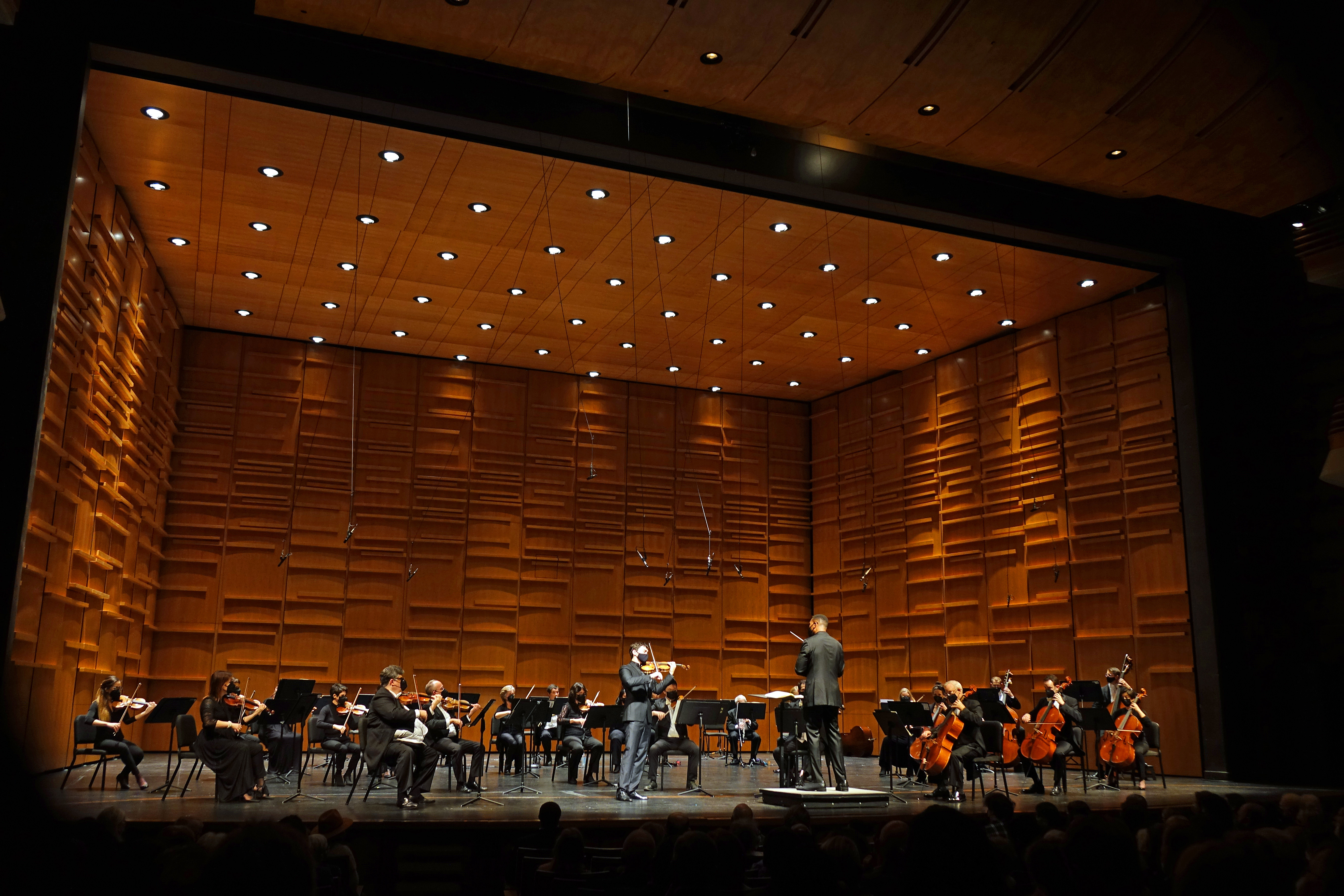
2021~CSO Brahms Serenade-03

Holding our collective breaths, subscribers can hope that the current Charlotte Symphony program represents the last retreats from the fare originally announced for the 2021-22 season. Although Richard Wagner’s Siegfried Idyll replaced Zoltan Kodály’s Dances of Galánta and Johannes Brahms’ Serenade No. 2 replaced his Symphony No. 3, we still had guest conductor Roderick Cox and guest soloist Benjamin Beilman, though Beilman needed to be as flexible as the orchestra, switching from the Charlotte premiere of Samuel Coleridge-Taylor’s Violin Concerto to Mozart’s “Turkish” Violin Concerto No. 5. Of course, Brahms himself might have laughed out loud at the hasty substitution, since he had been so famously averse to attempting a symphony while Beethoven’s shadow still loomed so large. Compounding the hilarity, the Serenade No. 2 may have been historic, possibly the first closing piece at a Symphony Classics Series concert to be played without violins onstage.

Written for his wife, Cosima, in 1870 and later dedicated to their son upon publication, Wagner’s Siegfried Idyll isn’t extracted from any of his operas, though the music sometimes smacks of themes from The Ring cycle, especially Siegfried. It begins intimately enough, with a quiet string quartet, comprised of principals from the string sections, with concertmaster Calin Ovidiu Lupanu unmistakably the lead voice. So audience members at Knight Theater could easily imagine the romantic story of the music’s informal premiere, when Wagner stealthily placed his little orchestra (just 13 on that morning) on the stairway leading to Cosima’s bedroom while she was still sleeping – gradually awakening her as the music swelled. A couple of French horns and a trumpet eventually added force and volume to the composition, and principal oboist Hollis Ulaky played memorably in numerous spots.

2021~CSO Brahms Serenade-02

Beilman seemed to be even better matched with the Mozart than he had been with the Beethoven in his 2017 Charlotte debut. Hearing a live performance at this level was more rewarding than listening to my favorite recordings by Arthur Grumiaux, David Oistrakh, and Julia Fischer. By this time, it was quite obvious that Cox had taken the eleventh-hour changes in programming totally in stride, for the introductory orchestral passages of first two movements of the Mozart, an Allegro aperto followed by an Adagio, had a bloom that rivaled the most sublime passages in the Wagner, with no less polish. Beilman’s highest notes had admirable muscle, his pianissimos in that stratosphere were ethereal, and his midrange was as burnished as I had remembered from the Beethoven. The closing Rondeau showed us how truly ingratiating Beilman can be as he genially swayed us in a waltzing 3/4 tempo – then suddenly jerked us out of our comfort zone as he and Cox conspired, nearly halfway in, to bring extra drama to the sudden lurch into the “Turkish” section of this movement and its lively duple tempo. Try counting this section any other way than 1-2, 1-2, 1-2… I couldn’t.

2021~CSO Brahms Serenade-07

Unlike so many of the serenades inflicted on us – there, I’ve said it! – during the pandemic, Brahms didn’t limit either of his to strings alone. The Serenade No. 2 includes a full complement of woodwinds and a pair of French horns. Bassoonists Joshua Hood and Naho Zhu were unusually prominent in the reedy opening measures of the Allegro moderato, with flutists Victor Wang and Amy Orsinger Whitehead soon afterwards coming to the forefront. Violins over plucked cellos and basses heightened the intensity and made a pathway for Ulaky on oboe to shine again. Rigidly on-the-beat handling his stick, Cox made the ensuing Scherzo: Vivace more march-like than the acclaimed Michael Tilson Thomas recording, but the rhythmic thrust and liveliness remained unmistakable.

2021~CSO Brahms Serenade-09

Audience members should have noticed by this time that Brahms intended his clarinetists to switch between A, C, and B-flat clarinets over the course of this Serenade. Churning lower strings (remember, there weren’t any violins) ushered in the middle Adagio non troppo movement, but principal woodwind players had sufficient time to leave their imprints, including Ulaky, Wang, and – far in the treble – clarinetist Taylor Marino. With Cox taking a notably sprightly take, the penultimate Quasi menuetto was more of a trinket than the Scherzo had been, Ulaky and Wang excelling once again. Discarding all remaining restraint and tenderness that we might have expected from a Serenade, Cox and Symphony made the closing Rondo a rollicking romp from the first bars, clearly taking aim at compensating for the lack of a symphony on the program. Oboes, clarinets, and horns led the charge, with the low strings high-stepping right behind them. Erinn Frechette finally had chances to tweedle on her piccolo as the winds reached their maximum effervescence, but the congregation of strings eventually had their say, building to a satisfying ending.

Symphony Demonstrates Their Seasoning in Beethoven

Review:  Beethoven’s Violin Concerto

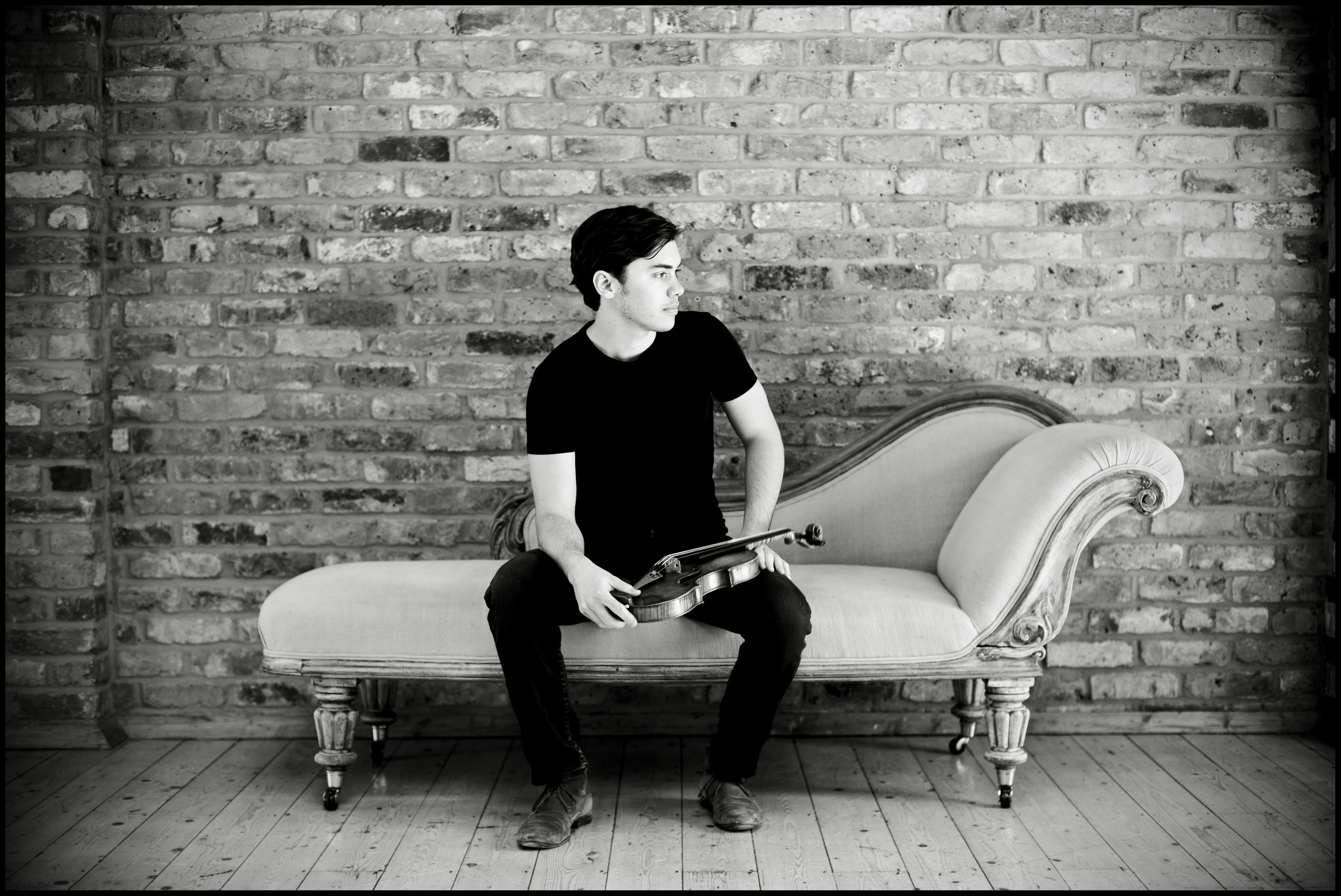
Beilman3(credit_GiorgiaBertazzi

By Perry Tannenbaum

Beginning in September with two of the pinnacles of Western music, the Emperor Concerto #5 and the Choral Symphony #9, the Charlotte Symphony has been presenting an autumn of Beethoven. They rewound Ludwig to Symphony #1 in October and checked in with two more symphonic works earlier this month, the Violin Concerto and the rarely performed “Overture to The Consecration of the House.” So it figures. They’re getting good at it.

Unlike the masses, I look forward to live performances of the Beethoven’s Violin Concerto far more eagerly than yet another iteration of the mighty Symphony #9. In fact, I played hooky from the earlier concert where the great Chorale kicked off the 2017-18 Classics Series. If Leo Direhuys, Peter McCoppin, and Christof Perick could triumph with the Symphony and their chorus (formerly known as the Oratorio Singers of Charlotte), so could their current maestro, Christopher Warren-Green.

Brassy, stately, contrapuntal, and grand, the Consecration overture convinces you that Beethoven had an English period like Haydn and Handel. Ludwig was likely studying Handel, along with Bach, when he received this commission in 1822 – or harvesting the fruits of recently studying those giants. It is music that Warren-Green, hailing from the UK, showed a natural affinity for. The maestro certainly sparked a fleet, zesty performance from the orchestra, especially the trumpets and the trombones, who brought gilded fire to the heraldic episodes.

Earmarks of the second movement of Choral Symphony showed up in the bustling section of this delightfully chameleonic work, and the ending took a similar path in amping up its intensity. I wasn’t at all surprised to discover that the composer was putting the finishing touches on both works at about the same time.

Beethoven had already completed his Symphony #5 when he wrote his lone Violin Concerto in 1805, so we can count it as one more glory of his wondrous Middle Period. After triumphing with the overture, Warren-Green wasn’t letting up on the orchestral power. The violins, sweet in their opening passages, became sharp and lively with the onset of the timpani.

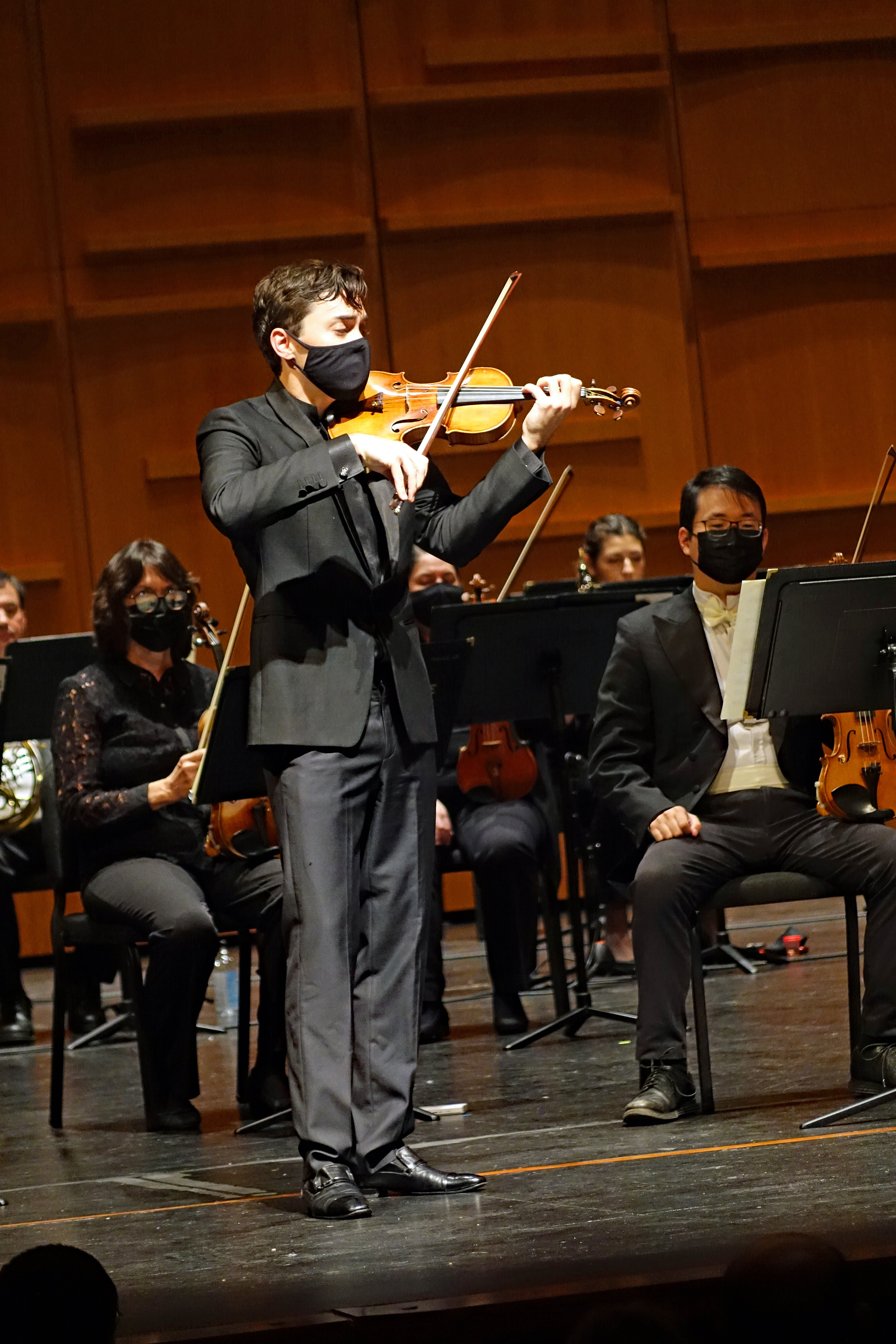
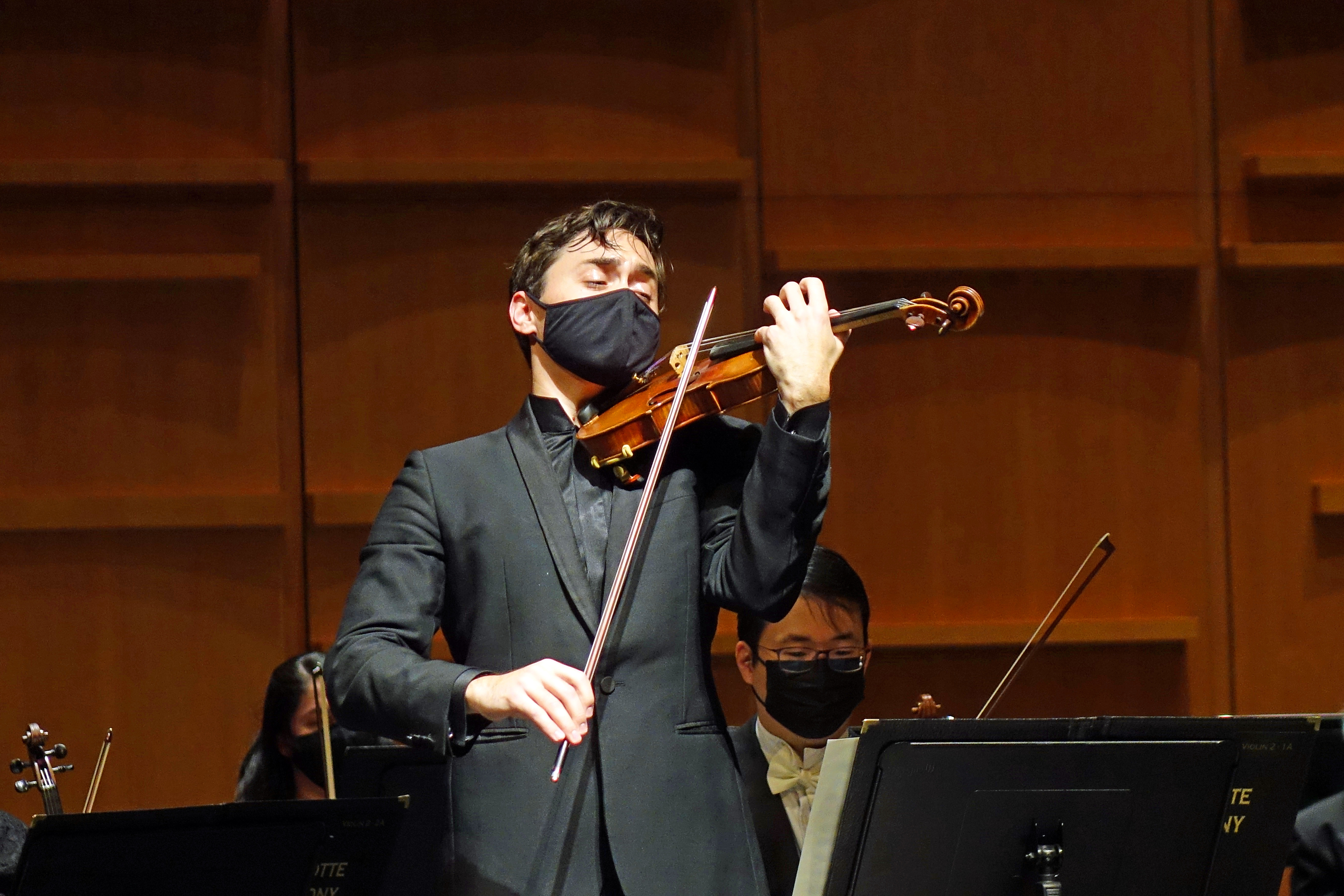
You could say, then, that after 13+ minutes of prime orchestral Beethoven, guest soloist Benjamin Beilman had a tough act to follow in his Charlotte debut. But this wasn’t his Carolinas debut, for the violinist has been one of the featured artists in the Bank of America chamber music series at Spoleto Festival USA for the past three years. He makes a suave impression, and I’ve heard him excel down in Charleston in a Beethoven string trio, a Ravel duo, and piano quartets by Dvorak and Fauré. But I was interested to see what would happen when he collided with this concerto colossus.

Beilman1(c)GiorgiaBertazzi

When the collision occurs, the music should win, carrying the soloist with it. You can hear that happening on the very best recordings, such as Itzhak Perlman’s with the Philharmonia Orchestra or Isabelle Faust’s with the Orchestra Mozart. Nothing quite that magical happened as Beilman took on the epic Allegro ma non troppo opening movement. But if Beilman didn’t sweep us up to the skies, he certainly treated us to some of the most muscular high notes I’ve heard at Belk Theater and – within his first solo spot – some stunning pianissimos.

While the ideal flow of the labyrinthine lines eluded him in the early part of the movement, the virtuosity demanded by the climatic cadenza did not. In the Larghetto middle movement, the woodwinds supplied cathedral-like sounds for Beilman’s rapturous entrance, a perfect showcase for his burnished midrange.

Flaunting tradition, he actually paused before the captivating Rondo-Allegro finale. After the dilatory opening notes, however, Beilman pounced on the familiar theme like a panther and infused the pizzicato passages afterwards with eager delight. The majestic cadenza was like a mini-concerto of its own, sweet and wistful at its center with fire and intensity on both ends.

After intermission, Warren-Green needed to grab a microphone and tell us about the novelty he had embedded in Symphony’s rendition of Johannes Brahms’s Symphony #4. Apparently, the composer had attended a performance where the conductor had reduced the violas to a mere two players when their section was to be most prominent. Brahms heartily approved, so Warren-Green decided to revive the practice.

When that hushed moment came in the Andante moderato second movement, and principal violist Benjamin Geller and Ning Zhao brought brief attention to their oft-overlooked section of the orchestra, it was a curiously effective way to evoke the living presence of the composer – 132 years after his death. Warren-Green’s anecdote also subtly pointed up the meticulous preparation of the entire performance.

You could hear the scrupulous attention to detail in the sweep of the violins in the opening Allegro. Aside from the violas, principal clarinetist Eugene Kavadlo and principal oboist Hollis Ulaky distinguished themselves in the newly emphasized second movement. The ensuing Allegro giocoso had a frolicsome feel as timpanist Leonardo Soto pleasantly traded licks with a triangle. After a long respite from Beethovenian fire, the flame was relit in the Allegro energico finale.

Battles between the violins and the trumpets were deliciously intense. These were counterbalanced with solo dialogues between principal French hornist Frank Portone and principal flautist Victor Wang – and a second helping with Portone and Kavadlo. Heading out of that quiet section into the rousing finish, the whole French horn section had their best showing of the night.