Tag Archives: Ben Allen

Old Barn’s “Orient Express” Is a Clue-ful Poirot Treat

Review: Murder on the Orient Express at Theatre Charlotte

By Perry Tannenbaum

We can thank the Brits for the notion that passenger trains should run with absolute timeliness and precision. Now that Ken Ludwig’s meticulous adaptation has opened at the Queens Road Barn, we can also thank Agatha Christie, Britain’s most avidly read mystery writer, for her Murder on the Orient Express. Layer on Jill Bloede’s bubbly direction – and dialect coaching – and the treacherous trip rattles along with a savory continental flavor.

That soupçon of glitter and effervescence is greatly enhanced by Theatre Charlotte artistic director Chris Timmons’ fleet and fluid set design, an art deco wonder that transitions delightfully from an Istanbul hotel to a smoky train depot to the luxe interiors of the Orient Express. Since the landscape and snowscape outside the legendary train are also moodily conveyed by projections, it’s difficult to draw a precise borderline between Timmons’ scenic exploits and his lighting design.

While the paucity of professional theatre companies in the QC continues to account for the plethora of professional-grade acting talent we behold at the Barn, so does the opportunity to appear in opulent costumes such as those designed by Sophie Carlick – for hotel waiters, train conductors, and various glitterati who can afford a first-class sleeping compartment on a luxury transcontinental train.

Speed is beneficial in a murder mystery, especially as it plods along, contrary to real life, when we’re introduced to a multitude of suspects who have sufficient motive to commit the cold-blooded crime. Anyone who grew up watching the Perry Mason series on TV (or has binged on it more recently) knows the classic drill: the murder victim antagonizes a slew of enemies. So many enemies that we’re unsure who might have done the deed and more than mildly uncaring about the victim, no matter how brutally they were killed.
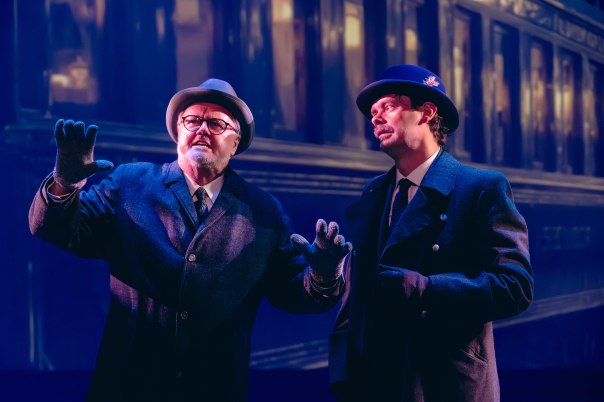
Ludwig admirably singles out our obnoxious victim-to-be and all the antagonisms he can spark while introducing us to Christie’s heroic protagonists, Constantine Bouc, owner of the Orient Express line, and peerless detective Hercule Poirot. There will be debate about Bloede’s decision to shitcan Poirot’s mustache wax and twirls in favor of a more conventional groom, but Brandon Samples’ initial entrance as the Belgian is star quality.

There’s a bit of aristocracy to Samples’ bearing that allows Poirot to fit in with his fellow passengers, including a princess, a countess, and a colonel. While Timothy Hager zestfully cements his repulsiveness as Samuel Ratchett, it’s also important for us to see that Poirot has sufficient dignity, discernment, and assets to reject Ratchett’s crass job offer.

Poirot also offers Samples a few brief episodes of befuddlement, for the culprit he is hunting leaves a blizzard of clues.

Unlike all of those complacent Perry Mason victims destined for the morgue and a court-ordered autopsy, Ratchett is keenly aware that he is being hunted. He’s willing to retain Poirot for a fabulous amount of money to protect him. Perry, you’ll remember, doesn’t arrive on the scene until after the wrong suspect is accused and arraigned. Here, Poirot is directly involved while the victim is alive. So when Samples shows no guilt or remorse for not accepting Ratchett’s offer after he is murdered, we’ll need further reasons for despising the playboy.

Christie piles them on and, in doing so, makes the bizarre solution to her mystery more plausible, for Ratchett is far more monstrous than he first seems to be.

Yet the elegance, hauteur, and glamor of the leading ladies would seem to instantly eliminate them from suspicion – or any close acquaintance with the vulgar victim. To think that Paula Baldwin as the Russian Princess Dragomiroff would deign to inflict eight stab wounds on the repellent Ratchett seems like sacrilege.

Likewise, Julia Howard as the serene and mysterious Countess Helena Andrenyi from Hungary seems worlds away from the slain playboy. The ethereal Gretchen McGinty as English governess Mary Debenham, also a smashing beauty, seems to live in an entirely different sphere, more involved with Scottish Colonel Arbuthnot (Ben Allen with a brash brogue) than the slain American.

As for Kathryn Stamas, as an esteemed actress traveling under the assumed name of Helen Hubbard, she is sufficiently brash, loudmouthed, and inconsiderate for us to worry whether Ratchett, trying to get some sleep next door and stewing with rage, will burst into her room and murder her. Murdering him would ruin her delight in riling him with her late-night singing.

However laudable it might be to murder Ratchett, three acts of God will prevent the ghoulish plan from eluding discovery: the unexpected arrival on board of legendary unraveller Hercule Poirot, the serendipitous intervention of Orient Express owner Constantine Bouc in securing a first-class compartment for Poirot, adjacent to the victim’s room. After these pieces are in place, with Bouc ready to serve as Poirot’s loyal sidekick, comes the fortuitous storm that halts the regal train in a snowbank out in the wilderness, giving Poirot sufficient time to investigate.

Bouc is obviously a key prong in Christie’s plotcraft, allowing Poirot to board the Orient Express and vesting him with the authority to investigate. Otherwise, our mustachioed sleuth wouldn’t be able to scan all our suspects’ passports or rummage through their luggage. Dramatically, he enables Poirot to interview all the suspects, another ritual of the mystery genre, corresponding to Perry Mason cross-examinations, that cries out for swift pacing.

The venerable Dennis Delamar would seem ideal for bestowing the requisite bonhomie on our gracious host and eager sidekick, except… for all his wholesome triumphs as Henry Higgins, Grandpa Vanderhoff, Kris Kringle, John Adams, Hucklebee, Jacob the Patriarch, and many more, has he ever done a French accent before? Maybe that was the question Delamar was asking himself on opening night when he uncharacteristically stumbled over a few of his opening lines.

Even for a semi-pro like me, those are lines you should be able to say in your sleep. Of course, Double D never broke character during his difficulties, so to neophytes in the audience, it may have seemed like the garrulous pensioner was stumbling over his English. Delamar’s imperturbability in this brief crisis only made Bouc more charming when he righted himself – and real panic was safely in reserve when the unsolved murder, right under his nose, threatened the image and prestige of his company.

Bouc also serves as a buffer between Poirot and the petty annoyances presented by our suspects, allowing Delamar to display his comedic chops. Samples, on the other hand, gets to revel in flipping over innocent façade after innocent façade in revealing the secret underbellies of his artful gallery of suspects. The parade of skeletons emerging from closets can’t help but add to our merriment.

So most of the actors on stage need to be adept not only in erecting their respective façades, but also in carrying off those deliciously satisfying moments when they are so disconcertingly exposed. Joshua Brand as Ratchett’s querulous secretary seems particularly innocent and above suspicion, while Emma Brand as the Princess’s trembling missionary ward is even further above. So pleasant when they fall.

Climb aboard this fatal train, and you’re likely to find the ride more fun than you expect.

Hohenstein Gets Greedier in His Second Go-Round With “Peter and the Starcatcher”

Review: Peter and the Starcatcher at Matthews Playhouse

By Perry Tannenbaum

July 12, 2025, Matthews, NC – Though their names are similar and they’ve both written about Peter Pan, the temperamental gap between James M. Barrie and Dave Barry would seem to be as wide as oceans. Barrie created Peter in 1904 as an embodiment of eternal youth and the spirit of noble adventure. A century after Peter made his stage debut (played by a woman, of course), Barry teamed up with Ridley Pearson to write a novel-length prequel, Peter and the Starcatchers, keeping the non-fantasy base of the story in Victorian England while snatching Neverland from up among the stars and plopping it down on an earthly ocean.

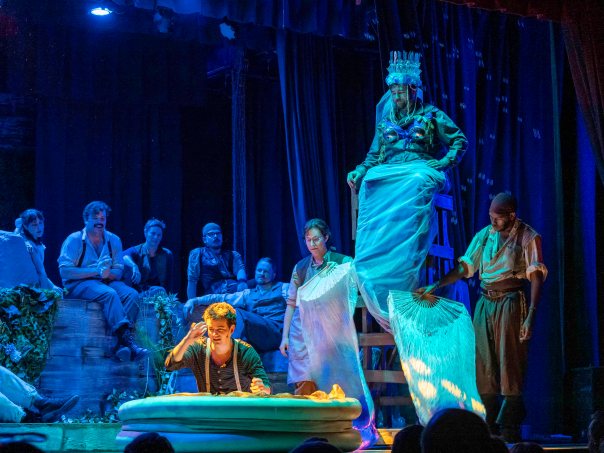
What Rick Elice seems to have done, in returning the Barry-Pearson preteen page-turner to its stage origins, is to worshipfully replicate all the seagoing pirate action of Starcatchers along with Barry’s choicest quips. Then to supercharge the effect, Elice seems to concentrate it all so that it flies by in a blizzardy blur, all the more frenetic because scenery is stripped so bare – people become doors, ropes become ocean waves, and flag streamers are crocodile teeth – that we’re exercising sizable hunks of imagination to fill out what’s actually happening before our eyes.

Barrie fairies were jubilantly diced and desecrated by Barry’s mischief and mirth: or so it seemed the first three times I saw Elice’s Peter and the Starcatcher – on Broadway, on tour, and at Theatre Charlotte, directed by Jill Bloede. Having read Barry’s Pulitzer Prize-winning humor pieces for decades, I was so sure of my familiarity with America’s beloved joke-and-quip machine that I never bothered to read a single page of his Starcatchers. My naïve conclusion was that Elice had simply let the Barrie-Barry mashup work its magic with as little intervention – and budget – as possible.

My fourth encounter with Starcatcher at Matthews Playhouse, once again directed by Bloede, helped to enlighten me. In her previous work with the script, the evanescence of the budding relationship between Peter and Molly Aster – and the poignancy of their parting – felt more touching to me than previously. That’s significant compensation for anyone who adores Barrie’s original story, whose magic can seem drowned in humor, wit, and shtick when first encountering Starcatcher.

This time around at Matthews Playhouse, another thematic thread struck me for the first time: Elice’s orphaned Peter reaches puberty without ever having a first or last name. By now, it will only come with his consent. At the other end of the moral spectrum, Black Stache has been searching throughout his pirate career for a hero antagonist who will perpetuate his fame.

So their first grand meeting and tussle have biblical Israel-Angel proportions and consequences, or Robin Hood-Little John echoes if you prefer a secular, literary parallel. Two combatants become permanently linked and one of them emerges with a new name. Bloede’s staging here, when Peter gets his name from Stache – and later when Pan is added on – brought a new aura to those moments.

That’s what sent me to the web in search of Barry-Pearson’s actual text. Elice’s wit and humor seemed to chime with the belly laughs Barry’s newspaper columns repeatedly deliver. But is the class clown who grew up no less jokey truly capable of such yiddishe flavor and mythic depth? My suspicions were confirmed in the very first sentence of Barry’s saga: it already includes Peter’s name! An even more amazing revelation awaits if we read on. The jokey Barry tone we know and love is nowhere to be found in the opening chapters we can sample at Amazon. Instead, Barry and Pearson were following along on the dark gallows humor path that Lemony Snicket had pioneered with his Series of Unfortunate Events books for kids.

Deep breath. In my previous reviews of Starcatcher, I repeatedly gave Barry too much credit and blame for what I had seen and much too little to Elice. Both the jokiness and the mythic dimensions of Starcatcher can be credited to Elice – with additional bravos for how thoroughly he convinces us that this is how Barry would tell the origin story of Peter Pan.

Meanwhile, community theatre in Davidson, Charlotte, and Matthews continue to reap the dubious benefit of having so little professional-grade theatre in the Queen City. What a cast Bloede has assembled! Before the show began, representatives from the North Carolina Theatre Conference presented artistic director Sarah Bumgardner with their Theatre of the Year Award for 2024. So the folks backstage with their costumes on, waiting overtime for the ceremonies to conclude, were obviously under extra pressure to deliver. Even Bloede was nervous!

No matter how good your cast is, there’s plenty of stage business to be nervous about in running Starcatcher.Actors must move all the props and furniture around and keep track of all the many Yvette Moten costumes they must find and change in and out of as we move from a London dock to two sailing ships to a faraway island with a beach, a mountain, and a jungle. Stage manager Jessie Hull had to be preternaturally adept. Molly must float in the air. Peter and some nameless alley cat must fly. A lot going on while the quips shoot out at us, many of them newly minted to mock Myers Park and nearby country clubs.

Nearly all of these players were newcomers to Starcatcher, beginning with Joshua Brand as Peter and Emma Brand as Molly, presumably arriving on the Fullwood Theater stage with ready-made chemistry. Their boy-girl antipathy is no less charming than their tentative stabs at intimacy, and both can seem fueled by the promise of adventure and ignited by its thrill. The only holdover from Bloede’s 2018 cast is Johnny Hohenstein, who in bygone days crossdressed to portray Mrs. Bumbrake, Molly’s flirtatious nanny.

With even more liberties, including more than a slight leftover effeminacy from Bumbrake, Hohenstein burst into full flower as the carnivorous Black Stache, heartily devouring the scenery in Stache’s emblematic amputation scene. His eyes shone greedily as he attacked the hambone bits, and yet a queer kind of avuncular calmness came over him as he finally met his predestined antagonist and named him. For some reason, Hohenstein drew the only problematic microphone on opening night but remained unflustered by its fussiness.

Of course, one of the glories of Peter Pan is its superabundance of meanies and piratical buffoons, and we do not lack them here. In her latest crossdressing exploit, Andrea King was the perfectly servile and supercilious Smee, with glints of valor and wickedness. Chip Bradley was the wily Slank, Captain of the Neverland,who steals the precious trunk full of starstuff from under the nose of Lord Aster, the Queen’s devoted ambassador and most eminent Starcatcher. Andrew Pippin portrayed the austere Aster with sufficient British crust, entrusted with the mission of transporting the precious starstuff cargo to Rundoon, where the trunk can be dumped into a nearby volcano and kept out of evil hands.

When we reach the faraway island where Peter and the trunk of starstuff serendipitously wash ashore, we will find that Neifert Enrique is the outré and eccentric King Fighting Prawn, monarch of the Mollusk natives. Was this the wildest of Moten’s costumes, or was it Hohenstein’s at the start of Act 2 during his brief song-and-dance as one of the Mermaids? Maybe Ryan Caulley snatches the prize toward the very end as Teacher, a salmon magically transformed into a Mermaid sage atop a lifeguard’s chair. It was a fitting reward for Caulley after a full evening gagged as Captain Scott from the first moment we saw him aboard his ship, the Wasp.

Ben Allen as Prentiss and Alijah Wilson as Ted were more individualized than Peter’s fellow orphans had been in previous productions I’d seen, and Miles Thompson was more rounded and nuanced as Alf, the smelly sailor who woos and distracts Molly’s nanny. Davis Hickson wasn’t as giddy and over-the-top as Hohenstein had been as Bumbrake at Theatre Charlotte in days of yore, so the Alf-Bumbrake thing (with Alf breaking most of the wind) was less orgiastic now and more genuinely warm.